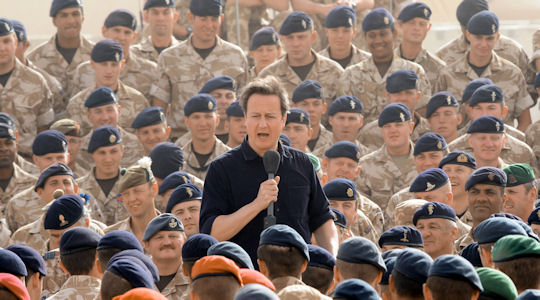
A Disservice To Our Military

British Prime Minister David Cameron (C)

The Daily Telegraph’s Con Coughlin writes today about the terrible incident in Afghanistan where a US soldier went on the rampage in an Afghan village, killing sixteen civilians, including a number of children.

I read the piece with interest, but the author makes a couple of throwaway comments that I found quite disrespectful. At one point Coughlin writes:

“We all know that soldiers, without the proper training and discipline, can easily degenerate into a murderous rabble that terrorises the local population. We have seen this happen hundreds of times in Africa where armies are no different from the militias who rape, murder and loot at will.”

This is unnecessarily harsh language to use with respect to the armed forces. Are there countless cases where this has happened in various conflicts around the world, yes. But to suggest that the only thing separating the British or American armies from being a ruthless militia with no morals is essentially a PowerPoint presentation on coping under stress is rather glib. He then follows this up with the following:

“After six British soldiers were murdered last week in southern Afghanistan when they were blown up by one of the Taliban’s roadside bombs, it is easy to imagine the murderous thoughts of revenge their fellow soldiers are today feeling towards the Taliban. But the reason they don’t pick up their guns and walk into the neighbouring village and massacre every Afghan they can find is the strict training they receive before they are deployed.”

Excuse me? I’m sure that the fellow soldiers mentioned here are full of many feelings of sadness and anger following the deaths of their colleagues, but I would submit to Con Coughlin that as well as the fact that they received strict training before they were deployed, another reason that they don’t “pick up their guns and walk into the neighbouring village and massacre every Afghan they can find” is because they are decent human beings with the intelligence to understand not only that the general civilian population was not responsible for the deaths of their comrades, but that to do so would make them no better than the forces that they are fighting. To say otherwise, and to suggest that there is little to separate the vast majority of soldiers who are decent and brave individuals from the deranged Staff Sergeant who perpetrated this massacre is not only wrong, but frankly offensive too.

I also don’t think I am imagining things when I detect undertones of class-based superiority from the author, that maybe he views the British soldiers as slightly dim and uneducated, less capable of reason than the average, middle-class Telegraph reader, and therefore in need of this strict training to ensure that their baser, more violent instincts do not come to the fore under stressful circumstances.

It amazes me to observe the difference in tone in terms of how the armed forces are talked about in Britain compared to the United States. Such an article would never have been written by a commentator in the United States, where even President Obama’s apology to the Afghan people for the accidental burning of the Koran by US forces was met with strong criticism, so above reproach is the US military to some on the right.

Honestly, I don’t believe that either country has it quite right. In the United States, I admire how serving soldiers and veterans are acknowledged and given respect in public places such as airports (where they are allowed to stay in USO club lounges while they wait to board their flights) and sports games, where they are frequently applauded before the game. However, sometimes I feel that the almost-worship of the armed forces goes too far, with all returning soldiers being labelled “heroes” whether or not they have seen active combat.

In Britain, on the other hand, I don’t think that we do nearly enough to acknowledge the contribution that our military servicemen and women make for our country, projecting our nation’s force to implement our foreign policy objectives. Hence we see serving soliders being refused permission to stay at an hotel because of an unbelievable “no military” policy, and London’s most sacred war memorial being desecrated by the spoiled, self-entitled son of a rock musician.

But while both of our countries may have some way to go in terms of striking the correct balance in terms of how we view, treat and discuss these topics, I would hope we can all agree that there is a lot more preventing the good men and women of our nations armed forces from becoming mass murdering militias than the training that they receive, important though that may be.


On Drive-Thru ATMs And Stale Tortillas

Drive Thru ATM


I read an interesting piece by Peter Foster in today’s Daily Telegraph, titled “The quaintness of America, the backwards superpower”.

The basic gist of the article (written, it should be acknowledged, by a self-confessed admirer of the US) is that while America remains the world’s preeminent economic and military power, in some areas it lags behind the rest of the “modernised” world. He goes on to give several examples of this backwardness, citing the prevalence banking cheques as a payment method, the widespread existence of ATM fees, the use of imperial measurement units, the state of the roads, and – perhaps most shockingly of all – the continued use of corks rather than screwcaps by the American wine industry.

Now perhaps we can forgive Peter Foster his perspective based on the fact that his biography states that he is “the Telegraph’s US Editor based in Washington DC. He moved to America in January 2012 after three years based in Beijing…”

I have also spent time in Beijing, and would certainly agree that if you stick to the glitzy, brand-new parts of the city (as you would likely do when covering “the rise of China”) and you are able to successfully block out the people riding rickshaws along the side of the motorways, then yes, parts of America are likely to lose some of their gleam by comparison. However, the litany of complaints about America, and the fact that the US is singled out, makes me wonder when was the last time the author spent any time in his home country.

In America, if you want to do some banking in a hurry, you can go through the drive-through ATM in almost any town. No parking on double yellow lines, sprinting to the ATM in the rain and hoping that your car hasn’t been towed by the time you withdraw your cash, as is the case in Britain.

In America, there are more drive-through restaurants, pharmacies, (rather dubiously) liquor stores, drive-by trash cans and any number of other modern conveniences that mean you don’t have to leave your car to conduct normal business. You can probably argue about whether this is a good or a bad thing, but the Americans certainly have one over on us in this sphere.

And when the time comes to refuel your car, the chances are that you can pay at the pump in America. Remember that handy invention? I think they tried to introduce it in Britain in a few places, and then the machines broke, were never fixed, and have been covered over with signs, poorly written in felt tip pen, telling you to pay inside and join the long line of other people in the convenience store. Truly the way of the future.

There is a picture at the top of the article showing Buzz Aldrin saluting the US flag on the surface of the moon, with the caption “Sure, they can do this, but they can’t work out how to pay for stuff with a debit card”. Seriously? Mr. Foster, are we even from the same country? I can’t count the number of times I have gone to a fast food restaurant, or the cinema, or any number of other places in Britain only to be told “the credit card machine is broken, cash only, sorry” by some dead-eyed employee. Again, there is usually also a badly-written sign informing me of the same fact, carefully tucked away where it is almost impossible to see when placing your order. In America, I can wave my McDonald’s card at the little sensor at the drive-through window and it automatically debits my bank account. Nice.

And let’s look at consumer goods and food. If I buy a loaf of bread from the supermarket in Britain, it is sealed with a little sticky strip of plastic which loses its adhesive qualities after about two uses, after which time you either have to try tying the plastic bag and squashing the bread in the process, or leaving it to go stale. In America, the same loaf of bread comes with a little trusty wire device that keeps on working until long after the bread has been consumed. If I buy a pack of tortillas in Britain – well, first of all, they will look and taste terrible, because decent Mexican food cannot be had in this country for love or money. But secondly, the tortillas will be kept in a sealed plastic vacuum pack, which, once punctured with a knife to access the tortillas, cannot be resealed. The result, once again, is stale tortillas. In America, the same tortillas actually taste good, and come in a ziplog bag so that you can reseal them.

Stale tortillas, British-style. Yum.


I opened this pack two days ago, and I could use the remaining tortillas inside as an effective lethal weapon in a pinch. And yes, I could have bought my own zip-lock bag to preserve them, but the point is that I shouldn’t have to!

Oh, and say you want to buy your loaf of bread and your tortillas and it happens to be after 6pm on a Sunday. Good luck finding somewhere that is open in Britain. Sunday trading laws, sorry. In America, I would just nip to Target. Or Wal-Mart. Or one of the many other stores where they have correctly interpreted the phrase “Open 24 Hours” to mean “we don’t leave our stations at 5pm on a Sunday and go home to watch TV, and if you haven’t had the chance to do your grocery shopping yet, well that’s just tough luck”.

Mr. Foster also takes exception to American cable TV, finding the online channel guides to be very confusing compared to “the standard Sky TV menus that most English readers will be familiar with”. Well, shock horror, a country of 300+ million people has lots of regional and national cable/satellite TV providers, rather than the Sky/Virgin duopoly that exists in Britain. Yes, in America the providers may go to war with the content providers sometimes, meaning that you lose your favourite channel from the airwaves for a couple of months while they stare each other down, which is hardly ideal. But at least the American consumers have choice. We still think that’s a good thing in Britain even if we don’t practice it ourselves, right?

I could go on. At one point I thought about starting a blog that focused exclusively on the many ways in which British consumers are shortchanged and under-served compared to their American counterparts. The point is that it works both ways. Britain and America both come across as rather tired and shabby if you have spent a lot of time in the glitzy new developments of Beijing and Shanghai. But I don’t know many people who would willingly up sticks and leave to go there, for all the tea and Mag-Lev trains in China.

And in conclusion – well, I don’t actually have time to write a conclusion. It’s 4pm on a Sunday afternoon and I haven’t done my grocery shopping yet, giving me 45 minutes to run into town, throw some badly-packaged food into my shopping cart and get in line at the checkout.

Newt Gingrich’s Path To Victory

I didn’t think there was one either, until I saw this footage:


Here, Newt Gingrich is waiting to address the AIPAC conference via ABC News satellite feed, and at one point the Happy Man nods off in front of the camera as the previous speaker, Leon Panetta, finishes his remarks.

Sadly, the moment comes eventually when he wakes up and starts delivering his speech. But captured here are at least 50 blissful seconds in which Newt Gingrich doesn’t really do or say anything overly grandiose, pompous, far-fetched, or in any other way further condemn his chances of winning the nomination.

If Sheldon Adelson has not yet turned off the financial life support taps to Mr. Gingrich’s campaign, perhaps this footage can be turned into his next television commercial. All he would need to do is whisper “I’m Newt Gingrich, and I approve this message…” in a voiceover at the end.

Why Santorum Is Wrong On Healthcare… Part 1/5000

Rick Santorum - Obamacare - ACA - Healthcare Reform

There is a small part of me that wants desperately to like Rick Santorum. This is entirely based on the fact that he will stake out a bold, uncompromising position based on his beliefs and defend it to the hilt rather than running away or backpedalling from the position under opposition pressure. That is a rare attribute in a politician and in the US Republican primaries he is matched or exceeded in this regard only by fellow candidate Ron Paul.

The small part of me that admires Santorum, however, is vastly outweighed by the rest of me, which is aghast at his riffs on the separation of church and state, on women’s healthcare, on contraception, on economic policy and his naive or callously cynical pledge (depending on how you view him) to bring about a manufacturing renaissance in America by tweaking the tax code a bit and drilling for more oil (domestic oil production is, of course, higher now under Obama than it was under Bush):

Furthermore, I am becoming increasingly convinced that Santorum is being given far too much praise for being an “honest politician”, when there is an increasing pile of evidence from his campaign speeches to suggest otherwise. By all means praise him for saying things that ignite his party’s base, and not backing down in the face of liberal objections, that’s one thing. But when you are standing in front of friendly crowds who more or less share your worldview and policy positions, that is not so hard to do.

If he really were honest though, he would avoid saying things like this, as quoted by the Jeffrey Anderson and Bill Kristol in the Weekly Standard today:

“The reason that .  .  . I ultimately decided to get into this race was .  .  . one particular issue that to me breaks the camel’s back with respect to liberty in this country—and that is the issue of Obamacare. .  .  . [A] little less than 50 percent of the people in this country [now] depend on some form of federal payment, some form of government benefit, to help provide for them. After Obamacare, it will not be less than 50 percent. It will be 100 percent. Now every single American will be looking to the federal government, not to their neighbor, not to their church, not .  .  . to the community .  .  . [but] to those in charge, to those who now say to you that they are the allocator and creator of rights in America. Ladies and gentlemen, this is the beginning of the end of freedom in America.”

You know what, Rick? You hate ObamaCare, and that’s fine. I mean, you haven’t proposed any detailed alternative solution to deal with the problems of the uninsured, or the rate of healthcare inflation (and as I said before, medical malpractice lawsuit reform and cross-state selling of insurance nibbles at the edges rather than fixing the problem), so let’s just assume that you believe 30 million uninsured to be a price worth paying to preserve the “liberty” that once existed in America, but which disappeared in a puff of smoke once the Affordable Care Act was signed. That’s fine.

But there are two things in the above extract from Santorum’s “victory” speech on Super Tuesday:

1. The fact that he laments that nearly 50% of Americans depend on some form of federal payment or benefit. Now, I am a fiscal conservative and also believe that this number is rather too high and represents an overexpansion of the federal government. However, Santorum says nothing about Medicare, the ‘socialist, government-run healthcare benefit’ that the grey-haired brigade benefit from, which makes up a substantial portion of that 50%. And why? Because they vote. MedicAid recipients, and those on unemployment or food stamps are less likely to vote, so it’s a lot easier to talk about them when you bash the percentage of Americans who rely on some federal handout.

2. “It will be 100 per cent. Now every American will be looking to the federal government, not to their neighbor, not to their church…” Now this one really has me stumped. I would be grateful if Santorum supporters could point me to the exact parts of the Affordable Care Act (and yes, I have the PDF downloaded on my computer) where extending health insurance to an additional 30 million people means that everyone – everyone –  is now beholden to the federal government. Unless parts of the bill were written in invisible ink, I saw nothing that says that government is taking over the means of healthcare delivery (hospitals) or health insurance (insurance companies). So say for example that I work in finance and have health insurance through my company, and have done for years. Which part of ObamaCare is going to cause me to spurn my current coverage and go running to nourish myself at the teat of the federal government?

Rick Santorum: There is nothing honest about you when you propogate arguments such as these. Like most other Republicans at the moment, you have decided to go along with the doomsday hyperbole and fear-mongering that has sadly become a feature of the GOP’s position on healthcare reform, rather than engaging and crititicising it on true conservative principles. This has been very effective for your party, and I understand why you have made it the lynchpin of your presidential candidacy. But it does not make you an honest man.

We Choose To Go To The Moon


“We choose to go to the moon. We choose to go to the moon [interrupted by applause]. We choose to go to the moon in this decade, and do the other things, not because they are easy but because they are hard. Because that goal will serve to organise and measure the best of our energies and skills. Because that challenge is one that we are willing to accept, one we are unwilling to postpone, and one we intend to win, and the others too.” – President John F. Kennedy, Rice University, September 1962

I have recently been re-watching the excellent television mini-series “From the Earth To the Moon”. Executive produced by Tom Hanks and in much the same style as the film “Apollo 13”, it tells the story of the entire Apollo space programme, from its early beginnings and the tragedy of Apollo 1, through the enormous triumphs of Apollo 8 and 11, the lucky escape of Apollo 13 right the way through until the end of the endeavour. If you have not seen it, it is very well worth watching.

I have been a project and programme manager by trade for the past six or so years, and the exploits of NASA and particularly the Apollo programme have always held a particular fascination for me. In past job interviews I have joked that while most people look at the first moon landing and wish they were an astronaut, I was probably the only one who was moved to become a project manager! Of course, I would not have minded being an astronaut at all, and do very much hope to fly in space some day. But I suppose one of the things that has always excited the geeky part of my brain is how human beings can come together and organise such a complex programme to achieve the goal of landing a man on the moon – in the 1960s no less, when the technology and computer processing power in even my humble, malfunctioning BlackBerry vastly outstrips that which was available to NASA at the time. How do people organise themselves to run such a huge project, and plan and track all of the millions of individual actions and steps that must be successfully completed in order to achieve the desired outcome?

I post the above video for a couple of reasons. I am a (very) amateur scholar both of the history of the Apollo space programme and the life of President John Fitzgerald Kennedy, and rewatching my television series and flicking back through some of my books about the space programme made me think about more recent human achievements.

I was born in 1982. What great accomplishments of the human race have taken place in my lifetime? I might think of the fall of the Berlin Wall and the defeat of communism, and the spread of liberty and prosperity that is still occuring as a result. I might also think of the cooperation of many nations to construct and inhabit the international space station – though no humans have left low earth orbit since that final Apollo flight, this is still a remarkable technological achievement. Or on a more micro scale I might think of the successful mapping of the human genome, with all of the promise that this holds for curing diseases in the future. There are probably many more that I have overlooked, and I would be interested if any readers would care to suggest some of them in the Comments section.

But all of this brings me back to President Kennedy’s speech on September 12th, 1962. How many people became scientists because of the unmatched human endeavour that followed this speech? How many people became engineers, or mathemeticians, or pilots, or astronauts, and how many people’s lives have been changed because of the new technologies and discoveries that resulted from it?

And in these hard economic times, when so many of the western powers seem to be retrenching and lowering their ambitions, what are we doing now that will inspire people, or challenge them, or make them proud of us in 40 years’ time?

We Choose To Go To The Moon - John F Kennedy - JFK - Apollo Program