On Grover Norquist And Ideological Headlocks

From The Boston Globe, an interesting long-form profile of Grover Norquist, the founder of Americans for Tax Reform  and promoter of the famous (or infamous) “Taxpayer Protection Pledge”:

http://articles.boston.com/2012-03-18/magazine/31199550_1_pig-farm-rocky-ledge-speech

The article is well worth reading, if for no other reason than the fact that we should all better understand the man who works quietly in the background in Washington and across the country to squash any efforts to raise additional government revenues, and who effectively owns the political souls of the vast majority of the congressional Republican Party. At the present time, an astonishing 238 members of the House of Representatives and 41 Senators are signatories to “the pledge”, including 97.5 percent of the entire Republican congressional delegation.

Few other special interest groups – even lobbying powerhouses such as the National Rifle Association – can boast such levels of fealty from elected representatives.

The only problem is that Americans for Tax Reform is obsessed with treating only one of the two symptoms of America’s fiscal malaise, and couldn’t care less about the underlying illness (the structural deficit). Seeking to cap the revenues that government can collect is all very well and good, but there is nothing bold or patriotic about doing that while doing nothing, or in some cases, actively thwarting efforts to make a serious effort at reducing expenditures, such as those outlined in the Bowles-Simpson committee proposal.

The following passage from the article lays bare, once again, the automatic, unapologetic contradictions at the heart of today’s GOP:

Jon Golnik, a Republican pledge-signer who was unsuccessful in his 2010 bid to unseat Democratic congresswoman Niki Tsongas, tells the crowd he’s running again and rails at the out-of-control spending of the Obama administration. He rattles off a host of statistics about the implications of the national debt that are so sobering they might give even a Keynesian pause.

When Golnik begins taking questions from the audience, the first comes from a North Shore man named Edward Purtz, who asks with furrowed brow: “We’ve seen the Navy cut to levels it hasn’t been since the 1800s. How do you stand on these defense cuts?”

Without missing a beat, Golnik replies, “I oppose them.”

I would point out that, as frequently said by Ron Paul, it is entirely possible to actually increase spending on national defence while cutting overall military spending by extracting America from costly foreign entanglements. I could further point out that comparing the number of ships in the US Navy in 1800 and 2012, noting a fall and interpreting this as a decline in relative naval power is about as stupid as it is possible to be, given the fact that any modern frigate or destroyer could make short work of the entire 19th century fleets of every naval power and not suffer a scratch, but again this is rather beside the point here.

Today we have a Republican Party caught in an ideological headlock by the likes of Grover Norquist and fired-up tea partiers, all of whom talk incessantly about cutting and balancing the federal budget, but all of whom reflexively oppose cutting their own pet projects, or those large parts of the non-discretionary budget that account for the vast majority of spending.

The interviewer in one passage asks Norquist that, given the fact that government spending as increased in real terms every year since the 1960s, has his personal crusade not been a complete failure?

Following our lengthy discussion about runaway spending under Bush, Norquist stresses that ATR’s “ultimate goal is to reduce the size and scope and cost of government as a percentage of the economy, so we want to spend less and not raise taxes.”

“So,” I ask, “that has been a complete failure, right?”

“No,” Norquist replies and begins to speak extra slowly. “The line in the sand on taxes has been very successful.”

And there we have it, folks. Defending the line in the sand – no new taxes, ever – is what matters, the only thing that matters at the moment to those on the tea party-hijacked right. They won’t look for additional revenues anywhere, under any circumstances. They talk loudly about slashing the budget but single out their pet projects for exemption and fail to seriously engage on the topic of cutting spending in the key areas which drive the federal budget deficit. And still they call themselves the party of fiscal responsibility.

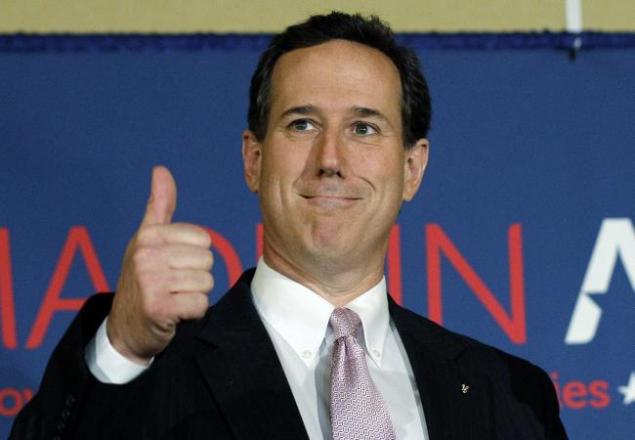
The Daily Beast Falls Under The Santorum Spell

Rick Santorum

Oh dear. The good people over at The Daily Beast have heeded the call of the Pied Piper of Pennsylvania and endorsed the never-gonna-happen pro-manufacturing-rennaissance mirage offered up by Rick “Blue Collar” Santorum.

Of course, they are at pains to distance themselves from his more extreme social policy positions, and they get that out of the way at the beginning:

“There’s a lot not to like about Rick Santorum on the social-issues front. He’s an anti-abortion absolutist, no fan of gay rights, and possesses politics so influenced by faith that even contraception remains controversial in his mind.”

But after this, and a couple of disclaimers about the effect of such a manufacturing policy on the budget deficit, they are all praise:

“But at least the man is making a bold proposal that attempts to address an issue that has helped destroy the jobs that used to enable families to get on the first rung of the ladder out of poverty. Rather than simply having products designed in the U.S.A. and then produced overseas, an added incentive to make things in America could help tip the scales back in favor of American manufacturing. It might help make a real dent in our half-trillion-dollar trade imbalance with China and other countries.”

Okay, firstly: future manufacturing jobs will be more highly skilled and require a greater level of education or prior training than many of those displaced by the decline in manufacturing currently have. They aren’t going to get these jobs, if employers bother to create them in the US at all, despite a big tax giveaway. Those jobs that don’t require this higher level of skill won’t offer a rung on the ladder out of poverty any more than an entry-level job in the service sector.

Secondly: What if I write and distribute an awesome piece of new software? What business is it of the government to tell me that my work isn’t as worthy as that of someone else who opened a factory or a sawmill? Are we supposed to pick winners now, based on perceived societal good? The Daily Beast seems to lean to the left somewhat so I can understand them espousing this argument, though I vehemently disagree with it.

But my point remains: a Republican – especially one who rails about government handouts to individuals and bailouts to Wall Street and Detroit – has no business espousing policies to favour one segment of the economy over the other. I mean, that’s European/Soviet style planned-economy socialism, right?

Arizona Joins ‘The List’

I have a partly tongue-in-cheek list of US states that I am currently ‘boycotting’, or have no intention of visiting in the immediate future, either because of unfortunate things that have happened to me there, or most usually because of particularly stupid and offensive laws that have been either proposed or actually voted on and passed in their legislatures.

Arizona was already strongly competing to join this exclusive list (it is difficult to join and even harder to be removed from the list) with the signing by Gov. Jan Brewer of their famous anti-illegal-immigration law, allowing state police to detain anyone suspected of being an illegal immigrant (quite how you tell such a person from a natural US citizen by their appearance or behaviour is anyone’s guess, but I think we all know the criteria they have in mind):

http://www.nytimes.com/2010/04/24/us/politics/24immig.html?_r=1

But then came this gem that I was alerted to by a friend on Facebook – now, the Arizona State Senate Judiciary Committee (a pompous title for a pompous group of individuals) has endorsed a controversial bill that will, if passed, allow Arizona employees to exclude contraception coverage from the healthcare plans that they offer to their employees, if their religious beliefs or moral convictions encourage them to do so. Furthermore, the bill would also allow employers to demand proof of a medical prescription (for non birth-control related reasons) if an employee wishes to claim for contraceptive pills on their health insurance policy.

http://www.statepress.com/2012/03/12/senate-judiciary-committee-endorses-controversial-contraceptive-bill/

Let me count the ways that this is an offensive and idiotic proposal.

The author of the bill – one Debbie Lesko, Republican of course – says that:

“So, government should not be telling the organizations or mom and pop employers to do something against their moral beliefs.”

Okay, well guess what. Maybe I’ll set up shop in Arizona and start a small business. But I am from a small and little-known religion that doesn’t believe in mammograms or cervical cancer screening. I don’t know why, my particular interpretation of my hypothetical holy book just tells me that to test for these diseases to allow early intervention would be an affront to God. So none of my female employees will get to benefit from these forms of healthcare as part of the insurance plan that I provide them. Oh, and my new religion also thinks that heart disease and erectile dysfunction are punishments from God that should be meekly accepted rather than treated, so no Viagra or anti-cholesterol medication for the gents. If you need Viagra to treat some other ailment not connected with erectile dysfunction we can maybe talk about coming to an agreement, but I’ll need a signed letter from your doctor explaining your precise medical history and needs.

Can you imagine the uproar?

Let us be quite clear. This is not about freedom of religion. Many states have been living under an expressed requirement that employers include birth control coverage in their healthcare plans for many years with nary a whisper of complaint until a Democrat named Barack Obama occupied the oval office. This is about slowly trying to establish a fundamentalist Christian theocracy in America, one in which even the overwhelming majority of Christians, myself included, would not wish to live in were it fully implemented. Republicans – who once criticised Obama because of the type of Christian church that he attended and the pastor who preached there – have decided that it would now be more politically fruitful to fan the embers of suspicion that he is in fact a muslim, and that he is launching an all-out assault on “Judeo-Christian” principles.

And while we’re on the topic, can someone please initiate a sensible conversation about moving away from the current employer-based health insurance system in America? Aside from the damage it does to the economy in terms of issues such as impeding mobility of labour (especially important during the current fragile recovery with unemployment so high), if individuals purchased their own health insurance rather than relying on the employer to do it for them, we could sidestep this whole argument about coercing employers to act against their moral beliefs. If Debbie Lesko ever chose to leave her political career and return to the private sector, she wouldn’t have to stay up all night worrying about what naughty things her employees might be doing with the healthcare coverage that she paid for, because the employees would be paying the premiums and taking their chances that they won’t be struck down by lightning for daring to use a condom, or the pill. And I think everyone would sleep better at night as a result.

Arizona, you have been teetering on the brink for a long time now. But congratulations,  you have officially made the list.

Growing Up In The Age Of Facebook

Facebook Password

There’s an interesting piece in The Daily Telegraph today about a 12-year-old girl from Minnesota who is taking her school to court because she was forced by the school authorities, against her will and without the expressed permission of her parents, to divulge her Facebook password and allow school officials to read her private messages.

I read this article and my first thoughts were – thank God for the Americal Civil Liberties Union, who are bringing the case on her behalf. Much maligned by the American right wing because they defend those rights that conservatives would actually quite happily squash (flag burning, mosque building, same-sex marriage) while they hypocritically parade around acting like the last stalwart defenders of freedom, you can usually rely on the ACLU to defend the cause of liberty, even if it means holding up a mirror to society and making us ask ourselves some difficult questions sometimes.

The article goes on to mention some additional egregious instances of personal privacy violations by schools and employers, including the following:

“The ACLU recently forced the Department of Corrections in Maryland to stop requiring applicants to provide their Facebook passwords when applying for jobs.”

As if such a practice should ever have been attempted in the so-called land of the free! And:

“In an recent investigation, the TV station MSNBC found that many university sports departments now require students to “friend” their coach, giving officials access to their “friends-only” posts. The University of North Carolina handbook reads: “Each team must identify at least one coach or administrator who is responsible for having access to and regularly monitoring the content of team members’ social networking sites and postings.”

Such actions are a total affront to privacy, and organisations that deal in such underhanded and coercive tactics deserve to be named, shamed and sued. Though many of us now live a substantial portion of our lives online in terms of our Facebook and Twitter accounts etc., this only makes the need to enforce a boundary between one’s personal and work lives even more important. There are many ways that a person can bring their family, church, school or employer into disrepute, but just as your boss cannot invite himself round for dinner to make sure you aren’t complaining to your family and neighbours about work at the end of the day, neither can your employer eavesdrop on the digital footprints you leave on social media. No ifs, no buts – it’s wrong.

But moving beyond this issue, we must recognise that growing up and going through school today is surely more different for today’s generation of schoolchildren than most people can ever appreciate. Facebook and Twitter, and the fact that everyone has a mobile phone from about the age of seven these days certainly makes socialising more fun and exciting, but can also take the damage that is caused by “run of the mill” bullying and increase it exponentially. Sadly there are already cases of teenage suicides precipitated by social media-related bullying, and the problem has attracted enough attention that Facebook and other social networks have had to take steps to make it easier to report such behaviour. Faced with this new threat to the wellbeing of young people you can therefore understand the school’s alarm, and perhaps understand (if not accept) the action that they took in this instance. However, I truly would have expected a story about the forced divulgence of personal passwords and the snooping by authorities on a school pupil’s online identity to have originated from Britain, and not the United States.

And it should not have to fall to the ACLU to argue the blindingly obvious in court – that schools, employers and other such authorities have no remit to spy on a private citizen’s online life.

On Closed Information Loops

Apparently we are all busy fleeing from, unsubscribing from or de-friending people who espouse differing political opinions on the social media sites that we frequent. Or so says Howard Kurtz, writing in The Daily Beast in an article entitled “Unfriending Over Politics”:

“According to a fascinating survey by the Pew Internet Project, 9 percent of those who frequent social networking sites have blocked, unfriended or hidden someone because they posed something about politics or issues that the user disagreed with or found offensive.”

I find this interesting because it doesn’t chime with my personal experience at all. While I will never know how many people have spat out their morning coffee and hurriedly de-friended me after reading one of my rants on Facebook, I do know that I have never even thought of doing this to anyone else. Well, with one disclaimer – I once defriended someone after she posted a comment in which she eagerly anticipated the death of Margaret Thatcher, a callous thing to say but really only the straw that broke the camels back in terms of that particular connection.

facebookdislike
Computer, cross-reference my friend list with the electoral register…


Perhaps I am the exception to the rule, but I rather like hearing contrary opinions expressed on Twitter and Facebook. I like dissenting and hearing other people disagree with me. Sometimes it makes me change my mind, and other times it makes my own arguments stronger. Life would be so dull if we lived in a world where everything that you posted was automatically “liked” by everyone else, with no dissent or discussion. But apparently this is the world that a lot of people are slowly moving towards.

Of course, we have observed this phenomenon for some time in terms of the traditional media, the newspapers and television news. With ever more options at our disposal it has never been more easy to gather one’s news from friendly sources and voices with whom one shares the same biases, prejudices and political leanings. I am guilty of this to some extent myself. As the US Republican Party has drifted ever further to the reactionary right over the course of the Obama presidency, I have found my television news habits shifting from a blend of CNN, Fox and MSNBC to the significant exclusion of Fox News and a slight decline in MSNBC viewing, compensated for by a large reluctant increase in CNN. And in terms of UK politics, when The Times Online went behind a paywall, my first instinct was to gravitate to The Daily Telegraph as a natural substitute, over The Guardian or The Independent.

However, I try to always remain very aware of the political biases of the news sources that I consume, and to compensate for them by reading or watching alternative outlets too. This is really important if we are to avoid buying in to the two-dimensional caricatures of our political adversaries that the television talking heads often perpetrate. Most Republicans are not racist, backward people harbouring a cultural resentment against President Obama and interested only in their own economic wellbeing, and most Democrats are not union-beholden thugs committed to subverting America and establishing a socialist economic model in the United States.

But at times you could be forgiven for holding one of these opinions, given the poisonous rhetoric and lack of balance that exists almost everywhere now. Take CNN for example, the only major cable news network that makes an honest effort to tow a middle-line and avoid political bias in its coverage – they are consistently beaten in the ratings by FOX and MSNBC, each of whom have carved out a lucrative niche catering to and reinforcing the preexisting leanings of their viewers.

Should we go back to the old days, when the trusty voice of Walter Cronkite or the generic BBC News announcer was the sole source of information and the undisputed truth? Surely not – though it is hard to see that movements like the “birtherism” movement in the US, questioning President Obama’s citizenship, would have prospered were it not for a television news network ready and willing give such radical voices succour and airtime.

Surely we would all do well to take time to watch and read the news from alternative perspectives sometimes – and not just to laugh at the crazy stupid liberals/conservatives, but really to watch and see the world from another perspective. We don’t have to change our minds, but we can change our tone and improve the level of public discourse in our respective countries.