The Republican Party’s Cynical, Anti-Obama Hysteria Created The Monster That Is Donald Trump

If you trawl for votes by quietly suggesting to people that their country has been taken over by a socialist, foreign-born, America-hating Muslim, don’t be surprised when they gravitate towards a politician who plays more effectively to those fears

The Republican Party has a lot to answer for when it comes to the rise of Donald Trump.

As a British conservative who has lived in America, knows the country (and not just the coasts) well and is married to a Texan, I have a sense of perspective lacking in many American conservatives. I come from a country with a far more left-wing political climate, in which edifices of the post-war consensus – the welfare state, the NHS – are idolised and often exempted from nearly all meaningful criticism.

I grew up in a culture which is a lot more suspicious of conspicuous success and achievement, more collectivist (though less so than continental Europe) and generally more expectant that government will play a hectoring, overbearing role in our lives. And therefore, when I see Republicans rending their garments wailing and rending their garments about the intolerable left-wingery of Barack Obama, I know exactly how whiny and entitled they are being.

The Republican Party reacted to the election of Barack Obama as though his presidency was going to usher in the end of the Republic. They acted as though a suite of rather workaday centre-left policies were part of a sinister conspiracy to turn America into a socialist country. Needless to say, they barely uttered a peep when their own side was busy ratcheting up the size of the state under the “compassionate conservative” Big Government presidency of George W. Bush, in which massive Medicare expansions – heck, even entire wars – were placed on the national credit card, and fiscal conservatism was put through the shredder. No, it was Obama who represented an un-American step too far, according to this false narrative.

And of course it was all nonsense. As Barack Obama’s second term reaches its end, the size and scope of the federal government is still stubbornly large, but America has by no means transitioned into a Soviet-style planned economy. Even the hated (in right-wing circles) ObamaCare has only tinkered around the margins, funnelling a few million uninsured into some form of health coverage, inconveniently disrupting the existing coverage of a number of other people but otherwise doing nothing to change the private insurance, private provision model of American healthcare. The Second Amendment has not been substantially undermined, let alone repealed. Defence spending may be misaligned but still eclipses the rest of the world, and the US military has not been decimated. In terms of domestic policy, in other words, the world has not ended.

Has America become a libertarian paradise under President Obama? Of course not. But that’s because a Democrat won the White House and focused (as much as he could, given a spineless Democratic congressional caucus and entrenched Republican opposition) on the kind of centre-left priorities you would expect from a Democrat. And crucially, neither has America become a socialist dystopia in that time.

That’s not to say that the Republicans did not often have a point, or that they were perpetually in the wrong – in many cases, their opposition to Obama’s agenda was justified. But at all times this opposition was carried out in a shrill, alarmist and hyperbolic manner – much as British left-wingers are currently mirroring the American Tea Party with their “pass the smelling salts” horror at the thoroughly unexciting, centrist government of David Cameron.

And when you go trawling for low information votes by feeding on prejudice and stoking up concerns about the personal motivations, the loyalty and even the American-ness of the president in a childishly obstructionist scorched earth strategy, you can’t really feign surprise when the sentiments you unleash give rise to a populist demagogue like Donald Trump. And people should call you out for doing so if you even try, as many Republicans are now doing as part of their cynical #NeverTrump movement.

Bill Maher – whose politics I often disagree with, but whose criticism of the Right is usually depressingly accurate – was on to something when he said on a recent episode of Real Time with Bill Maher that Republicans had “made a Faustian bargain with the racist devil years ago”, and are now paying the price.

During the panel discussion on his show, Maher said:

So let’s get right to it – the Republican Party, having an existential crisis. They are very upset that half their voters wanna give nuclear weapons to a guy who gets into Twitter feuds with D-list celebrities, and we understand that. I almost feel bad for them, except I really don’t, because they brought it on themselves. They made a Faustian bargain with the racist devil many years ago, and now those chickens are coming home to roost.

Let me read what Paul Ryan said this week. He said “if a person wants to be the nominee of the Republican Party they must reject any group or cause that is built on bigotry. This party does not prey on people’s prejudices”. LOL.

To which I would say to him: what about voter ID laws? What about once defending the guy who gets shot – the black guy, unarmed – instead of the cop? Y’know, I mean who are they kidding? This is the party they are, and Trump is just the latest.

And then the killer line:

They always say that it’s a big tent. To me it’s more like a house – think of it more like a house. And they let the racists have a room in that house. They didn’t go in that room with all the memorabilia, but they made a very comfortable room in there. And now they took over the house, and the regular Republicans are afraid to go to the kitchen at night to get a snack.

Ouch.

To be clear, while this blog does not support Donald Trump’s candidacy, neither does it subscribe to the idea that Trump or the majority of his supporters are racist. Certainly criticising illegal immigration in America is not racist, despite the cynical attempts by many Democrats and those on the left to suggest otherwise. Building a wall is not the solution, but the idea of properly enforcing the perfectly reasonable existing laws about illegal (the leftists love to leave out the word “illegal”) immigration is entirely defensible. Similarly, Trump’s nationalist, protectionist policies may well also be very counterproductive were they ever implemented, but this does not make them – or him – evil.

(One thing that does put Trump beyond the pale, in the view of this blog, is his lack of commitment to the constitution or to US treaty obligations, including those relating to torture. The First Amendment is not a plaything to be wielded like a weapon and undermined to snuff out criticism of a thin-skinned president, as Trump has suggested doing, and torture and reprisal killings were and are abhorrent and un-American).

As with many of Trump’s left-wing critics, Bill Maher is wrong to make this all about race. But he is quite correct in pointing out that in their desperation to win back the White House, the GOP tolerated all manner of crazy squatters and couch-surfers sleeping under their party’s roof. And while they did not explicitly add these people to the deeds of the house, they certainly left the front door wide open and stood on the street corner beckoning the crazies inside with a wink and a smile.

It is therefore exquisitely hard for me to feel sorry for the modern Republican Party as they are devoured by the very monster they kept as a pet and fed – particularly as I hail from a country which is planted a couple of steps firmly to the left in terms of the political centre ground, and have first-hand experience of the kind of “socialism” that the GOP cynically pretended was about to be unleashed on America.

I don’t want to see Donald Trump become the Republican Party nominee – though I feel much sympathy with many of his supporters – but if it does happen, as now seems increasingly likely, I cannot say that it was undeserved.
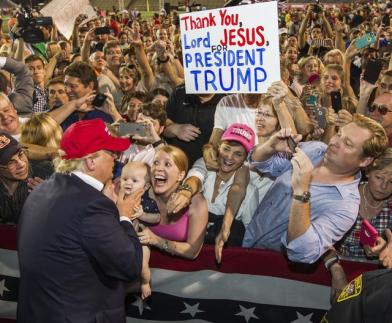
 

Thank You Lord Jesus for President Trump

Agree with this article? Violently disagree? Scroll down to leave a comment.

Follow Semi-Partisan Politics on TwitterFacebook and Medium.

John McCain, The Man Who Gave Us Sarah Palin, Criticises Brexit

The man who wanted to put Sarah Palin a heartbeat away from the American presidency has something to tell us about Brexit

Following swift on the heels of former US ambassador to the United Nations John Bolton’s welcome words of support for Brexit and the campaign for Britain to reclaim our democracy, Senator John McCain comes charging in to defend the status quo.

From the Times (+):

It is a few weeks before we get Barack Obama’s intervention in the EU referendum debate, but today we get a foretaste of America’s view of Brexit.

John McCain, the US senator defeated by Obama in 2008, has issued a blunt warning after meeting MPs on the Commons defence select committee that the “need for a strong and united Europe is greater than ever”.

Warning that Britain and the US are “confronting the most diverse and complex array of crises since the end of World War II”, McCain claims that “British membership in the EU is a vital contributor to the security and prosperity of Europe and the United States”.

He insists it is a decision for the British people, but notes that “whatever the outcome of the referendum on EU membership, it will send a strong message to Vladimir Putin”.

At least McCain does little to disguise that his view of Brexit is coloured almost entirely by his view of the American national interest, rather than what might be best for America’s strongest and closest ally, or for democracy in general – so in that regard he is slightly better than President Obama, who presumes to lecture the British people on what is best for them.

The Times – which seems to have deliberately ignored Ambassador Bolton’s contradictory intervention in the debate yesterday – goes on to suggest that Brexit supporters might have a difficult time dismissing a decorated war veteran like John McCain, as though a person’s military exploits from close to half a century ago have a direct bearing on their judgement about another country’s internal affairs.

Nonsense. If John McCain’s judgement is a factor at all here, then the failed presidential candidate who selected Sarah Palin to be his vice presidential running mate hasn’t a leg to stand on.

Let’s recall Senator John McCain’s finest hour:

The person I’m about to introduce to you was a union member and is married to a union member, and understands the problems, the hopes and the values of working people; knows what it’s like to worry about mortgage payments and health care, the cost of gasoline and groceries. A standout high school point guard; a concerned citizen who became a member of the PTA; then a city council member, and then a mayor; and now a governor who beat the long odds to win a tough election on a message of reform and public integrity. And, I am especially proud to say in the week we celebrate the anniversary of women’s suffrage, a devoted wife and a mother of five.

She’s not — she’s not from these parts and she’s not from Washington. But when you get to know her, you’re going to be as impressed as I am. She’s got the grit, integrity, good sense and fierce devotion to the common good that is exactly what we need in Washington today. She knows where she comes from and she knows who she works for. She stands up for what’s right, and she doesn’t let anyone tell her to sit down. She’s fought oil companies and party bosses and do-nothing bureaucrats, and anyone who puts their interests before the interests of the people she swore an oath to serve.

She’s exactly who I need, she’s exactly who this country needs, to help me fight — to help me fight the same old Washington politics of me-first and country second.

My friends and fellow Americans, I am very pleased and very privileged to introduce to you the next vice president of the United States — Gov. Sarah Palin of the great state of Alaska.

And this is the person whose advice we should be fawning over when it comes to global security, the future of our democracy and our right to self-determination here in Britain?

We have enough politicians and high profile public figures with calamitous judgement and weak powers of prognostication here in Britain, without importing any more uninformed voices from overseas.

I think you can sit out this round, Senator.


European Union - United Kingdom - Britain - Flags

Agree with this article? Violently disagree? Scroll down to leave a comment.

Follow Semi-Partisan Politics on TwitterFacebook and Medium.

John Bolton’s Alternative American Position On Brexit

John Bolton - Brexit

Former United States UN ambassador John Bolton provides a refreshingly different – and much more authentically American – position on Brexit to that of the sitting president

In marked contrast to President Obama – who treats his country’s closest ally with utter contempt by urging the British people to accept a continued loss of sovereignty and self-governance which America would never tolerate for herself – there are a number of other, more respectful American public figures who treat British democracy with the respect it deserves.

Some of these individuals not only recognise that the EU referendum is a sovereign decision for the British people alone to make without unwelcome hectoring from the Oval Office, but also appreciate that Brexit is the far better outcome for Britain, America and the world.

One such person is former US ambassador to the United Nations, John Bolton, who writes in the Telegraph:

President Barack Obama embodies the conventional wisdom, unabashedly supporting continued construction of a European superstate. Obama’s fascination with Brussels, however, reflects his own statist inclinations. His lack of international leadership perfectly mirrors the EU’s timid, ineffective defence of its own interests and values. Of course Obama loves the EU.

Arguing that today’s EU is collectively stronger than a continent of free nation-states misreads history, distorting it through a quasi-theological lens. The EU is less than the sum of its parts. Its politico-military “unity” is purest symbolism. Flags and anthems not only do not embody unity, but instead mask a poisonous, paralysing disarray.

Nor is unity reflected in incessant affirmations of Europe’s economic size, as if it were truly integrated. Indeed, if Europe had single-mindedly pursued a single market, abjuring political abstractions, it could have achieved more economic integration and broader political consensus together, rather than getting wrapped around the axle of “ever closer union”. And just as symbolic gestures do not ensure unity, reversing those symbolic gestures does not forestall Britain’s ongoing descent from representative government into Europe’s bureaucratic oligarchy. David Cameron’s proposed changes to London’s relationship with Brussels in no way addresses, let alone cures, the systemic failures inherent in EU decision-making structures.

Brilliant, stirring stuff. This blog does not often  share common cause with prominent neoconservatives in the model of John Bolton, but in this case he is absolutely correct. The point about Europe being less than the sum of its parts is particularly astute and counters the lazy (and never supported) trope that the EU amplifies our economic, military and diplomatic output, when in fact the European Union does no such thing.

The EU is far from a single, integrated economy – as John Bolton goes on to argue, the single-minded obsession with forging a political union has in many ways actually detracted from the creation of a true single market, such as could ever exist in a continent with such diverse cultures and no common language. Therefore, if we vote for Brexit, Britain will not be leaving some dynamic and prosperous unified economy – we will be leaving a political bloc dominated by an ill-fated currency union which imposes utter economic misery on the south and imposes financial obligations in the form of necessary transfer payments with the northern countries are unwilling to meet.

Bolton is also absolutely correct when he turns his analysis to the military and diplomatic angle:

America is partially at fault for the EU mirage because Nato, largely a US creation, has been so successful. For decades, sheltering under Washington’s military umbrella, Europe, including Britain, has recklessly shrivelled defence budgets and increased social-welfare expenditures. The results are not pretty. The EU has not only retreated from the world stage, it is becoming incompetent in ensuring security within its own “borders”. Europe’s loss of defence capabilities, as well as will and resolve, are deeply inimical to defending the West against today’s increasing global threats.

[..] If advocates of Britain remaining in the EU haven’t noticed, America’s international commitments are under attack from several populist directions in our ongoing presidential campaign. Some, especially among Democrats, simply do not value national security, preferring to focus on domestic issues, hoping – God forbid – to make America look more like social-democratic Europe. Others, especially among Republicans, think America’s allies have got a free ride, don’t appreciate US efforts, and should be made to fend for themselves. If Britain votes to stay In, this view may prevail across Washington. So be careful what you wish for.

These criticisms are entirely justified. Though Britain does best of the European powers in terms of maintaining any form of credible military, our armed forces have been pared back relentlessly while money is funnelled in an unearned peace dividend toward vote-winning social programmes.

And appallingly, many of the worst cutbacks have taken place under the current supposedly conservative administration of David Cameron, whose government’s disastrous stewardship of defence matters has left Britain with no maritime patrol capability and (far more crucially), no aircraft capability until the two (or possibly just one) new carriers currently being built come into service.

America has traditionally regarded Britain as her most stalwart ally because we have maintained moderate expeditionary capabilities together with the political will to use them where necessary. The political will has clearly ebbed away, as evidenced by the recent debacle with Parliament’s response to the Syrian crisis, and the expeditionary capabilities are gravely imperilled too. The Pentagon has always operated on the assumption that Britain could be relied upon to field an entire division operating independently of American forces in any joint action, but this is now being re-evaluated.

Part of the EU’s problem is that it has pretensions of significance on the world stage which are simply not matched by its willingness to divert money from generous social programmes to pay for them. Our defence is literally being guaranteed by the American working poor, who go without the kind of welfare perks (like working tax credits) and government-provided universal healthcare that we take for granted, in order to fund the American military machine.

Then there is also the issue of duplication. As well as spending far less on defence spending in real terms, the stubborn refusal of EU member states to give up the last vestige of sovereignty by abolishing national armies and contributing to joint European armed services means that there is massive duplication of HQ and some core infrastructure, while not nearly enough of everything else. There are probably enough European generals and admirals to fully man a Nimitz-class aircraft carrier, and yet Europe does not possess even one comparable ship (to America’s ten).

In all of these ways, the European Union fails to pull its weight, let alone punch above its own weight, and actively contributes to making Europe far less than the sum of its parts.

As Bolton rightly notes, flags and anthems do not embody unity. And in the European Union’s case, these ostentatious pretensions of statehood only mark the desperation of certain political elites to escape the irritant of accountability to their own electorates and instead dissolve themselves into the unaccountable anonymity of Brussels supranational governance. Or – to see the project in the kindest possible light – they reflect a desperate effort to create a single European demos through sheer force of will, the geopolitical equivalent of “if you build it, they will come”.

But no European demos came, and none is coming. The entire European Union is built on an imaginary foundation and cannot hope to succeed, let alone win the respect and devotion of an informed citizenry.

Ambassador John Bolton gets it. Tragically, Barack Obama does not.


European Union - United Kingdom - Britain - Flags

Agree with this article? Violently disagree? Scroll down to leave a comment.

Follow Semi-Partisan Politics on TwitterFacebook and Medium.

Tales From The Safe Space, Part 15 – Barack Obama On Campus Censorship

President Obama’s timely criticism of the Safe Space Generation of students

It may come as a surprise to his conservative critics, but President Obama’s stance on the creeping authoritarianism and Identity Politics culture infecting American college campuses is very much on the side of free speech and robust debate.

Pressed to discuss his views on “politically biased colleges” at a high school town hall event held late last year, Barack Obama said:

Sometimes, y’know, there are folks on college campuses who are liberal and maybe even agree with me on a bunch of issues, who sometimes aren’t listening to the other side. And that’s a problem too. I was just talking to a friend of mine about this, you know, I’ve heard some college campuses where they don’t wanna have a guest speaker who, you know, is too conservative. Or they don’t want to read a book if it has language that is offensive to African Americans, or somehow sends a demeaning signal towards women. And you know, I gotta tell you, I don’t agree with that either.

I don’t agree that you, when you become students at colleges, have to be coddled and protected from different points of view, y’know? I think that you should be able to – anybody who comes to speak to you and you disagree with, you should have an argument with ’em. But you shouldn’t silence them by saying “you can’t come because, y’know my – I’m too sensitive to hear what you have to say”. That’s not the way we learn either.

It is interesting to watch the reaction of the students standing behind Obama while he makes these remarks. Some are clearly bored and not paying close attention, but most clap politely when Obama reaches a natural break in his speech.

However, there is also a significant minority of students in the audience who are giving what can best be described as death stares. Clearly they do not like what they are hearing one bit, because Obama’s pragmatic suggestion that college is place where autonomous adults go to debate sometimes difficult ideas in the pursuit of personal and intellectual growth is contrary to everything that they have been taught is progressive and socially just.

Note in particular the two women on the top right of the screen when Obama says that campus speech restrictions are more suited to the former Soviet Union, approximately 3 minutes and 50 seconds into the video. While the other students seem to have fairly neutral expressions at this point, these two students look angry, sullen and passive-aggressive. The president of the United States has dared to come to their school and blaspheme against the Cult of Identity Politics to which they fully subscribe, and so they sit there, arms crossed and doubtless feeling quite triggered, plotting their revenge.

The point is this: it only takes a few such angry zealots to cow and intimidate an entire student population – and university administrations which should know better – into embracing every corrosive aspect of the Identity Politics culture. Of an entire student body, only a minority will drink deep enough from the well of competitive grievance culture that they turn and become the angry, authoritarian stars of many a YouTube video. But those who do are incapable of leaving everybody else alone. They cannot practice their new secular religion privately; all must share in their beliefs and abide by their behavioural codes, on pain of punishment.

Just seven years ago, the image of an African-American man addressing a group of high school students as President of the United States would have been seen as a powerful display of the social change that is possible when free speech is celebrated, guaranteed and used. Barack Obama, whatever one thinks of his record in office, did not become president by sheltering inside an academic safe space, after all. But Identity Politics does not encourage reflection on progress made; it primarily fosters resentment about the sins and injustices of the past.

Today’s generation of Identity Politics-practising students can talk endlessly about their “pain” and write interminable, barely literate screeds demanding that they be sheltered, acknowledged and validated in everything that they do.

But I doubt that a single one of them could write “Dreams from my Father“.


Safe Space Notice - 2

Agree with this article? Violently disagree? Scroll down to leave a comment.

Follow Semi-Partisan Politics on TwitterFacebook and Medium.

Could The Media Have Prevented The Rise Of Donald Trump?

There is no longer an Edward Murrow or Walter Cronkite to stand up to Donald Trump

Could mainstream television, radio, print and internet journalism outlets have done more to prevent the rise of Donald Trump? And should they have done more?

Glenn Greenwald thinks so:

Actually, many people are alarmed [by the rise of Trump], but it is difficult to know that by observing media coverage, where little journalistic alarm over Trump is expressed. That’s because the rules of large media outlets — venerating faux objectivity over truth along with every other civic value — prohibit the sounding of any alarms. Under this framework of corporate journalism, to denounce Trump, or even to sound alarms about the dark forces he’s exploiting and unleashing, would not constitute journalism. To the contrary, such behavior is regarded as a violation of journalism. Such denunciations are scorned as opinion, activism, and bias: all the values that large media-owning corporations have posited as the antithesis of journalism in order to defang and neuter it as an adversarial force.

[..] This abdication of the journalistic duty inevitably engendered by corporate “neutrality” rules is not new. We saw it repeatedly during the Bush years, when most large media outlets suppressed journalistic criticism of things like torture and grotesque war crimes carried out by the U.S. as part of the war on terror, and even changed their language by adopting government euphemisms to obscure what was being done. Outlets such as the New York Times, the Washington Post, and NPR refused to use the word “torture” to describe techniques long universally recognized as such — which were always called torture by those same media outlets when used by countries adversarial to the U.S. — because to do so would evince “bias,” lack “neutrality,” and “take sides” in the torture debate.

Contrary to what U.S. media corporations have succeeded in convincing people, these journalistic neutrality rules are not remotely traditional. They are newly invented concepts that coincided with the acquisition of the nation’s most important media outlets by large, controversy-averse corporations for which “media” was just one of many businesses.

I’m not so sure.

While Greenwald is absolutely right to chastise mainstream media outlets for clinging desperately to an “appearance of objectivity at all costs” dogma which routinely sees them humiliate themselves by speaking and writing about the utterly ridiculous as though it were merely an equal and opposing side to an argument, the idea that prestige nightly news anchors could have killed Trump’s candidacy in the crib either by initially declaring it ridiculous and mocking it, or by waging an Edward Murrow or Walter Cronkite crusade against him, seems to be wishful thinking.

It’s wrong because it underestimates the anti-establishment surge now underway in America (and in Britain too, as we saw with the rise of UKIP and the SNP). Suppose that mainstream news outlets like the New York Times, NBC, NPR and others had come out strongly to argue that Donald Trump’s ideas were outside the Overton window of “acceptable” political thought in America, and that he should henceforth be ignored by the media regardless of how many people were attending his rallies or how high he climbed in the opinion polls. What difference would it have made?

Political journalism is scorned by the public as much as Washington politics itself, and often for quite valid reasons – the incestuous, back-scratching relationship between the two is often entirely self serving and actively prevents the holding of government to proper account. Trump’s candidacy is fuelled in significant part by the opposition of those opinion columnists and TV talking heads who have come out to criticise him. If they were joined by everyone else, including news anchors and print journalists whose material does not appear in the opinion section of their television shows or newspapers, it is hard to see it doing anything other than confirming the suspicion of Trump fans that the “establishment” is out to get them, thus driving his poll ratings even higher.

This is important. Trump is riding high partly because of a small group of “let it burn” conservatives who believe that Washington is so corrupt that an authoritarian outsider beholden to no one is as good a choice as any to sweep out the garbage, but mostly because Trump supporters feel ignored and patronised by almost everybody else. And frankly, the opposition to Trump in the media has not helped, tending toward hand-wringing “ooh, isn’t he evil” editorials and one-sided accounts of violence at his campaign rallies rather than granular deconstructions of his policy proposals (such as his policies exist). Increasing the frequency and volume of the existing anti-Trump media coverage will not fix the problem, because it does little to tackle the sentiments and ideas which drive his support.

But more to the point, if we are to set arbitrary limits on our political discourse, beyond which any candidate promoting “unacceptable” ideas is rounded on by the corporate media as it is currently comprised, who gets to set the limits? Who gets to decide which ideas are okay to debate, and which are traps which will bring the entire media establishment crashing down on the person who dares to raise them?

There is almost nothing as infuriating as watching high profile journalists discuss an issue where one side obviously has the moral and intellectual high ground in terms that suggest that it is a finely balanced debate – witness the debates on torture, climate change, Brexit (UK secession from the European Union)  and more. But even worse than this would be a collusion between media outlets to freeze out certain ideas or candidates from being mentioned altogether because they are “evil” or contradict prevailing orthodoxies.

I’m sure that this is not what Greenwald has in mind. As a consistent advocate of free speech, I’m sure that he would prefer a brash and lively media landscape of much more fractured ownership, in which a multitude of independent news outlets are free to carry out the kind of unabashedly partisan campaigning journalism that Greenwald (and to some extent this blog) advocates. Greenwald would likely be fine if some outlets produced coverage very supportive of Trump, so long as other outlets were equally free to oppose him.

But we do not have such a media landscape right now, and moving in this direction would be a process taking years, not months – certainly too long of a timescale to have any impact on the rise of Donald Trump. The difficult truth is that given the hysterical, rabble-rousing behaviour of the Republican Party over the course of the Obama presidency – in which they chose hyperbolic, apocalyptic scaremongering over principled opposition to bigger government – there was nothing that could have prevented the monster they created from coming to life, breaking free of its chains and devouring them, as Trump is now doing.

It may feel good to imagine an American media landscape filled with luminaries like Edward Morrow and Walter Cronkite, journalists who would have taken one look at Donald Trump back when he launched his presidential bid, and masterfully snuffed it out in the course of one withering nightly news broadcast or newspaper column. But that is not the world we live in. Any attempt by major media outlets to scrutinise or inveigh against Trump in these anti-establishment times would only have fuelled his campaign even more than his many critics already have.

“Compelled journalistic neutrality” is not to blame for the rise of Donald Trump. Though corporate media has many faults – witness CBS chairman Les Moonves enthusing about the ratings Donald Trump’s presidential campaign is bringing to his network – they did not create the Trumpian monster, and nor can they stop it.

Far more deserving of blame are the Republican Party establishment, who shamelessly and hypocritically rode the anti-establishment, anti-Obama tiger for seven years before finally it turned on them. And also at fault is an entire remote and self-serving political establishment which in many ways thoroughly deserves the kicking it is now receiving – just not by Donald Trump, the opportunistic and undeserving current beneficiary.

Would it be a cathartic experience to witness more mainstream media types casting objectivity aside and coming out against Trump? Quite possibly. But would it have done anything to stop his rise? Let’s not kid ourselves.


Postscript – The following is an excerpt from Edward R. Murrow’s famous report on Senator Joseph McCarthy:

Earlier, the Senator asked, “Upon what meat does this, our Caesar, feed?” Had he looked three lines earlier in Shakespeare’s Caesar, he would have found this line, which is not altogether inappropriate: “The fault, dear Brutus, is not in our stars, but in ourselves.”

No one familiar with the history of this country can deny that congressional committees are useful. It is necessary to investigate before legislating, but the line between investigating and persecuting is a very fine one and the junior Senator from Wisconsin has stepped over it repeatedly. His primary achievement has been in confusing the public mind, as between the internal and the external threats of Communism. We must not confuse dissent with disloyalty. We must remember always that accusation is not proof and that conviction depends upon evidence and due process of law. We will not walk in fear, one of another. We will not be driven by fear into an age of unreason, if we dig deep in our history and our doctrine, and remember that we are not descended from fearful men — not from men who feared to write, to speak, to associate and to defend causes that were, for the moment, unpopular.

This is no time for men who oppose Senator McCarthy’s methods to keep silent, or for those who approve. We can deny our heritage and our history, but we cannot escape responsibility for the result. There is no way for a citizen of a republic to abdicate his responsibilities. As a nation we have come into our full inheritance at a tender age. We proclaim ourselves, as indeed we are, the defenders of freedom, wherever it continues to exist in the world, but we cannot defend freedom abroad by deserting it at home.

The actions of the junior Senator from Wisconsin have caused alarm and dismay amongst our allies abroad, and given considerable comfort to our enemies. And whose fault is that? Not really his. He didn’t create this situation of fear; he merely exploited it — and rather successfully. Cassius was right. “The fault, dear Brutus, is not in our stars, but in ourselves.”

Good night, and good luck.


Donald Trump - Make America Great Again - Hat

Agree with this article? Violently disagree? Scroll down to leave a comment.

Follow Semi-Partisan Politics on TwitterFacebook and Medium.