An Anti-Immigration Brexit Campaign Is Doomed To Failure

Michael Gove - EU Referendum - Vote Leave - Immigration

Ben Kelly of Conservatives for Liberty and The Sceptic Isle has an excellent new piece explaining why a Leave campaign focused on immigration is both depressingly regressive and doomed to failure.

Kelly’s warning is in response to Michael Gove’s latest contribution to the Vote Leave campaign, as reported today by ITV:

Michael Gove has warned the UK faces a migration “free for all” unless it leaves the EU, as the Leave camp moved to exploit an admission from the Government that EU free movement of labour rules make it harder to curb immigration.

The Justice Secretary insisted potential new members of the EU posed a “direct and serious threat” to public services such as the NHS, and social harmony.

He said five countries “due to join the European Union” – Albania, Macedonia, Montenegro, Serbia and Turkey – which he warned would mean Britain’s public services would not be left in a “strong position”.

Writing from the perspective of The Leave Alliance (an independent grassroots movement for Brexit supported by this blog) which advocates exiting the EU’s political union and using EFTA/EEA membership to maintain access to the single market, Kelly writes:

A recent ComRes poll that asked the question “what is the most important issue in your decision on the EU Referendum?” was illuminating. 47% said the economy was the most important factor, with immigration trailing on 24%. So the belief that it doesn’t matter that the Leave campaign loses the economic argument because they can win on immigration is bunkum.

First and foremost, people will vote according the economic risk. That is why we propose an EEA based solution; it de-risks Brexit, secures the economy and gives us a soft landing. That is stage one of the secession process, a safe platform to build on. This is the key to winning the referendum and thereby restoring democracy and self-governance in the United Kingdom. In any case, it will likely be the only offer on the table for Article 50 negotiations and is the likely government course of action.

Although the EFTA/EEA solution puts on hold changes to freedom of movement it crucially protects our Single Market participation and thereby neutralises the economic uncertainty surrounding Brexit. In the long term we can make the case for reforms to freedom of movement, but pending such reform there is plenty of scope for improving the management of our borders with a coordinated set of policies designed to address push/pull factors. We would also gain the option of activating the “emergency brake” provision in the EEA Agreement as a temporary safeguard measure against exceedingly high net migration numbers.

Many who unrealistically seek a clean break Brexit and want everything at once will see this position as sub-optimal, but the alternative – pulling out of the EU’s freedom of movement provisions – would lose us access to the Single Market.  Without continued access to the Single Market, we cannot win the referendum because we lose the economic argument.

Those who insist on ending freedom of movement and imposing strict new immigration controls on Day 1 are letting their own “perfect scenario” be the enemy of the good. The type of Brexit necessary to deliver what Vote Leave are promising inevitably means losing access to the single market, membership of which is contingent on adopting free movement of people. This creates a degree of economic uncertainty which is gleefully seized upon by the Remain campaign and makes it virtually impossible for Leave to win the referendum.

By contrast, exiting to an EFTA/EEA holding pattern allows Britain to extricate herself from political union with the EU while maintaining the stability in the economic sphere which is necessary to reassure the 47% of voters for whom this will be the deciding factor. Further changes to immigration policy can then follow according to the democratic will of the British people, subject to various economic and political constraints.

It should be pointed out, too, that the accession of the next group of EU candidate countries – Albania, Macedonia, Montenegro, Serbia and Turkey – could be more than a decade away from joining, and in Turkey’s case this may well not happen at all. This gives plenty of time for Britain to secure freedom from political union, and then flex our independent policy levers to address push and pull factors as Kelly advocates.

Kelly concludes:

Stepping back into the EEA means leaving political and judicial union safely.  From that position of security and strength a world of opportunity opens up. Over time we can take advantage of regaining control over a vast swathes of policy making and review the statute books. Gradually we can move towards a more bespoke “British model” of relations with the EU and form a coalition to push for necessary reforms.

Disastrously, this is seemingly unacceptable to a number of inflexible and uncompromising Eurosceptics who reject freedom of movement and the Single Market and are therefore actively adding to the perceived uncertainty of Brexit. Regressive Euroscepticism, which is unwilling to compromise and refuses to acknowledge that freedom of movement actually has many great positives, is a disease that will lead only to abject failure.

We need an optimistic message and a positive, liberal vision. The ability to move freely across Europe is hugely beneficial in so many ways and a great many Britons enjoy those benefits and will fear losing their rights.  EEA immigration has been good for this country in many clear and measurable ways, economically and socially, and this absolutely has to be said.

An independent Britain must be a positive, diverse and liberal country with an open economy; this is the key to our cultural and social dynamism and how we can make a great success of Brexit. Leave cannot possibly win with a regressive vision that contradicts this. An anti-immigration campaign arguing for the abolition of freedom of movement and the loss of Single Market access is guaranteed to lose, and the failure will be richly deserved.

The New Statesman’s political editor George Eaton is also devastatingly accurate with his take on Vote Leave’s pivot back to immigration:

Britain’s high immigration rate is undeniably of concern to many voters. The boast that EU withdrawal would exempt the UK from free movement (though Norway and Switzerland show it may not) is perhaps the best card the Brexiters have to play. But it may not deliver victory. The Remain campaign speaks of a “plateau” beyond which Leave cannot advance. There are millions of people whose priority is reducing immigration – just not enough for the outers to win. The issue is to them what the NHS was to Ed Miliband’s Labour – a strategic comfort blanket.

[..] The more the Brexiters play the migration card, the greater the risk that they animate their core voters while alienating others. It was for this reason that Vote Leave resolved to run an optimistic campaign, non-centred on immigration. Gove’s rhetorical escalation shows that they are struggling to abide by this vow.

In raising the salience of immigration, Leave is playing to its strengths. Until it is able to neutralise its weaknesses, that will remain a displacement activity.

Continuing to place this uncompromising immigration message front and centre in the Leave campaign is the quickest and surest way to a 45-55 defeat on June 23. The only ones not to realise this seem to be the official Leave campaign, who are more interested in covering their blushes and resetting the agenda after having their flimsy economic case taken apart last week by a gleeful Remain campaign.

Any campaign aimed at motivating core supporters at the expense of alienating swing voters (by preventing the adoption of a plan which would ease their economic concerns) is not helpful at this stage. Persisting with exactly the same unfocused, populist message which helped to secure the referendum will not also help to win it, and telling the UKIP contingent exactly what they want to hear rather than challenging them to think more strategically and longer-term could well be looked back on as the single biggest failure of the campaign.

 

European Union - United Kingdom - Britain - Flags

Top Image: Independent

Agree with this article? Violently disagree? Scroll down to leave a comment.

Follow Semi-Partisan Politics on TwitterFacebook and Medium.

With Allies Like These…

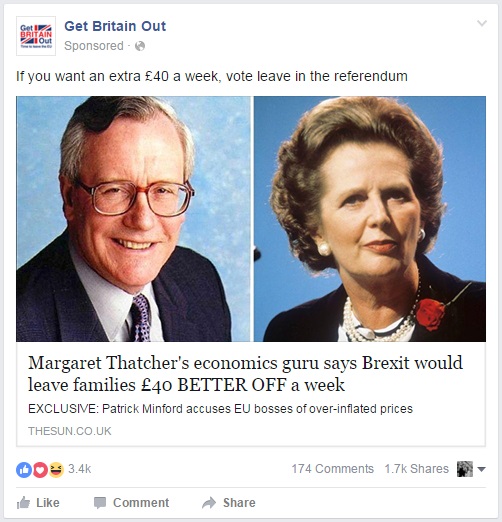
Get Britain Out - EU Referendum - Save 40 per week

With allies like Patrick Minford and Get Britain Out, who needs the Remain campaign?

The Sun reports:

Maggie Thatcher’s economics guru stormed into the referendum battle last night, claiming Brexit would cut living costs by £40 a week.

Professor Patrick Minford accused EU chiefs of imposing over-inflated prices on everything from food to cars.

And he calculated tearing down trade barriers after we leave will boost growth and bring consumer prices down by 8p in the Pound.

Prof Minford said: “Prices are 20 per cent higher inside the EU compared with world prices.

“The system is designed to keep prices up and consumers are paying for this.

“But if we pulled out, your average Sun on Sunday reader would be 40 quid a week better off.

Well, that’s sorted then. Punch a few numbers into the Minford Model and it turns out that £40 will magically materialise in our wallets the moment we achieve Brexit. Great! That will just about cover the cost of a bottle of Veuve Cliquot to toast the restoration of our democracy.

How long until Vote Leave use this “analysis” to knock up their own version of Britain Stronger in Europe’s risible calculator, which shows how terribly destitute we will all be if we are so rash as to spurn the European Union?

How long until either of the main campaigns treats the British electorate like intelligent adults?*


*rhetorical question


European Union - United Kingdom - Britain - Flags

Agree with this article? Violently disagree? Scroll down to leave a comment.

Follow Semi-Partisan Politics on TwitterFacebook and Medium.

The Guardian, The EU Referendum And Britain’s Entrenched Sense Of Inferiority

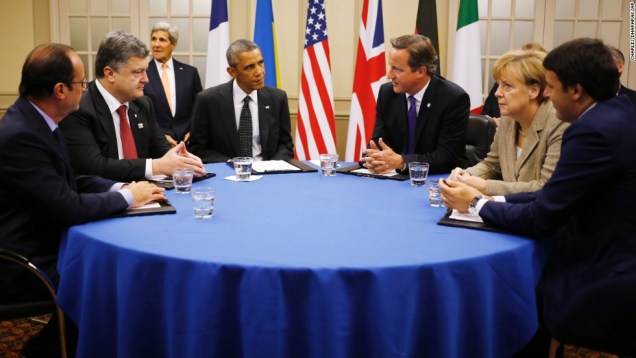
Obama Merkel Cameron Renzi Hollande - 3

A cake-filled misery-laden grey old island…

When does the Guardian become an enthusiastic, uncritical cheerleader for US foreign policy?

Why, when the US president jets in to lecture us all on the importance of voting to remain in their beloved European Union.

Meanwhile, we know exactly what the Guardian thinks about Britain from this giveaway paragraph in their article hailing Barack Obama’s arrival:

The importance of the UK as a key figure inside the EU club will be symbolically underscored when Obama again meets David Cameron, Angela Merkel, Mario Renzi and François Hollande in Hanover, Germany, on Monday to discuss Syria, Libya and the consequent migration crisis. The implicit message is that the UK outside the EU would not have been invited to such a high-level transatlantic conclave.

Oh gosh! How kind of Italy and France to allow Britain to take part in their Super Important Meeting with Germany and the United States. Of course, puny little Britain – the fifth largest world economy and pre-eminent European military power – would never normally be allowed to sit around the table with François Hollande and “Mario” Renzi, but for the fact that we are part of the same supra-national political union.

Is the Guardian serious? Sometimes it is hard to tell whether this dismal, miserablist attitude toward Britain is entirely genuine, or an attitude which is affected purely for the purposes of keeping our self-esteem just low enough that we don’t get ideas of national independence above our station.

The trouble, though, is that the Guardian is very much a thought leader in this area. Where the Guardian sighs, tuts and shakes its head at the hopeless prospects of puny, pathetic Britain, so many of its readers have been conditioned to automatically do the same. I’m frequently amazed by the number of conversations I have with otherwise intelligent, knowledgeable people who genuinely believe that Britain is a small and inconsequential nation.

It is almost as though someone distilled Britain’s despairing psyche when we were at our 1970s nadir into its purest, bleakest form, and then injected that dismal serum into half of today’s population. Once the infection takes hold, the feeble country that these National Inferiority Virus sufferers hallucinate bears absolutely no relation to the objective reality of modern Britain.

And these are the people who will be voting in the referendum on 23 June. These are the the pessimistic, resigned views which millions of people sympathetic to the Guardian’s position will carry with them into the polling booth. Citizens of a nuclear power, a P5 UN Security Council member, the world’s fifth largest economy and home to the financial and cultural capital city of the world, who nonetheless believe that it is only our membership of the EU which gives Britain’s prime minister the undeserved privilege of being in the same room as the leaders of Germany, France and Italy.

God help us.


European Union - United Kingdom - Britain - Flags

Top Image: CNN

Agree with this article? Violently disagree? Scroll down to leave a comment.

Follow Semi-Partisan Politics on TwitterFacebook and Medium.

Brexit Would Be Less Like Divorce, More Like Annulment On Grounds Of Fraud

Brexit - Messy Divorce - EU Referendum - European Union - Bias

If Brexit is like divorce (and it isn’t), it is only because we were tricked into marriage in the first place

You hear it again and again, the hysterical comparison Remainers make between Brexit and getting divorced.

Throughout this EU referendum campaign we have constantly been told that not only will voting to become an independent country will see us physically severed from the continent of Europe and cut adrift to bob around aimlessly in the Mid-Atlantic, but also that this “acrimonious split” will be akin to walking out on our European allies and leaving them with the house, the car and custody of the kids.

Latest to peddle the divorce line is Philippe Legraine in CapX:

On top of the disruption of a messy divorce, Britain would suffer enduring damage by separating from the huge, wealthy market on its doorstep. Not only would trade with the EU be less free, Britain’s access to other export markets would be worse too.

The Economist has been at it too, with their scaremongering and false depiction of Article 50 negotiations:

Article 50 provides that the EU will negotiate a new agreement with the withdrawing country over two years. That can be extended, but only by unanimous agreement. The article also specifies that, when agreeing a new deal, the EU acts without the involvement of the country that is leaving. To get a feel for the negotiating dynamic, imagine a divorce demanded unilaterally by one partner, the terms of which are fixed unilaterally by the other. It is a process that is likely to be neither harmonious nor quick—nor to yield a result that is favourable to Britain.

(This is false narrative is nothing but hyperbolic, biased scaremongering, as brilliantly debunked by The Leave Alliance here).

And the Guardian gets in on the act too, with William Keegan opining:

The Labour party turned out on parade last Thursday, and Jeremy Corbyn pronounced that there was an “overwhelming” case for our remaining in the EU. This is statesmanlike behaviour and judgment. Whatever the deficiencies of the EU, we are not going to remedy them if we leave. And the Lawson/Johnson idea that we can renegotiate our way into the advantages of belonging to an organisation that we have just left is for the birds. Messy divorces do not work like that.

The broader point keeps on cropping up – Brexit means a messy and acrimonious divorce, we are told, and therefore we should avoid this at all costs.

But this is pure nonsense. Britain’s relationship with the European Union is not like a marriage. Our membership is not a flawed collaboration or partnership whose kinks and problems need to be patiently worked through in couple’s therapy.

In truth, Britain’s experience of EU membership has been like being in a platonic friendship with someone who is desperately trying to turn that friendship first into a romantic relationship and then into a marriage, and using every single trick and deceit at their disposal in order to do so.

Britain wants somebody to hang out with sometimes, a bit of companionship and a mate who will be there to help celebrate the triumphs of life and provide support and encouragement when things are difficult.

The EU, on the other hand, keeps agitating for us to get a joint bank account, a veto over what TV shows we should watch, a common “guests remove shoes upon entering” household rule and is insisting that we spend our precious vacation time visiting their parents in the south of France rather than driving Route 66 like we always wanted.

Worse still, the EU is making ominous sounds about going vegan “for the good of the Earth”, the clear implication being that we are expected to forswear steak night and take the plunge as well.

And despite our repeated attempts to push back and hint at our desire for a platonic relationship, at some point soon we know in our heart of hearts that the EU fully intends to do to us what every newlywed wants to do on their wedding night – consummate the marriage.

Poor Britain just wanted someone to go to the movies with once in awhile, and now the EU has moved in, spent three grand on new curtains and turned the home cinema into a mini fitness centre. Throw in the fact that suspicious looking packages from Ann Summers have been arriving all week – not to mention that leather whip and pair of handcuffs resting casually on the bed – and it looks like we are in for a rather excruciating evening.

Of course, this could all have been prevented at any point if only we had been willing to have one slightly awkward but brief conversation making it clear that our view of the relationship and the EU’s view of the relationship are fundamentally different – that we want to be friends, and that if it is to be “friends with benefits”, the only benefits we are interested in relate to pragmatic things like trade and friendly cooperation (where doing so on a regional European basis makes sense).

There is still time to have that conversation – just. There is still time before the removal van comes to bring the EU’s clothes and furniture, and before the wedding invitations go out announcing our forthcoming nuptials to the rest of the world. The conversation will become trickier and more fraught the later we leave it, but if we Vote Leave in this referendum we can still salvage an important friendship while preserving our own national bachelorhood.

Brexit now would not be a divorce – it would be correcting a decades-long misunderstanding about the nature of our relationship with the EU, and what we wanted to get out of it.

Wait much longer, though, and the relentless process of political integration (which David Cameron has utterly failed to win an exemption for Britain) will soon be such that we find ourselves trapped in a common law marriage, and a relationship which is much harder – or even impossible – to escape.


European Union - United Kingdom - Britain - Flags

Agree with this article? Violently disagree? Scroll down to leave a comment.

Follow Semi-Partisan Politics on TwitterFacebook and Medium.

Love Our NHS? Prove It With Your Vote In The EU Referendum, Part 3

Vote Leave campaign rally - Save Our NHS - 350 million - Brexit

The Remain campaign are going to tell lots of apocalyptic, scaremongering and false tales about how leaving the European Union would destroy the NHS. But that does not mean that Brexit campaigners should stoop to their level

Vote Leave are going all-in with their risible, childish lies about saving £350 million a week in the event of Brexit, and offering the money as a sacrifice to Our Blessed NHS instead.

This is – to use the nicest words possible – completely amateurish and stupid.

Conservatives – especially real ones who aren’t all that keen on the state being a monopolistic provider of healthcare – don’t make very plausible knights in shining armour when it comes to defending the NHS, especially in the minds of voters conditioned by years of hand-wringing left-wing rhetoric that the Evil Tories are perpetually one step away from turning poor people away from hospital.

Besides, the high figure of £350 million fails the common sense test even for the lowest of low information voters. The risible suggestion will do nothing to persuade those who already mindlessly worship the NHS like some kind of secular new age religion and fear that Brexit will hurt their idol, while it offends the more intelligent voter by treating them as though they are stupid.

Richard North, much like this blog, is not having it any more:

What is unlikely to impress, to any one who has the first idea of the issues, is the sort of slogan shown above – the £350 million claim. Vote Leave know it isn’t true. That makes it a lie. Why they go ahead with a deliberate lie, I don’t know. They must think there is some advantage to it.

I find the lie offensive. But then the other side is lying as well. I also find that offensive, but it doesn’t worry me. In fact, I welcome it – it shows weakness, reduces their credibility and gives us leverage. It does worry me when our own side lies – for exactly the same reasons: it shows weakness, reduces our credibility and it gives the other side leverage.

Throughout my campaigning career, I’ve made a point of seeking accuracy – as best I can. For the very opposite reasons that the lie is a bad idea. It shows strength, it increases our credibility and it denies the other side leverage.

In other words, accuracy is the embodiment of good campaigning. The lie is the opposite. That matters. We don’t. We need people to grow up and realise that. There is far too much at stake for us to be playing these silly games.

For libertarians and conservatarians, one of the most depressing aspects of nearly all the Leave campaigns is the idea that any money saved through Brexit (and the sums we are talking are likely to be so small in either direction as to be insignificant) should not be handed back to the taxpayer in the form of tax cuts, but merely re-allocated to some other area of the state which is crying out for more funding.

Apparently there is precisely zero demand in this country for a campaign, or politicians, who dare to suggest that we should aim to reduce government expenditure in one area not to free up cash for another, but rather to return the money to the people who earned it and who create value in the first place. Therefore it is unsurprising that the NHS proved too shiny and appealing a target for the dilettantes at Vote Leave to resist. They know we worship the NHS uncritically, and so they think that we will be highly susceptible to any messages which link Brexit with the idea of helping the NHS.

Unfortunately, they also lack the intelligence to realise that making this campaign about our socialised healthcare system means fighting the EU referendum campaign on ground which is uniquely favourable to the mostly Remain-supporting Left. And there is simply no way that a Brexit campaign supported mostly by those on the Right wins a “Who Loves The NHS Most?” contest against the arrayed forces of the Labour Party and every virtue-signalling keyboard warrior in the country.

As this blog recently pointed out:

Whether we vote to leave the European Union or remain in the burning building, the NHS will continue to exist. We can’t seem to shake it. And it will continue to churn out moderately priced but increasingly substandard levels of care while nearly the entire population gathers round to uncritically praise the holy creation of St. Aneurin Bevan of Tredegar from dawn to dusk. Nothing, absolutely nothing, will change.

Do you really believe Britain Stronger in Europe when they suggest that “medical innovation” will cease or be harmed if Britain leaves the political construct known as the European Union? Exactly what is it about forsaking a foreign flag, anthem and parliament which will slow down the cure for Alzheimer’s?

Or do you seriously buy this idea that Brexit means that we can throw up a brand new hospital in every major British city within a year, and keep on doing that until the NHS is not only our largest employer but our only employer?

Don’t be taken in by this execrable, manipulative, transparently idiotic nonsense from the major Leave and Remain campaigns, all of which seem to be managed by B-student politicos and all of which are operating on the hopeful assumption that you are a frightened, credulous simpleton.

In order to have a shot at winning the referendum on 23 June, Brexit supporters must stop getting sidetracked by glitzy distractions like promising to funnel non-existent money towards the NHS, and focus instead on neutralising many voters’ fear of the potential economic impact of Brexit.

As Dr. North correctly points out:

The least important people in the referendum campaign are those of us who have already made up their minds which way they are going to vote, and will not change their minds under any circumstances.

[..] Those who matter are the people who are undecided or who think they have a position but are genuinely open to persuasion. Those are the people who will decide the referendum.

The EU is by no means beloved. If the Brexit campaign could only negate all of the mostly baseless economic fears surrounding Brexit, they would win the referendum by a landslide. But to do so means communicating a Brexit plan which clearly de-risks the process and shows people that it is quite possible to leave the political construct known as the European Union while still participating fully in regional and global trade.

Every day that those with the biggest platforms and media profiles waste their time making implausible and unconvincing promises about the NHS – hostile ground where the fighting is hugely favourable to the pro-EU Left – is a day which is not spent promoting a clear Brexit plan and neutralising the one issue (economic concerns) which is preventing this decision from being a landslide 65-35 in favour of leaving the EU.

In other words, fighting this referendum with Vote Leave hogging the limelight on the Brexit side is like – well, Geoffrey Howe (of all people) said it best in his 1990 resignation speech in the House of Commons:

It is rather like sending your opening batsmen to the crease only for them to find, the moment the first balls are bowled, that their bats have been broken before the game by the team captain.

With a captain like Boris Johnson and the hotshots at Vote Leave, all bizarrely exhorting us to leave the European Union in order to Save Our NHS, who needs a Remain campaign anyway?


More on the attempts by both sides to weaponise the NHS for the coming EU referendum here and here.


European Union - United Kingdom - Britain - Flags

Agree with this article? Violently disagree? Scroll down to leave a comment.

Follow Semi-Partisan Politics on TwitterFacebook and Medium.