Time To Raise The Voting Age?

Safe Space Crybabies

Young people who cannot hear dissenting ideas without running to the authorities have no business voting at the ballot box

Since the generation of coddled students now going through university expect and demand to feel “comfortable” at all times, insisting that trigger warnings be slapped on anything which may challenge them – and retreating into strictly enforced “safe spaces” if that doesn’t work – perhaps the time has come to stop treating people in their late teens and early twenties like real adults.

After all, if today’s wobbly-lipped generation of Stepford Students need the authorities to ban controversial speakers, punish dissenting opinions and treat everybody as though they are either current or recovering victims of severe trauma, they are essentially already asking to be treated like children.

At least that’s the point made by Glenn Reynolds, a University of Tennessee law professor, in USA Today:

In 1971, the United States ratified the 26th Amendment, lowering the voting age from 21 to 18. In retrospect, that may have been a mistake.

The idea, in those Vietnam War years, was that 18-year-olds, being old enough to be drafted, to marry and to serve on juries, deserved a vote. It seemed plausible at the time, and I myself have argued that we should set the drinking age at 18 for the same reasons.

But now I’m starting to reconsider. To be a voter, one must be able to participate in adult political discussions. It’s necessary to be able to listen to opposing arguments and even — as I’m doing right here in this column — to change your mind in response to new evidence.

This evidence suggests that, whatever one might say about the 18-year-olds of 1971, the 18-year-olds of today aren’t up to that task. And even the 21-year-olds aren’t looking so good.

Reynolds goes on to cite the various examples of student and young adult infantilisation with which we have become depressingly familiar over the past year – calls to outlaw clapping and booing, tearful temper tantrums about dress codes, stifling ideas by labelling them ‘problematic’, the insistence on safe spaces and mandatory sexual consent workshops.

If people still look to external authorities to help them navigate daily life, mediate normal encounters and resolve commonplace disputes, we should probably keep them as far away from the ballot box as possible, argues Reynolds:

This isn’t the behavior of people who are capable of weighing opposing ideas, or of changing their minds when they are confronted with evidence that suggests that they are wrong. It’s the behavior of spoiled children.

[..] But children don’t vote. Those too fragile to handle different opinions are too fragile to participate in politics. So maybe we should raise the voting age to 25, an age at which, one fervently hopes, some degree of maturity will have set in. It’s bad enough to have to treat college students like children. But it’s intolerable to begoverned by spoiled children. People who can’t discuss Halloween costumes rationally don’t deserve to play a role in running a great nation.

It is ironic that at the same time there is a push to lower the voting age in the UK – the Lords recently voted to allow sixteen and seventeen-year-olds to vote in the coming Brexit referendum – people only slightly older and now at university, who already have the vote, are busy regressing back into emotional childhood.

This blog believes firmly in universal suffrage and a single, defined threshold of legal adulthood at the age of eighteen. But given the increasing number of campus incidents of precious snowflake students demanding that the authorities curtail their liberties for their own “safety” – and the fact that increasing age is the last, best hope of gaining wisdom – the idea of raising the voting age does start to feel awfully tempting.

Top Image: grrrgraphics.com

h/t Patrick West in Spiked

Agree with this article? Violently disagree? Scroll down to leave a comment.

Follow Semi-Partisan Politics on TwitterFacebook and Medium.

Yale University Under Assault By The Stepford Students

Footage from a confrontation at Yale University reveals the true extent of the infantilisation of today’s students

If you do nothing else today, watch and listen to this Yale student shouting at a college administrator.

Some context: the university administrator in question is Nicholas Christakis, the Master of Silliman College. When the university sent a campus-wide notice asking people to be “culturally sensitive” when choosing Halloween costumes this year, Christakis’s wife (repeat: not Christakis, his wife) – who also works for the university – had the temerity to send an email saying that as an educator, what her students choose to wear is none of her damn business.

This didn’t go down at all well with Yale’s coddled population of Stepford Students, for reasons which are now depressingly familiar to many of us. And so it led to a confrontation between some angry young protesters – indignant that the safety of their Safe Space had been compromised – and a harried Nicholas Christakis.

Here is the transcript of the one-sided student tirade:

Continue reading

Fighting Safe Space Culture & College Censorship: The Best Weapon Is Ridicule

Sometimes the best weapon against the New Age Censors on university campuses is laughter at their desire to be treated like babies

All defenders of free speech have a duty to push back against the growing hordes of petty, censorious student activists and their childish demands for trigger warnings, safe spaces and the banning of speakers with contradictory opinions from campus. But it is equally important that we do not go so far that we inadvertently give additional weight – and a false sense of seriousness – to their demands.

Scholarly articles certainly have their part to play – “In College and Hiding From Scary Ideas” by Judith Shulevitz in the New York Times, for example, was instrumental in bringing the problem of infantilised students to a wider audience. And this blog tries to contribute in its own way too, with pointed critiques of the students who want to ban clapping, demands that universities teach adults the meaning of sexual consent, and the abuse of the label “problematic” to ban unwanted ideas and opinions.

But sometimes humour can achieve more than ten earnest articles making the same point. And so it is gratifying to see both South Park and satirical newspaper The Onion take on these symptoms of student infantilisation.

South Park recently devoted an entire episode of their current season to the topic of safe spaces – see the excerpt above, or watch the entire episode online if you are based in the United States.

And as is so often the case, hearing the language of safe spaces and “harmful” ideas spout from the mouths of Randy Marsh or Eric Cartman does more to render this burgeoning culture ridiculous than all the books in the world – even the excellent “Trigger Warning: Is the fear of being offensive killing free speech?” by Mick Hume, which I am currently reading.

Continue reading

The New Age Censors: Banning Ideas By Labelling Them ‘Problematic’

https://www.youtube.com/watch?v=6x-fpyvif6w

Declaring an idea or opinion to be “problematic” has become the activist Left’s tool of choice for shutting down debate and attacking free speech

I have a real issue with the recent hijacking and misappropriation of the word “problematic” by new generation feminists, trigger warning-toting student activists and the right-on Left in general. You could say that I find it…well, problematic.

Until recently, expressing a right-wing opinion or questioning the inexorable rise of identity culture might have seen you branded by the activist Left as being offensive, racist, sexist or oppressive in some other way. The criticism may well have been a shrill overreaction to a perfectly reasonable and valid point, but at least you knew where you stood and of what you were accused. Today, you are far more likely to be noted and quietly logged by the New Age Censors as being “problematic” – someone possessing opinions which do not properly conform to the current orthodoxy.

Take the insult that is university-sponsored sexual consent classes for fully grown adults, in which lecture theatres full of browbeaten good guys (the few potential future rapists never attend, of course) are made to feel like they are a potential threat to society, and that sexual relations between autonomous individuals should be stripped of their intimacy through the adoption of affirmative consent checkpoints at every stage of the relationship.

Frank Furedi writes in Spiked:

Continue reading

Sexual Consent Classes Are Demeaning, Infantilising And Pointless

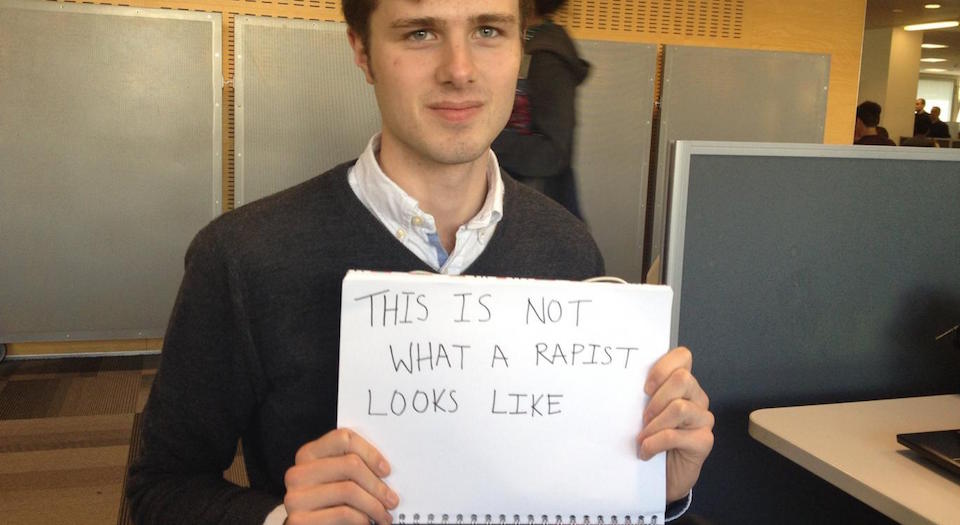
Sexual Consent Class - George Lawlor - This Is Not What A Rapist Looks Like

Student union-supported “Sexual Consent Classes” are pointless, infantilising, highly offensive to men and a distraction from the core purpose of academia and university life

When you reach the age of eighteen, you become an adult. You can drink, smoke, serve on a jury or fight for your country in the Armed Forces. You are no longer a child.

It should not be necessary to state something so mind-numbingly obvious in modern Britain, but that is exactly where we now find ourselves, somehow forgetting that at a certain point – the age of eighteen, in this case – it comes time for people to put away childish things and take their first solo steps in the world, unsupported by parents, schools or institutions.

This regression is not happening by chance. There are certain groups of people – student union activists and the virtue signalling Left in general – who are determined to roll back the whole idea of adulthood, to infantilise almost the entire population and create a nation of wobbly-lipped current or future victims who must be coddled and protected at all times by the self-appointed Defenders of the Vulnerable.

We see it with the increasing demands for professors to slap “Trigger Warnings” on texts that some may find offensive or distressing. We see it in the deadly serious attempts to ban clapping in favour of jazz hands at student meetings. And we see it with the insidious growth of so-called “safe spaces” or free speech black spots, spreading over campuses like a cancer. It is no longer a strange new phenomenon.

But one of the most troubling manifestations of this regression to childhood is the new fad for universities (in collaboration with – or at the gunpoint of – student unions) to run mandatory “sexual consent classes” for students, organised on the assumption that young men are wild and dangerous creatures who need to be tamed and taught how to behave properly in polite society before being unleashed on campuses.

Continue reading