Left Wing Hate Watch, RMT Edition

In Assistant General Secretary Steve Hedley, the RMT union have found a worthy successor to Bob Crow

With the entire country focus transfixed on Europe and David Cameron’s spectacularly poor negotiating skills, there has not been much emphasis on the Evil Tories in the media of late. Some nervous Tories, coming out of hiding for the first time since the Conservative Party Conference in Manchester, may have even considered themselves safe.

They were wrong. Steve Hedley of the RMT union is actively gunning for them using the most violent rhetoric imaginable, as he demonstrated in an interview on LBC today.

LBC reports:

RMT leader Steve Hedley has claimed the Tory government are “murdering” people, then called for them to be “taken out and shot” in an extraordinary LBC interview.

[..] “I think all the Tories are an absolute disgrace, they should be taken out and shot to be quite frank with you,” said Hedley, Assistant General Secretary of the RMT union.

“Oh Steve!” responded [presenter] Shelagh. “I’m not going to let you say that, so don’t repeat it…if your job is to represent your workers, and I was one of your workers, I would want you to represent me without resorting to things like that.”

Hedley then claimed that the government was “killing three disabled people a week by their cuts.”

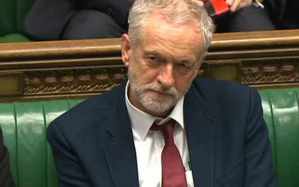
Everything changes, and everything stays the same. The Labour Party have a new leader, and Jeremy Corbyn’s admittedly haphazard opposition has thus far been mostly principled and courteous. Politically, Corbyn may be quite far from David Cameron (though not as far as he would be from a real conservative), but in his speeches he is more likely to forget that the Tories exist than indulge in an angry tirade against them. But same cannot be said for the people under him in the Labour Party and in the wider left-wing movement.

As we have repeatedly seen, many of these people are ready and willing to engage in the most overheated, provocative rhetoric against their political opponents on the right, continually implying that those who disagree with them are not just intellectually wrong but morally evil. And it is no longer just grassroots activists at fault – MPs and union leaders are increasingly getting involved too.

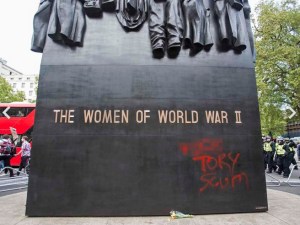
Whenever I write about the latest high-profile instance of left-wing anti-Tory bigotry and intolerance, I usually receive a number of comments chiding me for taking the intemperate war memorial-defacing actions of a few angry lunatics and claiming that they represent the Left as a whole.

That’s not what I am trying to do, though the way that some on the Left are so quick to take such criticisms personally suggests that in some cases, I may be striking a little too close to home. After all, since nobody suggested that all left-wingers are angry, screaming, spitting hate mobs, the fact that the likes of Owen Jones take the time to pen articles refuting this non-accusation can be taken as a sign that the criticism is hitting uncomfortably close to home, and that there may be a deep-seated, half-subconscious approval for these distasteful acts of protest.

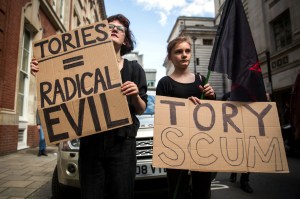
But the purpose is not to hold up instances where left-wing activists go too far just to act outraged. It is to point out (rather wearily at this point) that there is a poison within the Left which encourages adherents to believe themselves to be the sole possessors of compassion and virtue in a world where anybody different is immediately labelled “Tory Scum”. And until this poison can be sucked out of the Labour Party – or an adequate antidote found – the Left will continue losing elections by spending more time shouting angrily at the country for our supposed moral shortcomings than they spend presenting an attractive, cohesive alternate vision for government.

Steve Hedley is not your average left-wing grassroots activist, sharing Corbyn memes on Twitter and raging against the Tories on Facebook. He is the assistant General Secretary of the RMT, one of the most powerful (and high profile) trade unions in the country. He is the voice of organised Labour, which in turn increasingly claims to be the voice of the Labour Party. And when he angrily parrots the same drivel about the Evil Tories wanting to kill disabled people as the most zealous online activist, then it is no longer possible to say that this is an isolated problem of passionate ordinary folk getting a bit too carried away.

If the political Right has a problem in Britain (and it does; small-c conservatives are utterly underwhelmed and uninspired by the rootless premiership of David Cameron, no major conservative legislation has been enacted in the precious months following the 2015 general election victory, and the only motivated people online seem to be the ones churning out bigoted memes about migrants) then the Left should realise that they have a problem, too.

It may have started innocently enough, with Ed Miliband and his MPs turning a blind eye toward (and thus tacitly encouraging) overheated anti-Tory rhetoric as the coalition government found its feet back in 2010. And there may have been every good reason in the world to let demoralised Labour activists blow off steam by promoting the notion that this utterly unremarkable, centrist government is actually on an ideologically charged “more Thatcher than Thatcher” mission to roll back the state (if only it were true).

But the time has come to admit that the experiment has gotten out of control, and that the swivel-eyed anti-Tory hysteria has metastasised and started to re-infect the very left-wing political elites who first let it loose back in 2010. We see it in the ferocity with which some Jeremy Corbyn supporters attack their (far from blameless) centrist colleagues, calling them Red Tories. And now we see it in the shape and form of a senior trade union leader calling for Conservative supporters to be rounded up and shot.

I don’t spend much of my time worrying about what is best for the Labour Party or the British left-wing movement in general, but in this case I am writing out of genuine concern over what is happening to one side of the political debate in this country – the side which now finds itself represented by spokespeople like the RMT’s Steve Hedley.

Calling for all Tories to be “taken out and shot” is a juvenile piece of rhetoric from a half-baked political mind. It’s not a serious threat – let’s not go down the censorious road of calling the police on anybody who ever utters a mean word about us – but neither is it evidence of a person or political philosophy capable of showing respect, understanding nuance and thinking in colour, the kind of behaviour required of a movement which aspires to lead.

The closer Steve Hedley is to mainstream left-wing thought, the further the Left will be from tasting power again. Which is why any Labour politician with an ounce of sense must now furiously disassociate themselves from Hedley’s inflammatory remarks.
 

Tory Protests

Agree with this article? Violently disagree? Scroll down to leave a comment.

Follow Semi-Partisan Politics on TwitterFacebook and Medium.

Je Suis Tory Scum

Tory Scum - Left Wing Hatred

The hysterical left will always call conservatives “Tory scum” and hate us with a blind, unthinking rage. It’s time to stop cowering at their attacks and apologising for our values

As 2015 draws to an end, we still have four and a half more years of David Cameron’s wishy-washy, ideologically rootless, Conservative In Name Only government to look forward to, followed by a general election which will almost certainly deliver another five years of blandness.

For small government conservatives and libertarians, this continual betrayal of principle is bad enough. But as an added insult, it also means four more years of being spat on and called “Tory scum” by demented far-left types who view David Cameron and George Osborne’s half-hearted attempts to pare back the state as the modern-day equivalent of Nazi war crimes, and who have no reservations in publicly saying so. Not very appealing.

That’s why the time has come for conservatives of all stripes to finally seize back the word “Tory” from the haters and reclaim it with pride, rather than meekly and apologetically crawling around and apologising for our values – values which saved this country from decline and irrelevance three decades ago, and can do so again if only we fully unleash them.

In that spirit, Tony Parsons’ article from earlier this year in GQ magazine – in which he “came out” as a reluctant member of the Tory Scum collective – is a great opening salvo in the fight back against the hysterical Left.

In his article, entitled “Why I’ve Become Tory Scum”, Tony Parsons calls out the Labour Party and other forces on the Left for the sanctimonious nature of their campaigning during the general election, and their utter inability to empathise with their opponents – or even entertain the thought that those who oppose them might be doing so from a position of legitimate, morally valid disagreement.

Parsons points out:

The general election was decided not by shy Tories but by us reluctant Conservatives. The millions like me who saw nothing but catastrophe in Labour’s addiction to high taxes and big spending, their loathing of success, the way they could use a word like “mansion” with a straight face and, above all, that endless pious prattle about the NHS – as though the British have no other identity but as a sickly, enfeebled, diseased people in need of having our bottoms wiped by the state from dawn till dusk. 

Sadly, Parsons may be right about the British as an enfeebled and dependent people in thrall to the NHS, judging by the current exercise in mass virtue-signalling underway to make this awful song Christmas no. 1 in the charts.

But the truth is that David Cameron’s government is very much an unremarkable continuation of New Labour. Far from being a son of Thatcher, Cameron and his leadership team are very much the heirs to Blair, and would bear comparison with many centre-left governments around the world. The Conservative Party, even under Thatcher, has in many respects always been to the left of even the Democratic Party in the United States, and certainly is so now.

Of course, you would not think that the Conservatives were in any way moderate, judging by the hysteria among many vocal parts of the Left, who present David Cameron’s steady-as-she-goes paternalism and tentative deficit reduction as some kind of outrageous economic shock treatment combined with “human rights” abuses worthy of the Nazis.

Tony Parsons ponders why this is so:

Why are those of us who believe in a different economic model – one where aspiration is encouraged, where the state gets out of your way and doesn’t spend money it doesn’t have – morally reprehensible? Exactly why are we scum? History suggests that, when presented with the chance to vote for socialism the British people always run as fast as we can in the opposite direction. It doesn’t make us bad people. But the left have lost the argument and are reduced to shrieking abuse.

But then the hysterical far left have always talked about conservatives thus, and they always will. Parsons recognises this as he writes:

The loud left are as pertinent to modern Britain as blacksmiths. No wonder their protests are increasingly ugly. They react with furious disbelief at the result of a democratic election. They rave about balancing the nation’s books as if it was like drowning kittens in a sack. They scream in our faces about their own compassion while bandying around epithets like “scum” and “filth” with the vicious abandon of Nazis talking about Jews.

Since the abuse will never end, clearly there is nothing to be gained from running from it any longer. Nor is there anything to be gained by continually apologising for core conservative principles – free individuals and strong families, fiscal conservatism and a prohibitive national defence – as the current Conservative leadership sadly continues to do.

What British conservatism and libertarianism really need is their own version of Jeremy Corbyn – someone who unapologetically sticks to their principles, refusing to water them down for political expediency, and who seeks to lead and persuade rather than conform to the results of the latest opinion poll or focus group.

Or to use a West Wing analogy, British conservatism needs a Matthew Santos-like figure, someone willing to proudly wear the “Tory” label just like Santos refused to apologise for being a liberal in the famous presidential debate episode:


Speaking up for American liberalism in a way that one can only wish David Cameron or George Osborne would do for small government conservatism, Santos says to his Republican opponent:

What did liberals do that was so offensive to the liberal party? I’ll tell you what they did. Liberals got women the right to vote. Liberals got African-Americans the right to vote. Liberals created social security and lifted millions of elderly people out of poverty. Liberals ended segregation. Liberals passed the Civil Rights Act, Voting Rights Act. Liberals created Medicare. Liberals passed the Clean Air Act, Clean Water Act. What did conservatives do? They opposed every single one of those things. Every one.

So when you try to hurl that label at my feet – liberal – as if it were something to be ashamed of, something dirty, something to run away from, it won’t work, Senator. Because I will pick up that label and I will wear it as a badge of honour.

Of course it is almost unimaginable for a conservative to ever talk this way, with such passion, partly because we tend not to make such grand claims for ourselves in reshaping the world or forcibly changing human nature in pursuance of our goals. It is not in our nature to brag about our accomplishments, because the biggest accomplishment a conservative can aim for in government is to get out of the way and help remove obstacles from others so that they might reach their full potential.

But more than this, British conservatives since Margaret Thatcher have had precious little to brag about. Locked out of office under thirteen years of New Labour, the Conservative Party which emerged under David Cameron has made so many compromises with triangulating, Blairite centrism that there are almost no genuinely conservative policy victories or changes in the country which we can claim.

What are we supposed to brag about? Remember when the Tories stood up to the growing climate of intolerance toward freedom of expression, and formally codified a British citizen’s right to free speech? We can’t say that because it didn’t happen. Indeed, under Theresa May Britain is becoming an even more authoritarian police state than it was before, with human beings languishing in our prisons simply for saying, singing, or tweeting the “wrong” thing.

Remember when George Osborne struck a blow for fiscal conservatism, rallied the country with his argument that it was morally obscene for government to spend more on debt repayments than education or the military, and achieved a real budget surplus in order to finally begin paying down the national debt? We can’t say that either, because although Osborne is happy for the public and lazy journalists to believe that the Tories are “paying down Britain’s debts”, in reality the government is doing no such thing.

Conservative supporters truly have the worst of both worlds at present. We are attacked by the furious Left for an ideologically-motivated attack on the state and its poorest dependants, while in reality almost zero real conservative reform is being enacted. We are stuck with the leftist abuse, but have absolutely nothing positive to show for it.

As this blog asked when Jeremy Corbyn was on the cusp of winning the Labour leadership contest, finally giving one of Britain’s two main parties a leader who demonstrably believed in something more than the acquisition and keeping of power:

If David Cameron’s Conservative Party was voted out of office today, what will future historians and political commentators say about this government fifty years from now? What will be the Cameron / Osborne legacy? What edifices of stone, statute and policy will remain standing as testament to their time in office? Try to picture it clearly.

Are you happy with what you see?

No real conservative should be happy with what they see right now. Assuming that the political pendulum will at some point swing back in favour of the Labour Party, we conservatives have almost nothing to show after five years of David Cameron other than a half-finished job clearing the budget deficit. We have a reanimated Ted Heath sitting in Downing Street, not a worthy heir to Margaret Thatcher.

But just as the American Tea Party lay conspicuously dormant for the many years of fiscal profligacy and budget-busting spending under the George W. Bush administration only to miraculously awaken when a man named Barack Hussein Obama won the presidency, so the hysterical British Left are now shrieking bloody murder over a set of very pedestrian, middle-of-the-road centrist policies being enacted by the Conservative Party after having airily ignored the very same governing philosophy when the now-hated Blairites were in charge.

As conservatives, we realise there is no point in launching a futile battle against human nature or the instinct of many on the Left to demonise that which they do not or cannot understand. They will continue to call us “Tory Scum” and we have no control over that.

But we do have the power to take back ownership of the label “Tory” and refuse to see it as an insult.

We do have the power to point out that there is nothing virtuous or compassionate about throwing more money at unreformed healthcare and welfare systems, or spreading the wealth around so much that wealth creation is destroyed or driven overseas.

We do have the power to proclaim the importance of fiscal conservatism, not out of some wonkish obsession with balancing the books but because running up further government debt today is a blatant act of intergenerational theft, living at the expense of our children and grandchildren. And because as we have seen with other countries, excessive national debt can become a foreign policy and national security issue too.

We do have the power to point out to anyone who will listen that the modern Left love to parade their virtue and ideological purity but have apparently given up on coming up with alternative policies of their own, and to demand that Labour produce some costed tax and spending plans rather than simply railing against the inhumanity of the Evil Tories.

We do have the power to point out the many ways in which David Cameron’s pitiful excuse for a Conservative government ignores or betrays real conservative values, and to declare “not in my name”.

We do have the power to say “Oui, Je Suis Tory Scum – and I wish that our prime minister was a real conservative too, rather than a reheated Blairite with an ominous, socialist plan for every stage of our lives“.

The Left are not going to change, so we had better get used to the spitting, the vandalism, and the overwrought, emotional and short-termist way in which they discuss public policy.

But we can change. We can stop lying down and taking it every time a virtue-signalling lefty pontificates on welfare without offering a plan of their own, or seeks to win an argument on healthcare by stoking the public’s idolatry of the NHS.

We can stop fighting on the Left’s terms.

And who knows, if small government conservatives and libertarians actually succeed in getting off the back foot for the first time since Margaret Thatcher left 10 Downing Street, we might even manage to salvage something from David Cameron’s woeful premiership.

Bankers Toffs And Tory Scum - General Election 2015 - London Protests - Downing Street

Agree with this article? Violently disagree? Scroll down to leave a comment.

Follow Semi-Partisan Politics on TwitterFacebook and Medium.

Jeremy Corbyn, Owen Jones And The Thin-Skinned Labour Commentariat

Dan Hodges - Owen Jones - Labour Party

A campaigning journalist or opinion writer must write according to their conscience, without a second thought for whether it helps or hurts their own party in the short term

Owen Jones is angry that his attempts to make sympathetic, reasoned critiques of Jeremy Corbyn’s Labour Party are attracting the same levels of vitriol and hatred that those of us on the Right experience every day.

In his Guardian column yesterday, Jones complains:

I have several criticisms of the Labour leadership, held in good faith and constructive in approach. Because I want the left to succeed – otherwise, what’s the point? The need to build coalitions of middle- and low-income people; to reach out beyond the converted; to have a credible, coherent economic alternative; to rebut smears of being hostile to the country; and so on.

But when voiced, the right will use these as evidence that “even the left is losing faith”. Some on the left will see such suggestions and criticisms as playing into the hands of an aggressive media campaign regarding anything but blind loyalty as treachery. The isolated sympathetic commentators end up almost duty-bound to stay in line.

Such is the unrelenting nature of the media attack, any balanced discussion of the Corbyn leadership risks being shut down. That the media can be so dominated by one opinion – and so aggressive about it – is a damning indictment of the so-called free press. I’m an opinion writer: my opinions appear in the opinion section. But the media is swollen with opinion writers, and in too many cases their work ends up in the news section. A constructive critique of the Labour leadership is still needed for its own sake if nothing else. It is, however, an almost impossible task.

Meanwhile, Dan Hodges – a commentator with absolutely no concern about the potential impact of his words on the short term prospects of the Labour Party – has cancelled his direct debit and cut up his membership card (again) in no small part because of the vicious response to his opinions from the Corbynite Left.

In announcing his decision to quit Labour again, Hodges writes:

I’m done. Yesterday I cancelled my direct debit to the Labour Party. “Why don’t you just sod off and join the Tories”, Jeremy Corbyn’s supporters regularly ask anyone who dares to challenge their rancid world view.

I won’t be joining the Tories. But I am sodding off.

What’s a left wing polemicist to do if they find themselves disagreeing with the direction of the Labour Party in the Age of Corbyn?

It’s funny. Many of us on the right are well used to being called Evil Tories or labelled as heartless, uncaring monsters utterly lacking in all compassion – not because we don’t want to help the poor and disadvantaged, but simply because we don’t believe that endless, uncapped government spending is the best solution.

We are used to mainstream media outlets – heck, even the current Chancellor of the Exchequer himself – unquestioningly accepting and repeating the notion that conservatism is only about helping the wealthy, rather than the many. And when we are not being actively spat on or jostled in the street because of our political opinions, we are still used to being reviled, and our ideas not given a fair shake. And as a result, we have developed superior reasoning abilities, reserves of fortitude and patience, and very thick skins.

The left-wing commentariat utterly lack these qualities. For years they have marinated in the sanctimonious belief that their side has a monopoly on truth, compassion and decency. And since Labour lost power in 2010, it has been the easiest job in the world for them to sit on the sidelines throwing stones at the Conservative government.

(I’ll make an exception here for Dan Hodges, who correctly called Ed Miliband’s vacillating uselessness from the very beginning, and correctly predicted that he would lead the party to electoral ruin. And for his Cassandra-like efforts, he is now a pariah figure in the party he loves, with the small consolation of being David Cameron’s favourite columnist).

But to say that the left wing commentariat have had trouble adapting to the new reality under the leadership of Jeremy Corbyn is a huge understatement. Because now, more than ever, the Labour Party has devolved into warring factions and bitter rivalries. And all of them – MPs, writers and activists alike – are now treating each other with the same contempt and raw hatred that they previously reserved for “Tory Scum” like me.

And it turns out that the Left can dish it out, but can’t take it.

Owen Jones in particular seems to be struggling with the fact that writing critically about tactical errors by the Corbyn leadership is not generating a warmer and more receptive response:

I have several criticisms of the Labour leadership, held in good faith and constructive in approach. Because I want the left to succeed – otherwise, what’s the point? The need to build coalitions of middle- and low-income people; to reach out beyond the converted; to have a credible, coherent economic alternative; to rebut smears of being hostile to the country; and so on.

But when voiced, the right will use these as evidence that “even the left is losing faith”. Some on the left will see such suggestions and criticisms as playing into the hands of an aggressive media campaign regarding anything but blind loyalty as treachery. The isolated sympathetic commentators end up almost duty-bound to stay in line.

And when Dan Hodges found himself implacably opposed to the current direction of his party – with his anti-Corbyn positions being received even more coolly than his tirades against Ed Miliband – he simply upped and left.

One might suggest that Owen Jones & company could learn a thing or two from this site. I’m a natural conservative supporter, though I reluctantly voted UKIP in 2015 out of frustration with the pro-EU consensus, in solidarity with good people like Douglas Carswell who went out on a limb in pursuance of their ideals, and because my local constituency fielded a dithering left-wing Wet Tory candidate. And I made clear that the Conservative Party did not deserve my vote because in every important area – national sovereignty, rolling back the state, fiscal policy, civil liberties and more – they were quite simply not behaving like a conservative party.

This blog is the exact right-wing mirror image of left-wing commentators like Dan Hodges: a natural supporter of my party, but with complete contempt for the current leadership (Cameron and Osborne) and a strong desire to see the Tories move in a more conservatarian direction. Dan Hodges can’t bring himself to remain within the Labour Party while its leadership refuses to countenance military action against the middle age barbarians of ISIS. I can’t bring myself to give money to the Tories so long as their leadership remains slavishly pro-EU and believes that the British people can be distracted from the gradual loss of their sovereignty and democracy by manufactured “table-thumping rows” and a sham renegotiation with Brussels. Or when they field a Conservative In Name Only parliamentary candidate who rails against the “bedroom tax” and thinks that we should do away with our independent nuclear deterrent.

I get a lot of stick for my views. I’m universally hated by the Left (and recently discovered a Tumblr page full of foul-mouthed invective about yours truly), and can hardly get deeply involved in Conservative politics when I disagree so fundamentally and vehemently with the centrist wet rag of a leader who just delivered a resounding general election victory only in the total absence of a viable Labour prime minister in waiting.

But that’s my lot in life, and I accept it. I’ve been called every name under the sun on Facebook and Twitter, earned the opprobrium of friends and acquaintances, and written lots of mean things about my own party, taking them to task for their failure to advance conservative policies while in power. But the one thing I have never done is pull a punch or moderate a sincerely held opinion because of the friends I might lose or the immediate electoral damage I might do to the political party I used to call home.

Love him or hate him, Jeremy Corbyn remained a Labour Party member through all of the long wilderness years of Blairism, years which must have seemed to Corbyn like an unbearable compromise with flawed Tory-lite policies. Ridicule and obscurity were his crosses to bear, and he bore them patiently until quite unexpectedly his fortunes changed.

For many of the left-wing commentariat, however, just a few short months out of power and favour within the Labour movement is apparently already taking a psychological toll on people more used to calling the Tories “evil” and sitting back to soak up the lazy applause than being tarred with the same brush and called Red Tories themselves.

I have no sympathy for any of them. Jeremy Corbyn sits atop the Labour Party because of the wretched job that the centrists and their establishment buddies did in making a convincing public case for moderate Labour. And on the flip side, I accept my share of blame for the Conservative Party’s current directionless, centrist malaise – I should have done more and worked harder in my own small way to keep the party true to Thatcher’s legacy, and fought harder against the Cameron project. Sadly I only began writing in 2012, when it was far too late anyway.

But if nothing else, perhaps now that major and influential left-wing commentators like Owen Jones have been on the receiving end of the same kind of foaming-at-the-mouth left wing demagoguery that libertarians and conservatives receive every day, they will refrain from indulging in it themselves.

Of course, that would require that they stop feeling sorry for themselves long enough to recognise the pattern staring them in the face.

Jeremy Corbyn - Paris Attacks - Terrorism - Appeasement

Agree with this article? Violently disagree? Scroll down to leave a comment.

Follow Semi-Partisan Politics on TwitterFacebook and Medium.

The Daily Smackdown: Labour’s Pitch For Power Is A Child’s Temper Tantrum

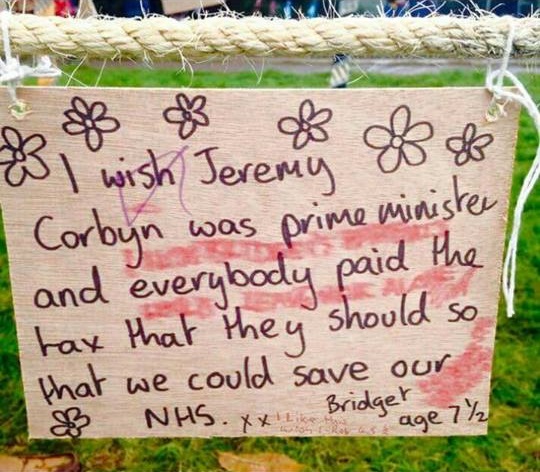
Labour - Save Our NHS

Thus far, Jeremy Corbyn’s elevator pitch for power would be more at home in the school playground than the adult political debate

When your core political argument and pitch to the electorate can be easily summed up in crayon by a seven year old girl, it’s time to develop a more robust vision for government.

A first good step for Labour to take would be to stop fomenting or tacitly condoning behaviours like these, from activists and supposed supporters:

Shouting “Tory Scum” at opponents

Vandalising war memorials

Shrieking about nonexistent human rights abuses

Physically threatening MPs

Being insufferable online

Pretending that there will be no offsetting behavioural consequences to dramatic tax hikes

Stubbornly believing in the magic money tree

I’ve written before about how, in their incoherent rage at the supposed transgressions of the Evil Tories, the Left are in great danger of becoming the British left wing equivalent of the American Tea Party – morally certain, impervious to facts, intolerant of the slightest internal dissent and quick to anger when contradicted by outsiders.

Where the Tea Party blindly venerate the US constitution (though they read it selectively, and from a highly originalist perspective) and would see the federal government shrunk back to its nineteenth century bare bones, the Corbynite Left venerate “our NHS” (genuflect) and the other monolithic edifices of the welfare state stemming from the socialist post-war consensus.

Neither seem very comfortable living in the present. And the worst excesses of both would be more at home stapled to the wall of a primary school classroom than reported and printed as serious ideas in the pages of a national newspaper.

Tory Protests

Agree with this article? Violently disagree? Scroll down to leave a comment.

Follow Semi-Partisan Politics on TwitterFacebook and Medium.

The Hysterical Left Don’t Know The Meaning Of Human Rights

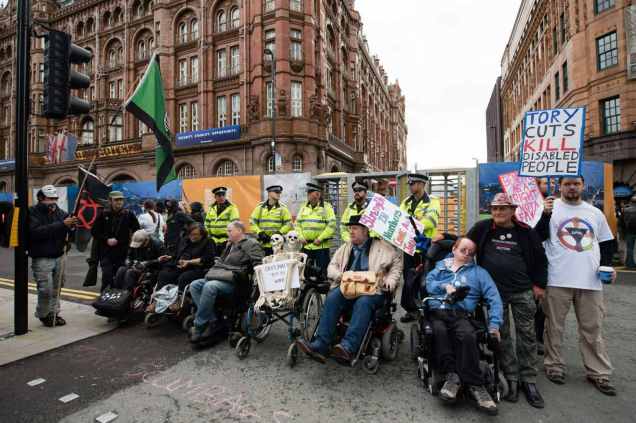
Human Rights - Disabled Protest 2

In their rage against the Evil Tories, activists are in danger of expanding the definition of “human rights” so far that the term loses all meaning

Last month, a ruling was handed down by a High Court judge. It barely received a ripple of attention in the media at the time, but it has potentially profound implications for our country and the ability of our elected governments to make policy.

In a stunning act of judicial activism masquerading as enlightened compassion, Justice Collins held that by implementing the welfare cap pledged in their manifesto, the Conservative government is actively discriminating against disabled people who might rely on the help of carers – other people – hit by the benefit cap.

The Guardian reports:

The welfare secretary, Iain Duncan Smith, unlawfully discriminated against disabled people by failing to exempt their carers from the benefit cap, a high court judge has ruled.

Mr Justice Collins said the government’s decision to apply the cap to full-time carers for adult relatives had created serious financial hardship for them, forced many to give up caring for loved ones, and loaded extra costs on to the NHS and care services.

The benefit cap, which limits working-age unemployed people to £500 a week in benefits, was introduced by the government on the basis that it sent a strong message to so-called workless families that they had to try harder to get a job.

The court ruled that the two carers who brought the case – and who were caring for upwards of 35 hours a week – were effectively in work even though they were in receipt of benefits, and therefore should be exempt from the cap.

Clearly the government should not have used the word “workless” and referred instead to “families without employment”. Of course caring for someone with illness or disability is work, though not employment. But a failure of semantics is hardly sufficient reason to overturn a flagship government policy, as Justice Collins seems to advocate:

Collins ruled that by applying the cap to unpaid family carers the secretary of state had unlawfully discriminated against seriously disabled people, because it meant they would no longer receive care from a trusted family member or relation.

He said: “For many it matters deeply that they are cared for by a family member. Thus there is adverse treatment since, although care can be provided by others, the loss of a trusted carer can be devastating”.

This ruling is but one small part of a wider programme of judicial activism which has seen the government found by our own Supreme Court to be in breach of international human rights obligations, has seen Britain investigated by the United Nations on the ludicrous suspicion of institutional domestic human rights abuses, and which establishes a truly terrible precedent in law. With this ruling, the government can theoretically be held liable for violating the human rights of Person A simply by enacting a policy that adversely impacts Person B.

Thus our so-called human rights now extend to the people around us, and a harm inflicted on any one of them is a harm inflicted on us. Not only is every citizen already surrounded by an ever-expanding protective bubble of their own “human rights” (including such imaginary leaps as the right of foreign criminals to a “family life” while serving a prison sentence), now that bubble theoretically extends to anybody associated with them in a caring capacity.

Let’s be clear – making somebody worse off financially is not a breach of their human rights, let alone the human rights of somebody else for whom they act as carer. It may be bad policy. It may be mean spirited. It may be short sighted or have any number of other flaws as a piece of social policy. But to call it a breach of a person’s human rights is an extraordinary over-stepping of the mark. Discrimination means treating somebody differently because of an inherent characteristic, but activists are now crying “discrimination!” when the government fails to treat people sufficiently differently.

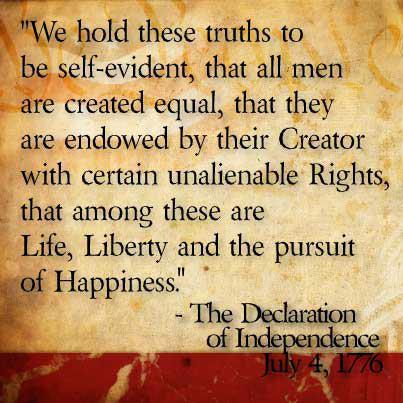
These attempts by the Left to weaponise the issue of human rights must be fiercely resisted. If human rights are to mean anything, they must be primal, sacrosanct and indivisible. It is hard to express those universal rights any better than the signatories of the US Declaration of Independence, who referred to “life, liberty and the pursuit of happiness”. Life and liberty in particular are crystal clear, and the state should have no power to infringe upon these rights except in the gravest of circumstances (usually as punishment after being found guilty of committing a crime).

Human Rights - Life Liberty Pursuit of Happiness - 2

But the American founding fathers were also quite clear that there is no human right to be happy, or to live a carefree, comfortable life. There is only the right to pursue happiness. This properly reflects the fact that one person’s idea of happiness may be quite different to another’s, and that proper government becomes impossible when the state is continually forced to adjudicate between competing claims of infringement on happiness.

Indeed, the difficulty comes when activists and pandering politicians try to drill down from these lofty principles in a control-freakish attempt to ensure equality of outcome for all. We are all different, and require different social and environmental factors in order to be happy and free.

For some people, their inability to express certain outdated or bigoted views for fear of police harassment or prosecution is a gross infringement on their liberty to hold and express personal thoughts and beliefs. But for other sensitive souls, the mere possibility that they might encounter such unpalatable opinions in the real world – and the belief that unpleasant words heard are somehow comparable to physical harm inflicted – infringes on their own happiness and liberty.

This puts the government in the impossible situation of having to pick winners. Does one person’s human right to live life offence-free trump another’s right to freely express their own thoughts? Does the right of some people to enjoy new public infrastructure trump another’s right to peaceably enjoy their own property without having it seized, built over or spoiled? Does the right of a foreign criminal to maintain links with their UK-based family trump society’s right to deport foreign nationals convicted of a crime on the grounds of cost and public safety?

We live in an imperfect world and so long as we maintain our current expansionist view of human rights, such tough calls will always exist, regardless of who holds power. The best that any government can do – to avoid becoming bogged down in endless competing claims for favouritism – is to remain as neutral as possible and stick to enforcing only the most core human rights.

And let us remember that it is quite possible to establish various additional rights and principles to protect the vulnerable – enshrined either in law or through codes of practice – without elevating every single claim to the level of an “human right”.

For example, as a society, we may well want to establish a duty on large businesses or government departments to spare no expense in accommodating the accessibility requirements of the severely disabled. But if an organisation happens to fall short of the required standards, is it really right that they are sued according to the same laws that govern torture, detention without charge or war crimes?

Consider the London Underground, the world’s oldest underground metro system. Because of its age, the vast majority of the Tube network does not conform to modern accessibility standards, and could not quickly be brought up to standard without exorbitant, prohibitive cost. Of course this is hugely unfair to those with mobility impairments, as they are unable to avail themselves of the full range of London transport options. But to call it an infringement of their human rights is wildly excessive, and something of an insult to the millions of people living in more benighted parts of the world whose fundamental rights to life, liberty and the pursuit of happiness are routinely trampled.

In the information age, and with the growth of social media, it is easier than ever to identify businesses, organisations and government agencies which fall short of their responsibility to provide accessible services for all, and to apply pressure on them to raise their performance. One trending Twitter hashtag, coined in outrage at the insensitivity of an organisation, now has the potential to achieve more far-reaching change than any judgement handed down in Strasbourg.

Human Rights - Disability 2

But we absolutely can not continue to abide the corrosive idea that government policies should be struck down if they impact differently on different citizens. Because nearly every government policy will, by definition, impact different groups in different ways.

Spending more money on roads penalises those who walk or use public transport. Spending more money on pensions penalises those people of working age who will inevitably receive a less generous settlement when they retire. Spending more money on education penalises those currently in retirement. Enacting tougher prison sentences for criminals penalises people from disadvantaged socioeconomic backgrounds who are more likely to end up in court. Government funding of research into cures for disease A penalises sufferers of disease B.

Where does it end? By clinging to the notion that individual government policies must never be disadvantageous to anybody, ever, we render ourselves ungovernable. We descend from being a cohesive society into a splintered and warring coalition of special interest groups, each jealously guarding their own perks and privileges at the expense of all others.

Government spending disproportionately benefits those who are not economically self sufficient. That much is obvious and unavoidable – rich people either do not or cannot claim the benefits on which poor people rely. And the fact that wealthier citizens support their less fortunate compatriots with their taxes is part of the social compact we make in order to maintain our inclusive society.

But to suggest that cutting government spending infringes on the “human rights” of the recipients is utterly abhorrent, even immoral, because it effectively enshrines a formal, limitless claim on the labour and earnings of the economically productive by the non-productive. It says that by refusing to fund government services with ever increasing taxes until the wishes of every welfare recipient are fully satisfied is to violate their human rights, to effectively inhabit the same low category as torturers and dictators.

Human Rights - North Korea - Kim Jong Un

It’s hard to know who comes out of this whole sorry affair looking worse – the disability rights activists, who have somehow managed to turn what should be a principled and laudable campaign into a grubby and petulant sulk, or the United Nations, which once again debases and undermines itself by treating the United Kingdom – of all countries – like some kind of rogue state.

It is perfectly possible to disagree with this Conservative government calmly and rationally. It is perfectly possible to advance the case that government spending restraint, the “bedroom tax” and welfare reforms are bad policy. But to claim that they infringe anyone’s human rights is a grotesque exaggeration that should be laughed out of town, not treated seriously and earnestly investigated by the UN.

Life, liberty and the pursuit of happiness: these inalienable, indivisible rights have served us well for centuries – and not only in the United States of America. Generations of campaigners before us were able to argue for (and win) the abolition of slavery, universal suffrage and civil rights protection with reference to these noble aims. And they would be appalled at the modern-day assertion that we should obsess over whether each and every government spending decision has been carefully calibrated to benefit us personally, rightly viewing this as a condescending attack on our liberty and autonomy as free citizens.

If human rights are to mean anything at all, we must stop trying to invoke them every time the government does something with which we disagree, or whenever we have a less than wholly successful interaction with a business or government agency. Human rights violations are real. Even today, while puffed up social justice warriors in the UK write furious screeds accusing Iain Duncan Smith of human rights abuses, people in other countries are being imprisoned, tortured, spied upon, maimed and executed. Babies with entirely survivable conditions and disabilities are being killed, or aborted before they are even born.

If we really cannot find a way to discuss the human consequences of shrinking the state without resorting to shrieking about supposed human rights abuses then truly, we are suffering from a grievous failure of empathy and imagination as a country.

And that’s the real crime.

UN Declaration of Human Rights - United Nations

Agree with this article? Violently disagree? Scroll down to leave a comment.

Follow Semi-Partisan Politics on TwitterFacebook and Medium.