Jeremy Corbyn’s Yellow Submarine Policy

Trident Nuclear Submarine - Faslane Naval Base

Jeremy Corbyn’s yellow submarine proposal is nothing but a white elephant, with all the cost and none of the benefits of nuclear deterrence

Spare a thought for those in peril on the Labour Party’s Trident renewal commission. As they seek to square their leader’s avowed nuclear disarmament stance with the parliamentary party’s broad support for Trident renewal, they are being forced to consider – and publicly discuss – ever more ridiculous potential compromises.

Jeremy Corbyn’s latest proposal is particularly bad, and would involve spending billions of pounds designing and building the next generation Trident submarines, but – crucially – not arming them with any new weapons.

The Guardian reports:

Jeremy Corbyn has suggested the UK could have Trident submarines without nuclear weapons, a move that would mean disarmament while protecting defence jobs in Scotland and Cumbria.

The Labour leader raised the idea on the BBC’s Andrew Marr Show as a possible compromise between his opposition to nuclear weapons and the position of the trade unions, which want to protect the jobs of workers who will build replacement Trident submarines.

In an interview over the weekend, the Labour leader argued it was not a binary decision on whether to replace Trident submarines, suggesting a possible compromise. Pressed on the Marr Show as to what this meant for Trident, Corbyn said: “They don’t have to have nuclear warheads on them.”

[..] Asked again whether he was suggesting that new submarines could be built to be used without nuclear warheads, Corbyn said: “There are options there. The paper that Emily Thornberry has put forward is very interesting and deserves study of it. I hope there will be a serious and mature response.” He also stressed that he would want to maintain employment for people in the defence industry, who would be involved in building Trident submarines, as a “first priority”.

Thornberry told the BBC’s Sunday Politics: “The way that it works is that the Japanese have got a capability to build a nuclear bomb…[but] you can then put them on to, or you can use them, in various delivery forms. So that’s a possibility, that is an option.” She said she would not speculate on what the review would recommend but she added that Corbyn “said there’s a number of options, and I said the Japanese already have this as the way that they use theirs”.

This is ludicrous.

Nuclear-powered submarines capable of carrying and launching Trident nuclear warheads are very expensive, as you would expect from high-tech stealth technology designed to last for a generation. Their only value is the fact that they provide a near-undetectable, continuous at-sea presence, so that any would-be aggressor knows that whatever attack they may launch at Britain, a retaliatory response always remains possible.

Investing in a new generation of nuclear submarines but failing to simultaneously build a new generation of missiles and warheads to deliver them would be like… well, it would be like commissioning two new aircraft carriers which will come into service without any aircraft capable of launching from them.

But at least this ludicrous defensive gap of the Conservative government’s making is only temporary. The aircraft to complement the Queen Elizabeth class carriers will follow the commissioning of the ships, albeit an embarrassing couple of years late.

Not so the Trident missiles to supply the next generation of submarines. Under Jeremy Corbyn’s proposal, Britain’s four (or three? Two?) new Vanguard replacement submarines will dart around under the ocean carrying no weapons and providing no deterrence of any kind. In fact, they may not launch at all, since Jeremy Corbyn probably sees little value in keeping a Navy. So in theory, Britain could end up spending over £20 billion designing and building four new ICBM-carrying submarines, only to sit back and watch them grow cobwebs in dry dock.

Jeremy Corbyn would counter – and indeed his ministerial colleague Emily Thornberry has already pointed out – that Britain would retain the ability to produce nuclear weapons under Labour’s latest plan. But this is extraordinarily misleading. By their nature, the kind of potential nuclear crises that Trident protects us from every day are impossible to anticipate and come about suddenly or with no warning. And in such cases, having the ability to one day rebuild a nuclear deterrent capability is very far indeed from having a system already live and operational.

In cases of nuclear blackmail or brinkmanship, it is not enough to say to our enemy “just you wait 12 months while we build our own nuclear weapon to destroy you, then you’ll be sorry!”. When you need the credible threat of nuclear weapons, you need it now, not after a lengthy lead time during which our design and construction facilities would be vulnerable to sabotage from within or attack from without. But this is precisely what Jeremy Corbyn proposes.

This is socialist pacifism at its most absurd. When people criticise Corbynite policies, their defenders retort that we misrepresent them by taking their publicly expressed ideas to illogical extremes. But in this case, Jeremy Corbyn himself has stated that the illogical extreme is his preferred option.

Jeremy Corbyn’s Britain would be a country which builds things not to use them or gain any utility from them at all (in this case the valuable insurance policy of nuclear deterrence), but rather just to give the people with a vested interest in their construction something to do. In this perverse worldview, keeping union chiefs happy and workers employed is a worthy national objective, but guaranteeing Britain’s national security and promoting our interests by ensuring that we are taken seriously as a military power is of no importance.

But never let it be said that the Corbynites don’t do compromise. Jeremy Corbyn may find the idea of nuclear weapons – or any military spending at all, really – to be morally repugnant and utterly indefensible, but because the trades union like the jobs which come from submarine construction and maintenance, he is willing to tolerate Britain’s continued construction of the things – just so long as we don’t ever use them.

What next? Why not have the armed forces spend all their time rolling massive boulders up hills in the Peak District, sending them tumbling down and pushing them back up again, in order to give the military something to do which doesn’t involve handling weapons? Why not extend the same principle to the British people at large, and pay everyone currently on JSA thirty grand a year to do the same?

A nation of people industriously labouring away to build complex, expensive machines whose purpose they fail to understand, and which they neither appreciate nor value. Just so that people have something to do besides watching Jeremy Kyle on daytime TV.

Welcome to Corbynland.

Unarmed Trident missile fired from HMS Vigilant

Agree with this article? Violently disagree? Scroll down to leave a comment.

Follow Semi-Partisan Politics on TwitterFacebook and Medium.

A Plan For Every Stage Of Your Life

David Cameron - Parenting Classes - Plan for every stage of your life - Coke Zero Conservatism

David Cameron’s rootless Conservative government is casting around, finding ever more ways to shoehorn the state into our lives

Buried in all the talk of Brexit and Bowie this week has been the Prime Minister’s announcement that he intends to force every British parent to take state-run classes in parenting – if not on pain of criminal penalty then at least at the sharp end of some pointed fiscal incentives.

The Telegraph reports:

All parents should enrol in state-backed parenting classes to learn how to raise their children properly, David Cameron will say as he announces a new plan to stop families breaking up.

[..] He will use a major speech on Monday to set out proposals for a new voucher system to incentivise parents to attend the classes in an attempt to make parenting advice socially “normal” and even “aspirational”.

The Prime Minister’s plan comes as he announces a £70 million investment in relationship counselling to prevent hundreds of thousands of families splitting up over the next five years.

Mr Cameron’s speech marks the latest step in delivering on the Conservatives’ key election promise to help families at every stage of life.

So here we are. The man who lets his daughter be carried around in a Waitrose bag in the Downing Street gardens – when he isn’t accidentally leaving her behind at the pub – thinks that the rest of the country make such bad parents that what they really need is a big, heaped spoonful of big government medicine to set them straight.

One does not have to deny that family breakdown and – how to put it – “unaspirational” parenting have real, negative consequences in our society to balk at the notion of government run classes enforcing the childrearing fads of the day on first time parents.

And Cameron is not even targeting potentially troubled familes – that would be far too judgemental. No, these classes will be “made available” to all, because children “don’t come with a manual” and apparently what has worked for parents for thousands of years is suddenly insufficient to the task of raising a child in twenty-first century Britain.

Dr. Ellie Lee retorts in Spiked magazine:

As parents well know, it is one thing to seek out genuine expertise and help when a child has specific problems (for example, parents of a sick or disabled child will do everything they can to get help from doctors and find all the advice possible to make their child’s life better). But it is quite another to imagine that parents want to be taught the supposedly general skill of parenting. Rather, being a parent means taking on the responsibility for trying, experimenting, failing and learning from experience over and over again. And parents find that the best people to support them in their childraising are those in their family and local community.

… [This] episode shows how a belief in parental determinism, justified through neuro-nonsense, generates a policy programme based on the idea that raising children is just too important and difficult to be left to mere parents, their families and their communities. Those who hold an a priori belief in the need for parenting education simply cannot accept that parents may neither need nor want expert advice. The only conclusion they draw is that more must be done to find ways to train parents, and to increase parents’ ‘demand’ for their own training. Furthermore, they openly support the idea that taking babies away from their mothers is a way to ‘alter destinies’ and ‘improve life chances’.

Policymakers and a parasitical layer of third-sector organisations, whose claim to expertise and professional status lies in knowing how to improve others’ ‘relationships’, are telling us nothing about parents and the family. And it’s not just parents who lose through the relentless politicisation of parenting, and, by association, the private sphere; it’s all of us.

How long, one wonders, until David Cameron seizes upon that totalitarian idea from north of the border, and seeks to introduce a Scottish-style Named Person scheme in England and Wales, whereby a specified adult named by the government is placed in a position of co-responsibility, together with the parents, for the welfare of every newborn child?

Don’t think he wouldn’t do it. If we have learned nothing else about David Cameron since he came to power in 2010, we know that there is no conservative, small government principle which he is not happy to cast into the woodchipper if it helps him to dominate the political centre ground and atone for the supposed reputational sins of Thatcherism.

Never mind that the Named Person scheme was cooked up by Nicola Sturgeon’s swivel-eyed SNP government in Scotland, and is the complete antithesis to how a restrained state should behave. That won’t stop David Cameron if he spies an opportunity to undermine the nationalists, steal a march on the Labour Party and gain short-term tactical political advantage.

But that doesn’t make it good policy, good politics or the right thing for any party calling itself “conservative” to be doing. Who within the Conservative Party – James Cleverley, Chris Philp, Lucy Allan, David Nuttall? – will stand against this creeping tide of paternalism, one which is otherwise likely to be implemented unopposed given that both sides of the warring Labour Party would probably also approve?

Mandatory parenting classes as part of your masterplan for every stage of our lives?

Dear God, man, stop talking. You sound more socialist than Jeremy Corbyn.

No to Named Person Scheme

Agree with this article? Violently disagree? Scroll down to leave a comment.

Follow Semi-Partisan Politics on TwitterFacebook and Medium.

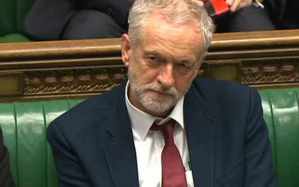
The Revenge Reshuffle: For Some Critics, Jeremy Corbyn Can Do No Right


There is no honour in the behaviour of Jeremy Corbyn’s shadow cabinet malcontents

Amid all the noise and self-important whining provoked by Jeremy Corbyn’s first shadow cabinet reshuffle, an important point is being rather overlooked – that as Labour leader, Corbyn is entitled to appoint or dismiss whoever he wants in order to build a cohesive and effective team. And the open defiance and public disagreement which continues to emanate from some restive shadow cabinet members would never have been tolerated under any other leader.

Maya Goodfellow writes in LabourList:

This is not, and was never going to be, a revenge reshuffle. It is not a contradiction of Jeremy Corbyn’s brand of honest, inclusive politics. By replacing shadow defence secretary Maria Eagle with Emily Thornberry, shadow EU Pat McFadden with Pat Glass and sacking Michael Dugher, Labour’s leader is doing his job – a position to which he was elected by 59.5% of the selectorate. On a landslide victory. He is well within his job description to make sure that his shadow cabinet is the most effective it can be. But you wouldn’t know that, listening to some Labour MPs, they’re clinging to the anti-Corbyn bandwagon – and they aren’t doing themselves or their party any favours.

For a small, vocal group of MPs Jeremy Corbyn can do no right. In fact, almost everything he does is wrong. These people are well within their right to point out areas of disagreement and argue their own point of view, but actively briefing against Corbyn, dismissing certain activists and shining a spotlight on discontent – instead of the Tories – is pernicious.

Goodfellow goes on to cite other famous historical reshuffles which – perhaps thanks to a stiffer upper lip and the lack of social media – did not lead to quite such an orgy of public posturing and self-aggrandisement, including those of Harold MacMillan and Margaret Thatcher.

Right now, it’s impossible to see how Labour’s restive moderates think that they are helping matters. They hate Corbyn and believe that he is leading Labour toward a third general election defeat, that much they have made abundantly clear. But do they seriously believe they are helping the situation with their incessant carping and tendency to run to the press with juicy anti-Corbyn quotes every time he does something they don’t like?

At some point, party unity – or at least trying to take seriously their responsibilities as the official opposition – should kick in, and encourage Labour MPs and politicos to stop targeting each other in order to focus on opposing the government. And yet we never seem to reach this promised land.

As Goodfellow observes:

The comments made by some MPs in recent months have been frustrating to witness. Change is difficult; negotiating with people you don’t agree with on certain issues is hard. Even when we try to take the personalities out of it, politics is so very personal.

But the way they’ve been acting is an insult to the overwhelming number of people who voted for Corbyn and a let down for all those people who desperately need a vocal, concise and coherent Labour opposition.

Is the sacking of the shadow culture secretary really something to go running to the press with angry quotes over, or taking to Twitter in high dudgeon about? Were any of Jeremy Corbyn’s unremarkable changes to his team truly so shocking that they merited a live TV resignation on the BBC?

Hardly. But the juvenile behaviour of Labour’s temporarily-out-of-power centrists is very revealing indeed. It speaks to their over-inflated egos and sense of self regard that they feel the need to publicly disassociate themselves from Jeremy Corbyn in the media rather than buckling down and helping him to oppose the government; that they are in many cases more concerned about how Corbyn’s leadership reflects on them and affects their future career prospects rather than how they can best serve the party and the country.

It would take a socialist miracle for Jeremy Corbyn to ever find himself in 10 Downing Street as prime minister, the odds (thankfully) are so small. But how Labour chooses to spend its wilderness years is important because it determines the type of party which will eventually emerge as a vote-winning force. Are they to stay deep within their comfort zone and become an angry party of protest, or will they oppose the government thoroughly by developing a credible alternative blueprint for government?

As Michael White notes in the Guardian, with reference to 1930s Labour leader George Lansbury:

Labour had been reduced to 52 seats in the general election of 1931, but Lansbury’s principled leadership cheered up the party activists and kept the show on the road. He’d never wanted to be leader (at 73 he was even older than Jeremy) and kept offering to resign. After hardheaded unions voted for a more robust stand against Hitler than Christian pacifism, he insisted on going.

But his legacy allowed Clem Attlee, the “interim” leader (1935-55) to triple the party’s MPs to 154 at the 1935 election. It survived to win the next election – the war delayed it until 1945 – decisively and do great things.

Like Lansbury, Corbyn’s principles and essential decency are obvious for all to see. He’s trying to make the best of a bad job when his party has just suffered a defeat arguably “worse for the Labour party than 1931”, chiefly because of the loss of Scotland to the SNP and at a time when many Labour supporters are, as in 1931, under the economic cosh.

It doesn’t sound like a recipe for success, does it? No, and I don’t think it’s meant to be.

Think of Jeremy Corbyn as the night watchman rather than the team captain, adjusting your expectations and success metrics accordingly, and moderate Labour’s hysterical overreaction to the “revenge reshuffle” begins to seem even more shrill and misplaced.

Jeremy Corbyn’s critics are measuring his performance and appeal with the wrong yardstick, in the belief that the 2020 general election is still winnable if only they can tame or replace their unexpected leader. Viewed this way, Labour centrists would do much better to quit the unconvincing “not in my name!” routine, get behind their leader when they can and maintain a signified silence when they can’t. And this should remain their strategy so long as they have a snowball’s chance in hell of retaking the leadership from Corbyn.

Labour MPs and shadow cabinet members currently revelling in the anarchy of being able to brief against their party leader to a salivating press corps with near total impunity should ask themselves what will undermining Corbyn from within actually accomplish when he won the leadership election by a landslide and retains significant support among the party base?

Seriously, what is their best case scenario?  All of this teenage sulking succeeds in destabilising Jeremy Corbyn and forcing a new leadership election, and then what? Labour’s army of activists forgive the parliamentary party for toppling their hero and willingly vote for Liz Kendall the second time around? The British public forget that Labour embraced Corbynmania in 2015 when they come to vote in 2020?

No. These temper tantrums against Corbyn from the centre-left serve one purpose, and one purpose alone. They act as a pressure release valve for the frustrations – and a balm to the bruised egos – of a group of forgettable, utterly unexceptional centrist politicians who so comprehensively failed to inspire excitement with their visions and policies that their mediocrity allowed Corbyn to win in the first place.

But these preening anti-Corbynites – who feign to be so much wiser and more pragmatic than we partisan hotheads on either side of the aisle – should consider the precedent for open dissent and disloyalty which they are now setting, as it will be very difficult to roll it back and expect the level of deference and respect accorded to say, Ed Miliband, when Jeremy Corbyn eventually leaves the stage and a new leader seeks to assert their authority. In fact, good luck to any party leader who has to endure the sheer volume of friendly fire taken every day by Corbyn.

Allister Heath, with uncharacteristic presumption about (and condescension toward) the working class, their likes and dislikes, writes in The Telegraph:

There is no going back from any of this. For the hard-left Labour activists who brought Corbyn to power, this is a belated Christmas present: their man is delivering on their terrifying agenda, and in turn they are helping to recruit a steady flow of new, radical and often London-based members. They want to turn Labour into a cross between a latter-day version of the Greater London Council, circa 1981, when Red Ken was in charge, and the current Green Party.

But for the rest of Labour, including most MPs, it’s a disaster. The traditional, patriotic working class, still a large chunk of the electorate, has even less time for the antics of the Stop the War Coalition and the Campaign for Nuclear Disarmament than other voters. They may be nervous about foreign adventures, but they loathe terrorists, love the Armed Forces and care deeply about national security. Labour needs both the “progressive” and the “working-class” elements of its coalition to come together if it is to win elections, but the careful balance found by Tony Blair is being deliberately jettisoned by the Corbynites.

Heath continues, in praise of those Labour MPs who either flounced out of Jeremy Corbyn’s shadow cabinet or were sacked in the reshuffle:

The truth is that it is no longer possible for any sensible Labour politician to serve in Corbyn’s shadow cabinet while retaining their self-respect. In time, Jonathan Reynolds, Stephen Doughty and Kevan Jones, the three shadow ministers who quit, will be seen as heroes: they put their principles first. They were braver that many members of the shadow cabinet.

[..] There are others in the same boat. Regardless of how they caveat their position, they are endorsing a leadership which has nothing but contempt for the values and aspirations of Middle England, and which believes in appeasing the extremists who seek to harm us. It is decision time for members of the shadow cabinet: they must quit, or be held responsible for the catastrophe about to engulf the Labour Party.

Set aside Allister Heath’s wildly misplaced hero-worship of utterly unremarkable politicians such as Jonathan Reynolds, Stephen Doughty and Kevan Jones. Many of Heath’s criticisms of Corbyn’s policies are correct, but he makes the classic mistake of assuming that the Labour Party should hold the same policies as the Conservative Party on a broad range of topics.

The drawback to having a broad, stultifying political consensus on everything from nuclear deterrence to the NHS is that when there is nothing left to debate, people lose interest in politics and stop taking part. Our current centrist malaise and the rise in voter apathy are not unrelated phenomena – when our political debate is reduced to arguing over who will better manage our public services, people understandably switch off. Jeremy Corbyn still offers the last, best opportunity to break this consensus and widen the Overton window in British politics, raising the possibility of a small state, free market revival – if we have the stomach to fight for it.

Heath of all people should appreciate this. Many of the small-government, conservative policies that he would no doubt like to see implemented are doomed never to see the light of day because of the political consensus typified by Blair, Brown, Miliband and Cameron. And there will never be space for more radical right wing ideas and policies so long as we become outraged when Jeremy Corbyn and his followers express their own, stridently left-wing ideas.

Thus even staunch conservatives have reason to support Jeremy Corbyn, and deplore those centrist malcontents within Labour who seek to topple him. Supporting Corbyn as a conservative does not mean endorsing his socialist policies – it means having the magnanimity and confidence in our own ideas to allow other, different arguments to be heard.

Jeremy Corbyn won the Labour leadership election by a landslide. That says an awful lot about the candidates who ran against him, the wing of the party from which they hailed, and our beleaguered, centrist politics in general.

But it is time for malcontents in the shadow cabinet and the media to get over it and learn to live in this new reality with a modicum of dignity.

Jeremy Corbyn - Cabinet reshuffle

Agree with this article? Violently disagree? Scroll down to leave a comment.

Follow Semi-Partisan Politics on TwitterFacebook and Medium.

Jeremy Corbyn, Owen Jones And The Thin-Skinned Labour Commentariat

Dan Hodges - Owen Jones - Labour Party

A campaigning journalist or opinion writer must write according to their conscience, without a second thought for whether it helps or hurts their own party in the short term

Owen Jones is angry that his attempts to make sympathetic, reasoned critiques of Jeremy Corbyn’s Labour Party are attracting the same levels of vitriol and hatred that those of us on the Right experience every day.

In his Guardian column yesterday, Jones complains:

I have several criticisms of the Labour leadership, held in good faith and constructive in approach. Because I want the left to succeed – otherwise, what’s the point? The need to build coalitions of middle- and low-income people; to reach out beyond the converted; to have a credible, coherent economic alternative; to rebut smears of being hostile to the country; and so on.

But when voiced, the right will use these as evidence that “even the left is losing faith”. Some on the left will see such suggestions and criticisms as playing into the hands of an aggressive media campaign regarding anything but blind loyalty as treachery. The isolated sympathetic commentators end up almost duty-bound to stay in line.

Such is the unrelenting nature of the media attack, any balanced discussion of the Corbyn leadership risks being shut down. That the media can be so dominated by one opinion – and so aggressive about it – is a damning indictment of the so-called free press. I’m an opinion writer: my opinions appear in the opinion section. But the media is swollen with opinion writers, and in too many cases their work ends up in the news section. A constructive critique of the Labour leadership is still needed for its own sake if nothing else. It is, however, an almost impossible task.

Meanwhile, Dan Hodges – a commentator with absolutely no concern about the potential impact of his words on the short term prospects of the Labour Party – has cancelled his direct debit and cut up his membership card (again) in no small part because of the vicious response to his opinions from the Corbynite Left.

In announcing his decision to quit Labour again, Hodges writes:

I’m done. Yesterday I cancelled my direct debit to the Labour Party. “Why don’t you just sod off and join the Tories”, Jeremy Corbyn’s supporters regularly ask anyone who dares to challenge their rancid world view.

I won’t be joining the Tories. But I am sodding off.

What’s a left wing polemicist to do if they find themselves disagreeing with the direction of the Labour Party in the Age of Corbyn?

It’s funny. Many of us on the right are well used to being called Evil Tories or labelled as heartless, uncaring monsters utterly lacking in all compassion – not because we don’t want to help the poor and disadvantaged, but simply because we don’t believe that endless, uncapped government spending is the best solution.

We are used to mainstream media outlets – heck, even the current Chancellor of the Exchequer himself – unquestioningly accepting and repeating the notion that conservatism is only about helping the wealthy, rather than the many. And when we are not being actively spat on or jostled in the street because of our political opinions, we are still used to being reviled, and our ideas not given a fair shake. And as a result, we have developed superior reasoning abilities, reserves of fortitude and patience, and very thick skins.

The left-wing commentariat utterly lack these qualities. For years they have marinated in the sanctimonious belief that their side has a monopoly on truth, compassion and decency. And since Labour lost power in 2010, it has been the easiest job in the world for them to sit on the sidelines throwing stones at the Conservative government.

(I’ll make an exception here for Dan Hodges, who correctly called Ed Miliband’s vacillating uselessness from the very beginning, and correctly predicted that he would lead the party to electoral ruin. And for his Cassandra-like efforts, he is now a pariah figure in the party he loves, with the small consolation of being David Cameron’s favourite columnist).

But to say that the left wing commentariat have had trouble adapting to the new reality under the leadership of Jeremy Corbyn is a huge understatement. Because now, more than ever, the Labour Party has devolved into warring factions and bitter rivalries. And all of them – MPs, writers and activists alike – are now treating each other with the same contempt and raw hatred that they previously reserved for “Tory Scum” like me.

And it turns out that the Left can dish it out, but can’t take it.

Owen Jones in particular seems to be struggling with the fact that writing critically about tactical errors by the Corbyn leadership is not generating a warmer and more receptive response:

I have several criticisms of the Labour leadership, held in good faith and constructive in approach. Because I want the left to succeed – otherwise, what’s the point? The need to build coalitions of middle- and low-income people; to reach out beyond the converted; to have a credible, coherent economic alternative; to rebut smears of being hostile to the country; and so on.

But when voiced, the right will use these as evidence that “even the left is losing faith”. Some on the left will see such suggestions and criticisms as playing into the hands of an aggressive media campaign regarding anything but blind loyalty as treachery. The isolated sympathetic commentators end up almost duty-bound to stay in line.

And when Dan Hodges found himself implacably opposed to the current direction of his party – with his anti-Corbyn positions being received even more coolly than his tirades against Ed Miliband – he simply upped and left.

One might suggest that Owen Jones & company could learn a thing or two from this site. I’m a natural conservative supporter, though I reluctantly voted UKIP in 2015 out of frustration with the pro-EU consensus, in solidarity with good people like Douglas Carswell who went out on a limb in pursuance of their ideals, and because my local constituency fielded a dithering left-wing Wet Tory candidate. And I made clear that the Conservative Party did not deserve my vote because in every important area – national sovereignty, rolling back the state, fiscal policy, civil liberties and more – they were quite simply not behaving like a conservative party.

This blog is the exact right-wing mirror image of left-wing commentators like Dan Hodges: a natural supporter of my party, but with complete contempt for the current leadership (Cameron and Osborne) and a strong desire to see the Tories move in a more conservatarian direction. Dan Hodges can’t bring himself to remain within the Labour Party while its leadership refuses to countenance military action against the middle age barbarians of ISIS. I can’t bring myself to give money to the Tories so long as their leadership remains slavishly pro-EU and believes that the British people can be distracted from the gradual loss of their sovereignty and democracy by manufactured “table-thumping rows” and a sham renegotiation with Brussels. Or when they field a Conservative In Name Only parliamentary candidate who rails against the “bedroom tax” and thinks that we should do away with our independent nuclear deterrent.

I get a lot of stick for my views. I’m universally hated by the Left (and recently discovered a Tumblr page full of foul-mouthed invective about yours truly), and can hardly get deeply involved in Conservative politics when I disagree so fundamentally and vehemently with the centrist wet rag of a leader who just delivered a resounding general election victory only in the total absence of a viable Labour prime minister in waiting.

But that’s my lot in life, and I accept it. I’ve been called every name under the sun on Facebook and Twitter, earned the opprobrium of friends and acquaintances, and written lots of mean things about my own party, taking them to task for their failure to advance conservative policies while in power. But the one thing I have never done is pull a punch or moderate a sincerely held opinion because of the friends I might lose or the immediate electoral damage I might do to the political party I used to call home.

Love him or hate him, Jeremy Corbyn remained a Labour Party member through all of the long wilderness years of Blairism, years which must have seemed to Corbyn like an unbearable compromise with flawed Tory-lite policies. Ridicule and obscurity were his crosses to bear, and he bore them patiently until quite unexpectedly his fortunes changed.

For many of the left-wing commentariat, however, just a few short months out of power and favour within the Labour movement is apparently already taking a psychological toll on people more used to calling the Tories “evil” and sitting back to soak up the lazy applause than being tarred with the same brush and called Red Tories themselves.

I have no sympathy for any of them. Jeremy Corbyn sits atop the Labour Party because of the wretched job that the centrists and their establishment buddies did in making a convincing public case for moderate Labour. And on the flip side, I accept my share of blame for the Conservative Party’s current directionless, centrist malaise – I should have done more and worked harder in my own small way to keep the party true to Thatcher’s legacy, and fought harder against the Cameron project. Sadly I only began writing in 2012, when it was far too late anyway.

But if nothing else, perhaps now that major and influential left-wing commentators like Owen Jones have been on the receiving end of the same kind of foaming-at-the-mouth left wing demagoguery that libertarians and conservatives receive every day, they will refrain from indulging in it themselves.

Of course, that would require that they stop feeling sorry for themselves long enough to recognise the pattern staring them in the face.

Jeremy Corbyn - Paris Attacks - Terrorism - Appeasement

Agree with this article? Violently disagree? Scroll down to leave a comment.

Follow Semi-Partisan Politics on TwitterFacebook and Medium.

The Daily Smackdown: Labour’s Pitch For Power Is A Child’s Temper Tantrum

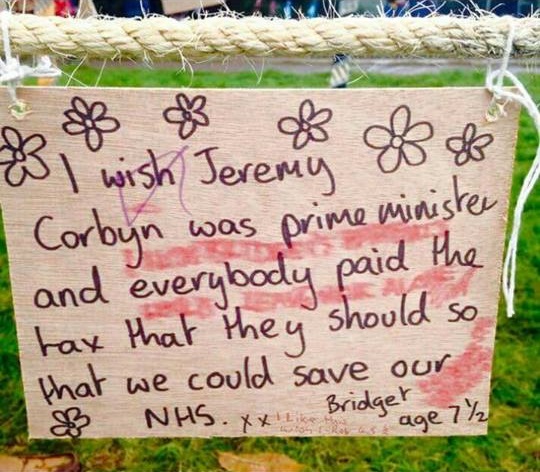
Labour - Save Our NHS

Thus far, Jeremy Corbyn’s elevator pitch for power would be more at home in the school playground than the adult political debate

When your core political argument and pitch to the electorate can be easily summed up in crayon by a seven year old girl, it’s time to develop a more robust vision for government.

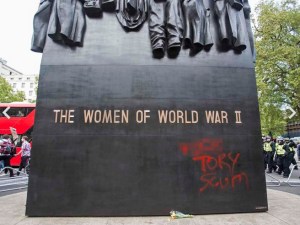
A first good step for Labour to take would be to stop fomenting or tacitly condoning behaviours like these, from activists and supposed supporters:

Shouting “Tory Scum” at opponents

Vandalising war memorials

Shrieking about nonexistent human rights abuses

Physically threatening MPs

Being insufferable online

Pretending that there will be no offsetting behavioural consequences to dramatic tax hikes

Stubbornly believing in the magic money tree

I’ve written before about how, in their incoherent rage at the supposed transgressions of the Evil Tories, the Left are in great danger of becoming the British left wing equivalent of the American Tea Party – morally certain, impervious to facts, intolerant of the slightest internal dissent and quick to anger when contradicted by outsiders.

Where the Tea Party blindly venerate the US constitution (though they read it selectively, and from a highly originalist perspective) and would see the federal government shrunk back to its nineteenth century bare bones, the Corbynite Left venerate “our NHS” (genuflect) and the other monolithic edifices of the welfare state stemming from the socialist post-war consensus.

Neither seem very comfortable living in the present. And the worst excesses of both would be more at home stapled to the wall of a primary school classroom than reported and printed as serious ideas in the pages of a national newspaper.

Tory Protests

Agree with this article? Violently disagree? Scroll down to leave a comment.

Follow Semi-Partisan Politics on TwitterFacebook and Medium.