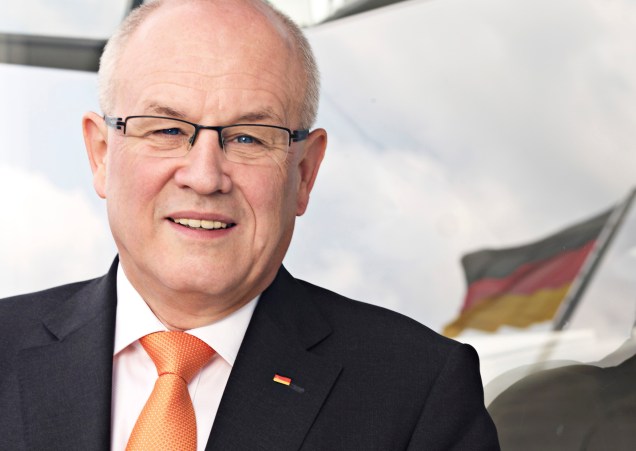
German Politicians, Drunk On Power, Prepare A Fresh Assault On Free Speech

volker-kauder-free-speech-social-media-censorship

German social media users test their leaders’ patience by exercising awkward, unruly free speech at their own peril

German politicians, ever anxious to squash strident criticism of their unilateral and, uh, somewhat controversial decision to expand the population by nearly a million migrants and refugees in the space of a year, are rounding on social media companies to strike another blow on already-constrained freedom of speech in Europe.

From Deutsche Welle:

Volker Kauder, a member of German Chancellor Merkel’s CDU, has said Facebook should pay for failing to remove online hate comments. There has been a surge in xenophobic posts as refugees have arrived over the last year.

Speaking to German magazine “Der Spiegel,” Kauder said: “The time for roundtables is over. I’ve run out of patience.” He said if companies like Facebook, Google and Twitter failed to remove offensive comments within a week of them being posted, they should be penalized with a 50,000 euro ($54,490) fine.

Social media websites needed to rethink their strategy, he said. “Otherwise, I have another suggestion. Cigarette packs always carry a warning that smoking can be dangerous. Why don’t we ask these [social network] providers to carry a warning on their websites, saying: ‘Anyone who communicates here must expect insulting remarks,'” Kauder said.

Kauder also insisted that the justice ministry should demand that the companies submit the IP addresses of people who posted hate messages on social networks.

Because heaven forfend that politicians should have to explain their decisions and win support for their actions (or better yet, follow the will of the people in the first place once in awhile). Far better to simply make it increasingly difficult for people to register their boisterous dissent.

Note the language. Kauder has “run out of patience”, suggesting that free speech in Germany is something granted to citizens at the sufferance of their thin-skinned leaders rather than an inalienable right. And of course that is exactly how it is in Germany, and most of Europe (including Britain). If some jumped-up politician decides that the civil discourse has become too un-civil – or, let’s be realistic too critical of them – then it is perfectly legitimate for them to turn the screws on private companies to shut it down.

Note too the ludicrous “public health” defence creeping into politicians’ language. One interpretation of Kauder’s threat to slap a mandatory trigger warning on the home pages of social networks is that he thinks so little of the German people’s intelligence that he genuinely believes they might currently be unaware that websites where political issues are discussed may contain opinions with which they disagree. That is one interpretation. But the other one (and the correct one in my view) is that it is simply a way of trying to hurt private enterprise for not bending the knee and doing government’s bidding.

Stephen Fuchs of the German-American culture blog German Pulse shares the same suspicions:

Do I think Germany is out of line to expect a level of cooperation to remove highly offensive posts once reported? No, not entirely. Where I begin to disagree though comes when any government starts policing excessively to the point where our outlets for expression become restricted by a set of rules that make any level of opinion a bannable offense.

How long until Germany pushes Facebook to delete any negative comments or opinions about a certain political party or candidate?

Negative remarks about refugees are deemed hate speech in Germany, but what about the negative remarks about Merkel’s refugee policies? Should we expect Facebook or Twitter to delete those immediately as well?

Maybe the government would be better off addressing the real issues that lead to the divisiveness, instead of playing the “you hurt my feelings” game online.

This is why free speech needs to be an absolute and indivisible right. It is a fragile freedom, with the slightest infringement causing a crack which easily grows and fractures our entire right to self expression. And while some (like Fuchs) may find it distasteful, the battle for freedom of speech must be fought at the unpalatable margins. Only by defending the rights of the racist to spew their bile about Syrian refugees can we be confident of preserving the upstanding citizen’s right to criticise German immigration policy without fear or expectation of censorship.

And as German Pulse rightly points out, no one step, no new draconian crackdown on freedom of expression is ever enough – just as one new health warning on cigarettes sugary food is never enough for the public health police. Individuals and companies cede more of their rights and autonomy, and it only ever emboldens the state to demand yet more.

Demanding that social media companies submit the IP addresses of users who post “hateful messages”to the justice ministry suggests that the German government (or at least significant factions within the ruling Christian Democratic Union) aims to become much more proactive in their persecution of thought and speechcrime. Why dream of building a massive database of social media users who type unacceptable keywords or are reported for causing “offence” by their thin-skinned peers unless you plan on unleashing some kind of retribution on them in response?

This is yet another dark day for free speech in Europe, but perhaps there is an upside – Theresa May will be able to find so much common cause with Angela Merkel over their mutual contempt for basic civil liberties that their shared authoritarianism could yet grease the wheels of the upcoming Brexit negotiations.

 

facebook-censorship-free-speech

Top Image: Wikimedia Commons

Support Semi-Partisan Politics with a one-time or recurring donation:

Agree with this article? Violently disagree? Scroll down to leave a comment.

Follow Semi-Partisan Politics on TwitterFacebook and Medium.

The Future Of This Blog: Readership Poll

Political Blogging 2

To infinity, and beyond…


UPDATE – 18 September: Many thanks to all those who have completed the surveys and taken the time to share comments or send me emails with your further thoughts as to the future of this blog – your input is very much appreciated, and the feedback I am getting is very useful. The polls will stay open for a further five days and then I will review the results in detail and blog my response and future plans. In the meantime, business as usual…


Driven primarily by the recent EU referendum, 2016 has already been by far the biggest year in the four-year history of Semi-Partisan Politics, with all daily, monthly and annual pageview records easily surpassed and many new readers arriving from around the world – not to mention a successful appearance on the BBC Daily Politics.

I want to thank all of you for your readership and support, and for making my angry and sometimes less-than-coherent rantings a part of your daily reading. To those who made generous financial contributions during the EU referendum campaign – a heartfelt thank you. I could not have sustained the pace of blogging and analysis over that hectic period without your help. And to those who have become regular commenters – you continue to teach me, challenge and stretch my thinking in new directions rather than simply reinforcing my existing prejudices. Your input has made me a more rounded thinker and (I hope) a better writer. Thank you.

But now we must look to the future…

Soon, both the EU referendum and the upcoming historic US presidential election will be receding dots in the rear-view mirror, and at this time of change I wanted to reach out to you, my loyal readers, to get a sense of how you would like to see this blog grow and develop over the next 12 months and beyond. I am particularly keen to know whether you think the current blog format (length and frequency of posts) is about right, or if you would like to see stylistic changes, as well as to get a sense of what you think I should be writing about in terms of issues.

I have my own thoughts on the matter, and may as well put my cards on the table. In order to increase readership (and hopefully engagement) further I am thinking of continuing the current schedule of 1-2 normal length commentaries per day, but to supplement this with an additional number (3-5) of short commentaries or reactions to different political developments or stories, as is common in most successful political blogs. These would just be a couple of paragraphs of commentary in reaction to a developing story or a noteworthy piece published elsewhere.

I am conscious that by only posting once or twice per day this blog fails to articulate a position on a lot of significant stories, and this is something I would like to change. And while I will never equal the prodigious output of my blogging hero, the great Andrew Sullivan, I have come to believe that more frequency and variety of posts will hopefully be of interest, encourage more debate and hopefully force me to grow as a political writer.

But all of that being said, I am open to persuasion. Therefore I would be very grateful if you could answer the three main poll questions shown below, to give me a better sense of what you enjoy at Semi-Partisan Politics and what you think can and should be changed.

The first question relates to the format of the blog, i.e. the length and frequency of posts. Please select your one preferred option here:


The second question relates to the topics covered at Semi-Partisan Politics, and whether you think that the site would benefit from a change or sharpening of focus. Here, you can select as many options and topics as you like:


While the third question looks at whether or not I should expand into other social media to reach a potentially much larger audience. Again, you can select as many options as you want in this case:


I would greatly appreciate your feedback on these key questions. Each mini-poll lets you add in your own answer if none of the pre-set responses accurately capture your preference. But if you have any longer or more general comments, please do use the Comments feature to let me know your more detailed thoughts.

Though this blog remains small and relatively unknown (or at least generally unacknowledged by the Westminster media – increasingly I see themes and analyses first expounded here cropping up some months later in more prestigious publications), I think that over the past year in particular something of a community has been forged here, one which I greatly value. I am eager for this growth to continue, and look forward to receiving your input as to how Semi-Partisan Politics should best adapt to face the future.

Thank you for your continued readership and support.


Political Blogging

Support Semi-Partisan Politics with a one-time or recurring donation:

Follow Semi-Partisan Politics on TwitterFacebook and Medium.

Police Should Spend Less Time Persecuting Citizens For Free Speech Offences And More Time Serving Communities

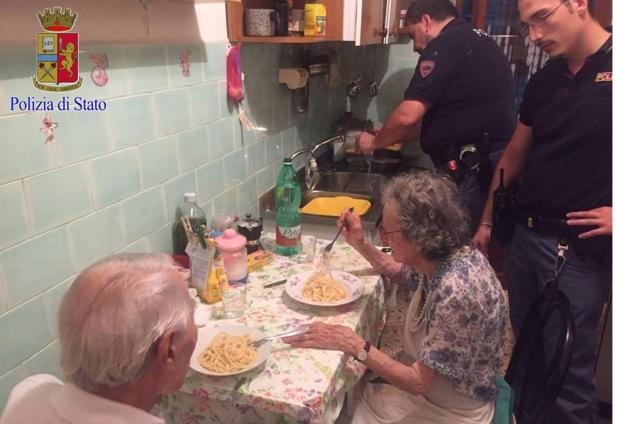
Rome Police - Old Age Loneliness - Questura di Roma

Our police forces should be knitting communities together and keeping them safe, not prancing around in military gear and threatening citizens who dare to express themselves on social media

A heartbreaking (or heartwarming, depending on your perspective) story from Rome forces us to ask stark questions of our own society, the way we treat our elderly compatriots and the proper community role of the police.

From the Evening Standard:

Kindly police officers came to the aid of an elderly Italian couple after neighbours called emergency services when they were heard crying in their apartment – because they were so lonely.

Officers rushed to the flat in the Appio area of Rome after nearby residents heard shouting and crying coming from inside, and found and 84-year-old Jole, and her 94-year-old husband Michele.

The couple said they had not been victims of crime, but were overcome by emotion after watching sad stories on the news.

The pair, who have been married for 70 years, said they had not had visitors for a long time and were very lonely.

While they waiting for an ambulance to arrive to check the couple over, the officers prepared a hot meal.

They then sat down to have a chat while the elderly couple ate the spaghetti with butter and parmesan they had prepared.

More:

The police force said on its Facebook page: “Especially when the city empties and the neighbors are away on holiday, sometimes loneliness dissolves into tears.

“It can happen, as this time, that someone screams so loud from despair that eventually, someone calls the State Police.

“There is not a crime. Jole and Michele are not victims of scams and no thief entered the house – there is no one to save.

“This time, for the boys, there is a more daunting task – two lonely souls who need reassuring.”

Meanwhile, what do our police spend their time doing?

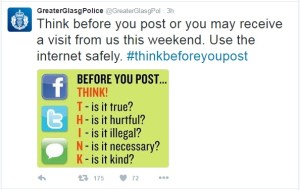
Well, no day is complete without threatening members of the public. Greater Glasgow Police in particular love to ostentatiously warn people that they are lurking on Twitter and Facebook 24/7, ready to pounce the moment anybody posts something deemed the least bit capable of causing offence.

And London’s own wonderful Metropolitan Police also love nothing more than turning up on the doorstep of people who dare to tweet the “wrong” opinions and sentiments, hauling them away to the police station and delivering them to the hands of the criminal justice system.

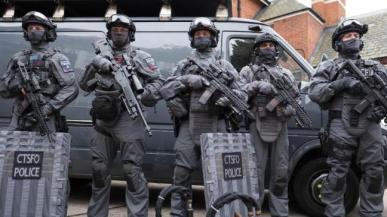
But never let it be said that the Met Police never leave their comfortable office desks. A new batch of them have recently acquired dystopian-looking, military grade combat uniforms and strutted their stuff before Britain’s news cameras in some kind of perverse authoritarian fashion parade. Ostensibly this new armed response unit is intended to keep us safer from Islamist terror attacks mentally ill people, though doubtless we will soon see the same militarised response to other, less violent incidents too. As is so often when it comes to the militarisation of the police, where America leads, Britain duly follows.

Counter Terrorist Armed Police - London

Meanwhile, communities go unpatrolled and some become no-go areas. Local police, either swamped with paperwork or too busy hounding innocent citizens for daring to exercise their right to free speech online, refuse to show up to cases of reported vandalism or burglary (though they mysteriously appear within minutes if a speech or thoughtcrime is reported by some beady-eyed public collaborator).

And to add insult to injury, we now live in a country where the idea of the police carting you away for something you write on Facebook seems perfectly normal, while the idea of the police coming to cook a meal for a lonely elderly couple is so rare that it makes the news headlines when it happens in another country.

Local Police and Crime Commissioners do not seem to have had much of an effect, though at this early stage it is difficult to be sure whether this is due to a lack of powers, regulatory capture by the police forces they are supposed to control or garden variety incompetence. And so here we are.

Is this the police force that we really want?

Is this the policing strategy that actually knits communities together, making them happier and safer?

Absolutely not. It would be very interesting to see a force-by-force breakdown of the number of police officers, civilian staff and other resources devoted to monitoring and curtailing the free speech rights and other civil liberties of Britons. And then immediately shutting down those statist, authoritarian programmes and diverting all of the freed resources to more worthy causes, like helping to tackle old age loneliness.

We’re not talking about police officers cooking roast dinners instead of catching criminals, but surely it should not be beyond the wit of man for police to act as an intermediary, perhaps connecting isolated elderly couples they come across in their work to suitable neighbours who could check in with them once in a while, or provide much needed regular social visits. The police already work with AgeUK to tackle scam criminals and improve home security. There is no reason why this collaboration could not be greatly extended.

At present, we have a police force of two extremes – small numbers of highly militarised officers, armed to the teeth with every counter-assault weapon one can possibly imagine, and a much larger force who seem unable to respond to garden variety crime in an acceptable way, and who are all too rarely visible on the streets.

If local, county and national government is serious about improving police-community relations, they could do far worse than by immediately ordering a halt to the nasty, frivolous and often arbitrary persecution of individuals on free speech and “hate crime” grounds and diverting those funds and resources to a much more worthy cause – helping to tackle the growing problem of old age loneliness in our society.


Postscript: You can donate to Age UK here.


Greater Glasgow Police - THINK - Social Media - Police State - Free Speech

Middle Image: BT

Support Semi-Partisan Politics with a one-time or recurring donation:

Agree with this article? Violently disagree? Scroll down to leave a comment.

Follow Semi-Partisan Politics on TwitterFacebook and Medium.

Brexit Will Not Cure The Cancer Of Authoritarianism In Our Society

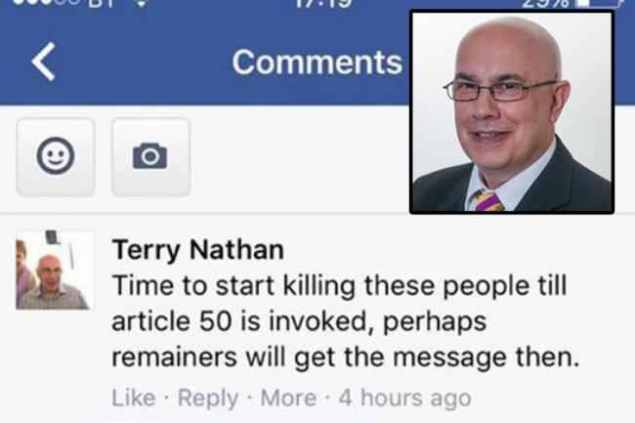
Terence Nathan - UKIP - Facebook

Death to Remainers!

Imagine for a second just how much safer our communities might be if local police forces spent half as much time patrolling the streets and engaged in community outreach as they do scouring Twitter for “offensive” speech.

Imagine just how much more responsive and well resourced our public services might be if local councils took complaints about potholes and vandalism nearly as seriously as they seek to persecute idiots for airing their half-baked opinions online.

Well, you can snap out of that reverie:

An investigation has been launched after a Ukip councillor made comments on Facebook suggesting those who voted Remain in the EU referendum should be killed.

The comments appeared on Terence Nathan’s Facebook page, councillor for Cray Valley West in Bromley, on Tuesday night.

The post, written in response to a news article referring to legal efforts against the Brexit vote, mentions Article 50 of the Lisbon Treaty, which when triggered would initiate the UK’s departure from the EU.

Mr Nathan wrote: “Time to start killing these people till article 50 is invoked”, adding “perhaps remainers will get the message then.”

After another Facebook user raised concern over Mr Nathan’s rhetoric, he replied in a second comment: “Not threatening anyone, no need for threats just a bullet.”

Mr Nathan has since apologised for the comments saying: “My comments were only intended to be taken with a pinch of salt.”

The Independent article concludes ominously:

Police and council officials have said they are looking into the remarks.

A Bromley Council spokesman said: “The Council has launched an investigation into the alleged comments made but it would not be appropriate to comment further at this stage.”

Bromley Metropolitan Police Service said: “Police in Bromley are aware of comments apparently posted online by a Bromley Councillor. Enquiries into this matter are ongoing.”

Is it not enough for Mr. Nathan to have made a complete fool of himself for all the world to see, and torpedoed whatever hopes he may have entertained promotion within UKIP or higher political office? Is it not enough that society’s natural self-righting mechanisms saw the man challenged and upbraided by other people exercising their own free speech to oppose him?

Must we really now assign some bored police constable and dreary office bureaucrat to sift through his Facebook profile, looking for further nonexistent evidence of a dastardly plot for Mr. Nathan to slaughter his way through the electoral register? Do we really need to be that pinch-paced, authoritarian society?

What possible good does this serve?

“But Jo Cox!”, I already hear some insufferable idiot screeching in protest.

No. Mentally disturbed people who snap and kill innocent bystanders almost by definition do not casually announce their intention to do so on social media beforehand. And though I don’t have statistics to hand, I would bet the house that a single police officer can prevent more human harm in one year on the beat than they would scouring social media and arresting every single cretin who voices a generic, non-targeted violent opinion.

Of course Mr. Nathan was being stupid when he called for Remainers to be killed until the British government invokes Article 50 of the Lisbon Treaty. But why can’t we leave it at that? Who actually benefits from bringing the fearsome correctional power of the state crashing down on somebody just for being an idiot? Isn’t being the kind of intellectually tepid individual who jokes about killing people online punishment enough?

Sadly not. Britain is fast becoming an authoritarian hellhole populated by an army of thin-skinned victims-in-waiting who leap at the chance to criminalise those who disagree with them, and ruled by an activist big government which is eager, proactive even, in taking their side.

How utterly depressing.


Greater Glasgow Police - THINK - Social Media - Police State - Free Speech

Support Semi-Partisan Politics with a one-time or recurring donation:

Agree with this article? Violently disagree? Scroll down to leave a comment.

Follow Semi-Partisan Politics on TwitterFacebook and Medium.

Britain’s Virtue Signallers For Remain, Part 2

Virtue Signalling - EU Referendum - Vote Remain

Virtue signallers for Remain!

Too bad that I stumbled upon this enlightened man’s Facebook post after returning home from the polling station.

Now I know that by voting Leave in the EU referendum just now I am a heartless isolationist, wholly without compassion, driven solely by a desire to hurt the weakest in our society through the implementation of Evil Tory policies.

There is clearly no other possible explanation, no other reason why someone might not want Britain to remain a part of the parochial, anachronistic, antidemocratic and terminally dysfunctional European Union.


European Union - United Kingdom - Britain - Flags

Agree with this article? Violently disagree? Scroll down to leave a comment.

Follow Semi-Partisan Politics on TwitterFacebook and Medium.