Jonathan Haidt On The Social Justice Self-Destruction Of Our Universities

Jonathan Haidt discusses the madness which has taken hold of our colleges and universities

Social psychologist and author Jonathan Haidt has an excellent interview on The Rubin Report, talking about the takeover of universities in the English-speaking Western world by the Cult of Social Justice and Identity Politics.

The full 30 minute video is well worth a watch, but these selected observations in particular stand out.

On the cult-like nature of the new PC movement:

We love to identify something as a sacred object, like a rock or a tree. Traditional religions would make a person or a river, something as sacred. And then we circle around it, we worship it, we make sacrifices to it. And that’s the way religions have always worked.

Well, now that formal religions are fading out, we have these new moralistic religions. So – “fighting racism”. You know, very good cause. But when fighting racism becomes the centre of a religious cult, you get all these extreme policies. And this is what universities have been for several decades – they have been basically been cults devoted to fighting racism. Again, a good aim. But it has been warping research.

And as it applies to racism, so it applies to today’s transgender bathrooms furore in North Carolina and across the United States:

Everybody at university is totally in favour of gay rights, gay marriage, that’s been true for decades. And it’s the most amazing thing that American society just in that twenty years we go from like “no way, never!” to “wow, okay, I guess that’s the law of the land” and most people accept it. So twenty years, that’s amazing.

Okay, but now what’s weird is three years ago nobody knew a transgender person, nobody thought about it – it wasn’t on anybody’s radar. So to make it in three years from that to “You must do this!” – this, I think, is a bridge too far. And this, I think, Obama is going to be remembered for this, I think it’s gonna cause a lot of reaction, because the country was not ready for this and it’s not appropriate for the federal government – I can see why the supreme court would way in on marriage rights because marriage has to be coordinated among the states, I get that – bathrooms? The federal government, bathrooms? Did nobody read The Federalist Papers? Has nobody read the Constitution? This is nuts.

And once this battle has been won by the Social Justice Warriors, new demands will be made:

As certain elements of the social justice Left have been victorious on certain fronts, this is the newest battleground. And so this becomes an object of sort of sacredness and extreme devotion. So the way to understand all these moral movements is as a kind of a crusade that binds people together.

[..] A good moral and political movement needs a good clear enemy. So you must, you must believe that the other side is really strong and is adamant against you, and racism is everywhere, sexism is everywhere, transphobia is everywhere, homophobia is everywhere. So you need a good solid enemy. And even though universities are the most anti-racist, anti-sexist places in the country, but it’s an article of faith that they are institutionally racist, institutionally sexist.

So it’s an incoherent movement if you look at it from the outside, but psychologically it’s very standard sort of Manichean, Us versus Them religion.

And on victimhood culture, and the hierarchy of the oppressed:

What’s happening is kind of a moral movement on campus, where the sort of social justice Left – and you find this on every campus, you find a group, they’ll meet, they’ll often take gender studies courses and intersectionality stuff, all that stuff – so you’ll have a group which is very much in an Us versus Them mindset. And everybody on every side thinks they’re the victim, that’s what’s so interesting here.

[..] So there’s seven. So there’s the big three, which is where almost all the controversy, almost all the stuff on campus is about, so it’s African Americans, women and LGBTs. That’s what almost everything is on campus. Then there’s what you might call the little three – not that they’re small, just less prominent – and that is Latino, handicapped of any kind, and Native Americans. Those are the six that have been around for decades. Just in the last year it’s Muslims. So the Left – and this is very alarming to me, I’m Jewish, and suddenly to say, you know, Jews are oppressors, Jews are evil, so there’s a lot of sympathy on the Left.

Also fascinating is the breakdown by subject – the illiberal, regressive Left has utterly captured some sections of the university while others are holding out far better:

The illiberal Left is a small portion, and then the liberal left – because liberals traditionally believed in freedom, freedom of speech, freedom of thought – so the illiberal Left has everybody else scared. It’s the students overwhelmingly. Because the students – everyone is afraid of the students. Students are afraid of the students, professors are afraid of the students. So the illiberal Left make these demands, they march into the president’s office, they demand this and that, they accuse everybody of racism and sexism, and because everybody is on the Left and everybody is afraid of the students, nobody stands up.

So when the Christakis at Yale [see here for more on the Yale Halloween Costume Drama of 2015]  so within three days there was a giant petition, five hundred Yale professors backing the students. Well, I had one of my research assistants find out what departments they’re all in, it was gender studies, film studies, English, it was that stuff. So the humanities, they’re totally onboard with this. The humanities are full of illiberal leftists.

Four weeks later, a small petition, forty names, mostly STEM – mostly scientists. So the natural scientists are still liberals, they believe in openness, they believe in debate. So that’s what you have to keep in mind. The problem comes out of the humanities, the social sciences are in the middle, and the question is where does the illiberal Left have such dominance that the professors are afraid to speak?

And finally, on the nascent fightback:

The methods that the students have demanded – more social justice training, more bias reporting systems, anonymous reporting systems, diversity training – these are going to make things so much worse.

And what I’m really encouraged by is this: outside the university, everyone thinks they’re crazy. And so the first university presidents who just caved in – so Peter Salovey at Yale, Christina Paxson at Brown, the first university presidents who were faced with a mob of angry students just said “woah, you’re right! We’re so racist! Brown is racist, Brown is racist, oh my god! Here’s fifty million dollars!”, Peter Salovey said. A hundred million dollars for diversity! So the first presidents did that.

What happens? The alumni are like, “what are you doing?! What are you doing to our – no. We’re not giving to you any more”. And Missouri, things are way down in Missouri, they’re in big trouble. The first presidents all caved in. But then they started hearing from alumni, they were laughing stocks, everyone was making fun of them, and so now we’re seeing some presidents willing to stand up because they know that if they cave in they are going to be made fun of forever and they care about their legacy.

The same situation has been observed in Britain, with leaders of Oriel College at Oxford University scrambling to backtrack on lavish concessions granted to angry “Rhodes Must Fall” students after being contacted by furious alumni and finding major pledged donations suddenly in calamitous jeopardy.

Haidt’s conclusion:

So I think we have turned a corner. Presidents aren’t just going to lie down and give in any more, that’s one. Alumni are mad as hell, they’re saying “we’re not giving if you do this because we believe in free speech and we don’t want to turn it into a left wing propaganda factory”. And I think we’re gonna see more students rising up, we’re not that yet. I mean, there are conservative groups on each campus but even they are often afraid to speak up. But I think next year we are going to see a lot more students standing up, alumni standing up, so I think the tide is turning.

I hope and pray that this is the case. But as Britain lags a couple of years behind the United States in the progression of the disease, it could well be that remission is similarly further away.

And:

So I think things are going to change when the younger – when the high school kids now, kids who are in high school now, when they join in laughing at these silly campus snowflakes, at students who are afraid to see a photograph or hear a word – so I think mockery and humour is actually the way that honour revolutions happen. So keep up the mockery and humour, I say, good work.

That certainly chimes with the message of this blog – see here and here.

Haidt himself admits to having been pushed from being first left-wing to centrist, and then again to a sometimes libertarian stance by these developments. And one suspects that Haidt is far from alone in this – that many people with absolutely no racist or homophobic tendencies are nonetheless being alienated by a social justice movement which preaches collective guilt and brings shrill charges of heresy against anybody who does not instantly conform 100% to the latest Newspeak.

This relates to the remarkable lack of magnanimity shown by the victors of the culture wars towards those whose only crime was not to be in the vanguard of change, loudly cheering from the front – something picked up on by Andrew Sullivan, among others.

But then Jonathan Haidt and Andrew Sullivan are just middle-aged white males, so what would they know about anything?


Jonathan Haidt - Social Justice

Bottom Image: The American Conservative

Agree with this article? Violently disagree? Scroll down to leave a comment.

Follow Semi-Partisan Politics on TwitterFacebook and Medium.

Tales From The Safe Space, Part 6 – California State’s Civility Cafe

Womyn's Herstory Month - California State University San Marcos - CSUSM

For an increasing number of universities, re-education (or indoctrination) of students into the cult of Identity Politics is becoming a central part of the induction process

When the young, eighteen-year-old me arrived at Cambridge in the autumn of 2001, there were of course a number of welcome and induction events, ice-breaking activities and Freshers Fairs to attend. But at no point did the University of Cambridge consider it necessary to run a remedial workshop for new students, teaching us how to function in society and engage in civil discourse with our peers. That basic level of understanding was, shockingly, taken for granted.

And this wasn’t just a snobby Oxbridge thing. When I first arrived at Warwick University a couple of years later, I was likewise expected to be able to take care of myself and conduct myself like the fully grown adult that I was. The Warwick Student Union (then a bit loopy but now apparently one of the most snarlingly authoritarian in the country) gave us each a welcome bag which I recall contained a Cadbury Boost bar, a Wilkinson Sword razor and a pack of condoms to help me on my way, but was otherwise happy to stand back while I enjoyed varying degrees of success with each of these gifts without feeling the need to further intervene in my life.

And as it was for me, so it was for thousands more people who went to university as little as a decade ago. Which is partly why it is proving so hard to raise the alarm about what is happening on university campuses today. People see the odd sensationalist headline (often written by a generalist commentator) about comedians being banned or campaigns against statues or the replacing of applause with silent jazz hands, and think that they are puff pieces based on isolated incidents. After all, many people think, I only graduated a few years ago myself, and I never witnessed any of this craziness.

Well, things have changed a lot in the space of a decade, and the alarm is very much justified. Sure, the inexorable growth of statist Big Government and authoritarian crackdowns on free speech have been going on for much longer than a decade – and this blog tirelessly makes the case against censorship in all its forms and for unrestricted free speech. But to deny that something uniquely concerning has recently started to take place on university campuses in Britain and America is to bury one’s head in the sand.

One of the most troubling aspects of this new environment has been the number of universities which, hoping to avoid being embroiled in a wave of hysterical social justice protests such as those which consumed Yale and Mizzou last year, are deciding to come out ahead of the trend and pre-emptively embrace the new Cult of Identity Politics, weaving it into the fabric of their institutions before they are pressured to do so by crazed protesters.

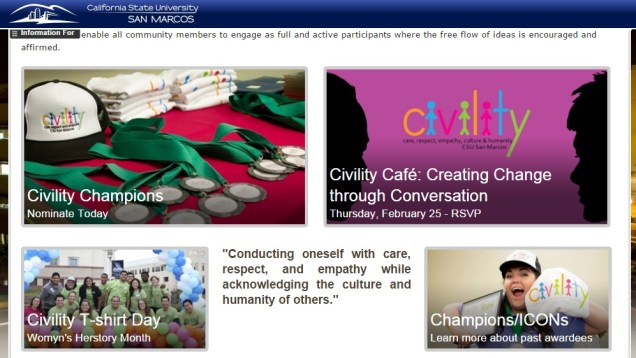
A case in point: California State University San Marcos, which has opened what it calls a “Civility Cafe”, less of a laid-back study lounge and more of a hectoring seminar where any hopeful expectations of free speech are swiftly recalibrated by campus authorities.

The aim is to turn all students into “civility champions”, as the university’s website explains:

CSUSM recognizes students, faculty and staff who display Civility on our campus by conducting themselves with care, respect, and empathy while acknowledging the culture and humanity of others.  Like waves through the ocean, our vision is that one simple act will have a ripple effect and a tsunami of civility will take over our campus.  We encourage you to identify and nominate students, faculty and staff on campus.

Students are then “invited” to take the following pledge:

As a member of the CSUSM community
I will conduct myself with care, respect, and empathy
while acknowledging the culture and humanity of others.

The university’s student newspaper, the Cougar Chronicle, elaborates:

The Civility Cafe, a skill-based workshop, aimed to encourage and educate students on how to engage in civil discourse with their peers.

John Loggins, University of San Diego’s Director of Community-Based Student Leadership and Learning, facilitated the event on Feb. 25 in USU 2310.

[..] Students then participated in an activity designed to increase their empathy and listening skills. Students partnered up and were invited to tell their partner a story about an instance in which they either excluded someone from a community or felt excluded themselves. After students shared their stories, their partner had to tell another student the story they had just heard, but from a first-person perspective.

Loggins then played a video for those in attendance. The film featured Dan Savage, a known advocate for LGBTQIA rights and creator of the It Gets Better foundation. After watching the video, students were asked to reflect and share actions, words or ideologies that trigger negative emotions.

“How we react to triggers says more about us than what triggers us. Try to reflect before speaking out of hurt or anger; this can create more civil discourses,” Loggins said.

Note Loggins’ use of the term “triggers”. It is now difficult to recall that the concept of trigger warnings originated in online discussion forums for rape and sexual abuse victims, as a means of flagging explicit discussions for those suffering from legitimate PTSD. But we have come so far from that limited usage now – and trigger warnings are now so widely used in academia and even the media – that the expert sent from the University of San Diego to run the Civility Cafe talks about “how we react to triggers” as though every single one of us is a victim of some kind.

Sure, we may not have been the victims of sexual violence. But we can nonetheless be “triggered” by the most minor perceived cultural slights, goes the theory, and we must attend special seminars to train us to manage our reactions when we are so triggered. What literally every generation of human beings before us managed to do (with a little trial and error) since the dawn of history now must be taught as a specific Life Skill by universities more obsessed with micromanaging the lives and daily interactions of their students than imparting a rigorous, valuable academic education.

This is incredibly corrosive, part of a wider narrative whereby everyone is treated as being sick – or a victim – by default, rather than by exception. But we should expect to see more of this, and more Civility Cafes (or similar devices) popping up at college campuses everywhere. Why? Because university administrators are risk-averse.

They saw what happened to Tim Wolfe, former president of the University of Missouri, who was unceremoniously forced to resign at the hands of mob justice. They saw what happened to legions of university professors and administrators who found themselves rooted to the floor, being screamed at for largely imaginary offences recast as capital crimes under the law of Identity Politics. And so, as a perverse form of liability insurance, some universities are now leaning into the trend, making Identity Politics indoctrination a mandatory or strongly encouraged part of the student experience so that they have a defence to fall back on should protests erupt on their own campuses over some future scandal, real or imagined.

Unfortunately, this only adds legitimacy to what the Identity Politics practitioners and the New Age Censors are trying to do, giving it the official imprimatur of the university and its leadership team. Rather than obsequiously bowing down to these demands and establishing two safe spaces for every one that was originally demanded, universities should be pushing back on the student activists and telling them that as adults, they are each responsible for managing their own human interactions, and must get out of the habit of looking to an external authority figure to mediate every single dispute or to mete out punishment for what often amounts to thoughtcrime – daring to hold or articulate beliefs which are in any way contrary to the prevailing Identity Politics narrative.

None of this is to say that genuinely racist, sexist, homophobic or otherwise discriminatory incidents do not occur on college campuses. Clearly they do. But the sense of panic and “danger” (student victims-in-waiting love to paint themselves as being in physical danger of nebulous words and ideas) is completely out of proportion to the issue, and overlooks the remarkable strides which have been made in overcoming prejudice and discrimination in our societies.

The American university system went from mass segregation to full integration in little more than a decade – precious gains which were made possible by exercising of unrestricted free speech, it should be pointed out. Why, then, do we need the most draconian measures – campus speech codes, re-education classes, social probation sentences for giving arbitrarily-taken offence to other students – to travel the last ten percent of the journey?

This is the case that the Identity Politics practitioners and New Age Censors need to answer. Why should freedom of speech, expression and thought be more severely curtailed now than ever before at this late stage, when most of the victories for tolerance, civility and equal rights have already been won?

Don’t expect an answer from them any time soon – for they have none. But do expect to see a lot more Civility Cafes popping up, serving flat whites with a sanctimonious side of social justice. It’s what the petty campus tyrants want, and many university administrations – like that of California State University San Marcos – either fully agree with their toxic agenda or are simply too spineless to stand up to them.


Safe Space Notice - 2

Agree with this article? Violently disagree? Scroll down to leave a comment.

Follow Semi-Partisan Politics on TwitterFacebook and Medium.

Now Even Peter Tatchell Is A “Racist”

Moscow Gay Pride Parade Attacked

In the accusatory minds of the new PC Left, a lifetime spent fighting for LGBT and racial equality counts for nothing if one also supports the free speech rights of those who disagree

Ask anyone to write down their top twenty racists in Britain, and very few people would put Peter Tatchell anywhere on their list. After all, the man’s life has been dedicated to overcoming prejudice and fighting for racial, sexual and LGBT equality.

While others now wear their progressivism as a virtue-signalling badge of honour, something to be ostentatiously flaunted on social media, Tatchell has put his body in harms way to protest what he sees as real injustices taking place against persecuted minorities. And whether you agree with Tatchell on every single one of his causes or not, one can certainly admire the way that he has lived his public life by the credo “actions and words”.

Unless, that is, you happen to be a member of the activist student PC Left, part of that spoiled and coddled generation of today’s young people whose freedoms were won by the likes of Tatchell, and whose own meagre campaigns perch precariously on the far greater and more noble endeavours of those who came before them. They have now turned on Tatchell, accusing him – hilariously – of being both racist and “transphobic” in a blatant and supremely ungrateful move to destroy his reputation and credibility.

Tatchell himself responds in the Telegraph:

Free speech and enlightenment values are under attack in our universities. In the worthy name of defending the weak and marginalised, many student activists are now adopting the unworthy tactic of seeking to close down open debate. They want to censor people they disagree with. I am their latest victim.

This is not quite the Star Chamber, but it is the same intolerant mentality. Student leader Fran Cowling has denounced me as racist and transphobic, even though I’ve supported every anti-racist and pro-transgender campaign during my 49 years of human rights work.

Fran is the LGBT+ (lesbian, gay, bisexual, transgender) Officer of the National Union of Students (NUS). She refused to speak at an LGBT event at Canterbury Christ Church University tonight unless I was dropped from the line-up. This is a variation of the NUS “no-platform” policy; instead of blocking me from speaking, Fran is refusing to share a platform with me.

While the Guardian explains the context:

In the emails, sent to the organisers of a talk at Canterbury Christ Church University on Monday on the topic of “re-radicalising queers”, Cowling refuses an invitation to speak unless Tatchell, who has also been invited, does not attend. In the emails she cites Tatchell’s signing of an open letter in the Observer last year in support of free speech and against the growing trend of universities to “no-platform” people, such as Germaine Greer, for holding views with which they disagree.

Cowling claims the letter supports the incitement of violence against transgender people. She also made an allegation against him of racism or of using racist language. Tatchell told the Observer that the incident was yet another example of “a witch-hunting, accusatory atmosphere” symptomatic of a decline in “open debate on some university campuses”.

Because campaigning is no longer about securing freedoms and liberties for marginalised people. It is about not just holding the “correct” opinion on any given issue, but crucially also being seen to hold the correct opinion, and orchestrating various situations whereby one’s own bien pensant opinions can be shown off to greatest effect.

It is about making oneself look good by jumping on the slightest deviation from prevailing PC orthodoxy by someone else – often a friend and erstwhile ally – and seeking to destroy them with it, hysterically declaring it to be evidence of moral turpitude, even when the target is someone as respected in the field as Peter Tatchell.

Some on the PC Left, recognising that this particular smear by the NUS may stretch credibility too far, are trying to spin Tatchell’s naturally outraged reaction as yet more evidence of racism. In an eye-rollingly titled piece called “Problematic Proximities, Or why Critiques of Gay Imperialism Matter”, Sara Ahmed tries to argue:

I do want to question here how Mr Tatchell is responding to the critique.

[..] Critiques of racism are reduced and misheard as personal attacks, which is what blocks a hearing of the critique. In the end, the situation becomes re-coded as a question of individual reputation and good will: we lose the chance to attend to the politics of the original critique.

We need to reflect on what we are talking about when we are talking about racism. Racism in speech does not simply depend on the explicit articulation of ideas of racial superiority but often works given that such associations do not need to be made explicit. So for example politicians might use a qualifier ‘this is not a war against Islam’ and then use repeatedly terms like ‘Islamic terrorists’ which work to associate Islam with terror through the mere proximity of the words: the repetition of that proximity makes the association ‘essential’.

[..] It is my view that Mr Tatchell’s writings on Islam and multiculturalism repeat and reproduce many ‘problematic proximities’ between Islam and violence, and thus participate in the culture of Islamaphobia.

Ahmed is trying to advance a semi-cogent (though still wrong) argument here. She is effectively saying “Wait a minute! We may have called Peter Tatchell a racist, but it wasn’t a personal attack. Heavens, no. It was simply pointing out that some of the things that he says are problematic for us because we believe they help to reinforce negative stereotypes about religious minorities”.

This would at least have the makings of a cogent argument – that we all have good and bad within us, that we all have our own prejudices which we should seek to recognise and overcome, and that any of us might say something which might be construed as “racist”, but with no malice whatsoever.

But if this is what the NUS and Fran Cowling actually believe, why refuse to take the stage with Tatchell? If indeed their intention was not to launch a “personal attack”, why on earth refuse to admit all the good which Peter Tatchell has done for their causes, and why refuse to share a stage with him now?

The answer, of course, is that this was fully meant to be a personal attack. Vicious personal attacks conducted through social media and the press are the chief modus operandi for today’s youthful practitioners of Identity Politics, and if their self-advancement involves a.few instances of friendly fire – even the destruction of someone like Peter Tatchell – so be it.

Some people tell me that I am being too hard on the students involved; that they are well-intentioned young people simply trying to navigate difficult issues as best they can. Well I’m sorry, but I’m just not buying it. Obviously we are only talking about a minority of students here – the ones drawn to take an active role in student governance, social affairs and campus life. But these students are behaving in an utterly reprehensible way, completely without justification and to be opposed by lovers of liberty at all costs.

This is an attempted power grab, plain and simple. Just like it was at Mizzou, and Yale, and Oxford, and countless more universities every year. This is an attempted coup by an utterly coddled and spoiled generation of students who know almost nothing of hardship, deprivation or prejudice compared to their predecessors even just a few decades ago.

These tinpot student dictators arrive on campus at the age of eighteen to find most of the really hard battles already won for them – ironically, by genuinely brave radicals like Germaine Greer and Peter Tatchell. But these students must find some outlet for their youthful “idealism”, and so they latch on to the growing Politics of Identity, assimilating its intricacies and genuinely persuading themselves of its core message – that what matters is not the content of one’s character, but rather one’s arbitrary lived experience as a member of a defined and segregated subgroup.

And so rather than simply accepting that they have it rather good, even compared to their parents and grandparents, these student snowflakes go on the march. They find ever-smaller slights or “microaggressions” and protest them ever-more loudly and hysterically in an attempt to assert power over university administrations – many of which meekly submit without so much as putting up a fight.

Throw in the fact that their social hierarchy is based on a purist adherence to the Politics of Identity – with members gaining social currency for flaunting their own tolerant nature or identifying and persecuting anyone whose behaviour happens to violate one of the many invisible lines restricting our speech and behaviour – and you have a potent and deadly combination.

Viewed in this context, it is obvious that NUS LGBT officer Fran Cowling is attempting to gain a vast amount of social currency and standing from her peers by trying to take down Peter Tatchell, an A-lister in activist circles. By refusing to share a stage with him, Cowling is effectively declaring to the world that she is morally superior to Tatchell, he having failed the latest racism and transphobia tests. Thus, she can bank all of Tatchell’s personal accomplishments for herself, add the fact that unlike him she is not a “transphobe”, and Win the Game.

And that’s the rotten core of today’s student identity politics movement. A constant, bitchy, backbiting game of snakes and ladders, with one insufferable petty tyrant rising to the top of the Moral Virtue Pyramid only to be brought down by their jealous rivals, either for no reason at all, or for having unknowingly violated one of the many red lines that they themselves helped to draw across our political discourse.

I can’t say any better than Brendan O’Neill on this occasion, so I will give him the last word:

This Veruca Salt-style revolt against late 20th-century liberators, this sullen, thankless turn by radical young women, gay people and black people against those who devoted their lives to fighting for women, gay people and black people, reveals how poisonous the politics of identity has become.

Where late 20th-century warriors for civil rights basically argued for the right of people to be free and equal regardless of their gender, sexuality or race — that is, they wanted identity demoted — today’s identitarians prefer to obsess over people’s natural characteristics and sexual habits. They instinctively loathe King’s claim that character is more important than colour. They hate Greer’s insistence that women are as capable as men (and that a man can’t become a woman at the click of his fingers). They have disappeared so far up the fundament of identity politics that they bristle at any argument that smacks of universalism, which emphasises the sameness and the shared capacity for autonomy of all human beings.

They seem hellbent on reversing the social gains of the late 20th century, preferring to shove people back into the biological, racial boxes from which mankind spent so long trying to escape. It is they, not Tatchell, who are racialist (if not racist), and a threat to what most of us consider to be the decent civilisational value of treating people as people rather than as colours or genders.

Amen to that. And shame – yet more ignominious shame – on the NUS.

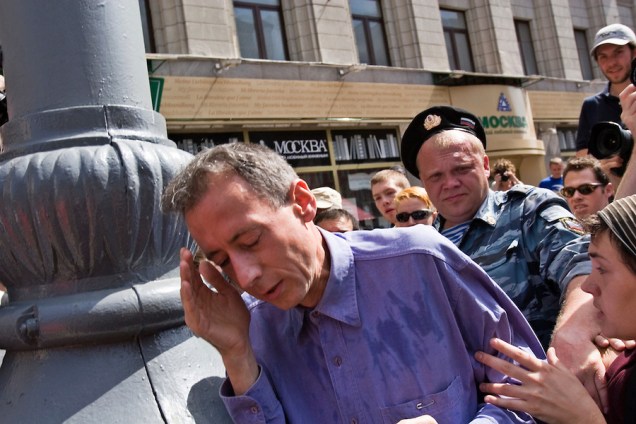
Peter Tatchell attacked

Agree with this article? Violently disagree? Scroll down to leave a comment.

Follow Semi-Partisan Politics on TwitterFacebook and Medium.

We Are All Cats Now

https://www.youtube.com/watch?v=YWeBunPiIzo

No, you are not a cat simply because you “identify” as one. And we should all be wary of where the rise of the Politics of Identity is leading us

When future aliens discover the ruins of human civilisation and wonder what set our demise in motion, they will likely identify the period through which we are now living – the time where we finally became so arrogant that we believed we could bend objective reality to our will, physically becoming something simply because we mentally “identified” as that particular object or state of being. They will say that we sowed the seeds of our destruction when we abandoned reason and put our faith in verbal alchemy.

A story is going viral today (see video above) which would be hilarious if it wasn’t so terrifying. It involves Nano, a twenty year-old woman from Norway who identifies as a cat, having come to this “realisation” when she was sixteen and apparently indulged in her belief by friends, family and psychologists alike.

The Telegraph reports, totally deadpan:

The young woman shows off her cat characteristics by wearing fake ears and an artificial tail. She communicates by meowing.

“I realised I was a cat when I was 16 when doctors and psychologists found out what was “the thing” with me. Under my birth there was a genetic defect,” she explains in the video.

[..] The cat woman wears a pair of pink fluffy paws with which to groom herself, and feels especially like doing so when she is in contact with water.

When asked if she was born as the wrong species, she said: “Yes, born in the wrong species.”

But terrifying it is, because stories like this are no longer so far-fetched, and Nano’s claims are not so unreasonable – at least not according to the insistent logic of modern day identity culture, which makes each one of us the little tin-pot god of our own reality, able to pick up and discard identities as core as gender or even species, in some cases on a whim.

And this is not the first such case. Just last month in Canada, a 52 year old formerly married father of seven revealed to the world that he no longer identified as a man, but rather as a six year old girl called Stefonknee.

The Daily Mail reported at the time:

Stefonknee (pronounced ‘Stef-on-knee’) Wolscht, 52, of Toronto, says she realized she was transgender – rather that simply a cross-dresser – at age 46, and split from her wife, Maria, after she told her husband to ‘stop being trans or leave’.

Now, Stefonknee lives with friends who she calls her ‘adoptive mommy and daddy’ as a six-year-old girl, dressing in children’s clothing and spending her time playing and coloring with her adoptive parents’ grandchildren.

Stefonknee says her ‘adoptive’ family, which consists of an older couple and their children and young grandchildren, are completely accepting of her identifying as a little girl.

She says she’s living as a six-year-old girl because it’s something she could never do when was in grade school.

‘I can’t deny I was married. I can’t deny I have children,’ she says in the video. ‘But I’ve moved forward now and I’ve gone back to being a child. I don’t want to be an adult right now.’

She’s moved forward, so that’s fine, then. Good for Stefonknee. Never mind her abandoned wife or seven young children who are doubtless hurt, confused and humiliated by what their father is doing. Stefonknee just doesn’t have time for all of that adult stuff right now, so she is going to put on a gingham dress and regress to a pre-pubescent age, until she gets tired of that and wants to try something different.

This is pure narcissism, plain and simple. He didn’t want to be an adult anymore, so he clicked his fingers and became a six year old girl instead? How are we to unpack this? Are we to accept his Wolscht’s statement that she is now female, since transgender acceptance is now (rightly, I believe) much more widely accepted and tolerated?

But if we do so – if we accept Wolscht’s statement that she is now female – do we not also then have to accept her insistence that she has also turned the clock back and become six years old again?

Stefonknee Wolscht - Identity Politics

The ludicrous thing here is that Wolscht’s own identity is floating, as she freely admits later in the article:

She says she previously lived as an eight-year-old girl, until the couple’s granddaughter asked her to be the younger sister instead.

‘A year ago I was eight and she was seven. And she said to me: “I want you to be the little sister, so I’ll be nine.” I said: “Well, I don’t mind going to six.” So I’ve been six ever since.’

So according to this jaw-dropping reasoning, our identity is not even fixed and core to ourselves (if unmoored from reality). Now, our identity is a commodity which can be haggled over and traded. And if winning the friendship of a young girl means that a formerly 52 year old man has to downgrade from being an 8 year old to a 6 year old girl, that’s absolutely fine, apparently. Who are we to judge in any of this?

Never mind the callousness of a father of seven doing such a thing to his own children, putting them through this ordeal in pursuit of an identity which he openly admits is free-floating and liable to change again in future anyway. That’s bad enough. But how are we all – individuals, employers (the six year old girl apparently has a job driving a slow plough in winter) or government agencies – supposed to relate to somebody who decides that they “identify” as a different age and gender?

If Stefonknee is really six years old she should be in school, and the local authority should by current laws be hounding her adoptive “parents” to ensure that she is receiving a proper education. But would the identity culture cheerleaders seriously propose sending what was once a 52-year-old man to primary school with young children? Surely, under today’s logic they have to?

Stefonknee has identified as a young girl, and therefore she must be treated like one in every way. Anything less – such as homeschooling – would be discrimination against 6-year-old girls who happen to have the bodies of 52-year-old men. The kind of women who are harmed by a performance of the Vagina Monologues.

Meanwhile, Stefonknee’s employer when she drives the snow plough in winter will need to be hauled before the court and prosecuted for infringing on child labour laws. The courts would probably take a very dim view indeed of any business hiring a young girl to operate heavy machinery, and since justice must be blind, Stefonknee’s carefree decision to become a little girl should put her employer’s livelihood and liberty in grave jeopardy.

It’s easy to laugh at these scenarios, but they are going to come up more and more frequently if – as will inevitably happen when stories like this gain traction – more people are tempted to follow in the dangerous footsteps of Wolscht, or the somewhat less threatening (but no less absurd) paw prints of Nano the Norwegian cat woman.

For what is to say that Nano and Wolscht are not the “new normal”? The people being hounded and “No Platformed” for their old-fashioned views on transgender issues are guilty only of holding thoughts which were incredibly mainstream just a couple of decades ago, yet in that short space of time they have been completely overtaken by received wisdom and the new orthodoxy of intolerant tolerance. What is to say that in thirty years’ time, those who question a person’s ability to discard their entire life and “become” a cat or a young child are considered as bigoted as today’s “transphobic” holdouts?

Nobody can say that this is unlikely to happen. The world has changed so much in just a few decades, and promises to change even more in the coming years. Social attitudes have changed enormously in this time – what is to say that the warm, fuzzy embrace of unquestioning tolerance and affirmation will not expand to embrace people like Nano and Wolscht by 2050?

In 2050, maybe the future version of Eddie Redmayne will be starring in a movie, not just playing a male-to-female transsexual person (how boring that will be by then) but turning in another Oscar-winning performance for his sensitive portrayal of the pioneering early 21st century woman who identified as a cat, or the brave Canadian man who threw away his family in pursuit of his new identity as a pre-pubescent girl.

But that’s fine. Since we seem intent on burying our heads in the sand and denying that there is anything wrong with our new Politics of Identity, by that time our Prime Minister will probably identify as a Beagle, the Home Secretary will be a barn owl except on Tuesdays, and the Chancellor of the Exchequer will be a goldfish who looks suspiciously like George Osborne’s grown-up kid wearing a wetsuit, Number 11 Downing Street having been converted into a walk-in aquarium in deference to their “mental safety”.

And Nona the Norwegian cat woman will be the very least of our problems.


Crazy Cat Lady - The Simpsons

Agree with this article? Violently disagree? Scroll down to leave a comment.

Follow Semi-Partisan Politics on TwitterFacebook and Medium.

Modern Safe Space Culture Will Never Produce Anyone Like David Bowie

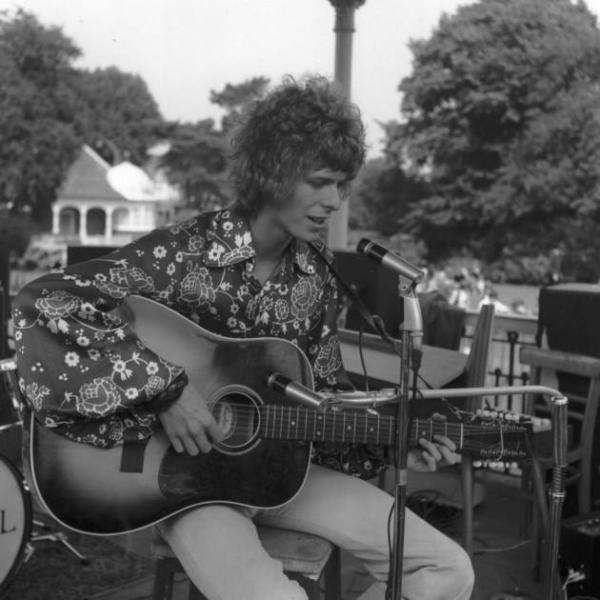
David Bowie - Beckenham Free Festival

Something more than David Bowie died this week

Why has David Bowie’s death affected so many people so deeply?

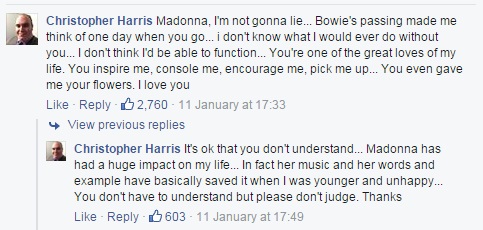
It goes much deeper than the pro-forma grief athleticism which the internet does so much to encourage. Yes, we can easily find examples of people going too far in their vicarious grief – often with extremely awkward effect:

David Bowie Death - Madonna Reaction - Facebook


But there is also something more than just anonymous people assuming a hysterical degree of mourning more appropriate for the passing of family members and close friends.

Neil Davenport attempts to draw out this undefined sense of loss in a piece in Spiked magazine entitled “Bowie and the shrinking sense of possibility”.

The piece begins by pointing out that while Bowie’s success was far from assured in the early years, it was made more likely by the greater sense of freedom and possibility which reigned in the early post-war decades, from the 1960s to the 1980s.

Davenport points out:

It’s worth remembering that Bowie slogged on the margins for ages, in two-bit bands, recording very minor songs, before finally finding his voice. Back then, British society created a kind of free space in which young people who were willing to take the unpredictable route of cultural experimentation could do so.

This should give some small measure of hope and a reminder to many of us toiling away in relative obscurity – be it in the arts or elsewhere – that success is rarely instant, and the lasting success we savour the most almost always requires a supreme degree of effort to be ploughed in to our endeavours before any results are seen.

But unfortunately, many aspects of our contemporary society conspire against encouraging this personal risk-taking and reinvention, as Davenport goes on to explain:

Today, in obsessively trying to ‘support’ and mollycoddle young people, society unwittingly robs them of the independence, resilience and drive that Bowie showed in his graft and in his shift from being a nobody to a zeitgeist-changing genius.

Where Bowie encapsulated a genuine sense of freedom and possibility, of total and frequent reinvention, today’s young people find themselves living in an era that discourages risk-taking, puts off adulthood, and erects official scaffolding around their lives. Young people have internalised a culture of anti-freedom.

We can see this in its most extreme form in the desire of some Western-born youths to join the death cult of ISIS, who seem to think that a repressive Caliphate which does all their thinking for them is a really great idea. We see it on university campuses, where student leaders make hectoring demands for Safe Spaces and ban controversial speakers, songs, newspapers or comedians. We see it with the daily emergence of yet another moronic petition calling for someone or something to be banned or punished for daring to ‘offend’ others. For all the celebrations of Bowie’s achievements, what he represented is actually in very short supply today. His death should serve as a reminder, or rather a wake-up call, of some of the backward social changes of the past 20 years.

Who would have thought that calls to outlaw clapping and booingtearful temper tantrums about dress codes, stifling ideas by labelling them ‘problematic’the insistence on safe spaces and mandatory sexual consent workshops for students would have such a repressive, suffocating effect on our society?

That’s not to say that there is no great new talent emerging seven decades after the birth of David Bowie – clearly there is. But time and again, we see the biggest acts and pop stars of today are more eager to ostentatiously embrace prevailing social values as an act of public virtue-signalling rather than court controversy by cutting across today’s strictly policed social norms.

Lady Gaga took no risk when she sang “I’m on the right track baby, I was born this way” – indeed it opened the door to stadiums full of even more lucrative fans. That’s not to say that she was wrong to do so; Lady Gaga’s advocacy of gay rights is laudable. But how often do you see an emerging pop star court real controversy or confound society’s expectations these days? You can blame some of this on commercialisation, sure, but not all of it. Something deeper is at work.

When emerging artists see ordinary people shamed and ostracised for saying the “wrong” thing or even just adopting the wrong tone on social media, how many will have the courage to incorporate anything truly daring or potentially “offensive” in their acts, or create spontaneously from the heart without first processing everything through the paranoid filter of societal acceptability?

No, trigger warnings and safe spaces are not directly to blame for the X Factor or One Direction. But all of these unsavoury phenomena – and the societal trends which create them – are indelibly linked.

Why, then, has this particular death hit many of us so hard? Perhaps because deep down, we realise that we have lost something more rare and precious even than David Bowie – the possibility of ever producing another like him.

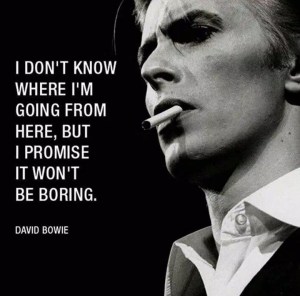
David Bowie Quote 1

Agree with this article? Violently disagree? Scroll down to leave a comment.

Follow Semi-Partisan Politics on TwitterFacebook and Medium.