This Generation Of Politicians Will Not Secure The Benefits Of Brexit

brexit-pixabay

Four months after the EU referendum, our leaders continue to shrink from the challenges (and opportunities) which lie ahead

As is nearly always the case, Pete North has the best analysis and summary of exactly where we are with our Brexit deliberations – and right now, the answer is rather depressing:

For several months we had the great and the good telling us how important the single market was and how valuable the EU was to the UK. Now that they are tasked with leaving the EU we see that they can barely define the EU and the single market let alone offer an adequate critique as to whether it is right for the UK.

Through successive treaties our parliament has idly signed away substantial areas of policy to be decided overseas with hardly any public scrutiny. It is therefore ironic that MPs now demand parliamentary sovereignty in scrutinising the terms of the exit arrangements when they showed so little interest in what they were signing away.

By voting to leave the EU we have caught the entire system of government off guard to show that is is totally ill-equipped to govern – and those claiming to represent us have failed in their duty to safeguard our democracy. Through forty years of negligence the UK’s trading relationship with Canada is decided not by Number Ten or Westminster. Instead it depends entirely on the Walloon assembly in Belgium.

And therein lies the inherent flaw in the EU design. The DNA is faulty. Introduce democracy and the whole thing grinds to a halt. Take it away and power ends up in the hands of the few. It cannot work and it cannot be reformed yet we have endured decades of politicians telling us otherwise.

One of the most depressing aspects of life post-EU referendum has been watching our national leaders shrink from the challenge of implementing Brexit. I don’t mean that they are all necessarily in denial, or that they wish to subvert the referendum result – but rather that their every public pronouncement suggests that many of them are simply not up to the task which lies ahead. Typically, this isn’t a question of intelligence, but rather a lack of imagination and ambition. And in truth, perhaps it is too much to expect the same politicians used to implementing EU decisions or operating within their constraints to suddenly step up and become adept drivers of a country suddenly without training wheels.

The debate has thus devolved into two rather tiresome strands – the one held by most Remainers, who have become intent on catastrophising Brexit at every turn and seizing upon every scrap of potentially troubling news as further evidence that the end is nigh, and the opposing, buccaneering view which loudly insists that everything can be wrapped up to Britain’s complete satisfaction by March 2019, and sees any questioning of this certainty as evidence of anti-Brexit treachery.

This blog falls down the gap between these two comically exaggerated positions, which is perhaps why I haven’t been writing about Brexit as much as I should have been lately. One can only slap down so much ridiculous establishment catastrophising of Brexit (now the nation’s fluffy kittens are in peril, apparently), while pointing out the need for a transitional arrangement and securing continuity of access to the single market still falls on deaf ears among those in charge, and only feeds the smug (but not entirely false) Remainer assertion that Brexiteers don’t know what they are doing.

And yet a transitional arrangement is exactly what we need, as Pete North explains:

What will become clear in due course is that Britain will need a continuity arrangement that sees little or no change to the labyrinth of customs procedures and regulations that make up the single market. Neither Britain nor the EU can afford to start tinkering under the hood of long established trade rules. The sudden collapse of CETA at the hands of a Belgian provincial assembly shows just how dysfunctional the system is.

If anything is inflicting damage on the UK it is not Brexit but the overall uncertainty over what Brexit looks like. This in part down to those media vessels determined to make Brexit look like a catastrophe and in part down to those politicians who have not bothered to plan for the eventuality. We are four months on from the referendum and key ministers are still struggling with basic terminology.

Brexit is by far the biggest and most ambitious thing that this country has attempted in decades – frankly, since the Second World War. It demands painstakingly extricating Britain from a web of agreements and schemes of a complexity befitting an organisation which still seeks to become the supranational government of a federal Europe. But to make it even more complicated, we will wish to maintain many avenues of cooperation after leaving the EU’s political union, meaning that a slash and burn of laws will not do – hence Theresa May’s much over-hyped Great Repeal Act.

As Pete points out, it is highly ironic that sulky Remainers are suddenly so interested in having Parliament examine every aspect of the secession deal (with the more juvenile characters, who clearly know nothing about negotiations, expecting to be briefed in advance) when over several decades they blithely signed away powers to the EU with barely a second thought, and certainly no real public debate.

It makes the Remain camp’s current favourite attack line – Brexiteers wanted to return decision-making power to Parliament, so why won’t they let Parliament have a say?! – especially cynical. But the argument is wrong anyway. “Returning powers to Parliament” is a handy catchphrase, but it is a glib one, always favoured more by eurosceptic MPs than the general public.

The current anti-establishment rage currently roiling Europe and America shows that political leaders have become too distant from (and unresponsive to) the people, no matter the level of power. Therefore, returning powers to the Westminster parliament is not enough – we need an end to British over-centralisation and the devolution of power back to the counties, cities, towns and individuals.

Sadly, the chance of meaningful constitutional reform taking place in Britain any time soon continues to hover around zero. And rather than Brexit being the catalyst for such change, as this blog once hoped, it now seems that an intellectually and imaginatively challenged political elite will hide behind the complexity of Brexit as an excuse to avoid doing anything else of substance. One can easily foresee a situation in a decade’s time where Britain is technically outside the EU but stuck in an increasingly permanent-looking halfway house, with acceptable access to the EEA but with none of the later work to move towards a global single market even started.

Would this be good enough? Well, Britain would be outside of the political structure known as the EU, which was always the base requirement – so if one is happy to shoot for the middle and accept the bare minimum then yes, it might have to do. But it would be an appalling failure of ambition, when there are real opportunities to improve the way that international trade and regulation works and to revitalise British democracy through wider constitutional reform.

But to realise great ambitions requires there to be half-decent leaders pointing the way. And looking at the Tory “Three Brexiteers” and the dumpster fire that is the Labour Party, one cannot help but conclude that great leaders – even just competent heavyweight politicians – are in short supply at present. Do you really see Boris Johnson’s name featuring in a future Wikipedia article about the great British constitutional convention of 2020? Or Theresa May’s? Jeremy Corbyn or Hillary Benn’s?

Do I regret my decision to campaign for Brexit? No, never. The European Union is offensive to any proper sense of democracy, or to the notion that the people of a sovereign nation state should decide and consent to the manner in which they are governed. Being rid of the EU (and hopefully helping to precipitate that hateful organisation’s eventual demise) is a solidly good thing on its own. But Brexit could be so much more than it is currently shaping up to become.

And perhaps this is the most damning thing of all about the European Union: the fact that 40 years of British EU membership has slowly turned the nation of Winston Churchill, Clement Attlee, Margaret Thatcher, Hugh Gaitskell, Tony Benn, Barbara Castle and Peter Shore – men and women of principle and substance – into the nation of Tony Blair, David Cameron, Nick Clegg, Chuka Umunna, Diane Abbott and Owen Smith.

A nation simply does not bounce back from that kind of decline in the space of a few years, and the more that our contemporary politicians carry on about Brexit the clearer this becomes.

Assuming that Brexit goes to plan, it may not be until the next generation of political leaders come of age (at the earliest) before we can finally take full advantage of our newfound freedom.


European Union - United Kingdom - Britain - Flags

Top Image: Stux, Pixabay

Support Semi-Partisan Politics with a one-time or recurring donation:

Agree with this article? Violently disagree? Scroll down to leave a comment.

Follow Semi-Partisan Politics on TwitterFacebook and Medium.

What Next For The Labour Party?

https://www.youtube.com/watch?v=aLa67mjm7hg

And when Jeremy Corbyn storms to re-election as Labour leader, what then?

Ben Kelly despairs:

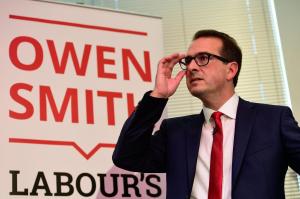
To see just how low the Labour Party has sunk don’t look at Jeremy Corbyn, look at the usurper the rebels have chosen; Owen Smith. Is that really the best they have to offer? He is a total non-entity with no personal charm whatsoever. His combination of smarm and Corbyn-lite policy ideas are sure to repel the electorate and offer no hope for redemption for his wretched party. His ambition vastly outsizes his talent and the fact his pitch has been an attempt to attract Corbyn supporters exposes him as not just weak, but utterly pointless.

If Owen Smith miraculously manages to win the leadership race is he really going to bring salvation for the Blairites? He asserts that he is the only person who can unite the Labour Party but it is clear that he hasn’t the courage or the political intelligence to confront the Corbynite activist base, nor has he got the full blooded support of the Parliamentary Labour Party.

The harsh truth is that those figures in the Labour Party who really want to be leader have opportunistically ducked out of this race because they don’t want to enter a leadership race they will probably lose. They are too cowardly to take on the Momentum crowd and want to bid for the leadership when they can cruise into the position in some fantasy future when the Corbnyites realise the error of their ways.

Before Corybn Labour were already losing voters and it was mainly due to welfarism and immigration. Owen Smith is in no better position to win back the voters that have abandoned his party because of these issues than Corbyn. To that you can also add his Europhilia and his commitment to push for a second referendum in a blatant attempt to prevent Brexit. Ideologically his is little more attractive to the electorate and personally? This creep isn’t going to be embraced by the British people anytime soon.

The spending commitments in his cringeworthy, amateur hour, 20 policy pledges is quite enough to repel the wider electorate. The 28% that Corbyn’s hapless Labour Party is polling at the moment is clearly an over estimation, and the idea that Owen Smith is the man to reverse this dire situation is laughable.

The fact that even the man trying to oust Corybn thinks Britain wants socialism of any kind, even after Milibandism was comprehensively rejected in 2015, is a clear indication that Labour is in very serious trouble. It will either split or leap head first into electoral oblivion from which it will likely never recover.

Pete North is similarly unenthused:

https://twitter.com/PeteNorth303/status/761532183458803716

Well, at least Corbyn is powering a thriving socialist folk song revival.

This blog’s assessment, however, remains unchanged:

If Jeremy Corbyn remains as leader and takes Labour to an historic defeat in the 2020 general election, the party will be out of power for nine more years at most. But if the centrists, acting in a fit of pique at finding themselves out of favour and influence for once, decide to split the party then it will be ruined and broken forever. The time horizon in the minds of the centrist rebels conveniently gels with the likely length of their own political careers. When centrist Labour MPs earnestly declare that the future of the Labour Party is at stake, what they really mean is that their own parliamentary careers are at stake. The Labour Party has survived bad leaders before. What it cannot survive is the treachery and self-serving behaviour of the majority of its own parliamentary caucus.

If Labour’s centrists are serious about regaining control of their party and influence within in, there is only one course of action. And it involves sitting down, shutting up and letting Corbyn drive Labour off a cliff at the 2020 general election. Anything less than their full-throated support (or at least their tacit acceptance of his rule) will see bitter Corbynites attempt to pin the blame for their defeat on lack of enthusiasm (or indeed sabotage) within the parliamentary party. If Corbyn is to be deposed and Corbynism rejected once and for all, he and McDonnell must be given a clear shot at the general election and allowed to fail on their own.

“But people can’t take nine more years of Tory rule”, sanctimonious centre-leftists wail, indulging in their favourite pastime of painting themselves as the sole Defenders of the Poor. This would be a marginally more convincing if there was actually a radical, Thatcherite conservative government in office rather than the Cameron/May Tories who preach statist, paternalistic big government solutions to every problem – effectively Tony Blair’s missing fourth term.

It would be more convincing if there was more than a cigarette paper’s difference between centrist Labour and the leftist Toryism practised by a party which has more to say about “social justice” than liberty and freedom. But since there is so little difference, it doesn’t really matter whether Labour are in power or not – so they may as well take this decade to get their house in order and decide exactly what kind of party they want to be.

And if, at the end of that process of sober reflection, the decision remains that the party would be better off splitting into a hard left contingent and a centrist contingent for the professional political class then so be it. But this is a grave and permanent decision indeed, of sufficient magnitude that it ought to be determined by something more than the frustrated career aspirations of a few restless centrist Labour backbenchers.

Advice that will doubtless be ignored as this failed generation of exceptionally unexceptional Labour centrist MPs howl, rage and bring the Labour Party crashing down upon their heads, beside themselves with self-entitled rage at being out of power and influence for even a few short years.


Owen Smith - Labour Party Leadership Coup

h/t Christopher Snowdon – Thank you for the music

Support Semi-Partisan Politics with a one-time or recurring donation:

Agree with this article? Violently disagree? Scroll down to leave a comment.

Follow Semi-Partisan Politics on TwitterFacebook and Medium.

Brexit: It’s Time To Tone Down The Article 50 Hysteria

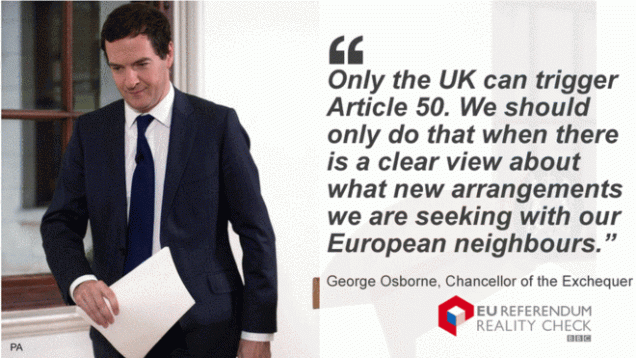
George Osborne - EU Referendum - Brexit - Article 50

There’s nothing super-democratic or virtuous about triggering Article 50 and starting the clock on our EU secession negotiation before we are ready

I like Spiked magazine a lot. Despite technically being a left-wing outfit, you wouldn’t know it from reading much of their output – they are certainly nothing like the morally bankrupt and ideologically rootless centrist politicos who infest much of the Labour, LibDem and Green parties. And on key issues like democracy and freedom of speech, their instincts are generally sound, while many of their writers argue with eloquent and forceful conviction.

That being said, Spiked’s new campaign to force the British government to immediately invoke Article 50 of the Lisbon Treaty to start the clock on our two (minimum) years of secession talks with the EU is rash and unusually ill-considered.

Editor Brendan O’Neill (whom again, I respect enormously) thunders:

Right now, today, the government must invoke Article 50 of the Lisbon Treaty. The people voted for it. More Brits voted to leave the EU than for anything else in history. So for officialdom, experts and agitators to demand that we hold off from triggering Article 50 – the clause that sets in motion a nation’s rupture with Brussels – is a straight-up denial of the democratic will. It’s an attempt to stymie, weaken, make meaningless the political demand of 17.5million people. Invoking Article 50 ought to be the great democratic cry of our times. Anyone who takes the franchise seriously, who cherishes the hard-won right of a people to shape their nation’s politics, must insist that Article 50 is invoked now.

The political and media elites are devoting an incredible amount of energy to ensuring Article 50 is not triggered. They have formed a protective ring around it, shielding it from being enacted on what they view as the reckless, ill-informed say-so of the public. From the legal realm, the political world, the media elite and the agitating leftist set, various actors have come together to say: ‘Don’t touch Article 50.’ And it’s no mystery why: they know Article 50 will make the people’s will a reality, and while they can just about handle the people expressing their will, they’re determined it should not form the basis of politics.

O’Neill then goes on to rightly criticise some of the delaying tactics we have seen orchestrated by the law firm Mishcon de Reya, attempting (on behalf of wealthy anonymous clients) to make invocation of Article 50 contingent on the will of Parliament rather than the outcome of the referendum.

We can all agree that any such delaying tactics borne out of a desire to overturn the result of the EU referendum are utterly abhorrent and toxic to democracy. But it does not follow, as Spiked seem to think, that maximal democracy is achieved by doing the exact opposite, by invoking Article 50 yesterday in a fit of pique.

The EU referendum question asked voters whether Britain should leave or remain in the European Union, and the electorate gave a clear instruction that Britain should leave. But it is the government’s duty to do so in a responsible manner, extricating the UK from a rejected political union while maintaining economic stability and limiting extraneous harm.

If the most “democratic” response to the EU referendum result is to leave the EU as quickly as possible, then Britain should immediately repeal the European Communities Act 1972 and walk away from all of our diplomatic and treaty obligations, consequences be damned. But what consequences they would be. Britain would rightly become a pariah nation, our word distrusted for many decades to come. And of course there is nothing amazingly democratic about such an act of self-harm.

Spiked love to take an maximalist stance on issues. When it comes to things like free speech, this is admirable. But applying the same uncompromising stance to the delicate issue of negotiating a departure from the EU on good terms is not wise.

Pete North agrees:

Ok kids, let me put this Article 50 nonsense to bed. Article 50 is a notification to the EU that we intend to leave. It triggers a two year period in which to negotiate our new relationship. Before that can happen we need to know from each member state what their position is likely to be on our position. This is called a scoping exercise so that we can create a timeline for events and an agenda whereby anything that was not agreed beforehand is not opened up for discussion unless the rest agree.

Before we do this we first have to know what our own objectives are and whether we wish to keep full membership of the single market and what we are prepared to compromise on and what we are not prepared to compromise on. That will require hearings of select committees, expert panels, public consultations and referrals to professional bodies, unions and trade guilds. I expect academia will want their say as well.

If we have even half a clue inside a year it will be a miracle. Scoping and testing the water with out position will take anywhere up to six months or more, also keeping in mind there are French and German elections which may see a change of position. So we would be quite reckless to even consider any rushed moves.

Some of this can happen concurrently but Article 50 invocation would be most ill advised until the process is complete. Keep in mind not a single strata of policy making is not affected somehow by EU laws. And at best after those two years of official talks all we will come out with is a roadmap for gradual divergence. To say this is complex doesn’t even begin to cover it.

Some have asked if I gave concerns that Article 50 may never be triggered. There is always a danger of that. It has yet to dawn on most politicians just how big this is and they may seek a pause when it does dawn on them. The only politicians who has thus far given us a hint of a clue that they know how big this is is David Cameron. That is ideally why we need someone from his camp leading the proceedings. They will have been given the same briefings. Gove will still be clinging on to childish fantasies about knocking up a free trade deal over beer and sandwiches followed by a slash and burn of red tape.

It is natural to want to see immediate, dramatic action following the referendum decision (not that we have been short of drama this past week), but even in the most reckless scenario, forty years of incessant and stealthy political integration cannot be unpicked in one quick move, as Pete North emphasises. And nor should it be attempted.

If there is some kind of coup to take place against Brexit, orchestrated by shadowy businessmen and lawyers over their cups of tea, I would be the first to march on Westminster with a flaming torch in hand. But in his admirable determination to defend democracy, Brendan O’Neill is making the mistake of conflating the absolute necessity of proceeding with initial scoping discussions to get an informal outline of a deal in place before invoking Article 50 with the more insidious attempts by vested interests and scorned left-wingers to unduly delay the Brexit process or thwart it entirely.

It’s understandable – like most of the Westminster media, O’Neill likely hasn’t heard of Flexcit. But if he were to familiarise himself with the only comprehensive, robust Brexit plan in existence, he might appreciate the narrow but crucial difference separating those who want an unhurried approach to Article 50 in order to plot out the smoothest and most economically non-disruptive secession and those who want to kick Brexit into the long grass altogether.

Spiked’s commitment to democracy and free speech is admirable, and a frequent source of inspiration to this blog. But in this case, by seeing the world in such black and white terms, divided between democracy-loving good guys who want to invoke Article 50 yesterday and the evil conspirators who want to delay it forever, Spiked is not serving the best interests of the country.

And sadly, this is one Spiked campaign which this blog can not support.


Brexit - EU - European Union Flag - Missing Star - Britain - UK

Agree with this article? Violently disagree? Scroll down to leave a comment.

Follow Semi-Partisan Politics on TwitterFacebook and Medium.

A Strong, Christian Case For The Nation State (And Against The European Union)

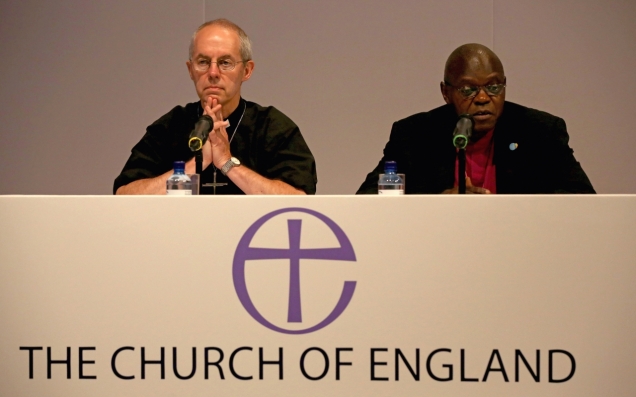
Justin Welby - John Sentamu - Archbishops - Church of England - EU Referendum - European Union - Brexit - Remain

Here is an intellectually robust, theologically rooted argument in support of the nation state and against the European Union. Why are Christian EU apologists unable to produce a similarly heavyweight case of their own, instead of relying on woolly platitudes about ‘togetherness’ and ‘co-operation’?

The Reimagining Europe blog has just published a serious intellectual (and even theological) but highly readable case for the continuance of the nation state, and criticism of those who suggest that the age of supranational government is either logical, inevitable or a goal to which Christians should aspire.

While I do not agree with every single nuance of the argument put forward by Nigel Biggar (Regius Professor of Moral and Pastoral Theology at Christ Church college, Oxford) the overall thrust of his argument is quite unimpeachable. It certainly is rooted in a far deeper reading of scripture and theological analysis than the glib statements of support for the European Union and Remain campaign from Archbishops John Sentamu and Justin Welby.

Biggar begins:

Thirty years ago I was told by a senior Anglican clergyman that the nation-state was passé. I can’t remember why he thought as he did, but I do remember that his conviction was a fashionable one. Quite why it was fashionable isn’t clear to me now. The mid-1980s were too early for globalisation’s transfer of power from national governments to free global markets and transnational corporations to have become evident. Perhaps it was the recent entry of an economically ailing and politically strife-torn Britain into the arms of the European Economic Community that made the nation-state’s days look so numbered. And, of course, the Cold War, which would not thaw until 1989, made international blocs look like a monolithic fact of global political life.

Finally, someone raises the historical context of Britain’s entry into the EEC in their Christian argument about the EU referendum. Good. Nothing can be understood without understanding the history and purpose of the European Union, but also the circumstances which led Britain to join in the first place. For if those circumstances (global obsolescence and lack of a “role”, economic decline, industrial strife, the very real risk of being ejected from what Michael Moore might call the “Premier League” of nations) are no longer present, why on earth would we now wish to stay, given all of the EU’s manifold flaws and failings?

Biggar goes on to discuss differing national attitudes toward being a quasi-autonomous member of a larger supranational grouping:

But there’s another, historically deeper reason. This was graphically impressed upon me during a visit to last year’s exhibition at the British Museum, “Germany: Memories of a Nation”. (I’d strongly recommend the book, by the way.) One of the exhibits was a map of north-western Europe in the mid-18th century, on which were superimposed the coinages current in Germany and Britain at the time. In Britain, there was one coin; in Germany, about sixty. Britain was a unitary state; Germany a territory with a common language, but comprising dozens of different kingdoms and principalities.

And here’s where being both German and Roman Catholic comes into play. For the dozens of mini-states in mid-18th century Germany were the vestiges of the multinational, Catholic, Holy Roman Empire, which the Protestant Reformation had helped to destroy. For Roman Catholics, especially on the European continent, and especially in Germany, the notion of a federation of states, sharing a broadly common culture and subject to a transcendent, quasi-imperial authority seems a perfectly natural condition.

Not so for the English, who have inhabited a nation-state whose basic structures span a thousand years, and whose history has taught them to fear the concentration of continental power. It’s no accident, therefore, that one can find in Anglican thought a marked tendency, from F. D Maurice in the mid-19th century to Oliver O’Donovan now, to affirm the existence of a plurality of independent nations, whose external relations are governed by international law rather than a supranational state.

Quite so. The lived experience of Britons, and our national history, is simply too different to reconcile with that of continental Europe under the umbrella of an overarching set of political institutions. In some areas of Europe, particularly the disputed regions which have changed back forth between countries over centuries (think Alsace-Lorraine), people have a history of maintaining a cohesive identity almost separate to whichever nation happened to claim their territory at the time. There is no similar history in Britain (though one could argue that the experience of the non-England home nations within the UK comes closest).

The upshot is that there is precious little in our folklore, literature, art or indeed politics which well equips us to carry on functioning happily no matter which foreign king makes the key decisions, or from which city they may do so. We are not built for supranational rule – despite ourselves having presided over an empire which did exactly that, we have not been on the receiving end in a thousand years.

Biggar then gets biblical, something which too few of the most prominent Christian apologists for the European Union have been willing to do:

Christians tend to view the nation-state and so the prospect of a European federation differently, according to whether they are Roman Catholic or Protestant, and according to their historical experience. All Christians, however, are accountable to the Bible. What does it have to say about these matters?

On the one hand, the New Testament makes quite clear that a Christian’s affection and loyalty have to go beyond the nation. They have to transcend it. Primarily, they have to attach themselves to God and to His coming Kingdom or rule. This we read in the third chapter of the Epistle to the Philippians, where St Paul, having identified himself strongly with the Jewish nation—“a Hebrew of the Hebrews”—then firmly subordinates his Jewish identity to his loyalty to God in Christ:

“But whatever were gains to me I now consider loss for the sake of Christ. What is more, I consider everything a loss because of the surpassing worth of knowing Christ Jesus my Lord, for whose sake I have lost all things. I consider them rubbish, that I may gain Christ…. [O]ur citizenship”, he tells the Christians at Philippi, “is in heaven” (vv. 7-9, 20).

Taken at face value, it would seem that Paul is saying that Christian identity must obliterate and completely replace national identity. But Paul, I think, is speaking hyperbolically here; he’s exaggerating. In fact, he never entirely repudiated his Jewish identity, but rather sought to understand how his new-found loyalty to God in Christ could actually fulfil his original national loyalty.

Biggar is right to suggest that St Paul’s injunction to completely erase national identity is a rhetorical exaggeration. And it is certainly the case that if British Christians were indeed called to renounce their Britishness, there is absolutely no reason why they should then take up a European identity – if any passing allegiance to country is wrong, then allegiance to a supranational body which is actively trying to become a country in its own right is just as wrong.

As Jesus Himself said, “My kingdom is not of this world” (John 18:36). While we are indeed all brothers and sisters in Christ, it is made very clear to us that our common citizenship is at an embryonic stage in this temporal world, represented by the global Church, and that the nation to which we shall all one day belong is not one of Earth.

Biggar goes on to concede the transitory nature of nation states:

Against such idolatrous nationalism, Christians must refuse the claim that nations have an eternal destiny, and that their survival is an absolute imperative. Nations are in fact contingent, evolving, and transitory phenomena. They come and they go. The United Kingdom did not exist before 1707 (and could have ceased to exist this year, had the Yes campaign won the Scottish independence referendum.) The United States could have ceased to exist in the early 1860s. Czechoslovakia did cease to exist in 1993.

So a Christian cannot be a Romantic nationalist, idolatrously attributing an absolute value to any nation. That’s one part of the truth.

With this important counterpoint:

But there is another part. This is alluded to by St Paul’s continuing identification with the Jewish people. And it’s made explicit in the Old Testament, where the prophet Jeremiah addresses the Jews, who had been carried off into exile in Babylonia, after the sacking of Jerusalem in the year 586BC. This is what he says:

“This is what the Lord Almighty, the God of Israel, says to all those I carried into exile from Jerusalem to Babylon: “Build houses and settle down; plant gardens and eat what they produce. Marry and have sons and daughters; find wives for your sons and give your daughters in marriage, so that they too may have sons and daughters. Increase in number there; do not decrease. Also, seek the welfare of the city to which I have carried you into exile. Pray to the Lord for it, because if it prospers, you too will prosper (vv. 4-7).”

Though they are citizens of another country, though they are currently exiles in Babylon, the people of God should nevertheless “seek the welfare of the city”.

Why is this? The answer lies in our created nature as human beings. We are finite, not infinite; creatures, not gods. We come into being and grow up in a particular time, and if not in one particular place and community, then in a finite number of them. We are normally inducted into particular forms of social life by our family and by other institutions—schools, churches, clubs, workplaces, political parties, public assemblies, laws. These institutions and their customs mediate and embody a certain grasp of the several universal forms of human prosperity or flourishing—that is to say, the several basic human goods—that are given in and with the created nature of human being. It is natural, therefore, that we should feel special affection for, loyalty toward, and gratitude to those communities, customs, and institutions that have benefited us by inducting us into human goods; and, since beneficiaries ought to be grateful to benefactors, it is right that we should.

This is true – we do indeed feel special affection and loyalty toward communities, customs and institutions which give us utility. But we should be wary of where this particular strand of thought may lead us. For as we know, the European Union is particularly adept at “purchasing loyalty” by using funds raised from nation state taxpayers and sent to Brussels as EU membership fees to then bribe national citizens with their own money in the form of development spending or sponsorship of various arts and community projects.

Pete North warns about this very phenomenon with this brilliant observation:

The founding fathers were savvy in their design of le grande project. They always knew it could never be done all at once because the central vision would never secure a mandate. Integration by deception has always been the modus operandi. It salami slices powers little by little, so gradually that few ever notice. And you’d never see it unless you know what the game plan is. They were long term thinkers. They knew it would take a generation or so to advance their agenda and they had a roadmap to do it.

It has always used funding of local projects to manufacture consent. It’s why you’ll find EU logos emblazoned on any nature reserve or community hall or obscure museum out in the shires, to convince the plebs that their benevolent EU guardians cared more for them than the London government. It is why it funds universities too. Every strata of civil society has an injection of EU cash. Education, NGOs, you name it. And it works.

[..] The founding fathers always knew a day would come where the legitimacy of the EU would be questioned. And now you see how well their pernicious scheme worked, with the entirely of the civic establishment coming out in favour of remain. They have made idle supplicants of our institutions, robbing them of their vitality, curiosity and dynamism.

While Biggar is absolutely correct to make his point, defenders of the nation state must be careful that this is not then used as justification by EU apologists for the behaviour and existence of the EU – a kind of retroactive justification for unwanted supranational political union based on the wheedling claim that people like it when Brussels gives them back their own money.

Biggar’s conclusion is a resounding rejection of pessimism about the nation state and the ignorant embrace of the EU by many in leadership positions in the church, based only on the woolliest of Christian thinking (my emphasis in bold):

Of course, institutions at a national level are not the only ones that enable us to flourish as human beings, but they do remain among them; and they are still the most important. This is true, notwithstanding the easy illusion of global identity that today’s social media create. While international institutions such as the United Nations have developed since the Second World War, they haven’t replaced nation-states and don’t seem likely to do so any time soon. Indeed, the UN only has as much power as nation-states choose to give it. So the nation-state is here to stay for the foreseeable future, and it continues to have great power to shape the lives of individual human beings. Insofar as it has shaped our lives for the better, helping us to prosper, we owe it our gratitude and loyalty; insofar as it has mis-shaped our lives (or other people’s) for the worse, we owe it our commitment to reform. Either way, we owe it our attention and our care.

So, in sum, as I see it, the Bible teaches on the one hand that no nation-state deserves absolute loyalty. Every state is subject to the universal laws of God, of which it may fall foul and deserve criticism. On the other hand, Scripture implies that nation-states can, and should, and often do furnish the structures necessary for human flourishing. They cause us to prosper. Therefore, they deserve our loyal, if sometimes critical, care.

[..] In the age of global capitalism, they are less powerful than they used to be. And they have always been bound, more or less, to each other by need, by treaty, and by law. Nevertheless, nation-states remain the fundamental units in the international order, and the day when they will be superseded by a global state is nowhere in sight.

Nation-states are not in fact passé, and the Bible doesn’t tell us that they should be. What’s more, my German Catholic friend really shouldn’t argue for Britain’s remaining in the European Union on the ground that the age of the nation-state is over. Because, of course, a federal EU would be nothing other than a larger state, serving the newly self-conscious nation of Europeans, and able to hold its own against the United States on the one hand, and Russia and China on the other.

There may well be good reasons for Britain to remain in the E.U. But if that is so, the unchristian nature, or the obsolescence, of the nation-state is not one of them.

An intellectually rousing piece with a resoundingly clear conclusion – that the nation state, for all its flaws, has been the underwriter of our most fundamental freedoms and liberties for too long to carelessly cast it aside in the blinkered rush toward supranationalism.

Those with senior leadership positions within the church – I’m thinking here particularly of Archbishops John Sentamu and Justin Welby of the Church of England – are too intelligent not to know the history, purpose and inevitable future trajectory of the EU. Unlike the average man on the street, we need not extend to them the charitable assumption that they are simply ignorant on the matter – after all, our state church is about as deeply embedded in the British establishment as it is possible to be.

Therefore, when the likes of Justin Welby or John Sentamu argue that Britain should vote to remain in the EU in the coming referendum, they do so from a clear base of knowledge that this would mean our continued participation in a project whose ultimate direction has never wavered – the creation of a common European state. This means that they either want Britain to be part of this reckless European endeavour (though they are too dishonest to admit as much, perhaps believing it is their duty to mislead their congregations, who they consider too stupid to appreciate the necessity of political union), or they think that Britain can somehow flourish as a kind of “associate member” on the margins of an ever-tightening political union of the eurozone countries, in which our existing influence would be greatly diminished.

If it is the former, and the Archbishops are closet euro federalists who dare not declare their ultimate goal in public, then this is a truly reprehensible way for them to behave, advocating as they do a wishy-washy, hand-wringing argument for Remain based on economic fears rather than making their true political intentions clear. And if it is the latter, and they have convinced themselves that remaining on the margins of a steadily integrating European Union can do anything but marginalise us and diminish our presence on the world stage then their political judgement is bordering on the catastrophic – and only reinforces the case that the Church of England should be fully disestablished and severed from its anachronistic, unjustifiable constitutional role in the United Kingdom.

But here we have it – a muscular Christian case in support of the nation state, and implicitly against the European Union. Will we ever hear the equivalent pro-EU Christian case articulated so eloquently, or at such length? We have certainly seen nothing to date. In fact, the further up the church hierarchy the Christian EU apologists are found, the weaker and more insubstantial their arguments generally become.

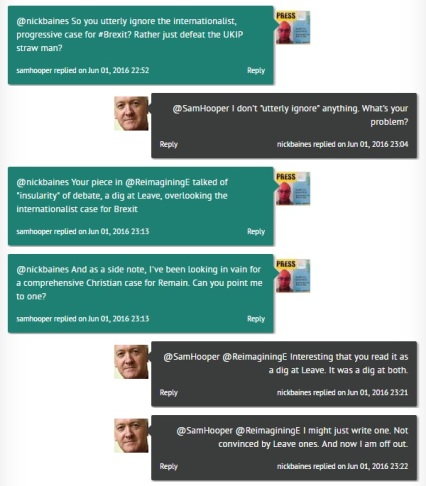
I recently had an exchange on Twitter with Nick Baines, the Anglican Bishop of Leeds, in which I questioned his description of the Leave campaign as “insular” and asked when we might expect a substantive Christian case in favour of the EU:
Bishop Nick Baines - Sam Hooper - EU Referendum - Brexit - Christian case for EU

Bishop Baines promised just such an article, but none has yet been forthcoming. Indeed, a clear, unambiguous and unapologetic Christian case in favour of the European Union and a Remain vote in the EU referendum can scarcely be heard, despite the weight of establishment Christianity coming down on the side of remaining in the EU.

This is untenable. If the bishops are to retain any kind of temporal authority – at least in my eyes – it is not enough to make wishy-washy statements vaguely supportive of the Remain campaign without any intellectual or theological legwork to back them up. This reeks of confirmation bias – of bishops, comfortably ensconced in the establishment, making up their minds that the EU is a good thing in advance, and then cherry picking facts to support their existing viewpoint.

A common Christian complaint is that our religion is being increasingly forced from the public square in this new secular age. And it is partly true – freedom of speech and religious expression are sometimes outrageously curtailed in this country. But participation in the public square comes with a price: if one wants to be heard and taken seriously, one must say sensible things and be prepared to back them up with a solid argument.

At present, too many bishops of the church are willing to sell out the public square and everything else in this country to Brussels, and do so without offering a sound argument for remaining in the European Union based on our knowledge of the nature, purpose and direction of the EU. The bishops believe that a sprinkling of glib words about “togetherness” and “co-operation”, mixed with some hand-wringing concerns about the short term economic impact of Brexit taken straight from the Remain camp’s playbook, amount to a sufficient case. But they do not.

Ideally, the bishops should come down unanimously on the right side of this issue. But since that is not going to happen, they should at least participate in the debate with a shred of honour. And if they arrogantly proceed with their current approach, preaching the Remain argument on the flimsiest of pretexts, then they should not be surprised if they cause the gates to the public square to be permanently locked to Christians.

And what a dismal legacy that will be.


Postscript: More on the Christian case for Brexit hereherehere and here.


European Union - United Kingdom - Britain - Flags

Top Image: New Statesman

Support Semi-Partisan Politics with a one-time or recurring donation:

Agree with this article? Violently disagree? Scroll down to leave a comment.

Follow Semi-Partisan Politics on TwitterFacebook and Medium.

Ambrose Evans-Pritchard Makes A Most Honourable Argument For Brexit

Ambrose Evans Pritchard - Brexit - EU Referendum

All the most eloquent cases for Brexit set aside the bleating of Vote Leave and appeal to the people’s understanding of the democratic case for leaving the European Union

Ambrose Evans-Pritchard’s measured and eloquent justification for his decision to vote Leave on 23 June, published today in the Telegraph, is a must-read example of the noble democratic case for Brexit.

He rightly eschews all of the nonsense spewed out by the official Vote Leave campaign, recognising that this has nothing to do with saving pennies here or there, and that the real basis for any decision on how to vote must be whether one is happy with the current direction of the European Union, and whether one believes there is any realistic chance of altering that trajectory.

And Evans-Pritchard, like this blog, firmly believes that the direction is indeed one we cannot follow, and that there is no such chance of changing the EU’s course:

Stripped of distractions, it comes down to an elemental choice: whether to restore the full self-government of this nation, or to continue living under a higher supranational regime, ruled by a European Council that we do not elect in any meaningful sense, and that the British people can never remove, even when it persists in error.

For some of us – and we do not take our cue from the Leave campaign – it has nothing to do with payments into the EU budget. Whatever the sum, it is economically trivial, worth unfettered access to a giant market.

We are deciding whether to be guided by a Commission with quasi-executive powers that operates more like the priesthood of the 13th Century papacy than a modern civil service; and whether to submit to a European Court (ECJ) that claims sweeping supremacy, with no right of appeal.

It is whether you think the nation states of Europe are the only authentic fora of democracy, be it in this country, or Sweden, or the Netherlands, or France – where Nicholas Sarkozy has launched his presidential bid with an invocation of King Clovis and 1,500 years of Frankish unity.

The following critique of the EU’s effect on national democracy is particularly damning:

The Project bleeds the lifeblood of the national institutions, but fails to replace them with anything lovable or legitimate at a European level. It draws away charisma, and destroys it. This is how democracies die.

“They are slowly drained of what makes them democratic, by a gradual process of internal decay and mounting indifference, until one suddenly notices that they have become something different, like the republican constitutions of Athens or Rome or the Italian city-states of the Renaissance,” says Lord Sumption of our Supreme Court.

And then:

It is a quarter century since I co-wrote the leader for this newspaper on the Maastricht summit. We warned that Europe’s elites were embarking on a reckless experiment, piling Mount Pelion upon Mount Ossa with a vandal’s disregard for the cohesion of their ancient polities. We reluctantly supported John Major’s strategy of compromise, hoping that later events would “check the extremists and put the EC on a sane and realistic path.”

This did not happen, as Europe’s Donald Tusk confessed two weeks ago, rebuking the elites for seeking a “utopia without nation states” and over-reaching on every front. “Obsessed with the idea of instant and total integration, we failed to notice that the citizens of Europe do not share our Euro-enthusiasm,” he said.

If there were more Tusks at the helm, one might still give the EU Project the benefit of the doubt. Hard experience – and five years at the coal face in Brussels – tells me others would seize triumphantly on a British decision to remain, deeming it submission from fear. They would pocket the vote. Besides, too much has happened that cannot be forgiven.

The EU crossed a fatal line when it smuggled through Lisbon Treaty, by executive cabal, after the text had already been rejected by French and Dutch voters in its earlier guise. It is one thing to advance the Project by stealth and the Monnet method, it is another to call a plebiscite and then to override the outcome.

The only vaguely objectionable part is when Evans-Pritchard fails to exhort others to follow his decision:

I urge nobody to follow my example. It ill behoves anyone over 50 to exhort an outcome too vehemently. Let the youth decide. It is they who must live with consequences.

On the contrary, people should be encouraged to follow the decision making process of somebody who actually recognises that the question before us is not a matter of penny-pinching, curtailing immigration, workers’ rights or any other particular outcome, but rather of determining whether the British people should make these decisions for ourselves or have them imposed upon us from a higher authority.

And “letting the youth decide” may sound magnanimous, but in fact it is only through the wisdom of age that we stand a chance of defending our liberties, as Pete North emphasises:

No. You see, the democracy we were born to was fought for and won with blood. It is not ours to give away. We are the custodians of it. And this is too important to be left to the youth, barely out of the state system, barely aware of what the EU is, how it functions or the devious tricks pulled on us to bring it about.

And when I think how dumb I was when I was twenty – and not much smarter five years later, I am inclined to trust in the wisdom of the elders. While they may not be the ones living with the consequences, we all have an obligation to ensure that which we pass on is something that will endure and sustain the peace.

Now look across the Channel and seriously ask yourselves if that political entity has the look of longevity about it. Look closely. Is that really the mess you want to hand to the next generation?

This point resonates strongly with me. As a teenager and into my first years at university I was an ardent euro-federalist, to the extent that the EU flag used to adorn the wall of my digs in Cambridge. I was not ignorant about how the EU worked, but I was ignorant about democracy – the arrogance of youth caused me to conveniently skip over the fact that the project I so admired was not the result of bottom-up desire among the European peoples for an overarching supranational government, but rather the manifestation of a very specific dream shared by a small number of European elites.

My attitude at the time: the EU is self-evidently wonderful, and too bad for those who disagree – they will come around when the project comes to full fruition and they are part of a powerful, prosperous United States of Europe. My attitude now, with fifteen more years of self-study, commercial awareness and general life experience, together with a greater respect and appreciation for democracy: quite the opposite.

The views of the young are important (at 33 I hesitate to include myself in their number), and in many cases their idealism is noble. But the fact that a seventy-year-old will not be around in thirty years to reap the benefits or negative consequences of this year’s EU referendum vote in no way means that their opinions should hold lesser weight. Wisdom, a greater sense of historical context and the desire to be a good steward to the best of our traditions and liberties are priceless attributes of older voters, and yes- sometimes parents and grandparents do know best, as those cheering eighteen-year-old europhiles will discover when they grow up and have families of their own.

Regardless – this minor point aside, this quietly eloquent case for Brexit from Ambrose Evans-Pritchard is very good, and should encourage all thinking Brexiteers that they are right to focus on democracy and the supremacy of Parliament over and above all of the noise from the official Leave and Remain campaigns.

Now, if only Ambrose Evans-Pritchard could be persuaded to go on the stump with this argument…


European Union - United Kingdom - Britain - Flags

Agree with this article? Violently disagree? Scroll down to leave a comment.

Follow Semi-Partisan Politics on TwitterFacebook and Medium.