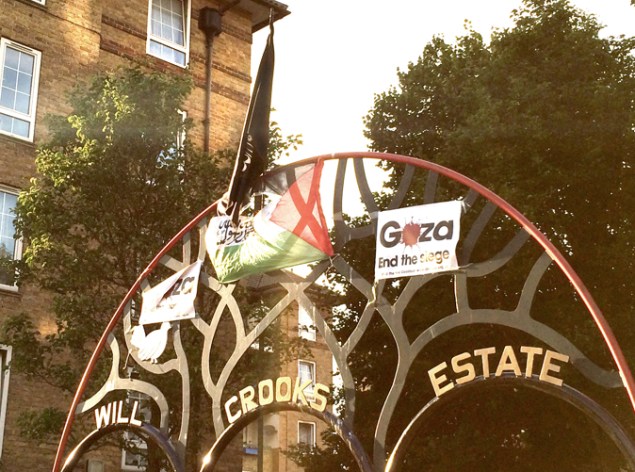
A black flag was flown from the gates of an east London housing estate, and an entire neighbourhood was effectively declared last week not only to be in solidarity with the people of Gaza and the cause of Palestinian statehood, but – contrary to any available evidence or the residents’ consent – to also be united in a shared, extremist interpretation of the Islamic faith.
As the Guardian reported at the time:
The flag bears similar writing to the jihadi flags that have been flown by the extremist group in Iraq and other jihadi groups since the 1990s. When the estate was approached last night, a group of about 20 Asian youths swore at Guardian journalists and told them to leave the area immediately. One youth threatened to smash a camera.
When a passerby tried to take a picture of the flag on a phone, one of the gang asked him if he was Jewish. The passerby replied: “Would it make a difference?” The youth said: “Yes, it fucking would.” Asked if the flag was an Isis flag, one local man said: “It is just the flag of Allah.” But another man asked: “So what if it is?”
Should the black flag be banned from the streets, as it is in some European countries such as the Netherlands? Absolutely not – the right to free speech and freedom of expression is one area where it is actually right to take a maximalist, uncompromising stance despite the difficulties and tensions that it may cause.
Banning the black flag, despite its similarities to the jihadi flags flown by ISIS, is not the right move. If a private individual wishes to mark themselves out in public as a ideologically extremist bigot with pro-terrorism sympathies, that should be their protected right. But the flag had no place being flown on council-owned housing property as though it spoke for all of the residents when it did not, and so it was right that the flag was removed by Sister Christine Frost, a Roman Catholic nun and local community activist.
Douglas Murray summed up the most appropriate reaction to the provocation at the time in The Spectator, explaining in stark terms the gravity of the fact that some British Muslims chose to proudly display a flag of this type in London, so far removed from the various conflicts:
When historians look back on Europe in this era, they will rub their eyes in disbelief. ISIS is carrying out actual genocide, ethnic and religious cleansing on the people of Syria and Iraq. Their exact ideological soul-mates in Hamas, Hezbollah and al-Qaeda are doing everything they can to set light to the same region. Right now the western states are finally talking of intervening in Iraq to stop ISIS wiping out the ancient Yazidi and Christians communities of Iraq. Yet we do nothing to stop the same murderous ideology thriving here.
Instead another pattern is set. When we see this disgusting ideology at work, as we have done for the last month, much of Europe turns its hatred onto the Saturday people for defending themselves. Israel continues to defend itself. And we may do something to hold back ISIS in Iraq. But what will we do in our societies when we finally realise that behind the flag of Hamas is the black flag of jihad, and that after failing to stand up for the Saturday people there will be fewer people left to stand up for the Sunday people?
Most importantly, what will we do when we wake up to the fact that, far from being in some neighbouring or far-flung country, we have allowed the enemy to plant itself deep inside our own countries?
But perhaps predictably, LondonLive is now reporting that the same young people who raised the flag over a housing estate in east London are complaining that the flag’s very removal is a sign of racism and Islamophibia:
A controversial black flag flown above the gates of an east London council estate is being defended by young Muslims.
The flag – which has been linked to some jihadist groups – has been removed twice by a concerned nun and police officers.
But youths at the Will Crooks estate in Poplar have today said assumptions that the flag is linked to extremist groups is ‘racist’.
One youth said: “It’s just racists complaining. If it was the St George’s flag, it would be alright. But this is our version and there’s this big reaction.”
More than the fact that the flag was raised in the first place by one or two deluded hotheads, it is the fact that the flag was then defended by other, supposedly representative local youths, that should give everyone the greatest cause for concern.
Here, in the young peoples’ protest, is the whole problem in a nutshell, the root of the problem with Islamic extremism in Britain. It’s the regrettable attitude by some Muslims that proclaims “You may be English, but we’re Muslim”. It’s the stubborn belief among its adherents that they are Muslims who just happen to live in Britain, rather than British people who happen to follow the religion of Islam. And yes, it’s the craven support from some appeasers on the left, who overlook or excuse the lack of integration with British society, and echo their accusations of Islamophobia and racism directed at anyone who argues for greater cultural assimilation and the embracing of British values.
The fact that the go-to defence offered up by the local youths was a comparison with the St George’s Flag, one of the home nation flags of the United Kingdom, reveals the height of the mountain that must be overcome. The St George’s Flag belongs just as much to the angry Muslim youths in the Will Crooks housing estate as it does to anyone else in England, but they choose to reject it in favour of a religious flag, despite the fact that their chosen standard has a violent, gory recent history.
In modern Britain (with the partial exception of Northern Ireland, where sectarianism and flags are still linked with intolerance and violence), one’s religion and faith is not demarcated with a flag. Indeed, religion and national identity or patriotism exist, for the most part, on separate planes – and much the better for it. A British Catholic may follow Church doctrine and hold the Papacy in the highest reverence, but will likely identify as British first and foremost, and it is to the country that their primary allegiance lies. The same could be said of most British Jews, or mainstream British Muslims.
But there is a sizeable, vocal block of non-mainstream Muslims who clearly do not identify themselves as British first and foremost, who in some cases feel that they are pitted against their non-Muslim neighbours and compatriots because of their faith. And these people are eagerly capitalising on events taking place many thousands of miles away – in Iraq, Syria and Gaza – to pledge their solidarity with and allegiance to this religious, cross-border fraternity before they give any thought to Britain, the country that gives them life and liberty.
This has to stop, but in order for the situation to change it must first be recognised as a problem. This recognition needs to come from Britain’s mainstream Muslims first and foremost – of course community leaders and parents can only do so much to teach tolerance and British values when social media and internet voices speak the language of extremism, but still an effort must be made commensurate with the scale of the problem.
But the rest of us have a role to play too. Where there is genuine Islamophobia, we must confront it and correct misconceptions about moderate, mainstream Islam. But equally, we must not be cowed into defending extremism when we encounter it, for fear of being labelled racist or intolerant. We have seen the insidious harm that can be done when a blind eye is turned to the extremist threat in the case of the Birmingham “trojan horse” schools scandal.
The people who chose to hung the black flag from the gates of the Will Crooks estate in Tower Hamlets were not merely expressing solidarity with the people of Gaza in the course of the current conflict with Israel. They went above and beyond that statement of solidarity (which was itself inappropriate as it presumed to speak for the whole community without their consent), and flew a flag which they knew to have connotations of violence and extremism. Any pretence that it was all just an innocent misunderstanding was shattered when the flag was re-flown again days after being taken down.
Unless and until the wall of stubborn, self-imposed segregation is broken down between tolerant, mainstream Britain (including moderate British Muslims) and those sullen holdouts who feel stronger identification and fealty to primitive, medieval dogma than to their own country, Britain will continue to wrestle with this toxic (and increasingly existentially threatening) issue.
And before long, an offensive flag flying in the shadow of Canary Wharf will be the very least of our concerns.
Photograph: From Trial by Jeory blog.




 Semi-Partisan Politics