Sincere Congratulations To The Spectator For Their All-Women Cover Issue

Fraser Nelson - The Spectator - Westminster Media - Journalism

A brief rant before normal service resumes…

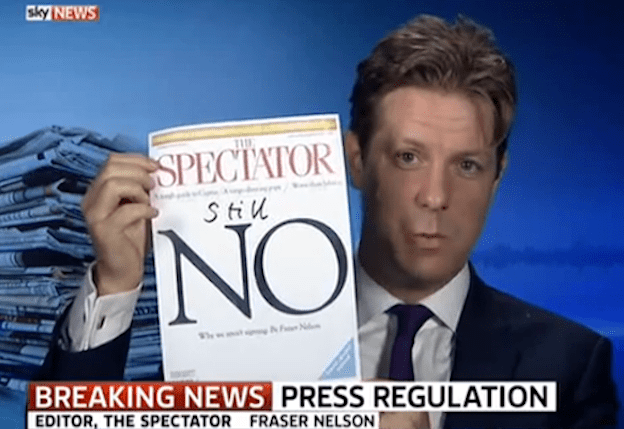
The Spectator editor Fraser Nelson today felt the need to publish a self-congratulatory humblebrag remarking on the fact that their latest print edition’s cover page apparently features only the work of female writers, despite no conscious decision having been made to indulge in affirmative action.

Nelson gushes:

Just before The Spectator went to press yesterday, my colleague Emily Hill pointed out that I’d just taken away the only male name away from the cover: all seven of our coverlines were stories written by women. Did I really want that? I hadn’t thought about it until then, and for a while I did consider engaging in tokenism and slapping a man on for the sake of it. But why bother? Spectator readers don’t really care about gender, just good writing.

In fact it hadn’t occurred to any of us, until that point, that we were about to run what Ariane Sherine, who writes our cover story, today hails as the first all-woman cover in The Spectator’s 188-year history. But this wasn’t a patronising attempt at a ‘wimmin’s issue’ or some other awful tokenistic wheeze. Our all-women cover wasn’t deliberate, it was just the way the cards fell. Each week we want to get the best writers on the most original topics: this week, they all happened to be women.

That’s not to say there’s no difference when it comes to getting hold of good writers. As Emily will tell you, women don’t put themselves forward as much as men. To get the full range of talent from all available writers can mean people like Emily going to great lengths to find and encourage new writers – like Ariane Sherine. As so often, Fleet Street follows up. As I write, two national newspapers are vying for the right to republish her cover story.

Full disclosure: I have a bit of a beef with lead article author Ariane Sherine (a one-sided affair; she, I’m sure, has no idea who I am) following her previous effort for The Spectator, an appallingly condescending report about how she performed a comedy gig in the heart of UKIP-supporting coastal Essex and somehow, miraculously, was not ripped to shreds by the rabidly racist, evil Brexiteers who dwell there.

It is interesting, too that Sherine (and apparently other women writers published in The Spectator) had to be sought out, coaxed and persuaded to write for the venerable magazine because “women don’t put themselves forward as much as men”. Funny, that. I, a despicably privileged man, have pitched to The Spectator before – it was actually a terrible piece from a few years back when my writing was very green, not at all worth publishing – but then I never had the pleasure of being sought out and implored to honour The Spectator’s readers with the fruits of my keyboard. That must be quite a nice feeling.

I don’t normally do this, but let’s just muse on the topic of gender equality for a moment, particularly as it relates to journalism. Regular readers will know that I spent pretty much every spare moment of the past year campaigning for Brexit in the EU referendum, initially rather haphazardly but (I hope) increasingly coherently as I read Richard North’s peerless eureferendum.com blog, learned about Flexcit and fell in with The Leave Alliance. I claim zero credit for any of the specific ideas this blog has supported around Brexit and the future of international trade – my tiny bit part in this effort consisted merely of standing on the shoulders of giants, particularly Richard North and Pete North, whose technical mastery and polemical writing I admire enormously.

The point, I suppose, is this. For some time now, a group of independent, citizen bloggers have churned out consistently better analysis and commentary on the EU referendum and Brexit on any given day than the mainstream media has given the British people in an entire year. Even now, dim-witted publications like the Guardian and FT are scrambling to catch up and think through some of the ramifications and issues which the people in my circle have been writing about for months. And what mention or recognition has this work prompted from the Westminster media? How many links to our widely-read and shared articles have appeared in mainstream outlets like The Spectator?

I think you know that the answer is zero.

Now, you don’t have to rate Semi-Partisan Politics at all – though I am personally quite frustrated, this issue is much bigger than little old me. But doesn’t it seem slightly odd that the entire Westminster media managed to somehow overlook the hard work of a small army of pro-Brexit bloggers on the biggest political issue to face Britain, just when fresh analysis was sorely needed, and yet The Spectator has time to scour Britain at great length for underappreciated female talent to promote to the front page?

Fraser Nelson claims that The Spectator’s all-women front page was entirely accidental, and I take him at his word. But isn’t it telling that this feat was achieved at the height of silly season, the summer recess, when the political news which is the Spectator’s bread and butter is almost entirely absent? When MPs come back from recess and things get serious again, let’s see how many months or years it takes for the next unintentional all-women issue to go to print. My guess is that it will be some while; that when PMQs is back and party conference season gets underway we will be seeing a lot more of James Forsyth, James Delingpole and Rod Liddle on the cover. Just a hunch.

So what was the amazing piece which made the cover of The Spectator anyway, you ask? Well, it was a thrilling exposé of a growing trend among millennials whereby single women stop looking for a suitable man and choose to marry themselves instead.

A snippet:

As far as the bride was concerned, the wedding was perfect. Her dress was beautiful, the vows were traditional and she changed her name after the ceremony. The clifftop scenery was breathtaking, the seven bridesmaids were encouraging and supportive: move over Princess Di. There was only one thing missing: the groom. Like a growing number of single women, Sara Starkström had decided to marry herself.

‘I thought about people marrying other people without loving themselves first,’ says Starkström, a writer, explaining what many would call a bizarre overreaction to finding herself single at the age of 29. ‘How could they pledge to do all this stuff for another person when they couldn’t promise themselves the same thing? I decided to marry myself to celebrate my independence and strength. I did it to promise to be my own best friend.’

[..] While many commentators make scathing judgments about sologamy (the feminist blog Jezebel ran a dismissive piece called ‘Single women, please stop marrying yourselves’, chiding, ‘You should be aware that you’re no trailblazer and you’re sure as hell not thumbing your nose at the system. You’re buying into it’), this hasn’t stopped increasing numbers of women from taking the plunge. For Starkström, self-marriage was a liberating act for which she is quite happy to take all the jokes ‘about me carry-ing myself over the threshold and making love to myself’.

And the thrilling conclusion:

Perhaps this is the crux of the sologamy issue: self-marriage is harmless, cheap compared to the £20,500 average cost of a classic wedding, and the union seems to make the bride very happy. If only the same could be said for the majority of traditional marriages which feature a groom. Princess Diana’s fairy tale fell apart when she found that there were three people in her marriage. Now, for an ever-increasing number of determined modern women, one is more than enough.

This isn’t even original. Even I know – don’t ask me how – that Sex and the City featured a similar storyline nearly fifteen years ago, in which protagonist Carrie Bradshaw decides to marry herself as a way of recouping the money spent on friends’ engagements and replacing an expensive pair of shoes which were stolen at a previous party. This kind of story is “and finally…” fodder on the TV news, not lead article material for The Spectator.

This may be silly season, but British politics is hardly dull at present – we have the ramifications of the EU referendum result to pick through, and the slow-motion car crash that is the Labour Party’s self-destruction, while America continues to wrestle with the Donald Trump phenomenon. In these circumstances, I’m sorry to say that Sherine’s story about sologamy has more than a whiff of affirmative action about it.

Before the inevitable feminist lynching begins, another disclaimer: I have long believed that The Spectator’s Isabel Hardman is the outstanding political journalist of her generation and, based on my couple of conversations with her, a genuinely nice person in the SW1 bubble. If The Spectator had ten Isabel Hardmans on staff, I wouldn’t expect a male-written cover story any more than once a year. It shouldn’t be necessary, but I want to put any idea that this rumination is some alt-right, anti-woman rant quickly to bed.

Note too that even when quoting the established feminist blog Jezebel, The Spectator fails to provide a link to the article Sherine cites by name. This is how unwilling the establishment British media are to share readers, clicks and opportunities. It is selfishness beyond measure, and is ultimately counterproductive – the American political blogosphere grew and thrives today not only because bloggers link to one another, but because there is a dialogue between what were traditionally the “legacy” print media outlets and alternative voices.

Readers aren’t forever lost to a publication which dares to link. In fact, readers often respect the original source all the more as a curator of other worthwhile information across the internet, thus increasing their loyalty. Maybe this doesn’t easily show up in the monthly SEO and web traffic reports which now seem to drive all media behaviour – and which have turned the Telegraph from a respectable broadsheet to a sensationalist purveyor of clickbait – but it is a real factor nonetheless. My own personal blogging hero, Andrew Sullivan, built the most influential political blog in history based entirely on this philosophy of curating the web for his readers and also providing fresh commentary which was picked up by the legacy media.

To this day, if there is a worthwhile piece of commentary or analysis on an American political blog, it is not unusual to see it linked to in a piece by an “establishment” journalist on the staff of, say, the New Republic or the National Review. Semi-Partisan Politics has been cited in the National Review a couple of times, a courtesy not once extended by any major British publication, and this despite the fact that 80 per cent of this blog’s output concerns UK rather than American politics.

So how should the British media interact with the blogosphere and promote new talent? Well, call me old fashioned but I believe that a simple commitment to meritocracy can’t go far wrong. Sure, The Spectator will always hire the likes of Pippa Middleton to write vacuous society guff about hunting for truffles in their Christmas issue, and that’s fine. But when it comes to political coverage, one wishes that established British publications would at least pretend to aspire to genuine meritocracy, seeking out the best analysis and commentary regardless of race or gender rather than indulging as they do in flagrant nepotism on the one hand and leftist affirmative action on the other.

I’ll speak plainly, because it’s better than dancing around the issue, from my perspective as someone no longer in the first flush of youth trying to build an audience and reputation as a writer. It is frustrating to pour every spare minute into this blog, providing (I dare to hope) sometimes original and refreshing commentary – particularly I think on the 2015 general election, the ongoing Labour leadership saga, free speech or academic freedom issues and the EU referendum – and see what is  objectively weaker commentary from nepotism beneficiaries or the obvious fruits of affirmative action benefit from a prestigious platform, greater recognition, and – oh yes, from monetary reward too. It’s just a little bit hard to take day after day.

I could play the minority card too, if I wanted to talk up my BAME working class background, but I would never compromise my principles by demanding that I be given a platform based on who I am rather than what I have to say. I won’t go there – it would be a violation of everything that this blog stands for. Others sadly seem happy to do so.

I write because I love to write, and because I think I have slowly created something quite small but precious here at Semi-Partisan Politics; because I have a small readership whom I love to serve, write for and debate with; because it is better than ranting into Facebook 24/7 as I used to before I opened a WordPress account. But sometimes it is a bit galling to see an inferior product exalted and given prominence when I and several of my good writer friends toil in obscurity.

Building a reputation and audience as a writer should be hard – it rightly takes time, effort, humility and perseverance. It has taken me over four years to even begin to get a sense of who my audience is / should be, and how best to serve them – and I claim no special skill at what I do, only a great deal of enthusiasm for it. But whether it is Twitter interactions, links to my site or other interactions, the amount of support I have received from American journalists and publications on the other side of the Atlantic vastly exceeds what little help or hand up I have ever received from the British media class – despite the fact that at least 80 per cent of my written output, networking and outreach efforts are focused on British politics and the Westminster media.

And I think British journalists and editors should be made to feel a little bit ashamed of that fact. Not for my sake – I’ll be just fine, and 95 per cent of the time I am happy to keep plugging away without a murmur of complaint. They should feel shame because my situation is far from unique, and because there are writers in my acquaintance whose insight, bravery and raw talent would enrich our country’s entire political discourse if only it had the bully pulpit it deserves.

The Westminster media establishment should be ashamed because the way they seek out and promote writing talent fails the British people, serving them an often substandard and derivative stream of written output and unoriginal thinking from the pens of the well-connected (either by parentage or ability to fill the checkboxes of a Diversity Officer’s form) while effectively pretending that the struggling political blogosphere – the primary outlet for so many talented, aspiring writers – doesn’t even exist, and certainly not as a source worthy of links or interaction.

Okay, rant over. I don’t have the energy to bring this piece to a neat end.

Normal business will now resume. Read it here first, or three months later from someone who gets paid to do this kind of thing.

 

Political Blogging 2

Top Image: The Spectator / Sky News

Support Semi-Partisan Politics with a one-time or recurring donation:

Agree with this article? Violently disagree? Scroll down to leave a comment.

Follow Semi-Partisan Politics on TwitterFacebook and Medium.

The Greatest Threat To American Democracy Is The Sensationalist, Ratings-Obsessed Television News Media

It took two monsters to create Donald Trump, Presidential Candidate Edition: the debased Republican Party of Sarah Palin, and the slavish, contemptible American television news media

After getting heartily sick of watching the British rolling news channels the past few weeks, I decided to spend the last couple of days watching CNN (the US version, not the godawful international version).

It wasn’t pretty. In fact, it was almost enough to make one long for the BBC’s barely concealed hysteria at the thought of Brexit and being forcibly ripped apart from their beloved supranational European political union, or Sky’s never-ending quest to be the first news organisation to get their newscopter hovering directly above anything which may or may not turn out to be of interest.

Take today as an example.

For the past four hours, CNN has been reporting the “breaking news” that Donald Trump claims that his campaign has “never been more united” when various Republican talking heads that CNN was able to lure into the studio were willing to say the exact opposite – and hardly surprising, since their presidential candidate is is a proudly ignorant egomaniac with a borderline personality disorder.

This couldn’t even be charitably described as “breaking news” when I first tuned in at around 8PM London time, and it certainly isn’t breaking news four hours later. But still, there it is: “Awaiting Trump Rally In Florida” proclaims the banner, while five disembodied talking heads float on a giant screen behind Wolf Blitzer, waiting to air their opinions.

What you notice watching American news – besides the constant advertisements for dubious pharmaceutical products whose long lists of compulsorily recited side-effects often outweigh their curative properties – is the degree to which everything, and I do mean everything, is about Donald Trump.

(At this point it is worth pointing out to uninitiated British readers that CNN is the closest you’ll get to “objective” cable news reporting in America, with fair ‘n balanced Fox News skewing firmly to the right and MSNBC leaning forward equally firmly left. Not being overt partisan shills for one or other of America’s two main political parties is a nightmare for CNN executives who need high ratings, and so in desperation CNN latches on to every single technical gimmick you can imagine – drone cameras! holograms! – in a desperate bid to make their offering more exciting to fickle viewers).

It is fair to say that were it not for the American television news media, Donald Trump would be filming a new season of The Apprentice and lending his name to another shoddily-made range of “luxury” businesswear right now, rather than facing Hillary Clinton as the Republican Party’s presidential nominee.

This blog has already raked the GOP over the coals for their pitiful part in these dismal proceedings. But in despairing at the intellectually and morally debased Republican Party we should not let the media off the hook.

For the fact is that America’s news networks failed to fulfil their democratic duty by treating a presidential election like it was sweeps week rather than a serious decision with long-term consequences for the future of the republic. Donald Trump makes a great television candidate because he is willing to do and say things – exciting, attention grabbing things – which no other candidate will say. Unfortunately, this nearly always involves Donald Trump being rude, immature, spiteful or wrong about something or someone. But the news networks don’t care. It makes for great TV. And so they show more and more Trump, and less and less of everyone else.

When the Republican Primary campaign was still being fought, at one point we reached the ludicrous position where Senator Marco Rubio made the tactical decision to emulate Donald Trump’s style and start making gratuitously offensive insults and statements of his own, just to try to wrest the attention of the television cameras away from Donald Trump for one wretched moment. Needless to say, it backfired – Rubio could never match Trump’s ability to mock and belittle people, and so he ended up tarnishing his own reputation while doing nothing to halt Trump’s rise.

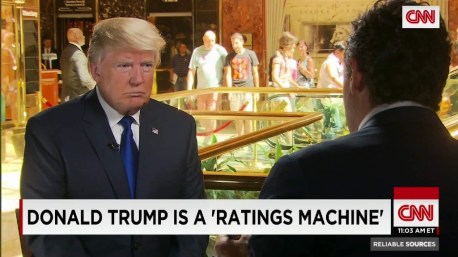
Donald Trump - Ratings Machine - CBS - Les Moonves - CNN - Television News

My point, I suppose, is this.

There is nothing funny or entertaining about this American presidential election. Voters are faced with a rather dismal choice between a far from universally loved Democratic Party candidate on the one hand and an absolute megalomaniac on the other. And they have been put into this position of not having a decent choice between two valid, honourable but competing political philosophies largely thanks to the decision of the television networks last year to break into their regularly scheduled programming every time Donald Trump raised an eyebrow, while giving the other Republican candidates (let’s face it, many of whom were so hopeless that they really needed a media leg-up of their own) almost zero screen time.

The other candidates had to drop what they were doing and go to Washington or New York if they wanted to be featured on the Sunday shows. Trump was permitted to appear by satellite link or even telephone, so eager were American news executives for a bit of Trump’s verbal gold. And whenever Donald Trump has been interviewed, the questions have frequently been of the most depressingly softball variety. America does not have a Jeremy Paxman figure, or even an Evan Davis (God help them). Nor do they have as strong a tradition of confrontational political interviews as we have in Britain – the tradition of deference to authority is, rather counter-intuitively, very strong in America. And so during all of his unearned media time, Donald Trump has very rarely been faced with a single question which caused him to stumble, despite his lengthy back catalogue of cruel and ignorant public pronouncements. Rarer still has Trump faced a searching follow-up question when he replies with one of his repetitious, opaque defensive statements.

All of which makes Amy Goodman’s excoriation of the American news media very true, and rather refreshing:

The media manufactures consent – for war, for candidates in elections, by bringing you more, for example, of one person. Like Donald Trump. He is pumped into everyone’s home. He can just stay in a gold gilded mansion in New York or one of them in Florida. The rest of the candidates trudge from one state to another. Why does he get this unfiltered pipeline into everyone’s brain, into your eyes and to your consciousness?

It matters. The Tyndall Center did a report in 2015, they looked at the whole year, and they found Donald Trump got 23 times the coverage of, say, Bernie Sanders. They found ABC World News Tonight did something like 81 minutes on Donald Trump and I think they gave Bernie Sanders 20 seconds.

[.] In this high-tech digital age, with high-definition television, digital radio, all we get is static, that veil of distortion and lies and misrepresentations and half truths that obscure reality, when what we need the media to give us is the dictionary definition of static. Criticism. Opposition. Unwanted interference. We need a media that covers power, not covers for power. We need a media that is the fourth estate, not for the state. And we need a media which covers the movements that create static and make history.

Obviously Goodman’s interest was promoting the candidacy of Bernie Sanders (the video was made several months ago before he officially dropped out of the Democratic primary contest), but her critique of the wildly excessive time and attention lavished on Donald Trump by the television news media is dead accurate.

As a Brexit campaigner during the EU referendum, representing an organisation (The Leave Alliance) which was the only group to actually offer a comprehensive Brexit plan yet struggled to get any meaningful media attention, all of these same criticisms apply to the British media too. It’s nice to know that these problems are universally felt on either side of the Atlantic, I guess.

As a small campaign organisation it was almost impossible to get our word out when the television news was racing to cover every last syllable which dribbled from the mouth of Boris Johnson, while our own esteemed experts – including one of Britain’s foremost authorities on the EU – struggled to get journalists to show up to a launch event right in their own Westminster back yard.

Nobody expects perfection from the media. Media companies have to pay the bills too, and often keep shareholders happy. But for so long as telegenic ignoramuses dictate television (and print) coverage to the extent that they do, our democracy will remain vulnerable to demagogues like Donald Trump.

On election night in America, we will see (as we always do) the great and the good of American TV journalism pat themselves on the back and endlessly congratulate themselves about the moving spectacle of democracy which they are helping to transmit to a grateful nation. Brian Williams, Rachel Maddow, Wolf Blitzer, Diane Sawyer, Lester Holt, Dana Bash, Joe Scarborough, Shepard Smith, Chris Wallace, Bret Baier, Greta van Susteren, Andrea Mitchell and all the rest of them will be churning out platitudes about the beauty of democracy faster than you can stick knitting needles in your ears.

This year, they might consider dwelling on the role they have played in debasing and jeopardising that democracy in the tawdry pursuit of ratings.


Donald Trump - Make America Great Again

Support Semi-Partisan Politics with a one-time or recurring donation:

Agree with this article? Violently disagree? Scroll down to leave a comment.

Follow Semi-Partisan Politics on TwitterFacebook and Medium.

This EU Referendum Is Of Existential Importance. So Why Is The Campaign Rhetoric So Unequal To The Occasion?

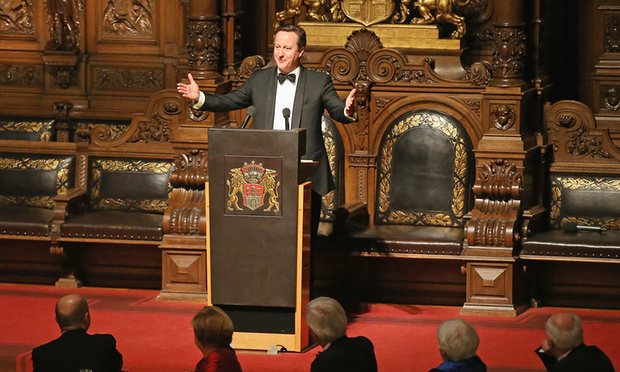
David Cameron - EU Referendum - European Union - Brexit - Speech - Rhetoric

The age of glib soundbites and dumbed-down, instantly shareable viral social media memes is perfectly suited to the Remain campaign’s strategy of sowing fear, uncertainty and doubt as widely as possible. But if we still lived in the age of great political speeches, the Brexiteers would be winning this EU referendum by a landslide

Because I’m an oddball, sometimes I like to spend time reading or listening to great political speeches from the past – particularly those from American politics.

Two of the more obvious such speeches – JFK’s “We Choose To Go To The Moon” and Theodore Roosevelt’s “Dare Mighty Things” – have been forcing themselves repeatedly to the forefront of my mind lately, though until tonight I was unsure why.

Then this evening I stumbled on this 2011 article by Peggy Noonan, Wall Street Journal columnist and former speechwriter for President Ronald Reagan. Though the article’s discussion of social media shows its age, it makes for an interesting read today:

One way to change minds about the current crisis is through information. We all know this, and we all know about the marvellous changes in technology that allow for the spreading of messages that are not necessarily popular with gatekeepers and establishments. But there’s something new happening in the realm of political communication that must be noted. Speeches are back. They have been rescued and restored as a political force by the Internet.

In the past quarter-century or so, the speech as a vehicle of sustained political argument was killed by television and radio. Rhetoric was reduced to the TV producer’s 10-second soundbite, the correspondent’s eight-second insert. The makers of speeches (even the ones capable of sustained argument) saw what was happening and promptly gave up. Why give your brain and soul to a serious, substantive statement when it will all be reduced to a snip of sound? They turned their speeches into soundbite after soundbite, applause line after applause line, and a great political tradition was traduced.

But the Internet is changing all that. It is restoring rhetoric as a force. When Gov. Mitch Daniels made his big speech – a serious, substantive one – two weeks ago, Drudge had the transcript and video up in a few hours. Gov. Chris Christie’s big speech was quickly on the net in its entirety. All the CPAC speeches were up. TED conference speeches are all over the net, as are people making speeches at town-hall meetings. I get links to full speeches every day in my inbox and you probably do too.

People in politics think it’s all Facebook and Twitter now, but it’s not. Not everything is fractured and in pieces, some things are becoming more whole. People hunger for serious, fleshed-out ideas about what is happening in our country. We all know it’s a pivotal time.

Look what happened a year ago to a Wisconsin businessman named Ron Johnson. He was thinking of running for the Senate against an incumbent, Democratic heavy-hitter Russ Feingold. He started making speeches talking about his conception of freedom. They were serious, sober, and not sound-bitey at all. A conservative radio host named Charlie Sykes got hold of a speech Mr. Johnson gave at a Lincoln Day dinner in Oshkosh. He liked it and read it aloud on his show for 20 minutes. A speech! The audience listened and loved it. A man called in and said, “Yes, yes, yes!” Another said, “I have to agree with everything that guy said.” Mr. Johnson decided to run because of that reaction, and in November he won. This week he said, “The reason I’m a U.S. senator is because Charlie Sykes did that.” But the reason Mr. Sykes did it is that Mr. Johnson made a serious speech.

A funny thing about politicians is that they’re all obsessed with “messaging” and “breaking through” and “getting people to listen.” They’re convinced that some special kind of cleverness is needed, that some magical communications formula exists and can be harnessed if only discovered. They should settle down, survey the technological field and get serious. They should give pertinent, truthful, sophisticated and sober-minded speeches. Everyone will listen. They’ll be all over the interwebs.

What a strange idea: the internet restoring rhetoric as an important part of our political debate. While this positive trend may have flared briefly in America for a time as Noonan indicates, we have certainly seen no comparable renaissance of political speechwriting here in Britain. Sure, Nigel Farage can deliver a withering put-down in the European Parliament and the SNP’s Mhairi Black can make sentimental lefties go all misty-eyed, but as a rule, for at least the past thirty years, political speeches in Britain have been pedestrian and utterly forgettable.

This is rather odd. Britain is currently engaged in an existential debate over whether we leave or remain in the European Union, the seriousness of this one issue dwarfing any mere general election, as the prime minister himself has opined. Surely the speeches made by our politicians should therefore reflect the gravity of the decision before us. But does our rhetoric meet the level and tone required of such a debate? Hardly.

As an ardent Brexiteer, one of the main problems I encounter when debating the issue with people – particularly online – is that abstract concepts such as democracy and self-determination are much harder to put into words or summarise with a glib but memorable phrase, while the fearmongering rhetoric of the Remain campaign naturally lends itself to viral sharing. It is much easier to (falsely and hysterically) declare that pensioners will be £32,000 worse off or that 100,000 marriages in London will fail because of Brexit than to explain the intangible importance of living in a properly free society – and almost inevitably the person attempting to argue the side of self-governance ends up sounding ponderous and vague in contrast with the swivel-eyed certainties uttered by Remainers.

And when eurosceptics try to dial up the rhetorical heat, too often it comes off badly. While UKIP-ish phrases like “we want our country back” are certainly memorable, they also have a distinctly nativist twang which alienates a good many people even as it fires up true believers. It is the same story with these key phrases, repeated over and over again by the official Vote Leave campaign, from their daily emails to the phrases of key surrogates:

We send £350 million a week to the EU – enough to build a new hospital every week

250,000 EU migrants a year come to the UK and five new countries are in the queue to join – including Albania, Serbia, and Turkey – it’s out of control and damages the NHS

It’s safer to take back control and spend our money on our priorities

This is apparently the best that the cream of Britain’s eurosceptic talent can do – an utterly unbelievable pledge about diverting 100% of our current EU contributions, including the rebate, to building new hospitals, and an unconnected pivot from the NHS to it being “safer” to spend money on our priorities. One can just about see what Vote Leave is trying to do, but it is an amateurish, almost childlike attempt at political messaging.

Meanwhile, here is the slicker effort from Britain Stronger in Europe:

Britain is stronger, safer and better off in Europe than we would be out on our own.

Join the campaign to remain in Europe – and let’s secure a stronger Britain that delivers opportunity now and for future generations

Never mind that it is based on a lie. A lie repeated identically and often enough can be incredibly effective, as it is with Vote Leave’s misrepresentation that leaving the political organisation known as the EU means leaving the continent of Europe. There is also more of a positive message here – where Vote Leave talk about Brexit being “safer”, suggesting danger and a defensive attitude, Stronger In talk about “deliver[ing] opportunity now and for future generations”, exuding positivity for today and for tomorrow as well.

Only when the message delivery window is longer than a quick email or a short social media meme does the Brexit side begin to redress the balance. Put aside their dubious and counterproductive tactics for a moment, but Vote Leave spokespeople like Michael Gove and Daniel Hannan (even Nigel Farage) can paint an extremely attractive picture of Britain outside the European Union in a speech, particularly when they aren’t butchering the idea of how to go about achieving their goal.

Even more pertinently, look at the Flexcit plan for leaving the European Union, which is increasingly being seized upon by key influencers who despair of Vote Leave’s amateurism and lack of a clear, risk-minimising Brexit plan. Flexcit itself is a 400 page document, while the summary pamphlet clocks in at a still substantial 40+ pages. At a recent TED-style talk in central London, Dr. Richard North (Flexcit’s primary author) took an hour to lay out the ideas and reasoning behind it. Though the Leave Alliance network of committed bloggers (full disclosure: I am one of them) do a sterling job of breaking down and simplifying the concepts so as to sell them more effectively to key influencers and the public, Flexcit will never be an easily-shared, one page meme on Facebook. Nor should it be. Serious and weighty issues require serious responses.

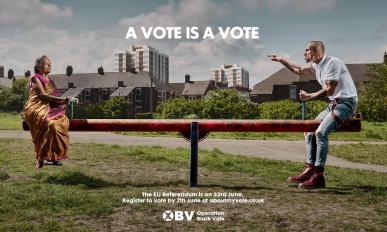
But increasingly it appears that the Leave camp will be punished at the ballot box for the fact that its core argument about democracy and self-determination cannot be boiled down to a single positive phrase or graphic in the same way as the establishment-backed Remain campaign can churn out endless content, together with slick but abhorrent messages from professional agencies:

Operation Black Vote - OBV - A vote is a vote - EU Referendum - European Union

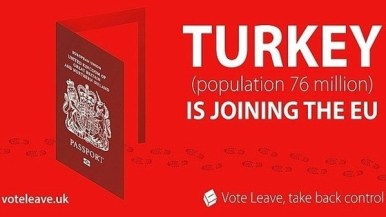
Of course Vote Leave are guilty of shameless fearmongering too, never more so than with this dreadful fearmongering ad about Turkey joining the EU:

Vote Leave - Turkey Joining EU

But whether it is raising fears of knuckle-dragging, Brexit supporting skinheads or the armies of Turkish immigrants who will apparently all decamp to Britain en masse at the first opportunity, both are seen as highly effective tools by their respective campaigns, and both rely on communicating a primitive, fear-based message not with rich rhetoric but with a short, sharp visual, the better to hold our limited attention spans.

In many ways, it is a tragedy for the Brexit cause that this opportunity to extricate ourselves from an unwanted supranational government of Europe has come about when the internet has taken off and the average person’s idea of profound political engagement is liking and sharing the latest snide Huffington Post article with their friends on Facebook. When the debate over whether or not Britain should join Europe raged in the late 1960s and early 70s, the art of making serious (if not quite great) speeches was still just about alive – Hugh Gaitskell’s famous address to the Labour Party conference warning against joining the EEC stands as one such example of memorable oratory, culminating in the famous “thousand years of history” quote:

We must be clear about this; it does mean, if this is the idea, the end of Britain as an independent European state. I make no apology for repeating it. It means the end of a thousand years of history. You may say: “Let it end.” But, my goodness, it is a decision that needs a little care and thought.

But when the history of Britain’s 2016 EU referendum comes to be written, what will we remember? Of all the particularly dramatic moments in the campaign to date, none of them have been speeches. Sure, sometimes the fact of a speech has been newsworthy, such as when an unexpected establishment figure has been wheeled out to say that Brexit will usher in the apocalypse, but the content – the oratory itself – has rarely raised hairs or stiffened spines.

In fact, proving Eleanor Roosevelt’s famous assertion that great minds discuss ideas, average minds discuss events and small minds discuss people, the media has determinedly reported almost exclusively on the latter two. Of course that is always the temptation for journalists, but our politicians have hardly given the media much to work with on the ideas front, even if they were minded to cover them.

This is a depressing state of affairs. This most important debate should be bringing out the best in our politicians and our media. We should be witnessing a straight-up fight between advocates of the democratic, independent nation state and those who ardently believe in the euro-federalist dream, adjudicated by a press corps  beholden to neither side and always willing to challenge baseless assertions rather than merely provide a “fair and balanced” platform for two partisan idiots to yell at each other for an equal amount of time.

In this debate, our elected leaders should be role models in setting the tone of the debate. Of course they are not, because our professional political class are very much part of the problem – the main reason why Brexit should only be the first step in a broader process of constitutional reform and democratic renewal in Britain.

But here we are, a country administered by followers rather than leaders, watched over by a childish and corrupted press who would rather giggle about the referendum’s personal dramas than fulfil their democratic function. And too little time before the referendum to hope that anything much will change.

All of which is bad for Brexiteers. After all, this is an age when scaremongering claims and assertions about the supposed cost of Brexit can be “quantified”, slapped on a smug little infographic and shared ten thousand times before breakfast, while the importance of self-determination an democracy – the ability of the people to influence the decisions which affect them and dismiss those with power – is almost impossible to boil down to a single eye-catching number, despite being the most precious benefit of all.

Without honest political leaders to establish a narrative and bigger picture – and without a robust media to report – it is effectively left to well-intentioned citizens to hold the grown-up debate amongst themselves, citizens who (for all their pluck) often struggle to cut through the noise of the vapid official campaign.

What’s most galling about all of this is the fact that there are many people alive today who have living memory of hearing great political rhetoric deployed in service of consequential issues – if not in Britain, at least in America:

The Only Thing We Have To Fear Is Fear Itself.

We Choose To Go To The Moon.

The Great Society.

I Have A Dream.

Ask Not What Your Country Can Do For You.

Robert Kennedy’s speech on the assassination of Martin Luther King.

Tear Down This Wall.

And even Britain has managed to offer worthy efforts, including:

We Shall Fight On The Beaches.

The Few.

The Winds Of Change.

The Lady’s Not For Turning.

The Grotesque Chaos Of A Labour Council.

What words uttered by our contemporary politicians during this EU referendum will be long remembered or quoted fifty years from now?

My prediction: not a damn one. But at least there will be a great treasure trove of vapid tweets and misleading infographics for historians to pick through as they wonder why Britain signed away her freedom.


European Union - United Kingdom - Britain - Flags

Top Image: Guardian

Support Semi-Partisan Politics with a one-time or recurring donation:

Agree with this article? Violently disagree? Scroll down to leave a comment.

Follow Semi-Partisan Politics on TwitterFacebook and Medium.

The British Media’s Shameful Coverage Of The EU Referendum

Mark Twain - It is better to remain silent and be thought a fool, than to speak and remove all doubt

Of the many disappointments in this EU referendum campaign, the utter failure of the British press to discharge its basic professional duty stings worst of all

A well-functioning, free press is essential to the health of a democracy.

Rigorous journalism, conducted with integrity, is the lifeblood of a vigilant, engaged citizenry – without it, the people cannot make informed decisions and corruption, incompetence and decay quickly begin to corrode good government.

The current EU referendum should therefore be a great test for our nation’s media elite, and reveal whether or not the British press are fulfilling their essential function. After all, here is an absolutely existential question facing the nation – do we stay in the European Union or do we leave? There are many interweaving areas to consider – trade, foreign policy, defence, national security, trade, immigration, the economy. And there is the temporal aspect – what is awkward or uncertain in the short term may have huge benefits in the long run, and vice versa. In every respect, this is a big, meaty issue for Britain’s finest journalistic minds to wrap their heads around.

Of course, no one journalist or publication can perfectly embody all of the great journalistic characteristics of fearlessness, impartiality, scepticism and rational enquiry all the time. That much is not possible, nor expected. We are all human beings and we all have motivations and core beliefs which give us blind spots or encourage us to take mental shortcuts. That’s normal. But at the macro level, if our democracy were in good shape, by now we should see an accumulation of evidence of rigorous enquiry by the media class. Even in a media market where newspapers and websites make no claim of impartiality we should still see evidence of lies being exposed, truth being searched out and upheld, and assertions constantly questioned.

This holds true even when the quality of the discourse itself – in this case driven by the two official campaigns on each side of the EU referendum – is poor, as is very much the case with the fearmongering establishment Remain campaign and the unhinged, loose cannon Vote Leave. Bad ideas are bad ideas and false statements are false statements, whether they come from the shouty man on Twitter or an oleaginous SW1 spokesperson. Therefore, bearing the imprimatur of establishment authority should make one more open to questioning, not less, and there should always be a healthy scepticism of authority and social status.

So are we currently passing the test? On this most important of issues, has the British media been doing its job properly?

It hardly needs stating that the answer is a resounding “no”. In fact, the quality of coverage has fallen incredibly short of the standard we should expect from a healthy democracy – but then, our democracy is hardly healthy. Or particularly democratic. Tthis is not a criticism of any one journalist or publication – though there are several whose deserve full and individual criticism for their groupthink, confirmation bias and craven deference to power. But for the purposes of this blog post we will focus our attention on the overall national media output.

And the best way to see how the media have fallen short in their EU referendum coverage is through their utter lack of curiosity about a plan for Brexit. This is particularly odd given the fact that the SNP government’s weighty tome outlining a plan for Scottish independence provided such rich pickings for journalists during the 2014 referendum. As time dragged on and on, one might have reasonably expected calls in the press for the release of a Brexit plan to have reached a loud crescendo, eventually forcing the hand of the official campaign.

But no – when it was high handedly decided that having an actual plan for what to do after the referendum would be stupid because it would (shock horror) invite scrutiny, there was barely a peep from the media. Vote Leave were allowed to get away with fighting this most rare and consequential campaign without so much as a list of bullet points scribbled on the back of a napkin. Yet you will struggle to find one television or newspaper interview where senior Vote Leave figures (or Leave.EU figures prior to the designation decision) were put on the spot about their lack of an agreed plan.

And yet a Brexit plan exists, and has done for several years. It’s called Flexcit and is hosted at the eureferendum.com blog authored by Dr. Richard North, one of Britain’s foremost authorities on the history and workings of the European Union. Now, it may not bear the stamp of the Westminster bubble, but it was at one point being considered for adoption by Leave.EU (who shamefully decided not to do so because it detracted from the simplistic anti-immigration, economically illiterate message which is working such wonders for the Leave campaign at the moment).

And yet does this warrant the slightest attention from the Westminster media? Apparently not. Besides a vaguely disparaging article in the Herald Scotland, you won’t find a single mention of it by name in a major UK newspaper, let alone on television. Those columnists and pundits who know of Flexcit (and thanks to many ordinary supporters and a large web footprint it is hard to miss in a Google search) and support the plan are forced to make murky allusions to it, because openly mentioning the one citizen-authored plan for leaving the European Union would mean the torpedoing of that article before it ever saw the light of day.

This is a plan which was originally drawn up as an entry to an official competition organised by the IEA, and which has now been downloaded nearly 100,000 times. It isn’t some child’s finger-painting stuck lovingly to the fridge door with a magnet – it is a serious piece of work. And yet even as Britain debates the merits of leaving or staying in the EU and the process by which Brexit might occur, apparently no “household name” Westminster journalist has considered it worthwhile to write about the only comprehensive Brexit plan in existence.

Why the media blackout of Flexcit? One can only speculate – but none of those speculations lead to a very pleasing conclusion. Some journalists and publications overlooking Flexcit might be accepted as a very odd act of omission. The entire Westminster media stubbornly refusing to to mention Flexcit while hanging on every word uttered by Boris Johnson begins to look like a conspiracy of silence. Particularly since The Leave Alliance – the network of Brexit campaigners united under the Flexcit banner (this blog is a member) – has twice met right under their noses in prestigious central London locations.

Warning - Journalist does not understand the subject they are writing about

In fact, if you want to see a serious mention of Flexcit and the staged withdrawal from the EU advocated by the Flexcit plan, one has to look in the American media – Andrew Stuttaford has twice written about Flexcit while covering the EU referendum for the prestigious conservative journal National Review, meaning that American readers are perversely better informed about the most comprehensive (and likely to be adopted) plan for leaving the European Union than most British people.

Take a moment to let that sink in. Britain is having a great national debate about whether and how to leave the European Union. There exists a comprehensive plan for doing so, which is particularly relevant now because one of the Remain campaign’s chief attack lines is that Leave supporters don’t know what Brexit looks like. But if you want to read about this plan, you will have to rely either on the American media or the small but dedicated army of citizen journalists and bloggers who promote it, because nobody in the British media cares to report on something of material significance to the campaign.

You don’t need to be a fully paid-up Brexiteer to realise that there is something profoundly wrong with this picture. Surely, if there exists a properly thought-out plan for how Brexit might work, it would be in the public interest to mention this plan? Maybe a couple of SW1’s finest journalists might take a few hours out of their busy day to skim the 400 pages and form an opinion, heck, even contact the author with a few questions. But apparently not. If it wasn’t dribbled into a microphone by Boris Johnson – a man who had not even decided that he wanted Britain to leave the European Union a few short months ago – the British media don’t seem to think it is worth covering.

Stuttaford’s latest National Review piece says what the British media will not:

David Cameron’s predictably dishonest ‘Project Fear’ is working predictably well.

The best way to counter it is to show that Brexit is, economically speaking, manageable, and the best way to manage it (there are alternatives) is by joining the European Economic Area—doing a Norway, to use the shorthand. It’s dull, and that’s the point: Dull is reassuring. Signing up for the EEA also recognizes the reality that, after decades of British entanglement with Brussels, leaving the EU is a process, not one bold break, however much romantics might wish otherwise.

Over at EU Referendum, Richard North has, as I have mentioned before in this Corner, been making this point for years (his EEA-based ‘Flexcit’ plan remains—for anyone who wants to get into the details—an essential read).

Before concluding:

I have always thought that Brexiteers would be the underdogs in this referendum. That’s how it has turned out to be, but if those who want out of the EU want to have a shot of winning this thing, they have to show that they have come to grips with the ‘how’ as well as the ‘why’ of Brexit. Their version of ‘how’ will not necessarily be definitive, but the fact that it is being articulated will go quite some way to reassuring an understandably nervous electorate that its concerns are being thought through.

[..] Like it or not, Johnson is the most prominent ‘face’ in the Leave camp.  He needs to start talking about a Brexit route with enough substance to it to reassure the anxious. Arguing that the UK has the economic and political clout to cut a good economic deal with its future former EU partners is not crazy, but it is not enough to convince nervous voters to take the Brexit ramp.  It looks too much like wishful thinking.  And what voters want to hear is evidence of serious thinking.

We can talk until we are blue in the face about the many failings of Vote Leave. And when the history of this campaign is written, they will rightly come in for much criticism for failing to embrace a comprehensive, risk-minimising Brexit plan like Flexcit. But a rigorous press should and would have discovered Flexcit without needing it to be trumpeted by Boris Johnson or slapped onto the side of Nigel Farage’s battle bus. Professional rigour should have seen to that much, or even (one would have hoped) natural curiosity.

The fact that the one rigorous Brexit plan in existence has played almost no role in the national referendum discussion to date is damning evidence of the British media’s lack of interest in rigorous reporting, and strong preference for covering the personality-based, tit-for-tat human drama. And one can understand the temptation. Reading through a 400-word tome about how to withdraw from the European Union while maintaining economic stability is soooo boring, especially when one could be writing breathless gossip pieces about how Michael Gove’s wife and Samantha Cameron have fallen out over their husbands’ divergent views on Brexit. Why do the serious research and analysis when it’s far easier – and generates far more precious web traffic – to report on the latest incendiary nugget to fall from the… mouth of Boris Johnson?

Here, Pete North says it best:

As present, we are only superficially aware that we don’t have democracy because we are missing an essential component of a healthy democracy – a free and inquisitive press. It is not that the state censors our media, rather it censors itself largely to appease advertisers and corporate cronies. In that regard the government does not need to censor the British press.

But as much as anything it has lost its essential inquisitiveness. It is concerned only with the entertainment aspect of politics rather than the dreary business of policy. It is for that reason I look forward to the day when our newspapers go the way of the dinosaur. A fate well deserved.

But in having such a dismally inept media, decisions that affect our lives go unnoticed. We are often taken by the idea that government takes sweeping decisions behind closed doors but the ultimate joke is that they are held in the open, transcribed and published on the web. These days the best way to ensure nobody will read something is to put it on the EU website.

Regardless of which side they happen to occupy in this referendum, most thinking people agree that the level of debate has been shockingly bad. Whether it is David Cameron suggesting that it is “immoral” to vote for Brexit (despite having “ruled nothing out” himself during the renegotiation) or Vote Leave insisting that Brexit would free up £350 million every week which they would prefer to spend building a brand new NHS hospital on every street corner, both sides are spewing out misinformation and hysteria, and talking down to the general public in an immensely grating fashion.

If the Westminster media were doing their job, they would not only fact-check the obvious untruths and misrepresentations emanating from both sides, they would also search out and report on the best of Brexit and Remain thinking from outside of the SW1 bubble. Yet it does not seem to occur to them that people who are not currently MPs, journalists, celebrities or the spouses of MPs, journalists and celebrities also have ideas and opinions about the EU referendum. Sometimes, those ideas and opinions are actually quite good. Sometimes – gasp – they are a lot better than what the professional politicians and pundits are saying.

As things stand, Britain is probably on course to vote to Remain in the European Union, based on a campaign in which both sides were reduced to screaming “but the NHS!” at each other until exasperated voters stopped paying attention. Very few of us will go into the polling booth with an understanding of the EU’s history, its strategic impetus and its future direction of travel. Very few of us will cast our vote with so much as a basic understanding of the global regulatory environment and the EU’s (diminishing) role in setting standards. And as the results start to come in, few of us will have voted purely according to the specific question on the ballot paper, which merely asks us whether we want to leave or remain in the European Union.

And to some extent that’s normal. Not everybody can be an expert. Most people have lives, and do not live and breathe this stuff 24/7. But conversely, just as not everybody can be an expert, nobody has to be totally ignorant, either. There is no reason why the British people, at this late stage in the campaign, could not have a better base level of knowledge than we do. There is no good reason why (for example) important terms like the EEA, Single Market and Schengen Area are routinely confused or conflated with one another. There is no good reason why, in a referendum about deciding whether or not to leave the European Union, so few people know about the one comprehensive plan to deliver precisely that outcome. No good reason at all. Yet here we are.

And for this dismal state of affairs you can thank the Great British Media.

You’re doing a heckuva job, Fleet Street.


If you actually put faith in modern journalism youre gonna have a bad time

European Union - United Kingdom - Britain - Flags

Agree with this article? Violently disagree? Scroll down to leave a comment.

Follow Semi-Partisan Politics on TwitterFacebook and Medium.

In Turkey, Journalists Sentenced To Jail For Charlie Hebdo Solidarity

Charlie Hebdo cover - Tout Est Pardonne

In Turkey, Theocracy – 1, Free Press – 0

Turkey takes another step towards fundamentalist theocracy as freedom of the press recedes even further.

Hurriyet Daily News reports:

Two journalists were sentenced to two years in prison on April 28 for republishing in their columns a cover of French satirical magazine Charlie Hebdo featuring an image of the Prophet Muhammad.

Istanbul’s Second Criminal Court of First Instance sentenced daily Cumhuriyet journalists Ceyda Karan and Hikmet Çetinkaya to two years on charges of “openly encouraging hate and enmity among people via the press” for reprinting the caricature of the Islamic prophet after the Jan. 7, 2015, attacks on Charlie Hebdo in Paris that killed 12 people.

However, the court ruled for the acquittal of the journalists on charges of “insulting people’s religious values” on the grounds that the criminal factors had not been constituted.

Some 1,280 people had filed a criminal complaint against Karan and Çetinkaya for republishing in their columns the cover of Charlie Hebdo, including Turkish President Recep Tayyip Erdoğan, his daughters Esra Albayrak and Sümeyye Erdoğan, his son Bilal Erdoğan, his son-in-law Energy Minister Berat Albayrak and his adviser Mustafa Varank.

So the climate for journalism in Turkey is now such that a despotic thin-skinned president and members of his parasitic family feel that it is appropriate to drag journalists before the court and have them convicted simply for carrying out objective reporting.

Closing down independent newspapers and converting them into pro-government propaganda outlets is apparently no longer enough. Individual journalists must also be persecuted and jailed for offending the sensibilities of the Turkish president, his close family members and a thousand or so other assorted religious fundamentalists who believe that their right to sail through life unoffended trumps the right of journalists to report the news.

The Telegraph outlines the wider negative trend:

But the sentencing comes amid a mushrooming crackdown on Turkish and international news media within the country. According to PEN International, some 28 writers and journalists were either detained or imprisoned in Turkey at the end of 2015 while more than 100 remained on trial, most for national security offenses.

Cumhuriyet’s editor-in-chief, Can Dündar, and the paper’s Ankara bureau chief, Erdem Gül, are currently on trial on trial behind closed doors on charges of revealing state secrets and could face multiple life sentences if found guilty.

International trial monitors and press freedom groups have condemned those proceedings, describing the case as an instance in which “journalism is on trial”.

And this is a country which entertains hopes of joining the European Union.

This is the regime which Europe Germany is scrambling to appease.

The sentencing of these journalists is unacceptable. But it is also exactly what many in Britain and the West tacitly condone when they leap to their feet in defence of the right of “marginalised” people to avoid having their religious faith and political opinions subjected to the same scrutiny, discussion and criticism as those from the “privileged” majority.

This is the legacy of every single person who supports the concept of “hate speech”, or whose condescending, neo-colonialist views of Muslims and other minorities hold that they are inherently less intelligent, less capable of engaging in debate and more prone to violence than the white majority, who should indulge them in their fragility or violent excesses like understanding parent figures.

As soon as one accepts the racist notion that some people are inherently less capable than others of having their beliefs and opinions challenged or even mocked, one opens the door to civil or criminal penalties for doing so.

When the Metropolitan Police arrest a man in London for tweeting something deemed by completely unconnected third parties to be “Islamophobic”, it becomes that much easier for authoritarian regimes in parts of the world with weaker democratic traditions to claim that they are only following “best practice”, that their despotic excesses are just a nothing but a difference of degree. And at the very least, this makes it much harder for Britain to remonstrate with Turkey. How can we lecture Turkey that arresting journalists is abhorrent when we do the same thing ourselves?

It is time for Britain and the West to reoccupy the depressingly deserted moral high ground. Yes, criticise Turkey for their government’s chilling suppression of free speech and a free press, and yes, proclaim that you are still Charlie (but only if you really are).

But as we do so, we should not allow the beam in beleaguered Turkey’s eye to distract us from the steadily-growing speck in our own.


Freedom of Speech - Free Speech

h/t Brendan O’Neill and  Mashable

Agree with this article? Violently disagree? Scroll down to leave a comment.

Follow Semi-Partisan Politics on TwitterFacebook and Medium.