As their uninspiring leadership contest rumbles on, the Labour Party is in the process of missing a massive opportunity, an existential moment which could very well determine whether the party of Keir Hardie exists at all in fifty years time.
Tristram Hunt – one of the real intellectual and political heavyweights who realised that Labour’s renewal could not be completed in time for the 2020 election, and decided to keep their powder dry for the next leadership contest – admits as much in a revealing interview with the Guardian today.
Rather than developing detailed policy on childcare, housing, or education, Labour’s debate should be about how government can help people to tackle massive economic, technological and social change.
“The party should be arguing for a progressive and interventionist state to support citizens and communities in confronting the challenges of globalisation. What are we for? We are for giving people the capacity to deal with a period of incredible socio-economic change and the advent of digital technology, migration flows, global capital flows.”
As the Tories trim back the state, they fail to address such questions. “Representing Stoke-on-Trent, you see the seismic change of the last 30 years. It is almost anthropological in terms of the taking away of traditional systems. The role of a Labour party and social democratic parties is to help communities get through that and thrive on the back of it.”
Here, in a nutshell, is the leadership contest which the Labour Party should be having, but is not. Watch any of the hustings or listen to the bickering between the candidates and their badly behaved proxies and you will soon see that (with the partial exceptions of Liz Kendall and Jeremy Corbyn respectively), and you will be struck by two facts about the conversation taking place in the party:
Those who are eager to undermine the nation state should explain how they intend to preserve democracy once it is gone
I’m on the losing side of history.
I still believe that the nation state is a force for good, and that it remains the best repository and defender of our most fundamental rights and liberties. But I’m in a dwindling minority, and others have different ideas. Most things to do with the nation state are either being replaced, deconstructed or just becoming passé. I get funny looks if I say wouldn’t it be nice if we brought back the national anthem before sporting and other events, or if I write anything about “British exceptionalism”.
I know that all of these things are fading into the past, and I can make my peace with that. But for those who call themselves “progressive” and heartily embrace conceptions and institutions such as today’s vast European Union or total, unmanaged multiculturalism*, I have a question: do you really know what you are letting yourselves – and all of us – in for?
At the moment almost all of our rights are vested in and guarded by the nation state. But the nation state is under attack on all fronts – unlimited immigration within the EU, free trade, global capital flows, multinational corporations. I broadly agree with some of these trends, I often like them in principle and even personally benefit from most of them; but they are all gradually undermining the nation state.
If 100 of the world’s top celebrities – from Angelina Jolie to Will Smith – suddenly dropped what they were doing and hunkered down together in a luxury hotel to debate the future of the entertainment industry in complete seclusion from the world, and then emerged three days later as though nothing happened, people would be rightly curious to know what they were up to.
Actually, curious is an understatement. There would be wall-to-wall media coverage, the TMZ drone would hover above the scene capturing aerial footage, pundits would offer endless speculation and real-time ‘analysis’ of what they thought might be taking place inside – in short, the world’s press would make a presidential election look like local newspaper reports about a lost kitten.
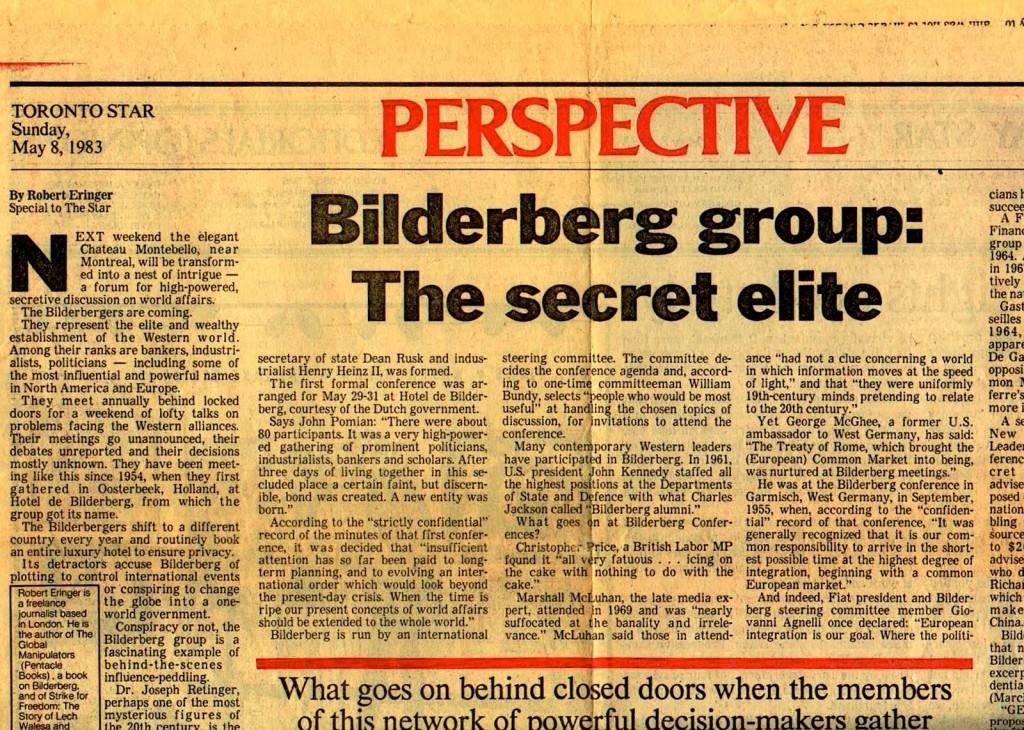
Isn’t it odd then, that when 100 of the most wealthy and influential people from outside of Hollywood – powerful establishment politicians, new rising stars, corporate CEOs, high-tech moguls and royalty – meet in secret every year to do the very same thing, nobody gives it a second thought?
The Bilderberg 2014 conference is now under way in Copenhagen, where a star-studded cast of characters from civilian, business and military-intelligence backgrounds are gathering to debate this year’s agenda of topics including sustainable economic recovery, the future of democracy, the Middle East, the Ukraine crisis and whether or not the basic concept of privacy still exists.
And no, you didn’t miss the hype. There has been scarcely any coverage of this year’s confab in the British or American press. Outfits such as the New York Times and the Daily Telegraph do not see fit to mention the meeting to their readers (in contrast to their coverage of the annual World Economic Forum meeting at Davos, Switzerland), and the BBC’s only acknowledgement of Bilderberg this year has been a Daily Politics segment which discussed conspiracy theories in general, and laughingly recalled the occasion last year when the show mocked and denigrated American radio host Alex Jones, one of the few activists to cover the 2013 Bilderberg meeting in Watford, England.
If Bilderberg was just another place for the wealthy and well-connected to hang out, there would be no issue – the world is awash with exclusive places and events for the elite to hobnob with each other. The same cast of characters also meet up at Davos for the World Economic Forum (the red carpet event of the year for people of lesser beauty and charisma), but if twelve months is simply too long to wait between encounters then nobody should begrudge them another opportunity to awkwardly flirt with one another while putting the world to rights.
The problem is not that successful and powerful people are meeting in secret in Copenhagen. The problem is the particularly volatile, toxic blend of people that assemble. Why are serving heads of government and state on the invite list to what is in part a giant, closed-door lobbying event? And how do attendees from the military and intelligence communities such as the secretary general of NATO, the head of MI6 and the former head of the NSA have common cause with corporate leaders including the Chairmen or CEOs of Shell, Barclays, BP, HSBC, Nokia, LinkedIn and Google?
And one more question – when the press are neither invited to the meeting nor briefed on its outcomes, why do the editors of media outlets including The Economist, The Financial Times, Le Monde and Italy’s RAI-TV sanction Bilderberg with their attendance?
In short, the answer is this: Bilderberg is the closest that western democratic societies come these days to openly, flat-out declaring that well-connected, wealthy people have an inherent right to rule and influence national and international policy, and to have their opinions taken more seriously than regular folk. From supposedly meritocratic “if I can make it there, I’ll make it anywhere” New York through the Scandinavian poster-children of equality and back to post-Citizens United Washington DC it holds true; but most of the time we try to convince ourselves that it is otherwise, that our voices still count and that we are all equal before the law. For those who pay attention, the yearly Bilderberg conference serves to disenthrall us, briefly lifting the curtain on the truth.
That truth is the fact that money talks, and exorbitant wealth carries the loudest megaphone of all. It’s hardly a revelation, but the only time when the rest of us have it shoved in our faces quite so explicitly is at the yearly Bilderberg meeting – ironically the one time when almost none of us, led by the press, pay any attention.
Marriott Copenhagen – venue for the 2014 Bilderberg conference
On the agenda for Bilderberg 2014 is the subject of privacy – very topical given the ongoing fallout and scandal resulting from the Edward Snowden surveillance revelations and consequent exposure of the real extent of government surveillance in and by the United States, United Kingdom and other Five Eyes group countries.
Meeting with John Sawers, General Petraeus and others who are intimately involved in the conducting of government surveillance activities will be many high-profile people of vast wealth and influence. Many of these people are likely to hold quite forceful opinions on the issue of privacy, but they are more likely to be interested in protecting their own privacy from the journalists who would make their activities and indiscretions known to the public than altruistically pressuring governments to cease collecting everyone’s private data in their indiscriminate dragnet.
Given the rare opportunity to hold face-to-face meetings with the people who run the surveillance programmes and formulate the policies which underpin them, which aspects of the privacy question – and whose personal interests, those of the elite or those of society as a whole – are the privileged attendees most likely to discuss?
Charlie Skelton at the Guardian, one of few mainstream journalists to cover Bilderberg every year, also picks up on the irony of an organisation as secretive as Bilderberg holding a discussion about the existence of privacy:
That’s an exquisite irony: the world’s most secretive conference discussing whether privacy exists. Certainly for some it does. It’s not just birthday bunting that’s gone up in Copenhagen: there’s also a double ring of three-metre (10ft) high security fencing … There’s something distinctly chilling about the existence of privacy being debated, in extreme privacy, by people such as the executive chairman of Google, Eric Schmidt, and the board member of Facebook Peter Thiel: exactly the people who know how radically transparent the general public has become.
Precisely. The average person might care about privacy issues because they don’t like being treated as automatic suspects in the intelligence services’ surveillance dragnet, or because they don’t want risk-averse insurance companies from searching out deeply private facts from our lives in order to increase their premiums. The privacy concerns of an oil company CEO or the queen of Spain (attendees all) are likely to be of a different order altogether, more focused on keeping potentially explosive or embarrassing information out of the public domain, and creating a legal framework that punishes those who reveal the truth while empowering those who seek to operate in the dark.
And you can bet that the Bilderberg attendees do want to affect change – they do not assemble for purely social reasons, but to leverage one another’s influence for their own ends – sometimes quite noble ends, but equally possibly very selfish ones. This leads to another sharp observation from Skelton:
The Bilderberg Group says the conference has no desired outcome. But for private equity giants, and the heads of banks, arms manufacturers and oil companies, there’s always a desired outcome. Try telling the shareholders of Shell that there’s “no desired outcome” of their chairman and chief executive spending three days in conference with politicians and policy makers.
If people want to shoot the breeze or have long, meandering yet inconclusive conversations about the state of the world, they go to Starbucks or sneak off to the pub with their friends. Influential and high net worth individuals – whose time is supposedly so valuable – don’t check out for three days and traverse continents unless there’s something significant in it for them, or the causes that they promote.
As Bilderberg 2013 drew to a close in the Hertfordshire countryside, Semi-Partisan Sam had this to say (among other things) about the motivations and biases of the people who get together once a year to decide what’s best for the rest of us:
The reason so many of the actions taken by [Bilderberg members] over the years have been so harmful to ‘normal people’ is because the membership is comprised entirely of the successful. None of the protesters were allowed to remonstrate with the Great Ones within. No refugees from the middle east Arab Spring. No malnourished people from Africa. No failed small business owners from the town of Watford itself, which has struggled in the recession.
If every year you and your chums reassemble at the next Bilderberg meeting and find yourselves even more spectacularly successful and wealthy than the last time you met, “more of the same” could start to seem like a pretty good prescription.
A year later, and this ‘confirmation bias’ explanation is starting to look rather too charitable toward the Bilderbergers. Since the Watford meeting we have learned of more government overreach in the realm of surveillance, more incursions on privacy, more intimidation of the media and the further undermining of national democracy from overturned limits on corporate political spending in the United States to the growing concentration of powers at super-national level in the European Union.
It really would be helpful if the organisers would consent to publishing minutes from their meetings, because at the moment it looks suspiciously as though the 2013 attendees listened to public opinion, then got together and resolved to do the polar opposite.
Perhaps the ultimate irony of Bilderberg 2014 is this: not one week ago, the voters of Europe delivered a stinging rebuke to the political establishment for their growing disconnect with the people and their tendency to talk amongst themselves and prescribe universal solutions from on high without a democratic mandate for their actions. And now today, at a Copenhagen hotel in the heart of Europe, they’re at it once again as though the European elections never happened.
Unfortunately for us, our political elites are seemingly the only ones still able to assert a right to privacy, conducting their business with Bilderberg behind closed doors. But it’s just as much our fault – by not paying any attention, we let them get away with it.
Of course, they are at pains to distance themselves from his more extreme social policy positions, and they get that out of the way at the beginning:
“There’s a lot not to like about Rick Santorum on the social-issues front. He’s an anti-abortion absolutist, no fan of gay rights, and possesses politics so influenced by faith that even contraception remains controversial in his mind.”
But after this, and a couple of disclaimers about the effect of such a manufacturing policy on the budget deficit, they are all praise:
“But at least the man is making a bold proposal that attempts to address an issue that has helped destroy the jobs that used to enable families to get on the first rung of the ladder out of poverty. Rather than simply having products designed in the U.S.A. and then produced overseas, an added incentive to make things in America could help tip the scales back in favor of American manufacturing. It might help make a real dent in our half-trillion-dollar trade imbalance with China and other countries.”
Okay, firstly: future manufacturing jobs will be more highly skilled and require a greater level of education or prior training than many of those displaced by the decline in manufacturing currently have. They aren’t going to get these jobs, if employers bother to create them in the US at all, despite a big tax giveaway. Those jobs that don’t require this higher level of skill won’t offer a rung on the ladder out of poverty any more than an entry-level job in the service sector.
Secondly: What if I write and distribute an awesome piece of new software? What business is it of the government to tell me that my work isn’t as worthy as that of someone else who opened a factory or a sawmill? Are we supposed to pick winners now, based on perceived societal good? The Daily Beast seems to lean to the left somewhat so I can understand them espousing this argument, though I vehemently disagree with it.
But my point remains: a Republican – especially one who rails about government handouts to individuals and bailouts to Wall Street and Detroit – has no business espousing policies to favour one segment of the economy over the other. I mean, that’s European/Soviet style planned-economy socialism, right?






 Semi-Partisan Politics