German Politicians, Drunk On Power, Prepare A Fresh Assault On Free Speech

volker-kauder-free-speech-social-media-censorship

German social media users test their leaders’ patience by exercising awkward, unruly free speech at their own peril

German politicians, ever anxious to squash strident criticism of their unilateral and, uh, somewhat controversial decision to expand the population by nearly a million migrants and refugees in the space of a year, are rounding on social media companies to strike another blow on already-constrained freedom of speech in Europe.

From Deutsche Welle:

Volker Kauder, a member of German Chancellor Merkel’s CDU, has said Facebook should pay for failing to remove online hate comments. There has been a surge in xenophobic posts as refugees have arrived over the last year.

Speaking to German magazine “Der Spiegel,” Kauder said: “The time for roundtables is over. I’ve run out of patience.” He said if companies like Facebook, Google and Twitter failed to remove offensive comments within a week of them being posted, they should be penalized with a 50,000 euro ($54,490) fine.

Social media websites needed to rethink their strategy, he said. “Otherwise, I have another suggestion. Cigarette packs always carry a warning that smoking can be dangerous. Why don’t we ask these [social network] providers to carry a warning on their websites, saying: ‘Anyone who communicates here must expect insulting remarks,'” Kauder said.

Kauder also insisted that the justice ministry should demand that the companies submit the IP addresses of people who posted hate messages on social networks.

Because heaven forfend that politicians should have to explain their decisions and win support for their actions (or better yet, follow the will of the people in the first place once in awhile). Far better to simply make it increasingly difficult for people to register their boisterous dissent.

Note the language. Kauder has “run out of patience”, suggesting that free speech in Germany is something granted to citizens at the sufferance of their thin-skinned leaders rather than an inalienable right. And of course that is exactly how it is in Germany, and most of Europe (including Britain). If some jumped-up politician decides that the civil discourse has become too un-civil – or, let’s be realistic too critical of them – then it is perfectly legitimate for them to turn the screws on private companies to shut it down.

Note too the ludicrous “public health” defence creeping into politicians’ language. One interpretation of Kauder’s threat to slap a mandatory trigger warning on the home pages of social networks is that he thinks so little of the German people’s intelligence that he genuinely believes they might currently be unaware that websites where political issues are discussed may contain opinions with which they disagree. That is one interpretation. But the other one (and the correct one in my view) is that it is simply a way of trying to hurt private enterprise for not bending the knee and doing government’s bidding.

Stephen Fuchs of the German-American culture blog German Pulse shares the same suspicions:

Do I think Germany is out of line to expect a level of cooperation to remove highly offensive posts once reported? No, not entirely. Where I begin to disagree though comes when any government starts policing excessively to the point where our outlets for expression become restricted by a set of rules that make any level of opinion a bannable offense.

How long until Germany pushes Facebook to delete any negative comments or opinions about a certain political party or candidate?

Negative remarks about refugees are deemed hate speech in Germany, but what about the negative remarks about Merkel’s refugee policies? Should we expect Facebook or Twitter to delete those immediately as well?

Maybe the government would be better off addressing the real issues that lead to the divisiveness, instead of playing the “you hurt my feelings” game online.

This is why free speech needs to be an absolute and indivisible right. It is a fragile freedom, with the slightest infringement causing a crack which easily grows and fractures our entire right to self expression. And while some (like Fuchs) may find it distasteful, the battle for freedom of speech must be fought at the unpalatable margins. Only by defending the rights of the racist to spew their bile about Syrian refugees can we be confident of preserving the upstanding citizen’s right to criticise German immigration policy without fear or expectation of censorship.

And as German Pulse rightly points out, no one step, no new draconian crackdown on freedom of expression is ever enough – just as one new health warning on cigarettes sugary food is never enough for the public health police. Individuals and companies cede more of their rights and autonomy, and it only ever emboldens the state to demand yet more.

Demanding that social media companies submit the IP addresses of users who post “hateful messages”to the justice ministry suggests that the German government (or at least significant factions within the ruling Christian Democratic Union) aims to become much more proactive in their persecution of thought and speechcrime. Why dream of building a massive database of social media users who type unacceptable keywords or are reported for causing “offence” by their thin-skinned peers unless you plan on unleashing some kind of retribution on them in response?

This is yet another dark day for free speech in Europe, but perhaps there is an upside – Theresa May will be able to find so much common cause with Angela Merkel over their mutual contempt for basic civil liberties that their shared authoritarianism could yet grease the wheels of the upcoming Brexit negotiations.


facebook-censorship-free-speech

Top Image: Wikimedia Commons

Support Semi-Partisan Politics with a one-time or recurring donation:

Agree with this article? Violently disagree? Scroll down to leave a comment.

Follow Semi-Partisan Politics on TwitterFacebook and Medium.

Debating Political Diversity And The Importance Of ‘Brave Spaces’ At The University Of Miami

college-lecture-hall-safe-space

Whether “brave spaces” are any less infantilising than “safe spaces” is a matter for debate, but the University of Miami community’s recognition of the importance of a more politically diverse faculty and campus is an encouraging sign

The editorial board of the University of Miami student newspaper, the Miami Hurricane, takes a surprisingly bold stance on the problem of progressive ideological dominance on campus, and – encouragingly for a student publication – calls for greater ideological diversity rather than the fearful conformism demanded by many students.

From the Hurricane’s editorial:

UM leans to the left, as do most universities. A report published earlier in the campaign by The Tab documented that 60 percent of faculty donations were made to Hillary Clinton’s campaign; the other 40 percent was split between the other Republican candidates and Bernie Sanders.

In the classroom, professors can be very vocal about their political opinions, whether that’s a subtle joke woven into a lecture or an actual discussion of their political beliefs.

When professors deride or mock certain political views in their teaching, that only alienates students and undermines the purpose of an educational forum. Part of the reason that conservative students feel so disenfranchised from the media and academia may be because for most of their lives, the intellectual “authorities” in their lives have been liberal and taught in left-leaning ways.

At this point, I actually felt a little uneasy. While it is certainly true that the progressivism and intolerance of conservative ideas shown by many university professors is often off-putting to conservative students and academic peers, the idea of people being disenfranchised or excluded because of the words of other peers and authority figures skates awfully close to the wheedling complaints of Social Justice Warriors that criticism and free speech must be suspended for their own mental health.

This blog has warned before that it is only a matter of time before conservatives, persecuted for their beliefs by fellow students and university administrators alike, begin to use the same language of fragility and vulnerability used by the SJWs – and I think we are now starting to see that prediction come true. None of that detracts from the point made by the Hurricane’s editorial board, which remains valid. But as always, a creeping culture of victimhood is something to watch out for, and guard against.

Fortunately, the editorial soon improves:

Courses like The Election are great because they expose students to professors and guests from both sides of the aisle, which can help break down the barriers of bias.  It is much easier to dismiss the opinions of a peer, a social media troll, or a crazy uncle than it is to automatically dismiss the ideas of an authoritative figure who has a Ph.D. in the relevant discipline. Ideological diversity may also help students recognize the flaws in their own opinions and be more self-critical.

When conversations focus on sweeping platitudes rather than individual reasons, our personal networks suffer as well. Too many students have given up Facebook friends or real-life acquaintances over political differences. It’s easy to generalize a whole group of people just based on one or two beliefs that they voice, but these generalizations create many false assumptions, especially in this election when few people are completely behind their candidate.

Restrain from automatically assuming that another student is racist, sexist, elitist or corrupt due to a few of their demonstrated ideological beliefs. People have reasons for holding their beliefs, and if they’re willing to talk about it in a respectful way, then take the opportunity to respond with dialogue rather than a diatribe. Identity politics has made political opinions just as personal as ethnicity and religion, making it hard to separate feelings from ideas.

This is good. Most of us can at times be too quick to pigeonhole and condemn people based on a few assumptions and extrapolations about their political leanings, and the board’s point that many people are not strongly behind their candidate this time (either disappointed Bernie Sanders supporters reluctantly supporting Hillary Clinton or Republicans holding their nose while supporting Donald Trump) should warn us of the sweeping range of variety and nuance which is lost when we simply label people as Trump or Clinton supporters.

The editorial board is also quite right to observe that the rise of identity politics has made it much harder to separate feelings from ideas. A self-aggrandising worldview which places the individual at the centre of everything is an atrocious way to discuss ideas, as it makes rejection of an idea seem like a personal attack. That’s why weepy young students now talk about their identities being “invalidated” when people do not accept the new orthodoxies around sexuality and gender, as though they might simply vanish in a puff of smoke unless everyone on campus is forced to approve of everyone else’s life choices.

And then comes an unusual suggestion:

A healthier alternative for a “safe space” is a “brave space.” A “brave space” encourages people to freely explore different questions and issues – still trying to respect other people, but not restricted by the fear that certain ideas make others feel uncomfortable.

The goal of a diverse college campus is not to create comfortable spaces, but to be caught a little off guard by all of the different types of people and ideas that might not be found in East Portland or a small town in South Dakota. That’s okay. If we embrace that vision, we can create a more tolerant, educated and cooperative community.

Well, a brave space is certainly an improvement on a space where the First Amendment is suspended in order to prevent glass-jawed snowflakes from colliding with reality. The rejection of the notion that uncomfortable ideas should be avoided is, in these depressing times for free speech and academic freedom, a positive step forward.

But surely it would be better still to simply cease talking about “spaces” at all? The term is now ubiquitous – even news articles totally unrelated to the Social Justice agenda talk about the need for public bathrooms to have a “safe space” for parents to change their baby’s diapers. As opposed to what, an unsafe space like a gun range or a demolition site?

Why, when the term “a convenient place” would have sufficed a decade ago, must we now describe everything as a “safe space“? Welcome to my home; here’s a safe space for you to hang your coat, and over there is a safe space for you to sit and watch television. It’s puerile and infantilising.

Is the whole world really so riddled with danger that we need to mark out those places which are actually safe for human foot to tread? The journey from my dorm room to my Ivy League college classroom is fraught with many dangers, but at least the gender neutral restroom offers me a safe place to pee, the shuttle bus provides a safe space for me to ride across campus, the students’ union is a safe place for me to relax between classes and the lecture hall itself is a place where no idea that I deem central to my identity can ever be challenged.

Flippant, yes, but also an accurate transcription of how the contemporary student mind seems to work. And of course it is utterly offensive – there are people in benighted parts of the world where daily physical safety cannot be taken for granted and is routinely violated, yet here are some of the most privileged youths of any generation in history trembling in fear that they may encounter disapproval or mean comments while walking between buildings at their $40,000-a-year degree factory.

(As Malcolm Gladwell explains, this is a result of a shift in the way which we describe actions or behaviours which are undesirable. Whereas once we would have condemned sexism, racism or homophobia as simply being wrong, today we talk spuriously of the “harm” that these words and encounters visit upon us. And when every single human interaction is viewed as having the ability to physically or emotionally harm us, calls for network of safe spaces to act as stepping stones through the world inevitably follow).

Brave spaces are marginally better, perhaps, but it is depressing indeed that we now have to pat ourselves on the back and give ourselves a lollipop for being “brave” and subjecting ourselves to the mere possibility of hearing contradictory viewpoints or unpleasant ideas.

This used to simply be called “being an adult”. Is it really too much to ask that we return to that bygone age of resilience and maturity?


Safe Space Notice - 2

Top Image: Pixabay

Support Semi-Partisan Politics with a one-time or recurring donation:

Agree with this article? Violently disagree? Scroll down to leave a comment.

Follow Semi-Partisan Politics on TwitterFacebook and Medium.


What Conservative Government? – Part 7, 2016 Party Conference Edition

theresa-may-conservative-party-conference-2016-birmingham

Fiscal incontinence, a bizarre grammar school obsession and a new crackdown on civil liberties – forgive me for not cheering along as Theresa May’s Conservative In Name Only Party assembles, victorious, in Birmingham

Theresa May would never have been this blog’s choice to be Britain’s new prime minister, but I have tried to maintain a spirit of cautious optimism in the months since the EU referendum toppled David Cameron and upended our national politics.

And there have been some genuinely positive signs along the way. For one, healthy national pride and patriotism – dead and buried for so long, with New Labour the principal executioner – is starting to make a comeback, no longer automatically scorned by all of Britain’s leading politicians.

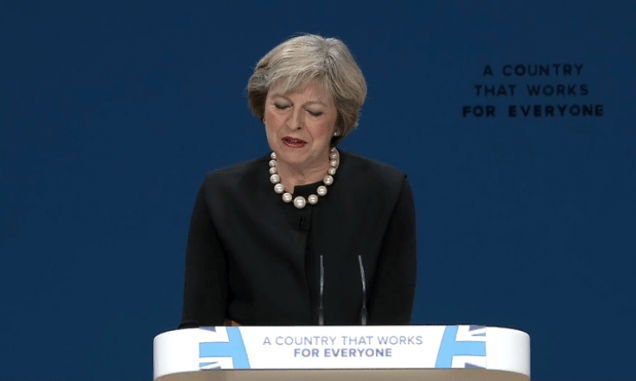
Indeed, the Telegraph reports that Theresa May made patriotism one of the lynchpins of her keynote speech to Conservative Party Conference in Birmingham today:

The establishment must stop sneering at the patriotism of ordinary Britons, Theresa May will say today.

During her keynote speech to the Conservative conference, the Prime Minister will proclaim that the Tories are now the party of working class people.

In a bid to attract millions of disaffected Labour voters across the country, she will add that concerns about immigration have for too long been dismissed as “distasteful” and “parochial”.

She will attack the condescending views of politicians and establishment figures who are “bewildered” by the fact that more than 17 million people voted for Britain to leave the European Union.

[..] “Just listen to the way a lot of politicians and commentators talk about the public,” Mrs May will say. “They find their patriotism distasteful, their concerns about immigration parochial, their views about crime illiberal, their attachment to their job security inconvenient. They find the fact that more than seventeen million people voted to leave the European Union simply bewildering.”

This is good. While sneering, elitist anti-democrats like Matthew Parris may suffer convulsions any time somebody outside Zone 2 or with an income of less than £100,000 dares to utter a political opinion, great (and deserved) political rewards potentially await a major political party which stops treating working and middle class patriotism like an infectious disease.

And there was more to admire in today’s keynote speech, not least the fact that Theresa May delivered it from behind a lectern while reading from a printed transcript rather than adopting the tiresome Gordon Brown / David Cameron habit of prancing around the stage while reciting from memory, like an over-eager Shakespearean actor or a Silicon Valley executive delivering a TED talk.

But unfortunately, in that same speech Theresa May also declared “I want to set our party and our country on the path towards the new centre ground of British politics”. In other words, gifted a blank canvas and meaningful opposition only from the ranks of Conservative backbenchers, Britain’s new prime minister is going to play it safe and stubbornly occupy the same tedious middle ground marked out by David Cameron and George Osborne, only a couple of steps further to the left.

But the worst part of Theresa May’s keynote conference speech came when she declared:

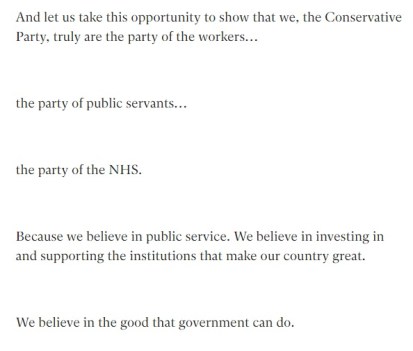
“A change has got to come. It’s time to remember the good that government can do. Time for a new approach that says while government does not have all the answers, government can and should be a force for good; that the state exists to provide what individual people, communities and markets cannot; and that we should employ the power of government for the good of the people.”

Excuse me, but no. What is this Miliband-esque, woolly Fabian nonsense?

Opinions differ as to what ails modern Britain, but almost nobody remotely serious would suggest with a straight face that we currently suffer because the state is not yet involved enough in our daily lives, or that it is not performing activities which the market could reasonably undertake. Nobody apart from our new prime minister, that is.

With a new Conservative prime minister singing hymns of praise to an activist state constantly meddling in the lives of its dependent citizenry, we may as well be back in the 1970s. At least David Cameron used to talk about the Big Society (even if he never made it a reality), and suggested that there might be a whole world out there beyond the suffocating reach of the public sector. If we take Theresa May at her word, she seems to believe the opposite – that we should expect to rely on the state in all matters of life, and that markets are terminally “dysfunctional”, requiring constant state intervention.

I’m sorry, but this is unforgivably leftist fluff coming from a supposedly Conservative prime minister. One appreciates that Theresa May has come to office at an exceedingly difficult time, with Britain’s EU secession by far the most ambitious enterprise which this country has attempted in decades. But that is absolutely no excuse for kicking ideology and founding principle to the kerb and engaging in what can only be described as flagrant socialist cross-dressing.

Furthermore, Theresa May’s sloppy wet kiss to Big Government presupposes that until now we have somehow been living in a Hayekian, libertarian nirvana, where the government stayed out of our lives, the successful didn’t have to fork over half of their income in taxes and everybody was left to sink or swim according to their merits. This was hardly the case. The terrible “austerity” inflicted by David Cameron and George Osborne was in reality nothing more than the meekest, politest attempt to stem the constant increases in public spending. Six years on and the deficit remains, the national debt is larger and interest on Britain’s sovereign debt rivals our annual Defence budget.

In other words, Theresa May’s speech made it seem as though working British people had up to now been left to starve in some awful libertarian dystopia, when in fact we remain prisoners of the welfare state/public sector prison created decades ago and put on steroids by Tony Blair and Gordon Brown.

And yet the parties of the Left uniformly fail to realise just how lucky they have it with Theresa May in charge of the country. A Britain led by David Davis, Liam Fox or Jacob Rees-Mogg would quite possibly offer a taste of real austerity for those parts of the country which have grown fat suckling on the taxpayer teat, but with Theresa May they don’t have to worry about any of that. For the prime minister is every bit as much of a champion of the state as Tony Blair, Gordon Brown or Ed Miliband ever were.

Not that you would know it, to read hysterical, weepy editorials like this one in Left Foot Forward:

Theresa May’s speech to Conservative Party conference was supposed to showcase her philosophy. And it did.

It showcased a nightmarish new Conservative ideology that cloaks drastic social illiberalism in the language of inclusive economics, panders to one section of the working class in order to marginalise another, and brands anyone who dares to disagree as unpatriotic and sneering.

And it takes the vote to leave the European Union as a justification for extreme, inward-looking and divisive policies, completely disregarding the 16 million people who voted to remain, not to mention all the decent leave voters, who voted for change, not for for xenophobia.

The delicious irony of a weepy leftist complaining about being disregarded and demonised when such flagrant hostility is the default left-wing attitude towards anybody with remotely conservative opinions is almost too much to bear, but it gets better:

However, the truly frightening aspect of this speech was its divisiveness, its aggression towards anyone who doesn’t fit into the prime minister’s definition of ‘ordinary’.

This includes anyone not born in Britain, despite May’s claim to want ‘a country where it doesn’t matter where you were born.’

It comprises most of the 48 per cent of people who voted to remain in Europe — May seems to have forgotten she was one of them — and all those who envision a more progressive approach to crime, immigration, human rights, healthcare or education.

Here is a prime minister who did everything but daub herself in red paint and sing the Internationale right on the stage of the Conservative Party Conference in Birmingham, and still it isn’t enough for the leftists because the Big Mean Scary Lady apparently used “non-inclusive” language. Truly there is no winning with these people.

In fact, the hysterical reaction from the Left only shows how far Labour’s metro-left ruling class have diverged from their party base and from traditional left-wing thought. Theresa May promises German style corporate governance, more wealth redistribution and the state as an overbearing, omnipresent parent – all of which which would have delighted 1980s socialists – yet the modern metro-left pitches a hissy fit because Theresa May didn’t sing paeans of praise to unlimited immigration or bow down before the altar of corrosive identity politics.

The goalposts keep moving and the ratchet keeps tightening and dragging us leftward. But ordinarily one might at least reasonably expect a Conservative prime minister to act as an anchor and a drag on that influence. Theresa May, though, seems eager to beat the centrist, metro-left in a full-on sprint to the left.

Look: I get that Theresa May is not a socialist herself. But the mere fact that she is comfortable using the same woolly, often meaningless language of Ed Miliband should be a real cause for concern among libertarian-leaning conservatives because it shows that she is far more interested in hoovering up centrist Labour voters than making a bold, compelling case for small government, conservative policies. It is undoubtedly the correct approach if one wants to pursue the path of least resistance, but to tack to the authoritarian centre at a time when the Labour opposition has all but disintegrated is an almost criminal waste of an opportunity to radically reshape Britain – not just through Brexit, but in terms of the relationship between government and citizen.

I know I can be a bit of a bore when it comes to analysing political speeches, but it is also depressing to see Theresa May adopt the short sentence / no complex paragraph style also favoured by Ed Miliband.

An excerpt:

theresa-may-conservative-party-conference-2016-speech-transcript


And another:

theresa-may-conservative-party-conference-2016-speech-transcript-2

Put aside for a the obscenity of a Conservative prime minister neglecting to talk about the importance of a flexible labour market to a dynamic economy in favour of trying to outdo Labour in promising counterproductive employment rights, and focus instead on the speechwriting style.

This is the same choppy, disjointed, machine-assembled soundbite speech favoured by Gordon Brown and honed to dismal perfection by Ed Miliband, as this blog explained some time ago:

Behold the short, stunted phrases, written with the news editor’s cropping software in mind while the poor listener’s brain isn’t given a second thought. This is nothing more than a word cloud, a jumble of phrases and platitudes deemed by a focus group to be pleasing or reassuring and then awkwardly bolted together by a computer and beamed onto a teleprompter.

Britain is about to embark on the most complex national endeavour that we have attempted in decades. In seceding from the European Union and deciding to forge our way once more as an independent country, the people of Britain are serving as a case study to the world in how best to maintain and strengthen democracy and accountability in the age of globalisation. Is it really so much to ask that we have a prime minister capable and willing to speak in complete paragraphs rather than ten-word soundbites?

Is it honestly unreasonable to expect that the first major set-piece speech of Theresa May’s premiership should make reference to history, to human endeavour, to our national destiny, rather than simply be a laundry list of bribes to the British people, promising them newer, better public services and an easier life?

This is Milibandism all over again. And while Theresa May is more traditionalist authoritarian than Fabian socialist, alarm bells should be sounding that she intends to govern using the same tired New Labour playbook. May’s conference speech reveals a depressingly small conception of what it means to be the prime minister of the United Kingdom, casting Theresa May as a mere Comptroller of Public Services or a puffed-up cruise ship director rather than a consequential world leader.

Nonetheless, Conservatives seem to be streaming away from Birmingham in a very cheerful mood – some almost outrageously so:

Et tu, Montie?

Yes, libertarian individualism is indeed “THE Tory weakness” if one is trying to appeal to people who love socialism and a big, activist state. Which is why a healthy, virile Conservative Party should either seek to make such people see the error of their ways or else quit pandering to them entirely.

But this is clearly not Theresa May’s approach. She has a different strategy. And what has it wrought thus far?

After three months of reflection over the summer, the Tories are absolutely nowhere when it comes to tackling Brexit, but every indication we have seen suggests that they are toying with the unnecessary self-harm option which would see Britain forsake the single market in a couple of years at the time of EU secession, well before any comprehensive replacement could possibly be negotiated.

We were supposed to be wowed by a so-called “Great Repeal Bill” to undo the 1972 European Communities Act, until five seconds of reflection revealed this grand piece of posturing to be nothing more than a statement of the bleeding obvious – if Brexit is to happen at all, the primacy of EU law and courts must be brought to an end at the moment of departure.

Flagship proposals to build new grammar schools only scratch the surface of problems with British education, but jubilant Tories seem to be treating this policy as the alpha and omega of their plans to create a more educated and skilled workforce when in fact so much more needs to be done to make the British education system the best in the world.

The last Chancellor of the Exchequer was bad enough, with his limp deficit reduction targets, obsession with white elephant infrastructure projects and shameful Brexit scaremongering. But his replacement, Philip Hammond, has taken what little authority the Tories retained on fiscal responsibility and thrown it out the window. Now Conservatives are mocked by John McDonnell of all people – John McDonnell! – for failing to grapple with the public finances, and the national debt will have increased every year after a decade of Tory rule.

And to add insult to serious libertarian injury, Theresa May’s steely-eyed authoritarian side is revving up, with planned new laws to criminalise insulting the army or advocating shariah law for Britain veering from the unworkable to the stupid all the way to the totalitarian.

So I’m sorry, but I can’t get excited about this revamped Conservative In Name Only government. While Theresa May is off to a bright start in terms of tone and temperament, what we have seen so far in terms of policy suggests a shift even further to the economic left than Cameron/Osborne, balanced out by a rise in authoritarianism and government meddling in every aspect of private life.

And for what? To beat Jeremy Corbyn’s Labour Party by a slightly greater landslide in 2020 than is already expected?

Maybe I’m alone in this, but I would rather Theresa May’s government struggle to a 30 seat majority in 2020 based on a really radical, small government manifesto in the model of Thatcher – and then actually go about reshaping the country based on that clear vision – rather than win a 100 seat majority by dressing up in the abandoned clothing of Ed Miliband.

As Margaret Thatcher said in 1968:

There are dangers in consensus; it could be an attempt to satisfy people holding no particular views about anything. It seems more important to have a philosophy and policy which because they are good appeal to sufficient people to secure a majority.

Theresa May clearly disagrees, and there is a very low limit to the respect that this blog can give to a leader who thinks in such unambitious, tactical terms.


David Cameron - Coke Zero Conservative - I Cant Believe Its Not Miliband

Top Image: International Business Times

Support Semi-Partisan Politics with a one-time or recurring donation:

Agree with this article? Violently disagree? Scroll down to leave a comment.

Follow Semi-Partisan Politics on TwitterFacebook and Medium.

Conservatism, Behind Enemy Lines

Rod Dreher reports on a fascinating (and depressing) exchange posted on the wall of Princeton professor Robert P. George, between Professor George and a closeted conservative colleague.

The recounted exchange is worth posting in full:

Closeted conservative colleague: “I don’t feel I can say what I think, at least not at this stage. I have a family to care for and other responsibilities, you know.”

Me: “Sure. I’m not criticizing you.”

CCC: “I’ve seen people’s careers ruined for saying what they think.”

Me: “I have, too. I’m really not criticizing you. I assume you’re following your conscience.”

CCC: “You say what you think and you’ve survived. But your the exception.”

Me: “I’ve been very fortunate. That’s true. But there are plenty of others. I’m not unique. There’s Harvey Mansfield, Hadley Arkes, Mary Ann Glendon, Jim Ceaser, and others. Even some people they’ve tried hard to destroy have survived. Mark Regnerus at the University of Texas, Austin,” for example. They threw everything they could find at him, every calumny imaginable. They tried to get him formally investigated and fired. But he has beaten them. I predict he’ll be promoted to full professor this year.”

CCC: “Yes, but there have been lots of victims, too.”

Me: “Yes. Alas. Lots of victims.”

CCC: “You think I should say what I think.”

Me: “I think you should follow your conscience.”

CCC: “That’s just your way of saying I should say what I think.”

Me:; “Look, as I said, I’m not criticizing you. Only you can discern the demands of your own conscience. I didn’t even bring this whole subject up, you did.”

CCC: “I know what you tell your graduate students to do. You tell them not to hide their politically incorrect views.”

Me: “Well, yes, I hardly hide my advice to them. They initially find it counterintuitive. Their natural instinct is to hide their dissenting beliefs or downplay them. I think that’s risky from a character point of view and also not the best strategy for success.”

CCC: “You ARE judging those of us who keep our opinions to ourselves, then.”

Me: “For heaven’s sake, I’m just saying that there is a certain moral hazard in not speaking your mind. As scholars, we’ve got a special obligation to truth and a vocation to truth-telling. Of course, everybody has a basic obligation to honor the truth, as best they grasp it, but our obligation is even more central to who we are. So, speaking for myself, I don’t see what the point of being a scholar is if we’re not willing to speak the truth as best we understand it. I mean, there are lots of other fields we could go into. We could be lawyers, or doctors, operate hedge funds. There’s the insurance business. Wendy’s franchises. Anyway, again speaking for myself, if I felt I couldn’t speak the truth out loud, I would abandon academic life and go do something else.”

CCC: “You’re not afraid to say what you think because you’ve been able to get away with it without your academic career being ruined.”

Me: “That’s exactly backwards. I’ve been able to get away with it because I’m not afraid to say what I think. Fear empowers the bullies. They’re far less bold and aggressive when they know you’re not afraid of them.”

CCC: “Well, I am afraid of them.”

What emotion do you suppose is primarily motivating CCC? I think that the answer is quite clear: terror. Sheer, unbridled terror at the thought of being purged not only from one’s current job but from one’s profession field altogether if one so much as questions the progressive, social justice/identity politics dogma which has descended on academia like a suffocating blanket.

Where else in history have we seen such terror, such fear of having one’s heretical personal beliefs exposed and punished by the state or the mob? It’s hard not to give way to hyperbole, but this is literally the stuff of Orwell’s 1984, or (back in the real world) Soviet Russia during the purges.

And for what? To bring about forced adherence to the new orthodoxy on gender identity, racial politics, climate change, immigration and any other left wing cause du jour. Left-wing academics and students have abandoned any glancing interest in persuasion as a tool, and have jumped straight to brutal enforcement. Some academic fields will take longer than others to fall under the jackboots of this new authoritarianism – the STEM subjects are still relatively free, the humanities dangle over the precipice while the social sciences have long since fallen – but all are heading in the same direction.

And this is why Robert P. George’s own stance matters, and is correct. Just as there can be no equitable accommodation with people who want to establish a fundamentalist Islamist caliphate across the West, neither can conservative academics and other defenders of free speech split the difference with the authoritarian, petty tyrants who are busy consolidating their control over the university campus. One either has academic freedom and the right to free speech, or one does not. There is either censorship and an ideological test for working in certain professions, or there is not.

The time for keeping one’s head down and trying to avoid trouble is over. Those of us who believe in free speech and unrestricted academic enquiry have an obligation to speak out in defence of those being persecuted or intimidated for their beliefs, today and in the future, whether we agree with the particular speech in question or not.

They can’t arrest us all and they can’t fire everyone simultaneously. Conservatism needs to make a stand, to boldly assert that it will not be intimidated and purged from academia without a fight, or without exposing the progressive, social justice cultists as the modern day tyrants that they are.


academia-learning-conservatism

Support Semi-Partisan Politics with a one-time or recurring donation:

Agree with this article? Violently disagree? Scroll down to leave a comment.

Follow Semi-Partisan Politics on TwitterFacebook and Medium.

Inclusive Language Week – This Is How Western Civilisation Commits Suicide

Ball pits, puppy dog videos and safe spaces – the seeds of Western civilisational decline are being sown on the university campus

Heat Street reports on the slow-motion suicide of Western civilisation:

During its “inclusive language” campaign, California State University-Northridge students lounged in a bouncy-ball pit and held forth about words that hurt their feelings in a so-called “vent tent,” Heat Street has learned after exclusively reviewing documents and video footage.

CSU-Northridge’s event stretched on for an entire week, teaching students about “potentially hurtful phrases” and cautioning that “using non-inclusive language can have a negative affect on others.”

The University Student Union, a student-led nonprofit campus organization, spent more than $1,000 in student fees on the event, according to invoices. Urging students to avoid hurtful language, USU came up with a list of offensive words — and then printed them in huge, all-caps text, hanging the poster on campus regardless of their supposedly triggering potential.

[..] USU also created a spinning wheel of the phrases it deemed offensive, hiring a videographer and prompting students to describe why a word or term could cause emotional harm and what language they’d use instead.

Most students acquiesced. Some suggested that specific words be banned outright.

The article doesn’t quite do it justice. Apparently California State University-Northridge also laid on a ball pit for their infantilised students to sit in and carp on endlessly about their feewings.

Katherine Timpf, who does an excellent job covering the social justice beat for the National Review, reports:

Students at the California State University–Northridge sat around in a big ball pit (which they a called a “vent tent”) and talked about hurtful words and their feelings as part of a school-sponsored inclusive language campaign.

According to video and documents obtained by Heat Street, the campaign lasted for a week, was put on by the University Student Union (USU), and cost more than $1,000 in student fees. It’s not clear exactly how much of that money was spent on the ball pit rental, or if there is any research supporting the idea that sitting in a ball pit while having a discussion provides any educational and/or therapeutic benefits.

Maybe Glenn Reynolds was right the first time – if these infantilised people are so desperate to be treated like children, maybe we really do need to look at temporarily removing the franchise from them by raising the voting age.

It is obscene as it is absurd that the current generation of students in the English-speaking West, living in the most prosperous and technologically advanced age in history and enjoying tools and luxuries undreamed of by their grandparents, have nonetheless been raised to be so self-involved and determined to wallow in their own confected fragility. What are we doing?

This is the way the world ends
Not with a bang but a whimper.


Safe Space Notice - 2

Support Semi-Partisan Politics with a one-time or recurring donation:

Agree with this article? Violently disagree? Scroll down to leave a comment.

Follow Semi-Partisan Politics on TwitterFacebook and Medium.