What Conservative Government? – Part 6, EU Referendum Legacy: A Tory Party Hated By Left And Right Alike

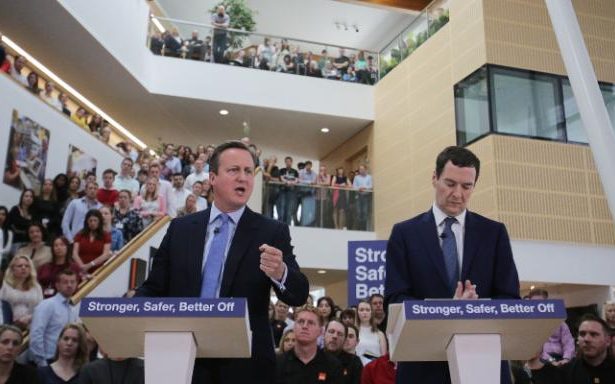
David Cameron - George Osborne - EU Referendum - Brexit - Remain - Stronger Safer Better Off

By waging such a disingenuous, fear-based campaign for Britain to remain in the European Union, David Cameron and George Osborne are sowing the seeds of their own political destruction

The excellent Archbishop Cranmer blog gives it to David Cameron and George Osborne with both barrels for the grubby, underhanded way in which they have gone about fighting the Remain case in this EU referendum campaign.

The devastating conclusion:

Frankly, both George Osborne and David Cameron have disgraced their offices of state in this referendum campaign, with their lies, hyperbole, disinformation and deceit. Whether or not the UK takes the first step toward leaving the EU on 23rd June; whether or not it becomes our Independence Day or is confirmed as the day we resigned to plod inexorably toward becoming an offshore regional council of a United States of Europe, David Cameron and George Osborne will go down in history as Tory charlatans, cheats and political frauds. They have successfully re-toxified the Conservative brand and made it impossible for many to support a party led by either. You cannot call a referendum on something as crucial as fundamental identity or the determination of national destiny, and then collude with corporates and conspire with other elites to feed the electorate a diet of blight, pestilence and woe. It’s enough to make a man never trust a Tory again.

Amen. And the curious thing is that both Cameron and Osborne seem utterly oblivious to the medium and long term damage they are wreaking on their party. Wanting their side to win the referendum is understandable – both men’s authority and political careers ride on the public voting remain. But the desperate and underhanded means to which they are going to win the referendum – the national propaganda leaflet, the Treasury statistics mysteriously missing an analysis of the Brexit to EFTA/EEA scenario – are storing up serious problems for the future.

In this blog’s opinion, both Cameron and Osborne are overrated as master political and strategic minds. Cameron actually failed to win the 2010 general election, and prevailed in 2015 only against a phenomenally weak Labour leader. Osborne, meanwhile, is much more of a tactician than a strategist, often quick to exploit opportunities to win a particular argument, but with little sense of the knock-on impact on other matters.

This is exactly what is happening now. Cameron and Osborne look at the polls, which generally show a steady lead for Remain, and mistakenly assume that this is the same as approval of themselves. But this is not so. Strip away the vast majority of Labour and non-aligned voters siding with Remain out of fear or ignorance, and over half of the Conservative Party may well oppose the prime minister. Had David Cameron conducted his campaign with a shred of decency or respect for the opposing side, this might not be a problem, and eurosceptic Conservatives might well have kissed and made up after being defeated on 23 June. But the sheer barrage of misleading statistics, analyses and inappropriate interventions from global figures organised by Cameron means that no rapprochement will be possible.

The bitter truth is that far from detoxifying the Conservative Party, David Cameron has retoxified it – to a supercharged degree. The prime minister may not be to blame for the Left’s hysterical reaction to any and every limited attempt at fiscal restraint by this government – with Labour shrieking that attempts to curb growth in public spending amount to a holocaust of the sick and disabled, the Left are to blame for much of the toxicity in our politics today. But Cameron is very much responsible for alienating vast swathes of his own side.

After the referendum is done, there will be a large number of small-c conservative voters who would sooner die than lift a finger to support a Conservative Party led by David Cameron or any of his cabinet allies from the Remain camp. This blog is among them. The Conservative Party is now as toxic among many conservatives as it is among the British Left. How then to fight a general election once the Labour Party finally gets itself organised?

This is David Cameron’s true legacy – a Tory Party hated by the Left despite being so boringly, forgettably centrist as to be indistinguishable from New Labour, and equally hated by many on the Right for having betrayed innumerable conservative principles through a policy of government by appeasement rather than the bold pursuit of conservative goals. Hated by the Left for having risked Britain’s place in the European Union by holding the referendum in the first place, and equally hated by the Right for having shamefully come down on the side of supranational, antidemocratic rule from Brussels.

Dave and George are probably not looking that far ahead right now – they are probably too busy lining up the next NGO head to go public about how apocalyptic Brexit would apparently be. But you could not pay me enough money to change places with either of them when it comes time for the first meeting of the Conservative Parliamentary Party after the referendum.

The anger and vitriol will be immense, and may well consume our arrogant prime minister and his chancellor soon after their moment of ill-begotten triumph.

And who will mourn their loss? If David Cameron and George Osborne are the best that the Conservative Party can offer, we may as well have a Labour government anyway.

 

European Union - United Kingdom - Britain - Flags

Top Image: Telegraph

Agree with this article? Violently disagree? Scroll down to leave a comment.

Follow Semi-Partisan Politics on TwitterFacebook and Medium.

The Moral And Intellectual Cowardice Of The Pro-EU Left

Ken Loach - Another Europe Is Possible - EU Referendum

The modern Left loves the EU because having lost the public argument for socialist policies, they see in Brussels their last and best hope of imposing their left-wing ideology on an unwilling population

Tom Slater has an excellent piece in Spiked, in which he takes to task all of the big name lefties – some of whom previously toyed with supporting Brexit as they watched the EU’s antidemocratic behaviour with growing horror – who are now supporting the Remain campaign, and thus betraying democracy when it truly matters.

Slater writes:

The last few prominent Eurosceptics on the left have started to peel away. They’ve been confronted with a once-in-a-generation opportunity to smash power, to strike out for democracy and to put the future of European politics firmly in the hands of the people, rather than a faceless, byzantine bureaucracy. And they’ve bottled it.

First there’s Yanis Varoufakis, the flash stepdad of European leftism and the former finance minister of ailing Greece. This is a man who has experienced the tyranny of the Brussels set firsthand. His modest proposals for rescuing debt-laden Greece from EU-enforced austerity were ignored. ‘Elections’, he was told by German finance minister Wolfgang Schäuble, ‘change nothing’. He quit government in protest as his Syriza comrade Alexis Tsipras signed an agreement that would once again shackle Greece to Troika diktat. What is the self-styled ‘erratic Marxist’ up to now? He’s touring the UK, telling Brits to say ‘Oxi’ to Brexit so that we can ‘reform the EU from within’.

Then there’s Owen Jones, the Corbyn choir boy who has followed the Labour leader’s transformation from Bennite Eurosceptic to apologetic Remainer. Last summer Jones called for the left to campaign for Brexit. After the horrors of Greece, he wrote, it’s time to ‘reclaim the Eurosceptic cause’. Now, just 10 months on, he’s joining Varoufakis on the campaign trail. His flirtation with principle over, he wants to ‘unite with people across the continent to build a democratic, workers’ Europe’. How propping up a democracy-thwarting institution puts you in line with the little guy is beyond me. Not least when said institution has effectively abolished workers’ rights in austerity-battered countries like Greece.

But perhaps the most glaring retreat of them all has come from Paul Mason. The former Channel 4 economics editor and ‘radical social democrat’ actually had the brass to pen an article titled ‘The left-wing case for Brexit (one day)’. One day. Those two, trembly words sum up the sentiment of these fair-weather Eurosceptics. Yes, yes, democracy – one day. Not now. Especially when, as Mason sees it, a Brexit would allow Michael Gove and Boris Johnson to ‘turn Britain into a neoliberal fantasy island’. He’s in favour of democracy, you see, just not when the pesky demos elects a government he doesn’t like. This is hypocrisy dressed up as strategic nous.

Tom Slater is absolutely correct to denounce each and every one of these reversals as a shameful failure of courage. His piece is entitled “The Progressives Afraid Of Change”, and regrettably that is exactly what we see from the supposedly ideologically pure Corbynite Left. Yet after having grown in prominence and power primarily by denouncing the compromises and betrayals of the centre-left, these virtue-signalling true believers are now selling out British democracy in exactly the same way, proving that they are no better than the Blairite New Labour government which they so despise.

This blog has also taken each of the prominent leftists identified by Tom Slater to task for their utter failure of courage and vision. My critiques of Owen Jones are here, herehere and here, Yanis Varoufakis here and Paul Mason here.

Slater continues:

In fact, it’s worse than that. It’s often said that the shift in left-wing attitudes towards the EU over the past few decades has been the result of pure political contingency. When, in the 1970s and 80s, the EU was seen as an avowedly capitalist project, Labourites and trade unionists took arms against it. Now that it’s been given a social-democratic lick of paint, replete with talk of workers’ rights and free movement, it gets the nod. But there’s something even more sickening going on here. These turncoat Remainers, these radicals for the status quo, don’t just bristle at the turn of public opinion, on economics or migration – they’re scared of it. Their Brexit-phobia is really a fear of the demos itself.

You see this in their panic-stricken talk of the furies Brexit might unleash. ‘We don’t know… how the plebeian end of the Leave campaign will react if they lose. My instinct says: badly’, writes Mason. Varoufakis, meanwhile, is even more pessimistic. Only fascists and racists, he says, will profit from the demise of the EU. A Brexit now would mean ‘anti-migrant racism, pandered to by the political establishment for decades’, writes a commentator in the New Statesman. There is constant talk of chaos. Democracy is seen not only as disagreeable, but as dangerous. The left, once intent on stirring the passions of the people, now wants to keep a lid on them at all costs.

This is why you shouldn’t take the left appeals to ‘reforming the EU from within’ seriously. Not only because Cameron’s paltry renegotiation revealed an EU incapable of making even minor concessions. Not only because the only salient proposal Varoufakis’s Democracy In Europe Movement has managed to come up with is livestreaming council meetings. But because the cowardice of the left in the face of Brexit is bred of the very same fear of an unshackled demos that forged the European Union in the first place.

Devastating, and utterly correct. For the European Union itself was deliberately designed to muffle and constraint the voices of national electorates, replacing them with the cool, cerebral and detached government of a supranational European elite, which is exactly what the pro-EU Left now want – a tool to suppress what they see as the “dangerous” authentic voices of the people.

Slater concludes:

The modern left’s detachment from the masses, its sneering distaste for our habits and desires, has fostered a profound fear of change itself. Their paranoia about where unleashed public passions might flow has led them to cling to the status quo for dear life. These are progressives terrified of change – and terrified of us. Faced with the opportunity to demolish an anti-democratic order, they are standing athwart, yelling Stop. History will not be kind to them.

But it is worse than a mere lack of vision and fear of change. Most offensive of all is the grubby desire of the pro-EU left to bypass democracy altogether, to give up on trying to persuade national electorates of the value of left wing policies and simply impose them from the EU’s unaccountable, supranational higher level of government.

As this blog recently put it:

The Left look around and see free markets accepted and delivering prosperity in nearly every country, including those who have sworn eternal opposition to capitalism. And despite the Corbynite takeover of the Labour Party in Britain, there is still no evidence of a groundswell of public longing for 1970s style statist economic policies to be brought out of mothballs. What chance, then, does the Left have to bring more of the economy under state control other than the extreme long shot of seizing control of Europe’s supranational layer of government on the back of the supposed European left-wing popular movement (DiEM25) talked up by Varoufakis and Jones?

As Varoufakis admits, “the retreat to the nation state is never going to benefit the Left”. The Left can only advance their cause by sidestepping nation states altogether, which means taking control of the EU, where national legislatures are bypassed and unpopular and even hated policies can be imposed on the peoples of Europe with very limited opportunity for effective resistance (see Greece). This may seem laughably unrealistic – and it is. But it is the Left’s only remaining hope, and so they cling stubbornly to their delusion even if it means betraying democracy and supporting the EU in its current form (and with its current policies) until the time comes for their popular revolution.

And that, to my mind at least, is the most disappointing thing of all. Even pugnacious, articulate left-wingers like Owen Jones and Paul Mason are unwilling to achieve their desired ends by first winning the public debate and then winning a national election. Their commitment to democracy is so feeble that they would rather see their preferred policies foisted on an unwilling British people from above by the European Union rather than do the hard work of winning support for those policies among the British electorate.

Of course, they don’t explain it this way themselves. Talk to Owen Jones and Paul Mason and you’ll get an earful about their deep concern for workers’ rights or some other emotive issue. But when push comes to shove, they would rather live in a country where their minority opinions were forced on the majority by Brussels than do the hard work of convincing voters of the necessity for left-wing policies.

And the Left are perfectly entitled to that opinion. They are entitled to advocate for Britain to remain in the European Union because they do not trust the British electorate to support what they see as essential policies at the ballot box. They can do all that. But they cannot any longer call themselves supporters of democracy.


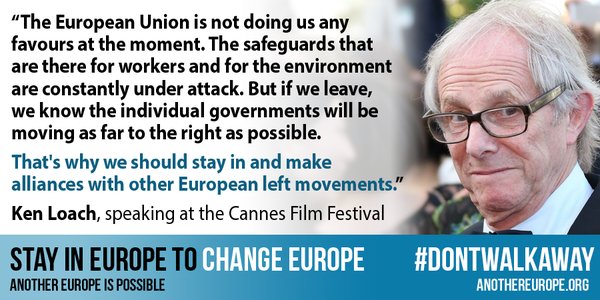
Postscript: Look at the image at the top of this article, showing a quote by filmmaker Ken Loach, in which he openly boasts that the chief advantage of the European Union is that it thwarts the will of democratically elected national governments. This is the toxic, antidemocratic position which left wing favourites like Owen Jones and Paul Mason have decided to embrace. Shame on them.


European Union - United Kingdom - Britain - Flags

Agree with this article? Violently disagree? Scroll down to leave a comment.

Follow Semi-Partisan Politics on TwitterFacebook and Medium.

Vote Leave: An Unhinged Fifth Column, Leading Brexiteers To Ruin

https://www.youtube.com/watch?v=LtlGN8wVnis

It’s time to declare open warfare on the malevolent idiots in charge of Vote Leave, if we are to minimise the further harm that they can yet inflict on the Brexit cause

Apparently the super-intelligent, well-connected, savvy people running the Vote Leave campaign think that this political broadcast, which aired today on national television, is a key part of some winning strategy to deliver 50%+1 votes on 23 June.

It certainly has a lot going on. There’s the slavish idolatry of “Our NHS” for a start, which actually might not be a bad tactic in NHS-obsessed Britain but for the fact that the Vote Leave campaign is mostly full of Tory types who didn’t exactly make a name for themselves by protesting their local A&E unit closure or otherwise worshipping at the altar of St. Aneurin Bevan of Tredegar. In other words, it strains credibility to think that Boris Johnson & co are fighting for Brexit because they are desperate to shower the health service with more money.

Ah yes, money. Then we see the flagrant, unapologetic repetition of the false £350 million claim, a number which does not take into account the UK rebate or EU funds disbursed back to Britain. Quite why the more accurate figure of £161 million could not be used is a mystery – perhaps because £350 sounded like a nice round number, and because it conveniently tallied with the cost of building a new hospital. And so the official Leave campaign goes charging into the last month of the referendum waving a headline figure which can be instantly disproved and mocked by any Remain campaigner with a functional brain, tarring the entire Brexit movement with their shameful idiocy.

I cannot stress this firmly enough – at this point, Vote Leave may just as well be part of the Remain campaign. They are essentially operating as a fifth column, actively doing more harm than good. They are wasting precious time and resources simply to ensure that their heavily eurosceptic base vote for Brexit even more emphatically than they already planned on doing, while appearing so shifty and unserious to undecided voters that they destroy our credibility – and with it, our chance of winning.

Therefore, the next month must be spent firing over, around and through Vote Leave. They are not our allies. They may as well be working for David Cameron and George Osborne. In fact, some of them quite possibly are doing just that.

At this late stage, Vote Leave will do nothing other than continue to burble unbelievable nonsense about building a brand new hospital on every street corner in Britain in their fantasy Brexit world; there is nothing we can do about that. But we are not powerless.

We need to go out there and talk about sovereignty and democracy.

We need to talk about the unappealing, authoritarian future of the EU.

We need to talk about the revolution in regulation and the emerging global single market, in which a free Britain can play a leading role.

But most of all, we need to get out there and do something, anything, to distract from the utter FREAK SHOW of an official Leave campaign being orchestrated by BoJo the Clown and his trusty sidekicks.

Glad as I am that they all seem to be having a roaringly fun time on the campaign trail, allowing the children to take the wheel unfortunately means that they are now running over the life’s work and dreams of many a committed eurosceptic and Brexiteer.

And they can not, must not be allowed to continue unchecked.


Postscript: This ad is even more idiotic. The cretin who put it together failed even to draw a link between the subject (possible future Turkish membership of the EU) and the conclusion (vote Leave to Save Our NHS), ensuring that the spot ends with that grating non sequitur. It’s almost as though the entire operation is staffed by not-very-bright nepotism beneficiaries and Westminster hangers-on…

https://www.youtube.com/watch?v=A8su2vCq950


Apparently the only reason now for wanting Brexit is to “Save Our NHS”. When did that happen? And when will the person who signed off on this strategy be made accountable for their utter incompetence?


Vote Leave - NHS 350 Million - Brexit

European Union - United Kingdom - Britain - Flags

Agree with this article? Violently disagree? Scroll down to leave a comment.

Follow Semi-Partisan Politics on TwitterFacebook and Medium.

Nonexistent Shared Christian Values Are No Justification For The EU’s Existence

Francis Campbell - Reimagining Europe

The latest feeble Christian case for remaining in the EU: “Let’s forge a meaningful common European identity based on the fluffiest and least well defined parts of our faith!”

More hand-wringing waffle from the Reimagining Europe blog, this time from regular contributor and former British diplomat Francis Campbell:

Whatever the outcome of the UK referendum in June, there will be equally important questions for EU leaders in the years ahead. The process of Britain’s renegotiation has led many to consider their own national identity and how it fits within the identity of the European Union. With a rising tide of Euroscepticism in countries across the continent, the challenge for Europe’s leaders is to instil a sense of European values which enhance rather than threaten national and regional identities.

Right-o. The challenge apparently is not to question whether the decision to unite the countries of Europe under a single supra-national government was a smart idea in the first place. No, the challenge is simply to do a quick PR job, to “instil a sense of European values” and force the restive people of Europe to come to terms with this government that has been designed for them, without their input or their permission.

Campbell at no point questions the wisdom of the project to establish a supranational government of Europe in the first place, taking its existence and benefits as a given despite the current referendum offering a once-in-a-generation opportunity to question old assumptions and break out of stale ways of thinking.

But Campbell has no interest in doing any of this – he is concerned that the EU try to “build bridges” with its citizens, even though the EU project was largely created behind their backs and without their permission. Saying that the EU needs to build bridges with those it has the nerve to call its citizens is like saying that a robber should be polite and avoid leaving a mess while they ransack your house – when the real issue, of course, is that they have no business walking off with your DVD player in the first place.

We are then treated to more of the same woolly, vague and undefined hand-wringing ecumenism which sadly typifies too much of the church’s response to the EU referendum debate. Campbell writes:

In such a context the EU’s task of building bridges between citizens is a daunting one. But perhaps there is an opportunity in the current crisis for EU member states to identify common interests and shared values in among the obvious cultural differences across Europe.

One powerful shared value that is missing from the negotiation tables in Brussels is religion. Faith plays a huge part in the lives of many millions of EU citizens, yet it has been all but barred from the political arena. Whether they profess to have a faith or not, political leaders should look to religion for inspiration when forging the future identity of the EU.

Christianity is arguably something that is common to all European member states and a potential value or source of identity around which they could unite. But how do we reconcile that sense of shared identity and history with those of other faiths or none?

Catholicism, and indeed all major faiths, teaches us to believe in the intrinsic dignity of every human person. If we can look beyond our differences and guard our national interests less jealously, every EU citizen has shared values and a common identity and a commitment to live within and promote a shared pluralist space.

Okay, but how does that translate into the necessity for a powerful and activist supra-national government to sit above the nation states, claiming exclusive competency in a wide array of areas to speak and act on behalf of a group of people as diverse as Brits, Germans, Poles and Greeks?

The answer, of course, is that it doesn’t. Campbell’s background is in the Foreign Office – including a number of postings to the European Union – so he of all people should understand at least the basic history of how and why the EU came to be and took its present form. Is such a complex and inherently antidemocratic structure in any way necessary to express whatever limited sense of European-ness which may exist in our hearts and minds? Of course not, and Campbell knows it. The only reason you create an organisation with institutions mirroring those of a nation state and staffed with people who constantly agitate for more power and competencies is because you ultimately want the new organisation to be an independent actor on the world stage, replacing the nation states from which it was built.

Of course we all share a common humanity, that much is self-evident. But the sheer disingenuousness required to make the huge leap between all of us believing in the dignity of human life and all of us wanting or needing to be governed by the same common set of institutions in Brussels is simply staggering. And hardly Christian.

Trying to shoehorn Christianity in to fill the spiritual and democratic void at the heart of the European Union also brazenly overlooks the rapid growth of secularism, particularly in Western Europe. If Campbell is seriously suggesting that the EU base its social law on the values of the Roman Catholic Church, as would no doubt be popular in much of Poland, how does he think it will go down in France, Germany and Britain?

And if we attempt to base European values partly on other assertively growing faiths (i.e. Islam), what will then be the consequences for fundamental rights such as freedom of speech? And if this isn’t what Campbell means, then what exactly is his suggestion, than more hand-wringing, morally relativist waffle from the Christian Left?

Pete North hammers this point home in a recent blog post on European disunion:

We are persistently told that Eastern European countries are just chomping at the bit for Western liberalism and that is the justification for root and branch social reforms at the behest of the EU. Anyone who objects is clearly regressive in their eyes. Except the problem with EU foreign policy is that EU elites speak only to other political elites who tell them what they want to hear.

But as with the UK the metropolitan view is somewhat different to the provincial view which is seldom ever heard. It’s all very well demanding sweeping reforms but this rather forgets the lessons we learned in the UK. All economic and social reform has casualties and too much too soon creates resentment that lasts generations. That is why the Tories still can’t win seats in parts of Yorkshire and the North East.

Now apply that same revolutionary industrial reform to Poland and Ukraine while demanding social reforms that do not sit well with the catholic population. Attitudes are nearly thirty years behind in some regions. Try being an unmarried mum in rural Poland. Even today there are still objections in Ireland to reforms to abortion laws. That goes double for Eastern Europe.

So Francis Campbell’s bright idea to base our perpetually missing common European identity on Christianity or religion is clearly a dud. As the Anglican church has discovered, there is such wide and irreconcilable difference between its own traditionalist and progressive wings that some people find themselves unable to remain part of the same congregation or communion. And that’s just one branch of Christianity! How, then, is forming the kind of robust, multi-layered identity required to legitimise a powerful supranational government going to be possible merely by reeling off a few bland pronouncements about Christian “values” and the dignity of human life?

In short, this is exactly the kind of desperately small, unimaginative thinking which is responsible for so much of Britain’s current democratic malaise. When presented with an historic opportunity to look again at European and global systems of governance and regulation, all that Francis Campbell can do is propose minor tweaks to the status quo – tweaks which in his heart of hearts he must realise are empty words which will make no discernible impact in bridging the gap between an increasingly powerful, unloved European Union and the citizens of its member states.

And this is why Brexit must be more than an event – it must be just part of a larger process of democratic renewal and reform of our governance. There is precisely zero point in reclaiming powers and competencies from Brussels through Brexit if we are only to give them back to a government and Foreign Office staffed by rent-a-bureaucrats, who have the “vision” only to ploddingly execute the instructions placed in front of them, and will probably end up giving power away again to someone else in exchange for a few magic beans.

Francis Campbell, like too many other prominent Christian EU apologists, begins from the lazy and unsupported starting point that the European Union is inherently good, virtuous and necessary, without so much as examining its history or asking why similar structures have not developed in other part of the world. The brain then only truly engages when considering how the people might be better made to realise all of the wonderful good being done on their behalf, at which point we get lots of flowery language about shared Christian values but no intellectual meat on the bones. And the analysis is worthless anyway, because the initial assumptions were flawed from the start – the EU is not inherently good, virtuous or necessary.

So still we wait for that most elusive of things – a structured, intellectual Christian case for the European Union, and for Britain remaining in the EU. Many have stepped forward to try, but none (to my knowledge) have yet succeeded. Some have made themselves look quite silly in the process.

And time is running out.


Christianity - Europe - EU - Brexit

Top Image: Times Higher Education

Agree with this article? Violently disagree? Scroll down to leave a comment.

Follow Semi-Partisan Politics on TwitterFacebook and Medium.

Where Is The Serious Christian Case For Remaining In The European Union?

Bishops - Catholic Church - Church of England - Brexit - EU Referendum - European Union

Friendship, cooperation and overblown claims about the EU keeping the peace in Europe do not amount to robust Christian arguments for staying shackled to the European Union

When the Church of England-sponsored Reimagining Europe blog launched last year, I was vaguely hopeful that it might lead to some fruitful discussion about the real Christian case for or against Brexit. Not just the kind of woolly left-wing platitudes which many bishops excel at delivering, but a real granular theological case for why Britain should either remain in the European Union or vote Leave to regain our independence.

Fast forward seven months and the promise of Reimagining Europe remains largely unfulfilled. The only really decent arguments have been those guest posts from Adrian Hilton of the Archbishop Cranmer blog, which have effectively demolished the laziest of the Christian cases for staying in the EU. There have been a few other decent commentaries and a large number of hand-wringing prevarications, but as far as I can tell not one unambiguously argued Christian case for Remain.

This recent blog entry by Guy Brandon is typical of the output in this regard:

At the same time, placing national identity above our identity in Christ should raise a warning flag. Our own legal system might be underpinned by biblical foundations and Christian heritage, but it is not God-given. Sovereignty should not be absolutised, whether the issue is approached from a practical or spiritual direction.

The question mirrors, on the national scale, our view of our own personal autonomy. To what extent do we see ourselves as the architects of our own destiny? We all make personal compromises in the interests of living together. As Freud remarked, ‘civilisation is built on the renunciation of instinct’. For the Christian, there is the added dimension that we have been purchased by Christ’s death (1 Corinthians 6:19-20) and are free – not to do anything we choose, but to ‘serve one another in love’ (Galatians 5:13-15)

So, should we give up a degree of national autonomy in the interests of the common good? As ever, the question is not cut-and-dried. There may be benefits we enjoy, such as guarantees around freedom of religion, which we would no longer have if we withdrew from the EU. Christians might contemplate the risks of withdrawing from such protections, as well as the attractions of being masters of our own destiny.

Immediately there are red flags that this is not a serious analysis, or even reflection.

For a start, the author takes it as a given that the European Union is the “common good”, against which national autonomy is perpetually placed in opposition. But why the European Union (with its dogmatic insistence on representing 28 countries with a single voice of compromise) is in the common good is never explained – and not just in this piece. Over and over again in Christian ruminations on the European Union, the most fundamental europhile assumptions are accepted as Gospel. Of course the European Union represents the common good.

Then we get the old workhorse about the EU guaranteeing freedom of religion, which is problematic in a number of ways. Firstly, it is profoundly antidemocratic in claiming that the British people should have rights imposed on them by others. Of course we should all have freedom of (and from) religion, but we the British people should establish and maintain this right for ourselves – ideally through a written constitution.

The same goes for workers’ rights, which are forever held up by the Remain camp as a scaremongering warning that if we leave the EU, it will be back to seven day working weeks and young children going up the chimneys to earn their keep. Why are so many self-professed Christians so happy for our most fundamental rights to be imposed on us from above, rather than arising organically as the democratic expression of our own hearts and minds?

Christianity - Europe - EU - Brexit - 3


The Catholic Herald’s recent review of church attitudes toward the EU also reveals an excess of woolly thinking at the top:

Cardinal Nichols is also fervently pro-EU, but his support for it has a less Roman flavour. He is, as I remember from his days as general secretary of the Bishops’ Conference, a man who works through committees and relishes bureaucratic procedure.

His politics bear the stamp of his Liverpudlian upbringing. He favours public expenditure over private enterprise; his speeches employ the vocabulary of the state sector. It’s hard to think of a bishop less in sympathy with Eton-educated Catholic Tory Brexiteers such as Charles Moore and Jacob Rees-Mogg.

The Nichols philosophy embraces the dirigism of Brussels; in this he is typical of the moderate British Left, which changed its mind about the Common Market after Jacques Delors persuaded it that Europe was an indispensable ally against “free-market fundamentalism”.

One suspects that Cardinal Nichols would admire the modus operandi of the European Union even if it had no association with the Church. The same could be said of many bishops of England and Wales.

This instinct to remain in the EU is borne out of fear of change and bureaucratic preference, which are understandable human emotions but about as far as one can get from being sound justification for continuing with the current mode of supranational European government.

As this blog recently concluded:

As a Catholic eurosceptic, it is frustrating to witness so many fellow Christians accepting the pro-EU, pro-Remain position almost by default, without actually engaging their brains or making considered reference to their faith. I’m no theologian myself, but I’ve read my Bible and I know that the New Testament offers little by way of clear instruction or even guidance as to how any entities larger than individuals and faith groups should organise or govern themselves, while much of the Old Testament reads as a “how not to do statecraft” manual.

If we restrict ourselves then to the teachings of Jesus, from where do Christian EU apologists draw their inspiration? The EU is not a democratic entity, nor is it likely to become one any time soon. What is so Christian about defending an organisation which insulates a continent’s leaders from the practical and political consequences of their rule? What is so Christian about sticking one’s fingers in one’s ears and loudly repeating the mantra “the EU is about peace and cooperation, the EU is about peace and cooperation”, while ignoring the known history of European political union and disregarding the fact that fruitful inter-governmental cooperation could take place just as well outside the EU’s supra-national structure?

[..]

Regrettably, I have come to the conclusion that much of the Christian case for Remain rests either on a lazy “agree with the Left by default” mindset, or the desire to virtue-signal generally “progressive” values across the board. I will be happy to be proven wrong, and to be presented with a serious Christian case for the EU based on the argument that staying part of a supranational political union unreplicated in any other part of the world is 1) what Jesus would do, or 2) what is best for Christians in Europe. But I’m not holding out much hope.

And if that’s what this is really about – cheering on the EU because it signals that one holds the “correct” progressive opinions in other areas – then they picked a really lousy time to do it. Our politics is suffering a crisis of legitimacy, and yet many in the Church have taken the decision to cheer on the one entity which best represents the interests of a narrow European elite overriding the interests of ordinary people.

In short, I have yet to see a Christian case for Remain that consists of anything other than woolly, tenuous and unsubstantiated assertions that the EU equals being friendly and co-operating with our neighbours (which, unlike the countries of every other continent in the world, can for some reason only be accomplished in Europe through a supra-national government), and that if we vote to Leave we will essentially be voting for war and the stripping away of religious freedom.

Well I’m sorry, but that facile level of argument is not good enough. I’m still waiting for serious theologians or senior figures in the Church hierarchy to put forward one good reason why Jesus would favour Britain’s participation in a remote and antidemocratic-by-design government of Europe.

If staying in the EU is so goshdarn godly, let’s hear why, without recourse to the fluffy, prevaricating jargon about ecumenism and friendship which Christian EU apologists tend to deploy like chaff to distract us from the paucity of their argument. And let them explain too why they are so desperate for continued political union in Europe, yet utterly blasé about the fact that Asia, Australasia and the Americas get by just fine without such a union.

There is a fight for self-determination and democracy underway right now, and far too many voices within the church are coming down on entirely the wrong side. Those who stay silent or openly advocate for Remain will justifiably find themselves on the hook and personally implicated in every future crisis which befalls the EU, and will bear some responsibility for each incremental unit of economic and political suffering experienced by Britain as a continent glued together by unwanted, inflexible political union slowly begins to rip itself apart.

The clock is ticking, and there is little time left for Christian Remainers to defend or amend their position before they go on to face the judgement of history.


Christianity - Europe - EU - Brexit

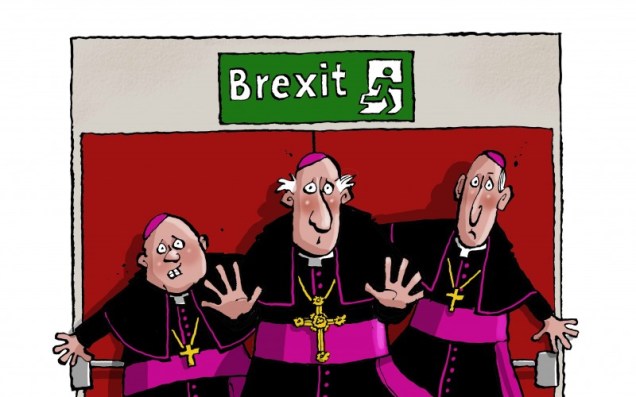
Top Cartoon: Christian Adams, Catholic Herald

Agree with this article? Violently disagree? Scroll down to leave a comment.

Follow Semi-Partisan Politics on TwitterFacebook and Medium.