Worried Remainers Are Now Desperately Attacking The Norway Option For A Reason

European Union - EEA - EFTA

By openly slandering the EFTA/EEA “Norway Option” for achieving Brexit in the event of a Leave vote, the Remain campaign and their allies in the media show that they are terrified of this sensible approach

The Guardian is, of course, desperate for Britain to remain in the European Union. The vast majority of those who read or write for the paper simply cannot conceive why tiny, pathetic, insignificant Britain would want to walk away from an EU which is basically all about puppies, daisies, hand-holding, Saving The Earth and “co-operation”.

As such, the Guardian is desperate to trash any and all Brexit plans which have a whiff of viability and sense about them – and now they are gunning for the interim EFTA/EEA or “Norway” option, just as it starts to be seized upon by an increasing number of influencers and ordinary people tired by the amateur, haphazard campaigning of Vote Leave.

The Guardian’s strategy – to slander the interim EFTA/EEA option as some kind of betrayal of democracy, and to lump it together with other parliamentary tricks MPs might choose to spitefully play in the event of a Leave vote.

The article begins portentously:

Pro-European MPs and some government sources believe it may be possible to use the Commons to mount a guerilla campaign to minimise the impact of a referendum vote to quit the European Union – or even to reverse the decision if the negotiations with the EU on the UK’s exit terms produce a disastrous deal.

The government is not willing to discuss its reaction in the event of a vote to leave since its sole goal at this stage in the campaign is to emphasise the risk of such a vote by saying that the decision would be irreversible and would likely be met with a brutal response from Britain’s European partners, primarily the French.

But privately ministers have pointed out there is a large cross-party Commons majority for the UK’s continued membership of the EU, and it could be deployed once the hugely complex, detailed and contentious legislation necessary to leave the EU started to pass through parliament.

All of which would be shocking if the Guardian had actually uncovered evidence of a plot by MPs to nullify or ignore the result of the referendum. But this isn’t what they mean at all. What they mean is the following:

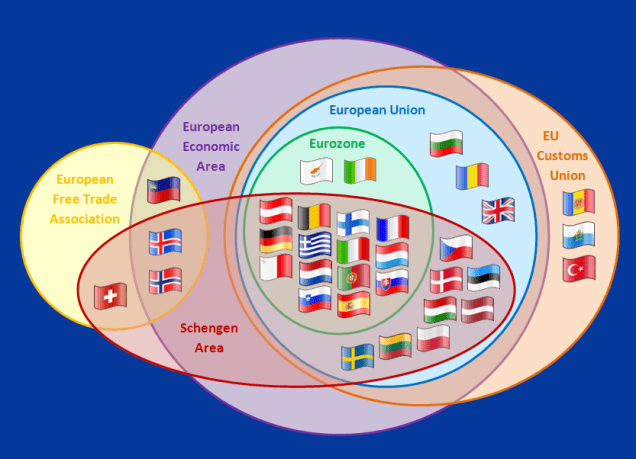
The first target is likely to be whether the UK could remain in the single market, while leaving the EU – so joining the European Economic Area, of which the non-EU countries Norway, Lichtenstein and Iceland are currently members. The single market guarantees the free movement of people, goods and services inside the EU.

The Guardian is trying to portray an eminently sensible – in fact, by far the most sensible – plan to leave the political construct called the European Union as some kind of grotesque subversion of the people’s will – which is pretty rich in itself, considering the contempt bordering on hatred felt by most Guardianistas toward those sympathetic to Brexit.

But let’s remind ourselves of the actual question on the ballot paper on 23 June:
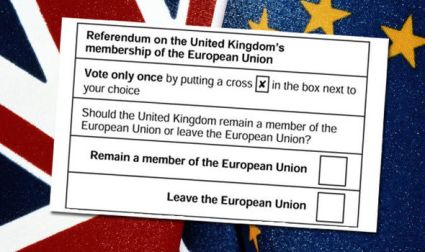
EU Referendum Ballot Paper

That’s right – there is nothing on the paper whatsoever about the European Economic Area or “single market”. A vote to leave the EU is a vote for Britain to do exactly that – to leave an explicitly political, ever-tightening union of European countries all embarked on a journey to one day become a common state (as the EU’s founders and current leaders happily admit).

Many people are rightly now coming to the conclusion that the best way to achieve Brexit with the minimum of political and economic disruption is to exit to an “off the shelf” interim solution which already exists in the form of the EFTA/EEA membership enjoyed by Norway. This is why David Cameron has suddenly started talking about “a vote to leave the single market” over the past few days – it is a tacit admission that if we vote to leave the EU but remain in the EEA, every single one of the Remain campaign’s arguments are instantly negated.

Hence the ardently Remain-supporting Guardian’s desire to do everything possible to slander the interim EFTA/EEA option, painting it as some kind of unconscionable scam when in fact it is an utterly pragmatic and realistic way of leaving the European Union while completely avoiding all of the apocalyptic economic scenarios which the Remain camp love to throw around.

And now, other newspapers are joining in. From the Times’ daily Red Box email briefing:

The Times splashes on warnings that pro-Europe MPs will fight a rearguard battle to stop Britain leaving the single market even after a Brexit vote. With fewer than 200 of the 650 MPs in parliament in favour of leaving the EU, a series of votes could be staged to put pressure on the government to keep Britain inside the single market.

Undemocratic? Of course. Plausible? Absolutely.

Except, as we have seen, it is not “undemocratic” at all. The British people are being asked whether or not they wish to leave the European Union. By gosh, we spent long enough obsessing over the wording of the question. And Brexit to a position where we continue to maintain our access to the single market in the short to medium term while planning more beneficial arrangements for the future is well within the scope of a Leave vote.

It is a surprise to see the Times engaged in the same grubby dark arts as the Guardian in this case. And even more surprising to see the Daily Mail follow suit:

Pro-Remain MPs are plotting to ignore the will of the people by voting to keep Britain in the single market – even if the referendum results in a Brexit victory.

This would mean continued freedom of movement and would ignore public concern about mass migration.

Anti-Brexit MPs on all benches – Tory, Labour, Lib Dem and SNP – could use their overwhelming majority in the Commons to force a Norway-style relationship with the EU.

Out campaigners warned last night that such a move would spark a ‘constitutional crisis’ as it would counter the spirit of a pro-Brexit referendum.

But MPs on the Remain side said such a move – dubbed guerrilla tactics by one source – would be justified because the Leave side have not set out the nature of Britain’s trading relationship with the EU if we left.

Again, we see this short-termist, Brexit-as-an-event rather than the more realistic Brexit-as-a-process viewpoint needlessly closing the mind of the Daily Mail to an eminently pragmatic option.

Certainly immigration is a key issue in the debate – and indeed as a non-EU EEA country, Britain would have a more effective emergency brake than that secured by David Cameron in his pathetic renegotiation. But more importantly, once safely and securely outside of the EU’s political union, Britain could begin planning, negotiating and building support for a better longer-term solution. And we would have our democracy back, to boot.

The “out campaigners” mentioned by the Daily Mail as calling the Norway Option the catalyst for a constitutional crisis are no doubt the same Vote Leave luvvies and insiders who made the calamitous, strategic error of going into the referendum campaign without a Brexit plan of their own, drawing a huge amount of damaging fire from the Remain campaign in the process. They are clearly desperate to slander and diminish any plan which is not cooked up in their own laboratory, perhaps under the auspices of their resident mad scientist Patrick Minford.

The Guardian article continues, quoting Sam Bowman of the ASI:

Sam Bowman, the executive director of the rightwing thinktank the Adam Smith Institute, which has advocated the UK leaving the EU in stages, welcomed the possible intervention in the Commons.. He said: “This is a referendum on EU membership, not the single market, and MPs would be right to keep us in the single market if we vote to leave the EU. Keeping Britain in the single market would take the main economic risks out of leaving the EU, avoiding the doomsday scenarios outlined by the Treasury and others.

“The EEA option outlined in a recent Adam Smith Institute report would give the UK economic security while allowing it to leave the EU. In many respects it gives us the best of both worlds – indeed the remain side has emphasised little else of value about the EU during the campaign apart from the single market.

“The EU is not a prison, but the remain camp risks portraying it as such. It is possible to leave without risking serious economic harm, and staying in the single market as a step towards a long-term settlement would give the UK that safe route out.”

While it is heartening to see the Guardian suddenly discover Roland Smith’s paper “The Liberal Case for Leave” (and the comprehensive Flexcit plan on which it is based), it is entirely unsurprising that they choose to portray it in a negative light, choosing to lump it together with what they accuse of being undemocratic ways of de facto remaining in the EU.

Some of the other acts of democratic and national self-sabotage mentioned by the Guardian as being mooted by government and MPs are indeed more concerning:

David Cameron has said in the event of a vote to leave, he would immediately and formally notify the EU of its intention to quit under article 50 of the Lisbon treaty, kickstarting a two-year negotiation that could only be extended beyond the two years by a unanimous vote of the EU member states.

But lawyers advising the expert UK parliamentary committees dealing with Europe say there is no legal obligation to notify the EU immediately.

Michael Gove, the justice secretary and prominent leave campaigner, said: “Logically, in the days after a vote to leave, the prime minister would discuss the way ahead with the cabinet and consult parliament before taking any significant step.”

He added: “It would not be in any nation’s interest artificially to accelerate the process and no responsible government would hit the start button on a two-year legal process without preparing appropriately. Nor would it be in anyone’s interest to hurry parliamentary processes. We can set the pace.”

There is no need to push the button on Article 50 the day after the referendum in the event of a Leave vote. In fact, such a decision would be a spiteful and churlish act committed by an irresponsible government willing to damage the long-term interest of the country as “pay back” to the people for having disregarded their advice to vote Remain.

Similarly with the idea of a counter-offer from the EU followed by a second referendum in the event of a Leave vote, raising the possibility that Britain might end up in a kind of democratic limbo, having voted to leave the EU but rejected the subsequent terms of departure.

Messing around with either the invocation of Article 50 or the sneaky addition of a second referendum would indeed be undemocratic, or at least a wild act of constitutional vandalism. Adopting the only comprehensive Brexit plan in existence – and as we learned on Newsnight yesterday evening, the plan being actively considered by civil servants, who must obey the laws of reality, not partisan allegiance – does not fall into this category.

Failing to give the UKIP-element of the Leave campaign everything they want wrapped up with a pretty bow on 24 June is not evidence of some sinister plot or an attempt to subvert a democratically made decision to leave the EU. On the contrary, pursuing the Norway Option is the responsible way forward, the best means of securing precisely what the British people voted for – independence from the Brussels political union, and the freedom to make all subsequent decisions democratically for ourselves, including on immigration (within the constraints of realpolitik).

(And for newspapers which usually treat Brexit supporters with dripping contempt verging on hatred to suddenly care whether the Norway Option goes against the “spirit” of a Brexit vote – it doesn’t – is disingenuous at best. A child could see through their attempt at emotional manipulation.)

So we should beware the motivations of those campaigners and newspapers who suggest otherwise. In seeking to tarnish the only comprehensive Brexit plan in existence (Flexcit / the Norway Option) such people clearly have an agenda – once which brings together unlikely allies like the Times and the Guardian, and which sees the Daily Mail also taking up arms for different reasons.

Thinking Brexiteers whose first priority is extricating Britain from the common European state being slowly but relentlessly assembled in Brussels should ask themselves why so many people – from the prime minister on downwards – are suddenly so desperate to conflate the single market with the European Union, and to trash the Norway Option.

Hint: it is because without being able to threaten all manner of apocalyptic scenarios in the event of Britain leaving the single market, the entire Remain campaign – in all its negative, pessimistic, fearmongering glory – utterly falls apart.

These people are desperate to halt the growing public awareness that it is possible to disengage from political and judicial union in a manner that is reasonable, non-hostile, pragmatic and politically feasible without the risk of economic disruption.

Because that might mean actually leaving the EU!

 

European Union - United Kingdom - Britain - Flags

Agree with this article? Violently disagree? Scroll down to leave a comment.

Follow Semi-Partisan Politics on TwitterFacebook and Medium.

Vote Leave’s Folly Gives John Major Free Ammunition To Attack Brexiteers

Every major current attack line being used against the Vote Leave campaign – and therefore Brexiteers in general – could have been avoided with a smarter, more intellectually robust strategy

John Major should be a walking, talking advertisement condemning Britain’s continued dysfunctional relationship with the European Union – the man who signed Britain up to the Maastricht Treaty and did so much to drag us deeper into the mire of political union.

But thanks entirely to the official Vote Leave campaign, John Major managed to sail through his appearance on the Andrew Marr Show today virtually unscathed, passing himself off as the wise, measured older statesman he so clearly wishes to be.

The Huffington Post breathlessly reports:

Boris Johnson and his fellow Brexit campaigners are running a “deceitful” campaign which is “depressing and awful”, former Prime Minister Sir John Major said today.

In a no-holds-barred interview this morning, the ex-Tory leader repeatedly attacked both the tactics and arguments used by Vote Leave as it tried to persuade Brits to quit the EU in the June 23 referendum.

The former Prime Minister, whose seven years in Downing Street in the 1990s were marked by Tory splits over the EU, accused Brexit campaigners of pumping out “a whole galaxy of inaccurate and frankly untrue information.”

He also mocked the notion that leaving the EU would benefit the NHS – one of Vote Leave’s primary claims – as he accused those at the top of the anti-EU group of wanting to privatise the health system.

Speaking on The Andrew Marr Show on BBC One this morning, Sir John said: “Throughout the whole of my political life people have regarded me of being guilty of understatement.

“I am angry at the way the British people are being misled. This is much more important than a general election. This is going to affect people, their livelihoods, their future, for a very long time to come and if they are given honest, straightforward facts and they decide to leave, then that is the decision the British people take.

“But if they decide to leave on the basis of inaccurate information, inaccurate information known to be inaccurate, then I regard that as deceitful. Now, I maybe wrong, but that is how I see their campaign.

He added: “For once I’m not going to give the benefit of the doubt to other people, I’m going to say exactly what I think and I think this is a deceitful campaign and in terms of what they are saying about immigration, it’s a really depressing and awful campaign. They are misleading people to an extraordinary extent.”

And who can really disagree with these accusations?

Vote Leave continue to brazenly peddle their £350 million lie.

They continue – despite being packed to the rafters with people who (quite rightly) question the ongoing viability of the current NHS model – to implausibly suggest that they will plow nearly all of the savings from no longer making EU contributions back into the same unreformed health service.

(This blog has no more to say about people who base their decision in the EU referendum primarily on the NHS than has already been written here, here, here and here.)

And now, having utterly failed to move the needle on the economic argument with their oh-so-bright lack of a Brexit plan, they are doubling down on the immigration argument. Which is a surefire way to get 40% of people to go charging to the polling booths to vote for Brexit, while alienating the moderate 20% who will take fright and ensure that Britain remains stuck in the European Union.

Ordinarily, this intervention by John Major might be seen as the last hurrah of a rather bitter man, eager to get revenge on people (like Iain Duncan Smith) whom he views as his disloyal tormentors, and dismissed as such. But every charge levelled by John Major at Vote Leave has an awkward ring of truth to it.

Britain doesn’t pay £350 million a week to the EU.

Boris Johnson, the clown in charge, really didn’t even make up his mind which way he was leaning until the very last minute, instantly undermining every one of his criticisms of the EU.

In fact, every major attack line currently being used against Brexit side could have been easily avoided if only the children running the official Leave campaign had charted and executed a better, more grown up campaign strategy – one based on an actual plan for achieving Brexit.

Richard North laments this very point in a recent blog post:

The absence of a plan has been a liability throughout the entire campaign. Had there been one published at an early stage it would have deprived the “remains” of one of their most powerful memes and thereby reshaped the entire campaign. We would by now have spent many months talking about detail and the very specific direction of travel in which Flexcit takes us.

At this late stage of the campaign, those arguing for Brexit should not have to endure the indignity of being lectured to by so hapless a leader as Sir John Major. We could be winning this referendum based on a plan which nullifies every single one of the Remain campaign’s economic scaremongering tactics.

But here we are. And the latest poll showing a slight lead for Leave, though quite unsurprising for this point in the campaign and crucially nowhere near 50%+1, will only encourage Vote Leave to double down on their present strategy.


European Union - United Kingdom - Britain - Flags

Agree with this article? Violently disagree? Scroll down to leave a comment.

Follow Semi-Partisan Politics on TwitterFacebook and Medium.

Unmasking The Anti-Democratic European Union

Democracy - European Union - EU Democratic Deficit - Referendum - Brexit

Elections alone do not make democracy

You’ll probably have heard it a thousand times by now, from a succession of glazed eyed EU apologists – “people have a nerve calling the EU anti-democratic! The European Parliament has proportional representation, which is better than the House of Commons! And what about the unelected Lords?”

The insidious idea that because parts of the British constitutional framework are undemocratic we should freely accept the deliberately antidemocratic governance of the European Union is glib and toxic, and deserves to be rebutted.

Fortunately, the bloggers of The Leave Alliance have been hard at work doing just that.

Lost Leonardo of the Independent Britain blog breaks it down to basics:

Democracy, from the Greek—demos and kratia—literally means ‘people power’. A democratic system is one in which decisions are taken as closely to the people as possible. The UK system of parliamentary or representative democracy could be said to be a limited democracy while the Swiss system of direct democracy is what one might call a true democracy.

The EU government, for that is what it is, is not only undemocratic but anti-democratic. The people have no control over the decision-making process whatsoever.

First of all, there is no self-identifying European demos. I am happy to identify as European, but I do not regard German or French people as my fellow countrymen. Although we are all born of the same civilisation, our different languages, cultures, customs and traditions makes us foreign to one another. The kind of solidarity needed to constitute a demos cannot be forced or faked and it is simply not present at the continental level. I am British first, not European.

As a result, the idea that the European Parliament represents the people of Europe is absurd. European elections are not really European elections so much as snapshots of how discontented a given people are with the politicians in charge of their respective national governments. Turnout in European elections is low, not only in Britain, and very few people take the results seriously. The European Parliament is the weakest of the five most important EU institutions: the European Commission, the European Parliament, the European Court of Justice, the European Council and the Council of the EU.

Lost Leonardo then goes on to detail how the strength and breadth of the EU Commission’s power alone is proof that the system was deliberately designed to lift power and decision making as far above the heads of the people as possible:

There are three features of the EU system which cement the European Commission’s dominance. First of all, the EU is the supreme law-making authority in the Member States. The precedents for this are long-established in European and English law. EU law trumps British law, and where the two conflict, the judge will find in favour of the EU. In the event that a decision is disputed, the final judgement is made by what is, while Britain remains in the EU, the highest court in the land, the European Court of Justice (ECJ).

Second, the European Commission has sole “right of initiative” within the EU. No new EU law can be proposed, amended or repealed without Commission involvement and approval. This is the key to the anti-democratic character of the EU. There is no way to “reform” this aspect of the EU because no initiative can or will progress without Commission consent. There is no mechanism to compel the Commission to act; legislative proposals put to the Commission by other EU institutions are advisory only.

The Commission is the executive arm of a supranational government, but the commissioners are not directly accountable to anybody. The European Parliament has the power to unseat the entire Commission, which has happened once, but there is no mechanism to hold individual commissioners to account.

Third, the Commission itself is comprised of political appointees who swear an oath of allegiance to act in the interests of the EU as a whole rather than representing the interests of any particular nation-state. Thereby does the Commission protect the body of EU law from democratic accountability.

This is the inverse of the British idea of freedom under law which is founded on the principle that no Parliament may bind its successor. Under the EU system of governance, every law is sacrosanct unless or until the Commission says otherwise.

Some EU apologists will try to hold up the fact that there is always a British commissioner as some kind of safeguard or firewall protecting our interests, but as Lost Leonardo points out this is entirely misleading – their allegiance is to the European Union only.

Tony Edwards of The Brexit Door blog gives us an overview of the type of calibre individuals which often make it to the European Commission:

Our present commissioner is Lord Hill, his role is in the financial stability portfolio. He has never been elected to any office in the UK. Other commissioners have often been failed or deposed politicians, none so more that the UK representatives: Mandleson, Kinnock, Patten, Jenkins, Brittan. Others were totally unelected at any stage such as Baroness Aston who was held the foreign affairs portfolio during the failed Ukraine adventure.

Which is less than ideal, because:

Individual commissioners cannot be removed by anyone but the commission or the council. The entire commission can be removed by a no confidence vote in the parliament.

So in essence the executive is almost unassailable, has prerogative on all legislative matters and its members are unelected. Not only that, they cannot be removed by the will of the people unless the parliament is willing to unseat the entire commission – a very unlikely scenario.

And Edwards rightly concludes:

The structures of the EU are in a sense democratic in one feature, in that they hold elections. But the power of the people is incredibly far removed from the real holders of power, the commission itself, which is not democratically elected nor removable by the people directly. It is not democracy in any form that would be acceptable in the UK institutions, and the people are largely voiceless in it.

Not only that, the bodies are constituted in such a way that those who are against the general direction of further federalisation are always in the minority. In effect, once a competence has been passed to the EU, there is no mechanism for it to be returned. The ECJ, by activism can also extend the role of the EU through interpretation of the treaties, and this transfer of competencies is also irreversible in practice. Any move to repeal legislation must realistically be made by or sanctioned by the Commission.

Reform of the EU is therefore impossible. It is designed with only one purpose, to integrate more and more power to the Commission which then acts as the head of a European Superstate. The commission makes the law and sets the direction of travel with little resistance from the EU representative structure.

But still, Remainers love to suggest that it is the United Kingdom which is democratically broken, and the European Union the white knight come to rescue us. Of course our British democracy has its flaws. The unelected nature of the House of Lords. The fact that Britain ranks alongside Iran as the only other country to have unelected clerics sitting in its upper legislative chamber – a literal theocracy.

But these are reasons to take back power first from the European Union, and then set about reforming our broken government in Westminster. We need root and branch constitutional reform to unpick decades and centuries of patching, fixing and bribing, so that at long last we have a constitutional settlement we might be proud of (or at least less ashamed of having to explain to perplexed foreigners).

We should devolve power equally to the four home nations of the United Kingdom, giving Wales, Northern Ireland and England the kind of policymaking and fiscal autonomy currently enjoyed by Scotland. Tax should be devolved even further, with a low base rate of UK income tax to fund the functions of the federal Westminster government – things like defence and foreign affairs – topped up by the home nations, regions and local authorities as they see fit, according to local needs and priorities.

But even if you disagree wholeheartedly with this suggested approach, these are decisions that Britain should make as an independent, sovereign state, not as a vassal of the European Union, which exists solely to act as a ratchet towards political union and for whom good governance is very much an afterthought.

But as Pete North darkly warns, we should be under no illusion as to what will happen if we fail to take this opportunity to wrest back power from the European Union as the first step toward revitalising our democracy:

Having failed to break the political deadlock the referendum will be used as an excuse to ignore the dissent and resentment bubbling under the surface. They will be free to do as they please as though a remain vote was a mandate. The cycle of introverted navel gazing will continue among our political class while the vitality of the media continues to drain away and journalism slides into the abyss.

And having surrendered the substance of government we shall see a further abdication from grown up decision making. We will have lost any kind of effective early warning system by way of having totally dysfunctional politics and we will be forever be on the backfoot, responding ineptly to crisis after crisis without the means to defend ourselves and lacking the political intelligence to formulate policy.

In that regard, one might have some sympathy with the remainer view that Britain does not have the capacity for self-governance. We have already squandered much of it. And if that be so, and the verdict from this referendum is that we should simply surrender and fade into obscurity, travesty though that will be, then this really is the end of Britain as an independent nation.

And what then?

There is a fork in the road. One road leads to a reboot; a collective reorganisation of everything to reshape our country to meet the challenges of the future. The other road leads to subordination, irrelevance and the quiet death of democracy.

In this, should we choose to remain, I don’t expect to see a big implosion. Just a very gradual crisis of competence. Things will break down without anybody quite knowing why – or even noticing that they are broken. Taxes will go up, prices will go up, the number and quality of services will decline. We will find ourselves paying for that which we assume we have already paid.

Corporates and government will do as they please to us as they will have figured out that all of the power is theirs and we won’t resist. We won’t rock the boat. We won’t risk anything radical. We will do anything to preserve the status quo and not let anything difficult intrude on our lives. Obedience is always the path of least resistance.

In that, you will be free in your gilded cage. Free so long as you live within the margins and pay your bills on time. If you make a stand individually you will be picked off. The whole weight of the system will come crashing down on you. You will have no democratic recourse. No day in court. No defence. No justice.

The European Union exists first and foremost as a ratchet process toward the full economic and political union of its constituent member states. You don’t have to take my word for it, or anyone else’s – the EU’s founders and past and present leaders openly admit as much. Only in Britain do we bury our heads in the sand as to this crucial fact.

This is the EU’s first and only priority. And if achieving it means dooming the south to permanent recession, exacerbating a worsening migrant crisis or committing any other kind of governmental vandalism, so be it. The EU certainly has no particular desire for individuals and communities to gain more control over their lives and the decisions which affect them – indeed, the entire structure of the EU reflects an enormous fear and disdain for the sentiments and priorities of ordinary people among the sainted “founding fathers”.

So whatever flaws may exist in our imperfect British democracy, do not believe for a moment that we shall transcend them by fearfully voting to remain in the European Union. We shall not.

And if you think things are bad now, wait until our Westminster parliament is truly just a council chamber in Europe.


European Union - United Kingdom - Britain - Flags

Top Image: The Economist

Agree with this article? Violently disagree? Scroll down to leave a comment.

Follow Semi-Partisan Politics on TwitterFacebook and Medium.

Maurice Glasman Makes A Thoughtful Left Wing Case For Brexit

Maurice Glasman - EU Referendum - Blue Labour - Brexit

Maurice Glasman’s thoughtful intervention in the EU referendum debate is more proof that left-wing thinkers who value democracy naturally gravitate toward Brexit

The glib, feeble left-wing case for Britain remaining in the European Union can basically be summed up as “don’t give us back democracy, because the British people might be so foolish as to demand conservative policies and vote for conservative politicians”. It is, in other words, profoundly and actively anti-democratic, springing from a toxic and elitist mindset which hates and distrusts the people.

Unsurprisingly, the great and the good of the modern Labour Party have therefore flocked to its banner, endlessly repeating the shocking (to them) warning that if Britain did not have certain values imposed from above by a higher authority in the form of the EU, the British people themselves might not be so enlightened as to choose left-wing policies for themselves.

This is a weak and contemptible argument, and those advocating it – from Jeremy Corbyn to Owen Jones to Yanis Varoufakis – should know better, and quite probably do know better, deep down. This makes their betrayal of British democracy all the more unforgivable.

But there is a left-wing case for Brexit of more substance and nuance, and Maurice (Lord) Glasman now makes it in LabourList. At its core is still the desire to favour left-wing politics in particular rather than seek to regain democracy in the abstract, but at least Glasman puts some actual thought into his argument.

Glasman concedes that the EU was flawed from the start:

Unfortunately, probably from the outset, and certainly by the Rome Treaty of 1957 a Jacobin tradition of unmediated space, emptied of decentralised institutions had asserted itself, particularly through the head of the High Authority, that became the European Commission, Jean Monet.  He asserted that economic exchange and legal uniformity would, over time, produce political unification.

Perhaps naturally, Glasman traces the EU’s decline firmly back to the accession of Britain in 1973:

Under the leadership of Edward Heath, who had a genuine feeling for the fate of Europe, Britain did join the Common Market, as it was called it for a long time.  It did not go well from that time on as the Common Market was not based on a shared political economy. 

Britain is an island and was always at an angle to Europe.  It avoided the continental territorial struggle for domination and developed a maritime rather than a landed economy as well as distinctive political institutions based upon the balance of powers within the Ancient Constitution. 

De Gaulle, in continuation with Napoleon, thought that all Britain cared about was free trade and the primacy of the City of London. He argued that the British State could never agree with either the administrative directives favoured by the French or the institutional co-operation embodied in the German Social Market. 

The difference between territorial rule underpinned by an army and central directives and a maritime economy based on the Navy and free trade was what was at stake in the Napoleonic wars.   In boycotting Britain and building a Europe of administrative conformity Napoleon continually blasted Russian, German and Austrian leaders for continuing to trade with Britain, which as a maritime power traded with the world.  Napoleon’s career ended when he voluntarily boarded a Royal Navy ship and was taken to a faraway island where his board and lodging was paid for by the City of London.  Despite the conclusive result of that conflict it was not the end of the argument. 

The political and economic systems of Britain and France was very significantly different.  Britain had dispensed with its peasantry during the last stages of enclosure and the Corn Laws, it had embraced the market at home as well as free trade abroad. On joining the Common Market the very unhappy marriage of Napoleonic directives and free trade objectives began which threatened the European Community’s earlier achievements of agricultural protection and worker participation.  The Common Market, or European Economic Community as it then became known, had been built on a substantive conception of an economy based upon agriculture and industry, land and labour.  Britain, in contrast, brought a model of a financial and services based economy in which free movement rather than social partnership was the primary goal of political union. 

And correctly identifies the anti-democratic black hole which appears when the EU technocracy instinctively recoils from the people and their dangerous passions:

As the European Union becomes more general, abstract and administrative it will naturally side with capital and directives, viewing politics itself as populist.  The reaction is already present within each European State. When I was in Berlin last weekend the AfD had surpassed the SPD in the polls.  When reason itself becomes desiccated and exclusively rational, severing itself from institutional judgement and historical experience it turns all forms of resistance into demagogy and madness.  And yet, democracy is the European way of resisting the outrageous claims of capitalism to own, commodify and de-contextualise human beings, nature and all civic institutions.  The tension between democracy and markets can no longer be resolved at the level of the EU, which through its inverted definition of subsidiarity in which the larger subsumes the smaller, is hostile to democracy, distinctive local and national institutions.

Obviously Glasman is particularly interested in democracy as a means for the people to resist what he sees as the “neo-liberal” agenda of the EU – he is not advocating Brexit for the pure sake of democracy. But at least democracy gets a look-in in Glasman’s argument, which is more than can be said of the Jeremy Corbyn / Owen Jones position, which unashamedly seeks to cling on to the European Union precisely as a means of suppressing British democracy.

Glasman’s conclusion is particularly devastating (my emphasis in bold):

For many years the European project has served as an alternative to Labour having a serious politics of national transformation, of building the coalitions necessary to constrain capital and strengthen democracy. It was a national political weakness that led to the enthusiastic embrace of the EU and it remains a refuge from domestic political defeat.  Labour should be robust in supporting free and democratic trade unions throughout Europe, in championing a balance of interests in corporate governance and strong civic self-government with a deep partnership between universities, cities and firms.  The question is whether being part of the EU hinders this.  Britain is already outside the Eurozone and the Schengen agreement.   It is gratuitous to remain part of a political union that is so hostile to diversity and democracy and so disposed to the consolidation of big capital that it has become a remorseless machine for the liberalisation of trade and the disintegration of society, in which the demand for liquidity has dissolved solidarity. Perhaps it is time to think again.

This really gets to the heart of it – the EU has indeed been an poor alternative to having a serious national political conversation about how we wish to govern ourselves. Labour are not exclusively to blame in this regard. Politicians from all parties have gladly surrendered power to the European Union, eagerly seizing the opportunity to keep the trappings of power for themselves while divesting themselves of ever more responsibility for the outcomes of decisions now made in Brussels.

And how refreshing it is to hear a personality from within the Labour Party actually suggest that maybe – just maybe – it should be the job of left wingers to argue their case in public and seek to convince the British electorate of the attractiveness of socialist policies rather than seek to bypass the electorate and impose social democracy from above via the EU.

In fact, Maurice Glasman, founder of Blue Labour, is exactly the type of voice that the Labour Party needs to listen to and place front and centre of their policymaking if they want to staunch the exodus of working class support from a party which increasingly resembles a middle class, creative industry, virtue-signalling talking shop.

A party which lost seats to the Tories because of traditional voters defecting to UKIP – and facing the prospect of Nigel Farage’s party nipping at its heels in a swathe of Northern constituencies – would make a place of honour for someone like Maurice Glasman, and perhaps even listen to what he has to say about the European Union.

But they can’t do it. Jeremy Corbyn and co. were happy to enrage the party establishment and donors on all manner of issues, from the Syria military action vote to their perceived tolerance of anti-Semitism. But on the crucial issue of Britain’s membership of the European Union, suddenly Stockholm syndrome kicks in and everybody robotically sings from the same worshipful hymn sheet. It’s pathetic.

There is still an element within the Labour Party that actually cares about the hopes, dreams, fears and priorities of the working class. But you won’t find it within Jeremy Corbyn’s inner circle, or the mainstream party in exile. This dwindling branch of the Labour Party is now much like the Popular Front in Monty Python’s “Life of Brian” – a solitary man, sitting on his own, ignored by everybody else.

In their unthinking support for the European Union, the shining practitioners of the New Politics have thrown the working class – indeed , everyone who loves democracy – well and truly under the bus. And at some point there will probably be a reckoning for that.


European Union - United Kingdom - Britain - Flags

Top Image: The Times

Agree with this article? Violently disagree? Scroll down to leave a comment.

Follow Semi-Partisan Politics on TwitterFacebook and Medium.

Little Englander Conspiracy Theories, Eh?

Francois Hollande - Common State - European Union - EU Referendum - Brexit

It isn’t difficult to discern the trajectory of the European Union over the next decades. Just listen to the words of the EU’s leading political figures from past and present

Leave Alliance blogger Paul Reynolds has published an excellent retort to claims by assorted Remainers and EU apologists that those of us who warn of the impending European state are somehow indulging in paranoid fantasies.

For while everyone in the Remain campaign, from the prime minister on downwards, may be shouting “move along, nothing to see here!” while the scaffolding for a single European state continues to be steadily assembled behind their outstretched arms, any objective person can clearly see what is going on.

Among the examples given by Reynolds, in a piece entitled “A Profound Choice”:

“We have sown a seed… Instead of a half-formed Europe, we have a Europe with a legal entity, with a single currency, common justice, a Europe which is about to have its own defence. ” — Valery Giscard d’Estaing, President of the EU Convention, presenting the final draft of the EU Constitution, 13th June 2003

“The proposals in the original constitutional treaty are practically unchanged. They have simply been dispersed through old treaties in the form of amendments. Why this subtle change? Above all, to head off any threat of referenda by avoiding any form of constitutional vocabulary!” — Valéry Giscard d’Estaing, 2007, referring to the the Lisbon Treaty achieving the aims of the rejected EU constitution

“The Constitution is the capstone of a European Federal State.” — Guy Verhofstadt, then Belgian Prime Minister, now an MEP

“The European Union is a state under construction.” — Elmar Brok, Chairman of the European Parliament’s Committee on Foreign Affairs

“Of course the European Commission will one day become a government, the EU council a second chamber and the European Parliament will have more powers.” — German Chancellor Angela Merkel addressing MEPs,  November 2012.

“We need a true political union … we need to build a United States of Europe with the Commission as government and two chambers – the European Parliament and a “Senate” of Member States … European Parliament elections are more important than national elections … This will be our best weapon against the Eurosceptics.” — Viviane Reding, Vice-President of the European Commission, January 2014

“For my children’s future I dream, think and work for the United States of Europe” — Matteo Renzi, Italian Prime Minister, May 2014

 “I look forward to the day when the Westminster Parliament is just a council chamber in Europe.” — Kenneth Clarke, Conservative Chancellor in International Currency Review Vol 23 No 4 1996

Reynolds then goes on to show how this was the plan all along. As it was in the beginning:

Nor should anyone believe that this is a recent development. The EU was always conceived as a vehicle for supra-national federal union, dating right back to its founding organisation, the European Coal & Steel Community (ECSC) established in 1951:

“Through the consolidation of basic production and the institution of a new High Authority, whose decisions will bind France, Germany and the other countries that join, this proposal represents the first concrete step towards a European federation ..”
 — The Schuman declaration May 1950

“By the signature of this Treaty, the participating Parties give proof of their determination to create the first supranational institution and that thus they are laying the true foundation of an organised Europe.” — Europe Declaration made on 18 April 1951, at the signing of the Treaty of Paris establishing the ECSC

Is now:

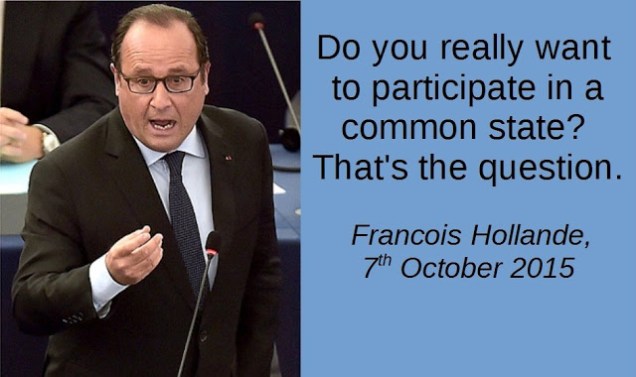
“Do you really want to participate in a common state? That’s the question.” — Francois Hollande, French President, addressing UKIP leader Nigel Farage in the European Parliament, 2015

And forever shall be:

This is reinforced by the proposals for the next EU treaty, The Fundamental Law of the European Union, published by the federalist Spinelli Group of MEPs, through the Bertelsmann house in late 2013. The preamble contains a telling paragraph:

“This proposal for a Fundamental Law of the European Union is a comprehensive revision of the Treaty of Lisbon (2007). Replacing the existing treaties, it takes a major step towards a federal union. It turns the European Commission into a democratic constitutional government, keeping to the method built by Jean Monnet in which the Commission drafts laws which are then enacted jointly by the Council, representing the states, and the European Parliament, representing the citizens. All the reforms proposed are aimed at strengthening the capacity of the EU to act.” 

European Political Union without end, Amen.

The time for childish, wistful self-deception is over. The British people need to wake up and make a decision – as Francois Hollande rightly exclaimed last year, in a moment of rare candour – about whether we want to participate in a common European state, or whether we wish to be independent, like every other major country in the world outside of Europe.

Ignorance about the intentions and trajectory of the European Union is no longer excusable. These quotes are not difficult to be defined. Neither can their existence be denied or countered in the way that the various economic claims on both sides have been subject to ridicule. These statements all exist because the real political leaders of Europe really do intend to take the European Union in this direction. Today’s EU institutions stand as testament to their vision and their determination to make it a reality.

Contrast the determined long game played by the euro federalists (the quotes selected by Paul Reynolds extend from 1951 through to 2015) with the flimsy, ethereal, cosmetic efforts of British politicians to supposedly win “concessions” from the EU. David Cameron’s renegotiation was nothing more than a grubby little fraud perpetrated on the British people, securing meaningless nods of assent from various heads of government acting in their own capacity, not the EU’s, most of whom will soon have moved on and been replaced by successors who do not feel bound to honour the various tidbits promised to Britain.

And leftists are no better. The once proud and principled tradition of left-wing euroscepticism is virtually dead, stabbed in the back by the likes of Jeremy Corbyn and Owen Jones (was the guilt and shame of this betrayal – and he knows he is betraying his true values – the reason why Owen turned in such a weak performance on Question Time last night?). And the leftists are now queueing up to talk about their utterly unachievable pipe dream of hands-across-Europe socialism, pretending to themselves and the rest of us that the EU can somehow be “changed” into a perfect socialist vessel. The EU’s founders and current leaders have been working toward a common state for nearly a century! What gives the likes of Owen Jones and Yanis Varoufakis such misplaced confidence that their little socialist tugboat can alter the course of the EU’s giant oil tanker, steaming at maximum knots toward economic and political union?

No, there are only two choices available to Britain – leave the European Union and seek to become a self-governing democracy once again (like every other major country in the world), or remain in the European Union and continue down Francois Hollande’s path toward a common European state.

There is no third way. David Cameron’s renegotiated settlement is not worth the used napkin on which it is scrawled – as far as the EU is concerned, a “Remain” vote mean that Britain is all squared away and ready to continue the march toward political union.

And those who continue to fatuously claim that the EU is simply about cooperation, trade and sharing cookies with one another are lying – to themselves, and to the British people. That benign version of “Europe” is not on offer in this referendum. We have a choice between independence and re-engagement with the world as a confident, powerful player on the one hand, and continued participation in the journey to a common European state on the other.

Do you really want to participate in a common state?

As Britons step into the polling booth on 23 June, this is the question which should ring in our ears.


European Union - United Kingdom - Britain - Flags

Top Image: The EU Question

Agree with this article? Violently disagree? Scroll down to leave a comment.

Follow Semi-Partisan Politics on TwitterFacebook and Medium.