Building A Britain Fit For The Future

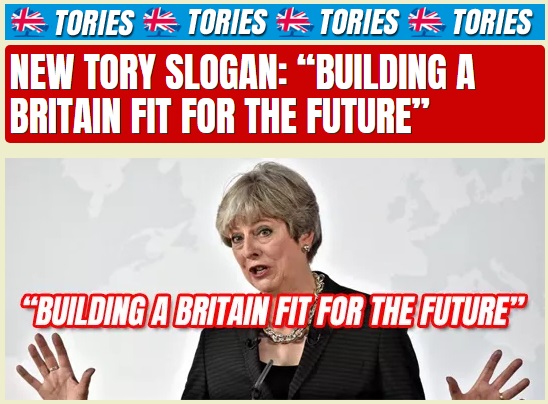
Building a Britain fit for the future - new Conservative Party Tory slogan

Strong and stable, version 2.0

Word on the street is that the Tories have got themselves a shiny new slogan. Guido Fawkes reports:

Here are seven words you can expect to hear a lot more of over the next few weeks and months: Guido understands the new Tory slogan is “Building a Britain fit for the future”. Theresa May used it three times at PMQs on Wednesday, telling the Commons: “this government is building a country fit for the future”, “we are building a Britain fit for the future” and “We in the Conservative Party are building a Britain that is fit for the future”. This morning the CCHQ Twitter account used the same phrase.

As slogans go, I suppose that “Building a Britain fit for the future” could be a hell of a lot worse. It is certainly better than “strong and stable”, though according to Guido it seems as though the Tories are already in danger of wearing out their new slogan through enthusiastic over-use.

BABFFTF has potential because it at least acknowledges that we are entering a period of discontinuity – a time where the current system or political consensus is starting to fray and show signs of fatigue, where new and previously politically unfeasible policies are required to break the impasse or respond to the concerns of the electorate. The rise of Jeremy Corbyn as Labour leader and the vote for Brexit are just two of the most prominent signs that we have entered such a time of discontinuity, with the pro-EU, centrist consensus adopted by Labour and the Conservatives through 2015 increasingly failing to address the hopes, fears, concerns and priorities of many people.

The problem, though, is that the slogan seems to have been trailed before the necessary supporting ideas – the vital national reboot checklist which can steer Britain through Brexit and on to the other challenges – have been developed. Now, it’s possible that Theresa May has been huddled in Downing Street with her SpAds brainstorming some breathtakingly original new ideas, and that we will all be bowled over when they are announced in the coming weeks – but it seems unlikely. Firstly, she would be breaking the habit of a lifetime (doing something bold and visionary) and secondly it is hard to tell when such inspired policymaking might have taken place given all of the shenanigans going on in her Cabinet.

While we can finally detect a few faint signs of new intellectual life in the Tories – notably the Big Tent programme launched by George Freeman, and the Square Deal initiative led by Nick Boles – these groups are barely getting formed, and are months away (if not more) from reaching full fruition. And as I have previously written (and will continue to expand upon in coming days and weeks), we are still missing anything like an overarching framework to diagnose the issues facing Britain, draw out the links between them and produce an electorally viable set of policies to tackle them. Discontinuity requires policymaking through extraordinary means; the same old processes tend to yield the same old solutions.

That being said, the Tories cannot remain silent altogether while they try to get their act together. It is good, in a way, that Brexit is currently consuming most of this government’s energy because that means that they have little time (and even less political capital) to push through some of the authoritarian, statist, anti-market policies which one suspects Theresa May would now be rolling out had she won a thumping majority. A de facto “first, do no harm” doctine has thus been partially imposed on this government, like it or not.

But still the Tories must do something, starting with the Budget next week, to show that they are starting to understand the depth of public dissatisfaction with the old political settlement, particularly on housing (since this is a vital policy area more separated from some of the others). Years of disappointment mean that I have zero positive expectations of Phillip Hammond when he gets to his feet to deliver the Budget next Wednesday. I fear that even if there is noticeable movement on housing, it will be a big sop to Labour by focusing on the building of new council housing rather than the big unleashing/encouraging of private development (upward, not outward) which we need. This is Hammond’s chance to prove me wrong, as well as everybody else who has lost faith in the current government being anything more than a very clumsy caretaker.

The pessimistic part of me still believes that a mid-term rescue for the Tories is simply impossible; that it will take a (hopefully) short, sharp spell in opposition to rid the current Tory frontbench of much of its dead wood and see some new talent push forward – hopefully talent less beholden to the current political consensus, and which wants to do more than simply make a few cosmetic tweaks to win back public opinion. Readers will no doubt correct me if I am wrong, but I cannot think of one example of a successful political turnaround that was driven by refreshed policies rather than the good fortune of events.

But a Jeremy Corbyn government is not something to be entertained lightly. The next government will likely set the tone and direction of Britain’s immediate post-Brexit years, and so will play a large role in stamping their imprint on whatever the new emerging political consensus or centre of gravity happens to be. After years of leftward drift under both New Labour and Conservative governments, it is important that the next significant course change is to the right. In a world of pure ideology one may well want the Tories decimated at the next election so that they can grow back stronger and with a renewed sense of purpose, just as controlled forest fires can ultimately benefit an ecosystem even as they destroy in the short term. But since we all have to live in this forest for the duration, dropping a match onto dry leaves by ushering Jeremy Corbyn into 10 Downing Street really must be an option of last resort.

Therefore let us hope that “Building a Britain fit for the future” and whatever quickly-concocted policies lie beneath it buy the Tories sufficient breathing room to attempt a more fundamental policy review – to create the new Stepping Stones report for 2018 that Britain needs to chart our way from one failed political consensus to a new one which addresses today’s challenges.

Let’s hope that it falls to conservatives to build the Britain of the future, and not Jeremy Corbyn’s Labour Party.

Conservative Party Logo - Torch Liberty - Tree

Support Semi-Partisan Politics with a one-time or recurring donation:

Agree with this article? Violently disagree? Scroll down to leave a comment.

Follow Semi-Partisan Politics on TwitterFacebook and Medium.


Recognising Failure In Brexit

Brexit - young professionals

One of the greatest failings of Brexiteers since the referendum has been our inability to convince more wealthy, urban, Remain-voting younger professionals that the old pro-EU political consensus is broken, or that they benefit in any way from nation state democracy

I spend a lot of time on this blog telling various people and groups – the establishment, Remainers, Labour centrists, Tory wets – to engage in a bit of introspection and consider where their own actions and behaviours may have helped feed the very circumstances or phenomena which now upset them.

It is only fair that I go through the same process myself, as a way to maintain intellectual integrity. And there is one failure in particular that I keep coming back to – never finding a way to bridge the gulf of understanding between the two worlds that I myself straddle, Brexitland (where I was born) and the urban bastion of EU support (where I now live).

In the immediate aftermath of the referendum result, even before we knew the demographic breakdown of the vote, I wrote:

I extend to you the magnanimity and friendship that (I hope) you would be extending to me right now had the result gone the way we all expected. It is incumbent on all of us now to work together to achieve the best possible form of Brexit.

I think it is fair to say that I have not always lived up to that aspiration, though most of my lapses have only taken place in the context of extreme provocation in terms of the rhetoric or tactics adopted by what quickly became an extraordinarily energetic (and often venomous) continuity Remain campaign.

I have at least never knowingly initiated a hostile encounter with an EU supporter, online or in real life, because I still believe that whatever convulsions or purges our political class may need to go through as Brexit unfolds, the rest of us will need to knit back together as one country. As I have written only recently, we have many other pressing issues besides Brexit facing us as a country, none of which can be tackled successfully so long as we have our hands round one another’s throats.

It was therefore been incumbent on Brexiteers like myself – in addition to safeguarding the referendum verdict and working to achieve a better form of Brexit than the present government is on course to deliver – to attempt to persuade at least some Remain voters (particularly those who are not hardcore eurofederalists) that Brexit has the potential to be a good thing and a catalyst for further change if we demand it through our active participation.

This has not been a roaring success. I live in northwest London, in an overwhelmingly Remain-voting constituency (Hampstead & Kilburn) where EU flags flutter from the windows, I work in a professional job and have a social circle largely consisting of people like me, some of whom read this blog and all but one of whom voted Remain. Not only was I unable to sway any of the young professional people who know me during the referendum or in the aftermath (though I did have more success with other demographics), my efforts on social media were even more disastrous.

To understand the scale of the problem, one needs to understand just how hard this particular demographic took the Leave vote. When my wife went to work (at an American-owned international public relations company) the day after the referendum, her company’s German office had already sent the following email to their London colleagues:

Dear Friends,

On this truly disturbing day, we want to send you our greatest empathy and heartfelt solidarity to London and the whole UK [company] Team. Although troubling times maybe ahead of all of us here in Europe, the whole team of [company] Germany keeps on believing in the European idea and the future of peaceful and prosperous unity for Europe with the United Kingdom and all the wonderful people living there.

So for us this is not the end of the road. Our friendship with you will be stronger than ever and we will get through this together.

Big Hugs from Germany

Please share with the whole office

This text was followed by a picture of the entire German team making heart shapes with their hands as they hold aloft the German, EU and UK flags.

This is what we have to contend with as we try to navigate Brexit – whole offices full of undeniably smart people who legitimately view the events of the past seventeen months as a nearly unspeakable calamity with no possible redeeming features.

The author of this email (and the senior person who authorised it) clearly had absolutely no doubt that their sentiments would be shared by every single one of their colleagues in London. There was simply no recognition that smart, professional people might come down on different sides of the Brexit debate, only the arrogant but genuine assumption that everybody working for the company (both in Germany and the UK) shared the pro-EU worldview.

Imagine working at such a place: certainly no Brexit-supporting employee would dare to openly admit their own political views in such a one-sided, hostile climate. If senior management think your political views are “truly disturbing” one is not likely to torpedo one’s own career by dissenting from the email. We saw the same intolerance of ideological dissent at Google earlier this year, when engineer James Damore was fired for what was portrayed by the media as an “anti-diversity screed” but which in reality was a thoughtful (if partially flawed) memo on Google’s specific diversity policies.

I was stunned when my wife showed me the anti-Brexit email circulated within her firm. But what struck me most was the way that the author described Brexit – the prospect of Britain regaining the kind of democratic control over its own affairs enjoyed by every other developed country in the world outside Europe – as “truly disturbing”. It simply should not be the case that the entire staff of any organisation (save perhaps the EU itself) view Brexit as an unmitigated calamity. That such uniformity of opinion still exists is a failure on the part of Brexiteers – despite the unwavering effort of many of us to present the progressive, internationalist case for leaving the EU.

We currently live in a country where many people are consumers first and conscientious citizens a distant second; where the elimination of the smallest short-term risk is seen as more important than safeguarding the long term democratic health of Britain. But it is not enough to rail at pro-EU professionals for voting for their own short-term economic self interest, just as it is not enough for disappointed Remainers to berate Brexiteers for supposedly voting against their own. Just as the rise of identity politics has stoked bitter divisions in society on both sides of the Atlantic, so in addressing Brexit here we must somehow find a new common language which unites all of us (or enough of us to establish a workable new consensus).

As of yet, I don’t have an answer to any of this. I just know that what I and other Brexiteers tried during the EU referendum and in the months following the Leave vote has not worked, and that something new must be attempted. The danger is that unless this key demographic of young urban professionals can be made to see Brexit in less catastrophic terms, they will reject any new conservative ideas out of hand and effectively hand the country to Jeremy Corbyn.

We have entered a new period of discontinuity in British politics, where the old consensus has broken down and new policies are required to solve new problems. Without a radically new approach we will be doomed to more of the same – weak, short-term governments reacting to events in isolation rather than proactively addressing them according to any kind of master plan.

It is impossible to build anything likely to stand the test of time – such as a new model for an independent, open country which is adaptive rather than defensive to globalisation, automation, migration and other issues – without the enthusiastic backing of enough people to elect a strong government with a clear mandate to deliver.

And it will be impossible for any Conservative government, at least, to secure such a mandate without better outreach to this truculent demographic of young urban professionals who currently believe that the Big Bad Brexiteers have stolen their future.


Remainer paints EU flag on her face - European Union - Brexit

Support Semi-Partisan Politics with a one-time or recurring donation:

Agree with this article? Violently disagree? Scroll down to leave a comment.

Follow Semi-Partisan Politics on TwitterFacebook and Medium.


Discontinuity, Leadership And Britain’s Place In The World

Stepping Stones Report - Discontinuity and Leadership - Sam Hooper.jpg

We don’t face a Brexit crisis, a migration crisis, a housing crisis, an NHS crisis, a social care crisis, an energy crisis, a productivity crisis, a deficit crisis or an education crisis — there is one universal and interconnected crisis of British politics and government

Yesterday I attended an event held by the Centre for Policy Studies, to launch a new initiative for the renewal of British conservatism. The event promised to elevate the voices of the 2015 and 2017 intakes of Tory MPs and certain “other voices”, though it was never made clear who these other voices would be, and no mention of them was made during the event itself.

The CPS is known as Margaret Thatcher’s think tank – it was founded by Thatcher and Sir Keith Joseph in 1977 to promote the cause of economic liberalism and a turn away from the statist post-war consensus. And so far as I could tell, its composition has not changed greatly in that times. Their hair may have greyed and receded, but as I waited for the event to start I saw many of the same figures standing around guzzling wine and congratulating themselves for the glories of decades past.

The event itself was both heartening and discouraging – heartening because many of the right words were said and sentiments expressed, discouraging because we have heard the same protestations that the Tories will open up their policymaking process on numerous other occasions in the past. The guest of honour that evening was Home Secretary Amber Rudd, who is hardly the fresh face of bold conservative renewal, and her speech was bland, utterly forgettable and targeted exclusively at the Tory MPs present rather than the wider conservative movement. Graham Brady, chair of the 1922 committee, spoke after Rudd, cementing this occasion as more of a Tory Party pilgrimage to Soho rather than an insurgent attempt to change the course of an ideologically lost political party.

It was sad to see that the Centre for Policy Studies has become in many ways part of the fossilised establishment which they did so much to uproot in the 1970s. When Maurice Saatchi opened proceedings by bragging that Henry Kissinger had given the initiative his personal seal of approval, I abandoned any hope of conservative revival even before the first speaker took the floor.

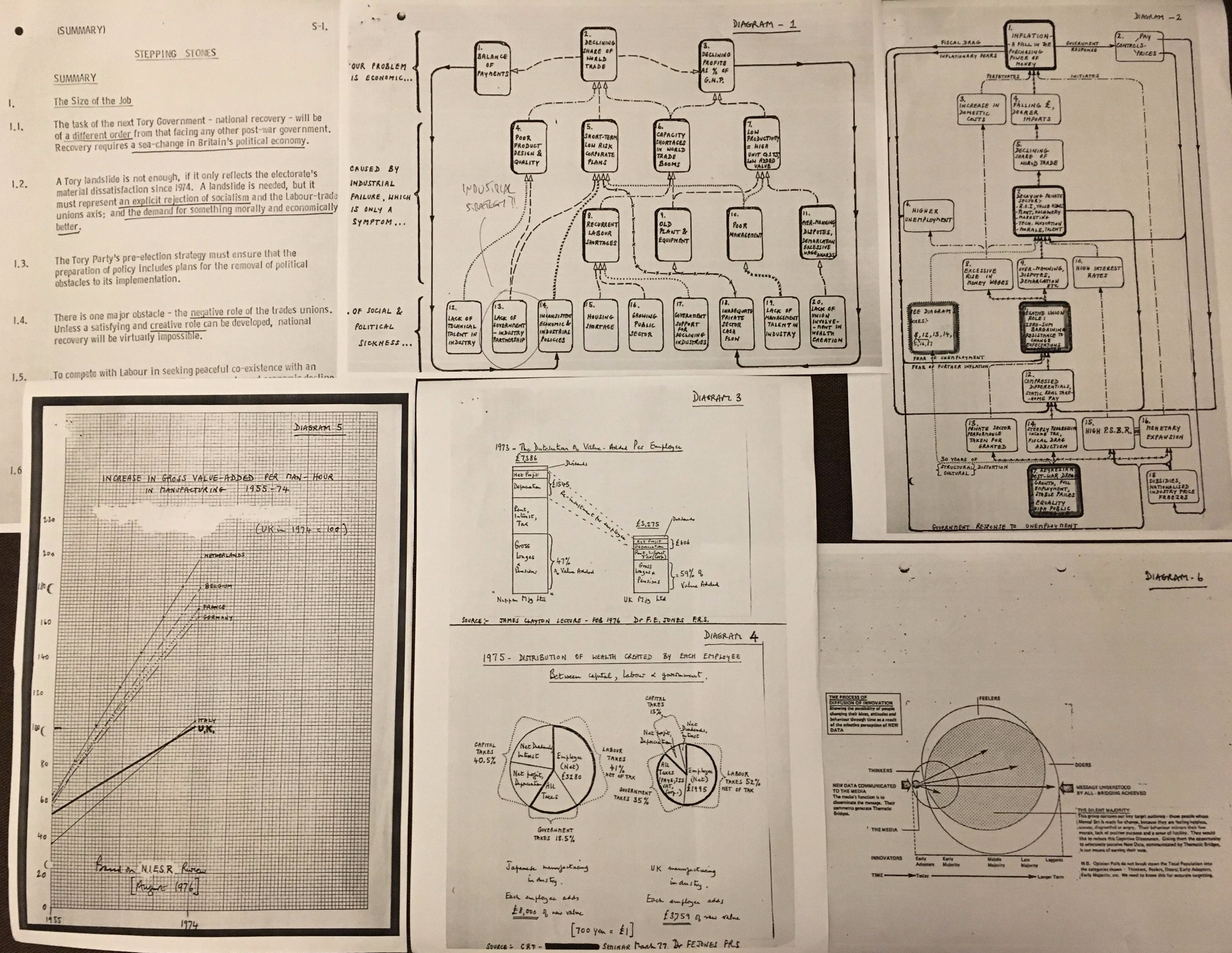
This is a great pity, because from the CPS came the influential and ultimately transformative Stepping Stones Report, an incredible document which summarised a body of work which sought to classify and diagnose all of Britain’s economic ailments of the 1970s and propose a comprehensive solution and communication strategy which Margaret Thatcher then effectively took with her into 10 Downing Street and started implementing in 1979.

I know I keep banging on about this report, but I can’t encourage people enough to go and read it – the thing is sixty short pages of condensed insight and wisdom. Britain in the 1970s was in a very perilous economic and social position, facing challenges which are entirely different to those we face today, but of similar pressing urgency. The central premise of Stepping Stones was that Britain could not be saved through haphazard and piecemeal efforts to tackle each various problem individually – rather, a coordinated approach would be required.

Back before Thatcher

Back in the 1970s, Britain suffered from a budget deficit problem (called the PSBR back then), high inflationary pressures, uncompetitive nationalised industries, bad management, appalling industrial relations and low productivity. In 2017, some of these problems have been quelled while others remain and have been augmented by the challenges of globalisation, automation, global migration, an acute housing crisis and a terminally broken healthcare model in the sanctified NHS.

Just as it was in the 1970s, the problems of the early 21st century can not be solved in isolation from one another or as a series of individual “damage control” measures by a worn-out and rudderless government desperate to stay in power but totally unsure what to do with it. Today in 2017, we need to bring to bear the same comprehensive (one might even say “intersectional”) style of analysis pioneered in the Stepping Stones Report to arrive at a new, mutually supporting suite of policies which are both politically feasible and equal to the task at hand.

As the preamble to the report plainly states:

We must know what a Tory government will have to achieve, before thinking about the way in which it must win office, because simply “winning a majority” on the wrong terms may not give it the authority it needs for success.

One of the key concepts discussed in the Stepping Stones Report is that of “discontinuity”, which is described thus:

In normal times a majority is enough. The task of government is to steer a basically healthy socio-economic system past hazards which are primarily external, while ensuring that the system’s fabric is maintained and making improvements to it here and there.

But once the system itself starts to show signs of fatigue, instability, disintegration, then we start to talk of discontinuity. In discontinuity, solutions can only be found by breaking constraints which we had assumed were unbreakable. It is not enough to settle for policies which cannot save us, on the grounds that they are the only ones which are politically possible or administratively convenient.

Reading or watching the news today, one observes endless argument over what policies or decisions may be politically feasible (be it in British domestic politics or the EU secession negotiations with Brussels), but scant discussion as to whether those policies actually rise to the challenge of our times – whether they actually solve the very specific and intractable problems at hand. Both sides of the equation must be addressed if good policies and decisions are to be reached, but in nearly all cases our shrunken horizon considers only what is possible, not what is actually needed.

1977 all over again?

Who can argue that Britain in 2017 is not experiencing another such period of discontinuity? The symptoms are everywhere and have been visible for some time, notably in the defection of Tory MPs to UKIP in 2014, Jeremy Corbyn’s humbling of the Labour centrists in the 2015 leadership election (and again in 2016), and Britain’s seminal vote to leave the European Union.

The latter in particular was fuelled by public disgust with a political class who contented themselves to operate within the narrow tramlines of EU rules and social policy without any regard for those voters whose values and priorities fell outside the narrow Overton Window prescribed by Brussels.

But that’s just the start. Automation, outsourcing and globalisation have incrementally, relentlessly eaten away at the idea of a steady, 9-5 factory or retail job being sufficient to raise a family or buy a house. Millions of people who in decades past went through an education system which prepared them for little else now find themselves having to learn new computer or service-based skills from scratch, with almost no support or coordination from local or national government.

Even university graduates find that their degrees are of increasingly dubious value, and are obliged to virtually fight to the death for a coveted place on a corporate graduate scheme. The losers go back to live with their parents or work in minimum wage drudgery, wondering why their BA in critical gender theory hasn’t proven to be the passport to the slick professional city life they crave. Call centres and giant Amazon distribution centres have become the new dark satanic mills of modern Britain. Our present education policy should be focused entirely on this looming precipice, yet we distract ourselves by arguments over grammar schools or whether boys should be allowed to wear tiaras and tutus in class.

Meanwhile, there is a huge global human migration underway, prompted by the fact that countless millions more people are connected to the world through the internet and have the means to move from struggling countries to new lands of perceived opportunity – sometimes legally, usually illegally. Political leaders have openly or tacitly welcomed and even fuelled this flow, seemingly oblivious to the fact that the required housing, infrastructure and services do not smoothly and automatically increase in direct proportion to a rising population – and then dare to act startled and affronted when the resident population complains about the impact.

At the same time, elites have preached a gospel of absolute tolerance and multiculturalism while refusing to promote British or Western values, or encourage new immigrants to assimilate, and then cry “racism!” when inevitable tensions occur. They have created a country where some British-born people feel more affinity and allegiance to a barbaric Islamist death cult than the country which gave them life and liberty – and then prove it by stealing away to join ISIS or launching terror attacks which kill and maim their fellow citizens.

And then, of course, there is our national religion, the National Health Service. As surgeons once operated under the dictum cor non tangeredon’t touch the heart – today’s politicians abide by the even stricter rule NHS non tangere, terrified to acknowledge that a nationalised, centralised health system built from the rubble of 1940s war might no longer be the optimal way to deliver healthcare to an advanced, ageing country of 65 million people. And so the fifth largest employer in the world (right behind McDonald’s) is not some world-beating British retail giant or consumer goods company, but a creaking nationalised bureaucracy in perpetual crisis.

A failed centrist consensus

Each one of these issues forms part of a crumbling edifice representing the failed, discredited and obsolete centrist political consensus. Tinkering with the EU – to the limited extent that Britain could ever effect meaningful directional change in Brussels – was never going to happen, despite the constant disgruntled, exculpatory outbursts from Remainers that “of COURSE the EU needs reform!”.

An open migration policy may well be best in raw economic terms, but it should be for the British people to democratically decide whether they want to take the economic pain of slowing immigration, not for politicians who “know better” to overrule them.

Globalisation delivers tangible benefits to many of us and previously unimaginable opportunities to a smaller, highly educated elite, but those at the bottom are tired of being thrown into the furnace to keep the engine running for everyone else.

The NHS model has not been copied anywhere else in the world for a reason, and while it does urgent care fairly well, when overall medical outcomes (notably cancer survival rates) are increasingly falling behind other countries then it should not be off limits to ask whether a nationalised, centralised system is the best way to deliver routine or preventative care to the whole population.

In other words, this is a time of extreme discontinuity in British politics and society. But people do not necessarily recognise discontinuity when it happens, at least not all at the same time. The Stepping Stones Report notes in section 6.1 (addressing the situation in 1977):

Discontinuity may not yet have been recognised by the electorate. In fact, with skilful propaganda and suitably ‘pragmatic’ – not to be cynical – government policies, it need not be recognised until the exhaustion of North Sea oil, by which time our last chance will have gone. Once it is recognised, however, the electorate is unlikely to give a mandate to a political party which has not itself changed sufficiently to match the changed prospects. On the other hand, a party which changes itself, because it fully understands how the rules of the game are changing, is more likely to awaken an electorate to a belated recognition of discontinuity and thus win its confidence.

Here, the situation we face in modern Britain actually differs from that facing the authors of Stepping Stones, because the electorate is increasingly aware that we are in a period of discontinuity. Dissatisfaction with the state of modern Britain is quite widespread, and the people are crying out for change. Rather, today it is centrist politicians (and much of the media) who fail to recognise the discontinuity around them, and often openly yearn to cling on to the failing but familiar consensus.

Opportunity knocks – but it needs leadership

Yet Stepping Stones is clear about the need for political parties to acknowledge discontinuity and to realign their policies and messaging in response to it. As leader of the Labour Party, Jeremy Corbyn has done this incredibly well. One may disagree vehemently with everything Corbyn stands for – this blog certainly does – but his election as leader and conduct since that time reflect a realisation among (at least parts of) the Labour Party that standing for the same old failing political consensus was not just wrong, but bad politics too.

No such reckoning has taken place within the Conservative Party, and despite the emergence of a few green shoots of recovery/new thinking, there are precious few grounds for hope that a sufficient reckoning is imminent. The Tories don’t even have a Jeremy Corbyn of their own. Amber Rudd being invited to speak as guest of honour at an event about conservative renewal is hard evidence that the sense of urgency and horizon of thinking is still not nearly equal to the task at hand.

This is why good, decisive leadership is so incredibly important at a time when Britain is not running in “steady state” but rather entering a period of sharp discontinuity. The report makes this crucial observation:

For at a time of discontinuity, leadership is at a premium. When the future is simply an extrapolation of the past, so that we are all tramping over familiar ground, the choice of someone to lead the procession may not be critical. But if we are setting out on unfamiliar terrain, we look for leaders who, at the very least, appear to have imagined what that terrain would be like in fact.

In discontinuity, conventional wisdom cannot get us out of the problems. Indeed, innovation is almost certainly the best way through discontinuity. Almost any vision, any programme, is better than confusion and uncertainty, for it can at least be modified in the light of experience, once it has broken the paralysing spell of past failure and present pessimism.

It scarcely needs to be said that the Conservative Party is not currently offering the country the kind of ambitious, proactive and visionary leadership which is required in this time of discontinuity. Theresa May was an awful choice for prime minister from Day One, seeing the future of conservatism as occupying traditional Labour territory on state intervention in the economy. Now, in addition to having all the wrong instincts, she is also a political lame duck, shorn of her intellectual brain trust (Nick Timothy) and waking up every day reacting to a new crisis rather than boldly setting the national agenda. Much of this is not her fault, yet it is undeniably true.

Pete North is one of few other thinkers and writers I know who regularly explores the systemic nature of Britain’s problems rather than churning out compartmentalised pieces about the housing crisis, the social care crisis, the obesity epidemic etc. And he is correct when he identifies Brexit as the catalyst which will force all of these other problems out into the open:

I take the view that nothing short of a radical shock to the system will drag our politicians out of their self-indulgent navel gazing. Even now as we coast toward a cliff edge Brexit they are still trapped in the pre-referendum paradigm unable to usefully influence the proceedings and easily distracted by trivia.

[..] In this, the Remainers can’t see the woods for the trees. They point to the dysfunction “unleashed” by Brexit as evidence that Brexit of itself is bad. But this is the dysfunction that has been festering for two decades under a well crafted and stage-managed veneer of competence.

If you are not familiar with Pete’s work then at first it can seem unduly alarmist and pessimistic, but Pete gets the systemic, interconnected nature of these issues and understands that Brexit and the political unpreparedness/incompetence it has exposed are just part of this general discontinuity, all of which must be addressed – including our politics, something the original Stepping Stones report did not have to deeply consider.

A new Stepping Stones Report for post-Brexit Britain

And this leads to my conclusion: we need a new Stepping Stones Report for our times. We need a comprehensive and dispassionate analysis of the problems we face as a country, and understand where and how they are linked together. Having diagnosed these problems (which in the case of many politicians many involve some painful introspection) we must decide where we want to go as a country – what we realistically want Brexit Britain to look like in 2020, 2025, 2030 and beyond – and then devise a programme of mutually supporting, politically feasible policies to get us there, and a way of framing and communicating this programme that can unite a sufficient amount of our fractured country to earn an electoral mandate.

It may be noted that many of the issues we face today – globalisation, automation, migration, terrorism – span national borders and can not be solved by any one country alone. This is not a concession to angry Remainers who naively view the European Union as the ultimate platform for all international cooperation, but it is a statement of fact. This means that for the first time in decades – since the Second World War, really – Britain must lift its eyes above our own domestic concerns and seek to use our position on the world stage to promote and coordinate the adoption of the new solutions we devise. Having voted for Brexit and upended our politics, embracing the discontinuity which most other countries still ignore, we are the canaries in the coal mine and other nations will look to us to see how they might navigate the same issues. For once, rather than lowering our national ambitions and ducking a challenge we must rise to the occasion.

This job is too big for any one person, any one group, and probably any one think tank or political party. It will require people on all sides to let go of long-held articles of political faith and ideological crutches. It will require discipline and commitment, but above all it will require strong leadership to get us there.

I don’t know how we go about doing this, whether it should be an open competition, a more academic exercise, a think tank project, a Parliamentary initiative or a citizen-led effort. But the work needs to be done, and soon, if Britain is to emerge from this period of uncertain discontinuity in an advantageous state.

Of course there is no convenient time for strategic thinking, especially when a party is in government and fending off daily crises. But realistically, if the Conservative Party does not do this then it will be left to Jeremy Corbyn to determine what kind of country emerges from the present discontinuity. Labour’s statist, socialist policies may then quickly become ossified as the new British political consensus, though the rest of the world certainly will not be following us if this transpires.

It has been decades since Britain truly took the lead in influencing world affairs. But having voted for Brexit and thrown into the open many pressing debates which other countries remain desperate to defer or ignore, we can now be both a laboratory and a beacon for the world.

And if we do so, whatever the outcome, when we are called to account for our life’s work at least we can say that we tried to accomplish something more significant, more impactful on the world, than hiring a few extra nurses for the NHS or making the trains run on time.


UPDATE – 16 November

It appears that people have been discussing my article and the concept of discontinuity in British politics over on another forum. One user made the comment:

That Hooper bloke makes a lot of sense, in my opinion. Where do I sign, to join his social movement? Oh, I’m instead encouraged to make a Comment or leave a Donation.

Well first of all, thank you for the compliment – nice to know that this Hooper bloke can occasionally still talk sense! And in fact I am actually trying to do something to turn this idea from more than a mere blog post to an actual project or initiative in the real world. We clearly can’t leave it to the usual inhabitants of Westminster to do this on their own – new ideas and fresh faces will be needed, just as they were in 1977.

If anybody else who reads this article feels called to action, please do get in touch with me, either using the “contact” menu link at the top of the page, or directly at semipartisansam@gmail.com

Thanks.

Conservative Party Logo - Torch Liberty - Tree

Globalisation

Support Semi-Partisan Politics with a one-time or recurring donation:

Agree with this article? Violently disagree? Scroll down to leave a comment.

Follow Semi-Partisan Politics on TwitterFacebook and Medium.

The Centre Must Not Hold

WTF is Centrism

Calls for the Tories to pursue and embrace the non-existent “radical centre” are a dangerous Siren song for conservatism at a time when the country needs conviction and clarity of purpose

We must know what a Tory government will have to achieve, before thinking about the way in which it must win office, because simply “winning a majority” on the wrong terms may not give it the authority it needs for success.

In normal times a majority is enough. The task of government is to steer a basically healthy socio-economic system past hazards which are primarily external, while ensuring that the system’s fabric is maintained and making improvements to it here and there.

But once the system itself starts to show signs of fatigue, instability, disintegration, then we start to talk of discontinuity. In discontinuity, solutions can only be found by breaking constraints which we had assumed were unbreakable. It is not enough to settle for policies which cannot save us, on the grounds that they are the only ones which are politically possible or administratively convenient.

– John Hoskyns and Norman Strauss, “Stepping Stones Report”, 1977

For over a week now I have not been able to bring myself to write anything new for this blog. Why? Because the patterns of failure in British politics are now tediously familiar beyond all endurance, as are the mistakes, missed opportunities and blunders routinely committed by politicians and thinkers who call themselves “conservative”.

Yes, the past week was a particularly torrid one for Theresa May’s shambolic government, but it did not teach us anything new. So more evidence emerged that Boris Johnson is totally unfit to be Foreign Secretary, the Tories no longer even seek to act like the party of Defence while the prime minister is utterly dependent on her questionable deputy Damian Green – these are not new revelations. They have been relentlessly, depressingly drummed into our consciousness over a matter of months and (in some cases) years.

Besides, even if Theresa May’s Cabinet were a precision-engineered Rolls Royce jet engine operating at maximum power and efficiency it would not matter – we would simply reach the same dismal destination somewhat faster than is currently the case. This is not an ambitious and visionary government let down by flawed execution and unfortunate scandal; it is a government which never had any real purpose to begin with.

Every two-bit conservative commentator is now saying what this blog has been screaming for years – that aimless, centrist government devoid of purpose is a dogma of the quiet past, inadequate to the stormy present; that we may as well not have bothered deposing New Labour in 2010 if we were only going to replace Gordon Brown with a bunch of slavish centre-left devotees wearing blue rosettes instead of red ones.

Well slow hand clap, guys. What do you want, a medal? Some of us have been making this point for years now, back when the well-paid and ubiquitous journalists and TV commentators were purring over David Cameron and Theresa May, predicting an uninterrupted decade of energetic, fruitful Tory rule even as their timidity and incompetence led us ever closer to the abyss.

Already there are a number of travelling quacks offering their own dubious potions and cures for the Tory malaise, most of which are vague at best or completely misguided at worst. A few thoughtful people have genuinely interesting ideas, but many seem to propose a further shift to the left, as though additional concessions to Corbynism will do anything other than validate Labour policies in the eyes of the electorate. Others suggest that “compassionate conservatism“, that hateful, self-sabotaging and worn-out phrase, is the magic solution. But most common are the tedious, meaningless calls for the Tories to recapture the “radical centre” of British politics.

The latest to take up this cry is Tory MP Johnny Mercer, who offers a fairly blistering (and by no means inaccurate) critique of past Conservative failures, taking Theresa May to task for her failures of leadership and the party as a whole to task for their ideological drift.

From the Telegraph:

“It smells of decline, and the people won’t have it” said Mr Mercer, MP for Plymouth Moor View, who bucked the national trend and increased his majority by five-fold at the last election.

“There becomes a cross-over point in seats like mine, it becomes about your personal integrity, about your credibility. You have to step back and question what your party is doing – of course.  Yes we are beginning to get there I fear”.

[..] He went on: “A Corbyn/McDonnell Government would fundamentally change Britain and what it means to be British. We would not be forgiven as a party for 20 years. We must remain, if nothing else at the moment, credible.”

[..] “We have a duty to the Nation to ensure the Cabinet is comprised of the best people in parliament, not the most famous names. Theresa May had to make a decision where she formed her cabinet: whether to select members to manage the fall-out from Brexit or select the best modernisers to bring about social change. She chose the former – I understand that, but now is the time for bold, outward facing leadership in my view.”

But then, just as you are expecting something radical or attention-worthy proposed as an alternative, Johnny Mercer merely proposes a further attempt to “grab the middle ground”.

This is so incredibly disheartening, coming from somebody whose profile and biography would potentially make him a very attractive future leadership candidate. Having diagnosed the problem, where is Mercer’s solution? More grasping for the centre?

People: THE CENTRE IS NOT A FIXED PLACE. It merely describes a point equidistant between two other, polarised positions on the political spectrum – usually the status quo, or today the groupthink of a pro-EU establishment who are becoming increasingly extreme in their contempt for democracy. The centre is not and cannot be a place from which to build effective policy because it is rooted in nothing but triangulation and brazen political calculation as opposed to any kind of firm conviction as to how society should be ordered, or the rights of the people and the role of government set out.

If the last few years in British politics have taught us anything, it is that the people respond surprisingly warmly to sincere politicians who hold clear convictions springing from a coherent and easily explainable worldview. People may not agree with Jeremy Corbyn, but even many of his detractors admire the fact that he has held and advocated for many of his ideas in good times and bad, back when they were on the discredited fringe and now, when they are being taken more seriously once again.

The Tories need a Jeremy Corbyn of their own, but instead they got Theresa May, who frittered away the Conservative majority because she stood for nothing. She is an authoritarian pseudo-traditionalist whose intellectual blood bank (in the form of Nick Timothy) has thankfully been exiled from government, but not replaced by anything better.

May’s risible pitch in the 2017 general election was strength and stability, but these are states of being, not a direction of travel. People jetting off in an aeroplane together would generally prefer less turbulence to a more bumpy flight, but more than anything they care about arriving at the correct destination. Jeremy Corbyn made his flight plan crystal clear to the British electorate. Theresa May didn’t even bother to produce one, preferring to pander to the Politics of Me Me Me.

You don’t win a convincing mandate to govern by chasing the centre. You win such a mandate by coming up with a clear plan of action flowing from a coherent and easily explainable view of the world, one which is so compelling that it makes sense to an election-winning majority of voters, thus causing the floating centre to shift in that direction.

Margaret Thatcher’s government did not rescue Britain from a failing post-war consensus and 1970s national decline by cautiously seeking consensus and the same elusive centre ground fought over by the previous Heath, Wilson and Callaghan administrations. She made her mark on Britain by charting a new course, braving resistance rather than capitulating to it, and dragging the centre to the right so that after the Tories finally lost power, New Labour had neither the ability nor the desire to undo many of the changes she wrought.

That’s how you run a government worthy of the history books. The Tories should stop slavishly chasing the centre, and come up with a new blueprint for Britain – the new Stepping Stones Report which we so desperately need, updated for 2017 – which will shift the centre of British politics back in the direction of liberty underpinned by the autonomous nation state (or some compelling improvement on it).

Whatever differs from this, to the extent of the difference, is just noise.

Conservative Party Logo - Torch Liberty - Tree

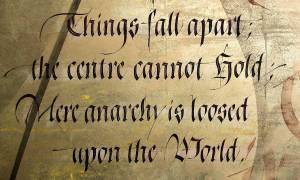
Things fall apart the centre cannot hold - Yeats quote

Support Semi-Partisan Politics with a one-time or recurring donation:

Agree with this article? Violently disagree? Scroll down to leave a comment.

Follow Semi-Partisan Politics on TwitterFacebook and Medium.

The Battle For British Conservatism: Seeking The New Generation At CPS

Centre for Policy Studies - CPS - New Generation project launch event

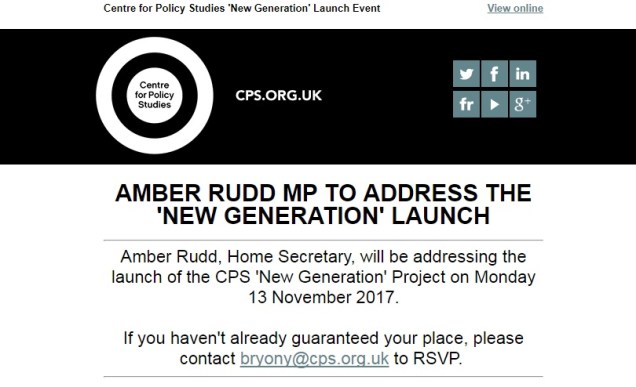
When it comes to breathing new life into the intellectually moribund Conservative Party, virtually any contribution is to be welcomed. But in this case, choosing Amber Rudd as the figurehead for the Centre for Policy Studies ‘New Generation’ project does not inspire great hope

Ever since George Freeman MP pitched a few tents in a Berkshire field and invited a select band of people to gather and plan the salvation of the Tory Party, there has been a steady trickle of other initiatives and articles musing on the same problem. Most of these people are catastrophically late to the party, having conspicuously failed to raise any red flags during the Cameron years (unlike this blog) or even during the beginning of Theresa May’s administration, but better late than never.

And while it may now be too late to save this government and prevent at least a short-term spell in Opposition, at least a few more people are finally starting to ask themselves what it actually means to call oneself a conservative in the year 2017, and what the modern Conservative Party should consequently look like and stand for.

Latest to climb aboard the bandwagon is the Centre for Policy studies, who a few weeks ago hosted the launch of Sir Oliver Letwin MP’s book musing on the same topic. Now, the CPS (founded by Keith Joseph and Margaret Thatcher) is launching an initiative of their own, entitled “New Generation”.

From the press release:

If we are to save Britain from a Corbyn government, the case for the market needs to be made once again. Not with empty slogans, but by developing concrete, practical, aspirational policies that make voters’ lives better.

Our flagship “New Generation” project will give a platform to the 2015 and 2017 cohorts of MPs, and other fresh voices, to make that case: to set out the policies that can make Britain a nation of opportunity and enterprise.

One gets the strong sense that this new project will stand or fall depending on how many (if any) additional “fresh voices” are actually invited to participate, and who those people are.

Inviting the most recent two intakes of Tory MPs to help shape the argument is not an altogether bad idea – these groups have tended to be slightly more libertarian-ish than the statist interventionists of yore, though even these new MPs tended to favour remaining in the EU. But given the inescapable reality that political advancement for backbench MPs depends to a significant extent on being seen to support and defend current government policy it is asking too much to lay all the responsibility at the feet of relatively new, junior MPs.

As this blog has repeatedly argued, real change must come from outside the Parliamentary Conservative Party. We all know how CCHQ love to centralise absolutely everything so as to ensure the consistency of the uninspiring, unambitious brand of Toryism for which they are famous, but this time an exception must be made and outside counsel sought. And if the party will not engage with other small-C conservatives through choice then the party must be hijacked and dragged kicking and screaming in a new, better direction, just as Margaret Thatcher and her intellectual blood bank did for the Tories in the late 1970s.

In short, any project serious about conservative revival in Britain needs to have at least a reasonably healthy disdain for those people currently piloting the country through its centrist malaise. And who better to emphasise the need for fresh, radical and unapologetically conservative thinking than…Amber Rudd?

If you are scratching your head wondering why Amber Rudd of all people has been given the honour of inaugurating this new CPS project, you are not alone. As Home Secretary, Rudd seems to be quietly competent in the same manner as her predecessor, the prime minister – that is, she largely manages to avoid dropping the ball, causing scandal or attracting any real scrutiny of her authoritarian instincts. But she most certainly does not have any kind of reputation as an original thinker or bringer of disruptive innovation.

And why would she? Amber Rudd, after all, is on record as having gone into politics more out of boredom and desire to add another accomplishment to her CV than through any burning desire to change Britain. She is the ultimate May-ite Cabinet member – a technocratic administrator, not a visionary. And while Rudd should be rightly commended for representing the Conservative Party in this year’s general election television debate while Theresa May lacked the courage to do so, her vision of conservatism was very much a defensive one, suggesting that right-wing policies are more unfortunate necessities than a positive choice for voters.

Now it is entirely possible that Amber Rudd will admit to some of these failings and exhort the CPS’s New Generation project to learn from the mistakes and missed opportunities of the government in which she serves. But it seems highly unlikely – Rudd’s own leadership aspirations are well known (being prime minister is, after all, the ultimate boasting point for one’s LinkedIn profile) and she is raising money in donations hand over fist. It hardly then seems likely that the Home Secretary will inaugurate this new initiative to save the Tory Party from itself by admitting that she is squarely part of the problem.

But you never know – perhaps there will be a sliver of introspection. For my sins, I will be attending the launch event on Monday 13 November and will raise some of these points if and when the opportunity allows.


Conservative Party Logo - Torch Liberty - Tree

Support Semi-Partisan Politics with a one-time or recurring donation:

Agree with this article? Violently disagree? Scroll down to leave a comment.

Follow Semi-Partisan Politics on TwitterFacebook and Medium.