Late Night TV Hosts vs Trumpland

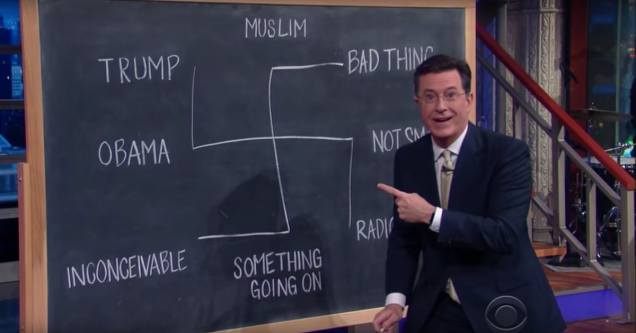
Stephen Colbert - Donald Trump - chalkboard swastika

When it becomes good business for left-wing late night comedy hosts to actively alienate and belittle half the country, it is clear that Donald Trump is not the only force stoking hatred and division in America

While in New York City last December, my wife and I were fortunate to get tickets to see The Late Show with Stephen Colbert being recorded at the Ed Sullivan Theatre.

It was a good show and ended up being a really fun experience, but as somebody who cannot reliably tick the “Yes, I agree” box next to every progressive cause under the sun, it was only fun because I knew what I was letting myself in for and readied myself in advance for an hour’s worth of dripping condescension, mockery and misrepresentation of conservatives and conservatism.

And increasingly that’s how it is for conservatives – and even some moderates – who want to consume the fruits of mainstream culture, be it network television, Hollywood movies, stand-up comedy or even classical music. Sure, you can watch – nobody barred me from entering the studio or administered an ideological test before I was allowed to sit and watch Stephen Colbert spit-roast Donald Trump in his monologue for the hundredth time. But in order to derive uninterrupted enjoyment from proceedings, those on the right increasingly have to perform a certain degree of mental disassociation from their political views before taking part. One has to fake laughter and perfect the wryly amused smile so as not to look out of place while everyone else clutches their sides and laughs at the Stupid Backward Conservatives.

During the warm-up act before Stephen Colbert came out, the warm-up comedian scoured the audience looking for interesting or odd people, and then made them stand up and engage him in conversation for the delectation of the audience. Pretty standard for a warm-up act, but one person in particular seemed to pique the warm-up comedian’s interest – a slightly patrician-looking, grey-haired and well-dressed man in his late fifties or early sixties. “A Republican in the audience!”, the comedian exclaimed.

The comedian got the man to stand up, confirmed that he was indeed a conservative and then went to town on him in a way which was superficially good-natured but as it dragged on (far longer than his other interactions) quickly became quite awkward both for the gentleman involved and a number of other audience members. This isn’t to resort to snowflakery – go to a comedy show and one should expect to get picked on by the person on stage, after all – but it was notable and entirely predictable that none of the conspicuously progressive stereotypes sitting in the audience received similar treatment. And of course this was but a foreshadowing of what would happen when Colbert himself took the stage (we in the audience were under strict instructions not to “spoil the fun” by booing at any point, though this rule was liberally disregarded when any mention was made of a conservative figure or policy).

Left-wing satire can be brilliant. I always felt that during his long tenure at The Daily Show, Jon Stewart did a fantastic job skewering the many foibles and failings of the George W. Bush administration without coming across as aggressively bitter or hostile to everyday conservative voters. He may not have been speaking to them for much of the time, but neither was Jon Stewart actively belittling those people who twice voted for Bush. Other late night hosts such as Bill Maher often make more pointed barbs directed at ordinary conservatives, but in Maher’s case his jokes are much funnier and are balanced with a frequent willingness to call out the excesses, failings and hypocrisies of his own side (such as the free pass given by much of the American Left to retrograde attitudes toward women in parts of the Islamic world).

Stephen Colbert, while often very funny, is less nuanced. As a non Trump-supporting conservative I personally fall down the awkward gap between agreeing with nearly all of Colbert’s criticisms of President Trump’s personal conduct and suitability for office while also wishing that not every single monologue had to be come a teachable moment about the supposed deficiencies of conservatism, the self-evident correctness of progressive positions and the supposedly inherent wisdom of even the dimmest people who happen to cheer for the progressive cause.

And this brings us to fellow late night talk show host Jimmy Kimmel, who took the opportunity (in front of an extremely friendly crowd of fellow progressives) to use a guest appearance on left-wing podcast Pod Save America to declare that progressive domination of late-night television was entirely right and proper, Darwinian natural selection at work within showbusiness.


From Ben Shapiro at The Daily Wire:

Following President Trump’s State of the Union address last week, CBS late night host Stephen Colbert had on the former Obama staffers of “Pod Save America” to bash Trump. Those same gentlemen welcomed ABC late night host Jimmy Kimmel to the stage for an event on Saturday night, where Kimmel proceeded to explain that all late night hosts are on the Left thanks to their vast intellect.

What a ridiculous and unnecessarily smug thing for Kimmel to say. One cannot rend one’s garments about hatred and division in America and then declare everyone on the winning side of a highly contentious election to be intellectually inferior. These are not the shocked and panicked moments immediately after election night in 2016 – by this point the American Left has had a long period of time to dwell on their missteps and shortcomings in that electoral cycle, but many Democrats and others on the left choose instead to marinade in their own anger, as though shouting at the other half of the country will win them around.

I have also been to a live recording of Pod Save America. It is actually a podcast to which I subscribe and listen frequently, and so when the hosts came on tour to London in January I went with a group of friends to Cadogan Hall to hear them do their thing. At its best, Pod Save America is entertaining and informative, albeit from an avowedly left-wing stance, and there is a real value to hearing how some of the most prominent alumni from the Obama administration view today’s politics. Being a left-wing podcast, nobody expects them to do anything other than preach to the choir in every episode, which is no worse than what many right-wing talk radio hosts do. But surely we should expect a little more from late-night network television?

Nothing good can come from the bitterness and rancour which currently seeps from the late-night talk shows. Network television comedy should bring people together, or at least not needlessly alienate them from one another. It may be good business for late night TV hosts to cater almost exclusively to staunchly Democratic voters – NBC’s Jimmy Fallon, who deliberately stays less political, is certainly suffering in the ratings for failing to bash conservatives on a nightly basis – but it is bad for our society as a whole.

A cohesive society requires that we maintain a public square where everyone is welcome, where people are not encouraged to self-segregate as progressives or conservatives, Christians or Muslims, whites or racial minorities. Where everybody can be American (or British) first and subordinate their various other identities and affiliations, albeit temporarily, to the one which we all hold in common. But time and again we see what should be common territory – places like  late night television or NFL football games – being tussled over by partisans until one side is forced to cede the field. When everything is political, everything becomes divisive and toxic.

In his latest show, Ben Shapiro makes a similar point with reference to last weekend’s Superbowl LII in Minnesota:

One of the things that football needs to understand – one of the things that the NFL needs to understand – is that the popularity of the sport is deeply entwined with the good feeling about the country. If you feel bad about the country it’s hard to enjoy sports, because you feel like sports are frivolous. If you feel good about the country then sports are a distraction from the mundane, sure, but they are also a reminder that all of our conflict is really play-acted.

And that’s not true in politics, you know, in politics there’s a lot of our conflict that’s not, that’s real, that’s about issues that matter and I care deeply about. But it’s good for Americans to recognise once in awhile – and I think that’s what the Superbowl is for – it’s good for us to recognise every once in awhile that there are these moments where we have more in common than we are separated by. So it’s amazing that in an evening that’s really about conflict between two teams is really more about the love for fans for one another. It’s really more about a love of country. It’s really more about what we are unified in favour of, and that’s why it was so entwined with the flag, with the military, and it’s why it alienated so many fans when the players started kneeling.

This is a time when we need to urgently be creating more shared, civic spaces where people of differing political views, backgrounds and identities can come together as fellow citizens first and foremost, not as victims, oppressors or activists. America actually fares better than Britain in this regard, since displays of patriotism and national pride are not yet considered quite so embarrassing or gauche as they are in Britain (though some on the American Left would doubtless love to change that fact), but neither country can afford to be complacent.

And here, late night television serves as a good barometer of just how polarised society has become. There are many excellent and respected comedians at the top of their field who do not feel it necessary to turn their acts into another campaigning wing of the Democratic Party. But many conservatives having already largely abandoned late night television, it does not make sense for ratings (and therefore for business) to do anything other than give the remaining progressive audiences exactly what they want – just ask Jimmy Fallon, who lags in the ratings precisely because he refuses to turn his show into a platform for progressive revivalism.

We see exactly the same situation in Britain, where new satirical news show The Mash Report (itself billed as hybrid of the Daily Show and British current affairs shows like Have I Got News For You) make endless fun of Brexit voters and conservatives as though being left-wing and pro-EU is the “natural” position, from which any departure should rightly trigger outrage and mockery. From a business and professional standpoint there may be every reason to continue along the current trajectory (including high ratings, monetary rewards and approval from fellow bubble-dwellers in the industry), but that doesn’t mean that the status quo is good for societal cohesion. It isn’t. There was a time (before Brexit) when people on the Left used to understand that not everything of value could be quantified, but apparently no more.

The best satirical comedy tends to punch upward, not down (though of course in a free society it should be free to punch wherever it likes). It should be possible to punch up at Donald Trump while reserving a few blows for other highly deserving fixtures of American political life, including the cadaverous and inept figures who make up the Democratic Party leadership. It should be possible to punch upward at ludicrous Tory Brexiteers like Boris Johnson while also using humour to point out the starry-eyed naivety of those on the Left who see the European Union as the fount of all good things.

But most importantly, it should be possible to punch up at the political class while avoiding punching down at entire groups of voters, let alone nearly half the country. Because when it becomes good business sense to deliberately alienate half the country to wring laughter and advertiser dollars from the other half, something has gone terribly wrong.
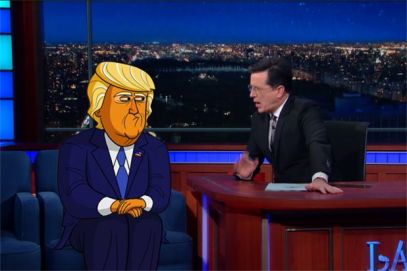
Stephen Colbert - Cartoon Donald Trump

Support Semi-Partisan Politics with a one-time or recurring donation:

Agree with this article? Violently disagree? Scroll down to leave a comment.

Follow Semi-Partisan Politics on TwitterFacebook and Medium.


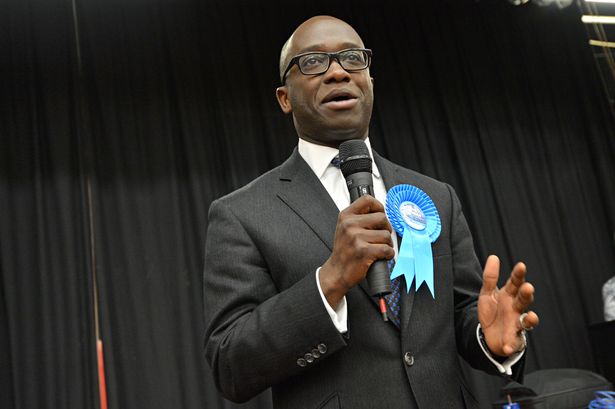
Sam Gyimah’s Great Conservative Roadshow

Sam Gyimah - Universities Minister - Conservative Party - Tories

It’s great that Universities Minister Sam Gyimah is embarking on a tour of university campuses to spread and defend the Conservative message in traditionally hostile territory. Now we just need the government to come up with a conservative platform that’s actually worth defending

Sam Gyimah appears to be on manoeuvres. Writing in the Times today, the Minister for Higher Education announces his intention to take part in a tour of higher education facilities and campuses, engaging in a dialogue with students, academics and administrators.

Gyimah writes:

In my new role as universities and science minister, I will continue to visit institutions across the country to meet with vice-chancellors, lecturers and researchers, but also, crucially, to speak directly to students. They are a key stakeholder in the success of our higher education sector – for universities to thrive, their students must flourish.

So many young people feel disengaged from politics and, although some students and I might not always agree, I want them to have a voice and be heard in the corridors of power. I’d like to be thought of as minister for students as much as minister for universities.

Politics should be a dialogue, not a monologue, so I’m looking forward to discussing tuition fees, safe-spaces, access to higher education and our potential post-Brexit, among many other topics, in a robust and honest fashion.

Displaying more gumption than most of Theresa May’s uninspiring Cabinet put together, Gyimah continues:

We must also get out there, outside Westminster, into what used to be ‘no-go’ areas and defend our record whilst showing how we want to do better. We must continue to call out Jeremy Corbyn and prevent him monopolising the student space.

I don’t have all the answers, but I am going into this tour in good faith, ready to discuss the challenges and opportunities in our higher education system. Together, with all those who work tirelessly in it, we will ensure our universities remain the envy of the world filled with students who have the best possible chance of success.

This should be interesting to watch. On the one hand, it is great that we finally have a Tory government minister seemingly willing to mount a bold and unapologetic defence of conservatism before a hostile audience – that much is excellent. But on the other hand, the continuing drift and incoherence of Theresa May’s government makes one wonder what Sam Gyimah can possibly say at these events, what stirring national plan of action or highlights reel of political accomplishments he can present that might make any significant difference to the perception of conservatism among young people.

It’s all very well having the Higher Education Minister inveigh against safe space culture in front of an audience of baying students (though to be honest the time to do that was five or ten years ago, not today) but it counts for relatively little when the government shows no sign of rolling back draconian anti-free speech laws which see people visited by the police in the middle of the night and carted off to custody for saying or writing “offensive” things on social media. What message could be drawn from a pro-Tory stump speech, in this context? “Stop creating your own safe spaces on campus, the government is already hard at work creating a national safe space on your behalf, backed by the awesome power of the law”? Hardly a ringing defence of liberal values.

These qualms aside, one wonders why Gyimah actually volunteered for this thankless mission at all, attempting to preach free speech and liberal enlightenment values to an academic world which increasingly rejects any such notion. No Tory government minister, however charismatic, stands any great chance of reversing the antipathy of many students toward conservatism – it will take determined peers and influencers their own age to do that. So why put oneself through the ordeal of being heckled and used as a foil for leftist establishment posturing when there is so little to be gained?

Perhaps it is expecting too much, but is this a glimmer of a new, muscular and unapologetic conservatism which has been so conspicuously missing under David Cameron and Theresa May? Is it the beginning of a slow motion, unofficial audition for the Tory leadership? And dare one hope that this might be a good thing? True, Sam Gyimah espoused the same kind of bland, reflexive, unthinking pro-EU stance in 2016 as most others within the parliamentary party, but the Tory bench is hardly brimming with sufficient talent that having been on the wrong side of the EU referendum can count as an automatic disqualifier. With the rising profile of Jacob Rees-Mogg and Moggmentum the only other sign that the Tories have an ideological pulse, beggars can’t be choosers.

When it comes to conservative policymaking, this blog has long argued that rather than running off in a million different directions and formulating a bunch of panicked quick fixes to the various slow-burning crises which ail Britain, a more analytical, holistic approach is required – a methodical study of how these national challenges and opportunities are interlinked so as to arrive at a suite of mutually-reinforcing policies which address them as a whole. But when it comes to conservative personalities, the same rule does not necessarily apply.

While it is true that there is much intellectual work to be done behind the scenes, it is also true that British conservatism desperately needs fresh new faces. For reasons both deserved and undeserved, Theresa May’s government has the pallor of death about it, pale and emaciated despite the recent reshuffle. And while throwing a hundred half-cooked policies at the wall to see what sticks (as Tory regeneration efforts risk degenerating into) is a suboptimal approach, throwing a handful of ambitious new Tory MPs at a crowd of sceptical students might be just the kind of proving ground the party needs as it searches for a new generation of leaders.

Let’s watch this space and give Sam Gyimah the opportunity to fill the unforgiving minute with sixty seconds’ worth of conservative apologetics. It can’t do any harm, and maybe in the process of saving student souls from the clutches of Corbyn the lost Tories will finally begin to rediscover themselves.

Conservative Party Logo - Torch Liberty - Tree

Support Semi-Partisan Politics with a one-time or recurring donation:

Agree with this article? Violently disagree? Scroll down to leave a comment.

Follow Semi-Partisan Politics on TwitterFacebook and Medium.

Dead In The Water

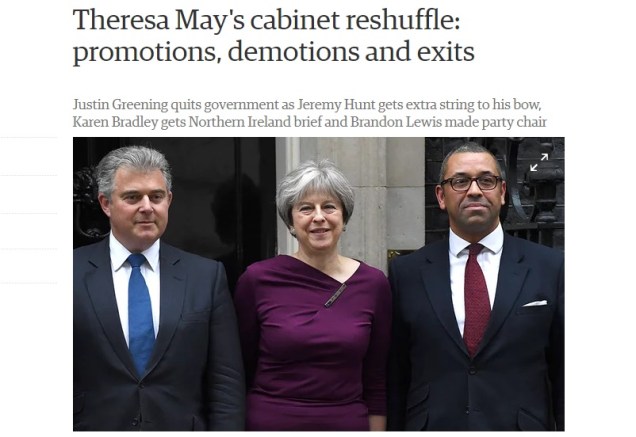
Theresa May - Conservative Party - Tories - Government Cabinet reshuffle

Looking for positive signs in this most underwhelming of ‘major’ Cabinet reshuffles

What to make of Theresa May’s Cabinet reshuffle?

Firstly, one cannot escape how incredibly underwhelming it is. If you are going to let the media run with the story that a “major” Cabinet reshuffle is imminent, better make darn sure that the extent of shuffling lives up to the hype. On this occasion the advertisement was significantly glitzier than the product, which together with the stunningly botched rollout only added to the impression that the Tories are a frightened, disorganised mess.

Following on from that, the limited extent of the reshuffle – with Education being the only really significant department seeing a change – is another depressing reminder that Britain is led by someone without the authority to stamp her will on a party which is crying out for firm direction, let alone on a fractious and divided country.

Thirdly, even if Theresa May had wanted to carry out a wider-ranging reshuffle, what could she possibly have done that would have made the slightest difference to the direction of her party, the ambitions of the government or the fortunes of the nation? Maybe tomorrow we will see some encouraging promotions to the junior ministerial ranks – one might hope that some solid backbenchers with a bit of vision and ideological gumption, people like Kwasi Kwarteng or Chris Philp, might finally be given some executive responsibility and a launchpad to bigger and better things.

But in terms of big-hitters whose appointment or shuffling might make an immediate impact on the overall tone of the government, there was precious little that could be done even if the prime minister had wanted to shake things up. The sickness within the Conservative Party is deep, pervading all the way up from the (dying) grassroots through the activists, prospective parliamentary candidates and much of the parliamentary party, and a reshuffle can only be as good as the cards you have to deal.

In terms of bright spots, one can summon a degree of enthusiasm for the fact that charismatic MP James Cleverly has been made Deputy Chair of the Conservative Party, but odds are that the centralising, micromanaging bureaucrats of CCHQ will chew him up and spit him out just as they did to Rob Halfon before him, nodding sagely while Cleverly reels off a litany of smart and worthwhile suggestions before ploughing on in exactly the same dismal direction as before, tacitly encouraged by Theresa May.

I do also reserve a spot of admiration for “beleaguered” Health Secretary Jeremy Hunt (which Health Secretary of either party has ever not been described as beleaguered, and at this point shouldn’t that really tell us more about the anachronistic National Health Service for which they are responsible than the personal acumen of any given incumbent?).

Being a Tory Health Secretary is surely the most lethal of poisoned chalices when it comes to future career prospects. The role guarantees that one will be pilloried by the Left as a heartless monster who cackles as nurses are forced to food banks and patients die on trolleys, regardless of one’s actual record.

Yes yes, All Hail the NHS.

For some reason either involving masochism or great nobility, Jeremy Hunt has borne this burden stoically for six years, and for him to plead with Theresa May to not only keep his current brief but also assume responsibility for social care is quietly impressive, and shows character. I personally think that the Tories are far too timid when it comes to healthcare, but if we must set our sights low and keep Our Blessed NHS in more or less its current form, we at least need to merge it with social care – and hopefully this is an indication that the government is looking to do so.

The main problem with the reshuffle though, aside from its timidity, is that it gives no real indication of a likely change in the soul of this ideologically lost Tory government. All of the great offices of state, the main levers through which a government might seek to remake the country in its image, remain in the same uninspiring hands. Meanwhile, a bunch of junior ministers play musical chairs with one another in a frenetic pantomine apparently designed to distract us from the fact that the prime minister remains far too politically weak to move any of the people who most need moving.

But even if Theresa May did have any residual authority to undertake a real reshuffle, what difference would it make? The reshuffles that truly matter in historical or strategic terms are ones where you think “ooh, that person is going to take Department Y in a totally different direction because they are a strong believer in X”. One thinks of Margaret Thatcher’s reshuffle in 1981, in which she sought to purge some of the Tory Wets, remaining holdovers from the days of opposition who were still wedded to the failed post-war consensus.

Yet few MPs serving in Theresa May’s Cabinet, especially the most senior ones, are known for having strong ideological feelings about anything at all. Indeed, many of them seem to cultivate a deliberate sense of vagueness, giving speeches stuffed with meaningless platitudes to disguise the fact that they are chickening out from taking a bold position on anything remotely controversial (cough, Amber Rudd, cough).

Believing in things and daring to stake a bold position is dangerous in this day and age – unless you are Jeremy Corbyn or retiring from electoral politics. Far better to be blandly inoffensive, to keep everybody on side and be ambiguous about your intentions if you want to get ahead – only too often this leads to the gradual atrophy of any real policy intentions at all. Spend long enough trying to be all things to all people and soon enough you’ll forget what, if anything, you went into politics to do in the first place.

This uninspired, unambitious, managerial technocracy was the algae-asphyxiated pond in which Theresa May went to fish for new talent, and her near total lack of authority within her own party was the dismal climate in which she set off with her rod and tackle. Unsurprising, then, that she came back with little more than a few old boots to show for her efforts.

And so to abandon the fishing metaphor for another, we have ended up with a reshuffle that most closely resembles a particularly dissatisfying game of Scrabble (or Words with Friends, for the smartphone-owning crowd). One swaps out a number of pesky and useless letter tiles in the hope of getting something better in exchange, but ends up with virtually the same tiles back again, only arranged in a slightly different sequence. All that effort and a missed turn, and still you are unable to spell anything meaningful or score more than a handful of points, be it on the Scrabble board or the statute books.

So far as I can tell, virtually nothing has changed. Good luck and God speed to James Cleverly as he goes off to bash heads together (or more likely have his own caved in) at CCHQ, and may angels minister to Jeremy Hunt as he continues his lonely mission to serve as Chief Cartoon Villain to every leftist in the land. But besides that, who seriously expects a shockingly new bold policy to emerge from this cohort?

I hope I’m wrong. But more than ever I think it is going to take external events – potentially very disruptive and unwelcome ones – to shock any kind of life back into the moribund Conservative Party, the kind of political shock therapy which also tends to land the patient back in Opposition for a time.


Conservative Party Logo - Torch Liberty - Tree

Support Semi-Partisan Politics with a one-time or recurring donation:

Agree with this article? Violently disagree? Scroll down to leave a comment.

Follow Semi-Partisan Politics on TwitterFacebook and Medium.

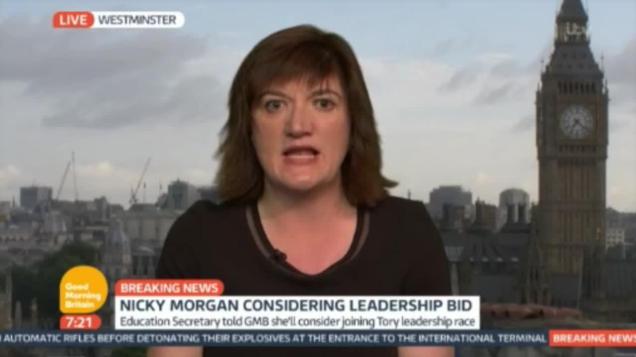
The Importance Of Conservative Principles, By Nicky Morgan

Nicky Morgan - conservative principles

Teach us, O great one

It’s good to see that Nicky Morgan has discovered the importance of fundamental driving principles to an effective government.

Writing in Conservative Home, Morgan graces us with this pearl of wisdom:

Values and principles matter. It isn’t enough to have great policies. People want to know what our motives are and they are looking for authenticity in their politicians. We need people to be clear that we are talking about aspiration, social mobility, mental health, education, housing, animal welfare and lots of other areas, not because a focus group told us to do so but because they matter to us, personally, and we aren’t prepared to put up with the status quo.  Last week has also deepened my understanding of why principles matter, and why it is worth defending them however difficult things get.  And that some people, despite saying they like MPs with principles, actually only like those with principles that they agree with.

It’s amazing how politicians can sometimes say all the right things yet so conspicuously fail to let their actions reflect their words. Ask any random Conservative activist what strand of conservatism Nicky Morgan represents, or what a Morganite government might look like or differ from Theresa May’s, and besides a difference of tone on Brexit you would draw blank faces nearly every time.

It is all well and good pontificating on the need for “authenticity”, but it doesn’t count for much when one served unremarkably in the thoroughly un-ideological Cabinet of David Cameron, or when one’s sole reputation for political steadfastness springs from a newly discovered fetish for our unwritten constitution, spurred by the electorate’s rejection of the pro-EU consensus and a burning desire for the pro-EU House of Commons to have the last word.

Morgan’s last point, whining about people demanding MPs with principles but then disliking MPs whose principles they disagree with, is particularly asinine. Many people do indeed respect MPs with strong and unapologetic convictions, but this does not have to translate into respect for their particular policies or moral code.

This blog has long supported Jeremy Corbyn’s leadership of the Labour Party on the grounds that the present centrist, managerialist consensus is conspicuously failing Britain in this period of political discontinuity, and because having the two viable parties of government both camped out in the same narrow centre ground is a recipe for political disengagement and fringe extremism.

But in no way is this an endorsement of Jeremy Corbyn’s economic or foreign policies, his closeness to Palestinian or Irish terrorist groups or endorsement of authoritarian leftist regimes which drive their countries into the ground. In other words, it is possible to respect the presence of principle while deploring individual policies, and Nicky Morgan should not be surprised that having finally taken something resembling a stand for something resembling a principle, she is now receiving a degree of political blowback. Unfortunately, that much comes with the territory.

And so long as MPs like Nicky Morgan continue to equate democratically legitimate calls for the deselection of MPs with other more concerning actions like online trolling or threats of violence, it is very hard to conclude other than that the entire exercise is really just a cynical ploy to grasp the mantle of victimhood and avoid accountability to the people.

Conservative Party Logo - Torch Liberty - Tree

Support Semi-Partisan Politics with a one-time or recurring donation:

Agree with this article? Violently disagree? Scroll down to leave a comment.

Follow Semi-Partisan Politics on TwitterFacebook and Medium.


CCHQ Should Not Automatically Protect Tory MPs From Deselection

Conservatives Tories start candidate selection process early - mandatory reselection - deselection of rebels

A seat in the House of Commons is not a job for life. And just as the Parliamentary Labour Party should not be encumbered with MPs increasingly at odds with their local constituency parties, so Tory MPs should not be immune from deselection if they repeatedly ignore the priorities and concerns of grassroots Conservative Party members

Try as I might, I simply cannot get myself worked up about the government’s “shock” defeat over the amendment to the EU Withdrawal Bill. While the legislative drama seems to have Hard Brexiteers up in arms and Remainers parading their newfound (and one suspects rather less than genuine) love and respect for Parliamentary sovereignty, I don’t see that these machinations will have any real bearing on the eventual outcome.

So Parliament gets to have a “meaningful” vote on the terms of the UK-EU agreement? Fine, so be it – though I have always held that the people, not Parliament, should be sovereign, and that no government should be able to divest itself of fundamentally important powers or seek to repatriate such powers without an explicit and specific mandate from the people. Of course, if we had a written constitution then such things would likely be enshrined automatically rather than be up for furious debate as new issues and obstacles are encountered along the road. But then if we had a written constitution we likely would never have ceded so much sovereignty to the European Union in the first place and would not now be in this position, making it all a rather moot point.

Of far more interest to me is the fact that talk of deselection of MPs has bubbled up again. We saw this last year as Jeremy Corbyn and his supporters sought to cement their control of the Parliamentary Labour Party, and for democratic reasons I supported the idea of mandatory reselection in principle. And now there are new calls to deselect sitting MPs, this time from Conservative politicians and activists angry at what they see as the Tory rebels’ deliberate undermining of the prime minister and the country’s negotiating position with the EU:

On this occasion I do not share the Tory Brexiteer outrage, but their case is every bit as compelling as was that of the Corbynite leftists who wanted to rid their party of centrist MPs who do not reflect the values and priorities of their local associations. While I personally find it hard to work myself into a spittle-flecked fury at the antics of Dominic Grieve or Heidi Allen, if it is the case that these MPs represent Leave-voting constituencies and a majority of local party activists find their voting record objectionable then I see no reason why they should be protected and continually re-imposed on an unwilling local party organisation.

Of course, CCHQ and the Tory Party machinery vehemently disagrees. Reflexively opposed to any notion that grassroots activists or local constituency associations should have any input as to the direction, policies or running of the party, CCHQ sees individual conservatives as little more than indentured servants campaign material distributors at election time, to be put to work when necessary and then roundly ignored the rest of the cycle.

Nick Timothy, Theresa May’s intellectual bloodbank-in-exile, makes it perfectly clear that the present Conservative leadership remains determined to run the party (if not the entire country) as their personal private fiefdom, and that local constituency associations should shut up and do as they are told, whether they like the candidate or MP chosen for them or not. Timothy unapologetically and shamelessly spelled out as much on Twitter today:

https://twitter.com/NickJTimothy/status/941254029488873472

This is an open admission that Theresa May, the prime minister and leader of the Conservative Party, saw fit to interfere in local constituency business and keep an unwanted MP foisted on an unwilling local party.

But what the hell business should it be of the prime minister who gets to stand as a Conservative candidate in a local constituency? This is everything that is wrong with the current Tory party – overcentralised and overbearing, with CCHQ pig-headedly declaring that it knows best while confidently marching us all to ruin. Given the litany of gaffes, unforced errors, scandals and bad judgements which have emanated from Theresa May’s cabinet, I would sooner entrust a panel of ten individuals randomly selected from the phone book to choose good Tory candidates than I would have Theresa May make the judgement call.

Of course, there is a counter-argument to all this, as a reader pointed out on Twitter:

We certainly don’t want a situation where conscientious, independent-minded MPs are peremptorily driven from office or from their political party because they fail to toe the hardest of hard lines demanded by their activists. We have recently witnessed just such a phenomenon lead the Republican Party to ruin (at best Pyrrhic victory) in America, where a succession of primary challenges and forced retirements saw an influx of ideologically uncompromising Tea Party politicians into Congress, hard-liners who thwarted any attempt at sane governance in the second term of Barack Obama, rendered the Republican congressional caucus unmanageable and ineffective and set the stage for Donald Trump’s hostile takeover of the GOP.

In actual fact we need both of these opposing forces – greater responsiveness to grassroots opinion and a cool, dispassionate process to adjudicate in the event of rogue or underperforming MPs – to be in balance. We need a far greater measure of accountability of MPs to their local party associations, and a more meritocratic system of selection (preferably primaries) which draws more people into the political process and prevents the mediocre-but-well-connected from leveraging their connection to CCHQ to be shortlisted or ultimately foisted on a constituency.

But we also need to build safeguards into the system so that the bar for triggering deselection is high but achievable – the recourseshould only become available at the time of a general election or by-election, so that MPs are judged on the body of their work and their voting record throughout a Parliament and not on the basis of any one single contentious vote.

Ultimately, the resurgent argument about deselection of MPs reminds us that Brexit is a necessary but not a sufficient condition for meaningful democratic renewal in Britain. Brexit was never going to be a cure-all no matter what some cynical Brexiteers may have implied, and we must all now recognise this fact. Achieving Brexit only to return power to the hands of the same MPs who negligently frittered it away in the first place, and who think so little of the people who campaign to put them in office that they seek to be made immune from their judgement, will not solve anything.

To this extent, the worries of Hard Brexiteers that the EFTA/EEA route may be used as cover by some Remainers in order to thwart Brexit entirely are quite valid. When there are so few penalties or recourses available to voters when politicians betray their own supporters, the trust required to sustain a well-functioning democracy is inevitably corroded.

But the real tragedy is that when we should be discussing how to respond to the period of disruption and discontinuity facing Britain, developing bold new mutually-reinforcing policies to tackle 21st century challenges, instead the Conservative Party is bickering about process and thwarting any attempts to clear out the intellectual deadwood and bring in some new ideas and personalities. Constitutional and electoral reform is important and eventually necessary, but there are pressing issues facing Britain which cannot be put on the back burner while we argue about the rules of play. Unfortunately, we seem less interested in these big debates and more interested in arguing about process stories.

When the Conservative Party fails to stand for anything – and Lord knows that under the rootless leadership of Theresa May, the Tories stand for little more than surviving the day at hand – it has plenty of time to devote to juvenile, internecine spats like the one playing out over the EU Withdrawal Bill rebels.

This is highly entertaining for the political media and a gift for Jeremy Corbyn and the Labour Party, but very bad indeed for everyone else.

Conservative Party Logo - Torch Liberty - Tree

Support Semi-Partisan Politics with a one-time or recurring donation:

Agree with this article? Violently disagree? Scroll down to leave a comment.

Follow Semi-Partisan Politics on TwitterFacebook and Medium.