On Citizenship

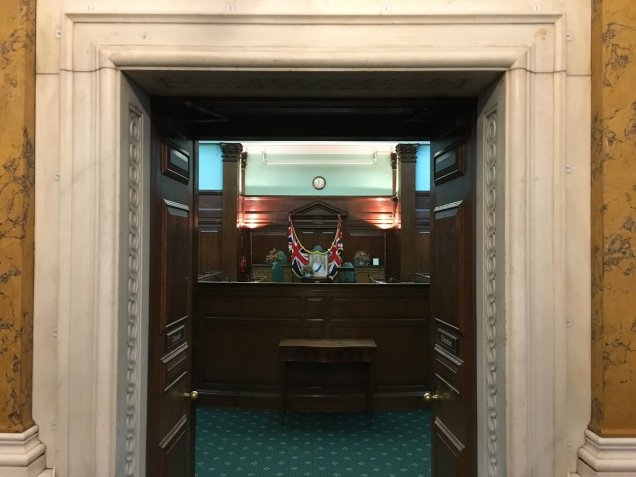
Camden Town Hall council chamber doorway - Citizenship ceremony - British UK flags and Queen Elizabeth portrait

The unexpectedly moving experience of watching forty strangers become fellow citizens and compatriots at a UK citizenship ceremony

“Citizenship is more than an individual exchange of freedoms for rights; it is also membership in a body politic, a nation, and a community”
— Melissa Harris-Perry

“There can be no daily democracy without daily citizenship”
— Ralph Nader

On Wednesday this week I had the privilege of attending a citizenship ceremony at Camden Town Hall, as my American wife finally took the oaths and became a British citizen.

This journey has been quite the odyssey for us. Jenny first came to this country on a short study abroad programme, staying for only a matter of months. She returned a couple of years later to study for her postgraduate degree, which is when we met, and after marrying we moved back to London (she on a spousal visa) and have been living here together since 2012.

The subsequent steps – applying for indefinite leave to remain, studying for and taking the Life in the UK test, providing biometric data more often than one would think necessary given the unchanging nature of one’s fingerprints and of course forking over large sums of money to the Home Office at regular intervals – were frequently stressful and time consuming, but there was never a question that this was a step we were going to take.

Britain is home for Jenny just as much as is the United States of America. She may have stubbornly refused to learn the 24-hour clock, use Celsius when talking about the weather or guzzle tea ten times a day along with everyone else at her office, but she is indisputably a proud Brit and a Londoner. She understands our cultural quirks, appreciates our history, loves the natural beauty of our countryside and maintains a richer social life and a wider network of British friends than I have ever cobbled together for myself.

Thus, naturalisation was simply a case of formalising on paper a transformation which had already taken place in her heart and mind. Jenny was already British in pectore; we were simply waiting for the legal side of things to catch up with reality. And so it was that I found myself sitting in the gallery of the council chamber at Camden Town Hall in King’s Cross, witnessing my wife and a diverse group of strangers complete the long and arduous process to become something which (through accident of birth) I have been fortunate to take for granted my entire life.

It was a genuine honour to be present as over 40 people from all backgrounds, races, religions and countries of birth solemnly affirmed their commitment to our United Kingdom. Many people are content to live in this country, building lives here, contributing and receiving back, without making this gesture of commitment. But I believe that it is very important, and admire those who do so.

Citizenship is more than a basket of rights, privileges and perks. It is also a binding commitment to the society in which we live. Choosing to naturalise means a willingness to undertake obligations as well as demand one’s due. Becoming a citizen is a declaration that one is bound to one’s fellow citizens by something more than temporary convenience or the accidental byproduct of an overseas work assignment or relationship.

This bond is hard to describe or put down in words, which is perhaps why so many self-declared “citizens of the world” – people who consider themselves to have transcended national alignment and who flit from place to place without ever making a binding commitment to anywhere they set foot – don’t understand why it matters.

But if you have built a life in Britain over the course of years or even decades, why would one not want to formalise that connection? Yes it costs money, and yes the Home Office does its damnedest to make the process as bureaucratic, expensive, frustrating and opaque as possible, often actively throwing barriers in the way of people who desperately want citizenship. But if one has the means and the opportunity, why not take the pledge and acquire the passport? Failing to do so is the civic version of cohabiting with a partner but never marrying, one foot always out the door, one eye always casting around for something better.

If I was a non-citizen living in Britain, I would take citizenship in a heartbeat. In fact, as a natural born citizen of this country I was almost envious that the immigrants who were naturalised today in King’s Cross were able to solemnly mark the event. Those of us born here often take our citizenship for granted, but these immigrants strove and sacrificed to attain their status.

With the ongoing debates around Brexit, I encounter all manner of arguments from people who clearly don’t understand the first thing about what citizenship entails or represents. For example, many are genuinely outraged that EU citizens could not vote in the 2016 referendum. I find it to be astonishing that people who live here but are unwilling to share the bond of citizenship with me seriously believe that they should still have the right to help determine the future of my country.

At this point I inevitably hear outraged spluttering along the lines of “I pay my taxes / serve in Our Blessed NHS / help employ local people, so why shouldn’t I have a say?” But this only highlights the transactional view of citizenship that many now hold, with paying taxes and claiming benefits the only relationship one might possibly have with a country.

And to be fair this transactional view of citizenship is also encouraged by the UK government, which rather than pursuing an immigration policy optimised for economic growth, social stability or national security instead blindly chases an arbitrary and unattainably low net migration number. When the state makes clear its view of immigrants as a problem to be mitigated and prospective citizens as purely a bureaucratic burden to be processed it is difficult to demand greater fealty or civic engagement from immigrants themselves.

Yet citizenship still matters, despite its somewhat tarnished image. Only citizens are able to participate fully in our civic life – voting, running for office, serving on a jury. If one is unwilling to undertake these commitments 99% of the time, as long-term EU residents who choose not to take citizenship are essentially declaring, you can’t object when you are then prohibited for participating in the one very specific event (voting in the EU referendum) in which you have a direct interest. That kind of cafeteria civics would represent a one-way flow of benefits from the state to the individual and undermine the reciprocity needed for society to function.

The Brexit debate has highlighted just how degraded our conception of citizenship has become. With reduced and increasingly ineffectual armed forces, only a very limited opportunity for national service (the National Citizen Service being one of the few entirely positive policies enacted by David Cameron) and our exquisite embarrassment about any display of patriotism, it is really no wonder that we have come to see citizenship as just a bunch of perks.

As I wrote back in September last year:

This very transactional approach has frayed the contract or bond between citizen/resident and the state. Of course, people still expect the state to protect them from foreign foes, guard against domestic security threats, provide healthcare, offer a welfare safety net and distribute various domestic and EU services. But even as they make these demands they offer rapidly diminishing loyalty to the state in which they live. People are increasingly insatiable for the benefits while being less and less willing to accept the responsibility.

I am sure that some of those who naturalised in the citizenship ceremony today did so for purely practical or transactional reasons. But I hope that even they will look back on today with pride and now feel a deeper connection to the country they call home.

Ultimately there is nothing magical about naturalisation. The certificate does not hold any special magical powers. It is not a measure of personal worth, and of course many UK residents who are non-citizens on paper are far better citizens in practice than many of us who are natural born. Naturalisation is just one indicator, albeit a very important one, of an important responsibility solemnly accepted.

Of course, none of this will be the case in perpetuity. The nation state is not forever, and in a century or two, civics and geopolitics will doubtless look very different. But for now, the nation state remains the best guarantor of freedom and incubator of prosperity that mankind has yet devised, and attachment to the nation state has been the means of securing these blessings for an individual. Wishing for its premature demise is foolish.

To those citizens of the world, outraged by Brexit, who hold their EU citizenship more dear than their British citizenship, I would simply point out that any objective, dispassionate analysis shows us that the European Union is not the only (nor best) vehicle for international cooperation, its status as the natural successor to the nation state is far from certain and it will never possess the essential spirit of democracy until there is a European demos – a body of citizens willing to take the oath that my wife and forty others willingly gave to the United Kingdom.

Watching these people – as diverse as one would imagine forty people randomly plucked from the streets of Camden to be – take the oaths of allegiance was to witness them transform from being strangers and fellow immigrants to being compatriots. It was nearly as emotional for me, sitting perched in the gallery, as it clearly was for many of them.

And if only more of us knew the journey involved and the sacrifices made by these people so that they might share the same rights and responsibilities that we enjoy as British citizens, we would not be so cavalier about our own citizenship and all that it represents.

Camden Town Hall council chamber - view from public gallery - Citizenship ceremony

Oath of allegiance - British UK Citizenship ceremony

Support Semi-Partisan Politics with a one-time or recurring donation:

Agree with this article? Violently disagree? Scroll down to leave a comment.

Follow Semi-Partisan Politics on TwitterFacebook and Medium.

The Story Of Hamilton Is Also The Story Of Brexit

Hamilton musical - London - Brexit

What do the latest imported smash hit musical from America and Britain’s historic vote for Brexit have in common? The answer, it turns out, is nearly everything.

It has been frequently remarked, that it seems to have been reserved to the people of this country, by their conduct and example, to decide the important question, whether societies of men are really capable or not, of establishing good government from reflection and choice, or whether they are forever destined to depend, for their political constitutions, on accident and force
—  Federalist No. 1, Alexander Hamilton

Yesterday evening I succumbed to the hype and went to see the London production of Lin-Manuel Miranda’s hit musical Hamilton, newly opened at the Victoria Palace Theatre.

Hamilton tells the story of Alexander Hamilton, American statesman and Founding Father, most famous for having been a delegate at the constitutional convention of 1786, writing many of the Federalist Papers, moulding the new country’s financial system as Treasury Secretary during George Washington’s presidency and having been killed in a dual by political rival Aaron Burr. Through his words and intellect, Hamilton made an enormous contribution to the birth of America, yet his untimely death robbed him of as prominent a place in history as his legacy deserved.

At first glance this might not seem the most promising material for a musical show, but theatre aficionados have been buzzing about Hamilton since it premiered in New York to rave reviews back in 2015. Such has been the show’s rapturous reception that it is fairly hard to find a negative review, let alone a ticket, especially in New York where tickets for the Broadway production have traded hands on the secondary market for insane sums of money.

Being something of a contrarian, I arrived at the theatre in sceptical mood, perhaps too eager to find fault with something that was being universally praised by everyone else. I was sceptical that the rap and hip-hop musical styles which predominate would be a good fit with the narrative material, and worried that the much-discussed “colour-conscious casting” might be little more than a convenient excuse to shoehorn an identity politics lecture into what should be an evening of entertainment.

As it turned out, my scepticism was blown away and any worries about ideological virtue signalling were (mostly) unfounded. Hamilton is an excellent show, the musical genres and clever allusions to other composers from Gilbert & Sullivan to The Notorious B.I.G. draw you in to the story rather than distracting from it, and the source material (Lin-Manuel Miranda based his show on the 2004 biography of Alexander Hamilton written by Ron Chernow) is catnip for history and constitutional geeks like me.

But as I watched the first act build to a climax – after Alexander Hamilton has arrived in New York, become involved in the revolutionary movement, served as General George Washington’s aide-de-camp, fought at Yorktown, studied law in New York after independence was won and ultimately chosen to be that state’s junior delegate to the constitutional convention in Philadelphia, which laid the foundations for the United States of America as we know it today – something else occurred to me.

It provoked groans and assorted expressions of incredulity from my wife and our friend when I confessed my epiphany during the interval, but as the show progressed I realised that the story of Hamilton – of people forging a new and uncertain path through a world in flux – is also the story of Brexit. Bear with me, and I shall explain why.

After they won the War of Independence, Americans didn’t know exactly what they were creating or the experiment they were embarking on. They knew that remote and authoritarian rule from an overseas power was intolerable and injurious to their right to freedom and self-determination, but having thrown off the shackles of monarchy there was no set template for them to follow, no clear-cut alternative to which they should naturally gravitate.

Much of the detail as to how freedom from empire would actually work in practice had to be hashed out in contentious discussions, first formalised in the 1777 Articles of Confederation between the thirteen original states and later in the 1787 Constitutional Convention. This was a time of uncertainty, but it was also an exciting time ripe with promise. Then, as now, there was a new world to build.

Today, we face similarly profound questions about how humanity should best govern itself in changing times, as the epoch of the nation state finds itself threatened and undermined by powerful forces such as globalisation, automation, mass migration and the need to balance smart regulation of international trade in all its technical complexity with the need to preserve democracy and the ability of ordinary people to defend their local priorities and concerns in the face of corporate technocracy.

The existing political order has never looked less equipped to deal with these challenges, or been so discredited and seemingly unequal to the serious task at hand. In Britain, the political class have forged ahead with a centrist, corporatist vision regardless of which political party was in power for the past three decades, an incredibly narrow Overton Window effectively shutting out a huge range of reasonable, non-extremist political ideas from the national political debate. And in the United States, politicians of both parties peddled the illusion that the post-war manufacturing economy could be resurrected together with the promise of a comfortable middle-class lifestyle sustained by semi-skilled manual labour requiring limited education.

In both cases the people themselves were partially to blame for falling for false promises and in some cases practically demanding to be lied to by pandering politicians, but regardless of ultimate fault it has increasingly dawned on people that national and international institutions as presently configured have not met the challenge of our times and can not keep pace with a world increasingly knitted together by technology.

The European Union, held up by its naive supporters as the unquestionably superior way for nations to peacefully cooperate (despite not being replicated on any other continent), has conspicuously failed to effectively tackle nearly all of the big challenges thrown its way, from the migration crisis to the pitfalls of monetary union to rampant corruption in some member states and growing authoritarianism in others. And through all this, despite Herculean efforts and vast sums of money spent with the aim of forging a cohesive European demos – a body of people who hold their European identity in equal or greater worth than their national identity – no such demos has formed.

The EU’s “if you build it, they will come” strategy, creating all of the institutions required for a supranational political state in the expectation that a demos would magically follow along to grant them legitimacy, has failed. Outside Britain, where misguided and low-information young idealists sing Kumbaya and paint the EU flag on their faces, euroscepticism among young people is increasing as more people recognise that the institutions of Brussels present a beguiling but erroneous vision of the future. To all these challenges and more the European Union has nothing to offer save more political integration for the sake of political integration. The EU has no answer, just as remote and exploitative monarchy failed to redress the legitimate grievances of the American colonists.

A recent article by Bradley Birzer in The American Conservative about the limited lifespan of any system or institution of government certainly applies to the European Union and other pillars of the post-war world order as much as it does to the nation state:

One must remember that no republicans believe their republic can last forever. A republic, by its very essence, must rely on its organic nature, a living thing that is born, flourishes, decays, and dies. It is, by nature, trapped in the cycles of life, bounded by the walls of time. While a cosmic republic might exist—as understood by Cicero’s “Cosmopolis” and Augustine’s “City of God”—it existed in eternity and, therefore, aloof of time.

For better or worse, the Roman Republic reflected not just nature, but the Edenic fall of nature as well. We can, the Roman republican Livy recorded, “trace the process of our moral decline, to watch, first, the sinking of the foundations of morality as the old teaching was allowed to lapse, then the rapidly increasing disintegration, then the final collapse of the whole edifice.” The virtues of the commonwealth—the duties of labor, fate, and piety—gave way to the avaricious desires for private wealth. When young, the Romans rejoiced in the little they had, knowing that their liberty from the Etruscans meant more than all the wealth of the material world. “Poverty, with us, went hand in hand with contentment.” As the republic evolved and wealth became the focus of the community, not sacrifice, so the soul decayed. “Of late years,” Livy continued, “wealth has made us greedy, and self-indulgence has brought us, through every form of sensual excess, to be, if I may so put it, in love with death both individual and collective.”

Who can deny that some aspects of our present society – our materialism, individualism and instinctive fear of anything that might (no matter its virtue or long-term benefits) temporarily disrupt the steady accumulation of wealth, assets and positive experiences which we increasingly expect and demand – are worryingly reflected in Livy’s words?

To paraphrase Birzer, all things must come to an end. The Britain of today is not the Britain of thirty years ago, just as the dogmas of Ronald Reagan’s “Morning in America” no longer automatically apply to the American present. We have witnessed tremendous progress in that time, but also political and social atrophy. We are not what we once were, and neither should we cling on in futility to what is past. Many Remainers, having fixed in their minds the false image of Brexiteers as Mafeking stereotypes – curmudgeonly old retired colonels pining for lost empire – fail to realise that through their devotion to the European Union it is they who yearn to preserve the past, slavishly devoted to an anachronistic mid-century blueprint for a new world order, one which came to partial fruition, peaked and then found itself wholly inadequate to the stormy present.

Brexit is not a magical elixir sufficient to address the stormy present or dissipate the challenges we face, but it is a necessary first step to confronting them, just as Alexander Hamilton and the other Founding Fathers could not fully contemplate and realise their revolutionary new system of government until they had first thrown off the shackles of monarchy. Looking at Brexit as a narrow and obstinate project to reclaim full sovereignty or purely as a technocratic matter of trade regulations is to miss the point – we are seeking not to go back but forward, and Brexit is a necessary (though not a sufficient) condition to enable this progress.

It pains me to read much of the coverage and commentary around Brexit, which overwhelmingly ignores the big picture and the long term to obsess over speculative short term costs. It is vital to consider short-term costs and risks in any endeavour, but good policymaking is only possible when short-term considerations are balanced with a broader, longer-term perspective. Remainers often react with incredulity to the suggestion that anything might matter beyond next year’s GDP growth rate, but the American colonists of Hamilton’s day were every bit as concerned about their economic prosperity and security as their modern-day British counterparts; they just also realised that other issues were at stake, issues worth enduring the hardship and destruction of a revolutionary war to correct.

We in modern Britain are called to make no sacrifice remotely comparable to that of the inhabitants of the thirteen colonies as they struck out on their own to form a more perfect union. It would be laughable to compare even the worst of mismanaged Brexits to the price that Hamilton’s peers paid for their freedom and for the opportunity to advance the model of human governance. Yet so great is our present culture of consumerism and so diminished our sense of citizenship or civic duty that few of us are capable of thinking in terms greater than the pursuit of whatever might sate our present desire for comfort and stability. And even when this stability is under long-term threat, such is our fear of disruption that we would rather cling on to the slow, familiar degredation than take any risk by seeking to prevent it.

Today we have a tendency to think of ourselves as having transcended our past, that we inhabit what Francis Fukuyama called “The End of History”, a time when all major human challenges have been vanquished and we inhabit some kind of permanent, beneficent steady-state from which any departure would be an intolerable disruption. And from this perspective, Brexit does indeed appear to be a crazy, irrational endeavour, threatening to unleash a backslide into the fascism and totalitarianism with which we struggled in the twentieth century.

But of course we have not reached the end of history. We are continually presented with new challenges and opportunities, and try as we might to pretend that our existing institutions and policies need only tweaking or adjusting to meet them, recent events have proven this to be patently false. Not all Brexiteers may have voted to leave the European Union based on these high ideals but as Shakespeare wrote, “There is a tide in the affairs of men. Which, taken at the flood, leads on to fortune. Omitted, all the voyage of their life is bound in shallows and in miseries.”

Through Brexit, history has gifted us the opportunity to imagine a new and improved form of government, one which strives to meet our future challenges rather than cower from them (all that EU membership offers, most telling in the rhetoric used by Remainers) or pretend that they do not exist (favoured by the more retrograde Brexiteers who envisage a simple rollback to the old nation state). We must seize this opportunity and be a beacon for other nations, all of which must ultimately grapple with the same issues though they may deny or postpone them for a time.

As I recently wrote:

It has been decades since Britain truly took the lead in influencing world affairs. But having voted for Brexit and thrown into the open many pressing debates which other countries remain desperate to defer or ignore, we can now be both a laboratory and a beacon for the world.

Rather than feeling rancour or relitigating the 2016 referendum result, we should feel the same sense of excitement and possibility that Alexander Hamilton and his co-revolutionaries felt as they debated among themselves how to keep the new republic that they had created. We must rediscover that spark within ourselves.

Perhaps it is no coincidence that a stirring tale about forging a new, more democratic future, a story kindled in America, is set to take Britain by storm as we negotiate our secession from the European Union and look questioningly but optimistically towards the future. Perhaps it is no coincidence that the spirit of Alexander Hamilton is flickering back to life on a London stage at this specific time and place.

Because when you strip away the political games and the media sideshow, the catastrophisation, recriminations, denunciations, speculations and bifurcations, the story of Hamilton may just also be the story of Brexit – if we have the courage and vision to make it so.


Hamilton tickets and information here.


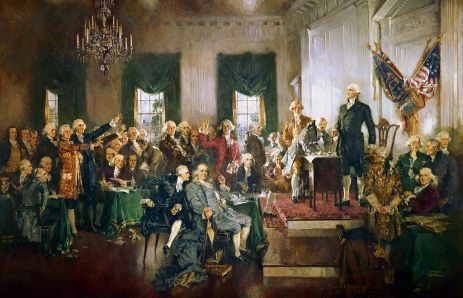
Scene at the signing of the Constitution of the United States - Howard Chandler Christy - Hamilton musical - Brexit

Support Semi-Partisan Politics with a one-time or recurring donation:

Agree with this article? Violently disagree? Scroll down to leave a comment.

Follow Semi-Partisan Politics on TwitterFacebook and Medium.

The Importance Of Conservative Principles, By Nicky Morgan

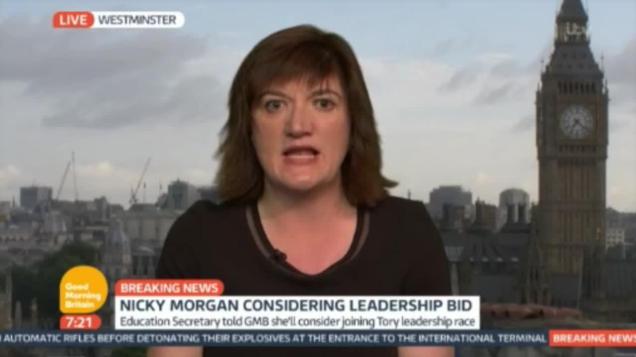
Nicky Morgan - conservative principles

Teach us, O great one

It’s good to see that Nicky Morgan has discovered the importance of fundamental driving principles to an effective government.

Writing in Conservative Home, Morgan graces us with this pearl of wisdom:

Values and principles matter. It isn’t enough to have great policies. People want to know what our motives are and they are looking for authenticity in their politicians. We need people to be clear that we are talking about aspiration, social mobility, mental health, education, housing, animal welfare and lots of other areas, not because a focus group told us to do so but because they matter to us, personally, and we aren’t prepared to put up with the status quo.  Last week has also deepened my understanding of why principles matter, and why it is worth defending them however difficult things get.  And that some people, despite saying they like MPs with principles, actually only like those with principles that they agree with.

It’s amazing how politicians can sometimes say all the right things yet so conspicuously fail to let their actions reflect their words. Ask any random Conservative activist what strand of conservatism Nicky Morgan represents, or what a Morganite government might look like or differ from Theresa May’s, and besides a difference of tone on Brexit you would draw blank faces nearly every time.

It is all well and good pontificating on the need for “authenticity”, but it doesn’t count for much when one served unremarkably in the thoroughly un-ideological Cabinet of David Cameron, or when one’s sole reputation for political steadfastness springs from a newly discovered fetish for our unwritten constitution, spurred by the electorate’s rejection of the pro-EU consensus and a burning desire for the pro-EU House of Commons to have the last word.

Morgan’s last point, whining about people demanding MPs with principles but then disliking MPs whose principles they disagree with, is particularly asinine. Many people do indeed respect MPs with strong and unapologetic convictions, but this does not have to translate into respect for their particular policies or moral code.

This blog has long supported Jeremy Corbyn’s leadership of the Labour Party on the grounds that the present centrist, managerialist consensus is conspicuously failing Britain in this period of political discontinuity, and because having the two viable parties of government both camped out in the same narrow centre ground is a recipe for political disengagement and fringe extremism.

But in no way is this an endorsement of Jeremy Corbyn’s economic or foreign policies, his closeness to Palestinian or Irish terrorist groups or endorsement of authoritarian leftist regimes which drive their countries into the ground. In other words, it is possible to respect the presence of principle while deploring individual policies, and Nicky Morgan should not be surprised that having finally taken something resembling a stand for something resembling a principle, she is now receiving a degree of political blowback. Unfortunately, that much comes with the territory.

And so long as MPs like Nicky Morgan continue to equate democratically legitimate calls for the deselection of MPs with other more concerning actions like online trolling or threats of violence, it is very hard to conclude other than that the entire exercise is really just a cynical ploy to grasp the mantle of victimhood and avoid accountability to the people.

Conservative Party Logo - Torch Liberty - Tree

Support Semi-Partisan Politics with a one-time or recurring donation:

Agree with this article? Violently disagree? Scroll down to leave a comment.

Follow Semi-Partisan Politics on TwitterFacebook and Medium.


CCHQ Should Not Automatically Protect Tory MPs From Deselection

Conservatives Tories start candidate selection process early - mandatory reselection - deselection of rebels

A seat in the House of Commons is not a job for life. And just as the Parliamentary Labour Party should not be encumbered with MPs increasingly at odds with their local constituency parties, so Tory MPs should not be immune from deselection if they repeatedly ignore the priorities and concerns of grassroots Conservative Party members

Try as I might, I simply cannot get myself worked up about the government’s “shock” defeat over the amendment to the EU Withdrawal Bill. While the legislative drama seems to have Hard Brexiteers up in arms and Remainers parading their newfound (and one suspects rather less than genuine) love and respect for Parliamentary sovereignty, I don’t see that these machinations will have any real bearing on the eventual outcome.

So Parliament gets to have a “meaningful” vote on the terms of the UK-EU agreement? Fine, so be it – though I have always held that the people, not Parliament, should be sovereign, and that no government should be able to divest itself of fundamentally important powers or seek to repatriate such powers without an explicit and specific mandate from the people. Of course, if we had a written constitution then such things would likely be enshrined automatically rather than be up for furious debate as new issues and obstacles are encountered along the road. But then if we had a written constitution we likely would never have ceded so much sovereignty to the European Union in the first place and would not now be in this position, making it all a rather moot point.

Of far more interest to me is the fact that talk of deselection of MPs has bubbled up again. We saw this last year as Jeremy Corbyn and his supporters sought to cement their control of the Parliamentary Labour Party, and for democratic reasons I supported the idea of mandatory reselection in principle. And now there are new calls to deselect sitting MPs, this time from Conservative politicians and activists angry at what they see as the Tory rebels’ deliberate undermining of the prime minister and the country’s negotiating position with the EU:

On this occasion I do not share the Tory Brexiteer outrage, but their case is every bit as compelling as was that of the Corbynite leftists who wanted to rid their party of centrist MPs who do not reflect the values and priorities of their local associations. While I personally find it hard to work myself into a spittle-flecked fury at the antics of Dominic Grieve or Heidi Allen, if it is the case that these MPs represent Leave-voting constituencies and a majority of local party activists find their voting record objectionable then I see no reason why they should be protected and continually re-imposed on an unwilling local party organisation.

Of course, CCHQ and the Tory Party machinery vehemently disagrees. Reflexively opposed to any notion that grassroots activists or local constituency associations should have any input as to the direction, policies or running of the party, CCHQ sees individual conservatives as little more than indentured servants campaign material distributors at election time, to be put to work when necessary and then roundly ignored the rest of the cycle.

Nick Timothy, Theresa May’s intellectual bloodbank-in-exile, makes it perfectly clear that the present Conservative leadership remains determined to run the party (if not the entire country) as their personal private fiefdom, and that local constituency associations should shut up and do as they are told, whether they like the candidate or MP chosen for them or not. Timothy unapologetically and shamelessly spelled out as much on Twitter today:

https://twitter.com/NickJTimothy/status/941254029488873472

This is an open admission that Theresa May, the prime minister and leader of the Conservative Party, saw fit to interfere in local constituency business and keep an unwanted MP foisted on an unwilling local party.

But what the hell business should it be of the prime minister who gets to stand as a Conservative candidate in a local constituency? This is everything that is wrong with the current Tory party – overcentralised and overbearing, with CCHQ pig-headedly declaring that it knows best while confidently marching us all to ruin. Given the litany of gaffes, unforced errors, scandals and bad judgements which have emanated from Theresa May’s cabinet, I would sooner entrust a panel of ten individuals randomly selected from the phone book to choose good Tory candidates than I would have Theresa May make the judgement call.

Of course, there is a counter-argument to all this, as a reader pointed out on Twitter:

We certainly don’t want a situation where conscientious, independent-minded MPs are peremptorily driven from office or from their political party because they fail to toe the hardest of hard lines demanded by their activists. We have recently witnessed just such a phenomenon lead the Republican Party to ruin (at best Pyrrhic victory) in America, where a succession of primary challenges and forced retirements saw an influx of ideologically uncompromising Tea Party politicians into Congress, hard-liners who thwarted any attempt at sane governance in the second term of Barack Obama, rendered the Republican congressional caucus unmanageable and ineffective and set the stage for Donald Trump’s hostile takeover of the GOP.

In actual fact we need both of these opposing forces – greater responsiveness to grassroots opinion and a cool, dispassionate process to adjudicate in the event of rogue or underperforming MPs – to be in balance. We need a far greater measure of accountability of MPs to their local party associations, and a more meritocratic system of selection (preferably primaries) which draws more people into the political process and prevents the mediocre-but-well-connected from leveraging their connection to CCHQ to be shortlisted or ultimately foisted on a constituency.

But we also need to build safeguards into the system so that the bar for triggering deselection is high but achievable – the recourseshould only become available at the time of a general election or by-election, so that MPs are judged on the body of their work and their voting record throughout a Parliament and not on the basis of any one single contentious vote.

Ultimately, the resurgent argument about deselection of MPs reminds us that Brexit is a necessary but not a sufficient condition for meaningful democratic renewal in Britain. Brexit was never going to be a cure-all no matter what some cynical Brexiteers may have implied, and we must all now recognise this fact. Achieving Brexit only to return power to the hands of the same MPs who negligently frittered it away in the first place, and who think so little of the people who campaign to put them in office that they seek to be made immune from their judgement, will not solve anything.

To this extent, the worries of Hard Brexiteers that the EFTA/EEA route may be used as cover by some Remainers in order to thwart Brexit entirely are quite valid. When there are so few penalties or recourses available to voters when politicians betray their own supporters, the trust required to sustain a well-functioning democracy is inevitably corroded.

But the real tragedy is that when we should be discussing how to respond to the period of disruption and discontinuity facing Britain, developing bold new mutually-reinforcing policies to tackle 21st century challenges, instead the Conservative Party is bickering about process and thwarting any attempts to clear out the intellectual deadwood and bring in some new ideas and personalities. Constitutional and electoral reform is important and eventually necessary, but there are pressing issues facing Britain which cannot be put on the back burner while we argue about the rules of play. Unfortunately, we seem less interested in these big debates and more interested in arguing about process stories.

When the Conservative Party fails to stand for anything – and Lord knows that under the rootless leadership of Theresa May, the Tories stand for little more than surviving the day at hand – it has plenty of time to devote to juvenile, internecine spats like the one playing out over the EU Withdrawal Bill rebels.

This is highly entertaining for the political media and a gift for Jeremy Corbyn and the Labour Party, but very bad indeed for everyone else.

Conservative Party Logo - Torch Liberty - Tree

Support Semi-Partisan Politics with a one-time or recurring donation:

Agree with this article? Violently disagree? Scroll down to leave a comment.

Follow Semi-Partisan Politics on TwitterFacebook and Medium.

The Battle For British Conservatism: Should The Tories Be Ideological?

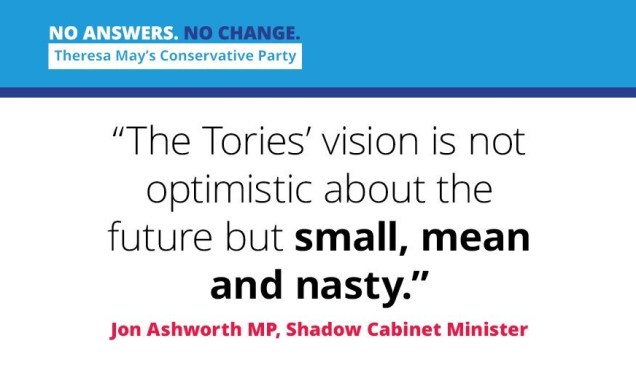
Tories vision is not optimistic about the future but small mean and nasty - Jon Ashworth MP - Conservatives

Some say that it is not the job of conservatives to think big or be ideological – but in a period of discontinuity such as this, being ideological and ambitious is exactly what conservatives must do

My interest was piqued recently by a Philip Collins column in the Times, in which Collins argues for pragmatic conservatism over idealistic conservatism, and chastises Brexit-supporting conservatives in particular for supposedly putting adventurism and ideology over the cautious stability which ought to flow from the conservative worldview.

Collins makes some interesting points, beginning with his conception of the differing roles of Britain’s two main political parties:

The electorate selects a Labour government to push the nation down the road of progress. That effort inevitably leads to an excess of public spending and too great a faith in the capacity of the state to improve the lot of the people. Much good gets done along the way but the temperature gauge of the British people is so attuned that, once spending starts to spiral, they call on the Conservative Party to tidy up. The whole point of the Conservatives, the absolute raison d’être of Tory government, is to provide sound money and solid competence, unburdened by too much radical belief.

I don’t necessarily disagree with this. Over the course of both short and medium-term timeframes one can witness this phenomenon in action, from the pivot away from New Labour in 2010 as a short-term correction by an electorate in search of economic competence, and on a longer-term macro level the big swings from pre-war government to Attlee’s post-war socialism followed by a Thatcherite rollback of the post-war consensus.

(Of course, one can also argue the opposite – that the 1979 and 1983 Conservative governments were a deeply ideological monetarist reaction against the managed decline wrought by Keynesian economics and the socialist mixed economy. But while I fully agree that these were very ideological movements on the inside, I must also concede that they came to power not because the British people suddenly bought into a particularly individualistic mindset but rather because the people knew that the Tories were delivering strong, necessary dose of needed medicine).

But it is when Collins applies this same thinking to the European Union and the question of Brexit, though, where I really take issue with his argument:

But the issue of Europe, alas, pricks Conservatives into believing things. Suddenly, all the errors of the left, which the right exists to correct, are being committed by the Conservative Party. The usual conservative view is risk-averse and frightened of grands projets by their sheer complexity and by the low capacity of the state to administer them. The true conservative, who is not a reactionary in thrall to the past, is also not a radical excited by a better tomorrow. He or she instead makes a fetish of the present. Better not to risk change for fear it will be worse than what we have. The caution and the complacency can be infuriating but it is a fool who sees no wisdom in the position.

Where are these conservatives today? Can you name a single one? Who is the person who holds the quintessentially conservative view, which is that the EU is a bit of a mess for which no affection can really be mustered but who thinks that leaving is really not worth the candle? The process of leaving, thinks the historical conservative, is just too difficult, too far beyond the capacity of the civil service to deliver, just far too much bother. To attempt the most complex administrative task that the British state has undertaken since the conduct of the Second World War is just a profoundly unconservative thing to do.

This, to me, seems a rather glib analysis. The United Kingdom has been a member of the European Union for slightly more than four decades. This is but a blip in the very long history of our country, and certainly an aberration in comparison to the independent course we charted before joining the EEC in 1973. To say that remaining in the European Union is the conservative option is to apply an exceedingly narrow temporal window in determining whether the “natural” state of being to which conservatives should naturally gravitate should be the status quo, or what existed for centuries up until forty years ago.

Collins would be aided in his argument that the EU represents the “new normal” if there were any other examples elsewhere in the world of nations voluntarily creating supranational governments to sit above their own courts and legislatures, cheered on at every stage by their citizens. But of course there are no such examples. The people of Canada, Mexico and the United States do not clamour to form an ever-closer union of their own, let alone one which includes central America (the equivalent of the European Union’s continual eastward expansion). Nor would the citizens of, say, Canada, tolerate the idea of a supranational court and legislature in Mexico City setting an ever-wider range of social, trade and foreign policy.

In other words, it seems clear that the European Union is the historical aberration, not Brexit. The EU is an anachronistic relic borne of a time when the world was divided into a few major international blocs. It is a solution to a problem which no longer exists, and while international cooperation is more important than ever, EU-based cooperation has conspicuously failed to live up to the challenges of our time, from the self-inflicted euro crisis to the great migration crisis. And given that EU membership represents such a narrow slice of our history, it seems clear to me that the conservative position is one which advocates a calm, orderly and pragmatic Brexit (probably of the kind which I and other members of the Leave Alliance campaigned, namely a phased exit from the EU via EFTA/EEA in order to avoid undue disruption to trade and economic links).

Also concerning is Collins’ assertion that Brexit is “just too difficult, too far beyond the capacity of the civil service to deliver, just far too much bother”. He seems to wilfully ignore the fact that the Conservatives are also traditionally the party of patriotism and the robust, self-confident defence of national integrity (the clue is in the name Conservative and Unionist Party). While conservatism may often mean cautious pragmatism in terms of domestic policy (which admittedly has sometimes needed to be disrupted by Labour’s progressivism to advance the social good) it has never meant timidity or a lack of faith in Britain’s ability to act and defend our interests on the world stage. Collins seems to equate natural conservative caution with a necessary lack of ambition, but I do not consider these one and the same thing at all.

And then Collins really loses me with this:

Britain feels very different from the glorious summer of 2012 when Danny Boyle’s opening ceremony to the Olympics was a paean to British culture that had spanned the world and to British institutions that had stood the toughest test of all, the test of time. In the distant past five years ago, it was an easy nation to be proud of. Boyle’s was a conservative vision of Britain, which the Tory party has thrown by the wayside.

I’m sorry, but this is balderdash. Prior to his career in journalism Philip Collins was speechwriter to Tony Blair, so his proclivities are very much of the centre-left. And while parts of Danny Boyle’s opening ceremony for the London Olympics might be said to be rooted loosely in conservatism, the part which most people remember is the bizarre open-air Mass in praise of the NHS and socialised healthcare.

(It is telling, too, how many of those on the left and centre-left almost seemed to discover patriotism for the first time back in 2012 while watching hundreds of actors in nurse costumes prance around a huge stadium pushing hospital beds and wheelchairs).

An all-singing, all-dancing Rite of Spring in worship of the National Health Service is not conservative in nature. In fact, its emphasis on uniformity, collective endeavour, equality of outcome and dependency on government is about the most un-conservative spectacle one can think of. The fact that it took a rather gaudy homage to that most socialist of socialist institutions to evoke feelings of patriotism in some on the Left shows that this was very much a leftist moment, not a conservative one – and in my opinion also shows that the same argument that EU membership is too new to fall under the protective umbrella of conservatism also applies to the NHS.

So should conservatives believe in anything, or should they be the timid, pragmatic and unambitious party of technocrats and fixers who are called in once in awhile to clear up the mess caused by an over-zealous Labour Party? I think this is where we need to be very clear about our meanings. It may absolutely be the case that most of the British public never see the conservative worldview and resulting policies in terms of an inspiring, coherent story. We may always be seen as the fixers. But that does not mean that we can get away without having a story to motivate and guide us, even if this remains largely internal.

Remember: British politics has now entered a period of discontinuity (as evidenced by the Brexit vote and the rise of Jeremy Corbyn) in which people have increasingly become dissatisfied with the previous Cameron-Blairite centrist, pro-EU political settlement and are demanding something new, something which addresses the unique challenges we face as a nation in 2017. This cannot be done without first diagnosing these challenges, understanding where they are interlinked, and then devising a set of mutually-reinforcing policies to tackle them.

We saw the same thing in 1977, when the influential Stepping Stones report (no, I’m not going to stop talking about it anytime soon) provided a blueprint which Margaret Thatcher then took to Downing Street and started implementing in 1979. The Thatcher government did not save Britain from inexorable national decline by conceding that reversing years of state ownership of industry and tackling the over-powerful trades union was “just too difficult, too far beyond the capacity of the civil service to deliver, just far too much bother”. On the contrary, the Conservative Party of 1979 was forced to accept that discontinuity had to be met by new and previously unthinkable policies, just as the idea of leaving the EU remains unthinkable to so many within the political class today.

Believing in nothing and playing the role of the calm technocrat is all very well when times are good, when society and the economy are in steady-state and there are no urgent or existential challenges to be addressed. In such times, the Conservative Party is very welcome to play the tedious but necessary role of fixer. Unfortunately, we live in rather more interesting times which require inspired and often disruptively innovative policymaking rather than the usual government painting by numbers.

I can understand why this scares people like Philip Collins. The last time it was incumbent upon the Tories to be truly ideological, in 1979, they ended up remaking the country (and together with America, the world) and stamped a new political settlement on Britain which even now has not been fully rolled back. It is therefore natural, if a little cynical, that he now counsels the Tories to think small, to “keep their senses” and throw their arms around the status quo. The alternative must be terrifying to contemplate.

The last thing that the guardians of the current, fraying political consensus want is for conservatives to come up with an ambitious, ideologically coherent new internal narrative and then remake the country anew all over again.

And that is precisely why we must do it.

Conservative Party Logo - Torch Liberty - Tree

Support Semi-Partisan Politics with a one-time or recurring donation:

Agree with this article? Violently disagree? Scroll down to leave a comment.

Follow Semi-Partisan Politics on TwitterFacebook and Medium.