Dispatch From Washington

img_6215

Nothing much to report here

I’m writing this from the desk in my study, where right now just four blocks away in the White House a president whose daily conduct raises legitimate questions about his fitness to govern is raging in helpless impotence. Why? Because some faux-patriot within his dumpster fire of an administration decided to hint to the New York Times about just how bad things have become – supposedly out of civic duty – yet lacked the courage to give the accusation real weight by putting his name to the anonymous OpEd. All this is just today’s drama; no doubt tomorrow there will be some new unprecedented scandal to bump this story down the news agenda.

These are interesting times to be living in Washington, D.C. I must admit that I have not yet gotten over the novelty of watching the bottom of the Washington monument appear in the background of a live TV broadcast, then looking out the window of my study and seeing the top of the same structure mere minutes away. In British terms, our new home is within close earshot of Big Ben and the Palace of Westminster. This means a constant stream of noisy motorcades carrying second-tier officials down the next road, and regular glimpses of Marine One as it ferries President Trump back and forth as he escapes the city to play golf.

It is strange to be living in the modern equivalent of Ancient Rome at the height of its power (or perhaps shortly into its terminal decline), the seat of government of what is effectively the most powerful empire in the world. Many of the buildings here are built in conscious acknowledgement of the torch that was passed from Ancient Greece to Rome, and so on through Britain to the New World. I find myself walking amid the classical architecture in this planned city and wondering what future historians or tourists will say as they pick over the ruins or buried past of this metropolis, many centuries in the future.

Highlights have to include the Lincoln Memorial. Abraham Lincoln has been a particular interest and inspiration of mine since I was a teenager, and since then I have devoured enough books on the 16th American president to comfortably fill a bookshelf. Standing inside that immense marble memorial and reading the inscription above Lincoln’s statue – “In this temple as in the hearts of the people for whom he saved the union, the memory of Abraham Lincoln is enshrined forever” – is a moving experience. Even when full of screaming children and selfie-happy tourists, there is a sense of power and dignity in that place. While there, it is also hard not to dwell on just how far we have fallen from that ideal in recent years.

Law school has started well. You must forgive me for the lack of blog posts over the last month; road-tripping half way across the country from Texas, establishing a new home in DC and going through law school induction took up all of my spare time, and even now I have thirty pages of Criminal Law reading which I should be tending to this evening. However, for my own mental health and diversion if nothing else, the blog will continue, albeit maybe somewhat more sporadically than before.

Being back on a university campus as someone with a record of speaking out forcefully against the excesses of identity politics has been interesting – I can confirm that all of the warnings I have been giving over the past few years were prescient and on point. There have been no stand-out incidents yet which lead me to believe that my institution is faring worse than any other, but it only takes one supposedly “controversial” speaker invite or student society activity to create havoc and endless protests, so we shall see how things develop. Halloween will likely be a good indicator, given recent controversies elsewhere and the growing conviction that “cultural appropriation” is a harmful, negative phenomenon. Today was the law student organization fair, and reflecting my semipartisan nature I added my email to the law school chapters of both the ACLU and the Federalist Society. I agree with neither organization entirely, but look forward to some interesting debates.

Adjusting to student life has been challenging, but frequently fun. Though I am a graduate student I am still on the generic university email list, so have been receiving helpful daily missives about how to do my laundry and accomplish other tasks now commonly known as “adulting”. On the flip side, there is nothing like living in close proximity to a bunch of eighteen-year-old undergraduates to make you feel your age, and there has been more than one occasion when I look from all these young whippersnappers with their lives ahead of them to myself and wonder momentarily what it is that I am doing, making this mid-life career course correction. Fortunately these moments never last long – I came here with a purpose, albeit a somewhat inchoate one, and many of my classmates have impressive and inspiring backgrounds.

Intellectually I feel like I am holding my own thus far, though the annoying habit of American law schools whereby the first real feedback only arrives in the form of all-or-nothing final exams in December means that I won’t really know precisely where I stand for awhile. Mostly it is just a relief to have made a start, after having done so much preparation and read so many conflicting pieces of advice about how to succeed at law school. There is a satisfaction when the reasoning behind some obscure rule or legal concept finally clicks into place – it is good to be learning again. Growing, hopefully.

We have some pretty eminent academics who teach here, people whom I knew and respected before the thought of going to law school even occurred to me. One Supreme Court justice teaches a constitutional law seminar here, and another is coming to speak next week. Mostly I am awed by a sense of vast new possibility – the law is not really one career, it is a gateway to a myriad of different sub-vocations, almost as different from one another as it is possible to be. And while I can pre-emptively rule out certain options – it is pretty safe to say that I will not be becoming a small-town lawyer or one of those personal injury kings with their face on a billboard above the freeway – the possibilities remain varied.

Anyhow, this will likely be the longest thing that I write for some time outside of law school. Necessity dictates that I will at last have to do what I have often threatened to do on this blog but never quite succeeded at, namely trying to adopt a “little and often” approach to commenting and reacting on stories of interest. At this point you all know what I think about the big issues anyway, and I can always link back to those longer-form pieces when necessary. Time constraints now mean that if I want to say anything at all – and keep the blog ticking over – I had better find a way to condense my opinions into a paragraph or two. It will be good practice; Lord knows that much of what I have written the past six years would have benefitted enormously from an editor’s red pen anyway, if not the shredder.

Finally, while it may be somewhat cheeky to mention this when I haven’t published anything new for a month, I am now technically an impoverished student once again and without a regular income, so any donations to the instant ramen noodle fund are most gratefully received.


img_6228

Support Semi-Partisan Politics with a one-time or recurring donation:

Agree with this article? Violently disagree? Scroll down to leave a comment.

Follow Semi-Partisan Politics on TwitterFacebook and Medium.

Unsurprisingly, The “Disparate Impact” Test Reveals That Brexit (And Everything Else) Is Sexist

Brexit - gender equality - womens rights - identity politics - EU - European Union

Leftists to women: “Don’t you worry your pretty little minds with complicated talk about geopolitics, democracy or the long-term national interest – just think about Brexit in terms of whether you stand to gain or lose government benefits and entitlements”

It must have seemed like a godsend to whichever scheming left-winger first thought it up – the notion that any proposed government policy should be analysed primarily according to its impact on different identity groups, with any disproportionate impact expected to be felt by minority or designated victim groups providing concrete “proof” that said policy is inherently racist, sexist or otherwise deliberately prejudiced and therefore political Kryptonite.

Here, suddenly, was a super-weapon which could be deployed effectively against almost any policy originating from the right-of-center, and an argument structure which could be adapted and endlessly recycled by lacklustre, uninspired left-wing politicians and activists who would otherwise struggle to string a coherent sentence together on television.

Why does it work so well? Because since right-of-center policies often involve reducing or re-targeting government programs (or encouraging their future provision through the private or nonprofit sectors rather than directly through the state) and since the Left ostentatiously claims to work and speak for the recipients of many of these services, leftist politicians have been able to insinuate that innumerable conservative policies were not conceived in the national interest but rather out of a burning desire to hurt certain vulnerable communities.

Since women and certain ethnic minority groups are disproportionate consumers of certain government services and benefits, virtually any policy which rolls back government spending in these areas can be condemned not only as misguided or callous but as inherently racist, sexist and discriminatory. And the policy’s proponents, in turn, go from being wrong on a matter of policy to inherently evil. Couple this with a left-wing media which is only too happy to take up the clarion call of discrimination without putting too much actual thought or analysis into the matter and you have effectively built an automatic, reflexive Conservative Policy Smearing Machine.

One need only put the conservative policy du jour in the machine’s slot, crank the handle (sometimes multiple rotations are needed depending on the number of degrees of separation between the policy and being able to suggest a favoured minority getting less stuff from the government) and out flies a prefabricated furious press release, a viral social media campaign and an eager up-and-coming left-wing politician to make their name fighting for justice and equality.

And so it was inevitable that leftists, once their initial shock at the EU referendum result had subsided, would seek to crank up their trusty Conservative Policy Smearing Machine and aim it square at the heart of Brexit. This blog has previously highlighted one such effort being promoted by EU idolatry magazine The New European, in which the author declared:

Let’s get one thing straight. This self indulgent pratting about over Brexit will be stopped. But not by MPs kowtowing to party whips in rapture to the latest autocratic executive power grab. And not because media silence blanks out the protests of citizens, but by women kicking off.

Let’s face it. Brexit is essentially sexist. Those spitting out their dummies need a good slap as my gran would have said, and she would have been only pleased administer. She’d have probably denied them sweets, treats and pocket money until they came to their senses too. Her view would be behave like brats, and get treated accordingly.

The chain of “logic” here is that because Brexit (or specifically a mishandled Brexit resulting in economic damage, not the concept of Brexit itself, though it is not in the author’s interest to acknowledge this nuance) may have negative economic consequences, this will result in a recession, which will result in lower government tax revenues, which would mean that the government would have no choice but to cut spending (though the Left also love to argue for stimulus spending, not cuts, during economic downturns) which would then disproportionately impact women, since women are more likely to claim tax credits or various other taxpayer-funded benefits.

You could be forgiven for thinking that this chain of illogic is rather too long and twisted for the conclusion to justify the premise, being more akin to the Underpants Gnomes from the satirical TV cartoon South Park (in which little creatures busily steal underpants from the town’s inhabitants, feverishly working to the formula Underpants + ? = Profit, with the question mark never being identified). And you would be right. But for Continuity Remainers and leftist defenders of the European Union, any embarrassment at drawing such a tenuous connection is outweighed by the opportunity to smear Brexit as being not only misguided but motivated by a callous desire to hurt women. No matter how implausible, if a line can be drawn linking Brexit to misogyny or racism then that line will be drawn, personal dignity and intellectual integrity be damned.

And now, charging into the debate, we have the London School of Economics’ execrable Brexit blog, an embarrassment to academia which exists primarily as a platform to cast as many aspersions against Brexit as possible without ever once seriously engaging with democratic or constitutional criticisms of the EU.

In a new essay by Julie MacLeavy of the University of Bristol for the LSE Brexit Blog, it is suggested that the goal of gender equality is “adrift in the Brexit backwash”. Good luck trying to decode the following identity politics word soup:

With European legislation and regulation on gender equality framed as inhibiting economic growth, the post-Brexit environment is likely to see the simultaneous intensification and erosion of gender. Should the UK government deregulation fail to enact sufficient legal protection to compensate for the removal of EU laws, directives and charters, the prior neoliberal tendencies of individualisation and the transfer of reproductive responsibilities towards the feminised spaces of communities and families – renewed in part through the implementation of austerity measures in recent years – will no longer be restricted by the promotion and implementation of gender equality policies.

At the same time, deregulation and the reprivatisation of social reproduction are likely to affect not just women, but a number of feminised individuals upon whom the burden of additional care work falls. The dimensions of class, race and ethnicity mean that any change in the gender regime will affect constituted groups differently. In this sense, Brexit indicates the significant intensification of the practices that reflect and reproduce gendered labour and economic inequality.

Making the case for Europe’s democratic values and its commitment to social justice will depend on both the popularisation of a feminist campaign in which gender equality as a main goal is rendered legitimate, as well as the incorporation of a feminist ethic within the auspices of the state. This latter task is becoming increasingly difficult given the support expressed for the repatriation of European powers by previously pro-European factions.

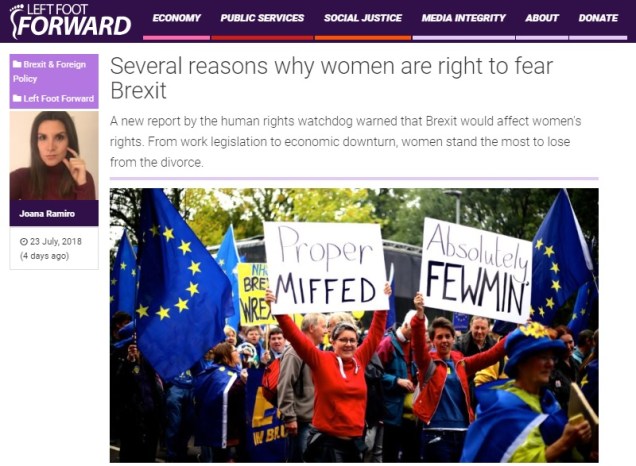
Left Foot Forward has also been promoting the same infantilising line of argument.

MacLeavy’s line of argument is distasteful more for its haughty contempt for democracy rather than its condescending view of women and minorities. The entire operating assumption of the article and the academic “thinking” behind it is that because Britain is a terribly backward and barbaric place, crucial and fundamental human rights have to be imposed on us by a higher, outside authority (in this case, the EU).

Since nasty, backward British voters cannot be trusted to believe in or vote for the right things, we need human rights imposed on us at a European level, so that present and future UK governments could not dial back certain rights or entitlements even if they wanted to. This is predicated on the belief that democracy, popular will, should not trump everything, which is actually a perfectly reasonable position – any good constitution should have checks and balances built in to it in order to prevent the passion of the moment finding its way onto the statute books without due discussion, diligence and consideration of the rights of dissenting minorities.

But the academic Left’s naive approach assumes that the EU will always be a force for the kind of socially progressive agenda that its academics seek to champion. By defending a structure which permanently paints the UK as the authoritarian bad guy and the EU as the right-dispensing good guys, it provides no defence in the event that the EU flips and takes a less expansive view of human rights than is currently the case. And this is more than a theoretical, irrelevant supposition – with the rise of populists and authoritarians throughout Europe, a time may eventually come when some decidedly illiberal policies flow down from Brussels. And what defence would Britain then have, given that the Left trust European voters and politicians over British people to be the final arbiter of rights and freedoms in the UK?

Thus, at best this “resist Brexit to preserve women’s rights” movement is guilty of exceptionally short-term, two-dimensional, narrow thinking in which the policy thought most likely to guarantee certain rights and entitlements today is mistakenly held as the optimal policy for the longer-term, and at worst it is as contemptuous of women as it is of democracy itself.

In truth, women should be insulted by this definition of sexism based on disparate impact, by the suggestion that women are helpless supplicants without agency or power, whose lives and livelihoods are dependent on government largesse. Self-respecting women should reject the condescending notion that their worth or societal footprint is somehow bound up in how many taxpayer resources they consume, and that they are effectively “gender traitors” if they allow their constitutional and democratic arguments for Brexit to overrule the grasping desire to secure government entitlements in perpetuity.

Is anyone else getting tired of the intellectually dishonest, emotionally manipulative “disparate impact” political test to determine the presence of sexism or racism? No policy or political decision will ever affect all identity groups equally, but this fact does not make them all inherently discriminatory. That much can only be determined by considering the intent of the policy – is there or is there not reasonable cause to believe that a particular policy was proposed or implemented with intent to disproportionately impact a specific demographic group for no reason other than an innate physical trait shared by that group?

Under this far more reasonable test for discrimination, the idea that Brexit is somehow sexist rightly appears absurd – one may just as well declare that going to war is sexist and deliberately antagonistic toward women because it would redirect taxpayer resources from welfare to the military, even though men would be doing the lion’s share of the fighting and dying. Brexit, like going to war, is based on a foundation of interweaving ideas and aspirations far wider and more complex than a desire to roll back societal progress toward gender equality. It encompasses arguments about governance, democracy, trade and regulation, almost none of which are even tangentially linked to the relative status of men and women. Even so far as Brexit can be conceived as a desire to roll back employment and other regulations, the idea that the goal of such rollbacks is to harm women because they are women is utterly ridiculous.

If politicians, activists or academics came to me and told me that as a mixed-race man raised in a single-parent family I would be disproportionately impacted by Brexit and should therefore abandon my existing views on the European Union in order to vote in accordance with someone else’s interpretation of my best interests, I would tell that person to take a hike, and none too politely.

As a country, isn’t it time we shut down this growing cottage industry of left-wing wannabe heroes whose loudly stated conception of what is best for minorities always conveniently gels with their pre-existing leftist, Utopian worldview? Isn’t it long past time that the entire country told these unwanted saviors to mind their own business?


Remainer paints EU flag on her face - European Union - Brexit

Support Semi-Partisan Politics with a one-time or recurring donation:

Agree with this article? Violently disagree? Scroll down to leave a comment.

Follow Semi-Partisan Politics on TwitterFacebook and Medium.

The Real Resistance

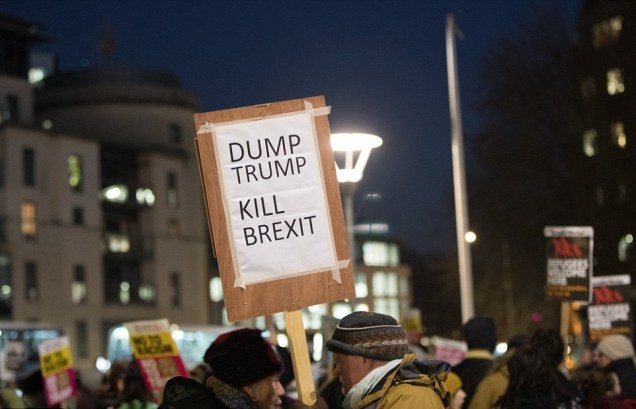
Protest Sign - Dump Trump Kill Brexit

The good aspects of this populist insurgency need saving from horrified (and increasingly organized) antidemocratic elites – but also from cynical and incompetent populist leaders who are squandering our last best hope of democratic renewal

I have struggled of late to bring myself to write much about politics. The temptation to offer the odd hot take on Twitter can never be fully avoided, but while I usually find myself with enough time to write only one of every five articles which pop into my mind, these past months I have struggled to generate more than a couple of vaguely original ideas or pieces of commentary in the space of a month.

The reason, I have come to realise, is that for all the furious words being written and opinions expressed, nothing much seems to be changing. Despite a political discourse which has rarely been more shrill, with unbridled hysteria on both sides and nearly every aspect of life being sucked into the black, inescapable vortex that is our ongoing culture war, neither side is making definitive progress. As at the Western Front in 1915, both sides have dug into hardened positions in anticipation of a long, drawn-out stalemate. Both sides double down on their dogma and rhetoric, both sides continue to defend or even embrace the worst elements of their own cause because the enemy does likewise with his; both dehumanise one another and suggest that what was once seen as sincere and legitimate political difference is now irrefutable evidence of moral turpitude.

Both sides feel that they are losing an existential fight; both feel under attack and in retreat. On a superficial level, the progressive left (and here I use the term to describe those who broadly hold socially liberal, secular, intersectional, economically redistributive and de facto open borders political views) have more cause to be alarmed – after all, they have to deal with what they see as the “twin disasters” of Donald Trump in the United States and Brexit in the United Kingdom, as well as rising populism throughout Europe and much of the world.

However, as someone who fits into neither the populist or elitist category but perhaps has greater sympathy for the former, I see only danger, risk and oncoming ruin for the populists. My gnawing fear is that an increasingly inept Trump administration which fails to deliver on even his more decent campaign promises and a botched Brexit leading to economic damage and future ongoing “vassal state” status within an unreformed European regulatory ecosystem may come to represent the dismal high water mark of populist achievement. Such has been establishment shock at the political success of the populists, such is their determination to wrest back control and such is their domination of the main levers of influence and power (media, business and culture) that it is those gathered under the banner of unaccountable supranational and technocratic government who now march with a spring in their step, and those who believe in the nation state, democracy and self-determination who find ourselves endlessly on the defensive.

All of which might not be so bad if the temporarily-displaced elites had learned anything meaningful from their electoral rebukes, engaged in some introspection and returned chastened and humble, with a newfound willingness to consult and be guided by the people they lead rather than continuing to implement their own highly Utopian vision of the future with no consultation or consent. But of course there has been no such introspection, and there is precious little humility to be found among those who lost control of the political narrative in 2016.

President Trump is bad, but the people whose self-serving incompetence in government gave us President Trump in the first place are still very much present, unrepentant and with their credibility intact. Brexit negotiations may be lurching toward disaster, but the people whose uninspired leadership and scant regard for democracy helped give us Brexit in the first place soldier on with reputations intact, peddling the myth that everything was fine before the EU referendum came along, and that Brexit can be thwarted with no adverse societal consequences.

If the people who believe they are morally and intellectually better than Donald Trump voters and Brexiteers want to win, they need to do more than stand laughing or indignant at the sidelines as the worst elements of these camps drive their populist train off the rails; they need to actively come up with something more attractive; a unifying, compelling national vision which amounts to something more than just rolling the clock back to the day before the EU referendum or US presidential election. But instead we see little other than smug self-satisfaction and blind hatred of (or contempt for) those who took the populist side, born of the delusion that populist incompetence in government somehow discredits their basic cause, and that political elites can therefore press on with their own discredited and failed agenda without incurring any negative consequences.

But the populists are by no means innocent. It is very easy to strike a trendy rhetorical pose against unloved ideas and institutions, but much harder to grapple with cold hard reality and propose policy changes which respect democratic input while also standing a chance of lasting success in the real world. One of the hardest things in recent months has been witnessing thinkers, writers and organisations I once broadly respected choosing the path of least resistance, playing to their respective galleries and choosing outraged purity over sullying themselves with necessary compromise.

Thus we see this year’s Orwell Prize for journalism awarded to someone who sniffs out and extrapolates wrongdoing in the EU referendum Leave campaign to the delight of her establishment audience, but shows zero curiosity about malfeasance in the Remain campaign (or the relative impact of each). And thus we are subjected to otherwise-compelling contrarians like Brendan O’Neill of Spiked magazine actively harming the cause of Brexit by ignoring all nuance when it comes to the trade and regulatory relationships under discussion, turning the most momentous issue to face Britain in decades into just another facet of the culture war.

It must be easy to write when possessed of great certainty that one is indisputably morally superior and on the “right” side of history (or at least that one’s actions and side will be recorded as being on the right side of history). I often envy the leftist, identity politics-soaked social justice warriors and their enablers within the political class for possessing such fervor. It is much harder to write day after day when one fears that one’s side will ultimately lose, and that one will be remembered as a cranky obstacle to glorious progress at best, and as something akin to a Jim Crow segregationist at worst. Every tweet or blog post them becomes not a small brick in the foundation of some glorious building for which one can claim partial credit, but rather just another nail in the coffin of one’s own future reputation and ultimate legacy.

And right now, I think the chances of defeat for conservatives, traditionalists, democrats and nation state defenders are very high indeed. In Britain, the UK government’s mishandling of Brexit and the atrophy of our self-governance capability may yet vindicate every hysterical warning about the folly of leaving the European Union’s unwanted, antidemocratic political-union-by-stealth. In the United States, President Donald Trump’s impulsive, often proudly ignorant or counterproductive policies and bigoted rhetoric tarnish the valid causes he supports (like greater immigration control) by mere association, rendering them toxic, while the reputations of some truly awful people are laundered thanks to their cynically ostentatious opposition to Trump.

In all of this, the media is firmly planted on one side, unable to report objectively on issues of concern to so-called populists by virtue of having so few reporters and editors drawn from the relevant social and demographic circles. And virtually every element of our culture, from classical and pop music to television and even corporate culture, are marching to the beat of divisive, intersectional identity politics with its avant garde gender theory and disdain for those institutions which are the bedrock of a stable society. In such circumstances it is small comfort to be right when one’s own side stands on the verge of total defeat.

And yet it is not in my nature to bow down before these forces and declare “I, for one, welcome our new antidemocratic, technocratic, authoritarian and coercive SJW overlords”. I don’t welcome them. Even if things go as badly as in my most pessimistic moments I fear they may, I believe it is still important to stand up and argue in the public square, register dissent, bear witness to what is happening and force the progressive side to defend their ideas on logic and merit rather than wallow endlessly in their feelings.

Conservatives and true liberal democrats, people who believe in government of the people and the right to freedom of speech and thought, should be under no illusion at this time – we are losing the decisive battle. A few standout conservative podcasts, YouTubers and bloggers are no match when the other side has a vice-like grip on the entire culture and is snarlingly intolerant of the slightest dissent to the extent that they willingly throw their own leaders and figureheads under the bus for thoughtcrime infractions.

I hope that this defeat can be reversed, but doing so will require millions of people who currently sit at home quietly shaking their heads at what our political elites and culture-makers are doing but otherwise raising no public objection to stand up and be counted – and quite likely incur social or economic cost – which they have not been called upon to do before.

I have just started reading “The Benedict Option“, a book by an American Christian conservative blogger I much admire, Rod Dreher. The book is a warning to Christians (particularly aimed at but by no means limited to traditionalists) that the demands of their faith and those of our culture and “polite society” are drifting decisively and definitively apart, and that the time may soon come when faithful Christians are forced to choose between practising their faith according to their conscience and maintaining their current social and economic standing.

I see a similar fork in the road coming the way of all conservatives and moderates, religious or not – indeed, anyone who is not a staunchly progressive social justice warrior or otherwise happy to accede to that particular worldview. Already we see businesses and charities seeking to adopt progressive positions on social issues as corporate policy, mandating speech and behavior which would force employees and volunteers to violate their own beliefs or else face disciplinary action. Already we see censorious activist mobs seek to dictate where private companies advertise or sell their product. And already, dissenters are paying the price when they stand up and refuse to go along with these coercive demands.

In a few weeks I shall matriculate at law school in Washington, D.C., where I will spend the next three years earning my law degree. Being on an American university campus, it would be infinitely easier – professionally, socially and otherwise – for me to simply delete my blog and Twitter account, and pretend to anyone who asks (and it will certainly come up; already I have had to give notice of my “preferred pronouns”) that I hold the standard suite of progressive leftist political views which are almost de rigeur for students and within the legal profession. But that would be a lie, and I will not do so. Will professing my religious and political beliefs cost me potential friendships and career opportunities? I would be naive if I thought otherwise. Will I find my own free speech threatened or stifled at times? Quite possibly – I have spent three years documenting on this blog what happens to free speech advocates and identity politics heretics on American college campuses, and it is often not pretty. But so be it.

And so even if it brings less joy than it once did, I will keep writing, speaking and standing up for both the expression and validity of traditional, time-proven values and honest political opinions which were considered perfectly mainstream just a few years ago, but which are even now being recast as fundamentally hateful and ignorant by zealots who would reshape the world with their uniquely totalitarian conception of tolerance.

We all have a duty to take a stand, and this is what I shall do, from my own very marginal and unscrutinized place in history. I encourage others to undertake a brief personal inventory and consider whether there is more that you could do at this juncture with your own time, talents and resources. Because right now, we are losing the war. Worse still, some of the gravest long-term threats we face come from the supposed leaders of our cause, and too few of us are willing to admit this painful truth.

Help is not going to come from outside; we go to battle with who and what we have at hand. Unlike the people who melt down over a presidential tweet or democratic referendum, or who cynically downplay their own immense power and privilege to cast themselves as latter-day victims, it is we who are engaged in the real resistance of our time.

The Resistance - Clenched fist protest - US flag

Support Semi-Partisan Politics with a one-time or recurring donation:

Agree with this article? Violently disagree? Scroll down to leave a comment.

Follow Semi-Partisan Politics on TwitterFacebook and Medium.

For A Proud New Immigrant, Independence Day Offers Much To Celebrate

City of McAllen Texas - 90th annual Independence Day celebration - presented by HEB

Some reflections on my first Fourth of July spent as a permanent resident of the United States of America

Today I spent my first Fourth of July, my first Independence Day, as a permanent resident of the United States of America. After receiving my long-awaited US green card I finally came to call America my home when I landed in Los Angeles on 25th May, and since that time have been staying with my wife’s family in the Rio Grande Valley of Texas while I wait for law school to begin in September. So now here I am, a British expat living in America on the day when everyone around me celebrates casting off the yoke of the British Crown.

We live in a time when it is fashionable (among some circles) to imagine that immigrants in general are persecuted and threatened to an unprecedented degree – largely thanks to a deliberate, concerted effort by many politicians and journalists to erase any distinction between legal and illegal immigrants, economic migrants and refugees, otherwise law-abiding illegal aliens and determined criminals. And spurred on by this delusion, many American politicians, particularly those of the Left, are presently burnishing their reputations (or in some cases their presidential aspirations) by claiming to speak for me and others who, like me, were not born in the United States.

From these liberal saviors, I learn that I am presently under attack; that I apparently feel despised, devalued, belittled and threatened, both by the elected head of state, those who support him and indeed anyone who does not support tearing down the entire immigration system and even the concept of national borders itself. All this I must feel deep in my subconscious, because as a mixed-race man who has travelled through some thirteen of these United States (many of them staunchly Republican states in the Midwest) I have known nothing but friendliness and an abiding, sometimes overwhelming hospitality. But clearly the liberal saviors know best, and in reality I live my life in permanent fear of verbal abuse, physical assault or deportation, even though I don’t realise it.

My point is not to relitigate the immigration debate here, or to point out the calculated cynicism of portraying arguably overzealous action against illegal immigrants as some kind of assault on all immigrants or a betrayal of America’s founding values. I write these words simply to put on record that I and millions of my fellow immigrants seek to make our home in the United States (legally or illegally) because we believe this to be a good country and a shining city on a hill, not the newly-opened fascist hellmouth which many decent Americans have been wrongly deceived into viewing their own country.

One thing which conservatives seem to “get” instinctively while those on the Left struggle to understand is that America is and always has been greater than the sum of her contemporary government. We see the same phenomenon in my native Britain, where many on the Left denigrate their homeland endlessly and are confounded that anyone might admire the United Kingdom, simply because they themselves take exception to the present Conservative government, or to the 2016 referendum’s decision to leave the European Union. And here in America I hear from many people, including some of my own left-leaning friends, that they see little good about the United States at present. When attempting to justify this statement, most point to the Trump administration’s perceived treatment of minorities and immigrants. More than one have confessed to me that they feel unable to celebrate their country’s Independence Day as a consequence.

To them and all those who feel similarly, I can only say: not in my name. Do not think less of your country or refuse to celebrate her independence thinking that you are acting in solidarity with me or any other immigrant, legal or illegal. We choose to come to this country believing it to be inherently good, not fundamentally bad. Ignore the buzzword-laden screeds of academics and activists steeped in toxic and divisive identity politics, who never tire of claiming that contemporary America is built on white supremacy and that systemic racism is a feature, not a bug, in this country’s basic source code. They could not be more wrong.

We immigrants understand that America is flawed like every other country, but is also a work in progress toward a noble goal which few other countries even bother to write down and set as a target, let alone strive to achieve – the creation of a country whose government is predicated on the belief that all men are created equal, and free. We immigrants understand that perhaps unique among nations, America is rooted in an idea, not an ethnicity or landmass, and that this idea will persevere and survive a demagogic authoritarian president just as it has survived the suave technocrats and neoconservative nation-builders who came before.

For the record: I opposed Donald Trump during his presidential campaign and have long realised the danger posed by an authoritarian executive branch aided by a supine Republican Congress. These dangers are not to be underestimated, and indeed are the very reason why the Founding Fathers sought to build separation of powers and the checks and balances of strong, rival institutions into the fabric of American government. I am also on record opposing Donald Trump’s often racism-tinged rhetoric, his grievous temperamental flaws and the harsh manner of his administration’s crackdown on illegal immigration and asylum processing. I have frequently written that at a time when advanced Western countries must adapt to the future, a leader who explicitly promises to make America great *again* and roll the clock back economically is a huge step in the wrong direction. Indeed, there are few people I would want to see in the Oval Office less than Donald J. Trump.

And yet here I am, a newly-minted green card holder and immigrant to the United States, because I know that this country is far bigger than the shrinking moral and intellectual footprint of the American presidency. I mourned Donald Trump’s election victory and fear for some of the near-term consequences of electing such a man as leader, but not for a second did I question my desire to emigrate and leave Britain, my beloved home, for the United States.

Shortly after having left London back in March, I wrote a piece attempting to explain why this is the case:

America may not be the country it once was in terms of the richness and profundity of its civic life (though this is not to dismiss the great and necessary advances in civil rights and equality) since many of its greatest thinkers left the stage, but it is a darn sight healthier than contemporary Britain.

Interventionism versus non-interventionism? That debate burns more brightly in America because it is the United States which must do the bulk of intervening in an age of parsimonious European retrenchment. Healthcare reform? The American system may exist primarily to make Britain’s NHS look good by comparison, but at least radical healthcare reform is possible in the United States, unlike Britain where NHS worship is a mandatory religion for those in power. Education? The federal system and greater role for local government in America means that far more experimentation with new policies and technologies can take place than in Britain, where “postcode lotteries” are feared and policy competition is severely limited. The benefits and costs of laissez-faire social liberalism? Nearly all of the most thoughtful writing can be found in American journals, not the incestuous British publications.

And in conclusion:

I will never stop following or writing about British politics, and this blog continues. Britain is my homeland, a place towards which I will always retain a deep attachment and where I will undoubtedly spend some future years raising a family – and indeed, one of the unique selling points of this blog – I hope – is my ability to provide a familiar Brit’s perspective on American politics and a (nearly) American perspective on British politics, which would make unplugging from the debate quite counterproductive to my work.

But since Britain has repeatedly shown itself to be disinterested in domestic or global leadership of any kind, my focus will naturally gravitate more toward the politics of my new adopted home, a country which despite its many dysfunctions still retains that optimism and self-belief that matters debated and decisions made in America can shape the world for the better.

Coming from another economically advanced country, it was not the prospect of a higher standard of living which led me to America – it was the kaleidoscopic culture, the endless variety, the sheer vastness of geography and opportunity, the freedom and (as someone interested in public policy) the fact that ideas and policies debated in America still matter and have the potential to shape the world for the better. How much more of an incentive is it then to come from a poorer country, where in addition to gaining the civil liberties and rights guaranteed under the Constitution one also stands to become immeasurably wealthier? And we immigrants are supposed to lose sight of these blessings and require additional support and encouragement because of an intemperate tweet or malicious statement from the temporary custodian of one of the three branches of American government?

I remember the interview for my green card at the US embassy in London like it was yesterday. Overprepared and unreasonably nervous, carrying far more supporting documentation and evidence than the already-onerous consular list required, I arrived early and sat on a park bench with my rosary in hand, under the statue of President Eisenhower, waiting to be admitted to the stentorious Eero Saarinen-designed embassy building (now replaced with a nondescript glass cube south of the River Thames). After a short wait I was called to hand in my documents, have my fingerprints taken and pay the remaining (significant) fees which legal immigrants are required to pay, and then waited again for the interview itself. The interview took place at a counter window much like a bank, and was over within five minutes and the answering of a few basic questions. I seem to remember asking the consular officer more than once to confirm that my application had been approved after he told me that I was “good to go”, so elated was I to be in possession of the immigrant visa I have wanted for well over half my life.

Of course, going through the process also made me very aware that it is not so easy or straightforward for everyone who wants to come to the United States. I applied for and received my green card through marriage to a US citizen; others without existing family ties, capital to invest or lucrative high-skilled jobs lined up often find it much harder, even impossible, to immigrate legally. I have sympathy for many of those who come to the United States illegally or overstay their time-limited visas, and can certainly envision myself in a similar position were my own circumstances different. Furthermore, some people now in the United States illegally live lives of otherwise-model citizenship which put many natural-born Americans and legal immigrants to shame.

That being said, the rule of law must be defended if it is to have meaning and authority, and a nation without borders is no nation at all. Uncontrolled flows of human migration can be economically disruptive and culturally destabilising, and it is in no way extremist to point out that not everybody who wants to emigrate to America can be allowed to do so. I would love to see sensible immigration form enacted, with protected status given to the many millions presently here illegally (all of whom cannot be deported without enormous economic damage and social unrest) in exchange for serious improvements in border security and enforcement, and a genuine effort to have a democratically responsive immigration policy reflective of the balance of public opinion. I abhor the ideologues on both sides, the open borders fanatics who seem to be taking over the Democratic Party and the unrealistic zero-tolerance hardline conservatives who scupper any effort at compromise.

To those who see the election of Donald Trump as some kind of negative turning point in America’s attitude toward immigration or immigrants, I would counsel that this belief stems largely from the arrogance of having assumed that there was a prior consensus when in reality there were a multitude of voices and opinions, ranging from genuine racists and xenophobes at one extreme through those opposed to uncontrolled mass immigration or those who simply believe that the rule of law and national borders ought to mean something in the reasonable center. One can perhaps argue that it is a shame that these more cautious or negative voices are now being heard and getting a hearing from the White House, but they are not new and they did not begin with Donald Trump. Opposition to illegal immigration is rooted in the successive failure of politicians to reform a broken immigration system – Donald Trump’s demagoguery on the subject is little more than the political cowardice and lack of ambition of past administrations personified.

Here in McAllen, Texas there are lessons to be learned for Trump supporters and devout open borders leftists alike. Here is a thriving town and region strongly shaped by immigration from Mexico and central Americas, which frequently displays the full richness of that cultural inheritance, but which at the same time remains resolutely and unashamedly American. Here you may well hear Mariachi music at Sunday Mass or read bilingual or Spanish language advertisements in the newspaper, hear Tejano music on the local radio or see clothes stores selling Quinceañera dresses, but the same people who consume these services also recite the Pledge of Allegiance at school, stand for the national anthem at sports games, serve in the US military or local police force and gather with family and friends to barbecue, watch fireworks and celebrate their country’s Independence Day.

In this town I have heard white girls singing along to Selena, watched people of all ethnicities gorge themselves on some of the best Tex-Mex and Mexican food to be had, and witnessed an elderly Hispanic veteran point to Donald Trump’s autobiography in the bargain bin at Sam’s Club and tell me with fervor in his voice that “this man is going to save America”. People do not fit into the neat, pure little categories created by the partisan extremists fuelling our ongoing, self-destructive culture war. America contains multitudes, and so do individual Americans.

These are not contradictions for most people here. The cognitive dissonance only exists for Trumpian hardliners who struggle to accept any Hispanic influence or cultural accommodation on the one hand, and open borders extremists who tend to hate the very idea of the nation state (or at least the United States) and who think that assimilation into the host culture is some kind of betrayal or prima facie evidence of white supremacist oppression. And on and on these two sides go, the ugly extremes dominating our politics and cultural discourse, while the broad mass of ordinary Americans simply want to get on with their lives.

I have spent this Fourth of July celebrating the independence of the country I now call home, and I have done so in a border town which is happy, prosperous and (from everything my inquisitive eye has observed) largely at ease with itself. Some 84 percent of McAllen’s residents have Hispanic or Latino heritage. Many on the progressive Left assume that all such people presently feel under siege with their American-ness called into question (or at least believe that such people should feel this way based on their own reaction to the Trump presidency), while some on the Trumpian Right would perhaps rather these people not be here at all. Yet here they are, getting on with their lives, attending the Fourth of July Parade and watching the municipal firework display. Here we all are, all of us legal immigrants, happy and grateful to be in this wonderful country, and in zero need of liberal saviors from the Democratic Party or anywhere else.

Many of us would rather that Donald Trump were not president, just as many natural-born Americans would doubtless also prefer. But none of the things which attracted us immigrants to this great land died when Donald Trump took the presidential oath of office, and with diligence and appropriately deployed Constitutional checks on executive power, all of those wonderful blessings will remain when President Trump’s successor eventually takes over.

If anywhere ought logically to be riven asunder by the Trump presidency, it would be border towns like McAllen, Texas. Yet it is not so – the town continues to prosper and people remain civil toward one another, as you would expect from well-raised Texans. The lesson I have learned from the past seven weeks living here is that we are nowhere near as divided as politicians and the agenda-driven media, with their cynical motivations, would have us believe. Partisan differences may be everything to politicians, television journalists and cable news talking heads, but they do not form an impermeable wall of cultural separation among the people in this town.

Yes, there is a culture war in progress with significant social stakes for both sides. Yes, Trump’s proposed border wall is incredibly unpopular here, and Texan Senator Ted Cruz was (with some justification) made to feel quite unpopular when he stopped in town for a rare campaign visit last Fourth of July. But if it was his goal, Donald Trump has not yet succeeded in bringing about a dystopian future where brown-skinned, Latino heritage or immigrant people feel generally unwelcome or less American. The divisive efforts of the Alt-Right and the Identity Politics Left, while dominating our cultural discourse, have not succeeded in driving people apart in communities like McAllen, Texas.

And this I find to be incredibly heartening. Today I witnessed a crowd of people which appeared to be majority Hispanic or Latino happily and proudly taking part in the town’s Fourth of July parade, celebrating their country as though it were the most natural and unremarkable thing in the world – which of course it is. I waited in line at the grocery store in front of a family who had immigrated from India and were buying patriotic cakes decorated with red, white and blue frosting. And my American family didn’t kick me out when I cheekily played “God Save the Queen” and King George III’s song “You’ll Be Back” (from the musical “Hamilton”) on my iPhone at our barbecue.

Lord knows that America has its flaws – every country does, most of them far graver than the problems which exist here. But while Donald Trump’s presidency is a justifiable concern for many people, America has not suddenly become newly hostile to immigrants. This country was built by immigrants, and many first and recent-generation immigrants number among its most engaged citizens and loyal defenders.

From Washington state and California through Colorado, Kansas, Arkansas, Oklahoma and Missouri to Illinois, Ohio and New York, I have seen the soul of the country I now call home, and here in Texas I have been carefully taking America’s pulse these past weeks. And I simply do not find the unwelcoming dystopian nightmare that many on the Left insist now prevails.

And so today I give heartfelt thanks for the United States of America and celebrate her independence, even if some pessimistic, misguided people who had the great fortune to be born and grow up with the great blessing of American citizenship sadly feel unable to join me.


US Flag - Fourth Of July Cake - Independence Day - Baking - Let Freedom Ring

Support Semi-Partisan Politics with a one-time or recurring donation:

Agree with this article? Violently disagree? Scroll down to leave a comment.

Follow Semi-Partisan Politics on TwitterFacebook and Medium.

Conservative Party Policy Renewal: 1000 Ways To Die Trying

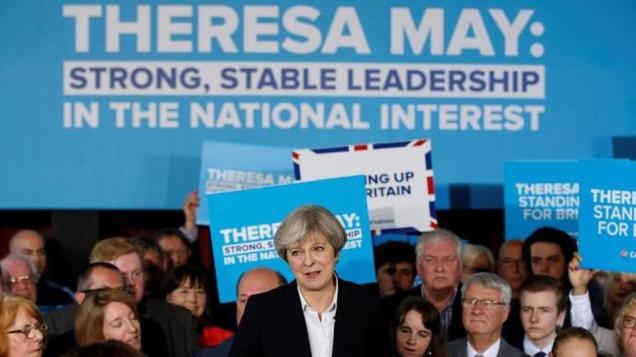
Conservative Party Tory policy renewal - Strong and stable leadership in the national interest - Theresa May 2

Rather than attempting to forge a compelling, coherent vision for Britain rooted in conservative values, our dithering Prime Minister is soliciting a thousand disjointed policy suggestions from every vested interest and armchair crank in the nation. This is not leadership.

Having been on the road since 14 March of this year, I confess that I presently find myself semi-detached from the day-to-day granular developments in British politics. I note the headlines and observe the main spectacles as they occur – this week it seems to be another Cabinet showdown about Brexit and the planned “Rite of Spring” style frenzied celebration of the NHS on its 70th birthday, complete with the worshipping of false idols at Westminster Abbey and perhaps enough human sacrifices to make even the mass murderers at Gosport Hospital seethe with envy – but otherwise have been forced to tune out the smaller procedural stories which, taken together, give the truest indication of where we are heading.

It is dispiriting, therefore, to tune back in this week and discover that the Conservative Party remains every bit as ideologically lost, rudderless and without leadership as it was when I flew from Heathrow Airport nearly four months ago, particularly since the fractious nature of British politics could see any more Tory missteps usher in a Corbynite Labour government and a chaotic, uncontrolled Brexit – two economic calamities both alike in indignity, one slow-burning and the other all too immediate.

At this point, I can scarcely bring myself to repeat the warnings that this blog has been making with increasing alarm (and clarity) for the past six years – that chasing Labour to the left and disowning/apologising for small government conservative principles is political folly, and that the period of discontinuity in which we now find ourselves – where the old political settlement neither adequately addresses our contemporary problems nor commands widespread public support – requires coherent vision and ambitious policymaking from our political elites, not more of the same old demos-phobic technocracy.

At this point I have warned of the urgent need for new Conservative policymaking which neither seeks to mimic statist Labour paternalism or reheat individualist 1980s Thatcherism, and have cheered on those few brave efforts to seed the Tory Party with new ideas – most notably George Freeman MP’s “Big Tent” initiative.

But it has become increasingly clear to me that the Conservative Party cannot save itself, that much of the heavy lifting will have to be done by people not beholden to the existing party power structure (and quite possibly outside of politics altogether), just as it took external voices to commandeer a 1970s Tory Party still stubbornly clinging to a failed socialist post-war settlement. Unfortunately, it has also become equally clear that the required external voices are not at all welcome, that “conservative reform” is seen by those in power as little more than a cosmetic exercise whereby people within the existing Tory ecosystem sit around reciting platitudes at one another.

Until this week. Now, it seems, Theresa May has decided to go in an altogether different direction. From the Telegraph:

Theresa May has launched an appeal for MPs, peers and party members to submit 1,000 policy ideas to form the basis of the Conservative party’s bid to win the next general election.

The Prime Minister has announced she has set up a new Conservative Policy Commission in the biggest overhaul of the party’s policy thinking in more than a decade, personally appealing to Brexit voters in particular to offer up their own ideas.

The new Commission, chaired by Chris Skidmore MP, has been charged with developing the ideas in time for the Tory party conference next year.

The next general election is expected in 2022 but the relatively short timetable means Mrs May will be presented with a ready-made policy platform if she chooses to call an early election in the months after Britain quits the European Union next year.

So from having almost taken a perverse pride in her government’s lack of direction or urgency for change, Theresa May is now seeking the oddly specific number of 1000 new policy ideas, even deigning to consider contributions from (relatively) ordinary people.

And how is this new Policy Commission intended to work?

Each task force will be asked to answer 20 policy questions set by Mr Skidmore with 10 separate policy ideas, to give the party 1,000 new ideas for consideration in the final policy report.

[..] Evidence will be gathered at meetings in towns and cities in every region around the country, with an interim report ready for summer next year and the final document published at the party’s 2019 conference.

The long-sickening optimist within me would like to think that some good might emerge from this exercise, even though a policy review seeking only answers to highly specific, pre-ordained questions is unlikely to produce many truly radical or disruptive ideas. However, the realist within me – whose low expectations have been repeatedly vindicated – suspects that this is nothing more than a Tony Blair-style cosmetic New Labour performance spectacle, that the task forces themselves will somehow end up stuffed full of the same Westminster bubble-dwellers you always see at London think tank events, and that if any genuinely bold policy emerges from the mess it will be met with polite interest and then disappeared down the memory hole.

But worse than that, by announcing this initiative Theresa May is veering from one extreme to another – from having solicited policy and strategic advice from only a small and insular circle of loyal sycophants to encouraging everyone in the land to start shouting ideas or promoting their personal pet projects at the same time. Rather than stepping back and attempting to forge a compelling, coherent vision for Britain rooted in conservative values, our dithering Prime Minister is now soliciting disjointed contributions from every vested interest and armchair crank in the nation. This is not leadership.

Back in November of 2017 I attempted to outline the approach which a Conservative government should be taking toward necessary policy renewal, beginning by quoting the influential 1977 Stepping Stones Report:

We must know what a Tory government will have to achieve, before thinking about the way in which it must win office, because simply “winning a majority” on the wrong terms may not give it the authority it needs for success.

In normal times a majority is enough. The task of government is to steer a basically healthy socio-economic system past hazards which are primarily external, while ensuring that the system’s fabric is maintained and making improvements to it here and there.

But once the system itself starts to show signs of fatigue, instability, disintegration, then we start to talk of discontinuity. In discontinuity, solutions can only be found by breaking constraints which we had assumed were unbreakable. It is not enough to settle for policies which cannot save us, on the grounds that they are the only ones which are politically possible or administratively convenient.

I then laid out a case arguing that we find ourselves in a similar moment of political discontinuity today, with new challenges producing the same frustrations and political sclerosis we witnessed during the national decline of the 1970s. For all his flaws, Jeremy Corbyn recognises that we are in a period of discontinuity and is promoting radical left-wing policies in tune with the moment. By contrast, the Conservatives seem terrified to articulate any kind of bold vision at all, and risk being correctly perceived as the party of the status quo.

Hence my final recommendation:

We need a new Stepping Stones Report for our times. We need a comprehensive and dispassionate analysis of the problems we face as a country, and understand where and how they are linked together. Having diagnosed these problems (which in the case of many politicians many involve some painful introspection) we must decide where we want to go as a country – what we realistically want Brexit Britain to look like in 2020, 2025, 2030 and beyond – and then devise a programme of mutually supporting, politically feasible policies to get us there, and a way of framing and communicating this programme that can unite a sufficient amount of our fractured country to earn an electoral mandate.

It may be noted that many of the issues we face today – globalisation, automation, migration, terrorism – span national borders and can not be solved by any one country alone. This is not a concession to angry Remainers who naively view the European Union as the ultimate platform for all international cooperation, but it is a statement of fact. This means that for the first time in decades – since the Second World War, really – Britain must lift its eyes above our own domestic concerns and seek to use our position on the world stage to promote and coordinate the adoption of the new solutions we devise. Having voted for Brexit and upended our politics, embracing the discontinuity which most other countries still ignore, we are the canaries in the coal mine and other nations will look to us to see how they might navigate the same issues. For once, rather than lowering our national ambitions and ducking a challenge we must rise to the occasion.

I still believe that this idea, or some variant of it, is the only surefire way for Britain to identify, acknowledge and overcome our present challenges. In principle, a Conservative Policy Commission could be a good idea, particularly one which pays particular attention to the aspirations and concerns of those areas of the country which voted to leave the European Union. But demanding 1000 fresh ideas and then frantically sorting through them, trying to weld together a new draft manifesto in time for the 2019 Tory party conference, is not going to result in anything coherent or sufficiently inspirational to make people positively want to vote Conservative. At best it looks gimmicky, and at worst it serves as a Trojan horse for multitudes of self-serving vested interest policy to find an unwitting champion in government.

Put simply, you cannot solicit 1000 random ideas and successfully pick through them in order to arrive at a compelling programme for government. What’s needed is an earnest attempt to identify, describe and measure the challenges, threats and opportunities facing Britain – be it automation, outsourcing, migration, productivity, education or national security – and then identify the linkages and interdependencies between them. Only on the strength of this bedrock of analysis can new policy ideas be properly evaluated to determine whether they are both politically feasible and adequate to the challenge at hand.

Any such approach would require something between the traditional insular elitism of the political class and the slap-happy populism of Theresa May’s latest initiative, inviting unfiltered ideas without any clear basis on which to evaluate them. Strong government involves making trade-offs and necessary compromises in pursuit of a greater good; Theresa May’s proposed policy commission risks being nothing more than retail politics at its worst, promising all things to all people and disappointing everybody in the process.

I wish that things looked more optimistic for the Conservative Party and for the country, but from my current perch here in the Rio Grande Valley of Texas, I see only a weak and dithering prime minister who thinks that conservative policy renewal is little more than a cosmetic exercise, or even worse, a political game to be played. All those Conservative activists working diligently to come up with new ideas are not well served by a CCHQ and leadership which bypasses their efforts and seeks an arbitrary 1000 new ideas simply because someone in 10 Downing Street thought that it would make a good headline.

Here in the United States, Hillary Clinton lost the presidential election to Donald Trump in part because her campaign was never able to satisfactorily or compellingly explain why she wanted to be president beyond the personal satisfaction of having her hands on the levers of power. In Britain, the Conservative Party has been in power for the better part of a decade, most of it without offering voters any kind of positive vision (let alone a granular strategy) for strengthening the country. With Jeremy Corbyn now offering a clear contrast and a very different vision for Britain, the Tories no longer have the luxury of being dull, dismal and technocratic.

Neither the Conservative Party nor the country needs 1000 wacky new policy ideas at this difficult juncture, or any other quick-fix solution proposed by Theresa May. Right now we simply need one leadership-supported policy renewal initiative which might plausibly deserve to be called “strategic”, and a leader who aspires to something more than just remaining in office.

This really shouldn’t be asking too much. At one time, strategic thinking and purposeful leadership were baseline expectations, not wistful pipe-dreams. We have fallen a long way in a relatively short span of time.

I close with this pertinent warning from the Stepping Stones report:

In discontinuity, conventional wisdom cannot get us out of the problems. Indeed, innovation is almost certainly the best way through discontinuity. Almost any vision, any programme, is better than confusion and uncertainty, for it can at least be modified in the light of experience, once it has broken the paralysing spell of past failure and present pessimism.

Conservative Party Logo - Torch Liberty - Tree

Support Semi-Partisan Politics with a one-time or recurring donation:

Agree with this article? Violently disagree? Scroll down to leave a comment.

Follow Semi-Partisan Politics on TwitterFacebook and Medium.