Separate But Equal, Part 1

Instituting a new series to examine disturbing cases of deliberate self-segregation of “marginalised” communities carried out in the name of social justice

Forget “the only gay in the village” – Manchester City Council is putting forward plans for a majority-LGBT housing community for people aged over 50. In this socially engineered ghetto, eligibility to live would depend not on one’s ability to afford the rent but one’s ability to satisfy the diversity checklist of a local government busybody.

Once again, the best intentions of the social justice community result in the most extreme and counterproductive of solutions.

From the Guardian’s report:

Manchester city council has announced plans to create the UK’s first retirement community aimed at lesbian, gay, bisexual and transgender people.

According to the local authority, the city is home to the country’s largest number of LGBT people outside of London and is due to see a rapid growth in the number of LGBT residents over 65 in the next two decades. More than 7,000 over-50s living in Manchester identify as LGBT.

A recent report by the Manchester-based LGBT Foundation, commissioned by the council, revealed that older LGBT people experience higher levels of loneliness and isolation.

Many were fearful of discrimination in existing accommodation and there was a desire for affordable LGBT-specific housing where people could be open about their identity in later life.

The extra care scheme – a targeted development for older people – will house a minimum of 51% LGBT residents, but heterosexual people will also be welcome to apply to live in the accommodation.

The housing will have specially trained staff based on site and pets will be welcome. As well as the LGBT Foundation, the project is being supported by Stonewall Housing and the Homes and Communities Agency.

As one sceptical interviewee in the BBC report wisely asks:

The issue we are going to come up against along the way is that we’ve fought for equality. Do we need a separate space?

Quite.

Of course, the gimlet-eyed do-gooder at Manchester City Council responds, patronisingly:

It’s not necessarily about ghettoising particular communities. It’s offering people who want it that opportunity to spend their time with people who they know will understand them.

Ah well, that’s fine then. If people want to withdraw from wider society into strongholds (weakholds?) where fragility is pandered to rather than resilience developed, of course it is the sacred and noble duty of local government to assist them in their folly at every turn. Who are the guardians of the public purse to question the latest social justice orthodoxy?

Some may say that this is a local decision for local communities, and ask what standing a writer from London possibly has to weigh in on a decision made by Manchester City Council? And I would be amendable to that argument if it were actually the people of Manchester on the hook for this experiment in social divisiveness. But of course they are not.

In overcentralised Britain, the dominant single source of local authority funds – 40% in the case of Manchester – are disbursed by central government after having been raised through general national taxation. And besides the obvious social folly inherent in creating fragile, unresilient and homogenous minority communities in the name of social justice, the fact that all British taxpayers are funding this folly makes it directly my concern, and that of everyone else.

If a private developer wants to create an ethnically, gender or sexuality-based homogeneous environment for private tenants or homebuyers then that is a separate discussion fraught with its own parallel legal questions about discrimination and equality. But in the case of a public initiative and social housing, the government has absolutely no business discriminating along these lines, setting quotas or engaging in any other form of naked social engineering.

We should not be unsympathetic to some of the stories of older LGBT people featured in the BBC News report – being ostracised by friends and family of one’s own generation after coming out must be incredibly hard, particularly in older age. But it should be for institutions of civil society to step in to address these real social problems, and we must get out of the habit of immediately pivoting to local and national government for a solution to each and every problem – especially where the mitigation involves the use of general taxpayer funds.

Heavy-handed governmental interventions such as this only serve to crowd out independent solutions from civil society, and reinforce the expectation that government must play an active, watchful part in nearly every area of our lives. And no matter how well-intentioned individual schemes may be, British taxpayers should not be left on the hook for implementing a social justice revolution in Manchester or anywhere else.


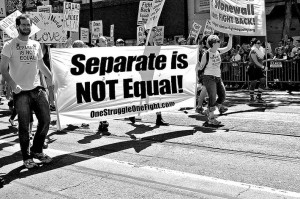
Separate is NOT equal - Stonewall - segregation - LGBT

Support Semi-Partisan Politics with a one-time or recurring donation:

Agree with this article? Violently disagree? Scroll down to leave a comment.

Follow Semi-Partisan Politics on TwitterFacebook and Medium.

Andrew Sullivan On The Importance Of Rediscovering Healthy Patriotism

donald-trump-make-america-great-again-patriotism-nationalism

To move beyond Trumpism, Democrats (and forward-thinking conservatives) must look to embrace a healthy and inclusive patriotism, and end their love affair with a cold form of globalism which undermines nation states, communities and livelihoods

Andrew Sullivan remains my blogging hero and inspiration, but I must confess that until very recently I have not greatly enjoyed his recent return to semi-regular online writing for New York Magazine. The thinking and prose is generally as fine as ever, but Sullivan’s excessive hysteria (not to say that real concern is unwarranted) in the face of Donald Trump’s election victory and the start of his presidency has been offputting, as has his continued slow drift away from conservatism and overly-enthusiastic embrace of Hillary Clinton during the 2016 election campaign.

That being said, last week’s Interesting Times column/diary is vintage Sullivan – beautifully poetic, well argued and undeniably valid.

Sullivan writes of globalisation and urbanisation’s losers, and in praise of patriotism:

I’ve always been unusually attached to places. It’s one reason I still call myself a conservative. Travel doesn’t attract me. I’ve now lived in the same loft in D.C. since I bought it, in 1991 (apart from an ill-fated year and a half in New York City); I’ve spent 20 consecutive summers in the same little town at the end of Cape Cod, and have no desire to go anyplace else. Even when I go home to England, I tend to spend around half my time near where I grew up.

I wouldn’t go so far as Malcolm Muggeridge, who famously said: “Travel, of course, narrows the mind.” (Don’t you love that “of course”?) But I would say that the reverse can also be true. Staying put allows you to really get to know a place deeply at different times and in different seasons, to capture, often serendipitously, a small detail you’d never seen before, or arrive at a street corner and suddenly remember that this was where you first met an old friend.

But staying home brings grief with it as well. Everything changes, and when your beloved tree at the end of the street is cut down, or a new Safeway replaces the corner baker, or, more fatally, the factory that used to be the linchpin of the place lies empty and crumbling, it stings and wounds and demoralizes. When I’ve visited my own hometown in England, so much is the same. And yet, on closer inspection, many of the once-vibrant shops are selling secondhand clothes, or given over to real estate offices. My old church has a broken window where the rain comes in. The services have dwindled to near nothing. Maybe it’s being away for so long, but it seems familiar and yet a little empty, as if something in it has somehow died, a continuity somehow lost.

And more and more, I suspect, the shifting winds of this merciless global economy and the impact of mass migration are bringing about similar changes all over the West. This beautiful but deeply sad story about how a provincial town in France has slowly died — as its young people flocked to cities, as its shops were supplanted by a supermarket, says a lot about the moment we are in: “Down another street is the last toy store, now closed, and around a corner is the last independent grocery store, also shuttered. Walk down the empty, narrow streets on some nights and the silence is so complete that you can hear your footsteps on the stones.” The town, Albi, is not alone.

In America, as Charles Murray has shown in his extraordinary book, Coming Apart, the young and the smart and the talented — the people who would once have formed the core of these small towns — have long since fled to distant colleges and cities. They don’t come back. They would once have been the police chief or the town librarian or the school principal. They once helped make the town a well-run place with a clear identity, where the same families and networks lived together, died together, belonged together. These connections have attenuated … as economics supplants culture, as efficiency erases the individuality of inefficient places, as Amazon rips the heart out of shopping districts, as the smartphone removes us from physical space, and as many more immigrants and their culture alter the feel of a place in ways that disorient those with memories and loyalties.

I don’t think we can understand the politics of this moment — Brexit, Trump, Le Pen — without noticing this abiding sense of loss. The middling city and small town are going the way of the middle class. Patterns of farming in rural America are being devastated. I loved this English farmer’s account of the changes he is seeing: “The future we have been sold doesn’t work. Applying the principles of the factory floor to the natural world just doesn’t work. Farming is more than a business. Food is more than a commodity. Land is more than a mineral resource.”

Jobs are vital not simply because of money — but because they give lives meaning, a meaning that now seems so remote people medicate themselves with opiates. People are grieving for a lost way of life. This is not racist or retrograde or even backward. It is, rather, deeply human. For it is in these places that a deeper identity forms, that Americanness, Britishness, la France profonde, endures. And what we’re seeing right now, across the developed world, is a bid to retain the meaning of a culture and a way of life in the headwinds of faceless, placeless economics.

And Sullivan’s conclusion:

Nationalism is one response. The answer to it is not globalism, which is as cold as it is remote, but patriotism, that love of country that does not require the loathing of other places or the scapegoating of minorities or a phobia of change, that confident identity that doesn’t seek to run away from the wider world but to engage it, while somehow staying recognizable across the generations. If the Democrats hope to come back, that patriotism is going to have to define them once again. But can they get past their racial and sexual and gender obsessions and reach for it?

This is the distilled question of our times.

The answer is not globalism – Sullivan is quite right. This does not mean a rejection of capitalism, globalisation and international free trade, on which our prosperity depends, but it does mean acknowledging that there are negative externalities to all of this aggregate economic progress. We accept that this is the case with the environment, and take measures to restrict environmental damage caused by economic activity, but until now governments have scarcely acknowledged the impact of globalisation on local communities, national identity and cohesiveness, let alone formulated meaningful ways to protect what we are unwilling to lose while still unleashing the best that globalisation has to offer.

This is a challenge – as I have repeatedly acknowledged on this blog – which falls hardest upon conservatives and small government advocates such as myself, who traditionally envisage a very limited role for the state in our lives. If corporations and cross-border economic activity create negative externalities as well as create wealth and material abundance, who if not the state will keep those externalities in check? Left-wing politicians can simply wave their hands and promise new economic programs to retrain workers or encourage labour mobility, inefficient or fruitless though they may ultimately prove to be. We on the Right have a more difficult job, relying as we prefer to do on individuals and the institutions of civil society.

And this is why Sullivan’s enthusiastic embrace of Hillary Clinton during the 2016 presidential campaign depressed me so. I also preferred Clinton to Trump because of the latter’s self-evident deficiencies in temperament, knowledge and ideological sincerity. But Sullivan was strongly for Clinton, and I found that fervour to be inexplicable. As Sullivan rightly notes in his latest column, the answer to nationalism is not more cold globalism. And yet that is precisely what Hillary Clinton and Democrats of her type offered. It is still all they offer – she who spoke openly of her desire for a borderless world where plane-hopping elites treated global megacities as their playground while the impoverished servant class were rooted to their dying towns.

Sullivan is quite right that patriotism – “that love of country that does not require the loathing of other places” – must be embraced again by all sides, not weaponised as a unique virtue by the Right or demonised as evidence of inherent racism by the Left. But right now we are moving away from that goal.

For as long as so many Republicans remain seemingly in lockstep with the Trump agenda, despite the president’s frequent deviations from conservative principle (let alone the normal standards of presidential decorum and basic decency), they effectively lend their tacit support to the administration’s more uncomfortably nationalist behaviour and rhetoric. And for so long as the Democrats and others on the Left choose to double down on their repellent formula of Maximal Globalism + Identity Politics, putting forward candidates like Hillary Clinton who are utterly incapable of speaking authentically to Middle America and the suffering working classes, their actions will continue to signal that they view rural and small town America as expendable so long as wealth and opportunity continue accruing to the urban, coastal elites.

For better or worse, the Republican Party seem to have made their choice. Though they may grumble about the ObamaCare repeal and replacement (or RyanCare, as some Trump loyalists insist on calling it) and some of the administration’s other ideas, it is hopeless to look to the GOP for an alternative to Trumpism so long as their man occupies the White House and they hold both houses of Congress.

That leaves it to the Democrats. The ideologically bankrupt, morally compromised Democrats, whose first response to a stunning repudiation by voters at the ballot box was to swiftly reconfirm all of the main architects of that defeat back into their gilded leadership positions, and who are too busy worshipping at the altar of identity politics to pay attention to the fears and aspirations of Trump’s America.

In short, embracing a healthy new sense of patriotism seems like a grand idea, and a necessary one – but Lord knows who in the American political and media class possesses the wisdom, foresight and bravery promote it.


US Flag - Fourth Of July Cake - Independence Day - Baking - Let Freedom Ring

Support Semi-Partisan Politics with a one-time or recurring donation:

Agree with this article? Violently disagree? Scroll down to leave a comment.

Follow Semi-Partisan Politics on TwitterFacebook and Medium.

Scottish Brexit Hysteria: Nicola Sturgeon’s Flawed IndyRef2 Argument

Scotland - European Union - Brexit - UK - Independence - IndyRef2

I begged once, back in 2014. I will not beg again.

Thus far I have refrained from commenting on Nicola Sturgeon’s tunnel-visioned decision to agitate for a re-run of the 2014 Scottish independence referendum following last year’s vote for Brexit.

Back then, I poured my heart into the pro-Union campaign because I strongly believe in our United Kingdom, and do not want to see what I believe to be one of the two greatest and most consequential countries on Earth torn apart unnecessarily to the diminution of all. My beliefs have not changed since then.

However, I do not intend to make another argument or write even one more article seeking to convince the Scottish people to realise the self-evident, inherent wisdom of remaining in our United Kingdom. As the 2014 campaign drew to a close, I quoted the peroration of President Abraham Lincoln’s famous first inaugural address, which sums up my feelings far better than I can put into my own words:

In your hands, my dissatisfied fellow-countrymen, and not in mine, is the momentous issue of civil war. The Government will not assail you. You can have no conflict without being yourselves the aggressors. You have no oath registered in heaven to destroy the Government, while I shall have the most solemn one to “preserve, protect, and defend it

I am loath to close. We are not enemies, but friends. We must not be enemies. Though passion may have strained it must not break our bonds of affection. The mystic chords of memory, stretching from every battlefield and patriot grave to every living heart and hearthstone all over this broad land, will yet swell the chorus of the Union, when again touched, as surely they will be, by the better angels of our nature.

Substitute “separation” for “civil war” and you have my distilled viewpoint on the matter of Scottish independence. But Scottish nationalism is a blind and unreasoning beast, appeals to logic and sentiment will get us nowhere, and we should recognise this fact. If one seriously believes that the Scottish people are being oppressed and having their democratic rights trampled by the Evil English, or that they somehow lack their due influence in our nation’s government despite enjoying political devolution and autonomy far greater than that enjoyed by the UK’s most populous home nation, then a sensible discussion cannot be had.

Neither am I willing to involve myself in another referendum campaign which will consist of those on the side of Scottish independence prancing around pretending that they are the sole custodians of compassion and progressivism (not that I claim the latter label for myself), and that the only thing preventing Scotland from becoming a modern-day socialist Utopia is the cold, dead hand of English conservatism. I will not buy into the pernicious myth that people’s hearts get a little bigger and their spirits more generous the moment they move north of Berwick-upon-Tweed. Scottish nationalists: try building that compassionate welfare state with a 15% annual government budget deficit and the economy-suffocating tax rises which would be required to close it, and then talk to me about compassion.

Nor am I willing to debate on the skewed terms of the Scottish National Party, which is an authoritarian, centralising machine (one fire and police service for an entire country, really?!) which would happily turn Scotland into an undemocratic one-party state under the cult of personality of Nicola Sturgeon or Alex Salmond given the opportunity. I will not debate further concessions or autonomy for Scotland when the SNP government refuses to avail itself of the fiscal autonomy which has already been granted, and when similarly populous English regions (like, say, Yorkshire) are equal in population but have a fraction of the voice, and yet bear this injustice with more stoicism than that of every last Scottish nationalist combined. The SNP does not debate or negotiate in good faith, as should be evident by the mere fact that we are even discussing a re-run of the independence referendum after the matter was supposedly settled for a generation.

All of that being said, and despite the known disingenuousness and bloody-mindedness of the SNP, I was rather surprised by Nicola Sturgeon’s widely reported public statements and recent series of tweets, which amount to nothing more than another hysterical hissy fit about Brexit coupled with an Olympian denial of reality – Trumpian “alternative facts”, if you will:

Sturgeon wants to hold another referendum when “the terms of Brexit [are] clear and before it is too late to choose an alternative path”. But it is clear to everyone with a functioning brain that there will be no alternative path. No matter how much the UK government screws up the negotiation and process of Brexit, there is no alternative for Scotland to remain an EU member. It has been stated and restated by one EU leader after another that there is no mechanism either for a region to remain part of the European Union when its parent member state secedes, or for a seceding region to claim automatic, continuous or even expedited EU membership on the basis of the former parent country’s membership.

One can argue about whether this is right or wrong – the political motivations behind it are quite clear, with certain other EU member states none too keen to give succour to restive independence movements in their own regions – but one thing a government should and cannot do is base its policy and public pronouncements on a denial of basic reality which can best be described as howl-at-the-moon stupid. If Scotland wants to be an “independent country” and an EU member (to the limited extent that the two overlap) then it must apply to rejoin the EU as a new entity from the outside, whereby its application will almost certainly be vetoed by Spain. Those are facts.

So what does Sturgeon mean when she says that the Scottish people must be free to pull the eject lever on the United Kingdom “before it is too late to choose an alternative path”? She is basically lying to her own citizens, pretending that the ejector-seat she is selling them is connected to a functioning parachute when in fact it is weighed down by the iron anvil of reality. And what is that awkward reality? The fact that voting to secede from the United Kingdom necessarily and automatically means that Scotland would find itself out of the UK and the EU, certainly for a long time and almost certainly forever.

Of course, many Scottish nationalists and their finger-wagging apologists in the rest of the UK love to argue that it is somehow ironic for pro-Brexit Unionists to warn Scotland of the dangers of finding itself locked outside of a larger political entity. These people think that they have hit on a clever, winning argument when in fact all they have done is reveal the paucity of their own understanding of patriotism and national identity, let alone why people voted for Brexit.

There never was (and likely never will be) a culture and common feeling of “European-ness” that outweighs British identity, and so it never made sense for such a powerful and dominant level of supranational government – one with determinedly expansionist, federal aspirations, no less – to sit over us in Brussels. There is, however, a strong sense of Britishness and shared British history, no matter what contemporary pundits say about the decline of Britishness and the rise of English nationalism.

If you doubt it, answer this one question: what was the name of the decisive Second World War air battle fought between July and October 1940? (Hint: even a post-patriotic millennial can tell you that it wasn’t the Battle of England, just as Pearl Harbor and 9/11 were attacks on the United States of America and not on Hawaii and New York respectively). Our sense of identity is overwhelmingly forged as a unified British entity (albeit one with proud constituent home nations), no matter what narratives of fracture that the pro-EU media class try to feed us. And so there is all the difference in the world between wanting to preserve the United Kingdom, to which most of us have at least some sentimental attachment, and wanting to free the United Kingdom from antidemocratic supranational European government which didn’t exist half a century ago and which most people barely comprehend.

Brexit, at its core, sought to return the highest and most consequential level of government to a polis with a commensurate sense of shared identity. If Scottish nationalists try to suggest that it is somehow hypocritical for Brexiteers to support the United Kingdom and warn of the cultural costs of separation then they either think that you are stupid or else are being catastrophically stupid themselves. Both options are equally plausible.

So by all means let Scotland hold another referendum, at the appropriate time. If they choose to defy the current polls and vote for true isolation on the world stage as a tiny country in poor fiscal health, determined to antagonise its larger neighbour, then that is their right. But they must do so only when the temper tantrum of their attempted divorce from the United Kingdom does not further imperil what is already a fraught and difficult Brexit negotiation for the rest of us.

Since Scotland is coming out of the European Union anyway (as even Nicola Sturgeon realises in her more lucid moments), it makes absolutely no sense for Scotland to pull the eject lever and jettison from the United Kingdom before the Brexit negotiations and process are complete. Sturgeon pretends that the referendum must be held virtually overnight, before it is “too late to choose an alternative”, but she is deliberately deceiving the people she represents. There will be no alternative other than the binary of life inside Brexit Britain or life as an independent country, whether the vote is held tomorrow or in 2025. All that holding IndyRef2 before Brexit is complete will accomplish is prioritising the vainglorious fantasy of Scottish nationalists over the UK government’s solemn responsibility (shoddily discharged thus far, admittedly) to secure the best deal and optimal future relations for our entire United Kingdom.

So go ahead, Scotland. Have your second referendum – at the appropriate time, once the United Kingdom you so despise has successfully finished negotiating its way through our present great national trial. I will not say a single further word to convince you to stay – the decision is yours, and if Project Fear worked back in 2014 then I can only hope that Project ‘Mystic Chords of Memory’ will ultimately do the job next time around.

So do what you will. But in 2014 you voted to remain part of the United Kingdom, and as a full and equal part of the UK you don’t now get to sabotage the Brexit process in pursuit of the SNP’s unachievable fantasy of leaping smoothly from our Union to that of Brussels.

 

Scotland UK Unity Rally Trafalgar Square London semipartisansam

Support Semi-Partisan Politics with a one-time or recurring donation:

Agree with this article? Violently disagree? Scroll down to leave a comment.

Follow Semi-Partisan Politics on TwitterFacebook and Medium.

Tales From The Safe Space, Part 51 – The Social Justice Movement’s Toxic, Self-Defeating ‘Call-Out Culture’

Call-out culture sucks sometimes - social justice - SJWs - identity politics

Self-awareness is a rare, endangered commodity within the Cult of Social Justice and Identity Politics

This blog has previously written about the ways in which the Cult of Social Justice and Identity Politics is a revolution determined to eat its own – see here, here, here, here, here, and (most recently) here.

Back in December I reported that there have been potential fleeting flashes of self-awareness from within the social justice community, as certain members – typically those who at one time found themselves persecuted and ostracised by their former comrades for having committed some minor act of thought crime – came to realise that the “call-out culture” within the social justice movement is doing far more harm than good.

Today there is another such spark of self-reflection in the pages of Everyday Feminism, as writer Lola Phoenix offers her tribe a few tentative suggestions as to how they might present a slightly less insufferable face to the outside world.

Of course, Phoenix’s testimonial begins with the now-familiar recitation of personal oppressions and “marginalised identities” to serve as mitigation for the harsh truths she is about to deliver:

Six months ago, I really got called out.

And by “called out,” I mean that the person had more interest in collecting me like I was garbage in a very public way and less interest in helping me understand where I was going wrong.

Hmm, sounds familiar.

Despite my willingness to apologize, to try and learn, their attitude pulled me back into that whirlwind of cognitive ability confusion. As a person on the autistic spectrum, I can’t count the amount of times I’ve been unsure of what I’ve done wrong and have tried to figure out what I did.

Blah blah, you get the idea. But pre-emptive excuses aside, Phoenix goes on to engage in some fairly accurate self-reflection:

We’re not robots, and when we learn we’ve been oppressive in some way, we’re going to have feelings about that. And sometimes that needs to be expressed, but – as of now – there’s no really appropriate place to do that.

As a white person, I’ve seen myself do this to other white people who haven’t learned better. When they exhibit the attitudes I once held, I become embarrassed, enraged at their ignorance, and treat them accordingly.

But we have to keep in mind that so many of us committed to social justice are living in a culture where we aren’t taught how to handle or process anger effectively, so it comes out in abusive ways even when we don’t mean it to.

More:

There is a “callout culture” where ally theatre happens and people enjoy “calling out,” naming, and shaming, witch hunting, and publicly humiliating people.

I’ve been on the receiving end of that.

I do think there’s a difference between confronting someone about their behavior versus humiliating them.

Wow. This is an astonishingly frank admission. It is perhaps unfortunate that it took being on the receiving end of an SJW witch hunt for Phoenix to realise that enforcing ideological conformity through public shaming and strict social ostracising is a bad thing, but we should take what we are given.

Meanwhile, Sara Lynn Michener – coining the term CSJW, or “Counterproductive Social Justice Warrior – makes some equally valid observations for Empire South Magazine, including advice such as:

Disproportionate Punishment
Someone has made a legitimate mistake, and there are calls by CSJWs to essentially have them drawn and quartered, thereby eclipsing the original offense and opening it up further for ridicule. Example: it is true that the British astrophysicist who wore a shirt covered in B-Grade Vargas Girls to an event of international significance (that would have had impressionable science-loving little girls in its audience) made a poor wardrobe selection that day that also spoke volumes of the negative experiences of women in science and tech. But verbal abuse or calls to have him fired, rather than specifically explaining the harm caused, were counter productive and fuel for the opposition. This rule also applies when the person who erred apologizes, but the apology is deemed insufficient (often not because it was deemed insincere, but because more than a sincere apology is what is being demanded) and calls for the proverbial pound of flesh continue until the vultures move onto another body.

And:

Confusing Preaching to The Choir vs Outreach
Sometimes expressing outrage and drawing support from such a community is wonderful and gives you strength for the fight. I do it all the time, but I do it knowingly. It is not the same thing as outreach and one rarely lives in the same place as the other. When a group (or individual) truly seeks to explain something to a listening audience who are not yet the in-group but are sympathetic, curious, and ripe for conversion; there is no excuse for using the same hostile and demeaning snark that you use in the in-group. So, if you’re about to post about an issue, ask yourself: am I sharing this for the people who already know? Or for the people who don’t? And proceed accordingly, especially in the comments section. Here’s a hint: preaching to the in-group is easy. Outreach is very, very hard work that keeps you honest about why the issue matters.

And:

Not being able to adequately explain the why behind your thesis
This one is practiced so often by college educated CSJWs it makes me wonder how tough their professors were on them. If your argument relies on a label rather than proving it is a correct usage of said term, your argument will only ever make sense among those who already agree with you. Rhetoric is a slogan. A real argument is both more and less work depending on how you look at it, but if you’re accusing someone of something like Ableism and you can’t explain why or back up your argument, you’ve already lost.

And:

Rejecting Imperfect Members of the Resistance
Amy Schumer, Taylor Swift, and Lena Dunham are imperfect members of the resistance. I am an imperfect member of the resistance. So are you. Human beings tend to have faults. Famous people’s faults, whether they are even real or not, get nevertheless amplified all over the world. It’s fine to call out a celeb if they have genuinely said or done something problematic. But if you then never forgive them, bring it up every time they are invited to speak at a rally, and routinely say they have no place in the resistance because of things they have long since apologized for, then you will have a very small and ineffective resistance. I personally only accept flawed people in my resistance, including CSJWs who sound like they’re sitting at a high school cafeteria announcing YOU CAN’T SIT WITH US, when they do this.

The above point is a great observation. But note how the language could almost describe a Christian’s understanding of himself as a sinner, and the Church as a community of sinners. This is the extent to which Social Justice has become a new, secular religion for those involved – that we now see “love the sinner, hate the sin” discussions taking place in SJW Land.

And so from these and a growing number of other articles expressing unease at the way the Social Justice community polices itself and engages with the world, ther is at least a recognition that their own behaviours are making activist communities “toxic” for many people. Will it ultimately change anything? Probably not.

Mea culpas and moment of self-reflection such as this can be likened a man trying to find his way out of a pitch black cave with only a broken cigarette lighter for illumination. Press the button and it may spark briefly, revealing tantalising glimpses of a safe path through the interior, but no sooner does the spark appear than it is extinguished again, and the darkness returns. “Call-out culture” and public shaming is such an inherent part of the Social Justice movement that nobody in the ascendancy within the cult has any incentive to stop using the techniques of free speech suppression and ideological enforcement which they themselves practice and benefit from.

Some time ago, I described the Cult of Social Justice and Identity Politics as “a constant, bitchy, backbiting game of snakes and ladders, with one insufferable petty tyrant rising to the top of the Moral Virtue Pyramid only to be brought down by their jealous rivals, either for no reason at all, or for having unknowingly violated one of the many red lines that they themselves helped to draw across our political discourse.”

I still think that this is a fair and measured description of the movement as a whole. But if the social justice warriors could get their impulses for virtue signalling and heresy persecution in check – at least within their own tribe, if not to change their sanctimonious attitude toward non believers – then they might at least stop appearing so ridiculous and out of touch to so many outsiders.


Safe Space Notice - 2

Support Semi-Partisan Politics with a one-time or recurring donation:

Agree with this article? Violently disagree? Scroll down to leave a comment.

Follow Semi-Partisan Politics on TwitterFacebook and Medium.

SJWs Say The Most Racist Things

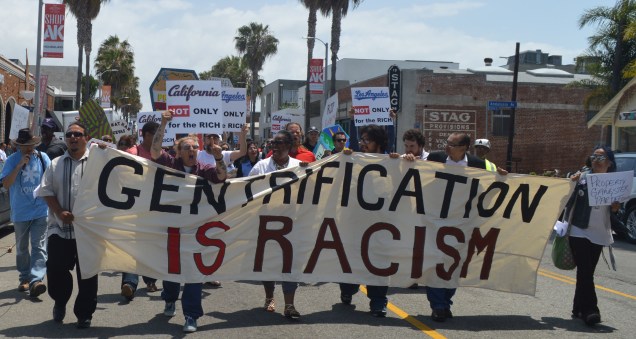
Gentrification is Racism

If racist sentiments like this count as “progress”, count me out

If anyone were still in doubt that much of the social justice movement is often little more than a thin veneer of moral respectability plastered over a movement built on the hatred and resentment of “cisgender, straight white males”, they need only read this article by writer/performer Taylor Steele in online publication The Body Is Not An Apology.

In the piece, Steele reacts to the creeping gentrification of her Brooklyn neighbourhood with a racist tirade that would see her roundly condemned and excommunicated from polite society were she white and the target of her ranting black:

Gentrification happened to me in steps.

At first I was confused.

Were the non-POC in this predominantly Black/Brown neighborhood lost? Did they miss their stop on this Queens-bound train? Are they simply taking a tour of the best Caribbean spots in Brooklyn? When I let it sink in that they were here to stay, noticeable implants to a previously self-contained body, there was anger and frustration. I could feel my rent rising every time a white family, Air BnB-ing in my neighborhood, asked which way to the nearest organic market. And yes, that really happened on a Bed Stuy corner outside of the Crown Fried Chicken and family-run bodega.

(For the uninitiated, “POC” means “people of colour”, and “Black/Brown” are capitalised while “white” is not for reasons that will soon become all too evident.)

Okay, so we have what appears to be a fairly standard diatribe against urban gentrification. So far, so typical. But Steele then continues:

It is traumatic finding strangers in your house, not understanding completely how they got there, not being able to ask them to leave, them rearranging the furniture, and you not being able to move any of it back — nothing will ever be the same; change is trauma.

I can logically/intellectually understand that the white people who move into predominantly Black and brown spaces do not do so with mal-intent; perhaps, these are the places they can afford to live. Perhaps, they can’t see that their presence in these spaces can serve as a kind of terrorism. I also understand they are not responsible for my mental health. However, this is how white supremacy works. It makes it impossible to point the finger at any one thing because the problem is a systemic, political, institutional one. White supremacist capitalist patriarchy proclaims that I am supposed to feel an inherent inadequacy and replaceability.

Author’s emphasis in bold.

A kind of terrorism. Go back and read that passage again, lingering over each sentence. Just read it, and then tell me with a straight face that the world is somehow better off for the presence of this toxic, self-obsessive, cancerous movement in our society.

Imagine that the situation were reversed, and a white author was complaining about black or other ethnic minority residents moving into the neighbourhood, explicitly complaining about the way that they are “rearranging the furniture” through their presence and fretting that the unwelcome newcomers cannot simply be asked to leave. Imagine that the white author described the mere arrival and presence of these newcomers as a form of terrorism being perpetrated on the white inhabitants. Just imagine the reaction. Imagine the outrage and social ostracisation which would rightly follow the expression such heinous, prejudiced sentiments. Now answer this: how does this new form of racism toward the often white beneficiaries of urban gentrification in any way expunge or heal historic racism aimed at black people?

While stubborn racist holdouts and the vestiges of real privilege and discrimination clearly do still exist in places, they are a shadow of what they once were, and thankfully in terminal decline. While full equality under the law should always be the only acceptable goal, those who fought for civil rights in the 1960s and preceding decades would often be astonished by the landscape faced by their successors in 2017. In fact, the only ones now openly using racist language and seeking to resurrect the “separate but equal” days of Jim Crow and segregation are the Social Justice Warriors, in their perverse fight against perceived “oppression”.

And this leads us to the perverse spectacle of a black writer, seemingly oblivious to the historical parallels she is invoking, talking resentfully about white people moving into “her home”, “terrorising” her with their somehow-illegitimate, organic food-purchasing presence (as though no wealthy black people shop at Whole Foods).

Here is someone who would no doubt be the first to join an anti-Trump protest as it marched through Brooklyn, and yet describes her resentment and fear of change in exactly the same language – social loss, fear of change, the undermining of local institutions – that she would castigate a white person or Trump apologist for using to articulate their own feelings about uncontrolled immigration and social change. There is simply no self-awareness at all – just rage, entitlement and self-inflicted fragility.

Have we really come this far as a society only to revert back to fearful, paranoid tribalism of this kind?

For some of us, yes, apparently so.


Gentrify This

Bottom Image: Amanda Farrer

Support Semi-Partisan Politics with a one-time or recurring donation:

Agree with this article? Violently disagree? Scroll down to leave a comment.

Follow Semi-Partisan Politics on TwitterFacebook and Medium.