On Booty Calls and Morning Croissants

The BBC reports that French president Francois Hollande has been accused by a French magazine of having an affair with a 41-year-old actress, Julie Gayet. The article reveals:

The magazine’s print edition came out on Friday and shows pictures it claims support the rumours that the 59-year-old president routinely spends the night with Ms Gayet at a flat not far from the Elysee Palace.

The pictures show the pair arriving separately. Mr Hollande, wearing a helmet, is on a motorbike driven by a chauffeur.

The magazine claims the president’s bodyguard arrives the following morning to deliver croissants.

I like the detail of the morning croissants. Even if one is sneaking out of the Elysee Palace late at night to get some action, one still needs a decent continental breakfast so as to appear statesmanlike again the next morning.

Just as with the fictional American President Grant in the US drama “Scandal”, skulking around the capital city in the dark with limited protection, exposing oneself (and the  secure, uninterupted governance of one’s nation) to any risk of kidnapping, physical harm, blackmailing or worse in the pursuit of a booty call, is probably not behaviour that voters would wish to see in a serving head of state. Transgressions which take place before taking office, honestly explained, atoned for and forgiven by the electorate, are one thing. Actively committing further such acts whilst in office is another matter entirely.

The BBC article reports that though Hollande is making noises about potential legal action against the magazine Closer, he does not deny the specific allegations of the affair.

Although, if ever proven true, this would represent a severe lapse in acceptable personal standards of behaviour, and of presidential decorum on the part of Hollande, the solitary refreshing fact (if that term may be used) in the sordid allegation is that Francois Hollande does not continually preach to his people about the sanctity of traditional marriage in the way that some politicians in the UK, but particularly America, insist on doing.

In contrast to the likes of Newt Gingrich or Rudy Giuliani, both adulterers with serial failed marriages to their names, the French president does not devote his every waking hour to fretting about the potential impact of allowing gay people to wed on the institution of holy matrimony.

And for not adding his voice to the hypocritical cacophony of self-righteous moral preaching, we still owe Francois Hollande our thanks.

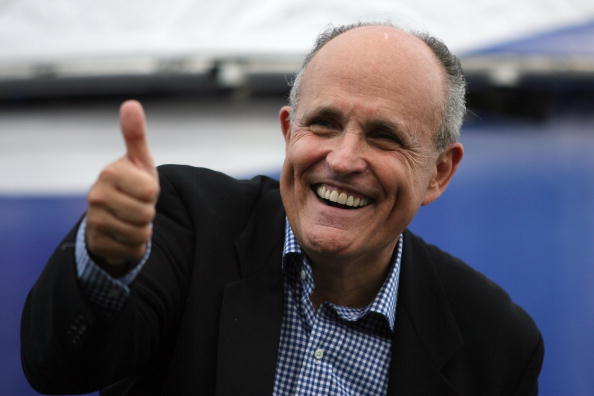
You don't want to know why Rudy Giuliani is smiling.
You don’t want to know why Rudy Giuliani is smiling.


Lost In Translation

The Daily Mail reports the confounding story that a baby boy was rushed to hospital in north Wales because his parents were unable to fill his prescription – because the prescription was written in Welsh only.

A sick baby was rushed to hospital after a supermarket pharmacy refused to hand his medication to his father because part of the prescription had been written in Welsh.

Aled Mann, 34, took the prescription from the family doctors to his local Morrisons pharmacy counter after his one-year-old son Harley developed a chest infection.

But staff at the supermarket in Bangor, north Wales, refused to give him the steroid tablets because they could not read the note as not all of it was in English.

The father was ultimately able to return to the GP surgery and get a new prescription printed in English and have the prescription filled, but the baby’s condition worsened overnight requiring hospitalisation, leading to speculation and conjecture that the delay (and hence the pharmacy’s unwillingness to fill a prescription that it could not adequately verify) was to blame.

The incident seems to have caused something of an uproar, but not in quite the way that I imagined. For some reason I had expected the consternation to centre on the fact that GPs in Wales are able to issue prescriptions in a language not spoken by the majority of the people in that country (and therefore inevitably more difficult for patients to redeem), but instead the ire is trained more squarely at the retailer, Morrisons, for not making sufficient effort to cater to the needs of the customer.

I love Wales and admire its people, history and natural beauty very much, so I am going to tread carefully here. I’m also a fervent unionist, as any frequent reader of this blog will know, and believe that Wales should remain an integral part of the United Kingdom – but again this is not relevant to the point I am about to make.

To me, this is an issue of public safety. Surely, in a country where everyone speaks English and only a relatively small minority speak or otherwise use the Welsh language, it is in the interests of the patient, and of common sense, for the prescription to be printed in the language which is common to everyone.

The undercurrent of sentiment surrounding the story seems to be that the Welsh parents were in some way discriminated against, and that their baby’s life was endangered, due to the fact that they receive their family healthcare services in the Welsh language. We can thus extrapolate and infer that the correct thing to have done, in the eyes of those who are upset, would have been for Morrisons to employ either only bilingual speakers in their stores, or to ensure that there is at least one bilingual speaker on hand in the pharmacy department at all times. Indeed, the Mail records Arfon Wyn, a local councillor, saying as much on the record:

‘This is totally diabolical. It is the trend of these large supermarkets not to employ bilingual local people and so such terrible events as this can take place.’

But would the real discrimination not arise if employers felt compelled, or were legally compelled, to hire only bilingual speakers at the expense of English-only speakers? Indeed, given that only 15% of Welsh citizens are able to read, write and speak the language with fluency, could it not also precipitate an enormous skills gap and labour shortage?

Here is an image of the prescription in question:

welshprescription

As readers can clearly see, the instructions on the prescription are printed bilingually, in both English and in Welsh. I understand that this is in accordance with the Welsh Language (Wales) Measure 2011, which also created the role of Welsh Language Commissioner who is entrusted with ensuring that Welsh is not treated less favourably than the English language in Wales, and that people can live their day-to-day lives through the medium of Welsh if they choose to do so. The patient-specific parts of the prescription, however, contain crucial information which is in Welsh only.

I would suggest that Dr. Ieuan Parry’s office is not serving its patients very well by providing prescriptions that run the risk of not being understood. Legally, they are completely in the right – indeed, Welsh is technically the only language accorded anything like official status in the whole of the UK – but practically and morally, I am not so sure.

I understand that the maintenance and preservation of the Welsh language is a very dearly held and important issue for some people. But we are talking about a medical prescription for a baby boy being printed with the key parts only in Welsh, a language with which 73% of the people have no familiarity (according to the 2011 census). Some may choose to be outraged at Morrisons for falling short, but I choose to feel more disappointment in the fact that patient safety was effectively jeopardised in pursuit of what seems to be a transparently cultural or political end.

If the goal is the preservation and extension of the Welsh language, Welsh-only prescriptions seems a lousy way of advancing that dream.

Or am I missing something?

Britannia Contra Mundum

Not necessarily the end of the world.


Britain, according to Mary Riddell writing in The Telegraph, is the friendless pariah of Europe.

Riddell informs us that our economy is in the doldrums, our foreign policy is a shambles and we are actively alienating the very people who we need to come riding to our rescue:

…the issue of Britain’s global influence should preoccupy every parliamentarian.

Our current position is not hard to plot. Hiding under a duvet of doubt and debt, Britain – so recently the buccaneer of the world – has become insular to the point of agoraphobia. Recession and hardship at home have made the UK a nation of political navel-gazers. The cost-of-dying debate, over whether we could possibly justify the cost of our wars, has been superseded by a cost-of-living crisis: gas bills have supplanted gas masks.

According to this defeatist and self-flagellating line of argument, it is Britain, the weak country, which needs to curry favour with her European neighbours, and not the other way around. Apparently it has gotten so bad that as a nation we are now suffering from some kind of identity crisis:

But inward-looking politics are bolstering, rather than reducing, Britain’s identity crisis. With power ebbing away abroad and the spectre of Scottish independence at home, Britons are wondering: who are we?

This comes as news to me, and probably to many other people who feel comfortable in our national identity and don’t feel the need to vex themselves with recurring thoughts of national inferiority or separatism.

I seem to remember urging against this type of declinist, pessimistic, self-defeating talk only very recently in “Why Britannia Rules”, but my small backwater blog has clearly made no impact on the mood of feeling in the British commentariat. As I said then, when everyone was tearing their hair out and prophesying the end of Britain after Parliament voted against military action in Syria:

We are British. We are a great country. Our economy may still be in the toilet, and we may be governed at present by dilettantish non-entities in the mode of David Cameron, George Osborne and Nick Clegg, but these things shall pass. And when they do, Britain will still be a great country.

What I wrote was true then, and it is true now. But this is where Mary Riddell really loses the plot:

With dangers abroad and our economic destiny far from assured, it is imperative that Britain should re-establish its identity and global niche. The irony is that our best hope is the one that politicians hesitate to flaunt, and that many citizens revile. The EU remains the largest single economy in the world, has the second biggest defence budget after the US and boasts the diplomatic muscle recently used by its (previously maligned) foreign policy chief, Baroness Ashton, in helping to secure the recent Iranian nuclear pact.

In what precise way has Britain lost her identity? Did this happen while I was sleeping?

The EU may indeed remain the largest economy in the world, but it is not the “largest single economy”, as Riddell and anyone with the slightest knowledge of current divergent conditions in Greece and Germany knows all too well. Whether we swoon with delight over our membership of the European Union and ever-closer union with our continental neighbours or chafe at the smothering bureaucracy of the whole project and yearn to leave, we still trade with the EU. And contrary to the shrieks of some scaremongers, even if Britain were to leave the EU, this trade would cheerfully continue by necessity and mutual benefit. Some unscrupulous commentators phrase their warnings in such a way as to leave the impression that all of Britain’s trade with Europe would cease and disappear in a puff of smoke if we were to leave the EU, a ludicrous and obviously nonsensical notion.

And are we really going to start talking national defence as a reason to lash ourselves ever tighter to the mast of the European Union? The EU may have the second biggest defence budget after the US, but this is a meaningless fact when you consider the obvious fact that the member states of the EU do not act with one common military purpose. Indeed, of the EU member states it is really only Britain and France that possess any capability to project significant force without airlift or blue water navy support from the United States. Furthermore, Britain’s military actions in recent years have primarily taken place either through NATO or in concert with our chief ally, the United States. It is hardly as though we would be putting any much-loved and time-tested military partnership with the Europeans at risk by disengaging from the EU, as no such partnership exists.

We are then supposed to believe that Britain is in danger of severing  herself from some great source of “diplomatic muscle” as a result of our ambivalence about Europe. But I could well point out that weighing against Riddell’s one example of EU foreign policy success (Baroness Ashton’s help in securing the recent Iranian nuclear pact) are the many times when other powers have looked at the incoherence or tense nature of European joint foreign policy and either laughed at it, rudely dismissed it or used it as an opportunity to divide and conquer.

Then comes the obligatory “but of course there are a few small issues that need ironing out” remark in reference to the EU’s many flaws, together with the standard plea to refrain from throwing the baby out with the bath water:

While no one doubts that reforms are needed, EU membership makes us an influential part of the largest global trading bloc. As Douglas Alexander, the shadow foreign secretary, and Ian Kearns write in their new book, Influencing Tomorrow, the EU is “not just an instrument for amplifying our power, but also for promoting peace and security and defending democracy and human rights”.

I can only despairingly repeat (as though to a brick wall) the fact that Britain, as one of the world’s few truly indispensable nations, would remain strong and secure whether or not we are an “influential part of the largest global trading bloc”. Indeed, I would further argue that we are not, have not been and are unlikely to become as influential as we should be within an EU structure which gives veto power to countries which are relative minnows or which have strongly divergent interests to Britain’s, and that by freeing ourselves from the yoke of so much European regulation and counterproductive harmonisation attempts we would have the potential to soar higher and achieve even more. But Mary Riddell seems too afraid of the world and too doubtful of Britain’s enormous advantages and assets to ever acknowledge this possibility.

None of this is to say that the right answer is for Britain to leave the European Union under any and all circumstances. It is just to point out that there needn’t be such a bone-chilling fear of secession and the idea of Britain standing on her own two feet like so many other sovereign nations manage to do. It is partly this fear that colours and undermines our relationship with the EU, and makes the current raw deal that we get from our membership a self-fulfilling prophecy. If our European partners believe that we are desperate to remain a part of the club at any price, the price that they are certain to demand and extract from us in each and every nation will be that much higher.

So rather than running into the arms of the EU in a scrabble to find identity and protection, as Riddell advocates in her less-than-stirring peroration, we should actually embrace some of the insularity (if we must call it that) that so many of the commentariat class seem to scorn, at least in terms of our approach to the European Union.

In order to prosper, Britain must look inwards at ways to release our own inherent national dynamism and competitiveness, rather than outwards for reassurance and protection in a world which will surely offer neither.
Snowden vs The Elite

Ruth Marcus from the Washington Post and Glenn Greenwald from the Guardian went head-to-head on CNN this Monday, discussing the recent New York Times editorial calling for clemency for US whistleblower Edward Snowden. As the New York Times rightly concluded in their editorial:

When someone reveals that government officials have routinely and deliberately broken the law, that person should not face life in prison at the hands of the same government.

This was not the view of Ruth Marcus, who, showing much in common with the self-serving elitists and power fetishists who festoon Washington D.C., seems to swoon at government overreach and seeks to protect her own kind from any kind of scrutiny or consequences of their actions, whilst happily throwing the little guy or the outsider under the bus at the first opportunity:

Snowden … is seized with infuriating certitude about the righteousness of his cause. Not for Snowden any anxiety about the implications for national security of his theft of government secrets, any regrets about his violations of a duty of secrecy.

Quite how she knows that Snowden has no anxiety about these things is not entirely clear, but since she has never met Snowden I think it would be fair to surmise that she made this statement up. It would harm her cause, cheerleading for the Obama administration and the national security apparatus, if she acknowledged the fact that Snowden may have wrestled with his decision to divulge what he knew, that he had to weigh up the pros and cons of his actions.

It’s never good when experienced, professional commentators seek to drag George Orwell into their arguments, but Marcus indulges herself:

George Orwell himself would have told Snowden to chill — and the author of “Animal Farm” surely would have shown more recognition of the irony of Snowden’s sojourn in Vladimir Putin’s Russia. Does a man whose life is conducted so much online really believe that Putin’s spies are not cyber-peering over his shoulder?

I believe that the irony, such as it is, is that a man from a supposedly free society has more liberty hiding out in Putin’s oppressive Russia than he would in his own native land, for doing nothing more than exposing the secret and unlawful actions of his government. That fact doesn’t make a mockery of Snowden, but it does make the United States look rather bad.

But it is on her next point that Marcus really overreaches:

On behavior, if Snowden is such a believer in the Constitution, why didn’t he stick around to test the system the Constitution created and deal with the consequences of his actions?

And here is where it gets good, because when CNN host Jake Tapper asked Glenn Greenwald to comment on Marcus’ position, he gave it to her with both barrels:


Temporarily putting aside the correctness of Greenwald’s position, the real money quote, and the thing that really gets to the rub of the matter is this:

I think Ruth Marcus’ argument exemplifies everything that’s really horrible about the D.C. media … People in Washington continuously make excuses for those in power when they break the law.

Yes, we see this time and again, and Greenwald has himself addressed this topic at length in his excellent book “With Liberty and Justice for Some”.

But in terms of refuting Marcus’ fatuous and glib suggestion that if Snowden really valued the US. Constitution he should have been willing to surrender himself and submit himself to the American legal system in order to advance his cause and win his case in the court of public opinion, Greenwald correctly states:

“If he had stayed in the United States, as Daniel Elsberg (widely considered to be a hero by most Americans) argued in the Washington Post, he would have been barred from making the very argument that she just said he should have made. Under the Espionage Act, you’re not allowed to come into court and say “I was justified in disclosing this information”, there is no whistleblower exception in the Espionage Act which is why whistleblowers don’t get justice in the United States.”

May this once and forever do away with the misleading assertion by national security fanatics and civil liberty deniers that Edward Snowden ever had – and spurned – a realistic chance of making his case to the public whilst remaining in the United States, or that his flight to Russia is in any way ironic or detracting from the validity and strength of his arguments. This is not the case.

Mediaite also provides a good summary of the exchange here.

Bring The Police To Heel

Two stories in the media this afternoon, each quite different in nature but both pointing toward the same dark, disturbing and authoritarian shift that continues unabated in Britain today.

policedogs

The first is from The Telegraph, serving up video footage of a police sergeant in Gloucester threatening a photographer, admitting to swearing at him and threatening him with physical harm:

The officer is heard to say, “we’ll nick you now and I will make your day a living hell, ‘cos you’ll be in that cell all day. What I’ll probably do is I will ask for you to be remanded in custody and I will put you before the magistrate.”

He added: “You’re lucky that I didn’t knock you out. I swore at you, yeah. It got your attention, though, didn’t it?”

Because apparently taking pictures or video of the aftermath of a road accident is now illegal in our country, as is showing anything but the most fawning and servile deference and adulation to the most power-crazed and high-handed officers in the police force.

The second article is chilling on an altogether different level, and chronicles the process by which the UK’s anti-terrorist police decided that it would be in any way appropriate and proportional to haul a twelve year old boy out of his class at school to question him about an event that he had organised on Facebook to protest the planned closure of his local youth club:

Wishart said that after the school was contacted by anti-terrorist officers, he was taken out of his English class on Tuesday afternoon and interviewed by a Thames Valley officer at the school in the presence of his head of year. During the interview, Wishart says that the officer told him that if any public disorder took place at the event he would be held responsible and arrested.

Speaking to the Guardian, Nicky Wishart said: “In my lesson, [a school secretary] came and said my head of year wanted to talk to me. She was in her office with a police officer who wanted to talk to me about the protest. He said, ‘if a riot breaks out we will arrest people and if anything happens you will get arrested because you are the organiser’.

The event was organised in the Prime Minister’s home constituency of Witney in Oxfordshire, but in what possible dark, dystopian world is it okay for the police to make a mountain out of a truly tiny molehill and question the intentions of a young boy who was doing nothing but being an engaged and activist citizen? Our country would be vastly better off if there were more children like Nicky Wishart, who actually care about local issues enough to take a stand rather than festering away in front of the television for hours on end.

But it is the next quote attributed to the police that is truly terrifying:

“He said even if I didn’t turn up I would be arrested and he also said that if David Cameron was in, his armed officers will be there ‘so if anything out of line happens …’ and then he stopped.”

If anything out of line happens, the armed officers will do what, exactly? Shoot a twelve year old boy as some kind of sadistic punishment? What reason is there to mention the potential presence of armed officers, other than to imply that they might do the one thing that regular police officers do not?

The truly scary thing is that we don’t even have to worry about our politicians using their power and influence to get the security services to intimidate and threaten the population on their behalf – the security services seem perfectly willing to proactively do so of their own volition!

We must also ask why it was the anti-terrorist police (who apparently have no real serious threats to the nation on their agenda at the moment to be wasting time on routine public intimidation work, for which I suppose we can all breathe a sigh of relief), of all the many branches of our national law enforcement apparatus, who seemingly felt it necessary to bully a small child about his planned political protest. Has GCHQ intercepted terrorist chatter that Al Qaeda intends to infiltrate local community action groups in order to launch their next attack? Whatever next – fears of ricin or anthrax being baked into scones at a Women’s Institute cake sale, and elderly ladies being detained in their kitchens?

The police make the predictable but ludicrous claim that their intention was not to cause distress or to intimidate Wishart, but was simply part of their standard community outreach efforts:

“On Tuesday 7 December, our schools officer for west Oxfordshire attended the school in Eynsham and spoke to a 12-year-old boy in the company of the pupil’s head of year, about a planned protest. This was not with the intention of dissuading him from organising it, but to obtain information regarding the protest to ensure his and others’ safety. As with any demonstration, we always aim to facilitate a peaceful protest.”

Perhaps the police need to apply the “ordinary person” test and reconsider the likely effect of being yanked out of class and spoken to by police in the presence of a senior teacher with no parents or legal representatives present, on the psyche of a young boy. Is doing what they did more likely to “facilitate a peaceful protest” or to stamp out a potential protest before it ever sees the light of day?

David Cameron needs to send a very clear message to the nation in response to this outrage, as a matter of urgency. And through the locally elected police commissioners, he needs to publicly rebuke and call off the police attack dogs currently biting at the ankles of the British citizenry. Cameron and the commissioners must make clear that individual police officers will curry no favour with their superiors by overzealously applying extreme interpretations of public order laws, and that those higher in the law enforcement hierarchy will receive no special favour from their political masters by using their extensive powers to bully and silence any protest that could be politically embarrassing.

Semi-Partisan Sam is quite unequivocal on this matter. The apology from the police to the family concerned is all well and good, but it is quite insufficient. It is high time that the British police are brought to heel once and for all.