Does Oxbridge Discriminate?

Brideshead Revisited - Oxbridge - Social Class - Discrimination

Oxbridge has every incentive to admit more students from disadvantaged and minority backgrounds. If diversity has failed to improve then it is our fault as individuals, families, communities and voters for failing to provide elite universities with a bigger, better talent pool

Another day, another tedious story about Oxbridge being a terrible bastion of privilege and discrimination where the few working class students who manage to evade the perimeter and matriculate find themselves mocked mercilessly by Bullingdon toffs while students of darker complexion are forced to drink from separate water fountains.

The trigger for this year’s rehashing of the predictable dirge was a freedom of information request submitted by Labour MP David Lammy, who selectively requested and interpreted data to paint the bleakest possible picture of barriers to elite higher education in Britain.

The Guardian reports on the “shocking” findings, and then have the temerity to criticise the Oxford University press office for daring to defend themselves rather than meekly accepting criticism and submitting to corrective punishment:

Oxford and Cambridge have been accused of failing to engage in serious debate over their lack of diversity by the former education minister David Lammy, who first highlighted the issue with data obtained by freedom of information requests.

The Labour MP said the universities had been “trying to make journalists change their stories” rather than address how little progress they were making in recruiting talented students by race, social class and location in England and Wales.

His accusation came after sparking national controversy over data – first published in the Guardian – that showed that as many as 16 Oxbridge colleges failed to offer any places to black British applicants in 2015, the most recent figures under the FOI request.

Note that when leftists call for a “serious debate” on something, in actual fact they do not want a debate at all. What they want is for you to flop over submissively on the ground and agree to whatever Utopian socialist pipe dream they have in mind. Back in the real world, Oxford and Cambridge do little else these days other than engage in never-ending symposia about diversity. The reason that these debates don’t satisfy the Left is because they do not end with Britain’s elite universities sacrificing their brands and academic standards by further lowering their entrance requirements to attract less qualified applicants who happen to tick the right diversity checkboxes.

David Lammy huffs in the Guardian that “seven years have changed nothing at Oxbridge”, but this is totally untrue. Elite universities are falling over themselves to admit minority and working class students to improve their admissions statistics. They face immense political and even financial pressure to do so. Seven years have indeed changed Oxbridge, but only in the direction of being even more amenable to considering applications from underrepresented groups. What has not changed, though, are the stubborn social and environmental factors which continue to restrict the pool of minority applicants in which Oxbridge and other elite universities must fish.

Of course, Labour were quick to pile on with predictable, cookie-cutter criticism:

Angela Rayner, Labour’s shadow education secretary, said: “This is the latest damning evidence on the government’s failure to widen access to our most selective universities.

“The proportion of comprehensive school pupils getting in to top universities under the Tories is lower than when Labour left office, and this data shows that the problem is especially serious at Oxford and Cambridge.

“Ministers claim their system is working, but these figures show that it isn’t.”

Because any imbalance simply must be the fault of institutions, and ultimately the government who wield absolute power over everything and everyone. The idea that poverty, social stability, family structure, engaged parenting or personal responsibility might play a part in the under-representation of certain groups at Oxbridge is unthinkable. Heavens, no. Successive British governments have created a perfectly egalitarian society, and the only reason that the enrolment at Oxford University does not perfectly match the makeup of the general population is because evil admissions officers in Oxford colleges harbour a seething, visceral hatred of poor, brown kids.

Lammy goes on to complain:

During this period [2010-2015], an average of 378 black students per year got 3 A grades or better at A-levels. With this degree of disproportionately against black students, it is time to ask the question of whether there is systematic bias.

Really? Now is the time? I’m so glad, because this conversation is indeed long overdue. Nobody has once raised the issue until this watershed moment, courageously midwifed into existence by David Lammy. At long last we can finally ask why, a time when every other institute of higher education in the country have conspicuously prostrated themselves before the Cult of Social Justice and Identity Politics, Oxford and Cambridge continue to openly revel in institutional racism.

This is asinine.

Getting angry at Oxbridge for not admitting more ethnic minority and working class applicants is putting all the blame for societal, cultural and family problems at the foot of higher education. I am technically a BAME individual (oh, how I hate that stupid, infantilising acronym) from a poor, single-parent family, yet I was admitted to Cambridge University and neither experienced discrimination while there nor witnessed anybody else facing discrimination. On the contrary, there was a rigorous, fiercely intellectual atmosphere (aside from all the drinking and punting) which cared only about what you think, not what you look or sound like.

If anything, given the incentives and political pressure faced by universities today, I would not be surprised if many elite institutions already do more than they should to correct for social and government policy failures by accepting students from under-represented backgrounds that would not stand a chance if they were white and middle class. I know that if I was a university administrator and my performance appraisal, reputation or funding were at stake then I would be very tempted to selectively lower standards.

To properly address this issue we need to have “honest conversations” not about institutional discrimination but about family structure, culture, parenting, wealth and both primary and secondary education. We need to ruthlessly eliminate influences which tell certain impressionable youngsters that academic achievement is uncool, that being a useless parent is socially acceptable, and which peddle myths about Oxbridge based on hazy recollections of Brideshead Revisited.

We also need to stop the media hand-wringing. Hysteria about the lack of BAME people at Oxbridge only feeds a false narrative that minorities are unwelcome at Britain’s elite universities. It is very hard to increase representation when you simultaneously tell a certain group that they probably won’t get in to Oxbridge and will likely have a very bad time there if they do manage to beat the odds.

What we cannot do is expect our best universities, the engine of Britain’s innovation and research, to expend scarce time and resources bringing some candidates up to the basic level they need to be starting at. Some remedial classes are already offered to students who arrive at universities without the required study skills. It would be unfortunate if this reactive solution were to bed down at Oxbridge.

It is very convenient for politicians such as David Lammy to point to an evil, imaginary bogeyman which is responsible for a lack of diversity rather than admitting the more complex and intertwined failures which contribute to the problem. But as a “BAME” person (ugh) from a relatively disadvantaged background who was accepted into Oxbridge, the narrative being spun by the Left smacks of cynicism and a lack of serious thought.

To be clear, I’m not suggesting that discrimination does not exist at the margins, or in the form of so-called microaggressions. I’m sure that it does. But I do not believe that it is systemic, particularly given that Oxbridge faces so many incentives and coercions to increase diversity.

Rather than badgering our elite universities to fix upstream issues and single-handedly correct disparities in the opportunities available to different demographic groups, we need to call individuals, families, communities and (yes) government to account for their failings and shortcomings. We need to foster a universal culture of ambition and respect for academic achievement which transcends lines of gender, ethnicity, wealth, culture or social background. This probably means making a thousand small and often inconvenient changes to the way that we behave as individuals, parents, teachers, students and policymakers, which is much harder work than joining the David Lammy Chorus and blaming everything on discrimination.

But the easy solutions are rarely the correct ones, and when it comes to increasing minority representation at our elite universities we must do what is hard rather than what feels good.

Formal Hall - Fitzwilliam College Cambridge University

Support Semi-Partisan Politics with a one-time or recurring donation:

Agree with this article? Violently disagree? Scroll down to leave a comment.

Follow Semi-Partisan Politics on TwitterFacebook and Medium.

The Best One Percent

In his brief remarks to the media, General John Kelly, chief of staff to President Donald Trump, momentarily made everybody else in Washington D.C. look small

Good speeches do not always have to be painstakingly crafted well in advance and written down or beamed onto a teleprompter. Neither do good speeches always require a grand event as their backdrop. Sometimes the most stirring speeches can be extemporaneous, or at least appear relatively spontaneous when delivered.

And into this latter category fall the remarks made yesterday by former Marine Corps general John Kelly, chief of staff to President Donald Trump. Kelly was seeking to defend his boss from accusations that the president had been dismissive bordering on callous when making a telephone call of commiserations to the wife of a fallen US soldier killed in an ambush in Niger, a call which was overheard by a Democratic congresswoman and reported to the media.

I make no comment about the individual circumstances of the case here, though many other media organisations have seen fit to voyeuristically pick over what should be an intensely private moment in order to extract political advantage from it. For those interested, the two opposing sides are effectively summarised here and here.

Far more inspirational than this tawdry back-and-forth, however, were the words of Chief of Staff John Kelly, who sought to end the unseemly debate by describing to the press corps in detail the process which takes place when a US service member is killed in action overseas. These remarks range from the very detailed and practical (describing exactly what happens to the body and where it is taken) to the profound, and are worth quoting at length.

Kelly begins:

Most Americans don’t know what happens when we lose one of soldiers, sailors, airmen, Marines, our Coast Guardsmen in combat. So let me tell you what happens:

Their buddies wrap them up in whatever passes as a shroud, puts them on a helicopter as a routine, and sends them home. Their first stop along the way is when they’re packed in ice, typically at the airhead. And then they’re flown to, usually, Europe where they’re then packed in ice again and flown to Dover Air Force Base, where Dover takes care of the remains, embalms them, meticulously dresses them in their uniform with the medals that they’ve earned, the emblems of their service, and then puts them on another airplane linked up with a casualty officer escort that takes them home.

A very, very good movie to watch, if you haven’t ever seen it, is “Taking Chance,” where this is done in a movie — HBO setting. Chance Phelps was killed under my command right next to me, and it’s worth seeing that if you’ve never seen it.

So that’s the process. While that’s happening, a casualty officer typically goes to the home very early in the morning and waits for the first lights to come on. And then he knocks on the door; typically a mom and dad will answer, a wife. And if there is a wife, this is happening in two different places; if the parents are divorced, three different places. And the casualty officer proceeds to break the heart of a family member and stays with that family until — well, for a long, long time, even after the internment. So that’s what happens.

This is made all the more poignant by the fact that John Kelly suffered the loss of his son – First Lieutenant Robert Kelly – in Afghanistan, and presumably experienced this same heart wrenching process, something invisible to most civilians in the age of an all-volunteer professional army.

The brief core of Kelly’s remarks then focus on the fine qualities of the men and women who serve in the US military, before defending the actions of his boss. First, the praise:

Who are these young men and women? They are the best 1 percent this country produces. Most of you, as Americans, don’t know them. Many of you don’t know anyone who knows any one of them. But they are the very best this country produces, and they volunteer to protect our country when there’s nothing in our country anymore that seems to suggest that selfless service to the nation is not only appropriate, but required. But that’s all right.

Goodness me, that’s powerful. Remember, this is a former Marine Corps general and the serving chief of staff to President Trump, and he is saying that the state of the country is such that America is no longer worthy of the sacrifice made by its men and women in uniform. Think on that for a moment.

And then comes the necessary defence of President Trump, in which Kelly references his own painful loss:

So he called four people the other day and expressed his condolences in the best way that he could. And he said to me, what do I say? I said to him, sir, there’s nothing you can do to lighten the burden on these families.

Well, let me tell you what I told him. Let me tell you what my best friend, Joe Dunford, told me — because he was my casualty officer. He said, Kel, he was doing exactly what he wanted to do when he was killed. He knew what he was getting into by joining that 1 percent. He knew what the possibilities were because we’re at war. And when he died, in the four cases we’re talking about, Niger, and my son’s case in Afghanistan — when he died, he was surrounded by the best men on this Earth: his friends.

That’s what the President tried to say to four families the other day. I was stunned when I came to work yesterday morning, and broken-hearted at what I saw a member of Congress doing. A member of Congress who listened in on a phone call from the President of the United States to a young wife, and in his way tried to express that opinion — that he’s a brave man, a fallen hero, he knew what he was getting himself into because he enlisted. There’s no reason to enlist; he enlisted. And he was where he wanted to be, exactly where he wanted to be, with exactly the people he wanted to be with when his life was taken.

That was the message. That was the message that was transmitted.

This next section (which reminds one of Cicero’s exclamation O Tempora, O Mores!) is good too, because it is so obviously heartfelt coming from somebody from an older generation raised in a dignity culture:

It stuns me that a member of Congress would have listened in on that conversation. Absolutely stuns me. And I thought at least that was sacred. You know, when I was a kid growing up, a lot of things were sacred in our country. Women were sacred, looked upon with great honor. That’s obviously not the case anymore as we see from recent cases. Life — the dignity of life — is sacred. That’s gone. Religion, that seems to be gone as well.

Gold Star families, I think that left in the convention over the summer. But I just thought — the selfless devotion that brings a man or woman to die on the battlefield, I just thought that that might be sacred.

Kelly ends with this scathing criticism of politicians such as the congresswoman who saw fit to leak details of President Trump’s telephone call to one of the families:

I’ll end with this: In October — April, rather, of 2015, I was still on active duty, and I went to the dedication of the new FBI field office in Miami. And it was dedicated to two men who were killed in a firefight in Miami against drug traffickers in 1986 — a guy by the name of Grogan and Duke. Grogan almost retired, 53 years old; Duke, I think less than a year on the job. Anyways, they got in a gunfight and they were killed. Three other FBI agents were there, were wounded, and now retired. So we go down — Jim Comey gave an absolutely brilliant memorial speech to those fallen men and to all of the men and women of the FBI who serve our country so well, and law enforcement so well.

There were family members there. Some of the children that were there were three or four years old when their dads were killed on that street in Miami-Dade. Three of the men that survived the fight were there, and gave a rendition of how brave those men were and how they gave their lives.

And a congresswoman stood up, and in the long tradition of empty barrels making the most noise, stood up there and all of that and talked about how she was instrumental in getting the funding for that building, and how she took care of her constituents because she got the money, and she just called up President Obama, and on that phone call he gave the money — the $20 million — to build the building. And she sat down, and we were stunned. Stunned that she had done it. Even for someone that is that empty a barrel, we were stunned.

But, you know, none of us went to the press and criticized. None of us stood up and were appalled. We just said, okay, fine.

So I still hope, as you write your stories, and I appeal to America, that let’s not let this maybe last thing that’s held sacred in our society — a young man, young woman going out and giving his or her life for our country — let’s try to somehow keep that sacred. But it eroded a great deal yesterday by the selfish behavior of a member of Congress.

As a speech, this has pretty much everything. It might not have been the most stirring or poetic, but John Kelly is a blunt, military man and to have spoken in the cadence of John F Kennedy or Barack Obama would have been totally false and out of character. The authenticity of Kelly’s remarks derive from the seriousness of the subject, the dignified way in which a story of personal loss was mentioned (compared to the overt emotionalism of many contemporary speakers) and the workmanlike delivery.

What John Kelly did more than anything else was shame the people who had sought to cynically use a story based on the death of American soldiers for their own purposes – be it Democratic politicians looking for more character flaws in Trump, Republican politicians who sought to defend Trump or the media who saw a potentially juicy mini-scandal which would generate pageviews and ad revenue.

He shamed a group of neophytes and cynics, people who by and large did not serve in uniform themselves, but saw fit to pontificate on the protocol governing military rituals as though they were discussing any old arcane political dispute. Kelly effectively contrasts the quiet, selfless duty of American soldiers with the self-aggrandising behaviour of American politicians. And there can be few among the Washington DC political class, who measure their popularity by the number of their Twitter followers and see themselves as the centre of the universe, who did not come out of that press conference feeling at least slightly chastened.

This can also only be good for the career and reputation of John Kelly himself, who has faced scepticism that he would be able to rein in the excesses of the Trump administration and criticism for those occasions when that superhuman feat eluded him. By briefly lamenting that women are no longer honoured in today’s America (putting aside the fact that such 1950s-style honour was a double-edged sword), Kelly not-so-subtly denounced his own boss, whose record of behaviour towards women is not good. Criticising the politicisation of gold star families during the Democratic National Convention served the same purpose. Thus, Kelly successfully burnished his image as a man serving out of duty to his country and respect for the office of president rather than admiration for the individual who currently holds that office.

I struggle to think of a contemporary British political speech of similar power and worth. Does anybody recall any of the speeches given this party conference season, besides the slow-motion self-destruction of Theresa May? Has there been a British political speech in the last decade which made the heart beat a little faster or brought a lump to the throat?This is made even more depressing when one remembers that John Kelly is not even a politician – he is a retired general pressed into service to steady a wobbling first-year Trump administration.

Kelly’s remarks are a fine example of an effective speech, composed and well delivered under difficult circumstances, with a hostile media audience ready to throw hard-to-defend accusations against his equally hard-to-defend boss. Yet by the time he was done, John Kelly walked out of that briefing room ten feet taller while everyone else visibly shrank in moral stature.

That’s impressive. I would like to import just a fraction of that ability to Westminster.


UPDATE: 21 October

This report from the Washington Post suggests that John Kelly’s account of Representative Frederica Wilson’s speech at the newly-opened FBI building was not accurate. This in no way detracts from the power of the speech or even necessarily mean that Gen. Kelly’s righteous indignation was altogether misplaced, but the record should be corrected.


UPDATE: 22 October

Having sat back rather pleased with myself, thinking I might have written something vaguely original, I discovered today that Jonah Goldberg was simultaneously coming to the same conclusion in his G-file newsletter.

Goldberg sees in Kelly’s speech the same thing that I see – a dignified admonishment to President Trump as much as to the media or the Left:

The trends Kelly alludes to are real and lamentable, and they predate Donald Trump’s arrival on the national political scene. But it strikes me as indisputable that Trump personifies these trends, and if Kelly were not trying to do his job, he would acknowledge that.

Perhaps Kelly was criticizing the Gold Star Khan family in his remarks about the convention. But he could just as plausibly have had the president in mind. We need not rehearse all of the ways in which Donald Trump — who has bragged of his adultery and sexual assaults and who has insulted women’s looks — has less than an exemplary record of honoring the sanctity of women.

I understand that many Christian groups have convinced themselves that Trump is an instrument of God, but let us not delude ourselves that he is also a man of God.

It is also worth pointing out the media’s evident latent, automatic animosity toward any member of the Trump administration, merited or not. When it was shown that John Kelly misreported the content of Rep. Wilson’s speech at the opening of the FBI Academy, nearly all the media ran with a headline about Kelly being wrong, or even lying. They neglected to point out that the video evidence actually also underlined the truth of what Kelly was trying to say – that on the occasion of the dedication of a building to the memory of slain law enforcement officers, the politician present chose to make the occasion about herself.


John Kelly - White House chief of staff - press briefing - Donald Trump call to military families

Support Semi-Partisan Politics with a one-time or recurring donation:

Agree with this article? Violently disagree? Scroll down to leave a comment.

Follow Semi-Partisan Politics on TwitterFacebook and Medium.

Resurrecting The Citizen Politician

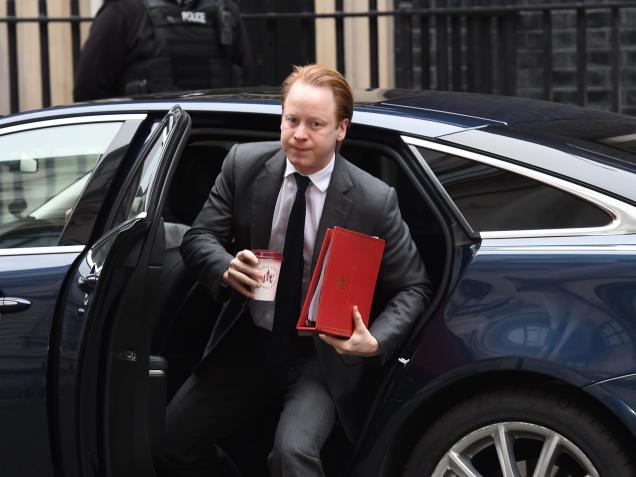
Ben Gummer MP

After Brexit, attracting more exceptional citizen politicians and fewer mediocre career politicians is the next crucial step towards democratic renewal in Britain

A worthwhile article by new Labour MP Laura Smith for LabourList underlines the urgent need for more politicians who look and sound like contemporary human beings rather than cautious clones who have been training to become MPs their whole life.

Laura Smith writes:

I’m new to politics. I’ve never been in local government; I was an activist, a member of the union and came from a long-standing Labour Party family. I haven’t come from a background of jargon and empty words, and I know what it’s like when life throws you a curve ball that takes the wind from your sails and the plans that you had made lay shattered in a million pieces. I can say with integrity that I will try my best to fight against the injustice that members in my constituency feel, and I’ll do it with vigour and sincerity.

Entering Westminster has been an eye opener without a doubt. Never have I been more sure that the ambitions of many there come from a place of self-indulging hypocrisy, and the decisions that they make are sheer games rather than coming from a place of care.

I don’t know the parliamentary protocol nor do I care much for it, I speak with a northern accent, I came to the door with an overdraft, no savings and a limited wardrobe purchased on a credit card to try and look smart.

I am what I am and that is representative of millions of women in Britain. My class has been with me my whole life, forged from the experiences of my Scottish mining grandfather, and I’ve ridden on the rollercoaster of the ups and downs of life. I’m proud to be working class, I’m proud of my people and for as long as my constituency wish to keep me in Westminster I will fight for the working people of this country.

How refreshing it is to hear a politician – especially a Labour politician – speak passionately about the politics of class rather than the politics of identity. Both are divisive, to be sure, but the former is at least reassuringly familiar and relatively harmless these days, while the latter is doing more than anything else right now to tear apart the fabric of British society.

I would probably disagree strongly with about eighty percent of what Laura Smith stands for, but there can be no denying that this is exactly the kind of decent, committed person we should want to attract to Westminster – somebody with strong convictions, a record of community service but also, crucially, a life outside politics (Smith held real jobs and ran her own business).

It cannot hurt to have more MPs of all parties who know what it is to live on a budget as Smith has done, or to have struggled with debt, unemployment or work-life balance issues, to complement those who know how to be an ambitious party functionary but little else. Being an MP is a calling and not a career, but certain accommodations can and should be made which would make serving in Westminster more appealing while still demanding sufficient dedication to public service.

Smith’s dismissal of parliamentary protocol will also chime with many people, including all those SNP MPs who didn’t understand why clapping after a speech was verboten while braying like a donkey at Prime Minister’s Questions is positively encouraged. While there will always be an important place for tradition and rituals which remind us of our heritage and the small part we play in our larger shared history, it is also undeniable that certain habits and protocols are hopelessly outdated and serve no useful purpose. There is no reason why Parliament should not adopt electronic voting, for instance, rather than wasting time while MPs physically traipse in and out of the Commons chamber to record their vote.

But most impressive in Laura Smith’s article is the fact that she clearly went to Westminster with a purpose greater than her own political advancement. Not every MP can or should be a statesman, a philosopher or a leader, though MPs of all backgrounds and ideologies have fulfilled these roles. We also need MPs who care deeply about their constituents and about particular issues, campaigning MPs who want to use their term(s) in office to make a specific difference. Indeed, such MPs can often be far more valuable and effective than those who merely spout reheated rhetoric from four decades ago, be it Michael Foot-style socialism or unreconstructed Thatcherite dogma.

Yet too often we let motivated MPs of this calibre languish for a term or two on the backbenches before they either become disillusioned and stand down, or else lose their inner fire and slowly transform into unremarkable, uninspired time-servers.

One of the best recent citizen politicians in Parliament was former Conservative MP Dan Byles, a man who was the first in his family to attend university, received a prestigious Army scholarship, served on active duty in Bosnia, rowed across the Atlantic, climbed mountains and served on the board of several charities before serving a single term in Parliament from 2010-2015.

This is exactly the kind of person who should now have a senior Cabinet role, and whose charisma and leadership skills might presently be leading the Conservative Party in a more inspiring, less suicidal direction. Yet despite becoming one of relatively few first-term backbench MPs to rack up some real accomplishments to his name (including constitutional reform of the House of Lords via a private member’s bill), Byles stood down in 2015 to “pursue new challenges”. Some of our most exceptional people no longer feel that they can make a meaningful difference by serving in Parliament.

Westminster attracts the power-hungry, the ambitious but also – thanks to elitism and nepotism – the mediocre and the self-serving. And too often, the genuinely talented are overlooked in favour of the well-connected. Witness Theresa May’s government, which managed to find a place for the utterly unremarkable Ben Gummer (son of former Tory minister John Gummer) in Cabinet while leaving thoughtful and intelligent conservative voices like Kwasi Kwarteng or James Cleverly to languish on the backbenches. Note also how Harlow MP Rob Halfon, who could actually articulate a positive (if controversial) vision for conservatism, was sacked as a minister while Theresa May kept faith in Home Secretary Amber Rudd, who entered politics not to advance any deeply-felt political agenda but to “get a grip on her life” and add another accomplishment to her CV.

As if the chaotic Brexit negotiations did not already make it abundantly clear, the calibre of leadership we manage to attract at the national level does not serve us well. This is in significant part due over-centralisation at Westminster and the neutering of local government in Britain, where at present there is probably only one executive role outside of Cabinet – the mayoralty of London – which might remotely prepare a politician to plausibly step into the role of prime minister. But it is also because we expect too little from the people we choose to represent us.

To take the next step in renewing British democracy, we must break the stranglehold that national political party headquarters wields over candidate selection. We must do away with affirmative action shortlists and central casting candidate lists alike, empower constituency party organisations and allow them to nominate candidates who they feel best represent their values and their concerns. We must devolve and decentralise significant powers away from Westminster to the counties and the regions, so that local government can transform from being adult daycare to a useful incubator of future national leadership talent.

And we must re-embrace the idea of the citizen politician, valuing the contributions of those candidates with different backgrounds.We must identify and advance talent wherever it is found rather than demanding that passionate and inspired MPs with executive experience outside politics first spend years acting as bag-carrier for other ministers before being trusted with any real responsibility.

Only if we embrace this radical decentralisation and ideological renewal – here it is particularly important that committed small-C conservatives seize back control of the Tory Party from the dead hand of Theresa May, just as the Corbynite Left deposed the centrists within Labour – can we take the next step after Brexit and finally begin the democratic renewal of Britain.

The alternative is more of the same uninspiring, grinding disappointment with which Britain has sadly become so familiar.


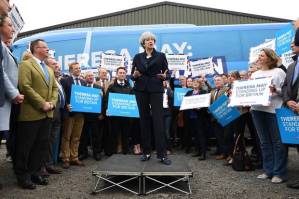
Theresa May - Conservative campaign bus - photo op campaign phony

Support Semi-Partisan Politics with a one-time or recurring donation:

Agree with this article? Violently disagree? Scroll down to leave a comment.

Follow Semi-Partisan Politics on TwitterFacebook and Medium.

Conservatives Are Conceding The Battle Of Ideas Without A Fight

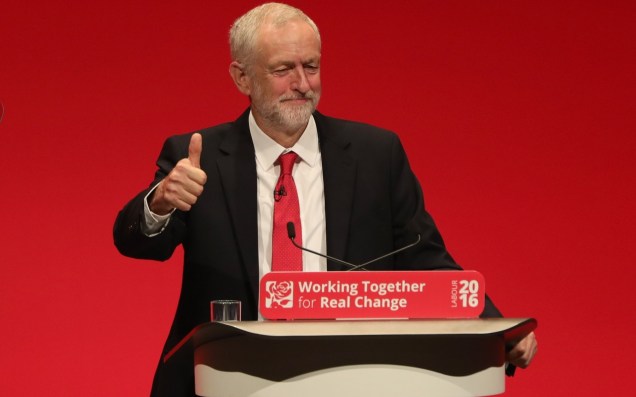
Jeremy Corbyn thumbs up

Jeremy Corbyn’s Labour Party is hard at work promoting their beguiling new left-wing vision for Britain while the Tories offer nothing but drudgery and incompetence

Every day now brings more ominous warning signs for the squabbling, directionless Tory government that the only people in Britain offering a clear, articulable vision for the country are those on the Corbynite hard-left wing of the Labour Party.

Four months after the general election, and all of the political energy and momentum is still on the Left. Jeremy Corbyn is more wily than he was in 2015, less prone to gaffes or accidentally handing his enemies the initiative. His centrist rivals have fallen into line, discredited and with no strong candidate to unite behind. Moreover, while most conservatives spent the summer licking their wounds far from the ideological field of battle, Momentum continued to organise and prepare for what they believe is one final push required topple the Tories and seize power.

And this newfound confidence is starting to creep into the rhetoric used by Labour politicians. Jon Trickett, Shadow Minister for the Cabinet Office, writes this week in LabourList:

There was a time after the second world war when government saw its central role as creating a socially just Britain where full employment, adequate housing for all and free education was the right of the many.

In that time, there was always more to achieve but the national sense of purpose was clear.

It was a time when jobs were secure and for the long term. Policy was designed to make communities feel secure, when the past was a bad place of mass unemployment, slum housing and no hope. But the future was full of promise, where strangers were welcomed into communities because no one felt their jobs were under threat.

And in the time, it was not acceptable that the growing wealth of the country was only distributed to the wealthiest.

A coherent set of progressive values aimed at building a social contract in which we had a sense of duty to the community, and the country agreed to stand behind those who could not care for themselves.

Note what Trickett is doing here. He is building a narrative, talking about the kind of country we once were and citing the great endeavours from our past in order to build a link with the present and generate enthusiasm for future Labour policies.

President Lyndon B. Johnson did something very similar (albeit at a much more sophisticated level) when introducing the Great Society initiative in 1964, not merely proposing a raft of random new socialist programmes but making them collectively seem almost inevitable by deliberately linking them with the American founding, history and national destiny:

The purpose of protecting the life of our Nation and preserving the liberty of our citizens is to pursue the happiness of our people. Our success in that pursuit is the test of our success as a Nation.

For a century we labored to settle and to subdue a continent. For half a century we called upon unbounded invention and untiring industry to create an order of plenty for all of our people.

The challenge of the next half century is whether we have the wisdom to use that wealth to enrich and elevate our national life, and to advance the quality of our American civilization.

Your imagination, your initiative, and your indignation will determine whether we build a society where progress is the servant of our needs, or a society where old values and new visions are buried under unbridled growth. For in your time we have the opportunity to move not only toward the rich society and the powerful society, but upward to the Great Society.

In fact, this is a simple device which even mediocre politicians and rhetoricians were once capable of using before technocratic centrism sucked the soul and energy out of politics. It is the exact opposite of anything written or spoken by a Conservative minister in Theresa May’s administration, because great political rhetoric can only exist when there are great ideas to be expressed or arguments to be won.

Trickett goes on to give a perfunctory but devastating indictment of the state of Britain under the Conservatives:

But now you would struggle to discover a shared sense of national purpose. You could describe a sense of anomie in Britain where a sense of common values, duty to others and co-operation for shared ends are, to one extent or another, lacking.

Too often: post-industrial communities have been abandoned; young people have less hope than ever before of acquiring a home at reasonable cost; education has become a commodity rather than a public good; where that which was common is frequently private or suffering from severe spending cuts; and, where the wealth of the most privileged is growing exponentially at the expense of the rest.

How do we explain this shift in the national culture?  Or rather, how do we account its disintegration and fracturing? Is this a uniquely British problem? And can we begin to rebuild a renewed socialist project based on 21st century.

At this point a five-alarm fire warning should be sounding in CCHQ and inside the head of every single Tory or small-C conservative in Britain, because Jon Trickett has just eloquently and concisely diagnosed the ailments of modern Britain – the fact that we are effectively drifting as a nation with no core unifying purpose or attachment to one another and a diminishing sense of obligation to our fellow citizens. In other words, Trickett has created an itch, a burning discomfort with the status quo, and now stands ready to offer voters the calamine lotion of Jeremy Corbyn’s socialist policies.

One does not have to agree that building “a renewed socialist project” is the answer. The point is that Trickett has clearly defined a problem and proposed a solution, all in the space of three short paragraphs. The Tories, meanwhile, are stuck defending a mediocre record with the huge distraction of Brexit, and seem to be loudly insisting that everything is great despite mounting evidence to the contrary (see Universal Credit). They have chosen to be cheerleaders for the status quo rather than agitators for change, even though the Conservative leadership election-that-wasn’t last year presented the perfect opportunity for unflinching self-assessment followed by an ideological reset.

That opportunity was squandered. And it has really come to something quite appalling when a Labour politician is responding to the priorities of this blog before the Tories pay proper attention. Jon Trickett is hardly known as Labour’s greatest thinker, but at least he understands that mandate-bestowing electoral victories are won on the back of selling the electorate an inspiring vision for the future.

Having a narrative is important. Good leaders and successful political movements understand this. The Attlee government alluded to by Jon Trickett certainly had a clear vision of the New Jerusalem they wanted to build out of the rubble of war. Margaret Thatcher had her urgent mission to save Britain from a failing post-war consensus and terminal national decline. Even David Cameron had his “Big Society”, an idea which might have been genuinely transformative if only it was bolstered with more thought and political courage.

In America, Franklin Delano Roosevelt had his “New Deal”. LBJ championed the “Great Society”. Ronald Reagan beguiled the nation with his promise of “Morning in America” after years of perceived stagnation under presidents Ford and Carter. And while President Obama’s soaring rhetoric often exceeded his relatively pedestrian governing agenda, his 2008 message of “hope and change” also strongly resonated with many Americans (including millions who deserted the Democrats to vote for Donald Trump in 2016 after no positive change appeared in their lives).

British politics has been stuck in such a dismal slump because for two decades an incredibly narrow, self-serving consensus was allowed to crowd out all other perspectives. And while this consensus served many people fairly well, its policy outcomes focused almost exclusively on funnelling material benefits (either wealth and career opportunities or literal welfare benefits) to certain specified groups of people rather than calling all of us together as a society united by a common bond, culture and purpose.

That approach has been found wanting. When the bipartisan political consensus (favouring EU membership, social liberalisation, globalism and corporatism) goes unchallenged it feels no need to respond to the concerns of those who do not benefit from existing policy. That is why for all the material progress seen in Britain we are still blighted by low productivity, family breakdown, divisions over immigration and a lack of any meaningful government response to the negative side-effects of automation, outsourcing and globalisation.

By electing Jeremy Corbyn as leader, some within the Labour Party recognised that continuing to stand up for a failing political consensus was no way to address these problems or win a decisive mandate for left-wing government. As incumbents, the Tories were left as the only major party championing the status quo, and rather than develop a radical, inspirational right-wing message of their own they continued to double down on bland, uninspiring centrism under Theresa May.

What makes it especially galling that the Left rather than the Right have recognised the need for a positive, bold new narrative is that it is the Left who are most in thrall to the Cult of Identity Politics which does so much to atomise society and make people see themselves as members of persecuted identity groups first and foremost rather than fellow citizens of a united country. Somehow, despite this increasingly prevalent mindset within their ranks, some on the Left still managed to recognise the need for a coherent, inspiring national message, a message with the potential to unite a broad swathe of society behind it (though whether it succeeds is another matter).

As John Prescott boasted earlier this year:

Finally, we’re talking about ideas and policies – not splits and personalities. Twenty years ago next month, Labour won an ­election landslide because we were united, trusted and had policies people could understand. When we lost in 2010, I felt we lost our way. We didn’t want to defend our record in government and by 2015 we accepted Tory austerity.

At least Labour is now ­developing clear red water between us and May. Not with soundbites and brickbats, but with popular policies.

Ideas and policies over splits and personalities.

Meanwhile, what do the Tories offer? False promises of being “strong and stable”, a moronic slogan which described an unattainable state of being rather than a clear direction for the country. More dull, technocratic drudgery in which eliminating the budget deficit (painstakingly slowly) is considered an aspiration worth putting in neon lights and making the focus of their government. Division and incompetence on Brexit, with the only optimistic Tory voices now belonging to free trade fantasists who want Britain to unilaterally lower barriers to trade and who think that crashing out of the EU and defaulting to WTO trade terms is a smart decision. Barely concealed leadership rivalries between a cast of identikit Cabinet ministers who seem to be competing with one another based on personality rather than different visions for the country.

Yet even now, the Conservative Party has no idea of the terminal danger it is in. Despite a few plucky efforts to re-inject some proper thinking and ideas into the party, the prime minister and her Cabinet offer no real ideological leadership whatsoever. Consumed by Brexit (and doing a pretty poor job at that) they seem to have abdicated any responsibility for using government to lead the country to a better place. Everything they do is reactive and cynical, like Theresa May’s university tuition fee freeze and Chancellor Philip Hammond’s age-based tax proposals, transparently cynical attempts to court the youth vote which are laughable in their inadequacy.

A couple of days ago I mused about whether the Conservatives can renew themselves ideologically and spiritually while still in office. This already slim prospect looks less and less likely by the day, both because senior people within the Tory Party seem to be too busy lurching from crisis to crisis to see the bigger picture and because all of the ideological energy and political momentum is on the Left right now.

And where there is new conservative thinking, it tends to counsel more, not less, accommodation with the Left. Some MPs, like Sam Gyimah, talk the right language of purpose and ambition but then disappointingly default to predictable, Left-leaning “compassionate conservative” solutions. And even these efforts at conservative renewal tend to focus more on what the government could and should do for us rather than what we collectively might accomplish together as a people. Time and again, the present Conservative Party capitulates to the Left and apologises for its own principles.

This is frustrating because conservatives should be able to come up with a far more inspirational, compelling message than the one they have been peddling. The Left’s entire focus is fixed firmly on inequality. Yet even die-hard Social Justice warriors would surely admit that equality is a hygiene factor, the absolute baseline for which society should aim (though they might then go on to disagree about whether equality or opportunity or outcome should be the goal).

Therefore, as eloquent as Jon Trickett’s words are – and as much as they should scare conservatives who are yet to join the ideological battle – equality remains insufficient as an organising principle for society or a shared national ambition. We need more concrete goals toward which we can all strive and move together, while in the background we are working hard to achieve a just society (however we choose to define it).

And luckily for conservatives, this is what the Left still does not get. Though they have woken up to the need to talk in terms of vision and ambition while the Tories are still lost at sea, the Left still sees achieving equality as the ultimate goal. One gets the distinct impression that many on the hard Left would not much care if we never really accomplished anything great as a country and even regressed somewhat in terms of material comfort and economic development, so long as society was flattened and the gap between rich and poor reduced. To listen to many a Labour speech, one almost pictures a country with a state-of-the-art NHS hospital on every street corner but a population so busy marvelling at their wonderful state of equality that they forget to go out and change the world.

So there remains an opportunity for conservatives to sneak in with an improved narrative and national ambition, one which aspires to something more than mere equality. Something which actually seeks to organise and harness the best of our energies and skills as we strive to make our country and the world better, not just more equal. Such a vision, carefully crafted and persuasively argued, would beat the Left’s narrow-minded focus on equality any day of the week.

So who will step up to the challenge and help develop a worthy conservative response to the re-energised Left? Because right now they are the ones fizzing with energy and ideas, while conservatism seems content to trudge wearily to its grave, quite possibly dragging the country along with it.


UPDATE – 17 October

Evgeny Pudovkin makes some good points over at Comment Central, specifically around how the Tories can potentially keep Theresa May in place as a “bad bank” repository for public dissatisfaction with the status quo while developing new ideas and new talent in parallel:

Some argue for replacing May with a fresh candidate who could offer the Tories a new vision. Yet May is still at Number 10 due to the very reason of her being a fulfiller and not a prophet. Her main role entails overseeing already introduced reforms – Iain Duncan Smith’s Universal Credit, George Osborne’s Northern Powerhouse, the house building programme and, indeed, Brexit. That doesn’t leave much time for blue-sky thinking, at least not until future relations with the EU are at least broadly defined. Just what exactly will toppling May achieve, apart from spawning new rivalries?

Any vision for post-Brexit Britain must be cultivated in parallel with May’s premiership. First of all, prospective candidates should establish a stronger presence on social media. The time when David Cameron could simply dismiss digital communication with his “Britain is not Twitter” jibe is over. As historian Niall Ferguson explained (here and here), the successes of both Donald Trump and the Leave campaign can be explained at least partially by their presence on social media. Secondly, the next leadership candidate might want to spend more time with the grassroots. Finally, a prospective challenger could create a new platform for developing policy. The Centre for Policy Studies served an important vehicle for Thatcher’s revolution, while Policy Exchange helped to inject a more coherent vision into Cameron’s project.

The dichotomy between May’s stable rule and the need to reinvigorate the Tory party is false. You can do both at the same time.

I agree in principle. Of course, this approach depends entirely on the public retaining patience with the Tories long enough for them to come through the other side of Brexit with an attractive new philosophy of government ready to go and an equally attractive leadership candidate to pick up the torch.

Right now, I struggle to see where the seeds of a new 21st century conservatism are germinating. Certainly the think tanks are nothing like the humming centres of creative energy that they were back when they propelled Margaret Thatcher to power with a copy of the Stepping Stones report in her pocket.

On paper, what Evgeny Pudovkin proposes makes perfect sense. In practice, I don’t see where the new ideas or the leadership talent are going to come from. I sincerely hope that this is due to my political myopia rather than a genuine dearth of new ideas within the British conservative movement, but I do not think it likely.


British Ambition - underground tube sign

Support Semi-Partisan Politics with a one-time or recurring donation:

Agree with this article? Violently disagree? Scroll down to leave a comment.

Follow Semi-Partisan Politics on TwitterFacebook and Medium.

In My Version Of The British Dream, Leaders Acted With Integrity

BRITAIN-POLITICS-EU-BREXIT

The World, Transformed

I saw this:

A traumatised and bedraggled family, still wearing the pyjamas in which they fled their smoke-filled flat in Grenfell Tower, were huddled together when the prime ministerial motorcade swept up outside the impromptu crisis centre and Theresa May strode through the open door accompanied by a single aide and minimal security, having dismissed police advice to maintain close-quarter protection at all times.

There were jeers, boos and some pointed profanity shouted in her direction as her entourage passed the crowd gathered outside, but the prime minister walked on unfazed and immediately approached the family, pointedly spurning the reception line of Kensington & Chelsea Borough Council officials assembled to greet her. The husband looked brittle, angry and ready to snap while his wife, in shock, stared blankly ahead.

But before either of them could speak, Theresa May knelt down and spoke to their two small young children. It was as awkward for those watching the scenes on television as it was to be there at the scene – the prime minister was not a natural empath at the best of times and as uncomfortable around children as she was in any other unscripted setting. But still she spoke quietly and reassuringly to the children while the cameras flashed, and produced some little toys from her bag before standing up to speak with the parents.

Again, it was awkward. The parents, still in shock, were monosyllabic and uncertain of what to say, but already some left-wing agitators gathered outside had decided that the inferno was the fault of the Conservatives and were chanting about the Evil Tories having blood on their hands. Over the muffled chants, however, the prime minister could be heard promising the family that they would be spending the next night together in a local hotel, and she would personally ensure that the Office of the Prime Minister, not anybody else, would secure them alternate local accommodation as soon as possible. As she went off to speak to other survivors, her aide followed behind, taking the details of each family and repeating the same assurances. Firefighters were still pumping jets of water onto the smouldering tower as the sun rose in the sky; the Mayor of London and Leader of the Opposition would not arrive for several hours yet.

As it became clear that Britain’s disaster preparedness and response plans were woefully outdated and inadequate, with poor coordination between the local council, emergency services and the Red Cross, Theresa May became a frequent fixture in the shadow of Grenfell Tower over the coming days. The hostility of the crowds became worse, if anything, and some of the survivors were understandably very angry, providing newspaper editors with choice quotes of criticism and TV news editors with more than one video of the prime minister being angrily dressed down by survivors.

But undeterred, the prime minister kept coming back. Though her security detail now maintained a more high-profile presence, the prime minister was frequently onsite, being briefed by response leaders and answering questions while her husband helped to coordinate donations and supplies. Once the immediate crisis was over, May gave a speech admitting that Britain’s disaster response plans were not fit for purpose, and pledging to create a new unified agency to take charge of Britain’s resilience against disasters both natural and man-made. Even many of her political enemies had to grudgingly admit that she had displayed real leadership in difficult circumstances.

This all happened shortly after the prime minister had finally imposed some order and discipline on her fractious Cabinet, pointing out to the Brexit Ultras that getting 100 percent of what they wanted on the back of 52 percent of the vote and an EU referendum question and campaign which deliberately avoided specifics was not reasonable.  Boris Johnson and several others had made their displeasure known and even sought to destabilise her position as leader, with Boris effectively drafting his own personal Brexit manifesto in the Telegraph. Theresa May’s response was swift and unforgiving, warning Boris Johnson and other rebels to fall in line or be sacked and personally denounced from the podium at 10 Downing Street. The next day Boris gave a contrite press conference in which he acknowledged May’s leadership and admitted that he was in fact not the sole custodian of Brexit, before being sent by the prime minister on a long diplomatic tour of South America.

There was still loud discontent in Parliament about the government’s Brexit stance, not helped by mischief-making and uncertainty from the Labour Party. But Theresa May made it clear in all of her speeches, press releases and PMQs appearances that Brexit is a process, not an event, and that the best way to abide by the verdict of the 52 percent while acknowledging the 48 percent was to seek continued participation in the single market in the short term by applying to rejoin EFTA and trading with EU countries through the EFTA-EEA agreement in the short to medium term. She acknowledged that this interim step out of the orbit of the EU would offer only limited and largely untested tools to manage the free movement of people, a sticking point for so many, but pointed out that through this mode of Brexit, any retaliatory measures taken by the EU in the face of democratically determined UK immigration restrictions would at least not then automatically impact the entirety of our trade with the EU.

But still there was discontent and rumours of plots. So Theresa May issued a public challenge from the garden of Downing Street, daring Labour to call a vote of no confidence in her government and plunge the country back into chaos, and to her disloyal Cabinet members to fall in line or prepare to hand their ministries over to Jeremy Corbyn’s government-in-waiting. This bold, conciliatory stance on Brexit paid off. The grumbling died down, and Theresa May went into the Tory Party conference in Manchester strengthened and respected, if still widely disliked by many.

And what a conference it was. Nobody had any great expectations for the Conservatives, particularly given the distrustful atmosphere in Cabinet and after Jeremy Corbyn cemented his iron rule of the Labour Party by delivering a triumphalist, ambitious left-wing credo. But for once in her political life, Theresa May surprised everyone. Freed from the pernicious influence of her old Red Tory brain trust, May showed a new willingness to listen to the Right of the party, on the condition that they applied their small government values to coming up with new solutions rather than simply reheating the old Thatcherite medicine of the 1980s.

Her conference speech, though marred by a prolonged coughing fit, a juvenile protester and the gradual collapse of part of the stage, was the complete opposite of her first outing in 2016. It was an acceptance that the dour, paternalistic, technocratic approach to government she had championed in her first year had inspired zero enthusiasm in the public, and that the Conservatives could not expect to win based on scaremongering about Venezuelan socialism or overwrought insults to Jeremy Corbyn.

The prime minister took responsibility for the awful 2017 general election campaign, pledging that henceforth the Conservatives would be a party of ideas, that the status quo was something unacceptable, not something to be preserved, and that only the Tories could be relied upon to preserve the best of tradition while orienting Britain to meet the challenges of this century. And the British media, showing a renewed dedication to serving the public interest by reporting seriously on policy over spectacle, gave the speech the hearing it deserved. Within two days, nobody remembered the prankster or the coughing fit.

But having set out these goals in her speech, Theresa May also made clear that she would not fight the next general election, but rather would step down at some point after the formal EU secession was complete to make way for new leadership. She did this knowing that it would ignite speculation about her likely successor, but maintained that neither the Conservative Party nor the country would benefit from a hasty leadership election – that potential Tory leaders needed time to think about their ambitions Britain as well as their career ambitions. By announcing this long-term intent, May enabled the Conservatives to finally begin a meaningful debate about what conservative government should look like in the 21st century. Ideas were debated, not policies floated, dissected, discarded or refined.

After a long period of questionable value added to British politics, the right-wing think tanks took on a new lease of life, finally becoming incubators of radical, civic-minded policy rather than mere enablers and cheerleaders for a very narrow agenda. The IEA, Centre for Policy Studies and Adam Smith Institute became among the most exciting places to work in Westminster, the mediocre-but-well-connected hires having been pushed out to make room for thinkers of real vision and expertise.

Because of this ideological renewal, when potential future Tory leaders did eventually start to manoeuvre for position they were forced to appeal to would-be supporters by convincing other MPs (and the general public) that they had the best ideas, as well as the courage and leadership skill to enact their agenda. No longer was it enough to appeal to the vanity or career aspirations of junior MPs with offers of advancement, or woo them over sushi and sandwiches.

And when Theresa May eventually stepped down as promised, one year before the next general election, her strategy paid off handsomely. In hindsight, her successor was a natural choice – someone with solid small government credentials but not an ideologue imprisoned by 30-year-old dogma. Someone able to talk up rather than down to the nation, unafraid to show a bit of poetry in their rhetoric but equally comfortable talking with voters at the local pub.

Theresa May’s successor came from a humble background and a history of community and philanthropic involvement, a walking refutation of leftist charges that conservatives are selfish, callous and born to privilege. But more than all that, the new prime minister was someone with a burning mission to improve Britain and a desire to help their fellow citizens help themselves. Someone who promised to inject some ambition and a sense of direction back into Britain. Someone whose conception of the journey ahead extended beyond the moment they stepped across the threshold of 10 Downing Street.

The 2022 general election would be a close-fought race, but at least the Tories now respected the threat posed by Corbynite Labour and stepped up their own efforts in response. The Conservatives had pulled off that most difficult of manoeuvres – a major ideological course correction whilst in government – but Jeremy Corbyn’s Labour Party were still riding high, level in the polls. For the new prime minister to truly cement their authority, a convincing general election result was needed to usher in an intake of new Tory MPs fully committed to the new project – and to sweep out a lot of dead wood from previous administrations (though Theresa May had graciously agreed to remain in Cabinet as Minister for Citizenship).

And there were some encouraging signs. While Jeremy Corbyn continued to attract support by offering free things to millennials, it appeared that Generation Z which followed them were more independent and receptive to a conservative message now that it was being delivered boldly and unapologetically. A nascent conservative youth movement was reborn. Campaign events were held in real public squares encouraging real public interaction rather than being clinical press photo opportunities with distant party activists brought in by bus. These campaign stops were used to discuss ideas, not transmit soundbites, and when the inevitable public heckles and hostile media questions occurred, the prime minister was fond of quoting John F. Kennedy, calling for people to ask not what their government can do for them, but what they can do for their country, and for their fellow citizens.

There was even a positive public and media response to the Conservatives’ new slogan and title of their 2022 election manifesto, which rejected the usual pandering platitudes and simply read: Dare Mighty Things.

It made me feel as though there is hope for our political class, for conservatism and for our country.

That is what I saw this week.

I should note – this part is true – that I saw much of this while slumped over, asleep at my desk after a long and tiring week. For an hour afterward, even knowing it was either a fantasy or a dream, I felt so . . . hopeful. Cheerful. Proud. I give it to you.


This article is inspired by the great Peggy Noonan, an homage to her recent Wall Street Journal Op-Ed re-imagining the Trump presidency in an alternate America where civic virtue is still valued. If I manage to become one tenth of the writer that Noonan is, all these years of blogging will not have been in vain.

Dare Mighty Things

Support Semi-Partisan Politics with a one-time or recurring donation:

Agree with this article? Violently disagree? Scroll down to leave a comment.

Follow Semi-Partisan Politics on TwitterFacebook and Medium.