The Green Party, 60% Income Tax And Lessons From The West Wing


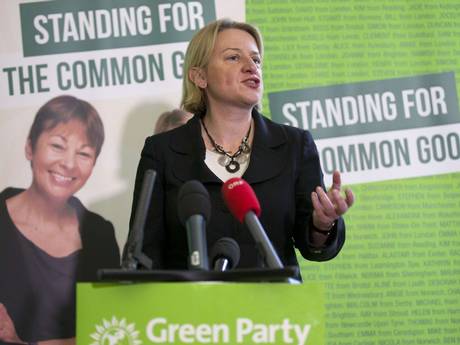
Natalie Bennett and the Green Party decided to use (or rather, waste) one of their rare moments in the media spotlight this weekend to announce their grand plan to levy a 60% marginal income tax rate on anyone earning over £150,000 a year.

The Greens are not even approaching the issue apologetically, with the tired old claim that confiscatory rates of income tax are necessary to fund public services. No, now they are suggesting that wealthy Brits should be hit with punishing rates of tax because apparently Britain’s brightest minds, shrewdest investors and most successful entrepreneurs “take too much” out of our society:

The highest earners would face a 60p top rate of tax under Green Party plans to make the richest “pay back” to society and deter companies from paying “excessive” salaries.

Britain’s top earners currently face a 45p rate on income over £150,000 but Natalie Bennett, the Green Party leader, claimed that they deserved to pay even more.

“What this 60p is for is really to identify the fact that some people are taking too much out of our society, they need to pay back,” she told the BBC’s Andrew Marr show.

You read that right. The Green Party actually believes that the people who invent things, make scientific breakthroughs, create jobs, run Britain’s top industries and make our art and culture the finest in the world take stuff out of our society. The people who already pay the most tax and keep our precious public services ticking over are nothing more than parasites, according to Natalie Bennett and the Greens.

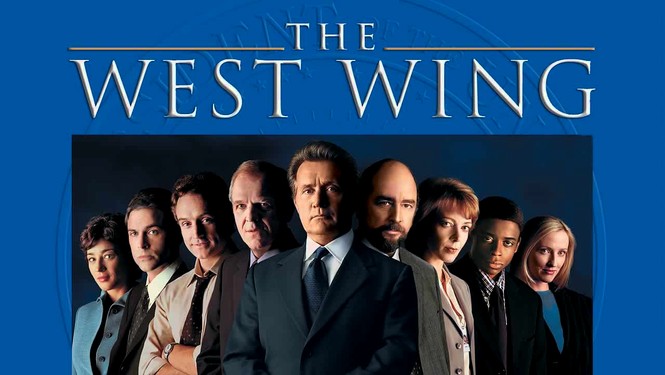
Clearly Natalie Bennett is not a fan of hit US television show The West Wing. If she was, she would know that even starry-eyed left wingers like fictional President Bartlett’s speechwriter, Sam Seaborn, accept that it is unseemly to bash the rich while taxing them to death at the same time.

In one very memorable quote (see the video above), Sam Seaborn says to a union boss:

“Every time your boss got on the stump and said it’s time for the rich to pay their fair share, I hid under a couch and changed my name. I left [my old job before going into politics] making $400,000 a year, which means I paid twenty-seven times the national average in income tax. I paid my fair share. And the fair share of twenty-six other people. And I’m happy to, because that’s the only way it’s going to work. And it’s in my best interests that everybody be able to go to schools and drive on roads.

But I don’t get twenty-seven votes on election day. The fire department doesn’t come to my house twenty-seven times faster and the water doesn’t come out of my faucet twenty-seven times hotter. The top one per cent of wage earners in this country pay for twenty-two per cent of this country. Let’s not call them names while they’re doing it, is all I’m saying”.

Hard to put it much better than that.

Of course, the Green Party delight in the fact that their radically “alternative” politics place them far to the left of even staunchly left-wing opinion.

But given the harm that a 60% top rate of tax would do – and it would be a catastrophic act of economic self-harm, based on Britain’s historical experience and the cautionary tale now underway in France under President François Hollande – even supporters of greater wealth redistribution may well think twice before endorsing this ruinous policy.

Meanwhile, the rest of us are left to wonder exactly what kind of twisted mind convinces itself that success is a bad thing, to be punished and discouraged at all costs?
The West Wing Green Party Natalie Bennett Sam Seaborn - Taxing The Rich - General Election 2015

Natalie Bennett, 60% Income Tax And The Dark Heart Of The Green Party

Natalie Bennett Green Party Income Tax Top Rate 60 Per Cent General Election 2015 2


Imagine an economy that gives everyone their fair share.

That’s what the Green Party website asks us to do, as they pitch their alternative, brave new world to the British electorate.

Put aside the fact that the very idea of a “fair share” is completely meaningless, rendering itself open to redefinition and misuse in any number of ways. What matters is that the Green Party views the economy not as a diverse group of individuals with their own talents, skills and interests, but as a monolothic entity entirely separate from the people, a money-making machine to be cranked up and raided at will in order to fund the social objective of the day.

When you view the economy in this way, it’s natural to see the people who produce and contribute most to the “economy machine” as nothing more than resources to be raided and exploited for the greater good, not as human beings with their own hopes and dreams (and the ability to pick up sticks and move elsewhere if they find themselves being bullied by Big Government).

And it is partly this toxic mindset which drives the Green Party to propose a new 60% top rate of income tax, not just for the yacht-owning super-rich elite but on anybody earning over £150,000 per year.

From the BBC’s report:

The Green Party has announced it would put up the top rate of tax to 60p in the pound.

Party leader Natalie Bennett claimed the move would bring in an extra £2 billion a year for public services.

She said the Greens would like to see a “ten to one ratio between the top paid and lowest paid”.

Not contenting themselves with confiscatory rates of income tax, the Green Party also propose stealing peoples’ hard-earned wealth, which has of course already been taxed at the point it was created (and, in the case of inheritance tax, passed down the generations):

Continue reading

Resisting The Evil Tory Austerity Agenda Through The Power Of Poetry

Austerity poem - David Schneider - Conservative Party


Meet Dave Schneider.

Dave is an actor (as well as being a writer, director, coach, voiceover artist and social media guru).

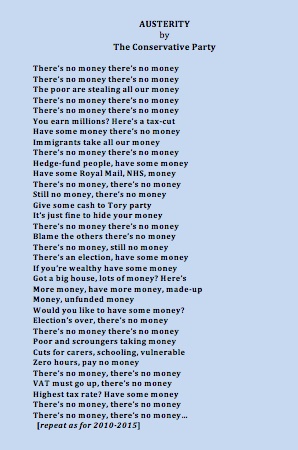
But despite the demands of his multifaceted career, Dave still managed to have a good, long think about the injustices of “austerity”, and produce this gem of a poem.

Here’s the best bit:

There’s no money there’s no money

Hedge-fund people, have some money

Have some Royal Mail, NHS money,

There’s no money, there’s no money

You get the drift.

Naturally, all money belongs to the state, and exists to be parcelled out equally among all British citizens (as well as anyone else who wanders across the English channel, apparently). So Dave Schneider is able to talk about “NHS money” and “Royal Mail money” with a straight face, because as far as he is concerned, money doesn’t belong to the entrepreneurs, risk-takers or investors who create it – it all belongs to the government.

Thus tax cuts are phrased as “have some money” from the state, because in the world according to Dave Schneider, the money never belonged to the people who created it in the first place.

So let’s all join in a rousing chorus of “There’s No Money”. And when we have memorised and recited the Austerity Poem, perhaps there will be time left over to perform some pro-NHS propaganda street theatre.

After all, there’s no such thing as bad art among the anti-austerity crowd.


h/t Vickster51Corner.

UKIP’s Subdued 2015 Election Broadcast: “Believe In Britain”


The first of UKIP’s party political broadcasts for the 2015 general election sets quite a different tone and mood than we are used to from the party. In fact, everything about the broadcast, now viewable on YouTube, seems designed to confound the expectations and prejudices of those who are reflexively opposed to UKIP and Nigel Farage.

Yes, the subject of immigration – UKIP’s key vote winner – is discussed in some detail. But this is the only context in which the European Union is mentioned, perhaps reflecting the party’s realisation that “banging on about Europe” is not attractive to voters in itself, and can only bear fruit when clearly linked to other subjects that voters consider important – like the state of Britain’s schools and hospitals.

The broadcast begins with Nigel Farage, seated against a black backdrop, channelling Monty Python by saying “And now for something completely different!” before breaking into a cheeky grin.

But what follows is neither laughably absurd nor tub-thumpingly, flag-wavingly nationalistic, which will no doubt come as a great disappointment to the party’s detractors.

Cue footage of Nigel Farage arriving at UKIP’s spring conference in Margate, greeting supporters and waiting in the wings while he is introduced before going on stage to deliver his speech. We then snap away to a voiceover, where Farage explains:

“UKIP was founded because people like me who were businessmen, not involved in politics at all, felt our political class were disconnected from ordinary people and were taking the country in the wrong direction. I think the point about UKIP, and the reason we call it the People’s Army, is it’s ordinary folks against the political class. That we’re a broad-based party and you’ve got people from all different walks of life, all classes, all races, all ages, and we want change”.

This is good counter-argument to those on the left who insist that Nigel Farage is every bit as much a part of the establishment as David Cameron or Ed Miliband, simply because he went to a private school and worked in the city – while overlooking the fact that Farage did not attend university, and makes the convincing case that he only entered politics because nobody else in Britain was advocating the policies that UKIP now champions.

When Farage goes on to claim that UKIP are “closer to the kind of conversations that go on in households up and down this country” not only is he likely right, he is also effectively rebuking the other party leaders – Ed Miliband is particularly guilty here – for their endless recounting of supposed interactions with “ordinary people” who just happen to think that they are doing a brilliant job, and who agree with their every policy pronouncement.

The broadcast then goes on to talk about concerns shared by nearly all British citizens, not just firm UKIP supporters – like worries about being able to afford a house, their children being able to find a good job, and whether the next generation will enjoy a better living standard than we enjoy today. When Farage bemoans the fact that “the rich are getting richer in this country, the poor are getting poorer and we want to do things, positive things, to help people” such as removing any income tax on the minimum wage, he sounds positively Labourite, not at all the Son of Thatcher.

It takes until the half-way mark until the first mention of “an end to uncontrolled, unskilled migrant labour coming into Britain and putting British people out of work” – as the camera cuts to the white cliffs of Dover. And then comes UKIP’s key message, placed very firmly in the context of needing independence from the EU to fully achieve everything else that the British people want: “I’m not against anybody, but I do think we have got to put the interests of ordinary British people first. We cannot have a net 300,000 people a year coming into Britain because of the impact on schools, on hospitals, on houses. But the problem is this: we cannot control our borders as members of the European Union.”

One man talking simply and honestly to the camera, contrasted with UKIP’s leader receiving a rapturous welcome at a local town hall meeting. With no tub-thumping and no scaremongering, no accusations or scapegoating of immigrants in sight. This calm and measured party political broadcast by UKIP is the work of a party no longer trying to expand its support base, but rather reassure their existing supporters that a vote for UKIP is “okay”, not something to second guess as polling day draws closer, or feel ashamed of as the other parties step up their attacks.

In an election campaign where Labour decided to wheel out the celebrity endorsements and the supposedly resurgent Green Party decided to squander any claim to seriousness with their boyband-themed election broadcast, UKIP decided to keep it simple – a sign of a party quietly confident of achieving gains, despite the barrage of attacks and a brace of new polls and articles suggesting that the party’s support is slipping back from its highs of late last year.

No dark warnings of invasion by foreigners. No union flag bunting. Not a single rendition of Land of Hope and Glory.

UKIP’s political operation is growing up. And the other political parties should be afraid.


UKIP Believe In Britain Party Political Broadcast General Election 2015

Rootless Tories Prefer LibDems Over UKIP As Future Coalition Partners

Nigel Farage Nick Clegg UKIP LibDem Coalition


An interesting (and concerning) poll in Conservative Home this week reveals that more Conservative supporters would prefer David Cameron to enter into a future coalition with the Liberal Democrats (again) rather than UKIP.

Paul Goodman breaks down the detail:

  • Liberal Democrats73 per cent. This finding may be a proof that familiarity doesn’t necessarily breed contempt.  To some degree it reflects the fact that Tories have simply got used to working with the LibDems.  It is also a tribute, in its own way, to the staying power of the Coalition: I put my hand up to not having expected it to last all the way to the end.
  • UKIP49 per cent.  Some members will see UKIP as a natural partner for the Party.  Others won’t, but will believe that differences can be fudged.  Others still, as with the Liberal Democrats, will feel that coalition is a price worth paying to keep a Conservative-led administration in office: in some cases, respondents will have selected both options.

What does it say about the modern Conservative Party and the mindset of its supporters, that they would prefer to enter into coalition with a party that is rabidly pro-EU and in favour of an ever-expanding public sector funded through ever-increasing tax bills on the successful, rather than UKIP, the party which (just about) believes in smaller government, lower and flatter taxes, personal responsibility, a stronger military and secession from the European Union?

The answer, of course, it that it says nothing good at all.

The fact is that some Conservatives have quite enjoyed having Nick Clegg and the Liberal Democrats as bedfellows for the past five years – the coalition has helped the wet Tories to cover their left flank, giving the party a plausible excuse for making little progress on shrinking the size of the state and zero progress on reclaiming power and sovereignty back from the EU.

But if the current course of the 2015 general election campaign tells us anything, it is that the bland centrism that characterises the modern Labour and Conservative parties is increasingly unattractive to voters. True, the smaller parties are seeing some shrinkage in their support as polling day nears, but we remain on course to see the largest ever number and percentage of national votes cast for parties outside the big three.

Whether left or right wing, people are finally getting tired of seeing their core convictions (be it trade union solidarity and income redistribution on the left, or personal liberty and small government on the right) bartered away in pursuit of ineffectual policies calculated to cause minimal offence to anyone.

Yes, the Tories still have work to do in order to detoxify their brand. But the answer is not for them to dress up in Labour Party clothing and bang on endlessly about the importance of public services and “our NHS”. Such an approach will never work – it has been tested to destruction by David Cameron and George Osborne, and has convinced no one.

To move to the left is to sidestep the issue and avoid the hard work detoxifying conservatism in Britain, when what is needed most is patient explanation and passionate promotion of the idea that small government and less state (and EU) interference in our lives would be something to celebrate, not to fear.

Here is an interesting – and different – way to frame the question to Tory activists and the Conservative Party leadership. Rather than simply asking whether they would prefer the devil they know or the devil they don’t when choosing a future coalition partner, let’s ask which of these UKIP policies and ideas have suddenly become so offensive to the modern Conservative Party that they would sooner jump back into bed with Nick Clegg than with Nigel Farage:

Sadly we already know many of their answers, and they give us very little hope for the immediate future of British conservatism.