Tim Montgomerie, The Good Right And The Battle For British Conservatism

David Cameron - Conservative Party - Tory Compassion - General Election 2015


With the opinion polls still neck-and-neck, David Cameron and the Conservative Party have good grounds to worry that they are not pulling ahead of Labour in the final month of the 2015 general election campaign.

The BBC’s poll of polls puts Labour and the Conservatives on 33% each, which, when constituency boundaries which favour the Labour Party are factored in, means that Ed Miliband’s party are potentially on course to win more seats than the Conservatives, throwing several highly unwelcome left-wing coalition scenarios into play.

Naturally, this is causing much hand-wringing both within the Conservative Party and the Tory-friendly press. But interestingly, much of the free advice being bandied about is encouraging the Conservatives to try to fight the election on Labour’s natural turf (such as emphasising the importance of public services), or to tack even further to the centre, in spite of UKIP’s challenge from the right.

The chief proponent of this strategy is Tim Montgomerie, who uses his most recent Times column (+) to argue that “a show of compassion” (whatever that means) from the Conservative Party could help to “swing the vote” in their favour. Montgomerie is absolutely correct in his diagnosis of the situation – an increasingly coddled, government-dependent British population representing unfertile electoral ground for the politics of individualism and self sufficiency – but hazy on his proposed remedy.

First, the good analysis:

The centre right has to worry that while Tony Blair was wooing Middle England it was really Gordon Brown who was running Britain. Blair was at the front of the shop but Brown was in the control room, overseeing the huge expansion in the number of people who received part or all of their income from the state. Even now, with austerity under way, 52 per cent of Britons receive more from the state than they pay in taxes. There are, to echo Mitt Romney’s infamous and ham-fisted description, more takers than makers. People who are dependent upon the state have every incentive to vote for bigger and bigger government and to get someone else to pay for it — especially, of course, “the rich”.

A redistributive, bash-the-rich message was exactly what helped Barack Obama defeat Governor Romney. If America, land of the free and home of the brave, was willing to choose big state interventionism over small state individualism then it’s hardly impossible that Britain might do the same in a few weeks’ time.

If ever there was a statistic to shock and shame British conservatives, it should be the fact that 52 percent of Britons are net financial beneficiaries from the state. In the conservative model society, there should be generous welfare support available for those suffering true hardship or disadvantage, but a level playing field and light-touch government regulations freeing everyone else to succeed to their potential.

Continue reading

Labour’s Arrogance Could Cost Ed Miliband The Election

Ed Miliband - Austerity - TUC March For The Alternative - Arrogance


With less than a month to go until the 2015 general election, the London Evening Standard (print edition) is currently running a Constituency Focus series, exploring the different dynamics and personalities at play in London’s diverse boroughs and constituencies.

Yesterday saw the focus on the constituency of Hampstead and Kilburn, this blogger’s home turf, with Labour candidate Tulip Siddiq featuring prominently. My own interview with Tulip Siddiq is here, and this blog’s overview of the electoral battle for Hampstead and Kilburn can be found here.

Today the focus moved to the west London constituency of Brentford and Isleworth, an area covering Chiswick, Isleworth, Brentford, Osterley and Hounslow, close to Heathrow Airport. Unsurprisingly, all of the main local candidates are proudly displaying their NIMBY credentials by opposing a third runway at Heathrow.

From the Standard:

In the Tory stronghold of Chiswick, the issue of school places dominates; while in the traditionally Labour-supporting parts to the west, NHS waiting times are the hot topic.

But the one issue that is a major talking point across the whole of the Brentford and Isleworth constituency is the proposed Heathrow expansion, which both the main candidates oppose.

Conservative candidate Mary Macleod won by just 1,958 votes in 2010, making this the 65th most marginal seat in the country. The constituency … is also one of the Tories’ 40/40 seats – 40 to win, 40 to keep.

But it is on the subject of austerity that a real difference is revealed between Labour and Conservative philosophies.

Ruth Cadbury, a long-serving Labour councillor and part of the Cadbury chocolate dynasty, is standing as the Labour Party candidate in the general election. And when she spoke about the level of Conservative support in the wealthier parts of her constituency, she had this to say:

Continue reading

UKIP Are Not The Ones Playing Politics With The Armed Forces

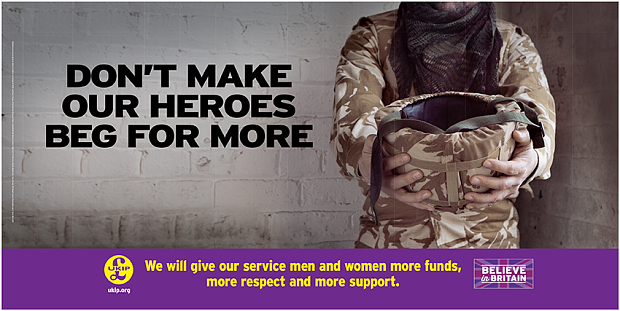
UKIP General Election 2015 Poster - Armed Forces - Dont Make Our Heroes Beg For More


UKIP’s latest election campaign poster is quite striking, and not just because it has none of the bland, derivative unoriginality that marks out Labour’s feeble effort to capitalise on public fears about ‘our NHS’.

The body shot of a soldier in camouflage gear, holding out his helmet as though asking for a donation, with the words “Don’t Make Our Heroes Beg For More” should prick the consciousness of the nation – in Britain we do far too little to fund our national defence, honour those who currently serve in uniform and support those who have borne the burden of keeping us safe.

The BBC summarises the UKIP announcement on defence:

UKIP has set out its defence policy, including a new independent veterans’ minister and a national defence medal for all members of the armed forces.

It would also cut foreign aid in order to spend 2% of GDP on defence.

The party said there was “not a cigarette paper” between the defence policies of the Conservatives, Labour and the Lib Dems.

Sadly, not everyone sees UKIP’s announcement as a good thing. The Conservative Party, perhaps having finally rediscovered their sense of shame at the way they have squandered their traditional position as natural party of the armed forces, has gone firmly on the attack, accusing UKIP of “playing politics” with the topic of defence.

From the Daily Mail:

A Conservative Party spokesman said Mr Farage was ‘playing politics with the military in a calculated and completely irresponsible way’.

He added: ‘We’ve balanced the defence budget after inheriting a truly enormous black hole from Labour. We have the second largest defence budget in Nato after the United States and will spend over £160 billion in the next decade on new military equipment.

‘It comes down to this: you can only have strong armed forces if you have a strong economy first. That’s exactly what this Government is delivering. Ukip would put that at risk – making it up as they go along and letting Ed Miliband into Downing Street by the back door.’

In truth, UKIP are not so much “playing politics” with defence as they are being the only party bothering to talk about what should be a central issue in 2015. Can UKIP really be blamed for daring to bring up the British government’s shameful neglect of our armed forces and military capability when the other major political parties are determined to bury their heads in the sand? Can Nigel Farage really be accused of political opportunism for bringing up an important topic for public debate when David Cameron and Ed Miliband would rather pretend that the issue did not exist?

Continue reading

Why Should UKIP Voters ‘Come Home’ To The Conservatives?

David Cameron UKIP Voters Come Home To The Conservatives General Election 2015


With only a month to go until polls open for the 2015 general election, the smart money is saying that Nigel Farage’s insurgent party, UKIP, are on the back foot.

A growing number of articles and opinion pieces are talking down UKIP’s prospects, citing poll results which point to a decline in UKIP’s level of support from recent highs of 20% back down to the mid teens, and even speculating that Nigel Farage could fail to win his seat of South Thanet and be forced to follow through on his plan to resign the party leadership if he does not become an MP.

Finally sensing weakness after months on the back foot, the Conservative Party have pounced with David Cameron using an interview on the Tory battle bus to appeal to disaffected former Conservative Party voters to “come home” and abandon their new allegiance to UKIP.

From the Telegraph’s interview with David Cameron:

Asked if he believes Ukip defectors are finally returning to the Tories, Mr Cameron says: “A little. I think that is beginning to happen. There are people who have been frustrated about wanting more changes on immigration, wanting more certainty about the situation in Europe and they can now see that we have listened to those concerns. The referendum is now there, as it were, on the ballot paper if I’m prime minister before the end of 2017.

They can see the tougher approach we’ve taken to immigration. They can see the changes we’ve made. And I think it’s the time for Conservative voters who went off to Ukip – it’s the time to come home. On the basis that the real choice in this election is economic mayhem and chaos under Ed Miliband, possibly backed up by Nicola Sturgeon, or the certainty of continued competence and growth under the Conservatives.

“This election is about choosing a government. It’s not a moment of protest. It’s not a moment to send a message. Those times are over.

“I would say to those voters who have concerns – message received and understood. Now please, come on, let’s get together and take the country forward and avert the danger of a Labour government.”

This is more than a little patronising.

Continue reading

General Election 2015: Dispatch From Hampstead And Kilburn

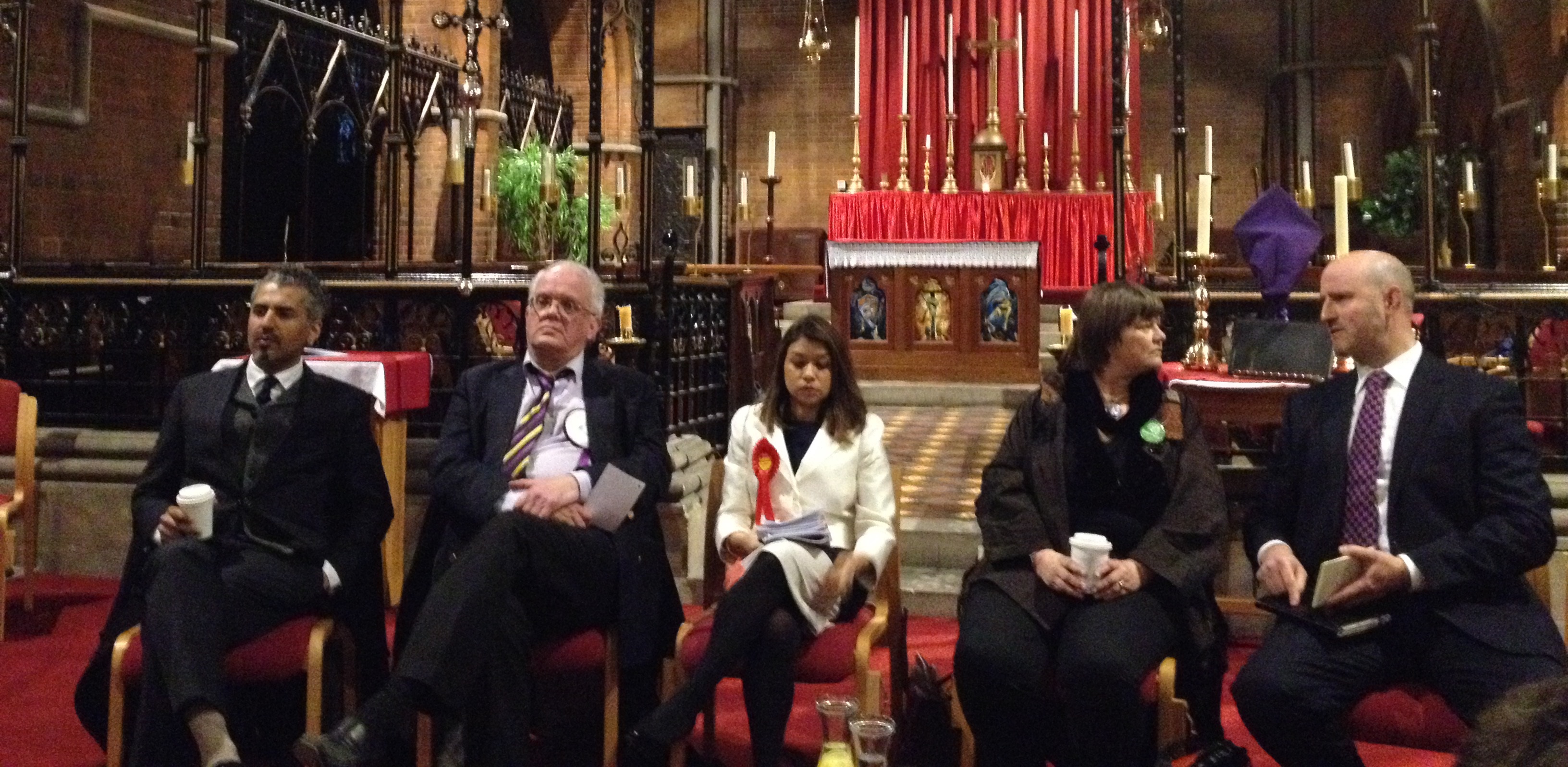
General Election 2015 Hampstead and Kilburn Candidate Hustings - Maajid Nawaz - Magnus Nielsen - Tulip Siddiq - Simon Marcus - Rebecca Johnson


The northwest London constituency of Hampstead and Kilburn was the tightest three-way marginal seat in the 2010 general election. Given the fact that the 2015 campaign is so closely-fought with none of the parties enjoying a clear path to outright victory, this should – on paper – be a fascinating local campaign to watch as general election 2015 approaches and Labour (minus current incumbent Glenda Jackson MP) attempts to hold and increase their wafer-thin majority of 44 votes.

But by and large, both the sense of anticipation and the bad tempered name calling or “low skulduggery” of the national campaign are entirely absent here. Local journalist Richard Osley attributes this to a form of “Stockholm syndrome” among the candidates, who have now appeared on stage together so many times that to begin tearing chunks out of each other a la Cameron and Miliband would somehow feel unseemly, and acutely embarrassing.

Says Osley, in a report from a previous hustings in the constituency:

The fact each candidate knows they have another set of evening dates ahead of them in the next month, events at which they will have to share tables together and say hello and goodbye nicely, means they have become all very pleasant to each other. It’s as if they don’t want to bring the big weapons out, because they know the person they are bazookering will be sat next to them again 24 hours later.

Last Wednesday saw the candidates participate in hustings organised by the local West Hampstead Life blog. I attended to watch and conduct interviews, and was struck by the quality of the local candidates (ideology aside, all have the potential to be good constituency MPs) but also the differing degrees to which the candidates were willing to deviate from their approved national party talking points.

The overall effect is one of a constituency expecting a Labour hold, but with all candidates willing to criticise the compromises and trade-offs of the current coalition government, and in some cases (particularly Simon Marcus, the Conservative challenger) quite happy to jettison fairly central policies and beliefs in pursuit of a more liberal but less overtly tribal local vote.

My interviews with the candidates, and thoughts on their respective campaigns, are shown below.

Continue reading