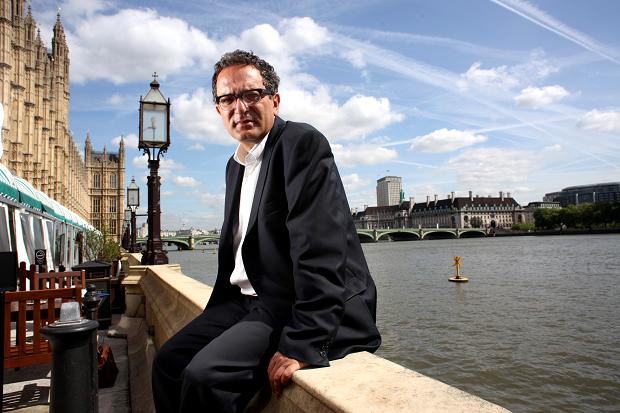
Maurice Glasman Makes A Thoughtful Left Wing Case For Brexit

Maurice Glasman - EU Referendum - Blue Labour - Brexit

Maurice Glasman’s thoughtful intervention in the EU referendum debate is more proof that left-wing thinkers who value democracy naturally gravitate toward Brexit

The glib, feeble left-wing case for Britain remaining in the European Union can basically be summed up as “don’t give us back democracy, because the British people might be so foolish as to demand conservative policies and vote for conservative politicians”. It is, in other words, profoundly and actively anti-democratic, springing from a toxic and elitist mindset which hates and distrusts the people.

Unsurprisingly, the great and the good of the modern Labour Party have therefore flocked to its banner, endlessly repeating the shocking (to them) warning that if Britain did not have certain values imposed from above by a higher authority in the form of the EU, the British people themselves might not be so enlightened as to choose left-wing policies for themselves.

This is a weak and contemptible argument, and those advocating it – from Jeremy Corbyn to Owen Jones to Yanis Varoufakis – should know better, and quite probably do know better, deep down. This makes their betrayal of British democracy all the more unforgivable.

But there is a left-wing case for Brexit of more substance and nuance, and Maurice (Lord) Glasman now makes it in LabourList. At its core is still the desire to favour left-wing politics in particular rather than seek to regain democracy in the abstract, but at least Glasman puts some actual thought into his argument.

Glasman concedes that the EU was flawed from the start:

Unfortunately, probably from the outset, and certainly by the Rome Treaty of 1957 a Jacobin tradition of unmediated space, emptied of decentralised institutions had asserted itself, particularly through the head of the High Authority, that became the European Commission, Jean Monet.  He asserted that economic exchange and legal uniformity would, over time, produce political unification.

Perhaps naturally, Glasman traces the EU’s decline firmly back to the accession of Britain in 1973:

Under the leadership of Edward Heath, who had a genuine feeling for the fate of Europe, Britain did join the Common Market, as it was called it for a long time.  It did not go well from that time on as the Common Market was not based on a shared political economy. 

Britain is an island and was always at an angle to Europe.  It avoided the continental territorial struggle for domination and developed a maritime rather than a landed economy as well as distinctive political institutions based upon the balance of powers within the Ancient Constitution. 

De Gaulle, in continuation with Napoleon, thought that all Britain cared about was free trade and the primacy of the City of London. He argued that the British State could never agree with either the administrative directives favoured by the French or the institutional co-operation embodied in the German Social Market. 

The difference between territorial rule underpinned by an army and central directives and a maritime economy based on the Navy and free trade was what was at stake in the Napoleonic wars.   In boycotting Britain and building a Europe of administrative conformity Napoleon continually blasted Russian, German and Austrian leaders for continuing to trade with Britain, which as a maritime power traded with the world.  Napoleon’s career ended when he voluntarily boarded a Royal Navy ship and was taken to a faraway island where his board and lodging was paid for by the City of London.  Despite the conclusive result of that conflict it was not the end of the argument. 

The political and economic systems of Britain and France was very significantly different.  Britain had dispensed with its peasantry during the last stages of enclosure and the Corn Laws, it had embraced the market at home as well as free trade abroad. On joining the Common Market the very unhappy marriage of Napoleonic directives and free trade objectives began which threatened the European Community’s earlier achievements of agricultural protection and worker participation.  The Common Market, or European Economic Community as it then became known, had been built on a substantive conception of an economy based upon agriculture and industry, land and labour.  Britain, in contrast, brought a model of a financial and services based economy in which free movement rather than social partnership was the primary goal of political union. 

And correctly identifies the anti-democratic black hole which appears when the EU technocracy instinctively recoils from the people and their dangerous passions:

As the European Union becomes more general, abstract and administrative it will naturally side with capital and directives, viewing politics itself as populist.  The reaction is already present within each European State. When I was in Berlin last weekend the AfD had surpassed the SPD in the polls.  When reason itself becomes desiccated and exclusively rational, severing itself from institutional judgement and historical experience it turns all forms of resistance into demagogy and madness.  And yet, democracy is the European way of resisting the outrageous claims of capitalism to own, commodify and de-contextualise human beings, nature and all civic institutions.  The tension between democracy and markets can no longer be resolved at the level of the EU, which through its inverted definition of subsidiarity in which the larger subsumes the smaller, is hostile to democracy, distinctive local and national institutions.

Obviously Glasman is particularly interested in democracy as a means for the people to resist what he sees as the “neo-liberal” agenda of the EU – he is not advocating Brexit for the pure sake of democracy. But at least democracy gets a look-in in Glasman’s argument, which is more than can be said of the Jeremy Corbyn / Owen Jones position, which unashamedly seeks to cling on to the European Union precisely as a means of suppressing British democracy.

Glasman’s conclusion is particularly devastating (my emphasis in bold):

For many years the European project has served as an alternative to Labour having a serious politics of national transformation, of building the coalitions necessary to constrain capital and strengthen democracy. It was a national political weakness that led to the enthusiastic embrace of the EU and it remains a refuge from domestic political defeat.  Labour should be robust in supporting free and democratic trade unions throughout Europe, in championing a balance of interests in corporate governance and strong civic self-government with a deep partnership between universities, cities and firms.  The question is whether being part of the EU hinders this.  Britain is already outside the Eurozone and the Schengen agreement.   It is gratuitous to remain part of a political union that is so hostile to diversity and democracy and so disposed to the consolidation of big capital that it has become a remorseless machine for the liberalisation of trade and the disintegration of society, in which the demand for liquidity has dissolved solidarity. Perhaps it is time to think again.

This really gets to the heart of it – the EU has indeed been an poor alternative to having a serious national political conversation about how we wish to govern ourselves. Labour are not exclusively to blame in this regard. Politicians from all parties have gladly surrendered power to the European Union, eagerly seizing the opportunity to keep the trappings of power for themselves while divesting themselves of ever more responsibility for the outcomes of decisions now made in Brussels.

And how refreshing it is to hear a personality from within the Labour Party actually suggest that maybe – just maybe – it should be the job of left wingers to argue their case in public and seek to convince the British electorate of the attractiveness of socialist policies rather than seek to bypass the electorate and impose social democracy from above via the EU.

In fact, Maurice Glasman, founder of Blue Labour, is exactly the type of voice that the Labour Party needs to listen to and place front and centre of their policymaking if they want to staunch the exodus of working class support from a party which increasingly resembles a middle class, creative industry, virtue-signalling talking shop.

A party which lost seats to the Tories because of traditional voters defecting to UKIP – and facing the prospect of Nigel Farage’s party nipping at its heels in a swathe of Northern constituencies – would make a place of honour for someone like Maurice Glasman, and perhaps even listen to what he has to say about the European Union.

But they can’t do it. Jeremy Corbyn and co. were happy to enrage the party establishment and donors on all manner of issues, from the Syria military action vote to their perceived tolerance of anti-Semitism. But on the crucial issue of Britain’s membership of the European Union, suddenly Stockholm syndrome kicks in and everybody robotically sings from the same worshipful hymn sheet. It’s pathetic.

There is still an element within the Labour Party that actually cares about the hopes, dreams, fears and priorities of the working class. But you won’t find it within Jeremy Corbyn’s inner circle, or the mainstream party in exile. This dwindling branch of the Labour Party is now much like the Popular Front in Monty Python’s “Life of Brian” – a solitary man, sitting on his own, ignored by everybody else.

In their unthinking support for the European Union, the shining practitioners of the New Politics have thrown the working class – indeed , everyone who loves democracy – well and truly under the bus. And at some point there will probably be a reckoning for that.

 

European Union - United Kingdom - Britain - Flags

Top Image: The Times

Agree with this article? Violently disagree? Scroll down to leave a comment.

Follow Semi-Partisan Politics on TwitterFacebook and Medium.

Segregation Comes To Glastonbury, In The Name Of Social Justice

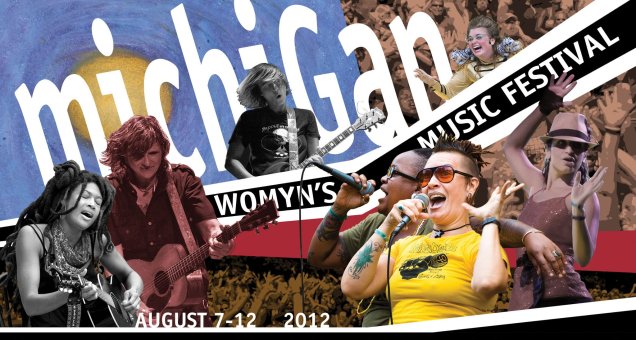
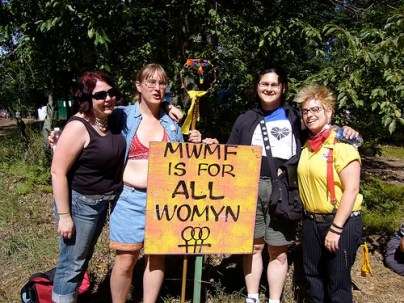
Womyns Music Festival 2

As if going to Glastonbury were not already insufferable enough, now those who do will implicitly be condoning segregation – in the year 2016.

Vice reports:

When you’re a woman, going to a festival brings a new set of problems, whether it’s batting off the advances of some limp chirpser in the healing field, or, worse, feeling unsafe in a space that has a serious and unaddressed problem of sexual assault. While some festivals have been attempting to tackle the issue with safety awareness campaigns, sometimes all you want to do is drink and dance in a space where those problems are less likely to occur.

This year at Glastonbury, for the first time, there will be a venue for women only, which will be tucked away in the Shangri-La zone of the festival. The venue itself is ran by an organisation called The Sisterhood, who describe themselves as an “intersectional, queer, trans and disability-inclusive space open to all people who identify as women”. All staff working in the venue will also be those who identify as women, whether they are the acts who are performing, bar staff or security guards.

“The producers of The Sisterhood believe that women only spaces are necessary in a world that is still run by and designed to benefit mainly men,” the festival organisers explained. “Oppression against women continues in various manifestations around the world today, in different cultural contexts.”

“In the UK, the gender pay gap in the workplace, cuts to domestic violence services and sex worker rights are current talking points that highlight this issue. Sisterhood seeks to provide a secret space for women to connect, network, share their stories, have fun and learn the best way to support each other in our global struggle to end oppression against women and all marginalised people, whilst showcasing the best and boldest female talent in the UK and beyond.”

If you think this defence of sexual segregation at Britain’s most popular music festival sounds more like a spiteful two-fingers up at men in general rather a defensive act in response to a specific threat, you would be quite right – The Sisterhood spent more time ranting about the “oppression” of women around the world than fretting about any specific perils faced by women at Glastonbury.

Digital Music News also questions the rationale:

The group dubbed this ‘the 1st ever women only venue’ on Twitter, though the rationale for the space seems less celebratory and pro-women, and frankly, more anti-male.

Still, ISIS would be thrilled with this segregationist nod to their hardline Islamist ideology. Or they would, if only music festivals weren’t themselves haram.


Womyns Music Festival

Safe Space Notice - 2

Agree with this article? Violently disagree? Scroll down to leave a comment.

Follow Semi-Partisan Politics on TwitterFacebook and Medium.

The Left’s Self-Righteous Fury Toward Donald Trump Turns To Violence

On campus and off, the Right are coming under attack in America. And one does not need to approve of Donald Trump to abhor the violence currently being directed at his supporters

The Washington Post reports on a disturbing turn of events:

Protests outside a Donald Trump rally in downtown San Jose spun out of control Thursday night when some demonstrators attacked the candidate’s supporters.

Protesters jumped on cars, pelted Trump supporters with eggs and water balloons, snatched signs and stole “Make America Great” hats off supporters’ heads before burning the hats and snapping selfies with the charred remains.

Several people were caught on camera punching Trump supporters. At least one attacker was arrested, according to CNN, although police did not release much information.

“The San Jose Police Department made a few arrests tonight after the Donald Trump Rally,” police said in a statement. “As of this time, we do not have specific information on the arrests made. There has been no significant property damage reported. One officer was assaulted.”

In one video circulating widely on social media, two protesters tried to protect a Trump supporter as other protesters attacked him and called him names.

Another video captured a female Trump supporter taunting protesters before being surrounded and struck in the face with an egg and water balloons.

To be sure, there have been instances of Donald Trump supporters behaving aggressively and attacking anti-Trump protesters, too. But the strong trend at present is that of anti-Trump supporters being unable to contain their anger and committing acts of violence and intimidation against Trump supporters.

Worse, though, is the way in which these acts of mob violence are often being blamed squarely on Donald Trump – as though the screaming, egg and punch throwing protesters are utterly blameless and without agency or responsibility for their actions. In this case, the mayor of San Jose was quick to blame Donald Trump for inciting the violence and his beleaguered supporters for bringing it upon themselves.

From local news:

The mayor, a Democrat and Hillary Clinton supporter, criticized Trump for coming to cities and igniting problems that local police departments had to deal with.

“At some point Donald Trump needs to take responsibility for the irresponsible behavior of his campaign,” [San Jose Mayor Sam] Liccardo said.

How quickly the much-vaunted compassion and tolerance of the Left evaporates when someone they don’t like is in the crosshairs.

And so we have the bizarre spectacle of the mayor of San Jose condemning Donald Trump for daring to hold a rally in the city for his supporters, and in so doing inflame the violent passions of the mob which then duly assembled to attack them. At one time, many on the Left could reliably be found condemning the act of so-called “victim blaming”, but when the victim hails from the radical Right then apparently those rules are inverted and the people cleaning blood and egg from their clothes are exclusively to blame for the behaviour of their attackers.

Or as Brendan O’Neill rightly puts it:

The behaviour of anti-Trump protesters is becoming more and more despicable. Last night in San Jose they physically attacked people leaving a Trump rally. This woman was cornered, spat on and pelted with eggs. Anti-Trump protests are starting to look less like left-wing demands for a more progressive politics and more like expressions of middle-class fury and disgust with the white proles lining up behind Trump. Class hatred disguised as radical politics.

There is a lot of truth in this. Many people have serious objections to Donald Trump and his presidential campaign. That is fair enough – this blog certainly does not want Trump within five miles of the Oval Office. But what we are now seeing in some of these protests goes beyond anger and objection to Donald Trump’s policies and behaviour, and is more an expression of rage and revulsion at those segments of American society which are receptive to the Trump message.

Rod Dreher thinks that the violence will backfire on the Left:

People who think that most voters will see these riots and reason that while the riots are terrible, we have to remember that Trump is worse — they’re deluded. Even if it is true, most people, left and right, don’t vote on the basis of reason. They vote on emotion. They vote on what’s in their gut. These Social Justice Warriors are making lots of people feel in their gut that Donald Trump is the only thing that stands between them and those mobs, and that if Hillary Clinton wins, mobs like that will have their champion in the White House.

Don’t come back to me and say, “It’s ridiculous that anybody would think such a thing.” Maybe it is. But it’s going to happen. A lot of people legitimately criticized the Republican Party and its presidential candidates for not taking Trump seriously enough early on, when they could have stopped him. Now the Democrats are not taking the effect of these anti-Trump rioters seriously enough. If they think Donald Trump is a threat to democracy, then the most important thing for them to do is to do whatever they can to stop street mobs from vindicating Trump’s critique.

[..] I’ll say it again: Trump is a bad man. And the Left is doing its part to put him in the White House by vindicating his critique. The media may think it can control this by downplaying those videos of street violence, but there were many people there recording what actually happened and distributing those scenes on social media. Outside the leftist bubble, those videos are hand grenades.

Is this what the Cult of Social Justice and Identity Politics looks like, outside of the academic university setting? I think Dreher has a point – we are witnessing the more militant wing of the social justice movement.

On campus, there are powerful authority figures who can be co-opted by the Left to shut down “offensive” talks, place limits on free speech, create safe spaces in buildings and trigger warnings in the curriculum to protect students from incurring emotional “harm”. And increasingly, all it takes is a short social media campaign or a quick protest outside the chancellor’s office to bring spineless universities to heel in enforcing the new doctrine.

Outside of academia, it is different. There is no central authority which can be co-opted to make Bad Men with their Scary Ideas go away and silence those who anger the Left – at least not so long as the First Amendment exists. And in this non-academic environment, some people are clearly more used to settling disputes with their fists rather than their words. So perhaps it is not surprising that the same impulse to shut down Donald Trump and his supporters that would have seen No Platform petitions and safe spaces pop up to help traumatised students on campus is leading instead to physical violence in the real world.

Maybe, maybe not – it’s a working theory. But these protests are disturbing, and they show a particularly nasty aspect of the Left. The Tea Party rallies of the early Obama years, for all their tri-cornered hat festooned silliness, were typically not violent. American conservatives disagreed profoundly with the policies of Barack Obama, but they were not moved to rove the streets in gangs looking to beat up Obama supporters heading to one of the president’s re-election rallies. Though there are many obvious exceptions, as a general rule the Right seem better able to tolerate dissent – perhaps through being constantly exposed to liberal trends in the culture.

The Left, by contrast, are struggling at the moment. Whether it is their fortified enclaves in academia or out on the street, the American Left is becoming increasingly unable to tolerate dissenting opinions or to meet offensive speech with reasoned counterargument. Now, they are far more likely to respond with free speech restrictions at best, and outright violence at worst.

This phenomenon is bigger than Donald Trump and bigger than any one election cycle. But it is going to get worse before it gets better. And the real danger is that the Right, already cowed into virtual silence on campus and now under physical attack on the streets, will come to the conclusion that the only way to prevail is to adopt exactly the same tactics as are currently being used on them. And then we will have two sides seeking to ban each other’s guest speakers, restrict one another’s language, shelter in their own safe spaces and feeling entitled to attack other people simply for holding different political views.

Unpleasant? Yes. But unthinkable? Not any more.

In short, the forbearance of the Right – under considerable provocation – may be the only thing preventing serious civil unrest this election cycle.


IMG_0058

Agree with this article? Violently disagree? Scroll down to leave a comment.

Follow Semi-Partisan Politics on TwitterFacebook and Medium.

Little Englander Conspiracy Theories, Eh?

Francois Hollande - Common State - European Union - EU Referendum - Brexit

It isn’t difficult to discern the trajectory of the European Union over the next decades. Just listen to the words of the EU’s leading political figures from past and present

Leave Alliance blogger Paul Reynolds has published an excellent retort to claims by assorted Remainers and EU apologists that those of us who warn of the impending European state are somehow indulging in paranoid fantasies.

For while everyone in the Remain campaign, from the prime minister on downwards, may be shouting “move along, nothing to see here!” while the scaffolding for a single European state continues to be steadily assembled behind their outstretched arms, any objective person can clearly see what is going on.

Among the examples given by Reynolds, in a piece entitled “A Profound Choice”:

“We have sown a seed… Instead of a half-formed Europe, we have a Europe with a legal entity, with a single currency, common justice, a Europe which is about to have its own defence. ” — Valery Giscard d’Estaing, President of the EU Convention, presenting the final draft of the EU Constitution, 13th June 2003

“The proposals in the original constitutional treaty are practically unchanged. They have simply been dispersed through old treaties in the form of amendments. Why this subtle change? Above all, to head off any threat of referenda by avoiding any form of constitutional vocabulary!” — Valéry Giscard d’Estaing, 2007, referring to the the Lisbon Treaty achieving the aims of the rejected EU constitution

“The Constitution is the capstone of a European Federal State.” — Guy Verhofstadt, then Belgian Prime Minister, now an MEP

“The European Union is a state under construction.” — Elmar Brok, Chairman of the European Parliament’s Committee on Foreign Affairs

“Of course the European Commission will one day become a government, the EU council a second chamber and the European Parliament will have more powers.” — German Chancellor Angela Merkel addressing MEPs,  November 2012.

“We need a true political union … we need to build a United States of Europe with the Commission as government and two chambers – the European Parliament and a “Senate” of Member States … European Parliament elections are more important than national elections … This will be our best weapon against the Eurosceptics.” — Viviane Reding, Vice-President of the European Commission, January 2014

“For my children’s future I dream, think and work for the United States of Europe” — Matteo Renzi, Italian Prime Minister, May 2014

 “I look forward to the day when the Westminster Parliament is just a council chamber in Europe.” — Kenneth Clarke, Conservative Chancellor in International Currency Review Vol 23 No 4 1996

Reynolds then goes on to show how this was the plan all along. As it was in the beginning:

Nor should anyone believe that this is a recent development. The EU was always conceived as a vehicle for supra-national federal union, dating right back to its founding organisation, the European Coal & Steel Community (ECSC) established in 1951:

“Through the consolidation of basic production and the institution of a new High Authority, whose decisions will bind France, Germany and the other countries that join, this proposal represents the first concrete step towards a European federation ..”
 — The Schuman declaration May 1950

“By the signature of this Treaty, the participating Parties give proof of their determination to create the first supranational institution and that thus they are laying the true foundation of an organised Europe.” — Europe Declaration made on 18 April 1951, at the signing of the Treaty of Paris establishing the ECSC

Is now:

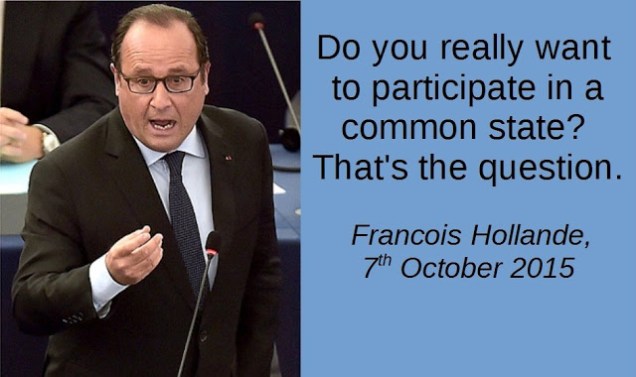
“Do you really want to participate in a common state? That’s the question.” — Francois Hollande, French President, addressing UKIP leader Nigel Farage in the European Parliament, 2015

And forever shall be:

This is reinforced by the proposals for the next EU treaty, The Fundamental Law of the European Union, published by the federalist Spinelli Group of MEPs, through the Bertelsmann house in late 2013. The preamble contains a telling paragraph:

“This proposal for a Fundamental Law of the European Union is a comprehensive revision of the Treaty of Lisbon (2007). Replacing the existing treaties, it takes a major step towards a federal union. It turns the European Commission into a democratic constitutional government, keeping to the method built by Jean Monnet in which the Commission drafts laws which are then enacted jointly by the Council, representing the states, and the European Parliament, representing the citizens. All the reforms proposed are aimed at strengthening the capacity of the EU to act.” 

European Political Union without end, Amen.

The time for childish, wistful self-deception is over. The British people need to wake up and make a decision – as Francois Hollande rightly exclaimed last year, in a moment of rare candour – about whether we want to participate in a common European state, or whether we wish to be independent, like every other major country in the world outside of Europe.

Ignorance about the intentions and trajectory of the European Union is no longer excusable. These quotes are not difficult to be defined. Neither can their existence be denied or countered in the way that the various economic claims on both sides have been subject to ridicule. These statements all exist because the real political leaders of Europe really do intend to take the European Union in this direction. Today’s EU institutions stand as testament to their vision and their determination to make it a reality.

Contrast the determined long game played by the euro federalists (the quotes selected by Paul Reynolds extend from 1951 through to 2015) with the flimsy, ethereal, cosmetic efforts of British politicians to supposedly win “concessions” from the EU. David Cameron’s renegotiation was nothing more than a grubby little fraud perpetrated on the British people, securing meaningless nods of assent from various heads of government acting in their own capacity, not the EU’s, most of whom will soon have moved on and been replaced by successors who do not feel bound to honour the various tidbits promised to Britain.

And leftists are no better. The once proud and principled tradition of left-wing euroscepticism is virtually dead, stabbed in the back by the likes of Jeremy Corbyn and Owen Jones (was the guilt and shame of this betrayal – and he knows he is betraying his true values – the reason why Owen turned in such a weak performance on Question Time last night?). And the leftists are now queueing up to talk about their utterly unachievable pipe dream of hands-across-Europe socialism, pretending to themselves and the rest of us that the EU can somehow be “changed” into a perfect socialist vessel. The EU’s founders and current leaders have been working toward a common state for nearly a century! What gives the likes of Owen Jones and Yanis Varoufakis such misplaced confidence that their little socialist tugboat can alter the course of the EU’s giant oil tanker, steaming at maximum knots toward economic and political union?

No, there are only two choices available to Britain – leave the European Union and seek to become a self-governing democracy once again (like every other major country in the world), or remain in the European Union and continue down Francois Hollande’s path toward a common European state.

There is no third way. David Cameron’s renegotiated settlement is not worth the used napkin on which it is scrawled – as far as the EU is concerned, a “Remain” vote mean that Britain is all squared away and ready to continue the march toward political union.

And those who continue to fatuously claim that the EU is simply about cooperation, trade and sharing cookies with one another are lying – to themselves, and to the British people. That benign version of “Europe” is not on offer in this referendum. We have a choice between independence and re-engagement with the world as a confident, powerful player on the one hand, and continued participation in the journey to a common European state on the other.

Do you really want to participate in a common state?

As Britons step into the polling booth on 23 June, this is the question which should ring in our ears.


European Union - United Kingdom - Britain - Flags

Top Image: The EU Question

Agree with this article? Violently disagree? Scroll down to leave a comment.

Follow Semi-Partisan Politics on TwitterFacebook and Medium.

Warning Of ‘Tory Brexit’, Labour’s Unspeakable Shadow Chancellor Parades His Contempt For Democracy

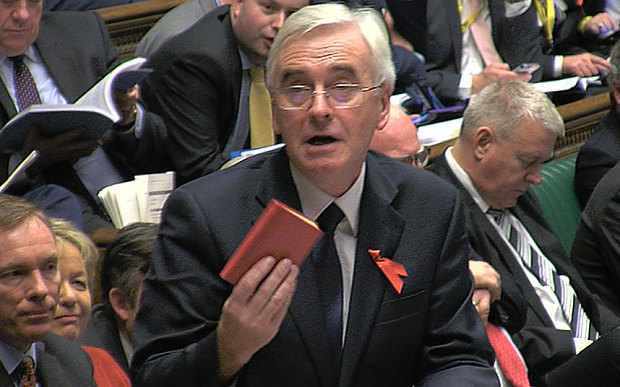
John McDonnell - Little Red Book - Tory Brexit

The Labour Party doubles down on its sick, openly anti-democratic case for Britain remaining in the European Union

That slobbering, Marxist, assassination-approving, lynching-advocating IRA-supporter John McDonnell continues to show his contempt for democracy by loudly opposing Brexit on the grounds that freedom from the European Union might make it easier for a democratically elected British government to actually, y’know, govern.

Of course this would be terrible and cannot possibly be allowed to happen – when the incumbent government is a Tory one, that is.

Labour’s unspeakable shadow chancellor is now taking to the pages of the New Statesman to promote his pie-in-the-sky, fantasy land “Another Europe”, whereby an explicitly integrationist and federalist club can be magically transformed by McDonnell, Jeremy Corbyn, Yanis Varoufakis and other assorted left-wingers into some kind of Utopian, socialist paradise.

McDonnell, trialling his “Tory Brexit” catchphrase again, writes:

The undeniable truth about the referendum is that what is on offer is a Tory Brexit. On 24 June, we will still have a Tory government, because under the Fixed-Term Parliaments Act the Conservatives could change leader from David Cameron to Boris Johnson and still try to cling on until 2020.

This would be a disgraceful betrayal of democracy. But what over the past six years has suggested to you that anything would be beneath the Tories? And, regardless of who would be leader of their party, the initial trade negotiations following a Tory Brexit could resemble TTIP on steroids.

We know what they think of the Working Time Directive; can you imagine what other workplace rights they would trade away and try to blame on someone else? With global economic uncertainties combined with George Osborne’s economic incompetence, the UK is uniquely exposed to the risk of an immediate economic fallout from a Tory Brexit.

Odd, you might think, that Labour’s shadow chancellor is so happy to associate the movement to restore democracy and independence to Britain with his lifelong enemies in the Conservative Party. But then these are not ordinary times.

McDonnell continues:

I want to see a reformed EU in which we make many of its institutions more transparent and democratic. For the first time in a generation, there is a growing coalition of socialists across the EU who can help us achieve this together. By choosing Labour’s “Another Europe” agenda, our country can stand with others across Europe to make a positive case to end austerity, offer a more humane response to the migrant crisis and protect and expand workplace rights.

And the evidence that this Magical Candyland Europe spoken of so warmly by leftists from Jeremy Corbyn to Owen Jones is actually achievable? Zip. Zilch. Nada. Tumbleweeds. The very purpose of the European Union is to facilitate a process of integration towards a common European state. Don’t take my word for it – see what the EU’s own leading voices openly say about their creation. In this grand endeavour, democracy is the mortal enemy. And John McDonnell seriously thinks that he can make EU institutions deliberately designed to shut out popular opinion more democratic?

Whether or not there is indeed a growing coalition of socialists, there is absolutely nothing to suggest that they currently form – or could conceivably form in the future – a bloc powerful enough to wrest control of the key European Union institutions. Even if the parties of the far-left somehow manage to defeat the parties of the centre, centre-right and far right and become a force in the European Parliament (itself an impossibly tall order), so what? The European Parliament is a rubber stamp, the least important and least powerful of all the EU institutions. How does that alter the makeup or direction of the Commission or the ECJ? The answer, of course, is that it doesn’t.

The very best scenario that McDonnell and friends could conceivably hope for is to jam the European Parliament with a bunch more angry leftists. But any anti-establishment wave which helps the left is generally likely to help the right, too. In fact, the radical right have been running rings around the socialists for some time. McDonnell’s dream scenario, therefore, is one where parties like Podemos and Syriza scream at parties like UKIP and others much further to the right, and bring the European Parliament to a cacophonous deadlock, while the other EU institutions – the ones which actually matter – glide on, unchecked.

Here is a political party – and an approximation of a man – who have let their blind, seething, inchoate rage against the Evil Tories snuff out what little dedication they ever had to democracy or respect for the will of the people. Here is a shadow chancellor and broader left-wing movement who are so wedded to their policy of unthinking, virtue-signalling pseudo-internationalism that they would sooner doom Britain to remain trapped in an antidemocratic, dysfunctional, failing political union than admit the terminal flaws in the European Union and fight for left-wing policies in a newly independent Britain.

But more than all of that, this is a left wing movement which cares about democracy only when it advances their own particular narrow agenda. John McDonnell isn’t willing to energetically make the case for the things he claims are under threat in case of Brexit. He simply wants those things to be undemocratically imposed on the British people by a higher, supranational authority. He wants to win without trying, to impose his beliefs on others without doing the hard work of winning them over. McDonnell literally doesn’t care how his policies are implemented, or who is steamrollered in the process – just as long as those clapped-out old left-wing policies somehow see the light of day.

You can call that “passionate” and “principled” if you want, if you are still enthralled by the Corbynite glow. But the rest of us should call it what it is – narrow minded, bigoted authoritarianism.

Meet your friendly Labour Party of 2016 – happy to throw democracy and British independence under the bus in pursuit of the fevered hallucination of a united, socialist Europe.


European Union - United Kingdom - Britain - Flags

Top Image: Telegraph

Agree with this article? Violently disagree? Scroll down to leave a comment.

Follow Semi-Partisan Politics on TwitterFacebook and Medium.