The EU’s Model Of Supranational Harmonisation Does Not Keep Us Safe

EU - European Union - Security Defence Policy

On national security as with trade and social affairs, the case for Brexit hinges on the conflict between intergovernmentalism and supranationalism

In his latest Telegraph column, Christopher Booker joins this blog in refuting the baseless, scaremongering claims by the Remain camp that being in the EU in any way protects Britain from the risk of terrorist attack.

Booker writes:

It was unfortunate timing for our not very convincing Defence Secretary Michael Fallon, when he used the Brussels terrorist attacks to claim that they only confirm how disastrous it would be for Britain to leave the EU. “The fact is,” he said, that “across Europe we do have these mechanisms now” for “sharing intelligence about terrorists’ movements” that enable “all intelligence services across Europe to pool their efforts”.

Do those “mechanisms” for sharing intelligence include the Parliament, Court of Justice, Commission, the supranational elements by which the European Union undermines nation states and seeks to usurp their role on the world stage? Of course not – these are all explicitly political institutions. All of the collaboration which actually helps to combat terrorism in Europe occurs on an intergovernmental, not a supranational basis, mostly outside of European Union structures.

When sovereign governments are free to co-operate on mutually important issues, they can often do so well. But when a busybody supranational regime seeks to take on ever more responsibilities from the nation state, vesting them in inappropriate and unproven institutions, that’s when things can easily fall through the cracks, as this blog explained yesterday.

Booker rightly goes on to argue:

In fact, there is here a much wider point, which highlights one of the most common misunderstandings about the EU, whose supporters try to persuade us that without it, international cooperation could not exist. In fact, over a whole range of issues, countries have long evolved extremely effective systems of inter‑governmental cooperation, such as on air-traffic control, Interpol, the international postal union, the European Space Agency and dozens more (not to mention Nato).

All these, negotiated between national governments, regardless of whether or not they are in the EU, work very well. And not the least absurd feature of the EU’s attempt to make itself a “supranational government of Europe” is how often it has tried to absorb these examples of effective cooperation into its own clumsy bureaucratic empire: as when it launched its “Single European Sky” programme, or set up “Europol”, or issued directives on postal arrangements with which it then expected non-EU states to comply, or tried to take over the European space programme for its crazy Galileo satellite project.

If only more people appreciated the crucial difference between “inter‑governmental”, which works, and “supranational”, which doesn’t, how much more enlightening our debate might become.

Inter-governmental versus supranational. It is very much in the interests of the EU’s apologists and closet federalists for the general public not to realise the difference between these two important terms.

The former describes the healthy co-operation between friendly allied countries, sometimes bilaterally and other times facilitated by an organising body (like Interpol). The latter describes weak nation states outsourcing key responsibilities to a higher third party, a reckless and unproven approach only ever attempted by national politicians seeking to escape accountability to their own electorates.

If the Remain camp succeed in their effort to lay a thick fog of war over the EU referendum debate so that important terminologies and ideas are confused and muddled, they automatically win. If they can persuade people that the EU equals warm, fuzzy co-operation with our friends while Brexit equals snarling isolationism and being an international pariah, the Remain camp need to nothing else. And so far, they are succeeding.

In order to turn this around, the Leave campaign absolutely must succeed in educating the public on the difference between laudable and (ideally) transparent and accountable co-operation between European countries on one hand, and the outsourcing of core government competencies to undemocratic, unwanted and untested unified European institutions on the other.

This applies not only to national security, but economic and social affairs too. When the Leave campaign are able to cut through the fog of confusion and make people realise that leaving the EU would actually represent an affirmation and strengthening of the only kind of co-operation which actually delivers positive results (the inter-governmental kind), they are far more likely to embrace Brexit and realise how the EU actively harms healthy intergovernmentalism in its rabid pursuit of ever-closer union.

Can the Leave campaign this message across in less than three months between now and the referendum? Perhaps. But enlightenment will not spring from the mouths of deliberately ignorant “leaders” like Boris Johnson.

Those who can actually distinguish between the real issues and the cosmetic ones – which sadly excludes much of the British press corps – urgently need to find a way to amplify their message.
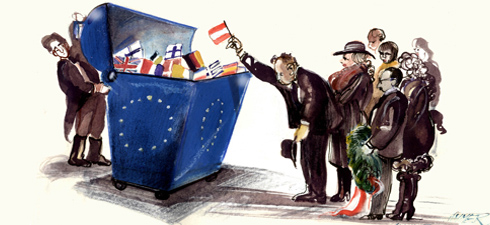
 

Intergovernmental vs Supranational - European Union - EU Referendum

Bottom Image: Cartoon by Wolfgang Ammer, published in Intergovernmentalism & Liberal Intergovernmentalism

Agree with this article? Violently disagree? Scroll down to leave a comment.

Follow Semi-Partisan Politics on TwitterFacebook and Medium.

The EU’s Undermining Of National Identity Creates A Space Where Islamist Extremism Freely Grows

Jean Claude Juncker - Manuel Vals - Brussels Attacks - European Union

Eroding national identities while forging an unwanted and unloved new European identity creates a dangerous gap, which Islamist extremists are now exploiting

There is a welcome glimmer of realisation in today’s New York Times that repeated attempts to artificially force political union on the disparate peoples of Europe (alternately by threat and by stealth) is leading to increasingly suboptimal outcomes.

Jochen Bittner writes:

Official Europe has worked hard to move past nationalism, so that there is no German or French Dream. But there’s no European Dream, either, not yet. So new migrants have no spirit to tap into, as they do in the United States. Instead, some Muslims find it more attractive to give their loyalty to Allah, their fellow believers or the Islamic State.

Intelligence services estimate that up to 6,000 jihadists from Western Europe have traveled to join the Islamic State. This enormous figure does not illustrate merely the failures of integration policy. It also shows the failure of mainstream European Muslims to keep their youth immune from extremism.

A result of this mutual apathy is too many Islamists, and too few police and intelligence officers — particularly in Belgium, but not just there. We may have a common European currency, but we still do not have a common European terrorism database. Islamists in Western Europe seem better coordinated than the European authorities hunting them.

There is a creeping awareness too that the head-in-the-sand insistence by many Western leaders that Islamist terror has “nothing to do with Islam” has been a textbook case of wishful thinking overriding political judgement, even common sense:

For the sake of social peace, after the Sept. 11 attacks, and later after the Madrid and London bombings, we told ourselves that Islam and Islamism had nothing to do with each other. But sadly, they do. The peaceful religion can sometimes serve as a slope into a militant anti-Western ideology, especially when this ideology offers a strong sense of belonging amid the mental discomfort of our postmodern societies.

That’s not to say that the article is right about everything. At one point it lapses back into the lazy, unthinking assertion that the European Union is solely responsible for keeping the peace since the Second World War:

So are Germany’s critics right? Is it reasonable to pull up the drawbridge?

In a way, the very question shows the disproportionality of the thought — unless you think it’s worth sacrificing 60 years of peace and international cooperation to the depredations of terrorists. It’s what they want; European disunity, confusion and extremism put them a step closer to the all-out war between Muslims and non-Muslims they so desperately seek.

The notion that the leaders of Islamic State – or radical jihadists in general – could give a hoot whether the Western European countries they so fervently loathe are grouped together under a single political umbrella or under their own auspices is ludicrous beyond words.

The home-grown radical Islamist terrorists from Belgium, Britain and France do not feel any allegiance to Europe or to their own particular country. Their only allegiance is to their warped strain of Islam, which teaches them to loathe anything and everything which does not conform to a very fundamentalist, conservative and specific worldview.

If anything, the European Union’s insistence on subordinating the national identities of individual member states in a thousand ways large and small, and attempting to shoehorn in an artificial new European identity which consistently fails to take root is primarily responsible for allowing a radical Islamist identity to creep in between the cracks.

If the European Union is the vehicle for international collaboration that its cheerleaders consistently claim, then it would focus on intergovernmental co-operation – for that is what will do the most good thwarting future terror attacks. But the EU doesn’t particularly care about co-operation between security services. Such matters are exquisitely boring to the architects and drivers of European political integration, who care only about creating a single European state.

Consider: if the European Union is a benign and non-threatening group of countries coming together to trade and solve common problems (like the threat of Islamist terrorism), why is such a tiny fraction of its budget – and an even smaller percentage of officials’ time – spent on enhancing intergovernmental co-operation so that agencies and forces work seamlessly together when they most need to?

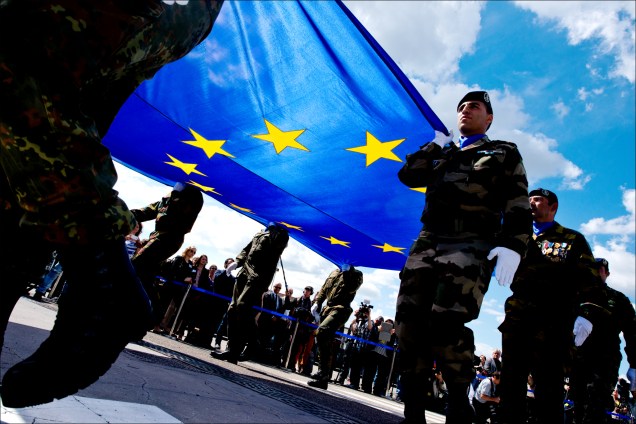
No, the European Union has a flag, anthem and parliament for a reason – because those are the things that matter to them, the building blocks of political union. Sure, the EU’s leaders are happy to take advantage of the Brussels terror attacks – as they do with every other crisis – to declare that the only solution is “more Europe”. But the more Europe they have in mind won’t do a damn thing to thwart future terror attacks. It will only make them more likely.

Building a politically unified European state involves first dissolving existing national identities, and then replacing them with a new European identity commanding the loyalty and affection of the people. The EU has been moderately successful at the former, but absolutely hopeless at the latter. Staggeringly few people see themselves as European first and foremost – nearly all retain primary loyalty to their country, or in some cases to a region – like Scotland or the Basque region.

And as the nation state is undermined on one side while the vaunted new European identity consistently fails to materialise, this creates an ever widening gap which can be filled by Islamist extremist recruiters and terrorists. When there is no healthy sense of national identity, first and second generation immigrants may struggle to assimilate, and sometimes they will find meaning and belonging in undesirable places.

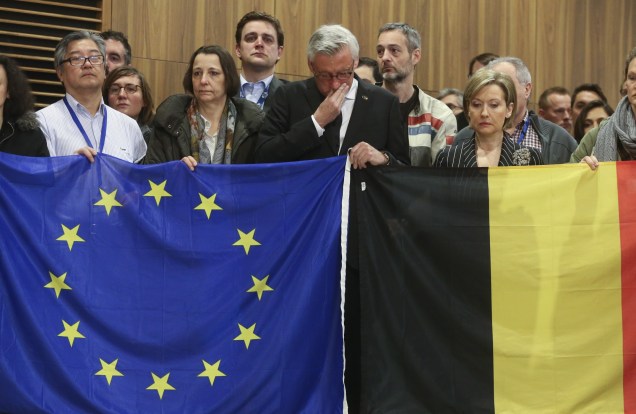
None of this should be shocking. Much of it was entirely predictable. But the European Union – who are now sickeningly claiming that they were the true victims of the attack, as though a self-important bureaucratic talking shop even registers on the Islamic State’s radar – refused to take the threat seriously, because it was too busy building up the appearance and trappings of a state.

Proper co-operation and coordination between national intelligence services does not require a European Parliament, a European Council, a flag, an anthem or pretensions on the world stage. If the EU really cared about keeping its citizens safe first and foremost, it could immediately deprioritise all further steps toward political integration, roll back its outsized role in supranational governance and focus on facilitating the kind of basic inter-governmental cooperation that might have feasibly prevented the Paris and Belgium attacks.

But of course the European Union will never do this in a million years. Because the EU has some other objective, far more important than trifling concerns over national security, on its agenda.

Now what could those other priorities possibly be?


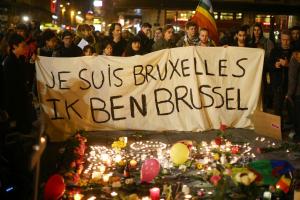
Brussels Attacks - Je Suis Bruxelles

Agree with this article? Violently disagree? Scroll down to leave a comment.

Follow Semi-Partisan Politics on TwitterFacebook and Medium.

Arrested For Thoughtcrime In Britain Following The Brussels Terror Attacks

Matthew Doyle - Facebook - Twitter - Brussels Attacks - Muslim Woman - Arrest - Free Speech - Police

Britain has become an authoritarian dystopia where the police prefer to waste scare resources scouring Twitter for instances of supposed thoughtcrime, rather than tackling real-world crime

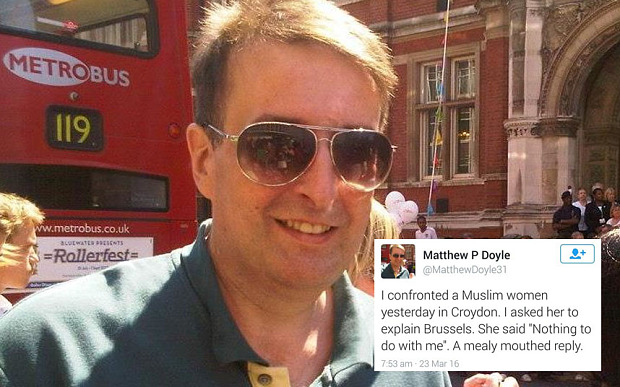
Matthew Doyle of Croydon, south London, was not the first person to say something stupid in the aftermath of the Islamist terror attacks in Brussels yesterday, and he will certainly not be the last. But Doyle does hold the dubious honour of being the first person in Britain to be arrested for thinking and saying – or in this case, tweeting – the wrong thing about the Brussels attacks, the latest victim of Britain’s dystopian hate speech laws.

As with most people whose free speech most urgently needs defending, Matthew Doyle does not come across as a remotely sympathetic character.

The Telegraph explains:

A man who tweeted about stopping a Muslim woman in the street yesterday, challenging her to “explain Brussels”, and lambasted on Twitter for his comments, has responded to the criticism today, insisting he is not some ‘far right merchant’.

Matthew Doyle, partner at a south London-based talent & PR agency, posted a tweet on Wednesday morning saying: “I confronted a Muslim woman in Croydon yesterday. I asked her to explain Brussels. She said ‘nothing to do with me’. A mealy mouthed reply.”

He was later arrested.

His tweet referred to yesterday’s bomb attacks on the Belgian capital’s main airport and Metro system that left at least 34 people dead and 198 injured. His comment went viral, being retweeted hundreds of times before he eventually deleted it.

Mr Doyle told the Telegraph he had no idea his tweet would be the “hand grenade” it has proven to be – and that Twitter’s 140 character limit made the encounter sound vastly different to how he thought it went.

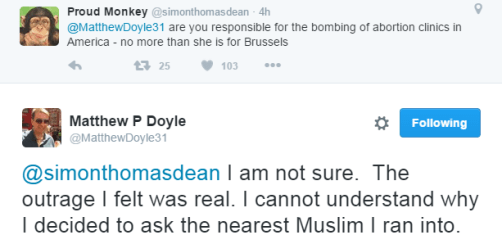
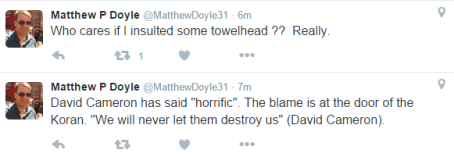
Now there is a good case to be made that Matthew Doyle is something of an idiot – in a follow up tweet, he later exclaimed “The outrage I felt was real. I cannot understand why I decided to ask the nearest Muslim I ran into”, which certainly suggests that perhaps we are not dealing with a world class mind here.

Matthew Doyle tweet

And his subsequent tweets veered firmly toward the knuckle-dragging bigot end of the spectrum, when he retorted “Who cares if I insulted some towelhead??”

Matthew Doyle tweet - 2

But let’s be clear – even if we apply the most unforgiving interpretation of Matthew Doyle’s tweet, and his subsequent account of the conversation, it should not be enough to land a citizen of a supposedly free democracy in trouble with the law.

Even if Doyle literally sought out the first Muslim-looking person he could see on the high street, approached them unbidden and asked them to account for the terrorist actions in Brussels yesterday, no country calling itself free should drag that man through the criminal justice system.

It may be incredibly ignorant and offensive to suggest that all Muslims share responsibility for the terrorist attacks in Brussels this week. It may be astonishingly stupid. But stupidity and lack of manners should not be enough to earn someone a knock on the door from the police.

In this case, the initial response of the Twitterverse was (for once) exactly what should happen – society’s self-righting mechanism kicking in against the actions of a conspicuous idiot. Doyle said something irretrievably stupid which was then widely retweeted, and he found himself on the end of thorough, fully deserved mockery from complete strangers online. Many of the subsequent parody tweets effectively (and wittily) exposed the total lack of logic behind Doyle’s sentiments and actions.

https://twitter.com/ThaKingSlayer/status/712613539366748160

So why is confrontation, rebuttal and mockery not enough in twenty first century Britain? Why can we not simply go to bed content that a self-declared idiot has had his idiocy widely exposed, refuted and mocked, without wanting to twist the knife further? Why is it now also necessary to compound his punishment by heaping an arrest, a trial and a possible criminal conviction on top of the self-inflicted public shaming?

As Alex Massie recently lamented when looking at the public’s response to Donald Trump’s comments about Britain, cases like these only prove his how snarlingly authoritarian and illiberal a place modern Britain can be once the sunny, progressive façade is peeled back:

It is always depressing to discover that there are vastly fewer liberals in this country than you might wish there to be. But that discovery should no longer surprise us.

This is the true attack on British and European values, and it comes from within. I am far less worried about the slim possibility that I will find myself standing next to a suicide bomber on my morning commute, and far more concerned that every single day I am apparently rubbing shoulders with people who smile and appear friendly at first glance, but who would not hesitate to bring the full weight of the criminal justice system crashing down upon my head if I happen to one day say the wrong thing (defined by British law as anything which gives them offence).

As a political blogger with sometimes forceful and controversial views, I am less worried that my writings may earn me a punch in the face from a stranger (I couldn’t be less famous, and my reflexes are quick – though I am probably playing with fire when I criticise our national religion, the NHS) and far more worried that someone will read something that I write, take massively overinflated exception to it, and – with a few clicks of a mouse or a quick telephone call – report me to the police, who would then be obliged to investigate me under Britain’s oppressive hate speech laws.

In the age of Islamo-fascist terror, my liberty and wellbeing is far more under threat from the Public Order Act 1986, the Communications Act 2003 and the Racial and Religious Hatred Act 2006 than it is from the terrorist’s bomb or the bullet. Not because I ever incite racial or religious hatred – indeed, I abhor those who do so – but because under the same laws that put Matthew Doyle in a jail cell, my “guilt” would depend entirely on the perception of the supposed “victim”. Anybody at any time can read anything that I write, claim to be alarmed and distressed by the ideas that I express, and have me carted off to prison.

They can do this to idiots like Matthew Doyle. They can do it to political bloggers like me. And they can do it to you. Sitting at your computer right now, you can get yourself arrested and cautioned, convicted and even sent to prison just by typing fewer than 140 characters on your keyboard. In Britain. In the year 2016.

In case the government actually cares, this is how the terrorists really win. They’ll never make Britain part of a radical Islamic Caliphate, but they can certainly help to ensure that we become such a snarlingly authoritarian, freedom-hating society that our country is changed irrevocably for the worse.

And as the freedoms and liberties which distinguish Britain from more benighted parts of the world – including primitive quasi-medieval regimes like the Islamic State – are shot to pieces, it is our own hand on the trigger. No one else’s. We do this to ourselves.


Postscript: What remains unclear at this time is whether Matthew Doyle was arrested for the content of his original tweet, his subsequent tweets (some of which were actually far more offensive) or the real-world act that his initial tweet described.

It may seem an arcane detail, but it will be interesting to discover whether the woman accosted by Doyle made the complaint, or whether it was a foot soldier in Britain’s growing army of professional online offence-seekers who took offence on her behalf. I would bet a very large sum of money that it is the latter, and that while the “victim” herself probably shrugged off the incident, Doyle’s prosecution is being urged most strongly by other people who are completely unconnected with the incident and who were not adversely affected in the slightest by his tweet.


CCTV - Police State

Agree with this article? Violently disagree? Scroll down to leave a comment.

Follow Semi-Partisan Politics on TwitterFacebook and Medium.

Brussels Attacks: Solidarity With Belgium Today, But What About Tomorrow?

Bruxelles - Brussels - Terrorist Attack - Brandenburg Gate - 3

Solidarity is great. What’s next?

There is a very familiar pattern to all of this.

A bloody Islamist terrorist attack brings carnage and fear to the streets of a major Western city.

Everyone from heads of state to the man next door rush to publicly register their shock and solidarity on Twitter.

Someone inevitably pops up after a few hours to lecture us that there is nothing Islamic about Islamic State, and that we should really be calling them Daesh, or “so-called Islamic State”.

Someone else usually pops up to say something incredibly bigoted or ignorant about all Muslims.

Impromptu shrines appear in a major square of the afflicted city, with candles, chalk drawings and sometimes a bit of impromptu John Lennon.

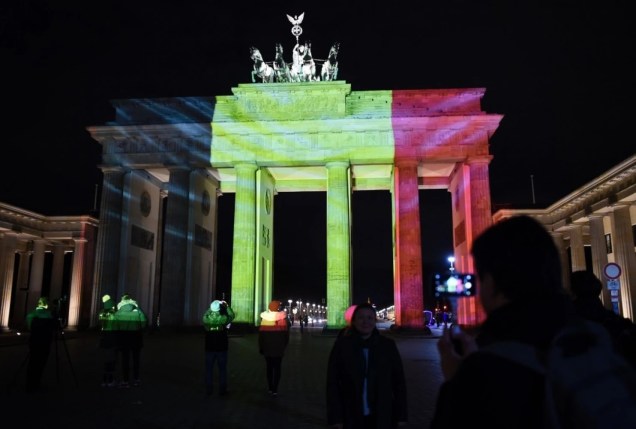
And the day closes with Europe and America’s major landmarks illuminated to resemble the national flag of the afflicted nation. They’re getting really good at that part now.

Fast forward a day, and plans are well afoot to grant even more powers to the well-meaning but overstretched security services – who were unable to make use of their current extensive powers to thwart the attack – and generally at the expense of our civil liberties. Particularly our rights to privacy and free speech.

Fast forward a month, and we have all moved on. Domestic political concerns, celebrity scandals and daily life have reasserted themselves.

I think we can all agree that we’ve got the public grief, cathartic expressions of solidarity and stern faced authoritarianism down to a fine art at this point.

When are we going to start acknowledging – and maybe even tackling – the root causes?


Bruxelles - Brussels - Terrorist Attack - Le Monde - Cartoon

Agree with this article? Violently disagree? Scroll down to leave a comment.

Follow Semi-Partisan Politics on TwitterFacebook and Medium.

The Leave Alliance Campaign For Brexit: Citizen Democracy In Action

The Leave Alliance Launch - TLA - 2

This EU referendum is about the people, not the Westminster elite. Fortunately, there now exists a truly independent Brexit group – the only genuinely grassroots campaign fighting the referendum, and the only one with a credible plan for safely leaving the European Union

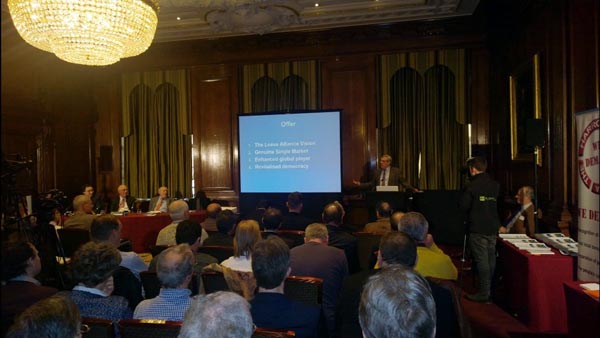
Last week – on Budget day, in fact – the Leave Alliance of individuals and groups campaigning for Britain to leave the European Union held its launch in Westminster.

Don’t worry, you’re not the only one who didn’t realise that anything had happened. The media is still having trouble wrapping their collective mind around the fact that in a referendum, the voices of politicians are no more important than those of ordinary citizens. That’s why every time Boris Johnson opens his mouth to utter his latest half-baked Brexit plan it is considered front page news, but when a group of private citizens and organisations form an independent campaign group to fight a national referendum it is deemed so un-newsworthy that it receives barely a ripple of attention.

Even when that launch takes place in the heart of Westminster, literally down the street from certain venerable news organisations (hello, Spectator), the idea of the Westminster media dispatching a journalist or two to see what was happening in their own back yard is apparently unthinkable. Every last resource simply had to be committed to this year’s Pulitzer Prize-winning coverage of George Osborne’s 2016 Budget, Omnishambles Revisited.

To be fair, The Leave Alliance – of which this blog is an enthusiastic supporterdid register a mention in Christopher Booker’s Telegraph column:

[Boris] Johnson’s empty-headed amateurishness only typifies the fatal failure of any of his allies in the “Leave” campaign to agree on a plausible, properly worked-out exit plan. One after another they come up with their own equally half-baked suggestions, which only demonstrate how none of them have done their homework. This is giving Cameron’s “Project Fear” an open goal, by failing to show how we could practically leave the EU while continuing to enjoy full access to the single market.

The only group that has done so, the Leave Alliance – launched last week with support from the Bruges Group, the Campaign for an Independent Britain and others – is too small to bid for the lead role in the campaign (although I am told on good authority that its expert and exhaustive analysis of all the options has been found very useful by civil servants).

But for a full account of the Leave Alliance launch you have to turn to the blogosphere. Lost Leonardo, writing at the Independent Britain blog, provides this summary:

The Leave Alliance (TLA) is a network of new and established political groups, bloggers and tweeters who are committed to winning the EU referendum for the “leave” side. What makes TLA unique among the declared leave groups is its support for a credible Brexit plan.

Flexcit: The Market Solution is a six-phase plan for recovering Britain’s national independence in stages, as part of a continuous process, rather than as a one-time event. That change of perspective shifts the Brexit debate firmly in the direction of pragmatic and practical politics. The exact form that our post-Brexit deal takes is less important than our vision for what we will do with our national independence. Self-governance means taking responsibility unto ourselves and, if our politicians are any indication, a long process of discovery and rediscovery lies ahead.

So as to short cut the economics- and trade-centred debate that has been allowed (some might say encouraged) to obscure the more important political question—who governs Britain?—the Flexcit plan advocates remaining in the Single Market and then working to create a genuine free trade area in Europe whilst also rebuilding the national policy-making framework and enhancing our democracy by means of The Harrogate Agenda.

This gravity of this referendum on Britain’s EU membership compels us all to think as fully engaged citizens, not merely as frightened consumers or “low information voters” easily manipulated by the cynical propaganda emanating from the major Remain and Leave campaigns. And in this campaign, it is the Remain campaign which benefits from our ignorance and the Leave campaign which is strengthened by knowledge.

When people educate themselves about the European Union, its history and its workings, they almost inevitably become more eurosceptic as the scales fall from their eyes and they realise that the EU is in fact not just a friendly club of like-minded countries who gather together to braid each other’s hair and have a good chat.

As I recently confessed:

Growing up, I was the most ardent European Union supporter and federalist imaginable. I firmly believed that the age of the nation state was over, that patriotism was silly and gauche, and that our only hope of a prosperous future lay in dissolving ourselves into a greater European collective. Adopting the euro, creating an EU army – you name it, I believed in it.

[..] Only when my appreciation for democracy and self-determination (and small-c conservatism) caught up with my authoritarian Utopianism did I realise that the accumulated wisdom of the British people might exceed my own, and that there may be good reasons to be sceptical of the European Union. And only when I came to realise the extent to which the EU is a creation of a small group of European intellectuals and political elites who thought that they knew best – and that the only way to bring about their creation was through stealth and subterfuge, never declaring the ultimate federal destination of travel – did I come to see how profoundly wrong it is.

[..] There is indeed an army of swivel-eyed ideologues in this EU referendum debate. And though they would hate to admit it, it is those on the Remain side who are most likely to be impermeable to facts, and who are least likely to have ever held a different view on the EU and been on an intellectual journey to arrive at their present position.

And as a rule of thumb, it is generally wisest to listen to those who can show evidence of having thought deeply about an issue and been persuaded by the steady accumulation of evidence to revise their thinking, rather than those who were born with their deeply-engrained love of the European Union pre-programmed in their brains.

One of the reasons I am proud of my association with The Leave Alliance is the fact that it is full of other people who, like me, have been on an intellectual journey. Sure, some of us saw through the EU from the beginning, but others – myself included – were won over to the side of Brexit by the steady accumulation of incontrovertible evidence.

We count Britain’s foremost authority on the European Union among our number, as well as several independent writers who possess more patiently acquired knowledge about the global regulatory environment than most of the Westminster media combined.

And if nothing else, the fact that the Westminster media failed to cover something as significant as the Leave Alliance launch – despite the fact that it was happening right in their midst – should be enough to convince anyone of the importance of doing one’s own research on Brexit, and not relying on any one single source or campaign when making this most important of decisions.


European Union - United Kingdom - Britain - Flags

Agree with this article? Violently disagree? Scroll down to leave a comment.

Follow Semi-Partisan Politics on TwitterFacebook and Medium.