The Future Of This Blog: Readership Poll

Political Blogging 2

To infinity, and beyond…


UPDATE – 18 September: Many thanks to all those who have completed the surveys and taken the time to share comments or send me emails with your further thoughts as to the future of this blog – your input is very much appreciated, and the feedback I am getting is very useful. The polls will stay open for a further five days and then I will review the results in detail and blog my response and future plans. In the meantime, business as usual…


Driven primarily by the recent EU referendum, 2016 has already been by far the biggest year in the four-year history of Semi-Partisan Politics, with all daily, monthly and annual pageview records easily surpassed and many new readers arriving from around the world – not to mention a successful appearance on the BBC Daily Politics.

I want to thank all of you for your readership and support, and for making my angry and sometimes less-than-coherent rantings a part of your daily reading. To those who made generous financial contributions during the EU referendum campaign – a heartfelt thank you. I could not have sustained the pace of blogging and analysis over that hectic period without your help. And to those who have become regular commenters – you continue to teach me, challenge and stretch my thinking in new directions rather than simply reinforcing my existing prejudices. Your input has made me a more rounded thinker and (I hope) a better writer. Thank you.

But now we must look to the future…

Soon, both the EU referendum and the upcoming historic US presidential election will be receding dots in the rear-view mirror, and at this time of change I wanted to reach out to you, my loyal readers, to get a sense of how you would like to see this blog grow and develop over the next 12 months and beyond. I am particularly keen to know whether you think the current blog format (length and frequency of posts) is about right, or if you would like to see stylistic changes, as well as to get a sense of what you think I should be writing about in terms of issues.

I have my own thoughts on the matter, and may as well put my cards on the table. In order to increase readership (and hopefully engagement) further I am thinking of continuing the current schedule of 1-2 normal length commentaries per day, but to supplement this with an additional number (3-5) of short commentaries or reactions to different political developments or stories, as is common in most successful political blogs. These would just be a couple of paragraphs of commentary in reaction to a developing story or a noteworthy piece published elsewhere.

I am conscious that by only posting once or twice per day this blog fails to articulate a position on a lot of significant stories, and this is something I would like to change. And while I will never equal the prodigious output of my blogging hero, the great Andrew Sullivan, I have come to believe that more frequency and variety of posts will hopefully be of interest, encourage more debate and hopefully force me to grow as a political writer.

But all of that being said, I am open to persuasion. Therefore I would be very grateful if you could answer the three main poll questions shown below, to give me a better sense of what you enjoy at Semi-Partisan Politics and what you think can and should be changed.

The first question relates to the format of the blog, i.e. the length and frequency of posts. Please select your one preferred option here:


The second question relates to the topics covered at Semi-Partisan Politics, and whether you think that the site would benefit from a change or sharpening of focus. Here, you can select as many options and topics as you like:


While the third question looks at whether or not I should expand into other social media to reach a potentially much larger audience. Again, you can select as many options as you want in this case:


I would greatly appreciate your feedback on these key questions. Each mini-poll lets you add in your own answer if none of the pre-set responses accurately capture your preference. But if you have any longer or more general comments, please do use the Comments feature to let me know your more detailed thoughts.

Though this blog remains small and relatively unknown (or at least generally unacknowledged by the Westminster media – increasingly I see themes and analyses first expounded here cropping up some months later in more prestigious publications), I think that over the past year in particular something of a community has been forged here, one which I greatly value. I am eager for this growth to continue, and look forward to receiving your input as to how Semi-Partisan Politics should best adapt to face the future.

Thank you for your continued readership and support.


Political Blogging

Support Semi-Partisan Politics with a one-time or recurring donation:

Follow Semi-Partisan Politics on TwitterFacebook and Medium.

Sincere Congratulations To The Spectator For Their All-Women Cover Issue

Fraser Nelson - The Spectator - Westminster Media - Journalism

A brief rant before normal service resumes…

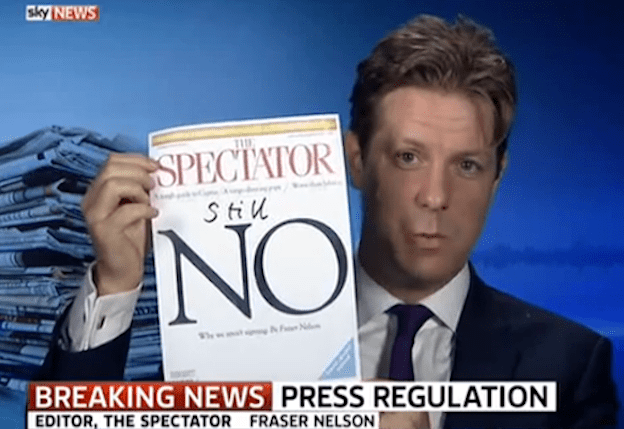
The Spectator editor Fraser Nelson today felt the need to publish a self-congratulatory humblebrag remarking on the fact that their latest print edition’s cover page apparently features only the work of female writers, despite no conscious decision having been made to indulge in affirmative action.

Nelson gushes:

Just before The Spectator went to press yesterday, my colleague Emily Hill pointed out that I’d just taken away the only male name away from the cover: all seven of our coverlines were stories written by women. Did I really want that? I hadn’t thought about it until then, and for a while I did consider engaging in tokenism and slapping a man on for the sake of it. But why bother? Spectator readers don’t really care about gender, just good writing.

In fact it hadn’t occurred to any of us, until that point, that we were about to run what Ariane Sherine, who writes our cover story, today hails as the first all-woman cover in The Spectator’s 188-year history. But this wasn’t a patronising attempt at a ‘wimmin’s issue’ or some other awful tokenistic wheeze. Our all-women cover wasn’t deliberate, it was just the way the cards fell. Each week we want to get the best writers on the most original topics: this week, they all happened to be women.

That’s not to say there’s no difference when it comes to getting hold of good writers. As Emily will tell you, women don’t put themselves forward as much as men. To get the full range of talent from all available writers can mean people like Emily going to great lengths to find and encourage new writers – like Ariane Sherine. As so often, Fleet Street follows up. As I write, two national newspapers are vying for the right to republish her cover story.

Full disclosure: I have a bit of a beef with lead article author Ariane Sherine (a one-sided affair; she, I’m sure, has no idea who I am) following her previous effort for The Spectator, an appallingly condescending report about how she performed a comedy gig in the heart of UKIP-supporting coastal Essex and somehow, miraculously, was not ripped to shreds by the rabidly racist, evil Brexiteers who dwell there.

It is interesting, too that Sherine (and apparently other women writers published in The Spectator) had to be sought out, coaxed and persuaded to write for the venerable magazine because “women don’t put themselves forward as much as men”. Funny, that. I, a despicably privileged man, have pitched to The Spectator before – it was actually a terrible piece from a few years back when my writing was very green, not at all worth publishing – but then I never had the pleasure of being sought out and implored to honour The Spectator’s readers with the fruits of my keyboard. That must be quite a nice feeling.

I don’t normally do this, but let’s just muse on the topic of gender equality for a moment, particularly as it relates to journalism. Regular readers will know that I spent pretty much every spare moment of the past year campaigning for Brexit in the EU referendum, initially rather haphazardly but (I hope) increasingly coherently as I read Richard North’s peerless eureferendum.com blog, learned about Flexcit and fell in with The Leave Alliance. I claim zero credit for any of the specific ideas this blog has supported around Brexit and the future of international trade – my tiny bit part in this effort consisted merely of standing on the shoulders of giants, particularly Richard North and Pete North, whose technical mastery and polemical writing I admire enormously.

The point, I suppose, is this. For some time now, a group of independent, citizen bloggers have churned out consistently better analysis and commentary on the EU referendum and Brexit on any given day than the mainstream media has given the British people in an entire year. Even now, dim-witted publications like the Guardian and FT are scrambling to catch up and think through some of the ramifications and issues which the people in my circle have been writing about for months. And what mention or recognition has this work prompted from the Westminster media? How many links to our widely-read and shared articles have appeared in mainstream outlets like The Spectator?

I think you know that the answer is zero.

Now, you don’t have to rate Semi-Partisan Politics at all – though I am personally quite frustrated, this issue is much bigger than little old me. But doesn’t it seem slightly odd that the entire Westminster media managed to somehow overlook the hard work of a small army of pro-Brexit bloggers on the biggest political issue to face Britain, just when fresh analysis was sorely needed, and yet The Spectator has time to scour Britain at great length for underappreciated female talent to promote to the front page?

Fraser Nelson claims that The Spectator’s all-women front page was entirely accidental, and I take him at his word. But isn’t it telling that this feat was achieved at the height of silly season, the summer recess, when the political news which is the Spectator’s bread and butter is almost entirely absent? When MPs come back from recess and things get serious again, let’s see how many months or years it takes for the next unintentional all-women issue to go to print. My guess is that it will be some while; that when PMQs is back and party conference season gets underway we will be seeing a lot more of James Forsyth, James Delingpole and Rod Liddle on the cover. Just a hunch.

So what was the amazing piece which made the cover of The Spectator anyway, you ask? Well, it was a thrilling exposé of a growing trend among millennials whereby single women stop looking for a suitable man and choose to marry themselves instead.

A snippet:

As far as the bride was concerned, the wedding was perfect. Her dress was beautiful, the vows were traditional and she changed her name after the ceremony. The clifftop scenery was breathtaking, the seven bridesmaids were encouraging and supportive: move over Princess Di. There was only one thing missing: the groom. Like a growing number of single women, Sara Starkström had decided to marry herself.

‘I thought about people marrying other people without loving themselves first,’ says Starkström, a writer, explaining what many would call a bizarre overreaction to finding herself single at the age of 29. ‘How could they pledge to do all this stuff for another person when they couldn’t promise themselves the same thing? I decided to marry myself to celebrate my independence and strength. I did it to promise to be my own best friend.’

[..] While many commentators make scathing judgments about sologamy (the feminist blog Jezebel ran a dismissive piece called ‘Single women, please stop marrying yourselves’, chiding, ‘You should be aware that you’re no trailblazer and you’re sure as hell not thumbing your nose at the system. You’re buying into it’), this hasn’t stopped increasing numbers of women from taking the plunge. For Starkström, self-marriage was a liberating act for which she is quite happy to take all the jokes ‘about me carry-ing myself over the threshold and making love to myself’.

And the thrilling conclusion:

Perhaps this is the crux of the sologamy issue: self-marriage is harmless, cheap compared to the £20,500 average cost of a classic wedding, and the union seems to make the bride very happy. If only the same could be said for the majority of traditional marriages which feature a groom. Princess Diana’s fairy tale fell apart when she found that there were three people in her marriage. Now, for an ever-increasing number of determined modern women, one is more than enough.

This isn’t even original. Even I know – don’t ask me how – that Sex and the City featured a similar storyline nearly fifteen years ago, in which protagonist Carrie Bradshaw decides to marry herself as a way of recouping the money spent on friends’ engagements and replacing an expensive pair of shoes which were stolen at a previous party. This kind of story is “and finally…” fodder on the TV news, not lead article material for The Spectator.

This may be silly season, but British politics is hardly dull at present – we have the ramifications of the EU referendum result to pick through, and the slow-motion car crash that is the Labour Party’s self-destruction, while America continues to wrestle with the Donald Trump phenomenon. In these circumstances, I’m sorry to say that Sherine’s story about sologamy has more than a whiff of affirmative action about it.

Before the inevitable feminist lynching begins, another disclaimer: I have long believed that The Spectator’s Isabel Hardman is the outstanding political journalist of her generation and, based on my couple of conversations with her, a genuinely nice person in the SW1 bubble. If The Spectator had ten Isabel Hardmans on staff, I wouldn’t expect a male-written cover story any more than once a year. It shouldn’t be necessary, but I want to put any idea that this rumination is some alt-right, anti-woman rant quickly to bed.

Note too that even when quoting the established feminist blog Jezebel, The Spectator fails to provide a link to the article Sherine cites by name. This is how unwilling the establishment British media are to share readers, clicks and opportunities. It is selfishness beyond measure, and is ultimately counterproductive – the American political blogosphere grew and thrives today not only because bloggers link to one another, but because there is a dialogue between what were traditionally the “legacy” print media outlets and alternative voices.

Readers aren’t forever lost to a publication which dares to link. In fact, readers often respect the original source all the more as a curator of other worthwhile information across the internet, thus increasing their loyalty. Maybe this doesn’t easily show up in the monthly SEO and web traffic reports which now seem to drive all media behaviour – and which have turned the Telegraph from a respectable broadsheet to a sensationalist purveyor of clickbait – but it is a real factor nonetheless. My own personal blogging hero, Andrew Sullivan, built the most influential political blog in history based entirely on this philosophy of curating the web for his readers and also providing fresh commentary which was picked up by the legacy media.

To this day, if there is a worthwhile piece of commentary or analysis on an American political blog, it is not unusual to see it linked to in a piece by an “establishment” journalist on the staff of, say, the New Republic or the National Review. Semi-Partisan Politics has been cited in the National Review a couple of times, a courtesy not once extended by any major British publication, and this despite the fact that 80 per cent of this blog’s output concerns UK rather than American politics.

So how should the British media interact with the blogosphere and promote new talent? Well, call me old fashioned but I believe that a simple commitment to meritocracy can’t go far wrong. Sure, The Spectator will always hire the likes of Pippa Middleton to write vacuous society guff about hunting for truffles in their Christmas issue, and that’s fine. But when it comes to political coverage, one wishes that established British publications would at least pretend to aspire to genuine meritocracy, seeking out the best analysis and commentary regardless of race or gender rather than indulging as they do in flagrant nepotism on the one hand and leftist affirmative action on the other.

I’ll speak plainly, because it’s better than dancing around the issue, from my perspective as someone no longer in the first flush of youth trying to build an audience and reputation as a writer. It is frustrating to pour every spare minute into this blog, providing (I dare to hope) sometimes original and refreshing commentary – particularly I think on the 2015 general election, the ongoing Labour leadership saga, free speech or academic freedom issues and the EU referendum – and see what is  objectively weaker commentary from nepotism beneficiaries or the obvious fruits of affirmative action benefit from a prestigious platform, greater recognition, and – oh yes, from monetary reward too. It’s just a little bit hard to take day after day.

I could play the minority card too, if I wanted to talk up my BAME working class background, but I would never compromise my principles by demanding that I be given a platform based on who I am rather than what I have to say. I won’t go there – it would be a violation of everything that this blog stands for. Others sadly seem happy to do so.

I write because I love to write, and because I think I have slowly created something quite small but precious here at Semi-Partisan Politics; because I have a small readership whom I love to serve, write for and debate with; because it is better than ranting into Facebook 24/7 as I used to before I opened a WordPress account. But sometimes it is a bit galling to see an inferior product exalted and given prominence when I and several of my good writer friends toil in obscurity.

Building a reputation and audience as a writer should be hard – it rightly takes time, effort, humility and perseverance. It has taken me over four years to even begin to get a sense of who my audience is / should be, and how best to serve them – and I claim no special skill at what I do, only a great deal of enthusiasm for it. But whether it is Twitter interactions, links to my site or other interactions, the amount of support I have received from American journalists and publications on the other side of the Atlantic vastly exceeds what little help or hand up I have ever received from the British media class – despite the fact that at least 80 per cent of my written output, networking and outreach efforts are focused on British politics and the Westminster media.

And I think British journalists and editors should be made to feel a little bit ashamed of that fact. Not for my sake – I’ll be just fine, and 95 per cent of the time I am happy to keep plugging away without a murmur of complaint. They should feel shame because my situation is far from unique, and because there are writers in my acquaintance whose insight, bravery and raw talent would enrich our country’s entire political discourse if only it had the bully pulpit it deserves.

The Westminster media establishment should be ashamed because the way they seek out and promote writing talent fails the British people, serving them an often substandard and derivative stream of written output and unoriginal thinking from the pens of the well-connected (either by parentage or ability to fill the checkboxes of a Diversity Officer’s form) while effectively pretending that the struggling political blogosphere – the primary outlet for so many talented, aspiring writers – doesn’t even exist, and certainly not as a source worthy of links or interaction.

Okay, rant over. I don’t have the energy to bring this piece to a neat end.

Normal business will now resume. Read it here first, or three months later from someone who gets paid to do this kind of thing.

 

Political Blogging 2

Top Image: The Spectator / Sky News

Support Semi-Partisan Politics with a one-time or recurring donation:

Agree with this article? Violently disagree? Scroll down to leave a comment.

Follow Semi-Partisan Politics on TwitterFacebook and Medium.

A Semi-Partisan Pledge Drive

Political Blogging

This is a shakedown

I don’t do this often – maybe twice a year – but this is one of those times when I walk up and down the virtual tube carriage shaking my tin and requesting any spare change from readers who find some real value in this site, and have the means to help support it through a monetary donation or subscription, however small.

(Those who have already kindly donated this year are specifically requested NOT to do so again, and to instead consider supporting The Leave Alliance here if they feel so inclined – your generosity towards me is already very much appreciated. You know who you are.)

I am pleased to report that this blog is going from strength to strength (as hopefully you will have observed). New features have been trialled, some have inevitably fallen by the wayside and others have really taken off. Most notably, yours truly was invited to debate the infantilisation of today’s students on the BBC’s Daily Politics show earlier this year – not necessarily the topic or angle I most wanted for my debut, but a good opportunity nonetheless, and one which led to this brilliant caricature drawn by a viewer:

Samuel Hooper - Daily Politics - BBC - Caricature - Sketch - Cartoon - 2

The upshot is that with two back-to-back record-breaking months in March and April, pageviews and unique visitors for 2016 to date have already surpassed the totals for 2015. In other words, in the first third of this year more people have visited and read Semi-Partisan Politics than did so in the whole of 2015.

This has been achieved partly by a significant increase in blogging frequency – from several posts per week to several posts per day, on average. In many ways this is bowing to the inevitable. A political blog is in some ways like a television channel, and going quiet even for a day is the equivalent of dead air during prime time – if you stop, people will simply change the channel.

But this growth is also due to the loyalty and help of you, the readers. Increasingly I find that Semi-Partisan Politics is getting significant referrals through Twitter, Facebook, Reddit and various online bulletin boards – not to mention from the sidebar links of my blogging comrades of The Leave Alliance. Now that this site has a small but real readership, I am able to spend more time writing and less time trying to drum up an audience. A sincere thank you to all those who have shared links to this site, or taken the time to comment and enrich the debate here.

The other fairly significant change is an increase in shorter response-based pieces, particularly with the “Tales From The Safe Space” series. Here, the broader argument (in defence of free speech and academic freedom) is advanced in multiple posts, without the need to restate the case in full each time, and I have shared numerous examples of bad (and occasionally encouraging) things taking place on British and American university campuses with some pointed commentary, but without the full context you would get in a complete essay.

Syndication continues at Conservatives for Liberty and Guerilla Policy.

While I continue to play around with the format and focus of individual posts and series, this blog retains its commitment to the following ideals:


Brexit: freedom from the European Union

Democracy and national sovereignty

Constitutional reform and a federal UK

Separation of church and state

Healthcare reform, not NHS worship

Smaller, smarter government

Free speech, without restriction

Fighting the Cult of Identity Politics

Fighting timid centrism on the Right

Fighting empty virtue-signalling on the Left


Maintaining the high tempo of blogging required to grow this site means that besides the day job and family time, this blog is my life. Other interests are largely on hold in order to commit to writing as much as possible, a sacrifice I am happy to make because I believe the issues which I write about are important. The few occasions on which this blog has been picked up in the national media validate this assessment, I believe.

I would like to do more. My future reading list now spills onto two book shelves as I try to stay up to date with the most important issues I cover while also trying to remediate a desperately poor grounding in history and philosophy (thanks, state education).

Obviously the EU referendum is a priority at the moment – I am proud of my association with The Leave Alliance, the only group with not only a plan for achieving Brexit in a safe and non-disruptive way, but more importantly a genuinely positive vision for what a globally engaged and democratically renewed Britain should look like.

If you agree with these objectives and enjoy this blog’s coverage and commentary, please do consider using the PayPal tip jar to make a small contribution to my work:


One-off donations or small regular contributions are all greatly appreciated, and help me to continue my work here. Reader contributions partially supported last year’s live-blogging of the UKIP party conference which won acclaim in the national media, and I hope to repeat the exercise at more of the party conferences this season.

Many thanks to everyone for reading, sharing and commenting.


Political Blogging 2

Follow Semi-Partisan Politics on TwitterFacebook and Medium.

The Age Of Trump: As The Republican Party Goes To Its Armageddon

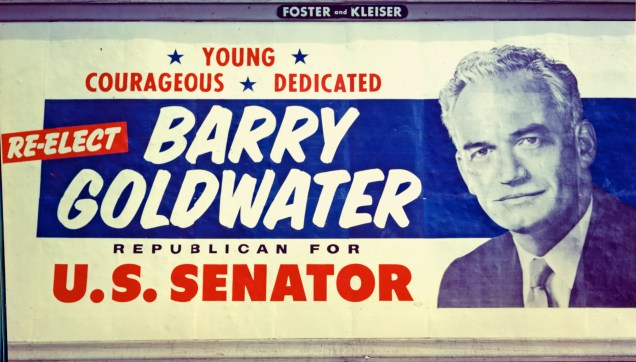
Barry Goldwater - Election Poster

To understand why the Republican Party are on course to lose their third consecutive presidential election, one must look much further back in time than the rise of Donald Trump

It gives no satisfaction to watch any storied political party hurl itself into oblivion – even the US Republican Party, which has frequently infuriated true conservatives with its sanctimonious and hypocritical habit of screeching about the dangers of encroaching socialism under Democratic administrations while themselves consistently cranking up the size and role of the state at every opportunity.

But while it now seems almost certain that the Republicans have thrown away any chance of reclaiming the White House, imploding in a foul-mouthed torrent of bluster and recrimination more worthy of Jerry Springer than a presidential primary campaign, it is worth looking back and asking how the GOP finds itself in this position, and exactly when the seeds of destruction were sown.

I have been reading widely on this, focusing less on the crowing and virtue-signalling Left, and far more on those thoughtful and introspective voices on the Right who are often appalled by the rise of Donald Trump in particular, but often sympathetic to the anti-establishment fervour which fuels his candidacy.

And if I have to pick just one excerpt from one piece to explain the predicament in which the Republican Party currently finds itself, I would encourage my readers to read “I was wrong about Donald Trump” by Daniel McCarthy over at The American Conservative.

In his piece, McCarthy concludes:

Trump succeeds because of more than outsize personality, of course. He attracts some support from everyone who thinks that Conservatism, Inc. and the GOP establishment are self-serving frauds—everyone who feels betrayed by the party and its ideological publicists. Working-class whites know that the Republican Party isn’t their party. Christian conservatives who in the past have supported Mike Huckabee and Ben Carson also know that the GOP won’t deliver for them. Moderates have been steadily alienated from the GOP by movement conservatives, yet hard-right immigration opponents feel marginalized by the party as well. Paleoconservatives and antiwar conservatives have been excommunicated on more than one occasion by the same establishment that’s now losing control to Trump. They can only applaud what Trump’s doing, even if Trump himself is no Pat Buchanan or Ron Paul.

Conservative Republicans™ somehow maneuvered themselves into a position of being too hardline for moderates and non-ideologues, but not hardline or ideological enough for the right. Trump, on the other hand, appeals both to the hard right and to voters whose economic interests would, in decades past, have classed them as moderates of the center-left—lunch-pail voters.

What’s even more remarkable is that movement conservatives, who have been given plenty of warning, ever since 2006, that their formula is exhausted, keep doing the same thing over and over again: they’ll dodge right, in a way that right-wingers find unsatisfactory but that moderates find appalling; then they’ll weave back to the center, in a way that doesn’t fool centrists and only angers the right. Immigration—which was another of George W. Bush’s stumbling blocks, lest we forget—has been the issue that symbolized movement-conservative Republicanism’s futility most poignantly. It’s not even clear that most GOP voters agree with Trump’s rhetorical hard-line on immigration—they just like it better than the two-faced talk of the average Republican politician.

Trump has a plethora of weaknesses, as general election polls amply demonstrate. But just look what he’s up against within the Republican Party: that’s why he’s winning.

I have yet to see the rise of Donald Trump explained as thoughtfully and succinctly as it is in the first three paragraphs quoted above. Sure, McCarthy’s piece does not tackle every aspect of the situation – whole books can and will be written about the causal factors of this huge anti-establishment backlash, which is far bigger than any one political party – but it does explain why the current GOP was so badly positioned to withstand a populist insurgency like Trump’s.

Much like the British Labour Party has become a fractious and increasingly unworkable coalition of idealistic left-wingers, pragmatic centrists and (let’s be frank) soulless political shapeshifters, and much as the historic splits in the Conservative Party are re-emerging following a vacillating 2016 Budget and the party leadership’s betrayal of the activist base on the coming EU referendum, so the Republican Party’s big tent of Reaganites, neo-cons, Evangelicals and social conservatives is collapsing – for those reasons outlined above by McCarthy.

Read the collected output of Rod Dreher too, and this piece by David Brooks, which looks to the future which could yet follow 2016’s rock bottom:

Trump is prompting what Thomas Kuhn, in his theory of scientific revolutions, called a model crisis.

According to Kuhn, intellectual progress is not steady and gradual. It’s marked by sudden paradigm shifts. There’s a period of normal science when everybody embraces a paradigm that seems to be working. Then there’s a period of model drift: As years go by, anomalies accumulate and the model begins to seem creaky and flawed.

Then there’s a model crisis, when the whole thing collapses. Attempts to patch up the model fail. Everybody is in anguish, but nobody knows what to do.

That’s where the Republican Party is right now. Everybody talks about being so depressed about Trump. But Republicans are passive and psychologically defeated. That’s because their conscious and unconscious mental frameworks have just stopped working. Trump has a monopoly on audacity, while everyone else is immobile.

[..] At that point the G.O.P. will enter what Kuhn called the revolution phase. During these moments you get a proliferation of competing approaches, a willingness to try anything. People ask different questions, speak a different language, congregate around a new paradigm that is incommensurate with the last.

That’s where the G.O.P. is heading. So this is a moment of anticipation. The great question is not, Should I vote for Hillary or sit out this campaign? The great question is, How do I prepare now for the post-Trump era?

As Brooks says (perhaps a little naively), this is not necessarily all bad news for conservatives. If we are honest, we have to admit that conservative policies in America and Britain are no longer perfectly calibrated to the challenges of the day as they were in Thatcher and Reagan’s time.

That is not to say that the Left are any better; Lord knows they aren’t. But it does mean we should acknowledge certain facts – like the fact that we still have a stubbornly large permanent underclass, and that for all the irreplaceable benefits of globalisation, there are still those who miss out – and seize the initiative by proposing radical conservative policy solutions to the great challenges of the new century.

In Britain, David Cameron’s Coke Zero Conservative government – or the Ted Heath tribute act, as this blog has taken to calling them – seem to think that One Nation Conservatism means stealing as many of Labour’s left-wing ideas as possible. And in America, Donald Trump’s brand of populist pseudo-conservatism doesn’t believe in One Nation at all, unapologetically carving the country up into winners and losers.

Neither is the correct approach. And as Cameronism and Trumpism run their respective courses, this blog will continue providing commentary and offering suggestions for an alternative conservatism, in Britain and America.


Postscript: This blog has decreased its focus on US politics in the past few years, primarily because I have been London based and fully occupied writing about British political issues. But Semi-Partisan Politics will begin to cover the American presidential election with a little more frequency going forward, partly because I have always remained a close follower of American politics – often more so than the household name journalists dispatched to the States by their newspapers and now portentously reporting back to us as self styled “experts”.

Having lived in America helps – particularly having lived in the American Midwest, not just the coastal enclaves of New York and Washington, D.C. familiar to most British journalists who write about America during election season. And the fact that I am married to a Hillary Clinton-supporting Hispanic Texan helps too. When I write about American politics, I know whereof I speak.

But I am also covering the presidential race because as a conservatarian with one foot firmly planted on either side of the Atlantic (and a heart divided equally between Britain and America), I believe that in my own small way I can bring a perspective to the left/right, authoritarian/libertarian debate that is often missed by those whose thinking and writing is rooted firmly in just one country’s specific conservative tradition.

To borrow an overwrought phrase from the dystopian world of Identity Politics, consider this my contribution to an “intersectional” perspective on conservatism.

They’ll absolutely hate me for that.


Donald Trump Hat - Make America Great Again

Agree with this article? Violently disagree? Scroll down to leave a comment.

Follow Semi-Partisan Politics on TwitterFacebook and Medium.

Why I Write

Political Blogging

At the risk of sounding like a PBS telethon…

Why isn’t there more good journalism out there? Gawker paints a depressing picture for those of us who toil away in the often thankless business of writing.

Hamilton Nolan writes:

Many writers believe that our brilliant writing will naturally create its own audience. The moving power of our words, the clarity and meaning of our reporting, the brilliance of our wit, the counterintuitive nature of our insights, the elegance with which we sum up the world’s problems; these things, we imagine, will leave the universe no choice but to conjure up an audience for us each day.

Time and experience have long since disabused me of any such idea. Fortunately, writing about politics and public policy – if immensely frustrating at times – is also its own form of reward.

Nolan concludes:

Maybe there is a talented young writer out there with a dream of starting the very best, smartest magazine or website that has ever existed, and building it into their very own historic legacy. I am here to tell you that it will not work. The business of media has very little, if anything, to do with quality journalism. If you aspire to be a Writer of Legitimately Good Things, the best you can hope for is to get the prestige spot that is paid for by the garbage. To hope for a prestige spot that is not paid for by garbage, or by a lone rich wacko, or by a new advertising technology, but instead by the mass audience that will flock to your brilliance is to ask for too much. If you are able to get a job writing good stuff, you are one of the lucky ones in the big Exercycle of Mindless Entertainment that is “the media.”

Now, political writing certainly shouldn’t be an easy career option. After all, it takes a certain arrogance to expect to be remunerated for sitting at a keyboard ranting about the state of the world and pontificating on the “obvious” solutions to society’s ills, particularly when there are people out there doing real work like serving in the armed forces, providing healthcare, creating world-class art, working out how to get to Mars or producing amazing, unthought-of new consumer products.

There are certainly times when my own efforts at political writing seem depressingly far from the high ideal set out by George Orwell, and much closer to the ranting of the pub bore or the slick keyword focus of the SEO marketer – though having done this (with varying levels of commitment) for four years now, I hope that I am somewhat better than when I started out.

Earlier this week I was at a talk given by Dan Hodges about his general election book “One Minute To Ten”, and got chatting to a senior journalist from the Sunday Times. I put to him that while political blogging may have been ripe with promise ten years ago, the format seems to have dried up today, and readers left with the choice between established legacy media outlets or the latest viral clickbait funnelled through social media.

He didn’t disagree, and hammered home the fact that many readers currently have almost zero loyalty to any specific news outlet, and instead get their news according to what happens to be trending on social media or appear in their (often bias-reinforcing) news feeds. This trend is reflected in the traffic stats for Semi-Partisan Politics. A sizeable minority of traffic now comes through Facebook in particular, and there is always the temptation to devote time and effort to promoting pieces on Facebook to get more eyeballs on the latest piece, even if it brings in few potential long-term readers with whom one can develop a relationship.

The one positive trend at present is the growing and thriving community of Brexit bloggers and campaigners coalescing around eureferendum.com and the work of Dr. Richard North to promote Flexcit – by far the best (and only) properly thought-through plan for how Britain might best leave the European Union and re-emerge as a globally engaged, prosperous sovereign democracy.

If only the same collegial, rigorous and dedicated spirit could be found elsewhere in the political blogosphere as exists among many of my fellow Brexiteers (see links in the sidebar on the right), journalism in this country – particularly citizen journalism and the concept of the campaigning blog – might not be in quite such a parlous state.

Regardless: whatever the people at Gawker say, Semi-Partisan Politics will continue to grow and flourish as we enter 2016, and will campaign – loudly and unapologetically – for the following goals and ideals:


Brexit: freedom from the European Union

Democracy and national sovereignty

Constitutional reform and a federal UK

Separation of church and state

Healthcare reform, not NHS worship

Smaller, smarter government

Free speech, without restriction

Fighting timid centrism on the Right

Fighting empty virtue-signalling on the Left


If you agree with these objectives and enjoy this blog’s coverage of UK politics and current affairs, please do consider using the PayPal tip jar to make a small regular contribution or a one-time donation:


Any reader donations will 1) be a personal ego boost to myself, 2) help me to do more original reporting, like the successful live blog of last year’s UKIP annual conference, and 3) help me promote this site and the work of other like-minded writers – particularly in the crucial effort to win a “Leave” vote in the coming Brexit referendum – so that we can actually make a difference.

Small donations from individual contributors are not only greatly appreciated by me, but also help to preserve independent journalism and commentary in general – so that nobody has to rely exclusively on the BBC, the Guardian or the Telegraph to understand what’s going on in our country and around the world.

But it’s not all about the money. What matters even more than that (for me) is spreading the word and sharing the message – and these days, like it or not, that means social media. So if you read something you like here, don’t just sit on it. Share it on Twitter or Reddit. Email it to a friend. Be that person on Facebook who posts provocative political articles on their timeline.

2016 is already off to a good start – pageviews and comments are at their highest ever, and an appearance on a certain major national political TV show (to be announced soon) is in the works. Onwards and upwards!

Many thanks to all my readers for your continued generous support.

Follow Semi-Partisan Politics on TwitterFacebook and Medium.