Social Justice Commandments: Being A Good Parent Perpetuates Unfair Privilege

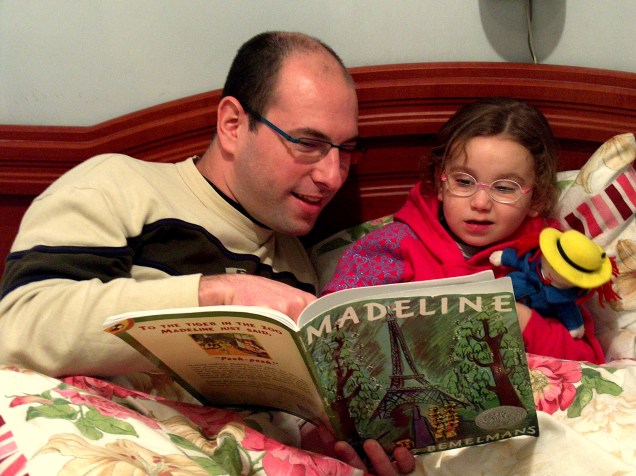
Bedtime Story

The warped philosophy of social justice decrees that good parents are part of the problem, not the solution

For more evidence of the sickness at the heart of our universities, I present the professor from Warwick University – my alma mater – who thinks that parents who read to their children are gifting them with unfair privilege over other kids whose parents are too busy watching Britain’s Celebrity Animals Bake-Off On Ice to lavish their own children with similar attention.

From the ABC summary of the segment on Australian radio:

[Professor Adam] Swift in particular has been conflicted for some time over the curious situation that arises when a parent wants to do the best for her child but in the process makes the playing field for others even more lopsided.

‘I got interested in this question because I was interested in equality of opportunity,’ he says.

‘I had done some work on social mobility and the evidence is overwhelmingly that the reason why children born to different families have very different chances in life is because of what happens in those families.’

Once he got thinking, Swift could see that the issue stretches well beyond the fact that some families can afford private schooling, nannies, tutors, and houses in good suburbs. Functional family interactions—from going to the cricket to reading bedtime stories—form a largely unseen but palpable fault line between families. The consequence is a gap in social mobility and equality that can last for generations.

Already this sounds ominous. And though Swift gets his mention of “equality of opportunity” in nice and early, the draconian means by which he wants to achieve this equality are quite something to behold:

‘What we realised we needed was a way of thinking about what it was we wanted to allow parents to do for their children, and what it was that we didn’t need to allow parents to do for their children, if allowing those activities would create unfairnesses for other people’s children’.

The test they devised was based on what they term ‘familial relationship goods’; those unique and identifiable things that arise within the family unit and contribute to the flourishing of family members.

For Swift, there’s one particular choice that fails the test.

‘Private schooling cannot be justified by appeal to these familial relationship goods,’ he says. ‘It’s just not the case that in order for a family to realise these intimate, loving, authoritative, affectionate, love-based relationships you need to be able to send your child to an elite private school.’

Note what Swift has done here. First of all, he posits a dystopian world where “we” have any right to “allow” parents to do certain things or raise their children in certain ways, the corollary to which is that these mystical external authority figures also have the power to prohibit parents from engaging in certain everyday activities.

But worse, he has made an arbitrary judgement with relationship to these “familial relationship goods”. You might think that it is up to individual parents and families to decide what is good for their young ones, or what is most needed to ensure that they thrive and become well-rounded, successful people. But you would be wrong. Because Adam Swift has a definitive list of all the things needed to create a well-behaved, social justice loving adult, and private schooling ain’t on the list.

And that’s when it gets really crazy:

In contrast, reading stories at bedtime, argues Swift, gives rise to acceptable familial relationship goods, even though this also bestows advantage.

‘The evidence shows that the difference between those who get bedtime stories and those who don’t—the difference in their life chances—is bigger than the difference between those who get elite private schooling and those that don’t,’ he says.

This devilish twist of evidence surely leads to a further conclusion—that perhaps in the interests of levelling the playing field, bedtime stories should also be restricted. In Swift’s mind this is where the evaluation of familial relationship goods goes up a notch.

‘You have to allow parents to engage in bedtime stories activities, in fact we encourage them because those are the kinds of interactions between parents and children that do indeed foster and produce these [desired] familial relationship goods.’

How gracious of Swift, allowing parents to continue to read to their children at bedtime, even though the unfair privilege they bestow by doing so eats away at his enlightened, equality-loving soul.

Swift continues:

‘We could prevent elite private schooling without any real hit to healthy family relationships, whereas if we say that you can’t read bedtime stories to your kids because it’s not fair that some kids get them and others don’t, then that would be too big a hit at the core of family life.’

So should parents snuggling up for one last story before lights out be even a little concerned about the advantage they might be conferring?

‘I don’t think parents reading their children bedtime stories should constantly have in their minds the way that they are unfairly disadvantaging other people’s children, but I think they should have that thought occasionally,’ quips Swift.

So by all means continue to read to your children, if you must. But you should feel very guilty while you do so, and chastise yourself once little Timmy has fallen asleep, while meditating on the various ways he will grow up to oppress those unfortunate children whose parents did not read to them.

Which, of course, is the one thing missing from Adam Swift’s “analysis” – any thought or mention of the parents who do not read to their children. As with everything else in the victimhood-soaked world of social justice, where everything must be viewed through a lens of privilege and oppression, only those who work hard and do the right thing are subject to criticism. Those who do the wrong thing, by contrast, are continually excused and stripped of any agency for their own actions – a condescending behaviour which actually does more to dehumanise them than any “harm” they incur from the privileged.

In the entire segment, Swift has no words of reproach for those parents who do not read to their children at bedtime. He neither suggests that this might be through their own fault, or that they need to anything to rectify the situation. It is simply taken as a given that they will continue to be bad parents, helpless to modify their behaviour, and that the only thing society can do in response is to worsen the overall standard of parenting in order to prevent the worst parents from feeling bad or experiencing the consequences of their own actions.

And this, right here, is at the root of our society’s decay. We now simply accept and nod our heads while academics airily consider how best to bring everyone down to the same, lower level of attainment rather than striving to confer as many of the benefits currently enjoyed by the rich (or those with good parents) on all. The insidious Cult of Social Justice and Identity Politics has done its work well, because many of us now look at inequality and feel the instinct to tear the successful down (or at least actively thwart their rise) rather than building others up.

Fortunately, Adam Swift is not about to be given wide-ranging power over how people raise their children. But it is worth noting the type of outcomes which one might get when beady-eyed authoritarianism (where external authority figures “allow” graciously parents to do things) meets the warped Social Justice view of inequality.

For so long as these ideas remain abstract discussions between philosophers, there is limited real-world harm. But when more young people who have percolated in this environment all through university start entering the job market and getting themselves elected to local and national government, we will have a real problem on our hands.

In Britain, the Labour Party is already very hostile to the idea of private schools, while many in the Conservative Party are themselves quite paternalistic and keen for the state to regulate behaviour. And while neither party has not yet succeeded in shoehorning government fully into the parent-child relationship (except for Scotland, where the SNP is making a game attempt at taking over from parents), it may well be only a matter of time.


Bedtime Stories

Safe Space Notice - 2

Top Image: Wikipedia

Bottom Image: Guardian

Agree with this article? Violently disagree? Scroll down to leave a comment.

Follow Semi-Partisan Politics on TwitterFacebook and Medium.

Justin Trudeau And Elbowgate: Safe Space Hysteria In Canadian Politics

It’s not just the students. Now fully grown adults – even elected MPs – are using the victimhood-soaked language of social justice and identity politics to score political points

As legislative brawls go, it hardly ranked with the fine example set by the likes of Turkey and Ukraine. But this most Canadian of restrained altercations is noteworthy for another reason – the fact that those parliamentarians on the side of the “victim” almost immediately resorted to the language of social justice and victimhood when establishing their narrative to the press.

The Guardian gives the background:

Justin Trudeau, Canada’s prime minister, apologised in parliament on Wednesday after he was accused of “manhandling” one member of parliament and elbowing another, in conduct that sparked an uproar in Canada’s normally staid parliament.

Footage from inside the House of Commons showed Trudeau striding purposefully across the floor of the chamber and into a group of MPs, pulling Conservative Gord Brown by the arm to lead him to his seat so that parliament could begin a procedural vote.

Trudeau swore as he made his way to Brown, according to the Canadian Broadcasting Corporation, reportedly telling MPs to “get the fuck out of the way”.

As Trudeau led Brown from the group, he elbowed New Democrat MP Ruth Ellen Brosseau in the chest. Parliament descended into mayhem as MPs heckled and pounded their desks while New Democratic party leader Tom Mulcair shouted at Trudeau. “What kind of man elbows a woman? It’s pathetic! You’re pathetic!” Mulcair can be heard shouting.

A close watching of the video shows that Trudeau is clearly impatient and exasperated, and quite possibly very rude in the way that he tried to grab opposition whip Gord Brown. But the elbowing of Ruth Ellen Brosseau was clearly unintentional, if still a likely consequence of the way that Trudeau went charging in to the tightly packed group of MPs.

So was an apology from Trudeau for an accidental physical contact enough to satisfy his critics? Of course not. CBC reports:

An emotional Brosseau said later in the House that she had been “elbowed in the chest by the prime minister,” bringing Trudeau to his feet once again to “apologize unreservedly.”

Brosseau said she was so upset from the incident that she had to leave the chamber, subsequently missing the vote.

Her NDP MP colleague Niki Ashton said she was deeply troubled by Trudeau’s actions.

“I am ashamed to be a witness to the person who holds the highest position in our country do such an act. I want to say that for all of us who witnessed this, this was deeply traumatic. What I will say, if we apply a gendered lens, it is very important that young women in this space feel safe to come here and work here,” she said.

“He made us feel unsafe and we’re deeply troubled by the conduct of the prime minister of this country.”

Far more disturbing than the incident itself is the fact that Brosseau, who clearly was not seriously hurt in the incident, nonetheless felt so emotionally overwhelmed by an accidental physical contact that she was unable to perform her duties in the House and had to leave the chamber. More depressing still is the way in which her colleague, Niki Ashton, whines about the incident using the same fragile, aggrieved tones that we have come to expect from student activists fully inducted into Cult of Social Justice and Identity Politics.

Ashton claims that the event was “deeply traumatic”, not just for Brosseau who was hit, but for every single other person who witnessed the event. It is worth replaying the video at this point, to marvel at the notion that “trauma” could be inflicted on anybody from so minor an incident. And then comes the inevitable cry that the Canadian House of Commons is no longer a “safe space” for women MPs – all because of an unintentional physical contact between a man and a woman.

Seriously. The Canadian House of Commons, an unsafe space. Aside from the terrorist shooting in 2014, there are probably few spaces in the world as safe as the Canadian parliament. To claim that a highly secure building protected by armed guards and filled with generally mild-mannered politicians is “unsafe” is not only incredibly self-obsessed, it also does a disservice to people who may work dangerous jobs, live in rough neighbourhoods or grow up in broken families, all of whom have legitimate cause to fear for their safety. But no, let’s all worry that the Canadian parliament is somehow a seething hotbed of misogyny, just because the prime minister lost his temper and brushed past somebody a bit roughly.

Even the safest of spaces – like the Canadian parliament – cannot prevent unfortunate accidents, or occasional random acts of stupidity. Trudeau’s was just such an act, for which he apologised fulsomely. But we should all be concerned by the reaction to the incident, for it reveals something festering and growing in our culture.

So far, this blog has covered 37 distinct “Tales from the Safe Space“, covering incidents of student authoritarianism, attacks on free speech and excessive mental fragility from young adults who appear unable to function in the real world. A frequent response to the concerns raised by this blog and others is that we are exaggerating the problem – that it only affects universities, and that only a small subset of students at those universities subscribe to the brittle, authoritarian mindset which demands trigger warnings, safe spaces, no-platforming and campus speech codes. Well, now we see that there is no exaggeration.

The idea of grown adults as chronically weak victims or soon-to-be-victims has leaked out from the university campus like a toxic oil spill, and now infects even the parliament of a major western country. Now, Canadian MPs, elected to represent their constituents, speak of being traumatised and made to feel unsafe by witnessing a minor moment of awkward physical contact between two other people.

So can we please start taking this seriously now? At long last, can we stop deluding ourselves that this is a silly non-issue only affecting a small number of hardcore student activists, and that those involved will soon grow out of their authoritarian, victimhood-soaked ways? Because we now have definitive proof that they do not grow out of these habits. They grow into (physically) mature adults who then get themselves elected as MPs. And when their numbers reach critical mass, they will begin to enact exactly the same draconian laws and regulations for the whole country as they were accustomed to seeing on their own college campuses. All of Canada will effectively become a “safe space”, with all the attendant consequences for freedom of thought, behaviour and speech.

And that prospect is far more terrifying and traumatic than watching slow-motion footage of one person brushing past another in the Canadian parliament.


Safe Space Notice - 2

Agree with this article? Violently disagree? Scroll down to leave a comment.

Follow Semi-Partisan Politics on TwitterFacebook and Medium.

Tales From The Safe Space, Part 37 – Whisperings Of A Revolt

NUS Disaffiliation Campaign

Has the NUS finally gone too far?

All tyrants, petty or otherwise, eventually go too far and overextend their vast authority. Maybe they get cocky. Maybe they surround themselves with so many Yes Men that they lose the pulse of the people. But inevitably, somehow or other, they will at some point find themselves overextended, and see their exalted position threatened as a consequence.

It is delightful to see such a thing now happening to the National Union of Students, that censorious, moralising platform for embryonic leftist politicians and demagogues, which long ago gave up any pretence at advocating for students, preferring to exercise paranoid control over them instead.

Now, some students are fighting back. A number of smart, more liberty-minded students have realised that since most Student Unions derive their democratic “legitimacy” from a vanishingly small slice of their respective student populations, it should be relatively easy to mount a small insurgency of their own to topple the Social Justice and Identity Politics cultists in charge, and make their local unions work for the students rather than simply trying to control their thoughts, behaviour and speech.

Hence the brilliant NUS disaffiliation campaigns now springing up at campuses around the country.

Spiked’s Tom Slater reports in The Spectator:

In a move that has left student union politicos across the country clinging to their therapy dogs, the University of Lincoln Students’ Union has voted to disaffiliate from the NUS. Springing from the new, anti-NUS sentiment that is brewing on campuses across the country, Lincoln students voted 881 to 804 to leave.

This was a big breakthrough, putting wind in the sails of disaffiliation campaigns currently being fought at York, Oxford, Exeter and Manchester. And though this was all sparked by the election of new NUS president Malia Bouattia – the overgrown student fond of waxing lyrical about the ‘zionist-led media’ – the gulf between NUS leadership and its members has been growing for years.

After Lincoln’s vote, outgoing NUS president Megan Dunn said she was ‘sorry this decision was made by such a small number of students’. Which was a bit rich, seeing as she was elected in 2015 by a whopping 413 NUS delegates, and turnout at campus NUS elections – which select those delegates – is notoriously low.

Lincoln’s vote is significant. Not least because so many felt so detached from the NUS they didn’t even turn out to vote. And, in an interesting twist, Lincoln SU’s own president appeared to approve of the move, telling the Independent that ‘for some time… the NUS has been far removed from the issues our students tell us are important’.

And now Newcastle University has followed suit:

Newcastle University Students’ Union (NUSU) has become the second to announce it is to disaffiliate from the National Union of Students (NUS) following a controversial National Conference in Brighton last month.

The move has come as a double blow for the national student campaigner after Lincoln University announced on Monday it, too, will be breaking away from the NUS at the end of the year.

NUSU confirmed on Thursday that 1,469 total votes had been cast in the referendum by Newcastle University students, with a majority of 67 per cent voting in favour of disaffiliation.

Brilliant. While this blog contends that the power and influence now wielded by the Cult of Social Justice and Identity Politics can only be truly broken when those with most authority – professors and university administrators – finally rediscover their backbone and begin to defend academic freedom and free speech rights, it is heartening to once again see students in the vanguard of the resistance.

For in truth, it is in the interests of almost no students – save the Identity Politics priests who derive power and influence from policing the culture of their institutions and the behaviour of their peers – to allow the NUS to continue along its present, authoritarian path. As Tom Slater argues in The Spectator, students deserve local unions which fight for their interests as students, rather than a union which wastes its time fighting a culture war and playing off different groups of students against one other based on an arbitrary judgement over how “oppressed” they happen to be.

The growing NUS disaffiliation movement should be encouraged and helped to spread like wildfire, burning through the rotten foundations and (ideally) causing the whole organisation to topple. And now is the time to strike, when the enemy is dangerously overextended, making very specific and highly controversial claims (pro-censorship and the identity politics agenda) on behalf of all students when in fact they speak only for a small but noisy illiberal minority.

First Lincoln, then Newcastle. Who will be next to throw off the puritanical, totalitarian shackles of the National Union of Students?


Safe Space Notice - 2

Agree with this article? Violently disagree? Scroll down to leave a comment.

Follow Semi-Partisan Politics on TwitterFacebook and Medium.

What Hath Social Justice Wrought?

It is our duty to fight.

It is our duty to win.

We have nothing to lose but our chains.


So chant thousands of students at rallies and protests in universities all across the United States of America.

Except that none of these students are oppressed. Not a single damn one of them.

None of them are chained.

They are all students attending university in the most powerful and prosperous country on the face of the Earth.

An ocean of possibility stands before each and every single one of these young students, the likes of which can only be dreamed of by millions of children in war torn, impoverished or otherwise benighted parts of the world.

This is a cult.

These people are cultists.

This is what the Cult of Social Justice and Identity Politics hath wrought.


Postscript: To be fair, from the smirks of some of the students in the last video it does appear that they realise deep down that this is all a fraud, that none of them are “chained”, and that this huge collective tantrum from the most privileged generation in history is nothing but a massive insult toward previous generations who really did have to fight, win, and yes, even cast off their chains.


More Tales From The Safe Space here.


Safe Space Notice - 2

h/t Sargon of Akkad

Agree with this article? Violently disagree? Scroll down to leave a comment.

Follow Semi-Partisan Politics on TwitterFacebook and Medium.

Tales From The Safe Space, Part 36 – Michael Bloomberg’s University Of Michigan Commencement Address

Michael Bloomberg delivers a college commencement speech worth hearing

While it is true that a generation of university students – the product of our therapeutic culture and “you can’t say that” attitude to political debate – is now being indoctrinated into the Cult of Social Justice and Identity Politics with alarmingly little resistance from the educational establishment, there is at least one graduating class which has been sent out into the world with a rather more inspiring (and small-L liberal) message ringing in their ears.

Former New York City mayor Michael Bloomberg was invited to address the University of Michigan’s graduating class of 2016, and from the first word of his speech he tore into the culture of safe spaces, trigger warnings and all of the other illiberal symptoms of this new orthodoxy.

From Bloomberg’s speech:

The most useful knowledge that you leave here with today has nothing to do with your major. It’s about how to study, cooperate, listen carefully, think critically and resolve conflicts through reason. Those are the most important skills in the working world, and it’s why colleges have always exposed students to challenging and uncomfortable ideas.

The fact that some university boards and administrations now bow to pressure and shield students from these ideas through “safe spaces,” “code words” and “trigger warnings” is, in my view, a terrible mistake.

The whole purpose of college is to learn how to deal with difficult situations — not run away from them. A microaggression is exactly that: micro. And one of the most dangerous places on a college campus is a safe space, because it creates the false impression that we can insulate ourselves from those who hold different views.

We can’t do this, and we shouldn’t try — not in politics or in the workplace. In the global economy, and in a democratic society, an open mind is the most valuable asset you can possess.

Think about the global economy. For the first time in human history, the majority of people in the developed world are being asked to make a living with their minds, rather than their muscles. For 3,000 years, humankind had an economy based on farming: Till the soil, plant the seed, harvest the crop. It was hard to do, but fairly easy to learn. Then, for 300 years, we had an economy based on industry: Mold the parts, turn the crank, assemble the product. This was hard to do, but also fairly easy to learn.

Now, we have an economy based on information: Acquire the knowledge, apply the analytics and use your creativity. This is hard to do and hard to learn, and even once you’ve mastered it, you have to start learning all over again, pretty much every day.

Keeping an open mind to new ideas is essential to your professional success — just as it’s crucial to our collective future as a democratic society.

Note the loud booing quickly drowned out by cheering when Bloomberg talks about the inherent intellectual and academic danger of a “safe space” – while his remarks were warmly received, there is clearly a very vocal group of students who did not want to hear this message, and who will step forth from the University of Michigan with very warped views about how political debate (and even ordinary interpersonal relationships) should be conducted.

Bloomberg then turns his attention to the presidential race and the state of American democracy in general:

Democracy in action can actually produce a lot of inaction, which we see every day in Washington and other levels of government, too. When governments fail to address the needs of the people, voters in both parties get angry and some politicians exploit that anger by offering scapegoats instead of solutions.

If we want to stop demagogues, we have to start governing again, and that requires us to be more civil, to support politicians who have the courage to take risks, and to reward those who reach across the aisle in search of compromise.

Here, Bloomberg is almost channelling Andrew Sullivan, who makes his incredibly welcome and sorely needed return to political commentary in the New York magazine with these words:

An American elite that has presided over massive and increasing public debt, that failed to prevent 9/11, that chose a disastrous war in the Middle East, that allowed financial markets to nearly destroy the global economy, and that is now so bitterly divided the Congress is effectively moot in a constitutional democracy: “We Respectables” deserve a comeuppance. The vital and valid lesson of the Trump phenomenon is that if the elites cannot govern by compromise, someone outside will eventually try to govern by popular passion and brute force.

(I’ll be blogging a response to Andrew Sullivan’s piece separately in due course).

Bloomberg closes with this warning:

Think about this: In 1960, only 4 to 5 percent of Democrats and Republicans said they would be upset if a member of their family married someone from the opposing party. In 2010, one in three Democrats and one in two Republicans said they would disapprove of such a marriage. In 1960, most people would never have believed that interparty marriage would attract such resistance, while interracial and same-sex marriage would gain such acceptance.

For all the progress we have made on cultural tolerance, when it comes to political tolerance, we are moving in the wrong direction — at campaign rallies that turn violent, on social media threads that turn vitriolic, and on college campuses, where students and faculty have attempted to censor political opponents.

As durable as the American system of government has been, democracy is fragile — and demagogues are always lurking. Stopping them starts with placing a premium on open minds, voting, and demanding that politicians offer practical solutions, not scapegoats or pie-in-the-sky promises.

This is a message which many students will not want to hear, but which needs to be transmitted nonetheless – and not only by commencement speakers, refreshing though it is to hear the likes of Bloomberg take up the cause.

University administrators and professors must also absorb and embrace this message and change the way they approach issues of free speech and academic freedom, for while they are not entirely responsible for the censorious and emotionally fragile nature of new students entering their institutions, they do represent the last and best hope of turning those students into robust and resilient young citizens by the time they graduate.

Michael Bloomberg delivering a crowd-riling, viral-ready commencement speech just as students are about to graduate cannot be our only firewall against the onslaught of this new illiberal movement. We must erect meaningful defences and interventions much earlier in the learning process – rather than simply bowing to the excessive demands and exaggerated sensibilities of perpetually offended students – if we wish to prevent our workplaces and government from going the same way as our university campuses.


Safe Space Notice - 2

Agree with this article? Violently disagree? Scroll down to leave a comment.

Follow Semi-Partisan Politics on TwitterFacebook and Medium.