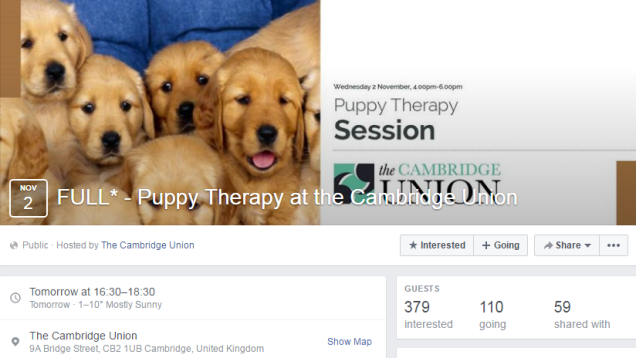
Tales From The Safe Space, Part 45 – Puppy Therapy Session Arranged For Stressed Cambridge University Students

cambridge-union-puppy-therapy-therapets-mental-health-stress-infantilisation

Et tu, Cantabrigia?

It is sad to see Cambridge University, my first alma mater, playing host to one of these infantilising “student puppy therapy” sessions. But after the Rhodes Must Fall nonsense at Oxford, it was only a matter of time before Cambridge started displaying more symptoms of the Adult Infantilisation Virus rapidly tearing through academia.

The advertisement reads:

Whether you have a deadline looming, are worried about your workload or are stressing over the number of societies’ you signed up to at the Freshers’ Fair, what better way to take a break than with a puppy therapy session, organised with the kind help of volunteers at Guide Dogs UK. The Union welcomes the volunteers and their canine counterparts for a relaxed afternoon of socialising which forms part of the puppies’ Guide Dog training. Donations for the Guide Dogs for the Blind Association welcomed.

Now, to be fair: this is a slightly more laudable event than some other puppy therapy sessions we have seen on other university campuses. In many cases, the puppy therapy has been presented entirely as a student service (like a dining plan or library facilities) but at least in this case there is a clear and worthy charitable connection. Any harm that attending students may do to their own future emotional resilience will at least be balanced by a well trained new generation of Guide Dogs for the visually impaired.

But this could have been sold to students just as effectively by calling it “puppy socialisation training”. This being Cambridge, they probably still would have had a line out the door had they named it “Canine-Human Familiarisation and Interaction Practice in a Social Setting.” But they didn’t, because puppy therapy is now all the rage on college campuses, and because the prevailing culture tells us that we are all only one unexpected bad grade or nasty personal remark away from a nervous breakdown, and so are in constant need of institutional hand-holding.

It is the same corrosive worldview which gave us “Inner Child Day” at Cardiff University earlier this year, and the introduction of “Therapets” sessions at Edinburgh University. Therapy animals have traditionally been used to help PTSD sufferers such as returning armed forces veterans, children with severe autism and hospice patients undergoing palliative care for terminal conditions. Are we really now including “two essays due on the same day” or “signed up to too many societies” in this list of severe mental stresses?

The danger of doing so is that we wrongly exceptionalise the normal stress of everyday life, putting relatively pedestrian problems on a pedestal and making it seem as though the sufferer is truly benighted and in need of external aid. This just about works so long as the student remains within the infantilising university setting and part of the noxious Cult of Social Justice and Identity Politics. But when these links are severed and the real world beckons, students who have been encouraged for years to celebrate and exaggerate their own fragility are opening themselves to incurring real trauma when they have their first less-than-pleasant contact with an indifferent world.

Most employers – excepting some of the large or wealthy technology companies, who were some of the first to be infected by the virus raging through academia – will not provide a puppy room for harried employees under tight deadlines. And while HR departments are scrambling as they (rightly) respond more positively and proactively to mental health issues among their employees, they will never be able to be the overbearing, protecting, auxiliary parent in the same way that universities are now becoming.

If universities are to have a pastoral role beyond pure academia, surely they should see the nurturing of anti-fragility (the quality of absorbing negative impacts and becoming stronger as a result of them) among their students as far more valuable in the long term than pandering to students’ largely imagined sense of vulnerability.

Throughout their storied histories, Cambridge University has provided Britain with 14 prime ministers while Oxford has supplied 27, including Theresa May. These illustrious records will likely soon begin to wither if future Oxbridge graduates are conditioned to reach for the puppy videos every time there is a crisis.

The Cambridge Union – of which I am a disappointed life member – should strongly look at rebranding their puppy therapy event, now and for any future events. The time has come for the university and its associated institutions to take a brave stand and become part of the solution to the rise in victimhood culture, rather than a collaborator in feeding the problem.


puppy

Safe Space Notice - 2

Top Image: Pixabay

Support Semi-Partisan Politics with a one-time or recurring donation:

Agree with this article? Violently disagree? Scroll down to leave a comment.

Follow Semi-Partisan Politics on TwitterFacebook and Medium.

Tales From The Safe Space, Part 44 – The Suffix “-phobic” Is Now Considered Oppressive Against People With Phobias

social-justice-word-cloud

The social justice movement, long ridiculous, has now disappeared so far up its own backside that it is quite simply beyond parody. These warped, self-righteous posers will weaponise anything and infantilise anyone to burnish their own right-on credentials

When faced with the latest example of SJW posturing and weaponised victimhood, one wonders just how much further these baby-faced tyrants can possibly go in policing our language and behaviour to make us conform with their ever-shifting conception of what is good and what is deplorable.

But in truth, they will never be satisfied. In SJW-land, the power and social standing of a Social Justice Warrior activist is derived entirely from “points” that they accrue defending their new orthodoxy and persecuting heretics simply trying to exercise their free speech. A diligent SJW can pick up points for riding to battle against something “offensive” written by a perfect stranger on social media, but they accrue even more kudos within their cult by accusing a fellow member(s) of heresy. We may be the usual targets, but the SJW cultists themselves must always look over their shoulders for fear of attack by an overzealous rival. The social justice / identity politics revolution loves to devour its own.

This manifests itself in all kinds of ways – witness the case of student union official Fran Cowling, who declared in a blaze of self-publicity that she would not share a stage with Peter Tatchell because he dared to take the side of free speech over SJW “no platform” policies designed to shut dissenting viewpoints out of university campuses. Never mind that Tatchell has done more for minority rights in a typical weekend than Cowling will likely manage her entire wretched life – Cowling cynically attempted to position herself as a better and purer cultist, and so leapfrog the many levels separating her own unscrutinised place in history and Tatchell’s far more tangible contribution.

But what if one enterprising SJW found a way to imply that nearly every other social justice cultist in the world is being inadvertently oppressive all the time, while they alone were enlightened enough to recognise the error of their ways? That SJW would then be able to claim the mantle of Most Compassionate Person, and accrue incredible kudos within that ridiculous community.

Well, it turns out that one such SJW – Denarii Monroe, writing at Everyday Feminism, the motherlode of idiotic social justice, victimhood culture nonsense – is attempting that very feat.

Monroe writes:

For years, through to today, we have named these oppressions as homophobia, biphobia, transphobia, or queerphobia. Other movements use phrases such as xenophobia, fatphobia, and Islamophobia.

It’s important to put a name to the systemic structures that marginalize us and have effects on our day-to-day living. This language is essential in the fight for liberation for all marginalized groups. I remember how empowering it was to have a name for the specific experiences and needs of the bi+ (plus) community.

Naming, well, just about anything in life – a spoon, a tree, a breed of dog – allows us to identify it. And in the case of oppression, being able to identify it allows us to tackle it head-on.

Unfortunately, in our quest to do so, we have chosen language that isn’t just problematic, but downright oppressive.

And I get it. Most of us were born into this language. Whether we belong to the communities who use this language or we’re just allies, it has informed much of our experiences – how we began to understand inequality, how we talk about the discrimination we experience, and how we relate to others with similar oppression.

But Islamophobia, transphobia, and other constructions that use “-phobia” as a suffix erase the fact that “phobias” are a real thing that happen to real people. Those of us who use these terms know all too well the damage that erasure can do in the fight to achieve liberation and social equity.

Regardless of good intentions, at the end of the day, it’s not okay to build our righteous movements on the backs of other marginalized people. Further, in choosing inaccurate, inadequate language, we harm ourselves as well.

Original emphasis in bold.

In other words, using the suffix “-phobia” when describing real or imagined acts of prejudice – as in Islamophobia, transphobia, homophobia – is itself “oppressive” because apparently it appropriates the language used to describe recognised phobias like claustrophobia, thus somehow erasing or denying the lived experience of claustrophobes, agoraphobes and assorted other phobics.

So according to the new draconian standard set by the Social Justice Warriors, this anti-Donald Trump meme (expressing a sentiment which they would otherwise doubtless support) is itself ableist and oppressive to those who suffer from traditional phobias:

phobias-are-oppressive

A year ago, this might have been regarded as an entirely legitimate form of anti-Trump protest. But so far have things moved in the space of twelve months that the cutting edge SJWs of Everyday Feminism would now regard references to “homophobia” as an unconscionable assault on the daily suffering and lived experience of people with medically recognised phobias.

Yes. To speak about Islamophobia or transphobia is now ableist – that is, oppressive towards those with disabilities – because it supposedly makes light of the “disability” of having a phobia. Denarii Monroe has essentially declared that nearly every other Social Justice Warrior, by virtue of still using the suffix “-phobia” as part of their daily activism, are in fact part of the oppressive, neo-colonialist masses. They are all part of the problem. She alone is part of the solution.

This is the social justice equivalent of the launch of HMS Dreadnought back in 1906. With the launch of the steam turbine-powered warship Dreadnought, every other battleship in every navy around the world was instantly rendered obsolete, giving the Royal Navy an immense strategic advantage and setting off a new arms race. And now, in a dismal pastiche of history over a century later, Denarii Monroe is essentially declaring that the language of every other Social Justice Warrior – people who spend their whole day festering in this fetid swamp of identity politics and weaponised victimhood – was oppressive all along, unbeknownst to them.

But why should we go to the effort of completely overturning the language that nearly all of us – not only SJWs – use to talk about prejudice and discrimination?

Phobias aren’t really something you hear much about, except as an exploitative tabloid episode on shows hosted by the likes of Maury Povich and Jerry Springer.

Like all marginalized groups, disabled folks have little representation in the media and in real-life institutions. This is reflected in how we are portrayed, talked about, and treated. Mental disabilities – from schizophrenia and obsessive compulsive disorder to bipolar disorder and generalized anxiety disorder – are particularly notorious for being misconstrued and inaccurately and harmfully portrayed, usually just for ratings (read: money).

[..] Phobias are virtually invisible in society outside of the aforementioned daytime talk show segments.  But the fact of the matter is that we are real.

We exist. We navigate this world, to the best of our abilities, every single day. We’re on disability. We work. We find love and sex, if we desire those things. We have dreams. We struggle.

And our lived experiences and truths deserve dignity and respect, not the further erasure and trivialization that phrases like “-phobia” actively perpetuate.

Good grief. Has any person suffering from a legitimate phobia ever been upset, outraged or “harmed” in any way by the fact that we also use the word for their condition to describe people who are prejudiced against certain groups? Of course not – just as if I were to say (as I believe) that the Cult of Social Justice and Identity Politics is a cancer on our society, people currently suffering from cancer will not suddenly wince in pain when I hit “publish”. It would be clear to any reasonable person (thus excluding the SJWs) that the cancer I speak of is metaphorical, and entirely different from the actual disease, just as it is clear to legitimate phobia sufferers that nobody is seeking to diminish their suffering when we speak of “xenophobia” or “homophobia”.

And mark this:

The use of “-phobia” as a suffix erodes the dictionary meaning of the word, but more importantly, it is one tool that helps society forget that phobias are real phenomena that affect real people every day, some of whom, like myself and my friends, are queer and trans.

It is as though the author is laying each one of her oppressed identities before us, to add weight to her specious argument.

Queer? Check.

Trans? Check.

Phobic (and thus disabled)? Check.

This is how you win an argument in Social Justice world. Not by appealing to facts, reason or evidence but rather by pointing to your identity in terms of race, gender and sexuality, and trying to claim the highest possible position on the Hierarchy of Oppression. Denarii Monroe knows that few people will be able to outdo the triumvirate of queer, trans, and phobic. And because the Cult of Social Justice and Identity Politics dictates that those lower on the hierarchy must defer to those who can claim greater victimhood, Monroe has carte blanche to change the terms of discussion and literally remove words from the permitted vocabulary of other SJWs.

Monroe does, however, eventually cut to the chase:

That is to say, while fear is behind much of the oppression we face, it’s not the whole story. It’s not even the primary story. The language we use should reflect that.

When we say what we’re actually talking about, it paints a more accurate picture for our movements and our allies of our needs. It makes our goal clearer, which makes it that much easier to accomplish.

Further, “-phobia” as a suffix ultimately centers the oppressor instead of the oppressed. The language becomes about their fear instead of our struggle.

And I don’t know about you, but I’m quite tired of privileged people being the center of attention.

Ah, there it is. All of this overwrought discussion of language and oppression, when in actual fact this whole article is borne of Monroe’s jealousy that using “-phobia” as a suffix puts the emphasis on the supposedly prejudiced person when in fact it should really be on her. Monroe doesn’t want “privileged people” to be the centre of attention because she doesn’t actually want us to focus on prejudice or do anything meaningful to tackle it – rather, she wants to revel in her own victimhood and be sure that we all acknowledge it so that she remains the centre of attention.

This is a sick, warped way of looking at the world. But it is also absolutely required behaviour among Social Justice Warriors and identity politics cultists the world over, who are intent on turning daily life into one great big collective group therapy session, in which those at the top of the Hierarchy of Oppression are free to unload on those further down, blaming them for their troubles all day, every day.

Denarii Monroe didn’t get so upset that she wrote an article in Everyday Feminism because she has legitimate, heartfelt concerns that saying words like “Islamophobia” or “transphobia” actually causes mental distress to people with real phobias. She wrote the article in triumph because she found yet another way to claim that other people – people on her own side! – were inadvertently transgressing one of the key tenets of social justice. Which, even though everybody was using this language a year ago without issue or complaint, is now a tremendous issue. And as a totally (ahem) unrelated bonus, it also just so happens to give Monroe heightened status and more power over her peers.

To slightly amend something I recently wrote on the same subject:

If all of this seems ludicrous and a million miles away from doing anything which might conceivably affect or help actual black disabled people in America, you would be right. Because at its dark, festering core the Social Justice movement is not about delivering justice, equality or doing any other kind of social good. Social wrongs are merely the fuel which power the machine to perform its true purpose – controlling the language and the thinking of society in order to establish beady-eyed little zealots like Party Island Denarii Monroe as the indispensable clerisy who tell everyone else what to say and do.

Social Justice is, above everything else, about the acquisition and exercising of power. Victimhood is actively sought and eagerly weaponised by members of this Social Justice clerisy in their scramble for status amongst their peers and contemporaries. The legitimate problems and grievances of minority communities become irritating background noise, a distraction from what really matters – this finickity, juvenile, university campus parlour game in which casting oneself as the most vulnerable, oppressed but simultaneously tolerant person imaginable confers tremendous power, while the slightest slip (such as accidentally using the wrong word) can lead to immediate excommunication from the group.

Monroe concludes by lecturing us that we should immediately replace the “-phobic” suffix with the much more clunky “-antagonistic”, as in “trans-antagonistic” or presumably “Islamo-antagonistic”:

From the queer and trans communities to Muslims and fat people, that is literally our experience. Our existence and identities cause the majority culture to be hostile toward us and, as a result, we struggle against them – for our humanity, our dignity, and our liberation.

But we can never be free until we’re all free – and this includes folks with disabilities. So it’s imperative that we begin to deliberately abandon “-phobia” once and for all.

The mind boggles. I would write that the social justice movement cannot possibly lose the plot any more than it presently has, but we all know that in a week’s time I will be back with another piece about some even more outrageous claim to victimhood or demand for censorship. The world record for Most Stupid Thing Said By An SJW is now being broken almost daily.

And this is because at its dark, sulphuric heart, the Cult of Social Justice and Identity Politics is an arms race, in which cultists have to continually invent new vulnerabilities and injuries just to maintain their position in the social hierarchy.

SJWs have perhaps marked what is happening in Britain, where the National Union of Students decreed that university LGBT societies should no longer allow “white cis gay men” to have their own representation on diversity committees because they are not sufficiently discriminated against. Being a gay man is apparently no longer enough to command even the lowliest of positions in the Hierarchy of Oppression. So all of those SJWs only slightly higher up on the hierarchy are desperately casting around for additional traumas and vulnerabilities that they can plausibly exaggerate just to keep themselves in the game.

Social Justice is about power, plain and simple. And while its cultists may preach rainbows and unicorns and solidarity, in practice it is a brutal club to suddenly find oneself excluded from. This is why the arms race has now decreed that saying “-phobic” is oppressive, and it is why next week we will be back here, marvelling that something even more vacuous and self-indulgent has occurred.


phobias-are-oppressive-2

Safe Space Notice - 2

Support Semi-Partisan Politics with a one-time or recurring donation:

Agree with this article? Violently disagree? Scroll down to leave a comment.

Follow Semi-Partisan Politics on TwitterFacebook and Medium.

Tales From The Safe Space, Part 43 – DePaul University Censors Pro-Life Conservatives To Placate Black Lives Matter

depaul-university-college-republicans-unborn-lives-matter-blm

Appeasing the gods of social justice and identity politics now overrides a Catholic university’s commitment to Catholicism itself

It is now indisputable: Black Lives Matter are rapidly becoming the one absolutely holy and inviolable interest group on American college campuses, a favoured priesthood of living saints who must be protected from blasphemy and offence at all costs.

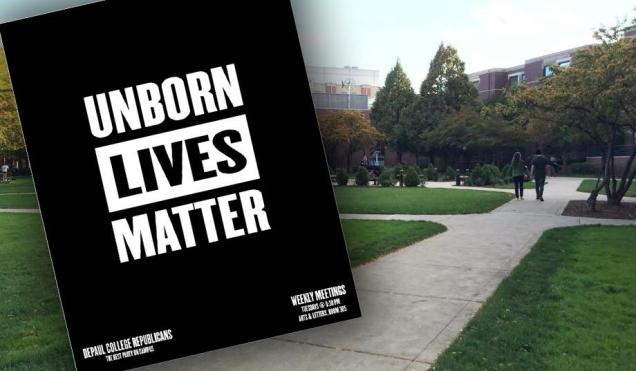
There really is no other way to describe the privilege enjoyed by this organisation following the news that DePaul University in Chicago – a Catholic institution – recently banned a poster produced by the DePaul College Republicans because their catchphrase “Unborn Lives Matter” is supposedly deliberately provocative and hurtful to the delicate Black Lives Matter snowflakes.

I repeat: the president of a Catholic university actively suppressed the free speech of his own students because they dared to publicly support traditional Catholic teaching on the sanctity of life and the rights of unborn children – which might have offended a group of people who are supposedly concerned about racial justice, not abortion rights.

Campus Reform reports:

The DePaul College Republicans chapter has been censored yet again, this time over promotional flyers proclaiming that “Unborn Lives Matter.”

According to University President Rev. Dennis H. Holtschneider, the club was forbidden from using the flyers because they were “bigotry…under the cover of free speech,” meant to “provoke” members of the Black Lives Matter movement.

DePaul College Republicans Vice President John Minster told Campus Reform that his group wanted to use the “Unborn Lives Matter” flyers to draw members to their club meetings, but had to submit the design to the Office of Student Involvement for approval.

OSI Director Amy Mynaugh was out of town during the approval process, however, and the design proposal made it all the way to President Holtschneider.

Holtschneider not only declined to approve the flyers, but sent a letter to the entire university body explaining that the pro-life posters constituted “bigotry” and were not considered free speech.

The letter from President Holtschneider reads in part:

DePaul is a private Catholic institution, and we also are part of the academy.  By our nature, we are committed to developing arguments and exploring important issues that can be steeped in controversy and, oftentimes, emotion.  Yet there will be times when some forms of speech challenge our grounding in Catholic and Vincentian values.  When that happens, you will see us refuse to allow members of our community to be subjected to bigotry that occurs under the cover of free speech.  In fact, you have seen this in past months, as we have declined to host a proposed speaker and asked students to redesign a banner that provokes the Black Lives Matter movement.

Some people will say that DePaul’s stance unfairly silences speech to appease a crowd.  Nothing can be further from the truth.  As we experienced last spring, it’s not difficult to agree that there is a difference between a thoughtful discussion about immigration and a profane remark about Mexicans scrawled in the Quad; or between a panel on racial climate and a noose — a powerful symbol of violence and hatred — outside a residence hall.  In both recent cases, the first, we encourage; the second, we abhor.

Because co-opting a topical phrase to express support for the Church’s pro-life stance is apparently “provocative” – the “provocation” outweighing the moral question at stake in the eyes of DePaul University.

And putting up a poster declaring that “Unborn Lives Matter” – the clearly stated and strongly affirmed position of the Catholic Church, the institution with which DePaul is inseparably affiliated – is not a statement of moral purpose, but is instead deemed the equivalent of a “profane remark about Mexicans scrawled in the Quad”.

The letter continues:

If you read DePaul’s Guiding Principles on Speech and Expression, you will see that our Vincentian values were in the forefront six years ago when these guidelines were developed.  Though a group of your own DePaul colleagues are giving them a fresh look for updates, the current guiding principles still apply.  I encourage you to read the entire document to gain a better understanding of the balance between our values and speech.  In particular, I ask you to reflect on these sentences: “We accept that there is a distinction between being provocative and being hurtful.  Speech whose primary purpose is to wound is inconsistent with our Vincentian and Catholic values.”

More:

Disagreements will happen on important issues—many that are personal to members of our community for whom race, immigration, gender disparities, religious beliefs and economic privilege are more than conversation topics; they are part of an inescapable lived experience.  Students and others will almost certainly continue to explore and seek the exact limits of our tolerance for free expression when that expression is meant to cause distress.  Certainly, everyone is allowed to have their opinions on these topics.  I simply ask when you are expressing your opinion that you respect the difference between a reasoned discussion and words whose primary purpose is to wound.  I also ask that the university community refuse to “rise to the bait” in those moments when speech may become uncomfortable or even exasperating, but falls within the bounds of the academy’s commitment to full and robust debate.

Because hurt feelings are far more important than abortion. And the omniscient president and administrators of DePaul university can look clearly inside the human heart and discern whether a given student intends to provoke, offend or hurt when determining their right to speak.

This is ludicrous. Holtschneider made no attempt to speak with the DePaul College Republicans before censoring their poster and banning it from campus – he high handedly presumed to know what motivated them to speak out in favour of the rights of the unborn, and then publicly find them to be morally deficient and their motives cynical. That is effectively the judgment on their character that Holtschneider passed by revoking their right to express themselves – that they are Evil Racists more interested in “provoking” certain members of the black community than witnessing to their faith and speaking their consciences.

The National Review rages:

As a private, Catholic university, DePaul is not explicitly obliged to respect students’ free-speech rights like a public university would be. But it is disturbing that the university would choose not to do so, and even more disturbing that DePaul’s administration justified their decision by invoking the university’s “Catholic values.” It is hard to believe that the phrase “Unborn Lives Matter” is in violation of a Catholic university’s values when, in fact, this phrase ought to embody them.

This is not the first time that DePaul’s administration has been confused about the proper application of its Catholic guidelines. For instance, one of the university’s 2016 commencement speakers was Martin Castro, chairman of the U.S. Commission on Civil Rights, who in his professional capacity has advocated same-sex marriage and radical gender theory, and opposed religious-freedom legislation that would have enabled Catholic institutions to uphold their values. DePaul was also found to have referred students to jobs and internships at Planned Parenthood, and to have promoted social-media posts celebrating the Supreme Court decision recognizing same-sex marriage nationwide.

While it is the university administration’s prerogative to take these actions — even though they openly conflict with established Church doctrine — it is appalling that the same administration would invoke its Catholic principles to ban pro-life flyers from campus. It is evident that Holtschneider and his staff are intent upon silencing conservative student voices, even if they must wield their Catholic identity as a cudgel to do so.

It is particularly depressing that the SJW snowflakes of DePaul have their grubby hands on the university’s Guiding Principles on Speech and Expression – we can safely assume that the next version of this document will be even more restrictive, and prioritise the feelings and “identities” of coddled students even more strongly over the imperative for debate and the quest for truth. Which will be some achievement, considering the current version already draws a specious “distinction between being provocative and being hurtful.

But one can only be so angry at the students themselves. As this blog has explored repeatedly, these thin-skinned students are very much a product of their environment and their upbringing. They are the result of Everyone Wins A Prize schooling, parental paranoia about a child abductor lurking on every corner and the endless, nauseating praise for the most pedestrian of accomplishments and the corrosive idea, inculcated at every stage of their academic lives, that “sticks and stones may break my bones but words will kill me stone dead”.

Far more to blame are the adults – the liberal college professors now struggling to stay ahead of their students in the race to be ever more strident, intolerant and authoritarian in response to ideas they dislike, and the spineless university administrators who would sooner collaborate with the new regime and stab academic freedom in the back than push back against their millennial masters.

But special criticism has to be levied at the leader of a Catholic educational institution – somebody with Reverend in their title – who prioritises the prickly feelings of Black Lives Matter (and their proprietary sense of ownership over the phrase “[insert interest group] lives matter”) over and above the Church’s teaching on a core social issue.

I happen to be Catholic myself. Personally, I do believe that All Lives Matter. I believe that life begins at conception, and that therefore abortion inherently means the taking of a life. But I also believe that this is also sometimes the lesser of two evils, or an understandable choice in an impossibly difficult situation. As well as the commonly given exceptions – rape, incest, the life of the mother – I believe that abortion should be a legal, safe and much, much rarer. And part of making abortion much rarer must surely involve easier access to (and education about) contraception. One of the best ways to stop new lives being discarded before they begin is to prevent the hideous situation from arising in the first place.

I recognise that all of the above places me in conflict with the church’s teaching, and that is something which I have to wrestle with. I’m reasonably sure that I am right, and that my viewpoint will be vindicated and adopted by the Church in the fullness of time, but that doesn’t lessen the sense of unease at being out of communion with my religion on such an emotive issue.

But here’s the difference: I don’t expect external authority figures to step in, suppressing the free speech of others to prevent my guilty conscience from being pricked. Nor do I expect them to do so because the language they choose to use in affirming traditional Church teaching “appropriates” the name of another cause I happen to care about, or which impacts me. I can think and write what I want – I have no business limiting the freedom of others to do the same.

And students at a Catholic university, of all places, should be free to affirm Catholic teaching through articles, peaceful protest and harmless posters without fear of censorship by craven university authorities – spineless, degenerate cowards who would sooner suppress freedom of speech and publicly reject their own religion’s teaching than risk the slightest offence to their new deity: the Cult of Social Justice and Identity Politics.

Bigotry “under the cover of free speech”? That is to be DePaul University’s sneering, dismissive and hostile attitude toward young conservative Catholics who dare to affirm the teachings of their faith?

People of faith should pray for the censored College Republicans (whether or not you agree with their cause), and for DePaul University. Because religion counts for nothing if it has to disregard doctrine and bend the knee to social fads and new secular shibboleths.

And I don’t know how much longer the academy can plausibly survive the continued ruthless letting of its most vital lifeblood – the right to free speech.


Safe Space Notice - 2

Top Image: National Review

Support Semi-Partisan Politics with a one-time or recurring donation:

Agree with this article? Violently disagree? Scroll down to leave a comment.

Follow Semi-Partisan Politics on TwitterFacebook and Medium.

Tales From The Safe Space, Part 42 – Universities Hunker Down For Halloween

halloween-costume-university-of-florida-free-speech

As the nightmare of confected Social Justice Warrior outrage about Halloween costumes comes round once again, spineless university administrators pre-emptively roll over, warning students not to wear “harmful” costumes and preparing lavish contingency plans to flatter and placate anyone who is triggered or traumatised by the annual celebration

Can you believe it has been a year since spoiled and hysterical Yale undergrad Jerelyn Luther achieved her dismal moment in the media sunlight for her on-campus meltdown at a professor who refused to echo the tiresome SJW pre-emptive condemnation of “offensive” Halloween costumes?

A brief reminder:

Some context: the university administrator in question is Nicholas Christakis, the Master of Silliman College. When the university sent a campus-wide notice asking people to be “culturally sensitive” when choosing Halloween costumes this year, Christakis’s wife (repeat: not Christakis, his wife) – who also works for the university – had the temerity to send an email saying that as an educator, what her students choose to wear is none of her damn business.

This didn’t go down at all well with Yale’s coddled population of Stepford Students, for reasons which are now depressingly familiar to many of us. And so it led to a confrontation between some angry young protesters – indignant that the safety of their Safe Space had been compromised – and a harried Nicholas Christakis.

That incident did not end well. The toxic atmosphere churned up by the entitled and oversensitive student protesters led to Professor Christakis having to give up his pastoral position as Master of Silliam College at Yale, while the students themselves shamed themselves in front of the entire world by weeping and rending their garments about Halloween costumes while enjoying the immense privilege of receiving one of the finest educations that money can buy while young people in less fortunate parts of the world are starving, being unjustly imprisoned or having their limbs blown off.

But nobody can say that last Halloween was not an instructive experience – for those currently working or studying at university as well as many other people who became aware of the madness infecting our campuses for the first time. But sadly, it appears that many universities have not learned the right lesson.

Now that Halloween is about to roll around again, the University of Florida is attempting to head off any costume-related hysteria from their student population of adult babies by sending a memo reminding them that wearing the wrong item of clothing could potentially cause “harm” to a completely unrelated third party, and that university authorities will be watching them closely.

From the International Business Times:

Certain Halloween costumes related to race, religion or culture are often deemed offensive. Now, the University of Florida is offering counselling to students who have been troubled by such costumes.

The university sent out a memo to students urging them to make appropriate costume choices for the upcoming holiday. It has also asked students to report incidents of bias to the university’s support team.

“Some Halloween costumes reinforce stereotypes of particular races, genders, cultures, or religions. Regardless of intent, these costumes can perpetuate negative stereotypes, causing harm and offense to groups of people,” the university said in the memo earlier this week. “Also, keep in mind that social media posts can have a long-term impact on your personal and professional reputation.”

Its Bias Education and Response Team will “respond to any reported incident of bias,” the university added. It will also “educate those that were involved, and to provide support by connecting those that were impacted to the appropriate services and resources.”

So standard practice, basically. Students are encouraged to self-censor their own personal expression, with the bar of “acceptable” behaviour set at the triggering level of the most oversensitive and feeble-minded of student crybabies.

That wobbly-lipped little SJW who spends their life hopping from safe space to safe space, and who thinks that encountering the occasional conservative opinion is tantamount to being the victim of “hate crime”? That’s the person who effectively now sits in judgement of all University of Florida students and the costumes that they decide to wear to their own private social engagements. Everyone must limit their own self-expression to avoid triggering the most easily-triggered of souls on campus.

And what if they don’t? What if some awful student, some shameful subhuman, some latter-day Nazi decides to wear whatever they damn well please to a Halloween party, whether it is a white girl wearing a sombrero or some other piece of “culturally appropriative” garb? Well never fear, because the University of Florida’s hilariously named Bias Education and Response Team (the acronym BERT belying its totalitarian mission) is on hand to “educate those that were involved”.

So while students technically keep their First Amendment rights to freedom of speech and expression, in reality the ever-watchful university authorities will be holding them to infantilising yet maddeningly opaque standards of behaviour, and stand ready to send students who cause “offence” to re-education classes.

And what then? What if the student refuses to be re-educated? What if they refuse to be put on “social probation”, as other paternalistic and authoritarian universities are now doing to students who commit speech, thought or clothing crime? Are they to be expelled for

Even the local newspaper, which bends over backwards to be reasonable to the insane people usurping the local university, thinks that they go too far by treating the approach of Halloween as though it as potentially harmful as an incoming hurricane:

We don’t necessarily intend to mock UF. The advisory speaks for itself. But the wording suggests that the current crop of UF students bears no resemblance to the university’s fierce, fearless and armor-skinned mascot. Their collective shells, like their capacity for mirth, seem thin.

It should be noted that UF is not trying to ban Halloween festivities, as far as we can tell. But it would not be surprising to learn that a wayward fraternity prankster who dons The Donald mask would invite chants of “Lock him up!”

[..] One might think mounting debt and a shrinking job market would be more intimidating to these students than a politically incorrect costume. But yes, that’s what we want our next generation of leaders to be: sheltered from controversy, aggrieved by contrary opinions yet critical of, if not revengeful against, those who express them, steeped in identity politics, and adjoined at the hip with some ego-stroking “counselor” so hurt feelings don’t linger. To borrow a phrase popular at the moment, feeding such an attitude at UF and beyond is definitely not how we’ll make America great again.

The behaviour of University of Florida administrators is so far beyond the traditional or reasonable remit of custodians of a place of learning that it quite simply beggars belief. These are young adults, not kindergarten students. These are people old enough to join the military and open lines of credit whom the university does not trust to successfully manage their own interpersonal relationships and any conflicts which arise on their own, without heavy-handed paternalistic intervention?

But to be fair, the students have created the university that they deserve. The minority (and one hopes that it is still a minority) who shriek for the authorities to adjudicate their every social encounter and nurse them back to good mental health in the event of a “bias incident” force university administrators to behave in this way. For as we have all seen over the past couple of years, even bleeding heart leftist professors and administrators with impeccable Social Justice credentials have found themselves vilified and hounded out of their jobs for failing to be sufficiently proactive in anticipating the unique needs of the snowflake generation.

So successful has the campus coup conducted by the Cult Social Justice and Identity Politics been that pre-emptive guidelines about acceptable and unacceptable Halloween costumes (together with stern warnings of punishment and “re-education” for those who transgress) are now all but inevitable.

Spineless university administrators and their thin-skinned, victimhood culture-soaked students are now trapped in a self-reinforcing negative spiral, with each new concession or collaborationist attempt to placate the Social Justice Warriors only serving to validate their actions and encourage them to make ever more egregious demands.

And that’s the real nightmare this Halloween.


Postscript: The University of Florida memo in full:

October brings fall weather and Halloween. If you choose to participate in Halloween activities, we encourage you to think about your choices of costumes and themes. Some Halloween costumes reinforce stereotypes of particular races, genders, cultures, or religions. Regardless of intent, these costumes can perpetuate negative stereotypes, causing harm and offense to groups of people. Also, keep in mind that social media posts can have a long-term impact on your personal and professional reputation. The University of Florida’s Division of Student Affairs Diversity and Social Justice Statement reminds us that UF fosters a community that values and respects diversity. An inclusive definition of diversity recognizes the variety of personal and social experiences that make individuals and communities different from one another.

As a community, we aspire to demonstrate integrity, respect, and compassion that strives to maintain an affirming campus climate for all members of our community. If you are troubled by an incident that does occur, please know that there are many resources available. Please take advantage of the 7 day a week presence of the U Matter, We Care program at the University of Florida by emailing umatter@ufl.edu. Additionally, there is a 24/7 counselor in the Counseling and Wellness Center available to speak by phone at 352-392-1575. Lastly, the Bias Education and Response Team at the University of Florida is able to respond to any reported incidents of bias, to educate those that were involved, and to provide support by connecting those that were impacted to the appropriate services and resources. You may submit a bias incident report at http://www.umatter.ufl.edu/stopbias. Thank you for being mindful of these values, and have a fun and safe Halloween


Safe Space Notice - 2

Top Image: Pixabay

Support Semi-Partisan Politics with a one-time or recurring donation:

Agree with this article? Violently disagree? Scroll down to leave a comment.

Follow Semi-Partisan Politics on TwitterFacebook and Medium.

Debating Political Diversity And The Importance Of ‘Brave Spaces’ At The University Of Miami

college-lecture-hall-safe-space

Whether “brave spaces” are any less infantilising than “safe spaces” is a matter for debate, but the University of Miami community’s recognition of the importance of a more politically diverse faculty and campus is an encouraging sign

The editorial board of the University of Miami student newspaper, the Miami Hurricane, takes a surprisingly bold stance on the problem of progressive ideological dominance on campus, and – encouragingly for a student publication – calls for greater ideological diversity rather than the fearful conformism demanded by many students.

From the Hurricane’s editorial:

UM leans to the left, as do most universities. A report published earlier in the campaign by The Tab documented that 60 percent of faculty donations were made to Hillary Clinton’s campaign; the other 40 percent was split between the other Republican candidates and Bernie Sanders.

In the classroom, professors can be very vocal about their political opinions, whether that’s a subtle joke woven into a lecture or an actual discussion of their political beliefs.

When professors deride or mock certain political views in their teaching, that only alienates students and undermines the purpose of an educational forum. Part of the reason that conservative students feel so disenfranchised from the media and academia may be because for most of their lives, the intellectual “authorities” in their lives have been liberal and taught in left-leaning ways.

At this point, I actually felt a little uneasy. While it is certainly true that the progressivism and intolerance of conservative ideas shown by many university professors is often off-putting to conservative students and academic peers, the idea of people being disenfranchised or excluded because of the words of other peers and authority figures skates awfully close to the wheedling complaints of Social Justice Warriors that criticism and free speech must be suspended for their own mental health.

This blog has warned before that it is only a matter of time before conservatives, persecuted for their beliefs by fellow students and university administrators alike, begin to use the same language of fragility and vulnerability used by the SJWs – and I think we are now starting to see that prediction come true. None of that detracts from the point made by the Hurricane’s editorial board, which remains valid. But as always, a creeping culture of victimhood is something to watch out for, and guard against.

Fortunately, the editorial soon improves:

Courses like The Election are great because they expose students to professors and guests from both sides of the aisle, which can help break down the barriers of bias.  It is much easier to dismiss the opinions of a peer, a social media troll, or a crazy uncle than it is to automatically dismiss the ideas of an authoritative figure who has a Ph.D. in the relevant discipline. Ideological diversity may also help students recognize the flaws in their own opinions and be more self-critical.

When conversations focus on sweeping platitudes rather than individual reasons, our personal networks suffer as well. Too many students have given up Facebook friends or real-life acquaintances over political differences. It’s easy to generalize a whole group of people just based on one or two beliefs that they voice, but these generalizations create many false assumptions, especially in this election when few people are completely behind their candidate.

Restrain from automatically assuming that another student is racist, sexist, elitist or corrupt due to a few of their demonstrated ideological beliefs. People have reasons for holding their beliefs, and if they’re willing to talk about it in a respectful way, then take the opportunity to respond with dialogue rather than a diatribe. Identity politics has made political opinions just as personal as ethnicity and religion, making it hard to separate feelings from ideas.

This is good. Most of us can at times be too quick to pigeonhole and condemn people based on a few assumptions and extrapolations about their political leanings, and the board’s point that many people are not strongly behind their candidate this time (either disappointed Bernie Sanders supporters reluctantly supporting Hillary Clinton or Republicans holding their nose while supporting Donald Trump) should warn us of the sweeping range of variety and nuance which is lost when we simply label people as Trump or Clinton supporters.

The editorial board is also quite right to observe that the rise of identity politics has made it much harder to separate feelings from ideas. A self-aggrandising worldview which places the individual at the centre of everything is an atrocious way to discuss ideas, as it makes rejection of an idea seem like a personal attack. That’s why weepy young students now talk about their identities being “invalidated” when people do not accept the new orthodoxies around sexuality and gender, as though they might simply vanish in a puff of smoke unless everyone on campus is forced to approve of everyone else’s life choices.

And then comes an unusual suggestion:

A healthier alternative for a “safe space” is a “brave space.” A “brave space” encourages people to freely explore different questions and issues – still trying to respect other people, but not restricted by the fear that certain ideas make others feel uncomfortable.

The goal of a diverse college campus is not to create comfortable spaces, but to be caught a little off guard by all of the different types of people and ideas that might not be found in East Portland or a small town in South Dakota. That’s okay. If we embrace that vision, we can create a more tolerant, educated and cooperative community.

Well, a brave space is certainly an improvement on a space where the First Amendment is suspended in order to prevent glass-jawed snowflakes from colliding with reality. The rejection of the notion that uncomfortable ideas should be avoided is, in these depressing times for free speech and academic freedom, a positive step forward.

But surely it would be better still to simply cease talking about “spaces” at all? The term is now ubiquitous – even news articles totally unrelated to the Social Justice agenda talk about the need for public bathrooms to have a “safe space” for parents to change their baby’s diapers. As opposed to what, an unsafe space like a gun range or a demolition site?

Why, when the term “a convenient place” would have sufficed a decade ago, must we now describe everything as a “safe space“? Welcome to my home; here’s a safe space for you to hang your coat, and over there is a safe space for you to sit and watch television. It’s puerile and infantilising.

Is the whole world really so riddled with danger that we need to mark out those places which are actually safe for human foot to tread? The journey from my dorm room to my Ivy League college classroom is fraught with many dangers, but at least the gender neutral restroom offers me a safe place to pee, the shuttle bus provides a safe space for me to ride across campus, the students’ union is a safe place for me to relax between classes and the lecture hall itself is a place where no idea that I deem central to my identity can ever be challenged.

Flippant, yes, but also an accurate transcription of how the contemporary student mind seems to work. And of course it is utterly offensive – there are people in benighted parts of the world where daily physical safety cannot be taken for granted and is routinely violated, yet here are some of the most privileged youths of any generation in history trembling in fear that they may encounter disapproval or mean comments while walking between buildings at their $40,000-a-year degree factory.

(As Malcolm Gladwell explains, this is a result of a shift in the way which we describe actions or behaviours which are undesirable. Whereas once we would have condemned sexism, racism or homophobia as simply being wrong, today we talk spuriously of the “harm” that these words and encounters visit upon us. And when every single human interaction is viewed as having the ability to physically or emotionally harm us, calls for network of safe spaces to act as stepping stones through the world inevitably follow).

Brave spaces are marginally better, perhaps, but it is depressing indeed that we now have to pat ourselves on the back and give ourselves a lollipop for being “brave” and subjecting ourselves to the mere possibility of hearing contradictory viewpoints or unpleasant ideas.

This used to simply be called “being an adult”. Is it really too much to ask that we return to that bygone age of resilience and maturity?


Safe Space Notice - 2

Top Image: Pixabay

Support Semi-Partisan Politics with a one-time or recurring donation:

Agree with this article? Violently disagree? Scroll down to leave a comment.

Follow Semi-Partisan Politics on TwitterFacebook and Medium.