Tales From The Safe Space, Part 7 – Halting The Encroachment Of Identity Politics On Campus

A role model for spineless university administrators everywhere

If rolling over and meekly submitting like a well trained dog is not the answer to the ideological coup underway in many of our universities – and it most assuredly is not – then what is the correct way for university administrators to respond to the encroachment of Identity Politics and its attendant chilling effects on freedom of thought and speech on campus?

Amid the ignominious resignations and grovelling apologies, we have seen a few encouraging early signs of academic leaders pushing back on the demands of their coddled students for their universities to be turned into ideologically homogeneous, endlessly self-validating bubbles. The speech by Oxford University chancellor Chris Patten, in which he told students protesting a statue of Cecil Rhodes that they should consider being educated elsewhere if they are unable to tolerate difficult or contrary points of view, stands out as one such example.

But no response to student complaints has been so direct as that of Everett Piper, president of Oklahoma Wesleyan University, a Christian institution in the American heartland.

After attending a mandatory chapel service at university, in which the sermon was from the book of Corinthians and on the topic of love (of all seemingly benign subjects), a student approached Piper and complained that he felt invalidated and victimised for not having lived up to the Biblical standard in his own life. Because being set an aspirational standard of moral behaviour at a religious institution was, to the student’s mind, an intolerable criticism of his own “lived experience”.

Piper perhaps had a little more latitude in the frankness of his response than many other university administrators, being the president of an explicitly religious private institution rather than a public university in receipt of taxpayer money. But nonetheless, his electrifying response is worth reproducing in full, because it puts so many other academic leaders to shame.

From the Oklahoma Wesleyan University president’s blog:

This past week, I actually had a student come forward after a university chapel service and complain because he felt “victimized” by a sermon on the topic of 1 Corinthians 13. It appears this young scholar felt offended because a homily on love made him feel bad for not showing love. In his mind, the speaker was wrong for making him, and his peers, feel uncomfortable.

I’m not making this up. Our culture has actually taught our kids to be this self-absorbed and narcissistic. Any time their feelings are hurt, they are the victims. Anyone who dares challenge them and, thus, makes them “feel bad” about themselves, is a “hater,” a “bigot,” an “oppressor,” and a “victimizer.”

I have a message for this young man and all others who care to listen. That feeling of discomfort you have after listening to a sermon is called a conscience. An altar call is supposed to make you feel bad. It is supposed to make you feel guilty. The goal of many a good sermon is to get you to confess your sins—not coddle you in your selfishness. The primary objective of the Church and the Christian faith is your confession, not your self-actualization.

So here’s my advice:

If you want the chaplain to tell you you’re a victim rather than tell you that you need virtue, this may not be the university you’re looking for. If you want to complain about a sermon that makes you feel less than loving for not showing love, this might be the wrong place.

If you’re more interested in playing the “hater” card than you are in confessing your own hate; if you want to arrogantly lecture, rather than humbly learn; if you don’t want to feel guilt in your soul when you are guilty of sin; if you want to be enabled rather than confronted, there are many universities across the land (in Missouri and elsewhere) that will give you exactly what you want, but Oklahoma Wesleyan isn’t one of them.

At OKWU, we teach you to be selfless rather than self-centered. We are more interested in you practicing personal forgiveness than political revenge. We want you to model interpersonal reconciliation rather than foment personal conflict. We believe the content of your character is more important than the color of your skin. We don’t believe that you have been victimized every time you feel guilty and we don’t issue “trigger warnings” before altar calls.

Oklahoma Wesleyan is not a “safe place”, but rather, a place to learn: to learn that life isn’t about you, but about others; that the bad feeling you have while listening to a sermon is called guilt; that the way to address it is to repent of everything that’s wrong with you rather than blame others for everything that’s wrong with them. This is a place where you will quickly learn that you need to grow up.

This is not a day care. This is a university.

What astonishing, revolutionary words – the idea that university should not be first and foremost a place of “comfort and home“, but rather a place of academic enquiry and personal growth through challenge. How astonishing, too, that a Christian university leader might dare to suggest that campus life should not revolve around the arbitrary offence-taking of students, and indeed that things larger than the individual self – community, society, God’s creation – are equally important and deserving of attention.

Except that none of this should be astonishing at all. This should be the way that every university president or chancellor reacts when confronted with the self-obsessed complaints of a generation of students who by most measures are the most privileged in history, but who nonetheless want to wallow and talk endlessly about their “pain”.

Piper’s interview with The Daily Signal (see video above) is also instructional as to the root of  the problem. Today’s snowflake students did not create themselves – they are a product of social and educational policies stretching back decades, and cannot be separated from the therapeutic yet authoritarian culture that has given us draconian hate speech laws, absurd political correctness and the elevation of Identity Politics.

In the interview Piper argues:

We’ve taught lousy ideas for decades. Let’s just cut to the chase. The academy, the university, the College with a capital C has created this monster. We’ve taught narcissism and self absorption. We’ve taught self-actualisation rather than personal morality. We’ve told students generation after generation it doesn’t matter what you believe as long as it works for you. We’ve actually come to the point where we can say I can’t tolerate your intolerance and I hate you hateful people and I’m sure that nothing is sure and I know that nothing can be known and I’m absolutely confident that there are no absolutes.

It’s the self-refuting duplicity of the 60s and 70s and 80s coming home to roost in the current generation, so we’ve got faculty who have created this monster and celebrated it until it turned around and bit them and starts consuming them, and now they’re scared.

Could there be a more blisteringly accurate condemnation of the missteps which have led our colleges and universities to their current dystopian reality of trigger warnings, safe spaces and Identity Politics mob trials?

And could there be a greater demonstration of how to show true leadership of an academic institution – not by meekly surrendering to the brazen power play being executed by today’s youthful, misguided activists, but rather by placing free speech, academic enquiry and debate first and foremost in the life of a university?


Postscript: Dr. Everett Piper was presented with the Jeane Jordan Kirkpatrick award for Academic Freedom at CPAC on 4 March.

h/t Rod Dreher at The American Conservative


Safe Space Notice - 2

Agree with this article? Violently disagree? Scroll down to leave a comment.

Follow Semi-Partisan Politics on TwitterFacebook and Medium.

Douglas Carswell Warns Against The Allure Of Protectionism

Container Ship - Cargo - Trade - Protectionism

Douglas Carswell makes the short and eloquent case against protectionism:

The prosperity we take for granted today couldn’t have happened without free markets and free trade. That doesn’t stop people – even presidential candidates – saying we’d be better off starting trade wars, and only buying goods made at home. But the fact remains: protectionism is the route to poverty.

Globalisation gets a bad press. When manufacturing moves from Britain or the US to China and India, it looks like we’re losing out. But the result is that we get our clothes, shoes, computers, phones, and televisions much more cheaply. And lower prices don’t just make us better off. They also increase demand, and create jobs.

As Adam Smith and David Ricardo realised 200 years ago, prosperity comes from specialisation. If each of us tried to be self-sufficient, we would all be living in prehistoric penury. Instead, we specialise in what we’re best at, and exchange the product of our work for what we need.

The same applies to countries. Today, Britain’s comparative advantage is in services. Other countries are best at heavy industry or agriculture. By specialising in services, we get more and better manufactured goods and agricultural produce than we would if we diverted our resources into making them ourselves.

Protectionism might seem like the solution for people who have lost out to globalisation. But its effect would be regressive – like the poll tax. It would force prices up, and employment down. That would hit the poorest hardest.

Carswell goes on to argue that protectionism does not bring prosperity, but rather leads to inefficient, monolithic corporations like British Leyland, churning out low quality product that nobody really wants – and even then, only at the cost of massive subsidies from the taxpayer.

The case against protectionism cannot be restated enough at a time when globalisation and free trade is under sustained attack on both sides of the Atlantic – by the otherwise polar opposite Donald Trump and Bernie Sanders in America, and by the worst elements on both sides of the EU referendum debate in Britain, who believe that we should retreat either into mercantilist isolationism or protectionist euro-parochialism.

There is an important debate here to be had among advocates for smaller government. Clearly the state is presently far too involved in our lives in all manner of ways, but surely one of the things that a smart, lean and effective small government absolutely should do is watch out for its citizens when they are impacted by massive changes to the way that the world trades and communicates.

Labour’s solution has been to park people on welfare and then forget about them, which is remarkably immoral for a group of people who love to endlessly brag about how virtuous and compassionate they are. The intelligent Right should come up with something better. And that means doing something more than simply aping Labour policy by raising the minimum (or “national living”) wage to £9 an hour so that the most tedious of low-paying McJobs keep people just out of working poverty.

The new permanent majority will not be secured by the Cameron / Osborne strategy of enacting Tony Blair’s fourth term of New Labour governance. It will come about by radically rolling back the state in all manner of areas where it should be doing less, while also giving citizens the tools and opportunity to prosper in the new economy.

Less protectionism, less pretending that the old jobs will come roaring back if only we leave the EU, embrace the EU or otherwise throw up barriers to global trade. Less shooting for the middle all round, and more empowerment of British citizens to pursue high value-add, high-wage, twenty-first century careers.

Now put that on a bumper sticker.


Semi Partisan Politics Logo

Agree with this article? Violently disagree? Scroll down to leave a comment.

Follow Semi-Partisan Politics on TwitterFacebook and Medium.

When The Established Church Goes To War With Half The Country

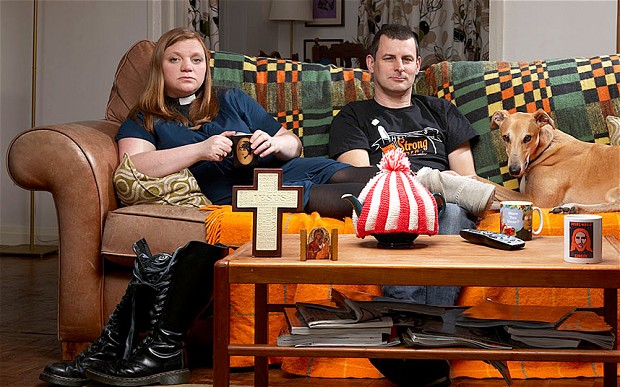
Kate Bottley - Gogglebox - Church of England - Partisan - Conservative Party - Tory Scum

What to do when the established church makes no attempt to hide its hatred for conservatives?

Those who watch Gogglebox are no doubt familiar with the Reverend Kate Bottley, whose ambassadorship for the Church of England probably reaches many millions more people than most bishops.

Should we be concerned, then, that one of the established church’s most high profile characters holds a seething contempt and hatred for one of our country’s two main political parties?

Archbishop Cranmer lays down the charge, based on Bottley’s recent on-air admission that “I hate it when I agree with a Tory”:

She wasn’t wearing her dog collar this week, but she doesn’t need to: the whole country knows (and so do Channel 4 editors and producers) that she is a Church of England vicar and a minister of the Word. And she is very well liked and respected: there is no hint of moral or doctrinal delinquency, but national admiration for her personal spirituality and great teaching capacity. She is a manifestly gifted, active communicator who is dedicated to serving her parish.

But ministry isn’t simply service, for that is the whole of Christian life. Her task as a vicar is distinctively liturgical, catechetical and pastoral, principally for the needs of the whole Christian community, including Tories. As an ordained priest, she is both servant and shepherd among the people to whom she has been sent, and that includes Tories. Her task is to proclaim the Word of the Lord and to watch for signs of God’s new creation, including in Tories. Her vocation is to teach, admonish, feed and provide for her flock, which includes Tories.

The majority of England is instinctively conservative: it appears to be a natural disposition; an affinity with the natural order; part of the psyche of essential Englishness. The Rev’d Kate Bottley is by no means obliged to approve of that: indeed, she is free to repudiate its consoling power and turn her religious fervour to more meaningful transcendent bonds. But you’d think there might be some sensitivity to the political-philosophical implications for mission praxis. Why should those Tories who attend her church bother to listen to her tell the story of God’s love, if all the time she is pinching her nose at their spiritual halitosis? Why should all those Tories who watch Gogglebox even consider walking with her in the way of Christ, hoping to be nurtured and encouraged in their faith? Why should they gather round the Lord’s Table if their vicar deems them to be unworthy or unable to resist the evil philosophies of men?

Bottley is far from an isolated case. Seething anti-Tory sentiment clearly exists much higher up in the church hierarchy, too, judging by the Bishop of Manchester’s decision to play host to Jeremy Corbyn and a left-wing rally coinciding with the Conservative Party conference taking place in the city.

Long gone, it seems, are the days when the Church of England was commonly known as the Tory party at prayer. And with church personalities using their pulpits to inveigh against right-wing policies and pontificate on the supposed dangers of Brexit, the time has come to urgently look again at the privileged position which the partisan established church holds in our constitution.


Church of England in Parliament - Church and State

Agree with this article? Violently disagree? Scroll down to leave a comment.

Follow Semi-Partisan Politics on TwitterFacebook and Medium.

Tales From The Safe Space, Part 6 – California State’s Civility Cafe

Womyn's Herstory Month - California State University San Marcos - CSUSM

For an increasing number of universities, re-education (or indoctrination) of students into the cult of Identity Politics is becoming a central part of the induction process

When the young, eighteen-year-old me arrived at Cambridge in the autumn of 2001, there were of course a number of welcome and induction events, ice-breaking activities and Freshers Fairs to attend. But at no point did the University of Cambridge consider it necessary to run a remedial workshop for new students, teaching us how to function in society and engage in civil discourse with our peers. That basic level of understanding was, shockingly, taken for granted.

And this wasn’t just a snobby Oxbridge thing. When I first arrived at Warwick University a couple of years later, I was likewise expected to be able to take care of myself and conduct myself like the fully grown adult that I was. The Warwick Student Union (then a bit loopy but now apparently one of the most snarlingly authoritarian in the country) gave us each a welcome bag which I recall contained a Cadbury Boost bar, a Wilkinson Sword razor and a pack of condoms to help me on my way, but was otherwise happy to stand back while I enjoyed varying degrees of success with each of these gifts without feeling the need to further intervene in my life.

And as it was for me, so it was for thousands more people who went to university as little as a decade ago. Which is partly why it is proving so hard to raise the alarm about what is happening on university campuses today. People see the odd sensationalist headline (often written by a generalist commentator) about comedians being banned or campaigns against statues or the replacing of applause with silent jazz hands, and think that they are puff pieces based on isolated incidents. After all, many people think, I only graduated a few years ago myself, and I never witnessed any of this craziness.

Well, things have changed a lot in the space of a decade, and the alarm is very much justified. Sure, the inexorable growth of statist Big Government and authoritarian crackdowns on free speech have been going on for much longer than a decade – and this blog tirelessly makes the case against censorship in all its forms and for unrestricted free speech. But to deny that something uniquely concerning has recently started to take place on university campuses in Britain and America is to bury one’s head in the sand.

One of the most troubling aspects of this new environment has been the number of universities which, hoping to avoid being embroiled in a wave of hysterical social justice protests such as those which consumed Yale and Mizzou last year, are deciding to come out ahead of the trend and pre-emptively embrace the new Cult of Identity Politics, weaving it into the fabric of their institutions before they are pressured to do so by crazed protesters.

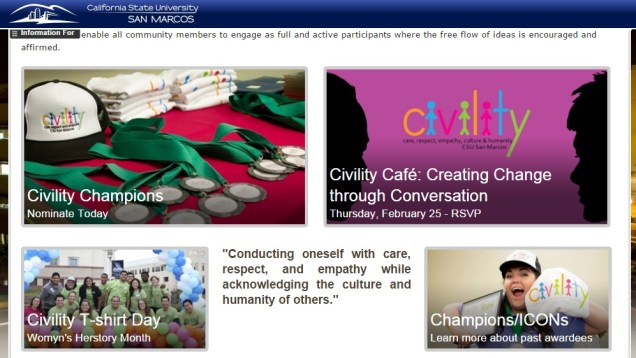
A case in point: California State University San Marcos, which has opened what it calls a “Civility Cafe”, less of a laid-back study lounge and more of a hectoring seminar where any hopeful expectations of free speech are swiftly recalibrated by campus authorities.

The aim is to turn all students into “civility champions”, as the university’s website explains:

CSUSM recognizes students, faculty and staff who display Civility on our campus by conducting themselves with care, respect, and empathy while acknowledging the culture and humanity of others.  Like waves through the ocean, our vision is that one simple act will have a ripple effect and a tsunami of civility will take over our campus.  We encourage you to identify and nominate students, faculty and staff on campus.

Students are then “invited” to take the following pledge:

As a member of the CSUSM community
I will conduct myself with care, respect, and empathy
while acknowledging the culture and humanity of others.

The university’s student newspaper, the Cougar Chronicle, elaborates:

The Civility Cafe, a skill-based workshop, aimed to encourage and educate students on how to engage in civil discourse with their peers.

John Loggins, University of San Diego’s Director of Community-Based Student Leadership and Learning, facilitated the event on Feb. 25 in USU 2310.

[..] Students then participated in an activity designed to increase their empathy and listening skills. Students partnered up and were invited to tell their partner a story about an instance in which they either excluded someone from a community or felt excluded themselves. After students shared their stories, their partner had to tell another student the story they had just heard, but from a first-person perspective.

Loggins then played a video for those in attendance. The film featured Dan Savage, a known advocate for LGBTQIA rights and creator of the It Gets Better foundation. After watching the video, students were asked to reflect and share actions, words or ideologies that trigger negative emotions.

“How we react to triggers says more about us than what triggers us. Try to reflect before speaking out of hurt or anger; this can create more civil discourses,” Loggins said.

Note Loggins’ use of the term “triggers”. It is now difficult to recall that the concept of trigger warnings originated in online discussion forums for rape and sexual abuse victims, as a means of flagging explicit discussions for those suffering from legitimate PTSD. But we have come so far from that limited usage now – and trigger warnings are now so widely used in academia and even the media – that the expert sent from the University of San Diego to run the Civility Cafe talks about “how we react to triggers” as though every single one of us is a victim of some kind.

Sure, we may not have been the victims of sexual violence. But we can nonetheless be “triggered” by the most minor perceived cultural slights, goes the theory, and we must attend special seminars to train us to manage our reactions when we are so triggered. What literally every generation of human beings before us managed to do (with a little trial and error) since the dawn of history now must be taught as a specific Life Skill by universities more obsessed with micromanaging the lives and daily interactions of their students than imparting a rigorous, valuable academic education.

This is incredibly corrosive, part of a wider narrative whereby everyone is treated as being sick – or a victim – by default, rather than by exception. But we should expect to see more of this, and more Civility Cafes (or similar devices) popping up at college campuses everywhere. Why? Because university administrators are risk-averse.

They saw what happened to Tim Wolfe, former president of the University of Missouri, who was unceremoniously forced to resign at the hands of mob justice. They saw what happened to legions of university professors and administrators who found themselves rooted to the floor, being screamed at for largely imaginary offences recast as capital crimes under the law of Identity Politics. And so, as a perverse form of liability insurance, some universities are now leaning into the trend, making Identity Politics indoctrination a mandatory or strongly encouraged part of the student experience so that they have a defence to fall back on should protests erupt on their own campuses over some future scandal, real or imagined.

Unfortunately, this only adds legitimacy to what the Identity Politics practitioners and the New Age Censors are trying to do, giving it the official imprimatur of the university and its leadership team. Rather than obsequiously bowing down to these demands and establishing two safe spaces for every one that was originally demanded, universities should be pushing back on the student activists and telling them that as adults, they are each responsible for managing their own human interactions, and must get out of the habit of looking to an external authority figure to mediate every single dispute or to mete out punishment for what often amounts to thoughtcrime – daring to hold or articulate beliefs which are in any way contrary to the prevailing Identity Politics narrative.

None of this is to say that genuinely racist, sexist, homophobic or otherwise discriminatory incidents do not occur on college campuses. Clearly they do. But the sense of panic and “danger” (student victims-in-waiting love to paint themselves as being in physical danger of nebulous words and ideas) is completely out of proportion to the issue, and overlooks the remarkable strides which have been made in overcoming prejudice and discrimination in our societies.

The American university system went from mass segregation to full integration in little more than a decade – precious gains which were made possible by exercising of unrestricted free speech, it should be pointed out. Why, then, do we need the most draconian measures – campus speech codes, re-education classes, social probation sentences for giving arbitrarily-taken offence to other students – to travel the last ten percent of the journey?

This is the case that the Identity Politics practitioners and New Age Censors need to answer. Why should freedom of speech, expression and thought be more severely curtailed now than ever before at this late stage, when most of the victories for tolerance, civility and equal rights have already been won?

Don’t expect an answer from them any time soon – for they have none. But do expect to see a lot more Civility Cafes popping up, serving flat whites with a sanctimonious side of social justice. It’s what the petty campus tyrants want, and many university administrations – like that of California State University San Marcos – either fully agree with their toxic agenda or are simply too spineless to stand up to them.


Safe Space Notice - 2

Agree with this article? Violently disagree? Scroll down to leave a comment.

Follow Semi-Partisan Politics on TwitterFacebook and Medium.

The Bishop And The Brexit Debate

christianity-europe-eu-brexit-3.jpg

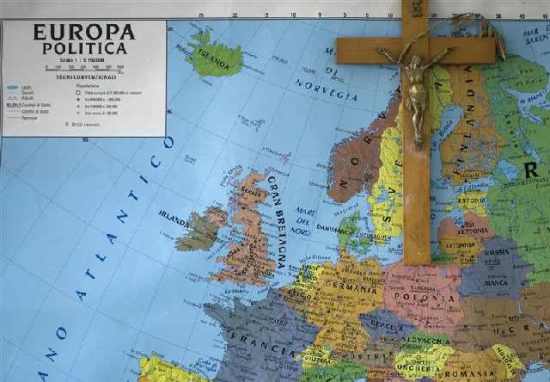
Apparently, Brexit constitutes a “nightmare scenario” for the Bishop of Guildford. No surprise, coming from an established church with such a dubious record on democracy

Should bishops in the Church of England (or indeed the leaders of any other religious denomination) be free to speak their minds on the subject of Brexit and in advising their flocks how to vote in the coming EU referendum?

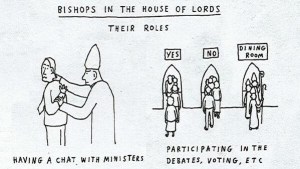
Of course they should. To suggest otherwise would be an unconscionable encroachment on religious liberty – the only exception being the intolerable Lords Spiritual whose anachronistic and unwelcome presence in the House of Lords makes Britain, like Iran, a technical theocracy.

But while non-political bishops have every right to express an opinion on Brexit, so we have the right to criticise their thinking on the subject, which tends to be woolly at best, and arrogant with a twist of elitism at worst.

King of the woolly thinkers is the Bishop of Guildford, who shared this recent gem on Twitter:

Adrian Hilton of Archbishop Cranmer dissects the Bishop of Guildford’s europhile ramblings over at Reimagining Europe:

So we read that the Brexit “nightmare” would be “very sad” because it would mark a return to “competing nationalisms” and “very dangerous times”. The EU has been “integral in delivering seven decades of peace and economic security”.We must resist the “widespread rise of populism” because “we are European” and “have nothing to fear or to lose if we remain so”. The Bishop of Leeds, Nick Baines, wants a ‘Third Way’, but that isn’t on the ballot paper. And the Bishop of Willesden, Pete Broadbent, aims directly for the Tories, but this isn’t a general election. As you see, it’s all impeccable political neutrality with rigorous episcopal impartiality.

The laity and other clergy will, of course, make up their own minds, but what manner of neutrality is it when CofE comms tells the media that the institution is neither for remaining nor leaving, while many in the House of Bishops preach the Gospel of Remain? Would a bishop ever tweet that his (or her) “nightmare” would be to wake up to a Corbyn premiership? What guilt does the prospect of voting for the Bishops’ (it probably is plural) Brexit “nightmare scenario” inculcate in the spiritually-discerning democratic intellect of the laity and subordinate clergy?

And here is the crux:

Some say we’d be poorer; others that the cost of holidays would rise; still others that our power stations would go dark and terrorism would increase. There is equal expert opinion to the contrary in every case, and it’s hardly four-horsemen-of-the-apocalypse stuff, is it? The matter of whether our national destiny is to be bound in perpetuity to an anti-democratic United States of Europe which is creeping, ratchet-like, toward continent-wide assimilation and uniformity cannot simply be distilled to short-term economic interests or security scaremongering.

I can understand Bishop Andrew’s desire to sustain a political union which is ostensibly based on sound Christian principles such as subsidiarity and solidarity. But, as Philip Booth has shown, the EU is antithetical to the very concept of localism, notwithstanding the letter of Maastricht. And I feel sure that the Greeks, Spanish, Italians and Portuguese might balk at assertions that the EU project is any longer concerned with fraternal solidarity, mutuality and social harmony.

This isn’t an organic social contract for diversity, liberty and limited state power, but a fabricated mechanism for the enforcement of national assimilation. When you’re locked – seemingly irrevocably – into a model of “economic governance” which hinders growth, destroys jobs, increases poverty, and leads mothers to abandon their children on the streets and fathers to commit suicide, I have to put to Bishop Andrew that his Brexit “nightmare scenario” would be welcomed by millions of Greeks as a dream of Grexit bliss.

The bishops’ willingness to swallow pro-EU talking points and then arrogantly sound off in public about how the EU has “kept the peace” and “delivered prosperity” is not just intellectually lazy. I would charge that it is a failure in their duty of pastoral care to all Christians in their flock, to accuse those who want Britain to leave the EU of trying to bring about a “nightmare scenario”.

Since when did believing in national democracy and sovereignty based at the level of a commonly understood demos represent a “nightmare” for the Church of England? Since when did the concept of self-determination (as opposed to slavishly following a pre-determined path toward unwanted European political integration set in motion decades ago) become unwelcome? And why is the Church willing to wring its hands and worry about human rights abuses and dictatorship abroad, but turn a blind eye when the rights of its own fellow citizens to determine the course of their own future is suppressed by Brussels?

At its root, the pro-European instincts of many bishops seem to rest in a desperate, stubborn insistence in seeing the world – and the European Union – as they would like it to be, rather than how it actually is. As Hilton suggests, the idea of the bad aspects of nationalism being eroded and replaced by shared European values of a vaguely left-wing bent of “subsidiarity and solidarity” is all well and good. But there is no European demos, and the relentless march toward further integration in the absence of a shared feeling of European-ness above national identity will only compound the simmering resentment.

The Church of England would clearly love nothing so much as to operate in a world where the nation state was consigned to the history books, and where we are primarily governed at a European level – no doubt as a stepping stone toward one world government. And they are entitled to that worldview, premature and perverse though it is.

But the Church and her bishops should at least show some embarrassment and contrition at the fact that by casting any concern for democracy aside and throwing their lot in with the European Union, they are helping to impose an elitist vision of a politically united Europe which more people vehemently oppose than have been scared and bullied by the Remain campaign into meekly supporting.

It is not the job of any Christian (least of all me) to judge another’s adherence to and practising of their faith, and so I will pass no comment on whether Andrew Watson’s gnawing fear that the British people might vote for self-government makes him a bad Christian.

But I will say without hesitation or apology that it does make him a bad citizen, a weak example of a community leader and an emblem of everything that is wrong with the established church’s continued role in the political life of our country.


Church of England - Church and State - Parliament - Lords Spiritual - Cartoon - 2

Bottom Image: Abbreviated cartoon by Dave Walker

Agree with this article? Violently disagree? Scroll down to leave a comment.

Follow Semi-Partisan Politics on TwitterFacebook and Medium.