No Prosecution For Matthew Doyle, But Free Speech Is Still Diminished

Matthew Doyle - Facebook - Twitter - Brussels Attacks - Muslim Woman - Arrest - Free Speech - Police

No trial for Islamophobic tweeter Matthew Doyle, but the mere fact of his arrest has served to further chill freedom of thought and speech in Britain

Vindication for “mealy-mouthed” tweeter Matthew Doyle, who will not be prosecuted for inciting racial hatred with silly social media messages after the police realised that they vastly overstepped their authority by arresting a man for speechcrime without first consulting with the Crown Prosecution Service.

The Guardian reports:

Charges against a man accused of posting tweets likely to stir up racial hatred have been dropped, Scotland Yard has said.

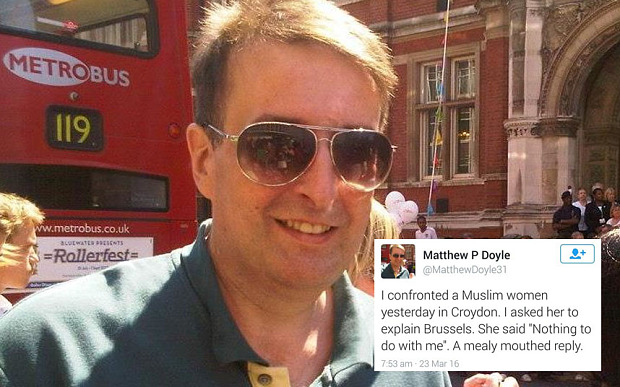
Police charged Matthew Doyle, 46, with a public order offence on Friday amid allegations that he tweeted about confronting a Muslim woman to ask her to “explain Brussels”.

But officers admitted later the same day that the Crown Prosecution Service (CPS) disagreed with their decision, adding that they did not have the legal power to bring the charges in the first place.

A statement released by police in the early hours of Friday morning said Doyle had been “charged under section 19 of the Public Order Act 1986; publishing or distributing written material which is threatening, abusive or insulting, likely or intended to stir up racial hatred”.

[..] But, late on Friday night, the Metropolitan police released a second statement saying that Doyle was “no longer charged with the offence and will not be appearing at court”.

It said: “Police may not make charging decisions on offences under Section 19 of the Public Order Act. There will be further consultation with CPS.”

So Doyle escapes on a technicality, the police (ever eager to respond to busybody public complaints about alleged thoughtcrime but much slower to respond when real crime occurs and your house is burgled) having brazenly overstepped their authority.

No doubt this is a relief for Matthew Doyle, whose initial tweet suggesting that all Muslims bear responsibility for the Brussels attacks, and subsequent inflammatory defence of that tweet, saw his life briefly put on hold and his flat ransacked by the police in their search for “evidence”.

But is this a victory for free speech?

Absolutely not. The fact that these draconian hate speech laws are on the statue book in the first place is an intolerable, long-standing affront to free speech in Britain. And the fact that the Metropolitan Police in London were able to drag a man from his home and hold him in jail when they did not have the authority to do so without suffering any kind of consequence whatsoever – there is certainly no talk of disciplining the officer(s) involved – is despicable too.

We must understand that the battle for free speech is won or lost at the margins. That often means defending the rights of people with truly heinous opinions on all manner of subjects to express themselves, while abhorring what they actually say. In this case, Matthew Doyle is hardly the world’s number one villain. He tweeted something particularly stupid about Muslims in the aftermath of the terrorist attack in Brussels, but he was light years away from cheering on such attacks himself (as many others do), or urging reprisals on all Muslims for what the Brussels terrorists did.

Under no reasonable definition of the word did Doyle “incite” anything at all, except in the minds of those joyless thought police who hold such a low view of humanity that they constantly fret that the public are mindless lemmings liable to being whipped up into a violent mob if they ever encounter a slightly controversial ideas. No, Doyle’s only crime was to be ignorant, and to broadcast that ignorance on social media.

Look at Doyle’s Twitter account page now, a full five days after his arrest and release. There is nothing new. Doyle has effectively been silenced, stopped from expressing his sincerely held opinions – opinions which he is fully entitled to hold, no matter how silly or wrong they may be – after the full weight of the criminal justice system came crashing down on his head one sunny afternoon:
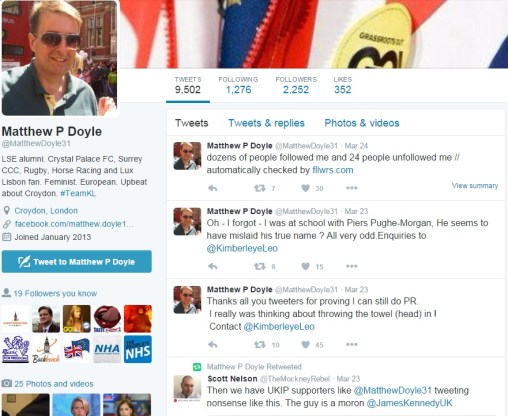
Matthew Doyle - Twitter Timeline - 28 March

The online disappearance of a man who was until now a fairly prolific Twitter user is quite poignant. It shows a case of public idiocy being responded to not with rebuttal, debate, correction and forgiveness, but rather with vengeful mob justice backed by the power of the state. It shows a free voice, however ignoble it may have been in this case, being frightened into silence.

Prior to his arrest, Matthew Doyle was more than happy to interact and debate with the army of online critics who mocked and argued with him. That is how free speech is supposed to work. Bad ideas are drawn out into the open, debated, dissected and discarded. Maybe Doyle would never have changed his views in response to his Twitter critics, but others observing the dialogue unfold may have done. And in any case, it added to the infinite tapestry of our social discourse.

Following his release, there are no new tweets. Any future opportunity for learning, debate or correction has been lost. And all because some moralising busybodies with nothing better to do thought that the best response to seeing something they disliked on the internet was to report it to the police. And because the police, who prefer to sit at desks scouring Twitter looking for thoughtcrime rather than getting out and tackling real crime, leapt at the opportunity to show their PC tolerance by arresting a man for his beliefs.

You don’t need to throw people in prison to create a chilly, hostile environment for free speech and free thought – although there are plenty of people languishing in British prisons simply for saying, writing, posting or singing the “wrong” things, “offensive” things.

You can suppress free speech in a society just as effectively by the threat of public shaming, harassment by the police and potential prosecution under draconian but arbitrarily applied laws. And in the case of Matthew Doyle, the message has been received loud and clear:

Think the wrong thoughts or write the wrong thing on social media, and we will come for you. We are watching you, all the time. Give offence to anyone, intentionally or not, and they have the right to make a criminal complaint about your speech. And in response, the police will come to your house in the middle of the night, bundle you into the back of a police van, take you away and leave you to fester in a jail cell for a day before grudgingly releasing you. Your arrest will be made public, and your reputation will be forever stained as the person whose ideas and opinions were so heinous that they got in trouble with the law. Good luck with the rest of your life and career.

This is Britain. In the year 2016. And this is what now happens to people who say the wrong thing or express an unpopular idea in public or on social media.

And you dare to boast that we live in a liberal, tolerant country which respects human rights and free speech?
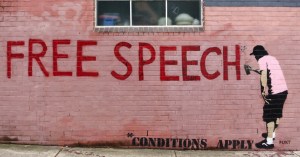
 

Free Speech - Conditions Apply - Graffiti

Agree with this article? Violently disagree? Scroll down to leave a comment.

Follow Semi-Partisan Politics on TwitterFacebook and Medium.

Tales From The Safe Space, Part 16 – The Prequel Begins Long Before University

School - Marking - Grading - Red Ink - Infantilised - 2

The banning of red ink for marking schoolwork – just one small part of our Prizes for Everyone educational culture – directly feeds the student authoritarianism on our university campuses

Over the course of this “Tales from the Safe Space” series we have seen glimpses of a coddled, fragile yet snarlingly authoritarian generation of young activists who perceive any disagreement with their ideology as tantamount to a physical and mental “assault” on their person.

These students demand not only complete submission from fellow students and university administrators to the arbitrary laws of Identity Politics, they also have the audacity to portray themselves as being so uniquely victimised and oppressed that unlike the generations which came before them, they alone need special protection and validation from an external authority. This, of course, is achieved through the establishment of safe spaces and draconian restrictions on freedom of thought and speech for everyone else on campus.

But students do not suddenly become baby-faced tyrants the moment they cross the threshold of college or university at the age of eighteen. Young people today are acted upon by three key environmental factors: the rise of Identity Politics as a movement, the West’s growing disregard for freedom of speech and the therapeutic culture in which we now live.

Every day brings new examples of each of these areas of civilisational decay. And one key factor in our modern day therapeutic culture is the way in which state schools increasingly pander to the feelings of their pupils rather than seeking first and foremost to impart a rigorous education and a strong character. Of course there are many noble exceptions. But if we ever believed that there would be no negative consequences to our present Everyone Wins A Prize culture, then we were sorely mistaken.

The Daily Mail reports on the latest depressing example:

Teachers have complained about a ‘ridiculous’ marking system which forces them to use pink ink for negative comments because it is ‘less aggressive’ than red.

The bizarre system is being implemented by some headteachers who believe pink is a softer colour which will make children feel less like failures.

Many are also making staff use up to six different coloured pens to give different types of feedback to pupils as part of a ‘triple’ or ‘deep’ marking strategy.

In one example, a school has asked pupils to respond to teachers’ comments in purple or blue, and if teachers want to give encouragement they have been told to use a ‘positive’ green pen.

[..] Lee Williscroft-Ferris, a modern languages teacher from Durham, said that in one school he worked at he had to draw a pink box at the end of each piece and insert positive comments in green ink and suggestions for improvement in pink.

This is not a new phenomenon. The Mail reported a similar story back in 2013:

Tory MP Bob Blackman revealed his anger after being told a secondary school in his Harrow East constituency had banned teachers from using red ink.

He told MailOnline: ‘A teacher contacted me and said I cannot believe I have been instructed by my head to mark children’s homework in particular colours and not to use certain colours.

‘It is all about not wanting to discourage youngsters if their work is marked wrong.

‘It sounds to me like some petty edict which is nonsense. It is absolutely political correctness gone wild.

The University of Colorado study often cited as being behind these ridiculous changes to school grading procedures warns that the colour red evokes “warning, prohibition, caution, anger, embarrassment and being wrong”. But surely that’s the whole point? Where there is error, the teacher’s red pen should be there to bring truth, and do so in an unambiguously clear way.

According to the same researchers, “in the context of communication, writing in red seems to shout in the same way as writing in all caps or writing which is underscored”. In other words, the current drive to eliminate red ink from schools stems from the same self-absorbed social media culture which frets that someone doesn’t like us because they failed to put a smiley face or a kiss at the end of their text message. But do we really want to be applying the neuroses experienced by the first generation to grow up with the internet to the current crop of students going through school?

While some of us might like friends, colleagues and bosses to validate us at every turn and sugar coat their feedback to us in warm and constructive ways, real life will not always be so kind. And children should be made ready for the world as it is, not as some naive idealists wish it should be.

School is the place where it is possible to fail in a safe and relatively consequence-free environment. Many people that students meet and collaborate with in the real world will not take the time to encouragingly point out the good parts of a report, presentation, product or other piece of work that generally failed to meet expectations. In some cases, the feedback may be quite harsh, often deservedly so.

This criticism is not usually an attack on the person, or an attempt to “invalidate their experience” or whatever other therapeutic phrase du jour is being used to pathologise everyday life. It is simply a statement that the work produced is incorrect, or in some way not up to specification. And children need to learn how to handle such feedback at a relatively early age. Young minds must be prepared for the challenges of life, not coddled and protected before being released unprepared into the wild.

Safe Space Notice - 1

We in the West increasingly live in an environment described by Rod Dreher as “a culture of autonomous individualists who don’t order their lives toward a common religion, or anything higher than what they desire”. And to that I would add that there is also an ascendant culture in which no longer values truth, where changes in how a person chooses to “identify” are taken to instantly overwrite reality.

In this brave new world, where even deluding oneself into thinking that one is an animal trapped in a human body is increasingly common among certain people, the awkward fact of a human birth certificate is just an inconvenient bureaucratic error to be erased as a new identity is created.

No wonder then that the teacher’s red pen is so hated – it stands as testimony to the despised idea that there is an objective reality, and often a right and wrong answer. For children who are raised to believe that everything they do is special and praiseworthy, and that their feelings are somehow sacrosanct and never to be trodden upon.

As my Conservatives for Liberty colleague Sara Scarlett puts it:

For years, children have been artificially insulated from any form of loss or emotional upset. The common practice of everyone getting a prize for taking part in sports regardless of how good they are, or how much effort they have put in. The reasoning being that no one’s feelings should get hurt. Whilst I appreciate that adults want their children to have happy childhoods, this has been taken way too far. It is not just the job of parents and educators to make children’s lives as happy as possible. It is the job of parents and educators to make their children into adults who can thrive in the adult world.

The rise of students who cannot exist outside of a ‘safe space’ shows that parents and educators have failed in many respects. Children should be exposed to competition and tests, offered incentives for doing well in them and working hard because that builds resilient adults who are ready for a world where not everyone gets a part in a blockbuster movie or a book deal. In trying to create a world where children are never subjected to rejection or losing, they are unprepared for an adult world where so much of life is about how you deal with rejection, loss, grief and disappointment and avoiding it is impossible. This is, after all, precisely what school is for; a place to fail when the stakes are low.

So as we can see, today’s young adults are uniquely susceptible to the toxic brand of Identity Politics coursing through universities, starting from the moment that they arrive on campus.

From birth, parents and teachers have instilled in these young adults the belief that they are special, unique and beyond reproach. And from there, it is only a small step toward internalising the language of Identity Politics to paint oneself as an oppressed or privileged individual who must be constantly mindful of – and responsible for – the slightest impact that their words or actions have on others.

That’s how you go from grading essays using friendly purple ink to a coddled, incredibly privileged black Yale student aggressively screaming at her college master because he refused to establish dictatorial, school-like rules governing what other adult students were allowed to wear at Halloween.

And that’s how abandoning red ink in schools today helps to create the baby-faced student tyrants of tomorrow.


Safe Space Notice - 2

Agree with this article? Violently disagree? Scroll down to leave a comment.

Follow Semi-Partisan Politics on TwitterFacebook and Medium.

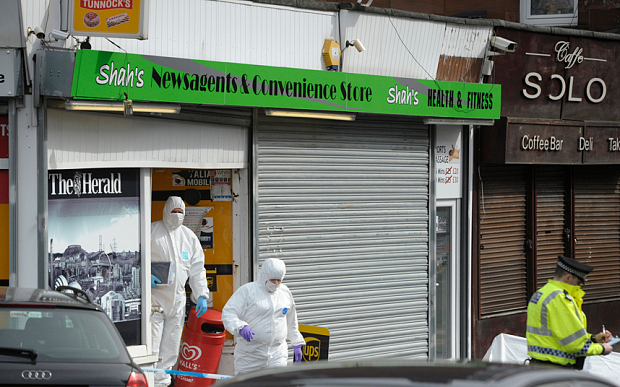
Asad Shah, Murdered For Showing That Islam And The West Can Coexist

Asad Shah - Murder - Happy Easter Facebook Message

Islamist murderers are as much a threat to peaceful Muslims as they are to any other British citizen

The cold blooded murder of Muslim shopkeeper Asad Shah this week is further proof, if any was needed, that primitive, reactionary Islamist thugs are just as much a danger to law-abiding, patriotic British Muslims as they are to anyone else in this country.

The Telegraph summarises the tragic murder of Asad Shah:

A popular shopkeeper was stabbed to death by another Muslim in a “religiously prejudiced” attack hours after posting an Easter message on Facebook to “my beloved Christian nation”.

Asad Shah, 40, a devout Muslim originally from the Pakistani city of Rabwah, had his head stamped on during a savage attack, according to one eyewitness.

Around four hours earlier the victim wrote online: “Good Friday and a very Happy Easter, especially to my beloved Christian nation.

“Let’s follow the real footstep of beloved holy Jesus Christ and get the real success in both worlds.”

It was later confirmed by the police that a man has been arrested in connection with Shah’s death, and that it is being treated as religiously motivated.

This should come as no surprise to anyone. Islamist extremists – whether acting in coordinated fashion or as lone wolves – cannot abide the idea of religious and cultural understanding, or of a strain of Islam which seeks peaceful coexistence and cooperation with its neighbours. They want holy war. And just as this leads them to commit terrorist acts like those in Paris and Brussels as an attempt to create a broader anti-Islam backlash and inflame tensions as an effective recruiting tool, so it also urges them to carry out reprisals against those Muslims who conspicuously reject the Islamists’ violent ideology.

The real tragedy is that too many politicians – with their blind devotion to unchecked multiculturalism as a positive end in itself – have actively made it harder for more people like Mr. Shah to emerge. Doggedly insisting that any culture is above criticism or reproach, as many apologists do, only encourages the British population to stratify into parallel “separate but equal”communities, without even the most basic fundamental values tying us together. And by all accounts, this is the very opposite of what Asad Shah wanted.

This peaceful, devout Glaswegian shopkeeper was murdered in cold blood by primitive, fundamentalist thugs who betrayed Islam and the peaceful majority of its adherents with their cowardly actions. But Shah was also betrayed by his own government, and a generation of politicians who sought to burnish and show off their tolerance credentials while the seeds of Britain’s own radical Islamist threat slowly took root.

As Rod Dreher wrote in his eloquent eulogy to Shah from across the Atlantic:

Asad Shah is with our Creator today. I am confident of that. Please, Christians, wherever you are this Easter weekend, pray for the soul of a righteous man, murdered for his compassion and love of mankind.

Remember, too, that if you condemn all Muslims over the bloodthirsty killers of ISIS, you also condemn this good man Asad Shah, may his memory be eternal.

May God bless the soul and the memory of Asad Shah, a man whose own life proved that religious identity can indeed blend harmoniously with a strong national identity, and whose bright example was extinguished far too soon.


Asad Shah - Happy Easter message - Facebook - 2

Agree with this article? Violently disagree? Scroll down to leave a comment.

Follow Semi-Partisan Politics on TwitterFacebook and Medium.

The Age Of Trump: As The Republican Party Goes To Its Armageddon

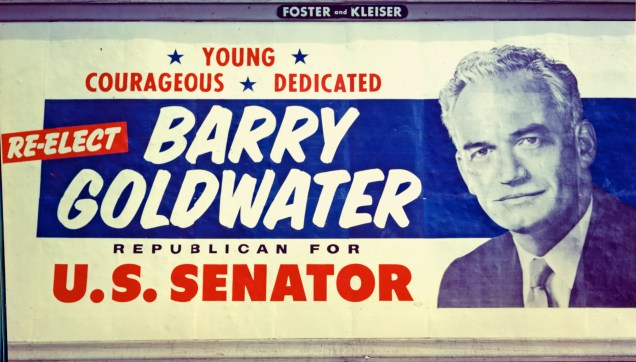
Barry Goldwater - Election Poster

To understand why the Republican Party are on course to lose their third consecutive presidential election, one must look much further back in time than the rise of Donald Trump

It gives no satisfaction to watch any storied political party hurl itself into oblivion – even the US Republican Party, which has frequently infuriated true conservatives with its sanctimonious and hypocritical habit of screeching about the dangers of encroaching socialism under Democratic administrations while themselves consistently cranking up the size and role of the state at every opportunity.

But while it now seems almost certain that the Republicans have thrown away any chance of reclaiming the White House, imploding in a foul-mouthed torrent of bluster and recrimination more worthy of Jerry Springer than a presidential primary campaign, it is worth looking back and asking how the GOP finds itself in this position, and exactly when the seeds of destruction were sown.

I have been reading widely on this, focusing less on the crowing and virtue-signalling Left, and far more on those thoughtful and introspective voices on the Right who are often appalled by the rise of Donald Trump in particular, but often sympathetic to the anti-establishment fervour which fuels his candidacy.

And if I have to pick just one excerpt from one piece to explain the predicament in which the Republican Party currently finds itself, I would encourage my readers to read “I was wrong about Donald Trump” by Daniel McCarthy over at The American Conservative.

In his piece, McCarthy concludes:

Trump succeeds because of more than outsize personality, of course. He attracts some support from everyone who thinks that Conservatism, Inc. and the GOP establishment are self-serving frauds—everyone who feels betrayed by the party and its ideological publicists. Working-class whites know that the Republican Party isn’t their party. Christian conservatives who in the past have supported Mike Huckabee and Ben Carson also know that the GOP won’t deliver for them. Moderates have been steadily alienated from the GOP by movement conservatives, yet hard-right immigration opponents feel marginalized by the party as well. Paleoconservatives and antiwar conservatives have been excommunicated on more than one occasion by the same establishment that’s now losing control to Trump. They can only applaud what Trump’s doing, even if Trump himself is no Pat Buchanan or Ron Paul.

Conservative Republicans™ somehow maneuvered themselves into a position of being too hardline for moderates and non-ideologues, but not hardline or ideological enough for the right. Trump, on the other hand, appeals both to the hard right and to voters whose economic interests would, in decades past, have classed them as moderates of the center-left—lunch-pail voters.

What’s even more remarkable is that movement conservatives, who have been given plenty of warning, ever since 2006, that their formula is exhausted, keep doing the same thing over and over again: they’ll dodge right, in a way that right-wingers find unsatisfactory but that moderates find appalling; then they’ll weave back to the center, in a way that doesn’t fool centrists and only angers the right. Immigration—which was another of George W. Bush’s stumbling blocks, lest we forget—has been the issue that symbolized movement-conservative Republicanism’s futility most poignantly. It’s not even clear that most GOP voters agree with Trump’s rhetorical hard-line on immigration—they just like it better than the two-faced talk of the average Republican politician.

Trump has a plethora of weaknesses, as general election polls amply demonstrate. But just look what he’s up against within the Republican Party: that’s why he’s winning.

I have yet to see the rise of Donald Trump explained as thoughtfully and succinctly as it is in the first three paragraphs quoted above. Sure, McCarthy’s piece does not tackle every aspect of the situation – whole books can and will be written about the causal factors of this huge anti-establishment backlash, which is far bigger than any one political party – but it does explain why the current GOP was so badly positioned to withstand a populist insurgency like Trump’s.

Much like the British Labour Party has become a fractious and increasingly unworkable coalition of idealistic left-wingers, pragmatic centrists and (let’s be frank) soulless political shapeshifters, and much as the historic splits in the Conservative Party are re-emerging following a vacillating 2016 Budget and the party leadership’s betrayal of the activist base on the coming EU referendum, so the Republican Party’s big tent of Reaganites, neo-cons, Evangelicals and social conservatives is collapsing – for those reasons outlined above by McCarthy.

Read the collected output of Rod Dreher too, and this piece by David Brooks, which looks to the future which could yet follow 2016’s rock bottom:

Trump is prompting what Thomas Kuhn, in his theory of scientific revolutions, called a model crisis.

According to Kuhn, intellectual progress is not steady and gradual. It’s marked by sudden paradigm shifts. There’s a period of normal science when everybody embraces a paradigm that seems to be working. Then there’s a period of model drift: As years go by, anomalies accumulate and the model begins to seem creaky and flawed.

Then there’s a model crisis, when the whole thing collapses. Attempts to patch up the model fail. Everybody is in anguish, but nobody knows what to do.

That’s where the Republican Party is right now. Everybody talks about being so depressed about Trump. But Republicans are passive and psychologically defeated. That’s because their conscious and unconscious mental frameworks have just stopped working. Trump has a monopoly on audacity, while everyone else is immobile.

[..] At that point the G.O.P. will enter what Kuhn called the revolution phase. During these moments you get a proliferation of competing approaches, a willingness to try anything. People ask different questions, speak a different language, congregate around a new paradigm that is incommensurate with the last.

That’s where the G.O.P. is heading. So this is a moment of anticipation. The great question is not, Should I vote for Hillary or sit out this campaign? The great question is, How do I prepare now for the post-Trump era?

As Brooks says (perhaps a little naively), this is not necessarily all bad news for conservatives. If we are honest, we have to admit that conservative policies in America and Britain are no longer perfectly calibrated to the challenges of the day as they were in Thatcher and Reagan’s time.

That is not to say that the Left are any better; Lord knows they aren’t. But it does mean we should acknowledge certain facts – like the fact that we still have a stubbornly large permanent underclass, and that for all the irreplaceable benefits of globalisation, there are still those who miss out – and seize the initiative by proposing radical conservative policy solutions to the great challenges of the new century.

In Britain, David Cameron’s Coke Zero Conservative government – or the Ted Heath tribute act, as this blog has taken to calling them – seem to think that One Nation Conservatism means stealing as many of Labour’s left-wing ideas as possible. And in America, Donald Trump’s brand of populist pseudo-conservatism doesn’t believe in One Nation at all, unapologetically carving the country up into winners and losers.

Neither is the correct approach. And as Cameronism and Trumpism run their respective courses, this blog will continue providing commentary and offering suggestions for an alternative conservatism, in Britain and America.


Postscript: This blog has decreased its focus on US politics in the past few years, primarily because I have been London based and fully occupied writing about British political issues. But Semi-Partisan Politics will begin to cover the American presidential election with a little more frequency going forward, partly because I have always remained a close follower of American politics – often more so than the household name journalists dispatched to the States by their newspapers and now portentously reporting back to us as self styled “experts”.

Having lived in America helps – particularly having lived in the American Midwest, not just the coastal enclaves of New York and Washington, D.C. familiar to most British journalists who write about America during election season. And the fact that I am married to a Hillary Clinton-supporting Hispanic Texan helps too. When I write about American politics, I know whereof I speak.

But I am also covering the presidential race because as a conservatarian with one foot firmly planted on either side of the Atlantic (and a heart divided equally between Britain and America), I believe that in my own small way I can bring a perspective to the left/right, authoritarian/libertarian debate that is often missed by those whose thinking and writing is rooted firmly in just one country’s specific conservative tradition.

To borrow an overwrought phrase from the dystopian world of Identity Politics, consider this my contribution to an “intersectional” perspective on conservatism.

They’ll absolutely hate me for that.


Donald Trump Hat - Make America Great Again

Agree with this article? Violently disagree? Scroll down to leave a comment.

Follow Semi-Partisan Politics on TwitterFacebook and Medium.

Happy Easter – He Is Risen

A very happy and blessed Easter to all of my Christian readers

Hallelujah, for the Lord God Omnipotent reigneth, Hallelujah!

The Kingdom of this world is become the Kingdom of our Lord and of his Christ, and he shall reign for ever and ever, Hallelujah!

King of Kings, and Lord of Lords, and he shall reign for ever and ever, Hallelujah! REVELATION 19.6, 11.5, 19.6

Hallelujah Chorus, Messiah by Georg Friedrich Händel, performed by the London Symphony Orchestra and Tenebrae Choir under the baton of Sir Colin Davis.

A brief and entertaining history of Handel’s Messiah is here.


He is Risen - Happy Easter

Follow Semi-Partisan Politics on TwitterFacebook and Medium.