Tales From The Safe Space, Part 19 – Cardiff Students Hold “Inner Child Day”

Cardiff University Students Union - Inner Child Day - Infantilisation - Safe Space

Good mental health does not mean regressing back into childhood

One of the most insidious things to emerge from the Cult of Identity Politics taking over Anglo-American university campuses is the false equating of good mental health with a state of childhood.

Safe spaces, campus speech codes and trigger warnings all serve to infantilise students, in the belief that if only these young adults are coddled like children and protected from ever encountering a dissenting opinion or a negative word, it might just be possible to preserve their fragile mental equanimity.

One of the most overt recent manifestations of this trend is the “Inner Child Day” recently held at Cardiff University (the same institution whose students were so traumatised by the hateful presence of Germaine Greer on campus last year).

The ad promoting Inner Child Day encouraged Cardiff students to “embrace your inner child with a whole day of free fun in Y Plas in Cardiff University’s SU! Think inflatables, games, face painting and some 90s classics!”. Because apparently university is no longer a place to emerge into adulthood, but rather place to regress back to the habits and mentality of a toddler.

Johanna Williams paints an excruciating picture of the event in an article in Spiked:

It took place in the nightclub of the students’ union building and featured such mental-health managing strategies as biscuit-decorating, dog-petting, face-painting and jumping about on a bouncy castle. Students were able to work towards the holy grail of positive mental health by practising their forward rolls and uploading pictures of their newly ornamented biscuits to social media in return for the approval of their peers.

The nightclub was suitably decorated. There were balloons everywhere to appeal to the six-year-old children just waiting to burst out of the students’ twentysomething bodies. A giant screen at the front of the room showed a woman cradling a miniaturised version of herself as someone would cradle a child. Apparently, the phrase ‘Can your inner-child come out to play?’ was meant ‘to offer hope to sufferers’.

Watching this event unfold was like walking into a perverse version of Alice in Wonderland. Twentysomething adults were catapulting themselves towards a healthier state of mind on the bouncy castle with an abandon that would get them banned from any normal event involving bouncy castles.

This all sounds disturbingly similar to the Safe Space room set aside during a debate at Brown University in Rhode Island, in which students who felt “triggered” by what they heard during a voluntarily attended meeting were offered infantilising consolations such as puppy videos, snacks, soft furnishings and Play Doh, as well as an army of trained counsellors.

Williams concludes:

This attempt to fight insanity with insanity is worrying. The trend towards medicalising everyday moods, to treat, say, the homesick student as someone with a mental-health problem, has led to the creation of a bogus epidemic of mental ill-health on campus. This means that people who suffer from a genuine mental illness, such as schizophrenia, are missing out on support because too much attention is focused elsewhere.

These childish events will do nothing to help students who are genuinely unwell. What’s worse, they’ll make today’s pampered students even less likely to grow up.

Williams is right. This is dangerous stuff, inflating good mental health with a regression to a sanitised version of childhood, with face painting and cookies and puppy dog videos. And whatever transitory benefit it may provide to students who are not really mentally ill but are simply stressed or homesick, it will do nothing for – and in fact diverts attention and resources away from – the far smaller number who are genuinely in need of help.

True mental health comes about by building a healthy resilience to the kind of everyday emotional bumps and scrapes which characterise adult life. In the real world, people sometimes have completely contradictory views about fundamental issues, but must nonetheless live, shop and work together.

Safe space policy makes that harder by sending the message that students should not have to so much as glimpse opposing ideas, while the entire cult of Identity Politics is built on the notion of a backbiting Hierarchy of Privilege, where everybody is an oppressor and nearly everyone (except for cis white men at the top of the pyramid) is also oppressed.

This culture does not produce resilient, well-rounded adults. Rather, it is producing a generation of self-involved, narcissistic adult babies who worship at the altar of their chosen “identity” and demand that everybody else admire their idiosyncrasies, acknowledge their pain and massage their egos on pain of censorship or disciplinary action.

And if none of that stirs you to anger, then at least be outraged by Cardiff University Student Union’s cynical, tawdry trivialisation of mental health, and the suggestion that ten minutes on a bouncy castle and a spot of face painting are the cure for those students who suffer from genuine mental health issues.


Safe Space Notice - 2

Agree with this article? Violently disagree? Scroll down to leave a comment.

Follow Semi-Partisan Politics on TwitterFacebook and Medium.

Tales From The Safe Space, Part 18 – At Edinburgh, The Revolution Eats Its Own

Imogen Wilson - Edinburgh University - Students Union - Safe Space Policy - Identity Politics

Censured for raising her hand and shaking her head in a student council meeting, but don’t feel sorry for her – this student fully supports the draconian Safe Space policy which saw a complaint raised against her

Edinburgh University has long been one of the dodgiest academic institutions in the country when it comes to tyrannical student activism and the suppression of free speech.

The university has consistently scored Red in the Spiked Free Speech University Rankings, with the student union’s bizarre rules banning “hand gestures which denote disagreement” or applause when a motion fails to pass marking the institution as a particularly insufferable place to take a degree.

(It’s amazing that they tolerate applause at all).

Therefore, in such a sanctimoniously authoritarian atmosphere, it was only a matter of time that the Identity Politics revolution which currently subjugates Edinburgh University claimed one of its own revolutionaries. And in this case, the victim is a student union officer (vice President of academic affairs) named Imogen Wilson, someone no doubt more used to doling out punishment for thought crime than being on the receiving end.

Wilson’s crime? Raising her hand to speak during a meeting of the student council, and then later – pass the smelling salts! – shaking her head in disagreement with something which was said.

The Daily Mail reports:

A student was almost kicked out of a meeting after she violated a ‘safe space’ by raising her arm at Edinburgh University.

Imogen Wilson wanted to make a point at Thursday’s student council session when she was told off by officials.

The vice-president for academic affairs at the university’s Student Association was accused of failing disabled students by not responding to an open letter.

She immediately raised her arm to disagree but was made the subject of a ‘ludicrous’ complaint and told not to make the gesture again.

Imogen was also warned for shaking her head during the meeting as it again breached the ‘safe space’ which is part of the university’s Student Association rules. 

But before you feel too sorry for Imogen, bear in mind that she is an enthusiastic proponent of Safe Space policy and the whole range of illiberal, stultifying policies which are crushing freedom of thought and expression at her university.

The Huffington Post explains:

Wilson later shook her head whilst someone was speaking, and was threatened with another safe space complaint.

“I completely understand the importance of our safe space policy, and will defend it to the ground, but I did not think that was fair, and had it gone further I would have either left or argued against it,” she said.

So Wilson was more than happy for the speech and behaviour of others to be strictly regulated and censored while on campus, but is now throwing a petulant tantrum when she herself accidentally steps on one of the very Identity Politics landmines that she and her student tyrant comrades have been busy laying throughout the political and social discourse, and in the students union rulebook.

This is also hilarious:

A fourth-year student at the meeting, who wished to remain anonymous, told HuffPost UK: “The whole thing was a ludicrous abuse of the entire intent of safe space.

“We were having one of the most emotionally tense councils of the year, with the vote on the BDS movement and people speaking who live in Palestine or are Israeli on both sides of the issue.

“There was ample risk of there being an actual safe space issue taking place—an anti-semitic or islamophobic comment for instance—but the whole debate was actually remarkably civil despite how emotional it was.

“So for someone to have abused the very legitimate purpose of safe space rules to get at someone they politically disagreed with was pretty low.

Gosh, so there was a real danger of an “actual safe space issue” occurring – the possibility that someone might have said something a bit crass or offensive about Palestinians or Israelis, thus immediately shattering the fragile psyches of the adult babies studying at Edinburgh University. How terrifying.

(And as always, it is great to see a students union spending its time debating the issues which really affect the day-to-day life of students on campus – like the BDS movement, whose principle agents will surely be quaking in their boots awaiting the verdict of a bunch of jumped-up student activists in Edinburgh).

But funniest of all is the fourth-year student’s complaint that in targeting Imogen Wilson, her accusers had “abused the very legitimate purpose of safe space rules to get at someone they politically disagreed with”.

Well, who would have thought that such cynical behaviour might be a consequence of laying so many verbal and behavioural traps everywhere? Who could have anticipated that by making so many rules governing who is allowed to speak and what they are allowed to say, it might provide an irresistible temptation for students to manipulate those rules to their own benefit, or to spitefully punish someone with whom they disagree? Who could possibly have foreseen such a shocking development?

Clearly not the adult babies of Edinburgh University, who – when they are not high-mindedly resolving the Middle East peace process on behalf of grateful Israelis and Palestinians – are so busy trying to entrap one another with their precious Safe Space / Identity Politics rules that they totally lose sight of why they are at university in the first place.


Safe Space Notice - 2

Top Image: Daily Mail

Agree with this article? Violently disagree? Scroll down to leave a comment.

Follow Semi-Partisan Politics on TwitterFacebook and Medium.

Attention, Thought Criminals: Glasgow Police Have You In Their Sights

Greater Glasgow Police - THINK - Social Media - Police State - Free Speech

Glasgow Police’s conception of public safety is plain old fashioned tyranny

Imagine the kind of dystopian police state you would have to inhabit for it to be normal for the authorities to routinely warn citizens to be careful about what they think or say, on pain of criminal prosecution and potential incarceration.

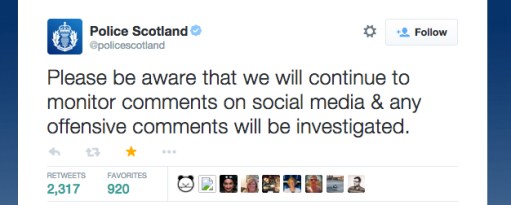
Well, you don’t have to imagine, because Police Scotland and the Greater Glasgow Police are busy constructing their own tribute to North Korea right here in the UK.

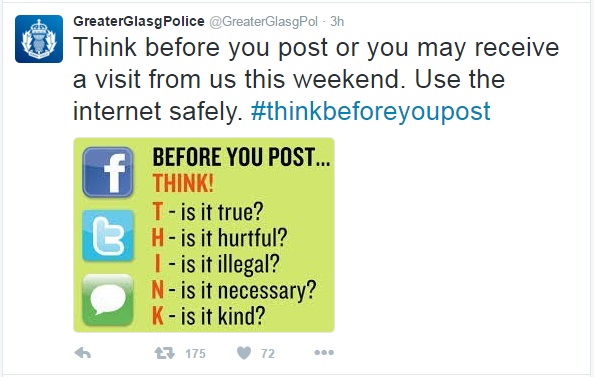
The tweet shown above was posted on twitter by the Greater Glasgow Police – unironically – this afternoon, along with the menacing hashtag #thinkbeforeyoupost.

Apparently before offering up our thoughts to the internet, whether they be on politics, cooking or sport, we are to ask ourselves whether what we are posting is True, Hurtful, Illegal, Necessary or Kind. The clear implication is that if our speech fails the THINK test, some snarling Scottish police officer will turn up on our doorstep to drag us away, much as the London Metropolitan Police did with Matthew Doyle last weekend.

This is something of a scope increase for the police, to put it mildly. Where once they largely confined themselves to preventing and solving crime, apparently having since eliminated all actual crime in our society (…) and finding themselves at a loose end, they are now eager to swoop in and punish speech which passes Britains’ already draconian hate speech laws but which happens to be arbitrarily perceived by others as hurtful, unnecessary or unkind.

Let’s call a spade a spade: this is tyranny. When an enforcement arm of the state can post jocular messages on social media warning citizens to be on their best, blandest and most inoffensive behaviour on pain of arrest, we do not live in a free society any more. And it is time that more of us acknowledged this, so that we can get on with the task of rolling it back and re-establishing our corroded right to freedom of expression.

Alex Massie thunders:

Whatever next? The monitoring of conversations in public houses? Why not? Twitter and Facebook, after all, are merely digital, virtual, gathering places. As the wags on social media have put it today, Thur’s been a Tweet and Detective Chief Inspector Taggart is on the case.

Beneath the necessary and hopefully hurtful mockery, however, lurks an important point. One that relates to something more than police stupidity and over-reach and instead asks an important question about the value placed on speech in contemporary Britain. The answer to that, as this and a score of other dismal examples demonstrate, cannot cheer any liberal-minded citizen. Such is the temper of the times, however, in which we live. Nothing good will come of any of this but you’d need to be a heroic optimist to think it will get any better any time soon.

What a country; what a time to be alive.

All very good points. If social media is fair game for the thought police, why not the local pub, too? What restraint should there be, besides time and resources, on blanket surveillance of everyone all the time in the pre-emptive battle against speech crime?

When will people finally start waking up to the sheer illiberality and the authoritarian nature of contemporary society?

When will people finally realise that weaponised offence-taking and the Cult of Identity Politics do not create a Utopian paradise of peace and harmony, that in behaving this way we are only driving bad ideas underground to fester and grow while punishing those who dare to think differently?

When will people get that having the state act as an overbearing, always-watching surrogate parent figure, monitoring our behaviour and punishing those who do no more than hurt our feelings, is creating a weak-minded and unresilient population who are unable to handle slights and setbacks without running to an external authority figure for redress?

In a healthy society, the author of that tweet by Greater Glasgow Police would have broken the law by using their position to threaten the right of the people to freedom of expression – a liberty which would be guaranteed in a written constitution enshrining our fundamental rights to life, liberty and the pursuit of happiness.

But we do not live in a healthy society, the police are free to do as they please without censure and there is no written constitution guaranteeing our liberties. Instead, we have a “make it up as you go along” constitution and form of government with a strong tendency to attempt to solve the immediate problem in front of it by taking power away from the people to act in their own interests and vesting those same powers in the state.

We are approaching the point where some kind of rebellion against this censorious, bullying, tyrannical behaviour by the police must be mounted – perhaps some kind of co-ordinated mass action whereby everyone tweets something “offensive”, gets a partner to report them to the police and vice-versa, the idea being to gum up the workings of the police and criminal justice system until the whole rotten edifice collapses in upon itself.

Semi-Partisan Politics is in very rebellious mood right now.


Police Scotland

Agree with this article? Violently disagree? Scroll down to leave a comment.

Follow Semi-Partisan Politics on TwitterFacebook and Medium.

The National Security Implications Of Failing To Support The Steel Industry

Save Our Steel - Tata Steel - National Security

With so many other glaring weaknesses in Britain’s national security infrastructure, does the loss of domestic steel production really matter?

While everybody rends their garments about the threatened closure of Tata plants and other steelworks around the country, many commentators – from both ends of the political spectrum – are touching on the national security implications of failing to support our steel industry.

Arguing in favour of government intervention to support the British steel industry, the Daily Mirror quotes Labour MP Dan Jarvis:

The steel sector crisis rocking Britain could put our national security at risk, a top Labour MP has warned.

In a boost for the Daily Mirror’s Save Our Steel campaign, Dan Jarvis will tell the annual State of the North conference of the dangers of closing major plants.

“It undermines our freedom and our influence if we become overly reliant on other countries for essential resources that we will need in the future,” he will say.

“Deciding whether we preserve some of the best coke ovens and the largest blast furnaces in our country has implications for our national security as well as our future prosperity.”

While from the other side, Allister Heath writes in the Telegraph:

Then there are the strategic and military dimensions. There may one day be another major war, or a large emerging nation could go rogue. But we cannot run Britain on a war footing. The Government should engage in contingency planning: it could stockpile steel, or even set up a couple of mothballed plants. None of this is any justification for nationalising unviable businesses.

But how much of a hammer blow to Britain’s independent warmaking (or defensive) capability would the closure of our remaining steel plants actually be?

The argument in favour of retaining significant steelmaking capacity is that we might need it in case of urgent re-armament or replenishment of lost military hardware. But the lead time for the construction of a Type 45 destroyer is 3 years – compared to one year for the groundbreaking HMS Dreadnought in 1906 and thirteen months for the famous HMS Belfast in 1938. While the aircraft carrier HMS Invincible was built in seven years during the 1970s, HMS Queen Elizabeth – first of the Royal Navy’s two new aircraft carriers – will have been in production and trials for eleven years before finally becoming operationally ready in 2020.

If we found ourselves facing a dire security or military threat requiring additional naval ships, besides directing our ire at David Cameron – who has presided over a shameful degradation of the Royal Navy’s surface fleet – Britain would have little choice but to attempt to buy the requisite ships from a foreign navy (who may or may not be willing to sell to us). The lead time for commissioning a modern advanced warship is now so long that most conflagrations would be over by the time new ships were completed. And all the time they were under construction, the shipyards – and steelworks, and any other supporting industry – building them would be vulnerable to sabotage from within and aerial attack from without.

In other words, the days when we could melt down iron railings and salvage bits of scrap material to aid the war effort or rush produce a battleship in eleven months are over (to the limited extent that they existed at all). In any future major war, Britain will effectively go to war with the hardware it has available at the time, with little prospect of rapid re-armament – which is why we should all be concerned about this supposedly Conservative government’s failure to prioritise defence spending.

And it’s not just steel. Britain has almost no domestic supply of the rare earth minerals which are needed to manufacture the computer components which go into everything from vehicles, weapons and medical equipment. Sure, the government could keep stockpiles – though our government is too woefully inept to do so. But where does it end? When so many goods are the product of a disaggregated global supply chain, what do you insist is produced locally?

These are not easy questions to answer. But in answering them, policymakers have an obligation to delve deeper than the very two-dimensional “steelwork closures will mean that Britain is no longer a military power” level of debate we are getting so far. And they have an obligation – not that they are likely to fulfil it – to be honest with the public about the trade-offs which guide such decisions.

As it happens, this blog would like to see more critical national security infrastructure brought back under British control – energy independence for a start, and a strengthened military with a Royal Navy befitting a powerful island trading nation. But so far, I have yet to be convinced by anyone that the loss of domestic steel production weakens us as a country any more than the many other inevitable global interdependencies which undergird our ability to make war – never mind the Conservative government’s reckless vandalism of the armed forces, which was utterly avoidable.

And so I put this out there to those with strong opinions backed up by detailed knowledge: from a national security standpoint, with so many other glaring (and often recently self-inflicted) weaknesses in our national security infrastructure, does the potential loss of our remaining domestic steel production capacity really matter?


Postscript:

This is not to say there should not be some type of government intervention to delay the steelworks closures or mitigate their effects. Surely one of the lessons learned from Thatcherism is that no matter how essential industrial and economic realignment may be for long-term success, simply expecting people (particularly a coddled British population used to being helped by the government) to brush themselves off and start lucrative new careers after being made redundant is callous and wildly overoptimistic. The word “Tory” is still utterly toxic in some communities, over thirty years later, and we must avoid making it even worse.

People have no right to demand that the state (i.e. their taxpaying neighbours) permanently subsidise the loss-making industry which gives them employment, but we should provide those affected with transitional support through re-training and educational grants to equip workers with more lucrative skills. Failing to do so, either out of bumbling incompetence (David Cameron and Sajid Javid) or rigid ideology will only create more negative consequences of social deprivation and regional dereliction, which is morally wrong as well as more expensive in the long term.

This piece in Conservative Home explains the consequences of failing to provide such transitional support, and the advantages of doing so.


Tata Steel

Agree with this article? Violently disagree? Scroll down to leave a comment.

Follow Semi-Partisan Politics on TwitterFacebook and Medium.

Tales From The Safe Space, Part 17 – Woman Assaults Student For “Cultural Appropriation”, Claims She Is The Victim

Identity Politics preaches that violence is an acceptable tool of coercion to make other people conform

Watch this video of a woman – believed to be Bonita Tindle, possibly a university employee – accosting a white male student in the corridor of a campus building at San Francisco State University, because she objected to the “cultural appropriation” behind his choice of hairstyle.

The Daily Wire gives context:

In a video published on Monday, a black female said to be a campus employee accosts a white male said to be a student at San Francisco State University out of hostility to the “cultural appropriation” of his dreadlock hairstyle.

“You’re saying I can’t have a hairstyle, because of your culture? Why?” asks the white male, who appears to be wearing a dress.

“Because it’s my culture,” responds the black female.

“Do you know that it was in Egyptian culture? Are you Egyptian? Naw,” replied the male student with animated body language.

Interjecting, a black male observer who appears to be wearing pink leggings asks the white male if he’s Egyptian.

As the white male attempts to leave up a staircase, the black female grabs his left arm sleeve. Giving in to the pull, the white male demands to be left alone as he descends back to the main floor.

Except that this is not the whole story. The white male student does indeed attempt to leave up a staircase, and is repeatedly prevented from doing so by the female. He is clearly, demonstrably trying to leave the scene and is prevented from doing so by the person accosting him.

At one point (20 seconds and 25 seconds in), she actually pushes him back as he attempts to walk up the stairs, prompting the student to say “Yo, girl, stop touching me.” Once he makes it up the stairs, the female has a hold of his sleeve and tries to cajole him back down, saying “come back”.

But then, when he does, she has the temerity to exclaim “you put your hands on me!” as though an unconscionable assault on her own person has taken place. “Do not put your hands on me” she warns, gleefully, as she takes out a notepad, presumably to document her own very biased take on the incident.

Forget the stupidity of taking offence at cultural appropriation in the first place.

Were it not for the fact that the encounter was recorded on video, it is not difficult to imagine the white male student being reported to campus authorities for having “put [his] hands” on his own aggressor, being dragged through a disciplinary process and quite possibly being found guilty at the end of it – especially given how spineless many university administrations have proven to be in the face of student power grabs.

Bonita Tindle - Assault White Student for Cultural Appropriation - Identity Politics

Consider the mindset one must have to accost a perfect stranger, harass them about their personal appearance, push them and actively prevent them from leaving, and then turn around and complain “you put your hands on me!”.

Consider, too, the entitled, mischievous grin of the perpetrator as she harasses the male student, believing that her weaponised Identity Politics-driven actions give her the license to do whatever she pleases, because she is “in the right”. We saw exactly the same look on the face of the young student protester who vandalised a pro-life campaign stand and was then unable to explain her actions to a campus security officer.

There is nothing noble about this person’s attempt to fight “cultural appropriation”. This is the action of someone who has been taught that she can get away with anything if only she only uses a few words from the Identity Politics lexicon as her shield. And if the San Francisco State University administration are even remotely competent, the aggressor will (if she is indeed a university employee) be terminated effective immediately.

But the point is not this one incident, caught on camera. Other, similar incidents like these are happening on college campuses across America with increasing frequency.

The same toxic ideology of Identity Politics has infected our academic institutions in Britain, and we are only lagging a couple of years behind the United States.

Those of us sounding the alarm are not making this stuff up. I follow this issue closely and have Google Alerts set to inform me when new stories break about campus authoritarianism, free speech curtailment and Identity Politics-inspired violence, and there are simply too many for me to cover on this blog. I currently have a backlog of over twenty incidents, each one worthy of comment, most of which will never be written up here for sheer lack of time.

Watch the video. Because this is where worshipping the cult of Identity Politics leads. Remarkably, it does not turn out well-rounded, robust young adults ready to become productive, engaged citizens. On the contrary, our Safe Space and Trigger Warning culture is turning out a generation of snarling, vindictive crybabies, people who are completely incapable of managing interpersonal relationships and interactions without the assistance of the higher authorities to which they constantly turn for help.

And when there is no higher authority to hand, these Identity Politics priests and priestesses are quite happy to lash out physically, assured of the righteousness of their cause.

This is no longer a joke. Bad actions – now including physical assaults – spring from bad ideas. And the cult of Identity Politics is the academic mother lode of bad ideas.


Update: It has been confirmed by San Francisco State University that the aggressor is not directly employed by the institution. The university has opened an investigation.


More outrageous “Tales From the Safe Space” are documented here.


Safe Space Notice - 2

Agree with this article? Violently disagree? Scroll down to leave a comment.

Follow Semi-Partisan Politics on TwitterFacebook and Medium.