This Remembrance Sunday, take some time to switch off from “broadcast” mode and enjoy a few moments of quiet reflection
The second movement (Andante) of Samuel Barber’s violin concerto, Op. 14, performed by Hilary Hahn with the Saint Paul Chamber Orchestra under Hugh Wolff.
The Andante begins with another inspired melody, this one given to the oboe. With touching tact, Barber lets the oboist bask in that glory, for the violin enters and occupies itself with quite different, more rhapsodic material; only at the recapitulation does the violin take the oboe theme, singing it molto espressivo low on the G-string. The coda, one of Barber’s most beautiful pages, is one of the products of the revision.
Now seems to be a particularly good time to enjoy the music of a quintessentially American composer. What were Samuel Barbers’ own personal political views? Would he be a Clintonite or a Trumpist if he were still alive and lived through the 2016 presidential election campaign? Would he believe that we are Stronger Together, or want to Make America Great Again? Would we consider Barber acceptably progressive or deeply intolerant by today’s standards?
Who cares? Today we know Barber as an American composer, not as a progressive or a conservative. Some things – like art, at its best – transcend our fierce little contemporary political debates. A point well worth keeping in mind on a day in which we recall that we are very much part of history, but blessed to be burdened with the the problems of 2016 rather than those of 1916 or 1936.
–
Support Semi-Partisan Politics with a one-time or recurring donation:
–
Agree with this article? Violently disagree? Scroll down to leave a comment.
Both professor and prophet depress,
For vision and longer view
Agree in predicting a day
Of convulsion and vast evil,
When the Cold Societies clash
Or the mosses are set in motion
To overrun the earth,
And the great brain which began
With lucid dialectics
Ends in a horrid madness.
W. H. Auden, The Age of Anxiety
We are just back from a refreshing weekend away in Paris, where we were able to soak in some culture and indulge in excellent food.
If you find yourself in the vicinity, I strongly recommend a trip to Yam’Tcha for lunch or dinner. In an horrific act of oppressive cultural appropriation (…), chef Adeline Grattard makes an amazing dim sum style bun filled with molten Stilton cheese and cherry, a sublime Franco-Chinois combination that works so well that you just want to stuff one into the whining mouths of every little SJW on tumblr, only of course they are far too good to waste. It is a beautiful but small space, so you will need to book well ahead to get a table. Non-celebrities like us gave it a month.
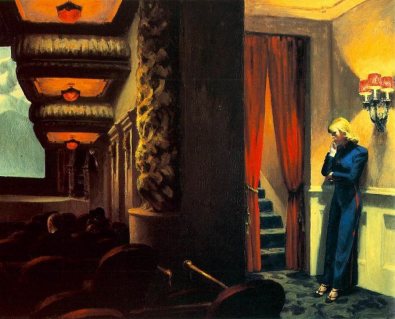
We also took in an excellent exhibition at the Musée de l’Orangerie, entitled “The Age Of Anxiety“, a display of American art from the depression-era 1930s. The exhibited works (featuring paintings by Edward Hopper, Georgia O’Keeffe, Paul Cadmus and Grant Wood, including the first overseas loan of “American Gothic” from the Art Institute of Chicago) give an insight into how different artists of the period captured or reacted to a period of great economic turbulence, uncertainty and (for many) deprivation.
The theme of the exhibit picked up the thread of my last blog post, in which I pondered why it is that Americans were able to endure the Great Depression with its attending sufferings and indignities without coming close to electing a hyper-authoritarian strongman as president, while today’s America may potentially elect Donald Trump to the presidency on Tuesday.
Now, this blog has every sympathy for many of Donald Trump’s supporters, who feel utterly let down by an American political class which has alternately pandered to them before betraying them, ignored them or held them in open contempt. And while this blog is very much pro free trade and managed immigration, the fact that Americans have not even had a choice when it comes to these issues based on the position of the two main parties is sufficient reason alone for the rise of a populist like Trump, albeit not necessarily a candidate with Donald Trump’s gargantuan personal flaws.
So yes, things are bad, and yes, the political class has not been responsive. But America managed to survive world war and economic depression in the twentieth century without coming this close to electing a dangerous authoritarian. Whatever afflictions the struggling “left behind” class said to make up much of Trump’s support may now be experiencing is nothing compared to the suffering of, say, the Dust Bowl. To react to these present circumstances by reaching for Donald Trump when their ancestors typically bore their tribulations far more stoically is in some way a reflection of American moral decline, which is very worrying indeed.
A few Trumpian defences immediately spring to mind – the fact that the stagnation of real wages and living standards among the squeezed middle is in some cases decades long now, leading to a much greater build-up of anger than was perhaps the case prior to 1929, or the fact that the alternative to Donald Trump is such a flawed candidate. But I think the criticism remains valid, and the question a pressing one.
Regardless: given that we are but two days away from the American presidential election in what is very much shaping up to be a 21st century age of anxiety, today’s Music For The Day is the Masque (Part 2, Section B) from Leonard Bernstein’s Symphony no. 2, The Age of Anxiety, performed here by the Simon Bolivar Youth Symphony Orchestra under the direction of Gustavo Dudamel, with pianist Kirill Gerstein.
This nervous, skittish piece with its odd syncopated rhythms and unpredictable air seems to perfectly encapsulate the current American political climate (and my mood).
I’ll be live-blogging the election results here on Semi-Partisan Politics on Tuesday night and through into Wednesday morning, while also hosting an election watch party and serving up some of Sam Hooper’s famous Buffalo chicken wings.
From a Remainer perspective, the drawbacks and perils of honouring the unexpected EU referendum result and actually leaving the European Union, as demanded by the British people, are endless.
Given the harsh, fascistic dystopia in which EU supporters now find themselves, one might fully expect many of their number to feel depressed, hopeless, withdrawn and resigned to defeat. Not so, though. One woman is fighting back, through the medium of music. And her latest weapon is a cover of Mariah Carey’s classic, “All I Want For Christmas Is You”, reimagined as a wistful ode to the European Union.
The singer is one Madeleina Kay, an “an artist, writer, musician and social activist from Sheffield” who is “committed to using the arts to address important social and political issues and challenge destructive ingrained cultural attitudes”. Yes, she’s a Social Justice Warrior.
We’ll be generous and ignore the fact that the track Madeleina Kay hopes to make Christmas #1 sounds like a worn-out cassette recording of Zooey Deschanel’s inexplicably tone-deaf ghost playing on a battered Sony Walkman with dying batteries running at half speed deep underwater – let’s take a look at the lyrics:
I don’t want a lot for Christmas
There just one thing I need
I don’t care about the presents
In a country fuelled by greed
I just want for us to remain
Yeah, I want things to stay the same
Make my wish come true –
Baby all I want for Christmas is EU.
Because today’s generation of coddled, entitled millennials are actually profoundly conservative, inasmuch as they “want things to stay the same”, preserve and protect their own entitlements and value stability over opportunity.
And here is the customary allusion to the idea that Remainers voted in the EU referendum based on a high-minded, dispassionate review of the facts, basing their decision based on pure reason, while Brexiteers supposedly voted based on ignorant, racially-tinged superstition and emotion.
You and I may have blundered blindly into the voting booth, heads stuffed full of lies told by Boris Johnson and Nigel Farage, but Madeleina Kay and her Remainer friends painstakingly considered every piece of available evidence, every testimonial and every possible angle (economic, diplomatic, political, cultural and historical) before deciding that the European Union is just super, and that Britain should remain a member state forever.
And Kay clearly hates the Evil Tor-ees so much (more on that later) that she would refuse a gift from Theresa May if one were offered. We are clearly dealing with a young lady of great wisdom and principle here.
I won’t ask for much this Christmas
I won’t even ask Jeremy Corbyn to go
I just want to share the love so
I’ll wait beneath the mistletoe
I won’t make a list of demands
To send to Boris Johnson or Saint Nick
I won’t even try to chase away
Nigel Farage with a large stick, oh
For the sake of peace I will fight
Until we have seen the light
What more can I do?
Baby all I want for Christmas is you.
Okay, so Madeleina is a trendy lefty, but not of the Corbynista variety. Good to know. And it is also encouraging to know that the songstress intends to wage unrelenting war in the cause of “peace” – the peace that only the EU can give.
Oh the red bus driving
Spreading lies everywhere
And the sound of NHS patients’
Crying fills the air
And everyone is doubting
The lies they kept on shouting
Santa won’t you bring me the things I really need?
Like compassion, tolerance, multiculturalism
And a fair democracy?
Obligatory reference to Our Blessed NHS (genuflect)? Check.
Because of course every single patient in the NHS is lying in their hospital bed, their kidney transplant utterly dependent on the instant £350 million windfall that we all totally believed would land in our laps the moment we voted for Brexit, weeping at having been so cruelly betrayed by Vote Leave. And again, the only lies uttered in this campaign were those told by the official Leave campaign. Remainers possessed a virtuous monopoly on truth at all times.
And who can argue with Kay’s assertion that compassion and tolerance have been sucked out of Britain ever since the EU referendum? Personally, as a Brexiteer I delight in witnessing the suffering of others and adding to it wherever possible, and am incredibly intolerant of dissenting viewpoints, seeking to squash free speech, shame and intimidate people into fearful silence – quite the opposite of enlightened Remainers.
I don’t want a lot for Christmas
This is all I’m asking for
All my European friends singing
Stille Nacht outside my door
Oh I just want for us to remain
Yeah, I want things to stay the same
Make my wish come true
Baby all I want for Christmas is you.
Well, at least Madeleina correctly recognises that Germany is the dominant force within the European Union, that community of (ahem) equals based purely on “friendship” and “cooperation”.
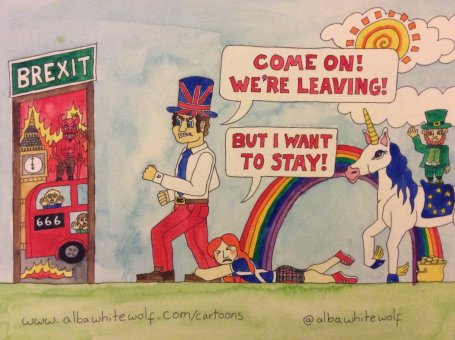
But it gets better. It turns out that Madeleina Kay is also a rather prolific cartoonist, expressing many of her stridently superficial pro-EU sentiments through numerous political cartoons. Much of her artwork seems to channel a bizarre Wizard of Oz obsession, in which EU supporters are portrayed as childlike innocents while any conservative or pro-independence politician is generally depicted as a snarling, fanged monster (Theresa May becomes the Wicked Witch of the West):
I am strangely drawn to Madeleina Kay’s art because it represents very simply and honestly the simplistic thinking of leftists and Remainers alike. When she draws winged demons snatching the “Future Opportunity”, “Life Chance” and “Hope” from helpless children, she reveals how leftists genuinely see the British people – as feeble lemmings in need of constant nurturing and support from government, utterly adrift when faced with separation from the European Union which seeks to be an auxiliary parent to us all.
So this is much less a criticism of Kay, and more an attack on the stunted, juvenile thinking of those politicians and commentators who frequently express in words the same ideas and sentiments that Madeleina renders in crayon. Kay, after all, is young and naive.
I myself was a drooling europhile in my student days only a decade ago, a committed euro-federalist with an EU flag adoring my university dorm room. Wider reading and real life experience eventually disabused me of these dangerous notions, and Madeleina Kay may yet go through a similar conversion and learn to put down the guitar and the Crayolas in pursuit of something more worthwhile.
Postscript: Now you can buy anti-Brexit Christmas cards designed by Madeleina Kay. An essential purchase for all virtue-signalling Remainers who don’t have the first clue what the EU is or how it works, but who need to show their friends that they are very much against leaving.
Something suitably brooding for a cloudy, unrelentingly grey autumnal Sunday
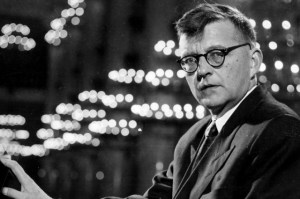
The third and fourth movements (Passacaglia and Burlesque) from Violin Concerto no. 1 by Dmitri Shostakovich, performed by Hilary Hahn with the Berlin Philharmonic Orchestra under the direction of Mariss Jansons.
Almost anyone, seeing a piano reduction of the third movement, would suppose the fanfares at the beginning to be trumpet music. It is in fact the horns who play them, another instance of a certain muted quality. This movement, the concerto’s great center of gravity, is a passacaglia, a series of variations over a repeated bass. Like his friend Britten, but arriving at the idea independently, Shostakovich found the passacaglia with its stubborn reiterations to be a marvelous device for creating slow movements of great mass and power.
The bass here is long—seventeen measures of Andante—beginning and ending on the keynote, F.
Here is an outline of what happens:
Variation 1: Low strings play the bass, horns add stern fanfares, timpani support both lines. (In most passacaglias the composer introduces the bass by itself, but here Shostakovich in effect starts with the first variation.)
Variation 2: English horn, clarinets, and bassoons play a chorale while bassoon and tuba take the bass.
Variation 3: The bass is in low strings again and the solo violin, after its first minutes of respite in the concerto, enters with an expressive counterpoint.
Variation 4: The bass stays in the low strings, English horn and bassoon repeat what the violin played in the previous variation, and the solo violin continues its meditation.
Variation 5: A solo horn plays the bass, the violin becomes more passionate and forceful, low strings add a new counterpoint, woodwinds bring back their chorale.
Variation 6: All the horns, tuba, and pizzicato low strings play the bass, the violin adding increasingly impassioned commentary in triplets.
Variation 7: With a rich string accompaniment, the solo violin plays the passacaglia bass in fortissimo octaves.
Variation 8: The bass goes back to bassoon and tuba, the violin adding a song, molto espressivo, on its lowest string.
Variation 9: Timpani and pizzicato low strings take the bass, the violin recalls the horn fanfares of the first variation.
With timpani, cellos, and basses on a long-sustained F, the music dissolves. The violin plays wide-ranging arpeggios and, as the orchestra falls silent, begins an immense cadenza. This is the bridge to the finale.
The violin begins with the fanfares from the passacaglia. As speed and intensity build ideas from the first two movements recur as well. After scales in fifths and octaves, the orchestra comes crashing back in for the Burlesca, a torrential finale.







 Semi-Partisan Politics