NHS-Worship, Non-Contributory Welfare And Britain’s Idea Of Fairness

Save Our NHS

Blind devotion to our indifferent, non-contributory welfare state plus a warped definition of “fairness” are holding Britain back

The Guardian’s ongoing “This Is The NHS” series is really pushing my buttons at the moment. The newspaper is clearly particularly proud of their feature project, which makes the series’ blatant NHS hagiography and stunning lack of intellectual curiosity especially infuriating to read.

As a journalistic exercise it has been utterly contemptible, constantly telling people what they want to hear – that the NHS saves lives (as though that were not a feature of every healthcare system), that it employs many hardworking people – rather than what they need to hear in order to make an informed, dispassionate judgement about whether the UK’s unique approach to healthcare delivery is sustainable in the future.

Any and every inconvenient fact which suggests that the NHS is not in fact the “envy of the world” is immediately shot down in the series of articles – like when the Guardian quotes a professor of European public health‘s dismissal of reports criticising the NHS as being “market oriented”, as though the accusation automatically ends the argument, and as though we could not have foreseen that opinion by simply reading his job title.

For the better part of a month now we have been treated to statements such as this, comparing the NHS to other healthcare systems and – unsurprisingly – finding it to be the best in the world:

A mission statement set in 1948 for a universal service free at the point of use is under strain like never before. People are still able to see a GP free of charge – though booking an appointment is becoming harder. It will cost nothing to call out an ambulance and go through A&E, to undergo chemotherapy or major surgery. And yet about 11% of the population prefer to pay for private health insurance.

“And yet”! And yet despite having this state-provided, socialist wonder on our doorstep, an astonishing 11% of the population elect to pay for supplementary coverage. Could it possibly be because cancer outcomes in the UK are about the worst in the developed world, or because getting to see the specialist who can actually treat your condition requires going through the gatekeeping step of booking a GP appointment, often with a month-long wait before each step? No. The people who pay to go private are clearly just ungrateful, verging on insane, to want to circumvent such a benevolent system.

Yesterday, this saccharine coverage – and the Guardian’s publication of a parsimonious little online calculator enabling readers to calculate how much they “cost” the NHS – prompted me to write:

But of course we all know exactly why the Guardian is so eager to talk about how much we cost the state (and chide us for doing so) yet desperate to avoid talking about how much we contribute. Because to look at both sides of the equation simultaneously would be to encourage the public to ask whether they getting value for money. And it would reveal – as we now know – that the majority of us are net takers, or beneficiaries, from the system.

The Guardian’s whole anti-Tory, anti-austerity schtick is built entirely on the notion that we all contributed to our public services, and that the dastardly Evil Tories are cutting services to which we have all made substantial financial contributions. They seek to perpetuate the vague notion that we have a contributory welfare system, when in reality Britain’s welfare system is defiantly, depressingly non-contributory.

And that, right there, is the real problem.

Not the NHS itself – a flawed but well-meaning organisation filled to the brim with mostly hard working and well intentioned people – but rather, the warped view we have of the concept of “fairness” in this country, and the desperate lengths the Left will go to to stop us from thinking rationally about important issues.

In Britain, the word “fair” has been taken by the Left and forcibly redefined to mean “redistributive”. You’ll see it in public discussions of any issue from tax policy to healthcare – no policy can ever be described or promoted as being “fair” unless it takes from the privileged few and given to the “disadvantaged” many. Everything now has to be redistributive – or at least, nothing can ever move in a less redistributive direction, resulting in a one-way ratchet to ever bigger government.

Thus Gordon Brown’s decision to hike the top rate of income tax from 40% to 50% was bold, progressive and generous, while George Osborne’s decision to undo just some of that punitive and unproductive tax increase (cutting the top rate from 50% to 45%) was a corrupt, almost immoral “giveaway to millionaires”.

And thus a healthcare system based on insurance – which might see people who make unhealthy lifestyle choices pay more, rather than being subsidised by their peers – is considered unthinkably bad, while the NHS model, funded through our progressive tax system, is lauded as being inherently good and virtuous. Indeed, the only way that the NHS could be improved in the eyes of its most ardent admirers would be if wealthy people could be targeted and forced to pay arbitrary additional “NHS tributes” every time they experienced success or felt any kind of joy in their unfairly privileged lives.

And this is why it is almost impossible to imagine real reform of the NHS, the welfare state or any other major modern edifice of British public life. Because “fairness” has been corrupted from its more authentic meaning, the meaning which we might apply in any other context in life – the principle of reward being commensurate with effort, or “getting out what you put in”. And while we may still be taught The Little Red Hen as children, as adults we much prefer to virtue-signal by nodding along to the mantra that fairness means the state blindly treating everyone exactly the same.

But there is nothing “fair” about the status quo. As this blog noted last year while discussing Britain’s homicidal welfare system:

Usually it’s good when government does not discriminate. Justice, for example, should certainly be blind, as the old saying goes. But when it comes to social security, we choose to regard our welfare system as a “safety net”. Yet any fisherman knows that different nets are needed for different environments, and likewise a one-size-fits-all safety net for citizens experiencing unemployment or hard times simply won’t catch everybody. Some will slip through entirely and crash to the ground, while others will become ensnared and trapped forever. In other words, when it comes to welfare we should actually want the government to actively discriminate.

[..] The problem – and the great moral rot at the heart of the British welfare system – is that the state makes absolutely no distinction between the perfectly-fit, perfectly-able eighteen year-old who can’t quite be bothered to look for a job, and people of more nuanced and complex circumstances. Worse still, the system treats people who have worked hard for many years, often contributing enormous tax payments to the Treasury throughout their lifetimes, in exactly the same perfunctory way that it treats a person spat out of compulsory education at eighteen without the curiosity or drive to find a career.

[..] People talk about the welfare system as being a “safety net” without thinking, and for some people it may function as such tolerably well, if they ever use it at all. But for many thousands and millions of others, our universal and non-contributory system – which remarkably, despite being the product of classic Big Government, takes absolutely no account of our individual lives and circumstances – is no such thing.

If a person is born into deprived circumstances, our social safety net is far more likely to resemble deadly quicksand, seeming benign at first but quickly trapping the victim without hope, dragging them ever deeper with each desperate exertion to break free. And if they are even moderately well-off but suddenly fall on hard times, Britain’s universal welfare system certainly isn’t like landing in a soft safety net – it’s more like smacking into a concrete floor from a fifty-foot drop.

Contributory vs non-contributory. Kristian Niemietz of the IEA perfectly encapsulated the difference between these two principles in an IEA article from 2013:

The difference between a contributory and a means-tested welfare system is not just an administrative one. The two reflect completely different conceptions of fairness, and different understandings of what a welfare system should be there for.

A contributory system is based on an understanding of ‘fairness’ in the sense of ‘proportionality’, or reciprocity: the more you have paid into the common pool, the more you should be entitled to take out of it. Quid pro quo, something for something. In a means-tested system, meanwhile, fairness is understood as supporting the needy, with support being proportional to need. The more you need, the more you get, and if you don’t need support, you won’t get any.

And goes on to explain that despite originating from an utterly perverse interpretation of “fairness”, re-establishing the contributory principle is politically toxic in Britain because it would mean breaking the association – forged in the many decades since the Beveridge Report was first published – between the word “fairness” and the idea of the state treating everybody exactly alike, regardless of merit:

Due to their emphasis on proportionality, contributory systems are not, in themselves, redistributive. They are only redistributive to the extent to which they deviate from the contributory principle, which no system adheres to in an entirely pure form. But a welfare state that honours contribution cannot, at the same time, be strongly redistributive, and a welfare state that is strongly redistributive cannot, at the same time, honour contribution. In this sense, those who have recently discovered their love for the contributory principle are not telling the full story. They are right to point out that the British welfare state offers those who have worked and contributed for a long time a rough deal. But they fail to mention that this is precisely what redistribution is all about. If the welfare state has little left for those who have a paid a lot into the system, it is because all the money has already been spent on non-contributory transfers.

So unless our new contribution enthusiasts are also planning to substantially expand the welfare state – and I take it that that is not their intention – then they can only restore the contributory principle by reducing the extent of redistribution. Since nobody appears to be prepared to do that either, ‘something for something’ is hollow rhetoric. There will be no return to contributory welfare.

It seems to me that there are two potential ways to go. On one hand, we could move toward a more genuinely contributory welfare system. Under such a system, the amount of (say) unemployment benefit received would vary according to prior salary and past taxes paid, making it closer to unemployment insurance – a disbursement intended to provide a time-limited “soft landing” in the event of unforeseen job loss. Means testing would cease under such a system. And while a basic payment would be available to all citizens, those who contributed most would receive more help should they fall on hard times.

And on the other hand, we could accept that this more discerning form of “fairness” is politically toxic and unachievable, cut our losses, and focus instead on making the current bloated and inefficient system of applying for a complex array of potential benefits much more streamlined. And our best hope in this case might be to follow the lead of Finland and implement a form of Basic Income (otherwise known as negative income tax).

Basic Income offers something to both the political Left and Right. For those on the Left, the principle of universality is maintained. Everyone receives a guaranteed, flat-rate disbursement from the state every month, regardless of their wealth or income level, to be spent on essentials like food and housing or frittered away on foreign holidays as the recipient needs – or prefers. And for those on the Right, the expensive bureaucracy involved in means testing is eliminated, nobody is ever disincentivised from working, and the existence of “flat benefits” may eventually help to normalise the mirror concept of flatter taxation.

Is Basic Income “fair”? Strictly speaking, not by either of the two definitions discussed here. It is neither actively redistributive, and nor does it deliver more benefit to those who contribute the most. But despite the many criticisms of Basic Income, it is eminently pragmatic. And this itself is a huge advantage. Rather than having the Left and Right continue to shout at each other and fight each other to the awkward draw which has bequeathed us our current system, Basic Income – once bedded in – could help to depoliticise welfare and guarantee a minimum living standard for all citizens at the same time.

These are debates that we could be having in this country, if only we were able to stop patting ourselves on the back for the enlightened “compassion” of our current welfare state. These are some of the radical policy ideas that we could be debating – not as fringe intellectual arguments but as serious policy discussions.

But the debate never happens. And unless something changes, it never will. Politicians – and newspapers like the Guardian – keep us nodding along to the same tired old soundtrack about how lucky we are to have institutions like Our Blessed NHS and welfare state, and we keep on agreeing, even as they kill people.
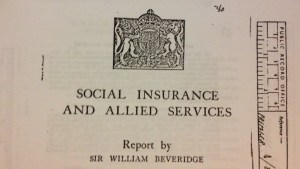
Beveridge Report - Welfare State

Agree with this article? Violently disagree? Scroll down to leave a comment.

Follow Semi-Partisan Politics on TwitterFacebook and Medium.

National Religion Daily Penance: How Much Do YOU Cost Our NHS?

NHS - National Religion - How Much Have I Cost The NHS - Worship - Self Flagellation - Socialism

Don’t join in the Guardian’s fawning worship of the state – you don’t owe the NHS anything

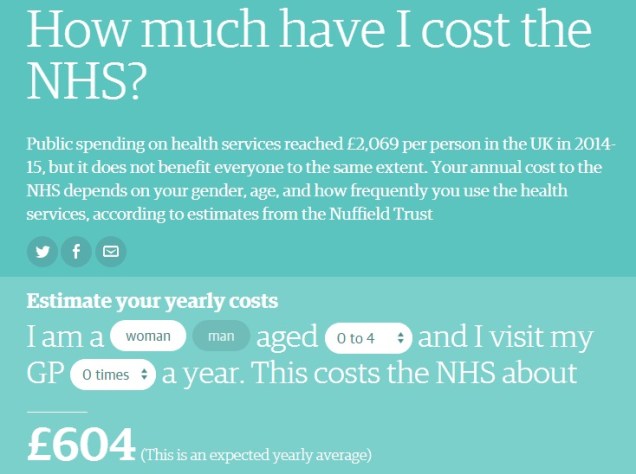
If any further proof were needed that conservatives and socialists think differently and see the world in a completely different way, you need only look at the latest feature in the Guardian’s nauseating, saccharine “This Is The NHS” series, a self-flagellating little feature asking “How much have I cost the NHS?”

In this post, the Guardian takes a break from exploiting real-life stories from doctors and patients to emotionally manipulate people into blindly supporting Britain’s unique but unexceptional healthcare system, and instead invites you to plug your personal details into their online calculator so that you can find out exactly how much money Our Blessed NHS lavishes on you every year. You ungrateful wretch.

The Guardian intones:

Public spending on health services reached £2,069 per person in the UK in 2014-15, but it does not benefit everyone to the same extent. Your annual cost to the NHS depends on your gender, age, and how frequently you use the health services, according to estimates from the Nuffield Trust.

So the total cost of your healthcare increases as you consume more healthcare services. Riveting stuff. Great investigative journalism.

The calculator does throw up some interesting numbers. Interestingly, if you sit stubbornly at home and never use a single NHS service or treatment of any kind, you somehow still manage to cost the health service hundreds of pounds a year.

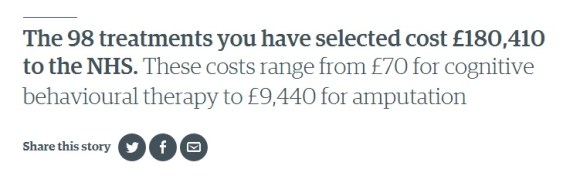
Meanwhile, at the other end of the spectrum, if you were really unfortunate and had every possible thing go wrong with you (once) in a given year, the NHS could be on the hook for as much as £180,410 – though I suspect that the calculator is holding back here, and that some patients may comfortably exceed this total without having to check every single box:

How Much Do You Cost The NHS - 3

How Much Do You Cost The NHS - 2

Also interesting is the fact that the only mention of mental health and associated problems from addiction to depression is buried deep in the “Other” section, and not given the prominence that a right-on publication like the Guardian might be expected to lavish. One can only speculate as to the reason for this sudden downplaying of mental health issues.

But the really interesting and revealing fact is that the Guardian published the article at all – and the conspicuous lack of a counterpoint piece asking how much we each contribute to the NHS (or indeed any of our other public services) every year through our taxes. Why the obsession with how much we are individually costing the state (or harming the environment with our carbon dioxide emissions, or doing any other Bad Thing) when there is no equal curiosity about how much we contribute? Looking at one side of the equation is meaningless until you also have visibility of the other.

This deliberate omission is especially galling at a time when some citizen-focused governments are now providing individual taxpayers with an itemised receipt every year, showing how much of their taxes have been spent on different areas of the budget like education, healthcare and defence. George Osborne even brought the practice to Britain, to the inevitable howls of protest (and accusations of disseminating propaganda) from the Left.

It may seem trivial, but this is a fundamental difference in mindset. Issuing a receipt showing how and where government is spending your money is an act of transparency and an acknowledgement that the government derives its legitimacy from – and can only function with the consent of – the citizenry.

Publishing a sanctimonious little online calculator so that your left-wing readership can calculate how much they cost society with every breath, on the other hand, elevates the state above all. It presupposes that we exist only at the pleasure of the government, that the state has a rightful claim on all of our possessions as well as the product of our labour, and that we should be grateful for any trivial sum that we are allowed to keep for ourselves after we have funded the Public Services behemoth.

Doing things the Guardian’s way – focusing on how much taxpayers “cost” their own government – inverts the proper power relationship between citizen and government, which should rightly be one of the state existing to serve and protect the people, not the other way around.

But of course we all know exactly why the Guardian is so eager to talk about how much we cost the state (and chide us for doing so) yet desperate to avoid talking about how much we contribute. Because to look at both sides of the equation simultaneously would be to encourage the public to ask whether they getting value for money. And it would reveal – as we now know – that the majority of us are net takers, or beneficiaries, from the system.

The Guardian’s whole anti-Tory, anti-austerity schtick is built entirely on the notion that we all contributed to our public services, and that the dastardly Evil Tories are cutting services to which we have all made substantial financial contributions. They seek to perpetuate the vague notion that we have a contributory welfare system, when in reality Britain’s welfare system is defiantly, depressingly non-contributory.

Some of us contribute vastly more to the exchequer than we will ever receive back in public services. Some of us struggle to break even. And others are on “take” mode for pretty much their entire lives – often for very justifiable reasons, but other times much less so. Most of us will fall into different categories at different stages of our lives.

But the Guardian doesn’t want people to know or think about any of this, or have access to this information. The prosperous middle-class couple on a joint six-figure income, blessed with good health and the lifestyle habits to maintain it, may well balk when they realise how much they are contributing to the NHS compared to what they receive back in a given year, or the equivalent projected lifetime figures. And they may balk again when they realise that their chain-smoking neighbour who trundles off to the doctor at the first sign of a cold contributes far less.

In short, real transparency about contributions made and benefits received would encourage a more consumer-like mindset among the people, forcing them to take responsibility and make the decisions which are best for them and for their families. And this goes against everything that the Guardian believes, because they want us to be a nation of state-dependent drones, flopping around helplessly, utterly reliant on services and/or alms disbursed by the government.

So, to recap: Itemised bills from the government for services provided to you by the state? Wonderful, brilliant idea, and a great way to remind us of everything that the beneficent nanny state does on our behalf.

Itemised receipts from the government showing the breakdown of how your tax payments are being spent? Evil propaganda designed to mislead the people and whip the lemmings up into a hysterical rage.

Glad we cleared that up.

A scene from the Olympic opening ceremony celebrating the NHS

NHS Worship - London Olympic Games 1

Agree with this article? Violently disagree? Scroll down to leave a comment.

Follow Semi-Partisan Politics on TwitterFacebook and Medium.

This Is The NHS

Save Our NHS

British healthcare reform should be the subject of forensic journalistic analysis and urgent debate, but all we have are saccharine, uncritical devotionals to the NHS

If you were the CEO of a company whose costs were relentlessly increasing and competitors gaining ground with every passing quarter, what would you do?

Would you waste valuable time looking back wistfully on the glory days, when every product launch was an unparalleled success and new customers were queueing around the block? Or would you take a hard-headed, dispassionate look at what was necessary – redundancies, divestments, acquisitions, innovations – to reshape and refocus the firm to prosper in the new, harsher environment?

Any executive worth their salt would do the latter. Corporate graveyards are littered with the bones of executives and companies who chose to dwell on a romanticised, sentimental vision of the past rather than face the difficult future.

Sadly, when it comes to the NHS we adopt the former, toxic mindset. Rather than thinking dispassionately about how best to deliver healthcare to an advanced nation of 65 million ageing, fattening citizens, we prefer to think of the glory days of socialised healthcare while utterly neglecting the future. We prefer to smugly bask in what we consider the wisdom and compassion of the post-war generation who created the NHS rather than ask ourselves whether what worked in 1948 will still work seventy years later in 2018, let alone by its centenary in 2048.

There is more than enough blame to go around for this depressing state of affairs. The NHS-Industrial Complex, that vast and interconnected web of (sometimes but not always well-meaning) special interests is certainly at fault. So too are glib and cowardly politicians, who would rather fire up a crowd (and win re-election) by making empty promises to Save Our NHS rather than grapple with the difficult (and politically toxic) detail. And we ourselves are to blame, for continually rewarding this short-termist and opportunistic behaviour in others.

But today’s entry in the Healthcare Hall of Shame is the Guardian newspaper, whose natural left-wing political leanings have prompted one of the worst cases of journalistic NHS hagiography in recent years. This time the Guardian have outdone themselves with their new ongoing series, This Is The NHS.

Visit the This Is The NHS mini-site and you will be confronted with three main types of story:

  1. Personal “the NHS saved my life” accounts from grateful patients
  2. Sympathetic “behind-the-scenes” profiles of staff, hospitals and departments
  3. Hectoring nanny-state demands from the public health lobby

Some of these stories are very moving, dealing as they do with illness, loss or periods of great hardship and vulnerability in the lives of their subjects. But none of them come close to explaining why taxpayer-funded, government-provided healthcare is the best possible solution for Britain. Both of these maxims – taxpayer funded, government provided – may still be optimal. Maybe. But is it not worth doing any kind of comparative analysis to be sure?

And when the physical expression of our healthcare policy is one of the five largest human bureaucracies in the history of the world, is it really not worth checking that we are on the right track, that a government-run National Health Service still makes sense?

Apparently not. Emotion and stubborn attachment triumph over reason, and we are supposed to suspend our critical faculties and clap along to each positive story about the NHS without questioning what treatment (if any) in each scenario is unique to the NHS and would not have been given to an equivalent patient in, say, Canada or France.

I take this extremely personally. Like most people, I have had occasion to use various NHS services throughout my life, sometimes – such as when I came down with appendicitis – at times of physical pain and imminent danger to my wellbeing. Naturally I was very grateful for the excellent, professional service that I received.

But I deeply resent my natural feelings of gratitude – and those of countless other people, many of them featured in the Guardian’s This Is the NHS series – being taken and deliberately twisted into a cynical piece of emotionally manipulative propaganda by journalists and special interests with a strong (and shamefully undeclared) desire to maintain one very specific model of healthcare funding and provision. That is simply not right.

The Guardian would hate this analogy, but with their navel-gazing, introspective examination of the status quo when it comes to British healthcare, they are exhibiting the same lazy superiority complex shown by US conservatives when ObamaCare was being debated. Like American conservatives, the Guardian (and nearly the entire British Left) stubbornly believe that their respective systems are the envy of the world, and insist on saying so loudly and repeatedly while failing to provide any proof whatsoever to back up their assertions.

As the ObamaCare debate raged in America, countless Republican politicians and Tea Party activists could be found ranting about President Obama’s evil socialist plan to destroy the “greatest healthcare system in the world”. And today, as David Cameron’s Conservative government rearranges the deckchairs in an attempt to look purposeful when it comes to healthcare, foaming-at-the-mouth left-wing activists shriek to anyone who will listen about the Evil Tories and their dastardly plan to sell off the NHS to their rich friends while leaving the sick and elderly to die on the streets.

Of course, both claims are ridiculous hyperbole. The Affordable Care Act (ObamaCare) was a relatively timid, incremental and (thus far) underwhelming attempt to expand the existing system of private healthcare coverage to more Americans. And whatever privatisation schemes the Tories may have cooked up to date are a drop in the ocean in terms of the total volume of services delivered by the NHS, and do nothing to change the twin fundamentals of taxpayer-funded care, free at the point of use.

So given the fact that nothing remotely shocking or remarkable is currently happening in terms of British healthcare policy, why publish the This Is The NHS series in the first place? The Guardian portentously explains:

Our aspiration is to examine a broad range of issues, from the strains on A&E to standards of care for the elderly, the multi-layered issues surrounding mental health, chronic disease, the high cost of drugs and the impact of alcohol. And exciting treatments using new sciences and cutting-edge technology. We want to understand the dilemmas over prioritisation, over-prescribing and the cost of drugs. And the fiendishly complicated way the service is managed and run. We want to address the question: do we have the NHS we need? The aim is to do this through diaries, fly-on-the-wall reporting, interviews, films and explanation.

We have asked a large sample of our readers what they want from this project. The most engaging focus, ahead of anything else was … hope. “I’d like to see both sides of the story, as all we hear about is the failings or pay issues,” one reader said. “What about those patients who have been cared for amazingly, staff who are brilliant at their job and enjoy it?” Another urged that amid all the perceived problems: “The successes of the NHS need to be celebrated.”

In other words, the Guardian is seeking to satisfy the desire of its left-wing readership to hear stories confirming how wonderful the NHS is. Sure, there will be a few token negative experiences thrown in to give the appearance of objectivity (though anecdotally, I have noticed far more positive than negative stories thus far). But there will under no circumstances be any challenge to the fundamental assumption that the NHS model is Good and Virtuous, and not to be questioned under any circumstances.

Imagine if the Guardian set out to create a similar month-long deep-dive series examining the workings of the Ministry of Defence and Britain’s armed forces. The Guardian’s journalists and commentators would have a field day forensically examining and questioning every element of spending, every organisational aspect and every core function. They would see it as their journalistic duty to take a root-and-branch view of the whole organisation, to muse about the very meaning of defence and national security in the modern age, and question whether the existing deeply historical structures are equal to our current and future challenges. And they would actually be right to do so, even though they and this blog would come to very different conclusions.

But when it comes to the NHS, nothing and nobody is allowed to challenge the dusty 1940s dogmas upon which the British healthcare system is built. Everything is up for debate – so long as the answer involves pumping more money into the same, fundamentally unreformed system.

This is stubborn childishness in the extreme. An infantilised British public (particularly the metropolitan left-wing segment who comprise the Guardian’s readership) demand stories which make us feel better about Our Beloved NHS, and which reassure us that the NHS is doing lots of great things despite the endless succession of negative headlines. And the Guardian responds with a spectacularly uncritical, depressingly uncurious series of devotionals to the decaying status quo.

I’ve said it many times before, but it still bears repeating: our blind, unquestioning devotion to the NHS is quite literally killing us. And thus far, the Guardian’s “This Is the NHS” series – which could have been the catalyst for a serious discussion – is just another smug monument to our national sickness/religion.

NHS Worship - London Olympic Games 1

Agree with this article? Violently disagree? Scroll down to leave a comment.

Follow Semi-Partisan Politics on TwitterFacebook and Medium.

Who Is To Blame For The NHS Junior Doctors’ Strike? Look In The Mirror

NHS Junior Doctors Contract Strike

By reflexively worshipping the NHS, vilifying people who don’t and rewarding politicians who tell us only what we want to hear, the junior doctors’ strike – and everything else wrong with the health service – is our fault, and ours alone

Who is to blame for the NHS junior doctors’ strike?

Is it heartless Jeremy Hunt, that doctor-hating, treatment-denying Conservative villain at the Department of Health? Is it the Evil Tories in general, with their single-minded obsession (mysteriously never realised despite all their accumulated years in power) with privatising and destroying Our Precious NHS? And if not them, who could it be? The capitalists? The bankers? Katie Hopkins?

Surely anyone and everyone is to blame, apart from ourselves.We love Our NHS. We are good people who believe that healthcare free at the point of use is one of the fundamental rights of citizenship. We stick up for the NHS at every turn, demanding that politicians pay obsequious lip service to the organisation every time they run for office. We’ll happily slap the NHS logo on our Facebook profile picture, paint it on our faces, wear it on a badge, lapel pin or t-shirt. You name it, we’ll do it to virtue-signal the love we have for Our NHS.

And that, right there, is the problem. Not Jeremy Hunt, not the Evil Tories, not Katie Hopkins. Us.

We don’t want elected officials who take a hard, uncompromising look at changes in medical treatments, life expectancies, the public finances and best practice from overseas to continually assess whether the NHS – that uniquely British solution to healthcare coverage – is still fit for purpose in the twenty-first century, and what changes may be beneficial or necessary.

We don’t want elected officials who tell us that difficult decisions might have to be made – that providing the latest treatments to an ageing, fattening population will cost all of us more in taxes, require radical overhaul of the NHS model, or both. We want our politicians to find the money to provide a world-class health service without disrupting other areas of public spending, or the fatness of our own wallets.

And we certainly don’t want elected officials who do anything to upset the NHS-Industrial Complex – that vast network of people, organisations and vested interests who are first to squeal and protest (always in the name of “public safety”) when their own livelihoods or ways of working are threatened. Like children listening to a trusted school teacher, we innocently take the words of such people as gospel.

Of course, this situation is quite unsustainable. And when any one element of this vast human bureaucracy reaches breaking point – whether that is manifested in industrial action, hospital death scandals or longer waiting lists – we will look for anyone to blame and attack for the fact that these problems have gone unaddressed. Anyone other than ourselves.

The Economist reaches the same conclusion in a very welcome “plague on all their houses” review of the context behind the first junior doctors’ strike:

[..] there is a more serious way in which the public is to blame for the sickness of the health service. The electorate that notionally adores “our NHS” and propels a saccharine song by health workers to the top of the Christmas charts shows remarkably little willingness to pay more in tax towards what remains a relatively cheap system. Without extra money and facing ever wider and wrinklier patients, the NHS must tighten its belt by £30 billion ($43 billion), or about one-fifth, by 2020. It is in this context that Mr Hunt is trying to expand services to evenings and weekends. Pity the well meaning health secretary, pity the hardworking doctors—and blame the sentimental but hypocritical British public.

The famous maxim says that people get the politicians and leaders that they deserve. Well, the same can be said for healthcare, too. We refuse to look difficult truths in the eye, preferring to ignore them in the risible hope that a healthcare system built in 1948 can still be fit for purpose in 2016, if only we pump a bit more money into it. And a bit more. And a bit more again.

We deserve the NHS we currently have, with its air of permanent crisis, in all its faded glory. It is the sum total of all our misplaced pride, boastfulness, smugness, ignorance, fear of change, intellectual laziness and lack of vision.

We have become self-entitled public service consumers rather than thinking citizens, demanding easy answers and instant results from our elected leaders, while rewarding all of the wrong behaviours when it comes to healthcare policymaking.

We have become the kind of intellectually dull society that will happily produce a cheesy Christmas hymn to the NHS and then propel it to Number 1 in the charts, but prefers to sit and vegetate in front of Britain’s Strictly Come Bake-off On Ice rather than question whether the organisation we were just singing about is fundamentally fit for purpose.

On this rare occasion, the Economist’s editorial line is quite correct. When it comes to the failings and shortcomings of the NHS, the government, the health secretary of the day and individual NHS staff are comparatively blameless.

It is we, the British people, who are most at fault for singing worshipful hymns of praise to a healthcare system we will neither properly fund, nor meaningfully reform.

NHS Choir - Harriet Nerva - 2

Agree with this article? Violently disagree? Scroll down to leave a comment.

Follow Semi-Partisan Politics on TwitterFacebook and Medium.

You Wouldn’t Buy A Song Praising HMRC, So Stop Worshipping The NHS

NHS Choir - Harriet Nerva

Buying and praising the NHS Choir’s Christmas single is not “harmless fun”. In fact, anyone who truly believes in improving healthcare should see through this complacent, self-congratulatory piece of propaganda

It’s amazing how easy it is to be published in the Guardian, just so long as you hold the “correct” right-on, trendily left wing views, and have distinguished yourself with some suitably ostentatious act of public virtue-signalling.

Enter Harriet Nerva, junior doctor and newly ordained High Priestess of the NHS. Nerva is one of the principal architects of that sappy piece of virtue-signalling NHS propaganda inflicted on the (sadly often-willing) British populace this winter – the “Bridge Over You” single which predictably made it to Christmas No. 1 in the charts.

I explained at the time why singing hymns to a powerful government monopoly was neither a morally virtuous nor a productive thing to do, and was met with a predictable chorus of criticism and accusations of being a Christmas Grinch. But the argument against this latest piece of NHS-worship needs to be restated and expanded, particularly in light of the failure of other commentators to utter a critical word, and also because of the nauseating victory lap currently being taken by the #NHS4XmasNo1 campaign chiefs.

In her self-aggrandising victory speech, published in the Guardian, Nerva begins by declaring:

As a junior doctor, I started a campaign that united the public, staff and patients in its demand for a free and properly funded healthcare service for all.

Already it starts to become clear that this is all about the Harriet Nerva Show first and foremost, long before any other consideration. The article continues:

Since becoming a junior doctor 18 months ago, I have felt immensely proud to work for the NHS. In particular, I’ve been humbled by how well we cared for one patient in their dying days, and felt privileged to have forged a relationship with this person in the last few weeks of their life.

Again, this is boastful and irrelevant. Nerva isn’t “humbled” by anything, she is proud of her accomplishment – and that’s fine, but not when it is wrapped in the pretence of promoting the NHS, or when the fact that she gave good care to a dying patient is misused as an argument for persevering with one very specific model of healthcare delivery.

Nerva concludes by inadvertently calling the song what it really is – a religious hymn:

This campaign has made it clear that the public, staff and patients are singing from the same hymn sheet. We are united in the belief that we should have a free and properly funded healthcare service available to all in our society, one that values and respects its staff and users. The choir have sung, the public have spoken, and now it’s time to listen.

Meanwhile, the Mirror reports approvingly:

Harriet told Mirror Online: “I didn’t have any links with the choir but what they have produced is a fantastic celebration of the NHS”.

“Seeing the video moved me to tears. The context of it is very powerful. I qualified 15 months ago and I love the NHS, I’m very proud of it. And I feel getting it to Number One would bring to the public’s eye the fantastic service it provides in very challenging times”.

But this reasoning is nonsense. Everyone in Britain already knows about the excellent and important work done by doctors and nurses, and the vast majority support the NHS. It’s hardly as though there is some massive popular revolt against our system of nationalised healthcare.

Most people seem content with our current system when they bother to think about it at all, and (left-wing scaremongering aside) no major politician from any party has serious plans to dismantle what currently exists, let alone end the principle of healthcare free at the point of use.

So, since there is no imminent threat to the NHS (it survived eighteen years of Tory government before 1997, and will do so again), what is this really all about? What really motivated a junior doctor to make us endure this turgid hymn to the NHS?

NHS Choir - Christmas Single - 3

By prancing around with her Twitter hashtags and handwritten signs, Harriet Nerva isn’t just saying that she shares our presumed love for the NHS or has a strong devotion to providing healthcare. What she is really saying is that she is a better person than you, because she A) works for the NHS, and B) organised a huge act of public NHS-worship.

“Think you’re a good person just because you like the NHS?”, Nerva is saying. “Well I’m ten times better than you, because I got the British people to collectively sing a hymn to the NHS on Christmas Day. I love the NHS so much that I made this extraordinarily extravagant public gesture. What did you do?”

And of course short of sacrificing ourselves on a huge pyre as a burnt offering to the NHS, there is nothing that we can do to better her accomplishment. Harriet Nerva wins.

But this is noisy, shallow virtue-signalling, and nothing more. I’m sorry if it sounds harsh or seems unpleasant to rain all over what first looks like a harmless act of charity, but the NHS Choir’s Christmas single is so much more than that. And so much worse. It is yet another part of the vast tapestry of reflexive NHS worship which smothers Britain, and prevents us from looking critically and dispassionately at one of the most important issues in our society.

And we need to wake up, stop patting ourselves on the back for the accomplishments of previous generations, and recognise that singing hymns to an outdated healthcare delivery model from the 1940s is going to do nothing – nada, zilch – to ensure that Britons enjoy the best healthcare in the world in this century.

NHS Worship - London Olympic Games 1

It is therefore heartening to see a few other brave souls also now daring to stick their heads above the parapet and call the NHS Christmas single what it is – emotionally manipulative propaganda.

My Conservatives for Liberty colleague and Creative Director, Paul Nizinskyj, also picks up on the pseudo-religious undertones beneath this latest act of NHS-worship:

This was encouraged by a message on the music video, which urged people to “Show how much you #LoveYourNHS” by buying the single. Well, this is a concept I struggle with, because I have no love for a catastrophically flawed system of healthcare which seriously fails its patients, despite the best efforts of its frontline staff.

But that distinction – between the structure of the NHS and the people who work for it – is one we seem to struggle with in this country. So, instead of a conversation about why the NHS continues to fail the people who pay for it, we again exalted it as an infallible deity, this time in a kind of Christmas Day papal coronation.

One of the Left’s greatest successes has been to conflate “Our NHS” with “healthcare” in the minds of the British people, so that the two concepts effectively merge to become one and the same. This was a war of words, and the Left won a total victory – now, even those people who are naturally sceptical of government monopolies often speak of the two terms interchangeably, and carve out an illogical exception for the NHS when they extol the virtues of competition and privatisation.

But as Nizinskyj points out:

I’m certain dedicated health professionals would be dedicated and professional under whichever system of healthcare they were working, but the results of that hard work often depend on whether the system is working with them or against them. And, when it comes to the NHS, I’m afraid it’s working against them.

This is the point which continually eludes the NHS priests and their congregation of grateful but uncritical Britons. Yes, of course the doctors and nurses who saved your life / delivered your baby / cared for your dying relative did an amazing job. But that is a reflection on them, not on the system in which they operate.

Lives are saved, babies are delivered and dying relatives cared for in healthcare systems all over the world. Many of these other healthcare systems do the job very well, if not better, than the NHS. Many of these other healthcare systems are also free at the point of use. Very few of them are like the American system, which is always cynically held up as a bogeyman to scare British voters and shut down debate. And yet mysteriously, none of these other healthcare systems copy the NHS model.

Think about that for a moment. Every day, people are treated with love and dedication in hospitals and healthcare systems around the world, and in many cases receive comparable or better care without being stuck with a bill that they can’t afford. Yes, poor people actually receive medical care in other countries, not just Britain. And yet we are not able to even look at these other systems or ask ourselves the question whether the decision we made as a country in 1948 is still the best choice in 2016.

Why are we not able to do this? Why can we not look at best practice from around the world and strive to emulate and build on these ideas so that we have the very best healthcare in the world, rather than being satisfied with an ebbing and subsiding parity? Because of people like Harriet Nerva, and the closed-minded viewpoint of legions of others like her.

NHS Choir - Harriet Nerva - 2

There are two forces are at work here. First, there is the British public’s irrational, unshakeable devotion to “Our NHS”, about which a bad word can never be spoken. Sure, you can criticise waiting lists, falling standards or the inevitable winter crises, but politicians question the wisdom of sticking with the NHS model itself at great peril – and so none do.

And secondly, there is the growing phenomenon of online virtue-signalling, fuelled by social media, in which your political stances are worn and discarded like this year’s latest fashion, and where your stance on key social issues is taken to determine whether you are a “good” or “bad” person. Thus thousands of Twitter bios proudly proclaim that the account owner is a “lefty” or that “I voted for Corbyn”, while people looking for love (or something else) on dating sites like Tinder will often have “don’t bother if you are a Tory”, or other dismissive words to that effect, emblazoned on their profiles.

Take the British public’s “pre-existing condition” of an uncritically sentimental attachment to the NHS and add the social cachet and sense of identity which now comes from blaring one’s political views online and wearing political stances like a fashion statement, and this is what you get: people taking selfies of themselves holding up devotional banners praising the NHS, and even more people singing hymns in honour of Saint Aneurin Bevan’s sacramental gift to our nation.

It’s the easiest thing in the world to get swept up in the NHS love-fest. You are guaranteed to get smiles from strangers and likes on social media with every unthinking post and re-tweet of a “Love Your NHS” meme. You will suffer no negative consequences at all for declaring your blind loyalty to this one particular branch of government, and in fact will be praised for doing so. Just by clicking a few buttons and sharing a couple of posts on social media, 90% of the population will think you are magnificent.

But it is not magnificent. It’s self-aggrandising, counterproductive and wrong. It actively detracts from efforts to improve healthcare for Britons, and it stifles and prejudices a much needed public debate before it can even take place.

I’m sorry to be Scrooge this winter, but there’s no other way of saying this: if you bought the NHS Christmas single, you are part of the problem, not the solution.

Christmas number 1 race

Agree with this article? Violently disagree? Scroll down to leave a comment.

Follow Semi-Partisan Politics on TwitterFacebook and Medium.