Owen Smith’s “Threat” To Theresa May Reveals The Arrogance Of The Left

Anyone can choose their words poorly under pressure. But the modern Left have made a habit of jumping on the verbal slips of other people and ruthlessly, cynically exploiting them for political gain using the weaponised language of identity politics. So forgive us for being less than sympathetic when one of their own makes the same mistake

In the ongoing, unwatchable carnival of stupidity that is the second Labour leadership contest in the space of a year, this week’s news coverage has been dominated by challenger Owen Smith’s poor choice of words when he spoke about his desire to take the fight to Theresa May and the conservatives.

From the Guardian:

Labour leadership contender Owen Smith has been forced to apologise after saying he wanted to “smash” Theresa May “back on her heels”, during a major speech to outline his policy ideas.

Smith said he wanted to “smash austerity” and pledged a raft of new measures including scrapping the Department for Work and Pensions in favour of a Department for Labour, plans to make zero-hours contracts unlawful and to end the public sector pay freeze during his speech in South Yorkshire.

Those announcements, pitched to the party’s left, were overshadowed by criticism of his choice of language. Arguing that Labour should be going after the prime minister’s policies harder, he said: “It pained me that we didn’t have the strength and the power and the vitality to smash her back on her heels. These are our values, these are our people, this is our language that they are seeking to steal.”

Smith initially defended the comments as robust political language, but a spokesman said later the remarks were “off-script and, on reflection, it was an inappropriate choice of phrase and he apologises for using it”.

A spokesman for the campaign of the Labour leader, Jeremy Corbyn, said: “We need to be careful of the language we use during this contest as many members, including many female Labour MPs, have said they feel intimidated by aggressive language.”

One can feel for Owen Smith. Clearly he has absolutely no desire to walk around the despatch box, cross the floor and physically punch Theresa May in the face, knocking her off her heels. In fact, the Left has a loud and angry tradition of wanting to “smash” anything and everything it happens to find objectionable, be it austerity, racism, sexism or Tory rule, without necessarily wanting to physically do so. It is fairly understandable how such language might therefore have crept in to a speech by this inexperienced leadership contender.

And yet. And yet…

One cannot help taking a small measure of satisfaction from watching somebody from the Party of Identity Politics – a vicious political clan who think nothing of smearing and ruining other peoples’ reputations with allegations of racism, sexism or any other “ism” they can think of when doing so offers them some slight political advantage – come a cropper by falling victim to the very same culture which their actions promoted.

Nobody seriously thinks that Owen smith wants to literally smash Theresa May and knock her off her feet, heels or no heels (in fact it was the heels reference that is actually the slightly more “sexist”, if one must call it that, rather than the threat of violence). But modern Leftist politicians like Owen Smith often end up self-detonating, and deservedly so, after stepping on one of the very same linguistic or cultural land mines that they love to lay across our language and political discourse. And if you make it unacceptable to say enough things, eventually you will trip over your own rules and find yourself convicted of accidentally infringing one of those very same edicts.

If any Tory MP spoke of smashing, say, Liz Kendall back in her heels, you can bet that Kendall would be touring the news studios that very evening, faux-earnestly warning of the violent misogynistic rhetoric being used by mainstream conservatives. But when one of their own does the same thing, as Comrade Smith did with his unfortunate remarks about Theresa May, nobody utters a peep. And while it certainly became a news story, Conservative MPs were not queuing up to make political capital out of the event, let alone those Labour MPs who fancy themselves champions of women.

Smith is too important to centrist Labour’s flimsy plot to prematurely terminate the leadership of Jeremy Corbyn to be brought down by his own violent rhetoric, you see. Besides, everyone knows that Labour are the good guys and that any racist, sexist or anti-Semitic remarks uttered by one of their own must simply be well-intentioned jokes taken out of context by people with sinister motives.

One would hope that Smith’s brush with political danger might force some kind of rethink within the party as to whether weaponising identity politics and making the English language a veritable landmine of things you can’t say / imagery you can’t adopt is really the best way to go. But of course there will be no such rethink. The next time a hapless Conservative MP talks about crushing the enemy or “targeting” Labour MPs, some weepy party apparatchik will be wheeled out to sob to the media about how terribly threatened and triggered they feel. Labour simply stands to gain too much from weaponised identity politics to consider giving it up, even as it poisons our politics and chills our public discourse.

But let us be magnanimous and take heart that Owen Smith does not seem to have suffered unduly from his amateurish speechwriting error. There are many reasons why Smith does not deserve to win the Labour leadership contest – starting with the fact that his 20-point policy pledge seems to be a condensed version of Labour’s disastrous 1983 “longest suicide note in history” manifesto, while the man himself seems to be nothing other than a younger version of Jeremy Corbyn minus the adoring fans.

We all know, those of us with brains and consciences, that Owen Smith does not harbour secret fantasies of karate kicking Theresa May across the floor of the House of Commons. It was an awkward turn of phrase, not a Freudian slip revealing deep-rooted male chauvinism.

And though Owen Smith’s party will never in a million years extend to us the same courtesy and benefit of the doubt, let’s stop talking about this pointless distraction and move on to matters of substance.
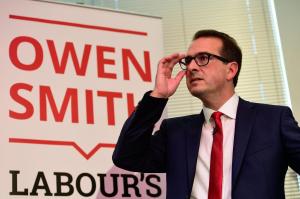
 

Owen Smith - Labour Party Leadership Coup

Bottom Image: Independent

Support Semi-Partisan Politics with a one-time or recurring donation:

Agree with this article? Violently disagree? Scroll down to leave a comment.

Follow Semi-Partisan Politics on TwitterFacebook and Medium.

Our Schools Are Hotbeds Of Anti-Democratic, Anti Free Speech Sentiment, Hostile To Conservative Students

EU Referendum - Brexit - Free Speech - Children - School - Education

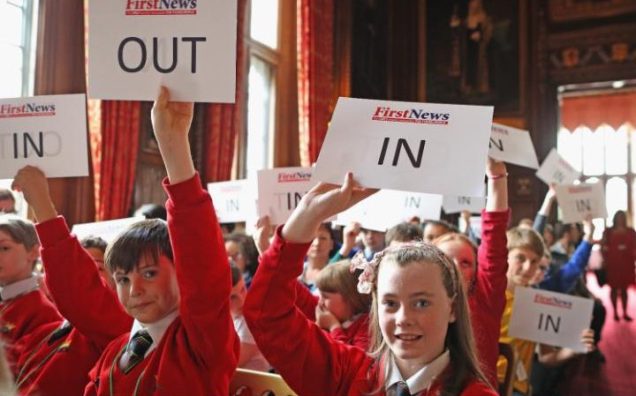
British schools and universities represent an oppressive and highly unsafe space for young students who believe in free speech or hold pro-Brexit beliefs

If you think that you have been made to feel uncomfortable for holding eurosceptic, pro-Brexit beliefs, spare a thought for those young Brexiteers trapped firmly behind enemy lines in the clutches of Britain’s left-wing educational establishment.

Tanya Kekic, a sixth-form student, writes in Spiked about the post-referendum climate endured by those who supported Brexit:

As they had scarcely met anyone supporting Brexit, they could not understand how this had happened. Their only explanation was that the electorate was misguided, brainwashed, uneducated and motivated only by their hatred of immigrants. They were not at all embarrassed by their disdain for ordinary people. In fact, teachers and pupils openly said that democracy is a sham, that we need ‘experts’ to make the big decisions and that idiot Leavers should not have been able to vote in the first place. I’ve not been around long, but I have never seen anything like it. I knew this kind of loathing of the ‘masses’ existed, but in the past it had been disguised.

The same low opinion of people is shown by my teachers’ and classmates’ rejection of freedom of speech on the grounds that, firstly, the public are too uneducated to hear dangerous views, and, secondly, the public are too weak and vulnerable to hear something that might offend them. Over the past year my freedom-loving friend and I have had ongoing debates at school about whether there should be a limit to freedom of expression. We have not yet found a teacher who believes in unfettered freedom of speech.

The most shocking encounters have been with our philosophy teacher. First of all, she declared that she completely disagrees with freedom of speech and the very idea of a free press. (I am not kidding.) Secondly, she became hysterical when we said that no religion, including Islam, should be above mockery or criticism (this was after we were shown a video ridiculing Christianity). She told us to ‘get out’ of the classroom, while whining that we can’t criticise the prophet Muhammad because it says not to in the Koran. We heard from another teacher that apparently we have ‘extreme’ views. (As far as I know, we haven’t yet been reported to Prevent.)

If believing in freedom and democracy makes you an extremist, we are really in trouble. Schools are encouraged to teach students about British values, such as tolerance and pluralism. But when they don’t know what these principles are, little wonder they fail to uphold them in practice. In particular, the idea of tolerance is very confused. We are not told to allow unpleasant views to be shared and then to challenge and criticise them; rather, we are told either to shut up and respect all beliefs, or to censor and shut them down. To understand why hypersensitive university students are cowering in Safe Spaces and banning ideas they disagree with, you only need to sit in on a Year Eight citizenship lesson.

This is concerning indeed, though not surprising. This blog has previously reported on the plaintive cries for help and/or of frustration from young conservatives, eurosceptics and civil libertarians who found themselves being ruthlessly persecuted at school, often with the full knowledge and participation of their own teachers. And clearly the EU referendum has taken that pre-existing hostile climate for free speech and injected it with steroids.

One marvels in particular at the philosophy teacher who “became hysterical” at the mere idea (not even the act) of criticising Islam, and who pre-emptively ejected Kekic and her friend from class as punishment for daring to suggest that all ideas should be open to debate and criticism. On might have thought that adherence to this view would be a prerequisite for anybody seeking to teach philosophy of all subjects, but apparently there are now schools employing philosophy teachers who actively oppose the idea of critiquing certain ideas and belief systems.

Where teachers lead, impressionable students will often follow. And the clear message being sent by the academic establishment – not only at the university level but at the school level too – is that the Cult of Social Justice and Identity Politics is firmly in charge now. Free speech is even less of an absolute right than it was before, woolly metro-leftism is firmly established as the only acceptable political worldview and ideas should no longer be judged on their own merit, but rather on the identity of their proponent and the position which they occupy in the Hierarchy of Privilege.

When I appeared on the BBC Daily Politics earlier this year to discuss the phenomenon of oversensitive students, I joked that something strange seems to happen in the minds of otherwise sensible young people the moment they first set foot on a university campus, making them suddenly obsessed with their racial and gender identities and utterly incapable of tolerating alternative viewpoints. But of course this facetiousness disguised an important truth, made clear by Kekic: the fact that we are raising our children to be this way from birth, through our therapeutic culture, worshipping of the self, encouraging of a state of constant personal fragility and a starkly authoritarian attitude toward any speech which even remotely contradicts certain established orthodoxies (Islam is above reproach, the EU is fundamentally good, etc.)

There are already whole industries – certainly in academia but elsewhere too – where holding conservative or eurosceptic beliefs amounts to social or professional suicide. The other day I attended a meeting of good people involved in various social enterprises and charities in the third sector. After I brought up the topic of the EU referendum in passing, the speaker proceeded to wax lyrical about just how awful Brexit is, never thinking for a moment that anybody in the room might possibly disagree with her. Though it was amusing, I also felt a pang of awkwardness and discomfort, knowing that I was surrounded by people who would be utterly repelled if I revealed my own true feelings about Brexit (I did anyway).

The point is that as a grown man and a political blogger well used to debate and disagreement, I still paused momentarily before airing a perfectly mainstream and acceptable opinion in front of people who strongly disagreed and who thought that those who supported Britain leaving the EU were stupid at best and malicious at worst. How, then, must those young people with conservative or eurosceptic beliefs feel, who have not yet developed so thick a skin? How are they to feel comfortable expressing their sincerely and legitimately held political views when finger-wagging teachers casually accuse them of “extremism” and conspire to silence them altogether?

There is a cancer in our schools and universities, metastasising throughout the entire educational establishment. It is a tumour which sucks the life out of free speech and academic freedom, and encourages dull, lumpen conformity invigilated by a watchful, censorious, politically correct Taliban.

We need to excise that tumour before it kills off independent thinking, freedom of speech and academic enquiry for good.


European Union - United Kingdom - Britain - Flags

Top Image: Telegraph

Support Semi-Partisan Politics with a one-time or recurring donation:

Agree with this article? Violently disagree? Scroll down to leave a comment.

Follow Semi-Partisan Politics on TwitterFacebook and Medium.

UK Supreme Court Strikes Down The SNP’s Unlawful Named Person Scheme

Nicola Sturgeon - SNP - Named Person Scheme - Supreme Court

The UK Supreme Court slaps down the SNP-led Scottish Government’s assault on privacy and individual liberty manifested in the evil Named Person scheme, citing the creeping threat of totalitarianism

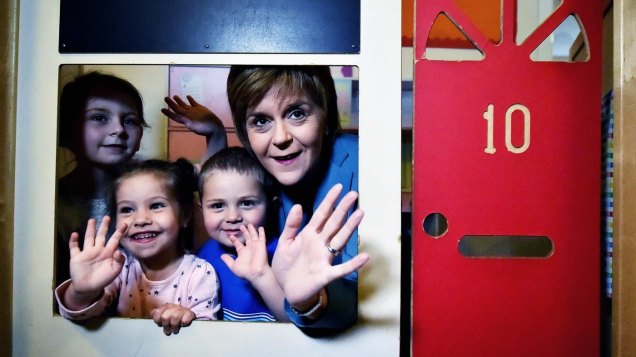
Good news from the UK Supreme Court today, which has made an important decision in favour of civil liberties and privacy by ruling the SNP government’s insidious “Named Person” child-monitoring scheme unlawful, giving Holyrood no recourse to further appeal.

Specifically the Supreme Court struck down provisions which allowed the sharing of sensitive data about Scottish children between agencies, which the court held to be in breach of the right to privacy and a family life under Article 8 of the European Convention on Human Rights.

The court further held that several of the provisions for data sharing in the Children and Young People (Scotland) Act 2014 were beyond the legislative competence of the Scottish Government – in other words that Nicola Sturgeon’s nationalist government has been getting far too big for its boots, and should perhaps focus on trying to deliver better governance for Scotland instead of greedily seeking to acquire ever more power over its own citizens.

What is most encouraging about this ruling – besides Nicola Sturgeon being put firmly back in her box, of course – is the strong, uncompromising language used by the justices in their decision.

From the judgment:

Individual differences are the product of the interplay between the individual person and his upbringing and environment. Different upbringings produce different people. The first thing that a totalitarian regime tries to do is to get at the children, to distance them from the subversive, varied influences of their families, and indoctrinate them in their rulers’ view of the world. Within limits, families must be left to bring up their children in their own way.

The justices then go on to quote the late US supreme court justice James Clark McReynolds, who held in Pierce v Society of Sisters:

“The fundamental theory of liberty upon which all governments in this Union repose excludes any general power of the state to standardize its children by forcing them to accept instruction from public teachers only. The child is not the mere creature of the state; those who nurture him and direct his destiny have the right, coupled with the high duty, to recognize and prepare him for additional obligations.”

The child is not the mere creature of the state – a universal truth, but one seemingly forgotten by the Scottish National Party in their paranoid desire to centralise and monitor everything that takes place north of the border.

This is a remarkable tirade against totalitarianism and in favour of individual liberty, and can only be seen as a stunning repudiation of the SNP’s entire suffocating, infantilising attitude towards their own citizens. To warn about the slippery slope toward totalitarianism in such an clear way only serves to underscore just how illiberal – and vastly disconnected from the welfare of the child – the Named Person scheme really is.

What is even more remarkable is that such a start warning against totalitarian instincts came not from a mainstream elected politician, but from unelected judges. In its short history, the UK Supreme Court’s judgments have not exactly set the world on fire or shifted numerous copies of approving books in the way that one might pore over the dissents of Ruth Bader Ginsburg or the late Antonin Scalia. That mild-mannered UK supreme court justices are mentioning totalitarianism and quoting McReynolds at all is proof that we are in trouble.

In their reporting, the British press has been making much of the fact that the ruling later goes on to call the Children and Young People (Scotland) Act 2014 “unquestionably benign”. In their article, the BBC makes no mention of these pointed references to totalitarianism in the judgment, immediately revealing the corporation’s bias and reluctance to report properly on stories which are critical of the authoritarian leftist Scottish government.

But as it was with the shock Brexit vote in the EU referendum, once again the media’s barely concealed support for infantilising, authoritarian Big Government policies has been overridden. In this case, the supreme court has spoken (though how much better it would have been had the Supreme Court been able to strike down the Named Person Act with reference to a British Bill of Rights or constitution rather than the expansionist ECHR).

As this blog noted when the Named Person scheme was last being debated prior to the 2016 Holyrood elections:

Whether any given Scottish person wants their top layer of government to reside in Holyrood or Westminster, surely anybody should agree that the bottom layer of government should not intrude deep into the family unit in the way that the Named Person Scheme does.

[..] This is the SNP at work in government. A hectoring, overbearing movement which seeks to centralise everything they can touch, from the state monitoring of children to the police and fire services – with deadly consequences, in the latter cases.

Today, a blow has been struck against the insidious ratchet effect underway in Britain, leading inexorably to a larger and more interfering state. We should be grateful to the Supreme Court for their decision, and to The Christian Institute and other appellants for fighting the case.

But it should not fall to an unelected judiciary to make the bold and uncompromising case for individual liberty. Ruth Davidson did a magnificent job opposing the Named Person scheme on behalf of the Scottish Tories, but we need more politicians across the board who are willing to stand up for liberty and who possess the imagination to conceive of a world where government is not the answer to every single problem.

The Supreme Court did us proud today. It is about time for more of our elected politicians to do the same.


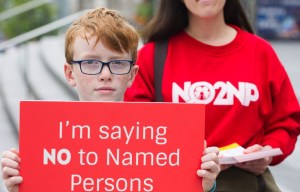
No2NP protest

Top Image: CapX

– 

Agree with this article? Violently disagree? Scroll down to leave a comment.

Follow Semi-Partisan Politics on TwitterFacebook and Medium.

Brexiteers Are Not Violent Savages. In Fact, More Brexiteers Than Remainers Strongly Oppose The Death Penalty

Darwin - Evolution of man - EU Referendum - Brexiteers

The BBC uncovers ‘devastating evidence’ linking support for Brexit with being a primitive Neanderthal

The latest act in the BBC’s ongoing effort to catastrophise Brexit and discredit Brexiteers is this delightful article from last week’s News Magazine, exploring the link between Brexit and the death penalty:

Immediately after the vote, commentators said it was about class – about professionals living and working in big cities, especially London (who voted Remain), versus working class people in smaller towns, especially in the north of England (who voted Leave).

So you would think that if you know that someone is working class and has a low income, you’d be able to confidently guess they voted Leave. But according to Stian Westlake, Head of Research at the think tank Nesta, this is not the case.

“If you look at someone’s class status and their income, and you try and use that to guess whether or not they voted Remain, it turns out it’s not that much better than guesswork. It gives you around 55% accuracy, and obviously a guess would give you 50% accuracy,” Westlake says.

His figures come from the British Election Study, in which around 24,000 people were asked about their voting intentions in the EU referendum.

Respondents to the survey were also questioned on their views on other things, such as the death penalty – and this provides a much better indicator of how people voted, Westlake argues.

“If you look at attitudes to questions such as, ‘Do you think criminals should be publicly whipped?’ or ‘Are you in favour of the death penalty?’ – those things are much better predictors, and you get over 70% accuracy,” he says.

“To give you an idea of how good a predictor that is, if you ask someone, ‘Do you think there is too much European integration?’ – which you’d think is a pretty good indicator – that only gets you to the high 70s. So if you can get to 71% or 72% prediction from these questions about traditional values, then it suggests it is that, rather than income or class, that is really driving the vote for Leave.”

So now Brexiteers are violent savages, dangerous authoritarian people who cannot keep their base desire for retribution and “an eye for an eye” under control. Brexit Britain will see a return of the stocks, the scold’s bridle and even the gallows in the town square if we get our way, the BBC is effectively telling its readers.

And of course this fits in with everything that Remainers like to think about themselves, and tell themselves about those who want Britain out of the European Union. To their minds, Remainers are compassionate, progressive, outward-looking, tolerant and fair, while Leavers are sneaky, conniving, closed-minded, inward-looking, highly intolerant and “post-factual”. Remainers want to hug a hoodie. We, apparently, want to bash their heads in with a brick and hang them from lamp posts as a warning to others.

Except that in their haste to demonise Brexiteers, the BBC neglected to mention the percentage of Remainers who also back the authoritarian policies cited in the survey. And there is a reason for this – to some extent, the data actually exonerates Brexiteers, while painting Remainers in an equally bad light, if not worse.

BES - Death penalty - Brexit

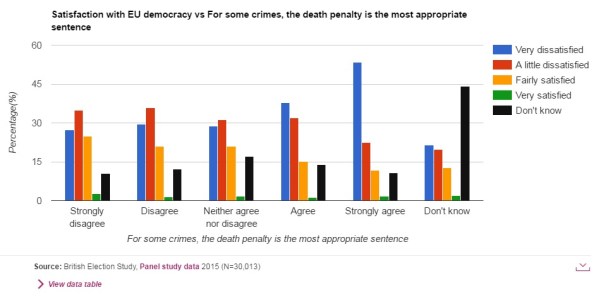
This chart plots satisfaction with EU democracy (a reasonable indicator of general euroscepticism given the fact that sovereignty and democracy were given as the primary motivation for voting to leave, according to post-referendum polling) against strength of agreement with the death penalty. The data is taken from the British Election Study, and and can be freely found and researched on their website.

And what we see here is that of those who strongly oppose the death penalty, over 62% are eurosceptic (that is, either very dissatisfied or a little dissatisfied with EU democracy). Of those who disagree with the death penalty a little less staunchly, over 65% are eurosceptic.

Admittedly, more staunch eurosceptics take up a much larger proportion of those who agree or strongly agree with the death penalty. But the europhiles (taken as those fairly satisfied or very satisfied with EU democracy) hardly cover themselves in glory as principled death penalty abolitionists. The proportion of europhiles either against or strongly against the death penalty struggles to break much above 20%.

This would seem to suggest that however much the BBC’s “traditionalist” narrative may play a part, there are also a significant number of very firm eurosceptic death penalty opponents who supported Brexit. That would make sense. This blog is one of them, as is nearly every other Brexiteer I happen to know. But why report on the principled band of anti death penalty Brexiteers when you can just play to the gallery and point at those eurosceptics who want to bring back hanging? It just fits so neatly into the tidy little narrative about primitive, left-behind idiots voting for Brexit against their own supposed interests.

But perhaps if the data tells us anything  at all, it is that people with strong opinions on either side of the death penalty issue (and perhaps other issues too) tended to favour leaving the European Union, while Britain’s army of vague, wishy-washy and noncommittal people wanted us to remain, guided as always by their dithering uncertainty and fear of change. After all, when it came to strongly disagreeing (or even strongly agreeing) with the death penalty, Britain’s EU cheerleaders are almost nowhere to be seen. That hardly fits with their sanctimonious claim to be more open and tolerant than the rest of us.

But that doesn’t quite fit the BBC’s preferred narrative. Far better to concentrate on the spike and declare all Brexiteers to be violent, vengeful authoritarians. That is the narrative the BBC loves to tell and Remainers love to hear, so that is the narrative which we will continue to get.


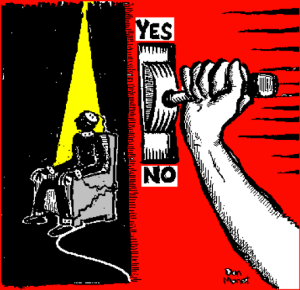
Abolish death penalty

Bottom Image: ForceChange

Support Semi-Partisan Politics with a one-time or recurring donation:

Agree with this article? Violently disagree? Scroll down to leave a comment.

Follow Semi-Partisan Politics on TwitterFacebook and Medium.

Theresa May’s Government Should Dramatically Increase Defence Spending

USO lounge airport

It is time to reject David Cameron’s lazy, noncommittal approach to our armed forces and national defence

After a rather assured start as Britain’s new prime minister, will Theresa May act to beef up Britain’s flagging and cash-starved armed forces, making them as steely and formidable as her own carefully cultivated image?

Conservative Home makes the case:

The introductions to British defence reports are characterised by assurances of the UK’s continued global relevance and ambitions. By contrast the bodies of most reports are composed of capabilities we allegedly no longer require. At some point rhetoric and reality inevitably collide.

The Royal Navy now has 19 frigates and destroyers where in 1998 it had 34. The UK has fewer tanks than Switzerland. The British MOD leads the world in operating at the extreme edge of the possible.

Our current defence strategy is largely premised on not having to defend ourselves. The lifecycle of the defence systems and equipment procured today is up to 45 years. Forty-five years ago, in 1971, the Iron Curtain was as firm as ever, Deng Xiaoping was yet to take power and introduce China’s transformative market reforms and Osama Bin Laden was merely a wealthy Saudi teenager. By historical standards these strategic shifts are reasonably minor. Nevertheless government strategic analyses generally assume the relative stability of the last 15 years will continue indefinitely; the 2010 and 2015 defence reviews inexplicably argues the UK will no longer need the capability to deploy an expeditionary force of the size sent to Iraq or to conduct two simultaneous medium sized operations as in Iraq and Afghanistan. Hopefully the 2020s are indeed an exceptionally peaceful decade, but premising our defence policy on an unstated and unjustifiable assumption they will be appears unwise.

Three illusions aid this approach to defence. Firstly over-dependence on Trident; if we continue to rely so heavily on our nuclear capabilities some scenarios will confront us with a choice between launching an immoral first-strike nuclear attack or doing absolutely nothing. Secondly over-dependence on NATO; the British Army is intended to act as an interoperable auxiliary to a much larger US force. Perhaps the US will remain highly committed to the defence of Europe, but Donald Trump is cheered when he denounces NATO and Newt Gingrich has publicly dubbed Estonia to be “a suburb of St Petersburg”. In 2012 Obama’s (largely rhetorical) pivot to Asia attempted to shift the US’s strategic and economic centre of gravity from the Atlantic to the Pacific. In this political environment, it would be unwise to have no plan for US disengagement from Nato. Finally, British defence planning tends to assume lost capabilities can be regenerated rapidly in the event of a crisis. Given the extraordinary logistical hurdles which confronted the Ministry of Defence in the run-up the Invasion of Iraq, a scenario consistent with defence planning assumptions, wide scale attempts to regenerated lost capabilities would probably be impossible except in the long-term.

Fundamentally only a very few voters have any personal contact with the military. Servicemen and women are constitutionally forbidden from protesting. The Ministry of Defence is therefore at a crucial disadvantage in interdepartmental budgetary warfare. Parliamentarians have a duty to compensate by holding the government to account. Of course there is no shortage of Conservative MPs who would favour higher defence spending but they face the challenge of highlighting less deserving areas of spending to cut instead.

Absolutely. And over-reliance on Trident in particular can only lead to a never-ending series of national humiliations, as adversaries test us and find us continually unwilling or unable to respond with conventional forces.

The military in particular needs to start throwing its weight around more, agitating for lost capabilities to be restored and highlighting the risks to Britain if they are not, rather than their current approach of quietly begging for cash behind the scenes but maintaining a brave face to the world. Sometimes, politicians need to be shamed into doing the right thing, perhaps especially when the government is a lily-livered centrist Conservative administration more concerned about pursuing “social justice” than defending the country. Operation Shame should therefore begin now.

ConHome are also right to point out that very few voters have any personal contact with the military. This is in marked contrast to countries such as the United States, where armed forces veterans are not only more visible, but much more highly honoured too. People visiting America for the first time are often struck by the frequent presence of soldiers in transit at airports, USO lounges set aside for them, and veterans being honoured at public events such as sports games or political rallies, often asked to stand as the crowd show their appreciation. Many restaurants and businesses offer a discount to veterans. In nearly every way, American society is geared to respect and honour the military more than is now the case in Britain.

The effects of the armed force’s diminished role in public life are telling. When the military is so invisible to most people most of the time, it naturally loses out in the endless departmental cash grabs every year when the government announces its budget. The NHS has a dedicated army of online priests and priestesses, endlessly and mindlessly singing the praise of the health service from dawn to dusk. Consequently, politicians terrified of electoral retribution throw more money at the NHS every year while rarely standing up to the many entrenched special interests which corrupt the working of the world’s fifth largest employer.

We need to start taking the defence and security of our country as seriously as many of us seem to take defending the NHS from criticism, reform or privatisation by the “Evil Tories”. That means putting great pressure on Theresa May and her government to show a steely resolve when it comes to protecting and growing the MOD’s share of government spending. Somebody needs to send a memo reminding Cabinet that NATO’s 2% of GDP target is a minimum aspiration, and not a level to be particularly proud of.

And we all need to let this government know that whatever other fiscal and political pressures there may be, doing the bare minimum when it comes to our national defence is simply no longer acceptable.


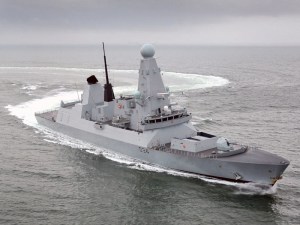
PHOTEX-HMS DIAMOND

Top Image: Nicholas Kralev

Bottom Image: Defence Industry Daily

Support Semi-Partisan Politics with a one-time or recurring donation:

Agree with this article? Violently disagree? Scroll down to leave a comment.

Follow Semi-Partisan Politics on TwitterFacebook and Medium.