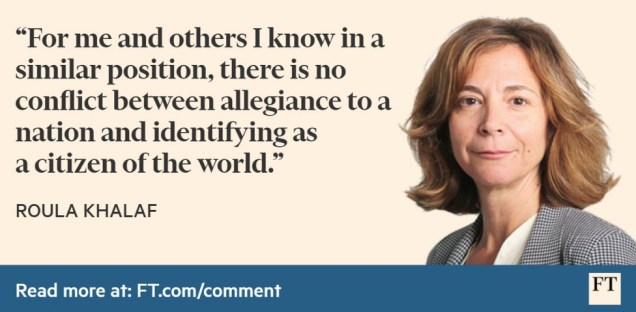
There’s Nothing Virtuous About Being a Rootless ‘Citizen Of The World’

citizen-of-the-world-roula-khalaf
Someone give that woman a medal

Most self-described citizens of the world are actually no such thing. They might enjoy the company of very similar people in increasingly similar global cities, but they probably couldn’t think of a single thing to say to somebody of different socio-economic status from a smaller town twenty miles down the road

Pete North explains perhaps better than anyone exactly why those people who style themselves as liberal “citizens of the world” are often no such thing – neither tremendously liberal, nor engaged citizens of anywhere, in any meaningful respect.

North writes:

In the end there is nothing especially virtuous about people who are well travelled and outward looking. A society needs all stripes to function. We need people to work the routine jobs and then we need a fluid workforce not tied down with responsibilities. Moreover, having dealt with more well pampered HR people than a person ever should, one thing I have noticed is that travel does not necessarily broaden the mind.

If you take an incurious person and lavish travel upon them you are wasting your money. Some of the most shallow, snobby and fatuous people I know would consider themselves liberal citizens of the world. Such people have no concept of what it is to be building or maintaining something with a long term plan. They latch on to the fashionable and socially convenient worldview that the EU is the manifestation of liberal values but it little more than virtue signalling.

And develops his argument:

What I find is that the broader your horizons, the harder it is to fit in wherever you go, and so there remains a polarisation between the settled and the travelled. It is then no surprise that there is an obvious demographic divide and opinion is split between the ages.

In this, the remain side of the Brexit debate seem keen to pour over these demographic studies to pathologise the leave vote, and consequently delegitimise it, as though you need to be of a particular set for your opinion to hold any worth. Democracy is lost on such people. The whole point of democracy is one person; one vote, where we take a sample of opinion and move together on the basis of compromise.

In something as binary as EU membership though there is only winner takes all. There is no third option on the ballot so we move with the majoritarian view which is to leave. For whatever reasons they voted for, they did so in accordance with their own views based on their own choices. Their worldviews are formed by what they see and hear in the media, but also in the street and in the workplace. They are the best judges of what is important to them. To suggest that choosing a more conservative lifestyle means you are not qualified to make such an estimation is to invite the very sentiment behind the leave vote.

What these people know better than anyone is that the frivolous and rootless people telling them how to vote are no better than anybody. I imagine the working classes would like nothing more than to live a more adventurous life but they don’t because they can’t afford it. It’s then a bit rich to tell them that the EU brings them freedom of movement and prosperity.

Earlier this year Theresa May said “If you believe you are a citizen of the world, you’re a citizen of nowhere. You don’t understand what citizenship means”. I smiled when I heard that. Nothing quite so succinctly demolishes the flimsy worldview that believing in the borderless homogenised EU, along with all the pompous garb that goes with it, is somehow enlightenment. May recognises that being a citizen is more than holding outwardly liberal views. It means making a contribution – to be part of something.

It takes no particular talent to drift through life going place to place – and in so doing all you’re likely to meet is others who have made the same choices or enjoy an extraordinary privilege. Far from broadening the mind it merely reinforces a particular mindset which is never exposed to the values of the settled community. It’s why self-styled “citizens of the world” have no self-awareness and do not for a moment appreciate just how naff they sound to everybody else.

In my experience, self-described citizens of the world have tended to describe their outlook in terms of what they get from the bargain rather than what they contribute to the equation. They call themselves citizens if the world because being so affords them opportunities and privileges – the chance to travel, network and do business. Very few people speak of being citizens of the world because of what they give back in terms of charity, cultural richness or human knowledge, yet all of the people that I would consider to be true citizens of the world – people like Leonard Bernstein or Ernest Hemingway – fall into this latter, rarer category.

What does it really mean to be a modern day “citizen of the world”, anyway, besides having a determinedly self-regarding outlook? Most of those who claim the title – either members of the ruling class or young hipsters whining that their futures and European identities have been somehow ripped away from them – are from the big cities, London most prominently. But to a large extent, many world cities are so alike in culture that one can negotiate and skip between them fairly easily,  even with a language barrier.

London has Starbucks, museums, galleries, bars and hipsters. So do Paris, Berlin, Copenhagen, Rome, Warsaw, Manchester, and everywhere else in Europe. In our interconnected world, large global cities are if not interchangeable then at least often share a common culture and vibe.

So you can successfully get smashed in Lisbon, Dublin, Stockholm and Munich? Congratulations, Mr. Citizen of the World. What do you want, a medal? Now go try to strike up a conversation with someone from your own country but from a different social class or region. Try going for a night out in Harlow or Wolverhampton or Preston. Your non-prescription hipster spectacles and quirky denim dungarees might buy you immediate entry to the trendy coffee shops of Amsterdam or the bars of Barcelona, but they’ll get you nowhere in Stoke-on-Trent.

And increasingly this is what it comes down to. We have a broad class of people with access to (and the desire to be part of) this emerging global tribe based in the top cities, and a class of people either cut off from this world or with little desire to participate in it. Now, we should certainly use economic policy to lift those who want to live more global lives into a position where they can do so, and avoid the urge to persecute or condescend to those who do not. But in general, we could all do with a bit less smugness and sanctimony from the Citizen of Starbucks Brigade.

For a start, the vast, vast majority of these people are such poor citizens of their own countries that they would feel adrift and culture-shocked, as though in a foreign land, if you lifted them from their home city and moved them to a smaller town thirty miles down the road. This is not some elite band of super-enlightened, non-judgmental, globally-minded, culturally-aware aesthetes, eager to experience new things. This is a pampered, cosseted tribe of relatively well-off millennials, many of whom are in thrall to the divisive Cult of Social Justice and Identity Politics, who barely understand their own compatriots yet arrogantly believe they are ready to be unleashed upon the world.

There is nothing particularly noble or praiseworthy about overcoming a language barrier to work and make friends with other people just like you who happen to live in other countries – which describes the vast majority of those people now tearfully painting the EU flag on their cheeks at anti-Brexit demonstrations and angrily declaring themselves “citizens of the world”.

Want to do something more challenging and actually worthy of praise? Try earning a reputation as somebody with friendships that span ages, social classes and other demographic indicators. Try living up to the ideal set by Rudyard Kipling:

If you can talk with crowds and keep your virtue,

Or walk with Kings—nor lose the common touch

And if you do so, you might not necessarily become a Man, my son. But at least you won’t be just another insufferable, identikit, cookie-cutter individual who conspicuously supports the European Union – despite barely comprehending what it really is – purely as a means of signalling your virtue to your insufferable, identikit, cookie-cutter fellow citizens of the world.
citizen-of-the-world-alba-white-wolf

Bottom Image: albawhitewolf

Support Semi-Partisan Politics with a one-time or recurring donation:

Agree with this article? Violently disagree? Scroll down to leave a comment.

Follow Semi-Partisan Politics on TwitterFacebook and Medium.

Hugging Is Bad, Mmkay? Parenting, ‘Everyday Feminism’ Style

how-to-hug-yourself

Now the act of hugging is oppressive

If you are not already taking these important measures to ensure that your child turns into a psychologically frail victim-in-waiting and/or a raging second generation Social Justice Warrior, completely unable to function in the real world, then you should check your privilege and begin immediately:

Two of my good friends had their first baby late this past year.

From the get-go, Baby was a cuddly little girl. (Or, as her two moms say, “We assume she’s a girl, but we won’t know for sure until she tells us herself.”)

Sigh.

She was all about being held and being rocked – and crying her head off the moment anybody dared to put her down. She wanted contact with all the people ever.

But in the past couple of months, it seems she’s had a serious change of heart.

When some of us were over for a visit, Baby suddenly wanted none of it. Passed from one person to the next, she wailed like a banshee until finally given back to one of her moms, where she instantly quieted.

“Don’t take it personally,” Mama said to everyone, bouncing Baby. “She’s just entering that stage where she’s developing some healthy stranger danger.”

And so the new process emerged: One of us would attempt to hold Baby every once in a while. And if she cried for more than 20 seconds, we’d hand her back to one of her moms.

If Baby didn’t want to be held by certain people, Baby didn’t have to be held by certain people.

It was as simple as that – and something her moms are determined to keep in place as Baby gets older.

It took the brilliant minds at Everyday Feminism to make us realise just how tyrannical and oppressive the act of hugging really is:

We as a culture simply need to stop drilling into our own heads that there are only a select few ways to show love for another human being.

Families don’t need hugs in order to count as families, friendships don’t need high fives to pledge loyalty, and romantic relationships don’t need sex to be considered serious.

Are these things nice to give and receive? Sure. But only if both parties actually want them.

Such things only hold so much affection weight because we’ve given them that weight ourselves.

To someone who doesn’t want it, an affectionate action is rendered meaningless at best and damaging at worst.

Forcing hugging on a child tells them that 1) they’re expected to show affection toward this person, and 2) that this is exactly how they must show that affection.

Instead of being a hug tyrant, allow your child to be creative in how they show affection. Let them draw a picture or share a piece of their favorite food or read to you from their library book.

Those gestures count just as much as a hug. And your child needs to be validated in that fact.

In other news, parents should avoid unintentionally oppressing their children by bending over backwards to indulge an excuse their every passing whim and misbehaviour:

Don’t force them to eat everything on their plate, and remember that them needing to go to the bathroom as you leave the house, or saying they’re not cold and don’t need a jacket, are all examples of kids listening to their bodies.

That might be frustrating as a parent, but we should still do our best to respect that.

Yet parents should also take time to scare their children witless by discussing the “terrible things in the world” with them at every opportunity, even when they are patently too young to understand:

War, slavery, and corruption are all topics of conversation I’ve discussed with my five-year-old. Why? Because it is contextually important and sadly still relevant to our day-to-day life.

We watched the Disney/Pixar DVD with Frozen Fever on it, and the first short film up was John Henry. As a story about an African American folk hero, it got us started on talking about slavery.

We don’t idly consume media in our house.

If the book, movie or song is about a concept, person, or event that my daughter doesn’t understand yet, then we unpack it. Which can be a brutal process.

Trying to explain the concept of slavery to a five-year-old is no easy task. However, it needed to be done so that she could understand the context of the film (and the world she lives in). 

I’m all for encouraging curiosity and a desire for knowledge in children, as well as a sense of justice and the instinct to consider the needs of people who are less fortunate. I’m pretty sure that this just used to be called “good parenting”, and didn’t require an army of online social justice activists churning out earnest articles to encourage.

But if these educational top-ups for a five-year-old child can be described as a “brutal process” then it is safe to say that you are probably going too far. It should be possible to watch Aladdin with your kid without first making them sit through a 30-minute lecture on classism and forced marriages.

And seriously: so now hugs are tyrannical?

On this current trajectory I give Western civilisation another twenty-five, thirty years, tops.


Postscript: For a more scholarly critique of hugging, see The Oatmeal.


Safe Space Notice - 2

Top Image: WikiHow

Support Semi-Partisan Politics with a one-time or recurring donation:

Agree with this article? Violently disagree? Scroll down to leave a comment.

Follow Semi-Partisan Politics on TwitterFacebook and Medium.

Defenders Of The Nation State Are Not The Authoritarians Here – That Would Be The Unrepentant Globalists

One does not need to be a snarling authoritarian to reject the anti nation state, globalist worldview – and if being wary about the survival of our rights and liberties in a post-patriotic world makes one a populist then so be it

During his recent Intelligence Squared debate/discussion with Nick Clegg on the causes of the populist backlash currently roiling British, European and American politics, Jonathan Haidt makes an interesting observation:

Once you have these incredibly prosperous, peaceful, progressive societies, they people there begin to do a few things. First off, not everybody has those values. Everybody in the capital city and the university towns, they have these values. So if you look at our countries, in America we’re pretty retrograde in some ways, but if you look at our bubble places they’re just like Sweden. And that means that these people now think that, you know, nation states, they’re so arbitrary. And just imagine if there were no countries, it isn’t hard to do. Imagine if there was nothing to kill or die for, and no religion too! So this is the way the values shift, and this is what I and others are calling – the new left/right is the globalists versus the nationalists.

And so the globalist ethos is “tear down the walls, tear down the borders, nation states are arbitrary, why should my government privilege the people who happen to be born here rather than people who are much poorer elsewhere?” And so you get this globalist idea, you begin to get even a denial of patriotism, the claim – there are some pictures going around right wing media now in the United States of anti-Trump protesters holding signs that say “patriotism is racism”. So you get people acting in this globalist way, inviting immigration, spitting on the nation state, spitting on the country and people who are patriotic, and very opposed to assimilation when there is integration because that, as people on the Left in America would say that’s cultural genocide.

So you get wealthy, wonderful, successful societies that are so attractive to poor people around the world you get a flood of immigration, and they are met by the globalists who say “welcome welcome welcome, don’t assimilate because we don’t want to deny you your culture”. And this triggers an incredible emotional reaction in people who have the psychological type known as authoritarianism.

Now it’s a very negative term, but there’s a lot of psychological diversity in this world; there are some people who are attracted to the Lennonist vision, the John Lennon vision and there are other people who are more parochial – I don’t mean that in a bad way, I mean there are people who really care about hearth and home and God and country, and they are actually friends of order and stability, and they are friends of many good things about civic life.

But when they perceive that everybody is coming apart, that the moral world is coming apart, that’s when they get really racist, homophobic, they want to clamp down, they want to restore moral order, and if anybody here saw Donald Trump’s acceptance speech at the Republican National Committee that’s exactly what he said, he modelled himself after Richard Nixon’s 1968 speech, a time when cities are burning, there are riots, and Nixon came in – law and order will be restored, and that’s basically what Trump’s whole speech was.

So what I’m saying is successful democratic capitalist societies create – they change values, they generate wealth, they invite people in and then they make some of the people act in ways that trigger the other people to be furious, and those other people actually have a point because you have to have trust and social capital to have a redistributive welfare state. My point is that yes the economy matters and economic changes matter, but they matter in ways which always run through psychology.

I follow Haidt’s argument, but I do not see myself or many others of my acquaintance in the binary model he describes. For a start, I see nothing particularly liberal about the starry-eyed EU-supporting globalists, particularly when one examines the full palette of their typical political opinions. And there is certainly nothing inherently authoritarian about being a small-c conservative and fearing the jettisoning of the nation state in favour of an ill-defined globalism built upon the foundation of supranational institutions which are flawed, remote from the people and totally lacking in democratic legitimacy.

I and this blog are about as far from authoritarianism as it is possible to get, despite being staunchly pro-Brexit and anti-elite. I alternately use the labels conservatarian and libertarian to describe this blog’s desire for a much smaller state and greatly enhanced personal liberty – give me classical liberalism or give me death! The difference is that I see a strong and healthy nation state as being essential to the defence of these personal liberties, while the globalists (as described by Haidt) seem to lazily imagine that these liberties will automatically continue to endure beyond the era of the nation state.

Our experience with supranational governance – whether the United Nations or, more viscerally, the European Union, has not been a pleasant one in terms of democracy, accountability or the amount of control that ordinary people feel they have over their lives. Perhaps there are ways to reform those institutions in theory, but in practice they are loath to change and almost allergic to close scrutiny. Recall, even the prospect of losing its second largest economy and most powerful military member could not persuade the EU to consider the smallest of meaningful reforms.

Thus the European Union plods blindly onward towards a federal destination set decades ago by grey old men who presumed to decide for us how we ought to govern ourselves in the years following the Second World War, but who never thought to ask our permission. And the result is a remote and unloved supranational government whose “founding fathers” are unheralded and whose true leaders lack all accountability.

More worryingly, the ability of organic popular movements to influence the direction of supranational juggernauts like the EU is almost non-existent. Whether it is anti-austerity movements in Greece or the need for domestic industries to influence vital global trading rules in forums at which the EU speaks for all of us while really representing none of us, it is almost impossible to get the attention of EU leaders or encourage them to change direction. Just ask Greece’s Alexis Tsipras, or anybody who used to work in Britain’s beleaguered fishing industry.

I am patriotic because I love my country and consider it special and exceptional, yes. But I am also patriotic because I believe that the basic unit of the nation state remains a crucial building block in the world order, essential to the defence of our rights and liberties, and will remain so until humanity finds a way to make the various supranational institutions now undermining nation states more democratically legitimate and more responsive to popular opinion.

And so when confronted with a movement full of people who talk eagerly about being post-patriotic, who revel in being “more European than British” and who want to dissolve our democracy into a remote and dysfunctional supranational government of Europe without a second thought for our own distinct history and culture, I oppose them. Because however well-intentioned they may be, they are actively undermining the one institution (imperfect though it may be) which has thus far kept us relatively free and prosperous for centuries – our own nation state, the United Kingdom.

Does this make me an “authoritarian”? I hardly see how. While Britain has its share of authoritarian tendencies (which I despise and frequently campaign against), these tend to be even stronger on the continent. If hate speech laws seem draconian here, they would only become stricter if we were to harmonise our laws with those of much of mainland Europe. Want the police to regularly use water cannon to break up public protests? Again, look to Europe, not Britain. Much of Europe is ambivalent about property rights, to the extent that no watertight right to property is truly enshrined in the European Convention on Human Rights.

And putting all that aside, the vast majority of people in this and other European countries, when asked, do not want their countries to become dissolved into a federal European government and assume the subordinate rank of American states. Maybe rejecting this Utopian vision is backward and foolish, but a fully federal Europe is not what people want (which is why the EU has been forced to move in this direction by unapologetic stealth and deception for over half a century). So since the majority of people in the countries of Europe are not yet post-patriotic, how does opposing an institution which seeks to covertly undermine their wishes make me an authoritarian? And how does it make the people who know the truth but still support this vision enlightened “liberals”?

So much as I admire Jonathan Haidt, hail his work in exposing the Cult of Social Justice and Identity Politics and agree with most of his diagnosis of the reasons behind the current populist backlash, I cannot support his conclusion because it totally fails to take into account people like me and other liberal Leavers and Brexiteers.

Indeed, Haidt’s usual perceptiveness appears to desert him when he suggests that something simply snaps and makes people “get really racist, homophobic” when confronted with pro-globalism policies and sentiments. That is simply not how it works. All racists may be anti-globalist almost by definition, but that does not mean that everybody with reservations about globalism (as it currently exists) is remotely prone to racism.

Clearly there are other reasons for opposing globalist projects (or the current state of globalism, at least) that have nothing to do with authoritarianism, including those I have outlined here, which Haidt fails to take into consideration.

The full picture behind 2016’s populist backlash has yet to be fully understood.


globalism-versus-culture

Support Semi-Partisan Politics with a one-time or recurring donation:

Agree with this article? Violently disagree? Scroll down to leave a comment.

Follow Semi-Partisan Politics on TwitterFacebook and Medium.

The EU Snubs Britain At Its Own Risk

Friendship and cooperation

No, Theresa May was not mortally humiliated at the current EU summit underway in Brussels. Somehow, probably after a few nights in intensive care and some trauma therapy, the prime minister of the United Kingdom of Great Britain and Northern Ireland will bounce back from being denied the opportunity to make idle small talk for a few minutes with the likes of Federica Mogherini.

Let’s be serious. Were there non-stop footage of every political leader to ever attend an EU summit, we could undoubtedly find instances where each one of them stood alone with nobody to talk to for a short while, even the sainted Angela Merkel. Keep watching the video beyond the first twenty seconds and you actually see May engaged in several conversations with other European leaders. This is a complete non-story.

But seizing on the footage of Theresa May looking momentarily awkward, however, helps to reinforce a narrative that Remainers (and their friends in the media) are desperate to encourage – that of pathetic, little old Britain being banished to the margins of the world having voted to isolate ourselves “from Europe”.

This is an idiotic and superficial analysis, and it speaks volumes about the people pushing the theory that they seem to take delight in what they see as the humiliation of their own prime minister (who, let’s not forget, represents all of us). If Brexiteers have been too harsh in impugning the patriotism of Remainers, as is sometimes claimed, then now is the time for Remainers to finally take their patriotism out for a spin. They claim that our prime minister has just been insulted on the world stage – therefore they should be encouraging a collective national outrage rather than trying to score smug political points.

Remainers claimed throughout the referendum campaign that the EU is a bastion of rationality, of grown up countries cooperating sensibly with one another. Well, what is grown up and sensible about deliberately ostracising one head of government just because the member state she represents is exercising its right to leave (not that any such ostracisation took place)? What is enlightened and admirable about such childish behaviour? And why is this snarling, punitive and insecure little club something of which we would want any further part?

Iain Martin goes further in a piece for Reaction:

It’s a funny video, although not in the way May’s opponents might think.‎ Funny meaning odd, curious, in that your response to it is probably shaped by your existing view of May and Brexit.

For Leavers – and quite a few Remainers who accept the reality that Brexit will happen and no amount of shenanigans by Blair, Mandelson and Clegg (what a dream team!) will stop it ‎- a British Prime Minister being treated in a rude fashion will only encourage Brits to say “if that’s your attitude then please get stuffed” to the EU.

In that gathering I see a room that‎ is overwhelmingly male – a sausage party of smugness. May is too polite or diffident to charge up to them and start “handbagging” and beating up the boys Thatcher-style, so she hovers. Millions of people, most people, who lack liberal elite social confidence will know the feeling from school or parties ever since. It induces sympathy.

We’re not talking to you, you smell, we don’t like you, is the message. Oh, and ‎the UK is not invited to dinner.

The response all this provokes – in me, anyway – is incredulity at the continuing stupidity of the EU’s leaders in their determination to rough up Britain in a manner that amounts to self-harm. Yes, we voted to leave the EU, which is our right and had been coming for ages, ‎but we cannot leave Europe. That would be a geographic, culinary, cultural, commercial impossibility, thank goodness. That means we are going to have to get along, and find new ways of co-operating and co-existing. Punishing Britain and being rude to Theresa May is simply a waste of time and energy, when the world is changing this fast.

I would caution Iain Martin against going down the identity politics route, trying to drum up additional sympathy for Theresa May by portraying her as a lone female in a room of arrogant and threatening men. I see no evidence that gender has anything to do with this non-story. Martin (I assume) is not a fan of the Cult of Social Justice and Identity Politics, and he should avoid resorting to their tactic of playing the oppression card when engaging in argument.

But that minor quibble aside, Martin is quite right. Many people will indeed empathise with the awkwardness of walking into the middle of a room of people who generally already know each other quite well and who are already engrossed in conversation. Throw in the fact that the television cameras were rolling and May becomes quite a sympathetic character. So if Remainers’ best argument is now “see how they treat you when you scorn them and try to leave the club” then I think it will largely backfire.

If anything, the history of recent British diplomacy has been one of excessive fawning and deference, punching well beneath our weight considering our status as Europe’s second biggest economy, one of only two nuclear powers and possessing the continent’s most deployable and skilled armed forces, not to mention the popularity and dominance of our culture. Martin also picks up on this point:

Britain has the leading listening, intelligence and security capability in Europe, at a time when the place is under assault from jihadist maniacs and the Russians are out to discredit democracy and create mischief in elections in Germany and France. Even in its depleted state, Britain is a leading player in Nato, which is dedicated to the defence of Western Europe. On the cyberwarfare front in particular that defence is now an urgent priority.

The UK also provides in the City of London ‎the capital of the eurozone, which makes the giant debt machine go round. The British economy is growing and we buy a lot of cars and much else from Europe.

What will it take to wake up the countries of the EU? Their post-1989 experiment is in a terrible state, with the euro and open borders proving to be a disaster. They need a bit of humility and a rethink.

I don’t normally go for “we buy lots of cars from them!” style arguments, but it is not wrong, and everything else that Martin says is persuasive.

If anything, the trouble is that our goodwill and cooperation is too easily taken for granted by our partners. We tend to enforce EU laws and directives while other countries skirt, bend or flout them. We generally honour our obligations with little fuss. And so we should, when that behaviour is equally reciprocated. But right now that reciprocity is missing.

The fact that Britain will be a supplicant during the secession negotiations is currently emboldening the leaders of some otherwise quite unremarkable and forgettable countries to “play the big man” and swagger around, lecturing or threatening Britain safe under the wing of Brussels. They would be advised to realise that at some point Brexit will be complete, and that future goodwill and cooperation from Britain – which many of them need – should not be taken for granted if things become too heated or punitive during the exit negotiations.

Martin notes that the shift is already starting to happen:

Away from Brussels the smart Poles have realised that Britain will remain a partner, and are talking of the UK being the key country in the defence and security space in Europe. The Germans too, seem to be waking up to the need for a different way of thinking about these questions. The conversation at a dinner I was at recently with German policymakers and business people was one of the most interesting, open and illuminating things I’ve heard all year.

But Brussels blunders on, playing its usual games, thinking it clever to humiliate the naughty British. Carry on like this and they really can get stuffed.

It is altogether time for less EU-style holding hands beneath a rainbow (which is all fake, anyway) and more good old fashioned self-interest and realpolitik. Immediately following Brexit we witnessed a number of gestures of solidarity and support from true allies outside the EU while our supposed partners and allies within dealt in condescending language and veiled threats. That alone tells us that membership of the European Union has forced us to pour time and effort into nurturing partnerships which were never natural or terribly fruitful while having to ignore closer and more natural alliances beyond the artificial construct of the EU.

But if the EU and its member states are behaving irrationally and emotionally it is only because they remain in thrall to a beguiling, powerful but unachievable vision of continental political union by stealth from which Britain thankfully escaped. Sensing an existential threat to the group delusion, other countries may naturally wish to lash out at Britain, to make us “pay the price” (and there will be a price – serious Brexiteers have never shied away from that fact).

But while this may explain intransigent or punitive behaviour from the European Union, it will not excuse such antics for much longer. The time for childish temper tantrums and playground insults is over. Voters in Britain and across Europe did not elect their politicians with a mandate to create unnecessary drama just because one country chose to reject a rusting mid-century vision of political union and peaceably extricate itself from that union. And unnecessary drama they must absolutely not create.

A deal must be done and the deal will be done. Hopefully it will be a deal based on common sense, achieving the goal of extricating us from the political union we voted to leave while taking a transitory and measured approach (through continued EEA participation) to avoid any cliff-edges or avoidable economic disruption.

But whatever kind of deal emerges, it will not be influenced by video footage of Theresa May standing alone at an EU summit, no matter how much the images may warm the hearts of strangely-motivated Remainers.


theresa-may-snubbed-eu-summit-brussels

Support Semi-Partisan Politics with a one-time or recurring donation:

Agree with this article? Violently disagree? Scroll down to leave a comment.

Follow Semi-Partisan Politics on TwitterFacebook and Medium.

Labour’s Hopeless Immigration Quandary

harold-wilson

The Labour Party is doomed to break apart on the issue of immigration because the Metro-Left has become so ideologically insulated and closed-minded that they can no longer speak the same emotional language as half of their own voters (and the country)

Martin Kettle has some advice for the Labour Party as it wrestles to come up with a compromise between the blithe open borders attitude of the Corbynites and the suddenly nativist instinct of Midlands and Northern MPs whose seats may be in jeopardy unless the party moves convincingly on the issue of immigration.

Kettle lays out the issue in the Guardian:

After the issue of Brexit itself, voters think immigration is the most important question facing the country. But Labour’s poll ratings on immigration are terrible. Only 11% of voters in the most recent YouGov poll think Labour is the best party on immigration, with only 29% of Labour voters from the 2015 election – which Labour lost badly – agreeing. A mere 5% of leave voters think Labour is best on immigration.

If Labour’s priority is to re-secure its core voters on the issue, that is a very bad place to start from. Latest research by Chris Hanretty of the University of East Anglia suggests that 64% of Labour’s 232 parliamentary seats voted leave in June. So if it is correct that immigration control was the decisive issue in the leave win, Labour MPs are right to demand that, at the very least, their party says something about immigration that engages with that stark reality.

And suggests a solution based on dubious historical precedent:

There’s a framework for this. For most of the last half-century Labour’s policy was that managed migration made community integration and mutual trust possible. The policy had periods of success and failure. It was too repressive in the 1970s and it was too insouciant in the early 2000s, after EU enlargement. But until recently it worked reasonably, and won electoral consent.

Labour’s challenge in 2017 is to renew that same approach around the realities of Brexit. It won’t be easy, and it will involve compromises of the sort that Crossman expressed half a century ago. The policy cannot be based solely on liberal principles. But it cannot be based solely on ignoring those principles either.

It has to place intervention in the labour market to ensure fair treatment, alongside an unsentimental approach to immigration control. If Labour’s factions can at least agree to start from there, there’s just a chance that enough of the rest will fall into place.

But there can be no agreement between Labour’s factions. One faction – the metropolitan Regressive Left faction, incorporating everybody from leftists like Jeremy Corbyn to virtue signalling centrists – hold it as an article of faith that to even question whether everybody who wants to come to Britain should immediately be allowed to do so constitutes damning evidence of racism. The other faction – call them Old Labour, rooted in the party’s historic Northern, industrial and post-industrial heartlands – have not yet sacrificed patriotism and a belief in the uniqueness of British values and culture on the altar of globalisation, and fail to understand why immigration controls such as those imposed by countries like the United States or Australia are somehow racist.

These two sides simply cannot reconcile – certainly not so long as the metropolitan Regressive Left continues to arrogantly insult agnostics and sceptics, either accusing them of moral deficiency for failing to meekly toe the party line or ignoring their arguments altogether. In fact, with immigration currently a high priority political issue, one can argue convincingly that there is no longer any place for the two factions within the same political party, and that Labour must split (and probably should have done so some time ago).

Kettle, however, would have Labour look back to 1965 for a solution to their dilemma:

Yet the disagreement is not a new one, and Labour has succeeded in managing it before. Back in the summer of 1965, Harold Wilson’s Labour government published a radically restrictive white paper on immigration from the British commonwealth that shocked even cabinet ministers. “This has been one of the most difficult and unpleasant jobs the government has had to do,” the housing minister Richard Crossman wrote in his diaries. “We have become illiberal,” he mourned. “This will confirm the feeling that ours is not a socialist government.”

Nevertheless Crossman was absolutely sure that the controls were necessary. “I am convinced that if we hadn’t done all this we would have been faced with certain electoral defeat in the West Midlands and the south-east,” he went on. “Politically, fear of immigration is the most powerful undertow today … We felt we had to out-trump the Tories by doing what they would have done … I fear we were right.” Antisemitism and racism were endemic in Britain, Crossman suspected. “One has to deal with them by controlling immigration when it gets beyond a certain level.”

The fact that left-wing politicians and commentators would turn to the overtly racially tinged 1965 White Paper Immigration from the Commonwealth as a blueprint for dealing with Brexit and present-day immigration concerns only goes to show how little they understand the totally different present day context or appreciate the different public attitudes toward immigration in 2016.

The regressive leftist mind is seemingly unable to compute the idea that objections to unlimited immigration could be based upon anything other than racism. And perhaps this is partly understandable, when historically racism has formed one of the key objections to immigration. But no longer. Racism is now, thankfully, a fringe issue in Britain (despite the continual efforts of SJWs and others whose livelihoods depend on representing official victim classes to inflate the problem). Today’s concerns centre around integration and assimilation into society, and the affect on employment, infrastructure and public services.

None of these concerns are remotely race-based, and yet the response of the Labour Party has historically been to dismiss them all as a thin veneer covering for xenophobia. When voters plead with Labour politicians to believe them when they say that their objections are not connected with race, too often the response has been sneering dismissal. And even now, when some MPs and commentators are considering making concessions on immigration, it is done in the spirit of “we must join the British people in their racism as a matter of political survival” rather than a genuine attempt to understand legitimate public concerns.

And thus we have Martin Kettle essentially arguing that the Labour Party should hold its nose and support something which it believes to be overtly racist in order to stave off political annihilation. Why else cite the case of the 1965 White Paper, written at a time when “coloured immigration” was still openly spoken of as a specific problem?

High-minded it isn’t. But those words echo today because the essence of the argument in which Crossman’s generation participated – hard times, more migrants, native resentments, press and public prejudice, liberal principles under challenge, electoral defeats – has not altered all that much. Yet just as the Wilson Labour party was right to grasp the issue, though it could have grasped it far better, so the Corbyn party needs to grasp it in an equivalent way too.

This is the infuriating thing about leftists. They manage to be insufferable bordering on slanderous even in their attempts to be conciliatory and find compromise. Because they sincerely believe that any departure from their worldview can only be prompted by malice or grave moral failure, their attempts at dialogue with political opponents are awkward and strained as they inadvertently insult the people they are trying to flatter.

Martin Kettle has gotten it into his head that Brexit proves that the British people are having one of their funny turns and have come over all racist, just like we did in the 1960s. Unable to even consider that the Leave vote was prompted by sincere and virtuous political disagreement about the merits of EU membership, Kettle therefore suggests that the Labour Party recycle some good old fashioned racist outreach from 1965 as a kind of olive branch to persuade swivel-eyed Labour Brexiteers back into the fold.

This is the kind of clumsy gesture we have come to expect from a political elite which has become so isolated from much of the country that they can barely speak the same language. Listening to Martin Kettle try to strike up a rapport with Brexiteers would be like listening to me using Google Translate to talk to someone in Korean. The rough message might get through, but the garbled syntax would prove that I am not really speaking their language, that I do not truly understand them.

I’ve said it numerous times, and I will say it again: the Labour Party will not taste power or enjoy another general election victory until they stop giving off such strong signals that they openly despise the voters and hold more than half of the country in open disdain.

The British people do not want to be told “okay, we’ll try racism for awhile!” by an exasperated and uncomprehending Labour Party. They want to be listened to, to have their ideas and concerns heard and engaged with rather than being summarily dismissed.

This should not be a lot to ask, yet it is proving to be an almost impossible challenge for a bitterly divided Labour Party. And time is of the essence. Even assuming that the next general election takes place in 2020 and not earlier, it takes years to execute a convincing policy reversal while re-establish public credibility and familiarity.

If the Labour Party are to make a change and decide to meet the British people half way on the subject of immigration, then now is the time to do it. But with Jeremy Corbyn and John McDonnell in charge and an increasingly London-centric party behind them, don’t bet on it happening.


Britain Immigration EU

Top Image: Allan Warren / Wikimedia Commons

Support Semi-Partisan Politics with a one-time or recurring donation:

Agree with this article? Violently disagree? Scroll down to leave a comment.

Follow Semi-Partisan Politics on TwitterFacebook and Medium.