The NHS Choir’s Christmas Single Is Propaganda Worthy Of North Korea

If you buy the NHS Choir’s mediocre Christmas ditty you are part of the problem, not the solution

Imagine that a large, critical government department was gradually but incessantly becoming less and less fit for purpose.

Suppose that (say) HM Revenue & Customs suffered from major failures of management and leadership, an outdated structure, a confused remit and an ever-increasing list of responsibilities coupled with constantly changing priorities. What should be done?

Was your first thought the idea that a group of HMRC employees should get together and release a song with the hope of reaching the Christmas No. 1 slot in the charts? Did you think – in a moment of epiphany – that recording a Christmas song would in any way address the issues with that organisation, or that any public goodwill generated by the song would somehow make the various deep-rooted organisational problems and resource constraints melt away?

Probably not. You would most likely want to see some kind of hard-headed, evidence-based action plan to turn things around, not a cheesy song that pretended everything was great. But this “sing your problems away” approach is exactly what is happening today, not with HMRC but rather with the NHS. And now we are all being asked to allow ourselves to be swept up in the self-deception, mindlessly tweeting our support for an organisation – and model of healthcare delivery – which becomes more out of its depth and more inadequate to our needs with every passing day.

From the Metro:

The Lewisham and Greenwich NHS Choir are leading the in way in the race for the 2015 Christmas Number one, as the battle to secure the top spot heats up.

According to initial reports from the Official Charts Company, the choir’s track A Bridge Over You – a mash-up of Simon and Garfunkel’s Bridge Over Troubled Water and Coldplay’s Fix You – is currently ahead of rivals Justin Bieber and Louisa Johnson.

But with the track leading the way by just under 5,000 sales, it’s still looking likely to be a three way race for the top spot.

The NHS choir could also receive a boost following the release of the accompanying video earlier this week.

That video is the one shown at the top of this piece.

Of course, this whole stunt is really more of an opportunity for cheap virtue signalling of our enlightened, progressive credentials than a meaningful contribution to the healthcare debate, or even a sincere “thank you” to healthcare staff working over the Christmas period.

That much is evident from the flurry of self-promoting tweets gathering under the hashtag #NHS4XmasNo1:

But this piece of lazy, self-congratulatory, virtue-signalling NHS worship is nothing to be proud of and certainly not something which any engaged and informed citizen should support.

Why? A couple of reasons:

1. First of all, it’s a poor piece of music making. It’s a bad mashup, even by the low standards of most mashups. It takes one timeless classic (the Simon & Garfunkel) and one decent contemporary song (the Coldplay) and unimaginitively smooshes them together in a way which somehow manages to destroy or obfuscate the best of both pieces.

But of course, we can’t possibly acknowledge this fact, because:

2. Second, the video is emotionally manipulative twaddle, yet more unthinking pro-NHS propaganda of the kind that will ensure Britain’s healthcare system continues to lurch, unreformed, from crisis to crisis for another seventy years. And the fact that the propaganda is produced not by government diktat but by zealous citizens who believe they are working for the Greater Good only makes it all the more insidious.

“Aren’t NHS workers wonderful?”, the video asks us to ponder. Yes, I suppose so, but no more so than those who work for HM Revenue & Customs. Both perform a vital service, and both draw a government paycheque at cost to the taxpayer. And yet we all know that if George Osborne’s Treasury barbershop ensemble released an album of Christmas classics it would already be festering in bargain bins and languishing at the very bottom of the charts.

When it comes to “our NHS” (genuflect), on the other hand, we can’t stop proclaiming our love for it. And doing so very publicly, just so that everyone else can see what a good, progressive little person we are. But by lapping up these hymns to the NHS, we simply encourage people with sinister agendas to create even more of them in future.

Thus, over five tedious minutes of this particular pseudo-inspirational dirge, we are treated to scenes of saintly NHS workers helping wobbly old people stand up from chairs, therapists teaching amputees how to walk again, premature babies being nursed to health, and other everyday scenes of hospital life. Are these heartwarming scenes? Sure they are. Are they unique to the NHS? Hell no.

“What other organisation but the NHS could possibly do any these things?”, screams the message from the video. After all, we all know that old people, premature babies and the disabled are simply thrown into woodchipping machines and disposed of in other advanced countries without an NHS. Only in Britain with “our NHS” (genuflect) do people receive healthcare free at the point of use.

Except that none of that is true. Britain is not an island of enlightened compassion in a sea of cruelty and denied cancer treatments. And precisely zero countries are knocking on our front door and sending in their experts to learn about how we organise healthcare in this country so that they can replicate our system back at home. Shouldn’t that maybe tell us something, and cause us to take a pause from the incessant, self-satisfied boasting?
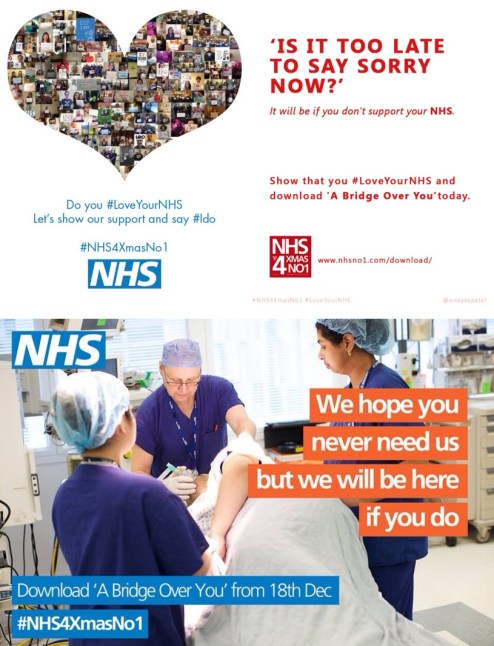
NHS - NHS4XmasNo1 - Worship - Guilt Tripping
Emotional blackmail / NHS propaganda


This isn’t an attack on NHS workers. It’s not even an attack on the Lewisham and Greenwich NHS Choir, even though their unremarkable song no more deserves to be Christmas No. 1 than will the next inevitable re-release of “Feed the World”.

This is an attack on our unthinking, embarrassing commitment to the NHS model, our apparent desire as a nation to worship what is in fact an immensely powerful government department, and the sanctimonious belief that by propelling this mediocre song to the top of the charts in time for Christmas we are making any positive contribution toward the future of British healthcare (beyond the admittedly welcome charitable donation).

We can sing songs about the NHS until we are blue in the face (and the number of songs is growing – how long until they coin an official anthem?), but it will do nothing to change the fact that a centralised model of state-funded and state-delivered healthcare designed in the post-war 1940s is highly unlikely to be the optimal solution in the year 2015.

Singing songs in praise of Aneurin Bevan’s rusting creation will do nothing to address the cold, hard truth that rising life expectancies and the continual developments of new, expensive treatments can only be tackled by an unreformed NHS if there are immediate, dramatic increases in personal taxation. For everyone, not just the Evil Bankers, of whom there are sadly not enough.

But sure, let’s make the NHS Choir song the number 1 Christmas single. Then let’s all sit back and smugly reflect on what right-on, progressive people we are for spurning Simon Cowell’s latest manufactured hit-by-numbers offering in favour of doctors and nurses who sing in their spare time. Let’s keep pretending that we alone, of all nations, stumbled upon the optimal way to deliver top quality healthcare to a growing, ageing population, back when we were still digging ourselves out of the rubble of World War 2.

It’s ironic. The NHS Choir is warbling away about “trying to fix” us this Christmas, when it is hagiographic stunts like this which mean we may never summon the political will required to fix (or replace) the NHS.
NHS Worship - London Olympic Games 1

Agree with this article? Violently disagree? Scroll down to leave a comment.

Follow Semi-Partisan Politics on TwitterFacebook and Medium.

The Daily Smackdown: Cynical Bishops Exploit Terrorism For Publicity

BBC Religion Television

Who will condemn the bishops for exploiting our fear of terrorism in their grubby bid to preserve taxpayer funding of the BBC’s religious output?

The Church of England is very upset that the BBC is considering cutting the amount of taxpayer money it spends on (predominantly) Christian television output.

From the Telegraph:

A spokeswoman confirmed that the BBC was planning to “look at ways we can reduce costs” as it faced “huge financial challenges” but added that cuts would come from across the corporation.

The Bishop of Norwich, the Rt Rev Graham James, the Church of England’s lead spokesman on media issues, said the move could threaten something which was “fundamental to our public life”.

“It seems to me that religion has already taken a hit,” he said.

“It has already been reduced certainly in terms of its scope as an independent part of the BBC, at a time when we already need – as everyone acknowledges – more religious literacy in the nation.”

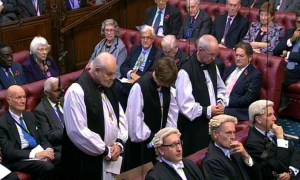
Nothing unusual there. The Church of England is a well oiled lobbying machine, and any private organisation lucky enough to have a bloc of 26 unelected representatives sitting in parliament to influence our laws in their favour would be foolish not to make good use of them. Thus it is no surprise that the unelected theocrats of our state church have been hard at work speaking out against the BBC’s planned actions.

But the fact that the Church of England’s behaviour is understandable does not make it any less reprehensible. Firstly, because it makes a total mockery of the idea of the BBC as an independent broadcaster. Nobody seriously believes that an organisation whose budget is nearly totally dependent on taxpayer money can be truly independent, but the fact that the Lords Spiritual are now actually speaking in parliament about the internal decisions and strategy of the BBC makes any pretence of the BBC’s impartiality or the government’s non-involvement utterly ridiculous.

Worse than this, though, is the flimsy rationale now offered by the bishops as a pathetic excuse for more taxpayer funded religious programming:

Bishops have warned the BBC it risks turnings its back on efforts to tackle extremism and aid integration by slashing spending on religious programming.

[..] The first female cleric in the House of Lords, the Bishop of Gloucester, the Rt Rev Rachel Treweek, remarked that the decision had presumably been taken “to reduce the possibility of offending people with too much God stuff over the holiday”.

It is good to see the newly enobled Rachel Treweek, my Lord Bishop of Gloucester, is wasting no time in rolling up her sleeves and interfering in our national democracy as generations of theocrats have done before her. She will be making the home team very proud. But unfortunately, she and her fellow Lords Spiritual are talking nonsense.

The argument that cutting the amount of taxpayer money devoted to religious television and radio programming on the state broadcaster is somehow a threat to anti-extremism efforts is as ridiculous as it is unfounded.

More moderate Christianity on TV will not result in less Islamic extremism on the margins of British society. And pontificating, busybody bishops who abuse their parliamentary platform to suggest otherwise should provide evidence for the supposed link, or else retract the claim and admit that they are simply exploiting serious issues of national security in a cheap ploy to gain more taxpayer-funded airtime.

The real issue is not so much the pull factor of extremism as the push factor of the alienation of too many young Muslims from British society. It’s the fact that we have living among us too many self-segregated societies comprised of people who hold the same passports as us, but look upon us – and the enlightenment values of reason, education, liberty and democracy to which we try to adhere – as alien and unwelcome. By failing to inculcate a strong and inclusive sense of Britishness, out of craven fear of causing offence, we provide the Islamist recruiters with easy fodder.

Do my Lord Bishops of Gloucester and Norwich (flowery titles for a bygone age) seriously believe that the kind of alienated youths and their families who are now quietly slipping away to ISIS in Syria or seeking out radicalising materials online are the same type of people who tune in to BBC Two at six o’clock in the evening, ready to be reached out to and placated with a documentary about public spirited imams, rabbis and priests working together to open a new community centre? What nonsense.

The people most in need of the BBC’s moderate religious programming and generally liberal worldview are those whose eyes are glued to YouTube videos of anti-American 9/11 conspiracy theories or seditious social media conversations on their smartphone screens. More government intervention – be it through Prevent or the BBC – is not going to make meaningful inroads to these people. The only lasting solution must come from the bottom up, a revitalisation of patriotism and pride in Britain, and the promotion of a common British identity which transcends racial divides (rather than revelling in a multicultural dystopia which sees groups living side by side but separately in parallel, alienated lives.

Do the Lord Bishops have anything meaningful to say about that? No, they do not – perhaps with the exception of the Bishop of London, Richard Chartres.

This is in no way intended as an attack on religion, or on the Church of England (so long as it stays within its own boundaries and stops trying to play an undue role in our public life). I grew up watching Songs of Praise on a Sunday, and have happy memories of doing so. But it is not right for general taxpayers of an increasingly secular country to continue funding religious programming using a model that invites some appointed bureaucrat or another to choose which religions or denominations are to be favoured above others.

Perhaps the Lords Spiritual begin to grasp this. Perhaps they are grasping at these increasingly ludicrous excuses for their continued influence because deep down, they realise that they have no place in the government of a twenty-first century democracy.

But if these are the death throes of theocracy in Britain, they are still very offensive indeed. Claiming that the BBC should continue to spend taxpayer money on religious output favouring the established church because failing to do so will unleash more extremism – and note how the bishops cannot bring themselves to utter the name of the religion from which that extremism currently emanates – is cynical and manipulative, playing on the fears of British people just to win more free promotion.

I have never expected much from the Church of England’s upper hierarchy, or their antidemocratic parliamentary delegation. But this is low, even by their rock-bottom standards.

First female bishop to sit in House of Lords

Agree with this article? Violently disagree? Scroll down to leave a comment.

Follow Semi-Partisan Politics on TwitterFacebook and Medium.

The Daily Smackdown: Labour’s Pitch For Power Is A Child’s Temper Tantrum

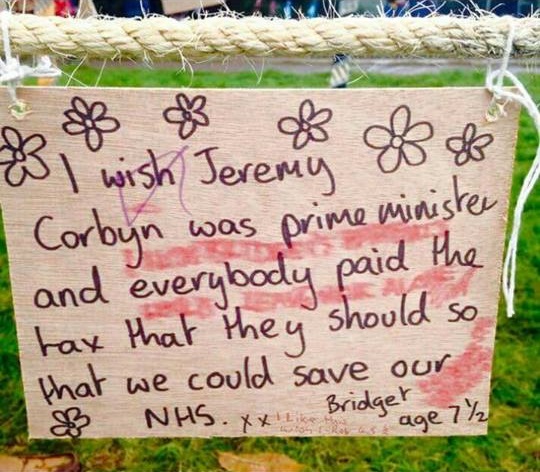
Labour - Save Our NHS

Thus far, Jeremy Corbyn’s elevator pitch for power would be more at home in the school playground than the adult political debate

When your core political argument and pitch to the electorate can be easily summed up in crayon by a seven year old girl, it’s time to develop a more robust vision for government.

A first good step for Labour to take would be to stop fomenting or tacitly condoning behaviours like these, from activists and supposed supporters:

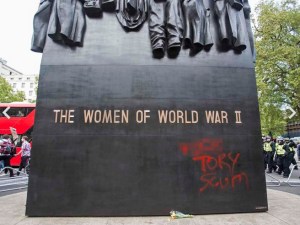
Shouting “Tory Scum” at opponents

Vandalising war memorials

Shrieking about nonexistent human rights abuses

Physically threatening MPs

Being insufferable online

Pretending that there will be no offsetting behavioural consequences to dramatic tax hikes

Stubbornly believing in the magic money tree

I’ve written before about how, in their incoherent rage at the supposed transgressions of the Evil Tories, the Left are in great danger of becoming the British left wing equivalent of the American Tea Party – morally certain, impervious to facts, intolerant of the slightest internal dissent and quick to anger when contradicted by outsiders.

Where the Tea Party blindly venerate the US constitution (though they read it selectively, and from a highly originalist perspective) and would see the federal government shrunk back to its nineteenth century bare bones, the Corbynite Left venerate “our NHS” (genuflect) and the other monolithic edifices of the welfare state stemming from the socialist post-war consensus.

Neither seem very comfortable living in the present. And the worst excesses of both would be more at home stapled to the wall of a primary school classroom than reported and printed as serious ideas in the pages of a national newspaper.

Tory Protests

Agree with this article? Violently disagree? Scroll down to leave a comment.

Follow Semi-Partisan Politics on TwitterFacebook and Medium.

Forget Migrant Benefits In The EU Debate; What About The S-Word?

Alan Johnson - Labour In for Britain

The EU debate is about so much more than relatively petty questions about migrant benefits and immigration. But few from the official “Leave” campaigns are willing to broaden the debate

It is rare for this blog to find itself in agreement with Labour grandee Alan Johnson, chairman of the “Labour In For Britain” campaign group.

But Johnson is absolutely correct in his criticism – expressed on the Andrew Marr show today – that the EU debate has been narrowed down to an insultingly simplistic degree.

LabourList reports:

Johnson, who is leading Labour’s campaign to stay in the EU, appeared on The Andrew Marr show this morning to make the case for Britain to stay in the EU. He pointed out that issues like climate change can only be solved by countries working together, and that the EU was an essential “political union”.

He slammed the Prime Minister for narrowing the debate, saying there has been a lot of focus on Cameron’s attempt to ban migrants who are in work from receiving benefits until they have been employed in the UK for four years. Cameron is thought to have abandoned these plans in favour of imposing new limits on benefit payments to out-of-work migrants instead of those people in jobs. Johnson said this focus had distracted from other important issues.

Forget the orchestrated shenanigans over David Cameron’s supposed tussle with other EU leaders over migrant benefits – this is a ridiculous sideshow obsessed over by a credulous media, as my Conservatives for Liberty colleague and editor Ben Kelly wearily points out.

But Alan Johnson’s broader criticism is devastatingly accurate. From the outset, particularly on the “Leave” side, the Westminster campaign has been incredibly myopic and unimaginative.

We should expect no better from the prime minister – David Cameron is an avowed europhile, has stated numerous times that his preference is for Britain to remain a member of the EU, and has been unable to force the words “campaign for Brexit” from his lips even as a remote hypothetical. And thus it is no surprise that Cameron went in to the renegotiation with no set demands (contrary to the media narrative) but simply with a begging letter to Donald Tusk pointing out areas for discussion.

And those areas do nothing to assuage the concerns of the thinking eurosceptic or Brexiteer. Because the real problem with our continued membership of the European Union is not immigration, welfare, fiscal policy, social policy or the euro. The real problem is the little-mentioned S-word: sovereignty. Because this one word encapsulates all of the many ways in which the EU infringes upon our democracy.

It’s not about Schengen, or the single market – Britain is already outside the former and a full member of the latter. That’s why when David Cameron comes back brandishing something called “associate membership” we should be immediately suspicious, because it will essentially be a formalisation of the status quo, with all of the existing drawbacks of Britain’s EU membership hardwired into a future new treaty, with a few extra problems sprinkled on top as a garnish.

The fundamental issue of sovereignty will go unanswered, because David Cameron is not even raising it as part of his sham renegotiation, and while the overly credulous may believe that a toothless and unenforceable exemption from “ever closer union” is some kind of great victory, it ignores the fact that our union with Europe is already far too close. The EU remains an explicitly political union (as Alan Johnson happily states in his Andrew Marr interview) and Britain remains firmly part of it.

Neither Leave.EU nor Vote Leave hammer the sovereignty aspect, having decided that scare stories about what the EU will do to “our NHS” (genuflect) and other public services will do more to win over the bovine masses. But sovereignty is the key.

Is Britain to be a real democracy, accountable to its own citizens once again? If so, then we need to recognise – and repeat endlessly – that national democracy and the European Union are fundamentally incompatible.

As the preamble to the Bertelsmann Stiftung report “A Fundamental Law of the European Union” (soon heading our way via the Five Presidents Report) explicitly states:

This proposal for a Fundamental Law of the European Union is a comprehensive revision of the Treaty of Lisbon (2007). Replacing the existing treaties, it takes a major step towards a federal union. It turns the European Commission into a democratic constitutional government, keeping to the method built by Jean Monnet in which the Commission drafts laws which are then enacted jointly by the Council, representing the states, and the European Parliament, representing the citizens. All the reforms proposed are aimed at strengthening the capacity of the EU to act.

It’s right there in black and white – a major step towards a federal union. The EU will drive a wedge between nation states and their citizens by enshrining and expanding the model whereby national governments sign off on laws and policies initiated by the EU Commission, while the people will have redress only through the European Parliament, thus (hope the federalists) gradually legitimising the Brussels and Strasbourg parliament.

But you’ll hear none of this from the major “Leave” campaigns, and certainly from nobody within the Conservative Party. The only real exception at present is the small but growing group of campaigners and bloggers coalescing around Dr. Richard North’s site eureferendum.com, who do a good job holding the media to account and pointing out lazy thinking and writing (sometimes including this blog) which unwittingly aids David Cameron’s agenda.

At least the Left and the “Remain” camps are able to appreciate that the EU referendum is a fundamental question of who we want to be as a country, and where we believe democracy and decision making should rightly sit. They have their particular vision – abhorrent to me, but clear and unambiguous – that the UK is a weak and ineffectual country incapable of robustly defending our own national interests, and that the fifth largest economy, formidable military power and cultural beacon that is the United Kingdom can only survive by dissolving our political identity into the European Union. And they will be repeating this message from now until referendum day.

The “Leave” campaigns have no similar clear vision. They believe that the referendum can be won by reducing the great questions of democracy and Britain’s place in the world to a tedious, nitpicking discussion over how many migrants can be kept out of Britain, or how much money saved by renegotiating the terms of our surrender. Alan Johnson’s view is utterly wrong, but at least he has the confidence to state his case.

When will the Leave campaigns appreciate that the referendum cannot be won if people believe that leaving the EU is a leap into the unknown, or when the only ones talking passionately about Britain’s place in the world are the europhiles?

When will the Leave campaigns stop their myopic obsession with issues like migrant benefits, an arbitrary issue picked by our devoutly pro-EU prime minister, which are only designed to distract our attention from the ultimate deal – associate membership – which will ultimately be presented?

And when will the Leave campaigns get over their overriding fear of the S-word?

David Cameron - Donald Tusk - EU Renegotiation - European Union - Brexit

Agree with this article? Violently disagree? Scroll down to leave a comment.

Follow Semi-Partisan Politics on TwitterFacebook and Medium.

Gay or Straight, The Robert Dyas Christmas TV Ad Is Cheap and Cynical


Don’t praise Robert Dyas for their awkward, virtue-signalling Christmas television commercial. Condemn them for exploiting the hard-won civil rights accomplishments of others for monetary gain

If any further proof was needed that tolerance and equal rights have morphed from being simply the right thing to do into just another opportunity for ostentatious virtue-signalling, you need look no further than the bizarre Christmas television commercial recently released by Robert Dyas.

In the ridiculous TV advert – a parody of a 2009 satirical video by Rhett and Link – various Robert Dyas staff members are shown confessing their sexuality before going on to plug completely unrelated products stocked by the retailer.

(The original video showed black and white employees explaining how the products in their furniture shop were suitable for both black and white customers).

From the Telegraph:

The minute-long film, described as “the weirdest Christmas advert ever”, shows men and women declaring whether they are straight, gay or bisexual while describing unrelated products in the store.

In the clip filmed in one of the chain’s branches, a member of staff introduced himself by saying: “Hi, my name’s Marcus, I work at Robert Dyas, and I’m gay.”

Before showing off a large inflatable yellow Minion toy, he adds: “I like going out with my friends and playing volleyball. I also like showing our gay and straight customers a funky range of our Christmas gifts.

[..] The confusing advert then comes to a close with a shot of staff members and customers standing at the shop’s counter, and announcing in unison: “Robert Dyas – where gays and straights can buy drills and much, much more”.

Like all clever television adverts, this was clearly designed to be controversial and to generate discussion which would expand Robert Dyas’ marketing reach well beyond the number of people who will ever see the commercial on television. And as with the creepy John Lewis “Moon Hitler” commercial, also released this year, much of the weirdness is intended to get people talking – so mission accomplished.

But in this case it is worth taking the bait, because the message of the Robert Dyas commercial is symptomatic of a wider trend sweeping Anglo-American society, whereby it is no longer enough to quietly practice the principles of tolerance and non-discrimination in one’s own life, but rather we are continually encouraged to make ostentatious public displays of conformity with the new enlightened PC dogma.

Of course people of any sexual orientation should be treated with respect and dignity at all times, including people either working for or shopping at large chain retailers. But since when did it become the job of hardware shops to start preaching about social issues? How does the spectacle of individual staff members inexplicably revealing their sexuality help to advance equal rights? And what of those customers of traditional (or bigoted, depending on your view) beliefs, who do not agree with the message? Are they worthy of no respect, or magnanimity in the face of now-inevitable ideological defeat?

The Robert Dyas affair is not dissimilar to a similar action taken by Starbucks in the United States following the shooting of unarmed black teenager Michael Brown in Ferguson, Missouri. Following that tragic death, Starbucks became possessed by the idea that they were going to make a meaningful contribution to race relations in America, and encouraged their baristas to “start a conversation about race” with customers while serving them in store.

In other words, Starbucks decided that it was no longer enough for private citizens to be non-racist themselves, and engage in whatever activism or campaigning on the issue that their hearts dictated in their roles as private citizens. Now, Starbucks – that beacon of moral enlightenment – would “help them along” by prompting them with guilt-tripping conversation openers about white privilege.

Quite how initiating a serious conversation about Ta-Nehisi Coates’ “The Case for Reparations” with a bleary-eyed morning commuter might meaningfully help the country was never fully explained. And no sooner was the proposal announced in a blaze of sanctimonious publicity than it was then quietly dropped in the face of public scepticism and mockery.

The Robert Dyas affair is much the same – an ostentatious display of “right on” progressivism from a corporate retailer, who rather than being lauded for their enlightened position on civil rights should be condemned for co-opting the still serious issue of discrimination against gay people and exploiting it in service of their viral Christmas marketing campaign.

Of course Robert Dyas has the right to say anything they like in their television commercials – that much is an issue of free speech which should be protected and defended at all times. But not every PC pronouncement is made for the “right” reasons, and we should be smart enough to see through the virtue signalling of the social justice warriors and the cynicism of the business interests, which are more about self aggrandisement or monetary gain than advancing important social issues.

Real social change – positive or negative – comes from the ballot box, the picket line, the popular culture, the academy and the hearts and minds of private citizens.

Real social change does not come from the marketing department of Robert Dyas or their advertising agency – though thanks to their cynical marketing they do stand to reap financial rewards from the hard-won accomplishments of others.

UPDATE – 14 December: As the sharp-eyed commentator below points out, the Robert Dyas video is a parody of a 2009 satirical internet commercial by Rhett and Link, which is very similar – except that gay and straight are replaced by black and white. Top of the piece is now updated to make this clear, though I don’t think this necessarily changes the validity of my argument. Robert Dyas still chose to make and release the parody, and their motivations were still likely to be as described, half viral quirkiness and half virtue signalling – only now we can add unoriginality to the list of faults.

Robert Dyas have yet to comment on the video.

Robert Dyas - Christmas TV Advert - Gay

Agree with this article? Violently disagree? Scroll down to leave a comment.

Follow Semi-Partisan Politics on TwitterFacebook and Medium.