Are Technocrats To Blame For The Rise Of The Know-Nothing Celebrity Politician?

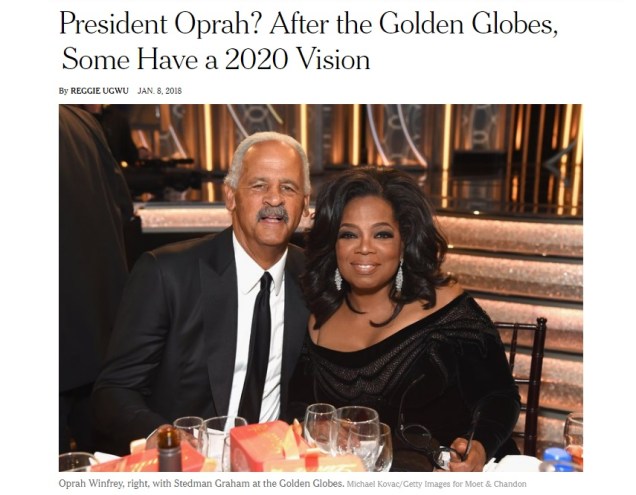
Oprah Winfrey - Golden Globes acceptance speech - MeToo - President Oprah

When unelected technocrats increasingly set policy and carry out the day-to-day business of governance we should not be surprised that electoral politics, castrated and less consequential than ever before, is becoming a circus freak show

Michael Brendan Dougherty has a new piece in the National Review which so succinctly captures the state of Western democratic politics that busy as I am this week, I feel the immediate need to blog a response/reaction to it.

Dougherty’s jumping off point is the sudden, feverish interest among assorted leftists and Democrats for television personality Oprah Winfrey (yes…) to run for president against Donald Trump in 2020, driven almost entirely by a speech Winfrey gave about the #MeToo movement while picking up an award at last night’s Golden Globes.

You might think it a little hypocritical for people who have spent the past two years bashing Donald Trump as an inexperienced dilettante in way over his head, a reality TV blowhard with no credentials and no right to occupy the office he holds, to immediately embrace a similar figure from their own side of the political divide – and you would be correct in thinking so. But the mere fact that voters are being drawn to these celebrity candidates is itself noteworthy, and crucially, Dougherty places the blame not with the voters but with the bland, interchangeable technocrats of the political class who offer those voters no compelling alternative.

Dougherty writes:

The average voter is going to be blamed for this. The great disdain of the educated class will fall on the Uhmurkans who have been hypnotized by their televisions. Maybe some of that’s right. But I blame the wonks. It was the wonks who, unawares, made the celebrity president not just desirable but logically necessary.

The wonk’s role is well-fitted to the centrist political ideal in the post–Cold War West. For them, government is most highly admirable when it is totally denuded of questions of value or morality (these having obvious and uncontroversial answers), and reduced to a purely technical exercise. The politician working with the wonk finds that his job is reconciling the public with what’s good for them. And this fits the machinery of the executive branch, which is filled with hundreds of thousands of civil servants, overseen by a much smaller retinue of political appointees almost all chosen from within the governing class of the country. Where this model of government is most advanced — in Europe — policy questions are routinely taken away from the passions of democratic peoples, and quarantined for expert management.

Taken together, these trends are more or less the abolition of traditional democratic politics. And so there is little use for the traditional politician, a person of judgment and charisma who represents the community from which he or she emerges, using his own wisdom in reconciling the diverse interests and needs of his nation and constituency.

You couldn’t write a better paragraph describing the impact of Westminster centrism and EU integration on our democracy, even though Dougherty is talking in his essay about American politics as much as European. On both sides of the Atlantic, political leaders have behaved as though we are living in the End of History even when Francis Fukuyama’s prediction has long since been disproven through bitter experience. Elections, while often bitter and hard fought, have generally offered little meaningful choice when it comes to big questions about how the nation can best order society and relate to the world. Even when political rhetoric has been heated and the candidates have seemed very different, the economic system and world order they ultimately support has tended to be the same, an embrace of the status quo.

Michael Lind also wrote at length in 2017 about the severing of the compact between the ruling class and the governed, with those in the political, professional and creative classes increasingly feeling no bond of kinship with or obligation to others in society, those they look down upon for holding “incorrect” or “oppressive views” (which can often be taken to mean “that which was mainstream twenty years ago”. And many politicians, nearly all drawn from this class (or inducted into it soon after election) do indeed spend their time explaining and defending the status quo to the citizens they nominally represent, rather than striving to change the status quo on their behalf.

I noted the same phenomenon only last month, in the context of Brexit:

Look at the big issues facing the West and the world in general in 2017 – global migration flows, Islamist terror, globalisation, outsourcing, automation and more – and there is not one of these complex problems which we as a country have failed to comprehensively sweep under the rug or otherwise avoid meeting the challenge.

Even on those occasions when the people have recognised burning problems and the need for bold new solutions, public opinion (such as on Brexit and immigration) has been repeatedly slapped down over the years by a cohort of politicians who think it is their job to explain and defend the current status quo to the citizenry rather than change the status quo according to the demands of the citizenry.

As I have also written, this managerialist technocratic approach to government, with the wonks in the driving seat and politicians as mere interlocutors to the public can potentially be justifiable when things are in steady-state, when times are good, society and the economy stable and when no large threats loom on the horizon. However, rather than a benevolent steady-state we instead live in interesting times, with numerous opportunities and threats ranged around us. This is the discontinuity about which I have been writing so much of late.

In such periods of discontinuity politicians must not remain in the back seat, because it then falls to unelected civil servants and powerful economic agents to dictate the nature and scope of change on their own terms and to their own advantage. For two decades now, globalisation, automation, outsourcing and immigration have changed the structure of our economies and the very meaning of work, and yet there has been no meaningful political debate about these topics until public dissatisfaction reached such a level that the debate could no longer be suppressed.

Nowhere has the debate been suppressed more effectively than on the subject of immigration, and nobody has done more to suppress that debate (thus pushing it toward the unpleasant fringes) than the Labour Party. On immigration, Labour and left-wing politicians very much see themselves as interlocutors rather than elected representatives. When people (including many of their own constituents) raise concerns about the dramatic levels of net migration since 2004, left-wing politicians and commentators see it as their job to explain why unprecedentedly high immigration is actually a good thing rather than seriously engage with voter concerns and amend policy based on that feedback.

When politicians refuse to take voters at their word and assume that their qualms about immigration are really about something else, this is not only patronising but ultimately counterproductive. One of Labour’s favourite fallbacks when it comes to immigration concerns is to pivot to worker exploitation. They think that by instituting new laws to crack down on hiring workers for less than minimum wage (as though it were not already illegal) the public will be placated because foreign workers will no longer be able to undercut local labour. Another favoured technique is to talk about infrastructure, a glib pseudo-concession to the reality that roads do not automatically widen nor hospitals acquire additional beds with every new migrant who lands at Heathrow. Of course, if they really cared about matching infrastructure to population increases caused by immigration they would have done so when they had the opportunity, so this is yet another evasion.

And even now that this tactic of ignoring voter sentiment and patronisingly explaining to voters why they are wrong to be concerned about mass immigration has spectacularly blown up in their faces, still the key voices of the Left can imagine no other way of functioning. Accepting that voters may have a point and amending their policies to reflect the democratic mood doesn’t occur to them. Instead we just see more earnest think pieces about how voters need to be better taught the benefits of immigration.

But immigration is only the most prominent policy area where we see this behaviour from politicians. The same haughty dismissal of public opinion occurs in nearly every sphere. As another example, both Labour and the Conservatives have long since coalesced around what is basically a social democratic economic worldview where profits were tolerated (though rarely celebrated) because the resulting taxes on those profits fund the massive, omnipresent public sector. This locked old-school socialists and more free-market conservatives out of the conversation until Ed Miliband’s failure to win the 2015 election saw Jeremy Corbyn bust open the consensus on the Left and take Labour in a more ideological direction. Theresa May still stubbornly refuses to come to an accommodation of her own with the libertarian right of her party, and this obstinacy and unwillingness to allow alternative views to influence policy is one of many reasons why the Conservative government is idling in neutral, doing nothing of value for the country and waiting for somebody to put it out of its misery.

So given the fact that our politicians (at least the ones who get ahead) tend to be dismal functionaries rather than inspired leaders with disruptive new ideas to meet the period of discontinuity in which we find ourselves, it is perhaps less surprising that many voters gravitate toward someone, anyone with charisma and a willingness to do something more than patiently explain to voters why all of the things they dislike are actually really good for them.

Dougherty writes:

Having eliminated the need for real probity in politicians, why shouldn’t the parties turn to celebrities as their political leaders? The celebrity will do the job of winning elections and riling up the public, but the machinery of government will go on, almost undisturbed.

This may be cathartic for some voters, but it has not taken long for the establishment blob to get the measure of most populist uprisings and swiftly tame them in all but rhetoric. In France for example, Emmanuel Macron discovered that by jumping around on stage and shouting a lot he could amass huge numbers of disillusioned voters and easily see off the threat from Marie Le Pen’s Front National, even though Macron is himself little more than a young face and a neat hairdo atop the same policies which so irritate the public and have increasingly proven inadequate to our present challenges.

And so it is too in America. Dougherty writes:

We can see how the permanent class of Republicans in government almost immediately tamed the Trump presidency. Instead of the populist presidency Trump promised, Trump is ushering in much of the pre-existing “moderate” Republican agenda of corporate tax cuts and economic deregulation. The political class and the media allied to it were able to expunge most of the populist figures from the administration. Soon, they might even succeed in expunging Trump, too.

We are thus heading toward a place where the theatre of democracy is almost entirely divorced from the process of governing. The connection between national elections and meaningful policy reform is becoming about as tenuous as the link between scripted reality TV and actual reality – in other words, almost nonexistent.

In this increasingly dystopian world, all our favourite celebrities can duke it out to become nominal presidents or prime ministers while the technocratic wonks pay no heed to the sideshow and quietly continue to go about implementing their preferred policies relatively unmolested.

But the blob may no more have the national interest at heart than the populist celebrity politician. Both are prone to self-interest, and while the celebrity politician’s interest likely lies in self-aggrandisement, the blob has often proven itself to be more interested in perpetuating policies which benefit its constituent classes in the short to medium term than strategically positioning the nation(s) they effectively govern to face the challenges and reap the rewards of the future.

And the blob is especially dangerous right now, having been moved to anger by unprecedented popular rejection in 2016. The disruptors may have thought that they could summon a good rage or indulge in a lavish pity party when they wanted, but their antics have proven to be nothing compared to the centrist persecution complex the displaced establishment has conjured up in response.

Neither side does their country any favours. The populists – whose figureheads are Donald Trump in America and the Hard Brexit Ultras in Britain – have by now proven their unseriousness and detachment from reality, but the blob still seems to be of the opinion that things can go back to the way they were once what they see as these temporary aberrations are over and the populist rebellions put down.

Patrick Deneen put it best in the Spectator this week, remarking that we now have “a liberal elite without a populace, and a populace without a moderating elite.” And so we are left to pick our poison – on the one hand an arrogant technocratic class which even now shows no humility or willingness to change its ways, and on the other a succession of telegenic performers who are great at channelling public anger but totally lacking the knowledge or leadership ability to turn anger into smart policy.

Not an enviable choice.

donald-trump-anxiety-therapy

Support Semi-Partisan Politics with a one-time or recurring donation:

Agree with this article? Violently disagree? Scroll down to leave a comment.

Follow Semi-Partisan Politics on TwitterFacebook and Medium.

The Story Of Hamilton Is Also The Story Of Brexit

Hamilton musical - London - Brexit

What do the latest imported smash hit musical from America and Britain’s historic vote for Brexit have in common? The answer, it turns out, is nearly everything.

It has been frequently remarked, that it seems to have been reserved to the people of this country, by their conduct and example, to decide the important question, whether societies of men are really capable or not, of establishing good government from reflection and choice, or whether they are forever destined to depend, for their political constitutions, on accident and force
—  Federalist No. 1, Alexander Hamilton

Yesterday evening I succumbed to the hype and went to see the London production of Lin-Manuel Miranda’s hit musical Hamilton, newly opened at the Victoria Palace Theatre.

Hamilton tells the story of Alexander Hamilton, American statesman and Founding Father, most famous for having been a delegate at the constitutional convention of 1786, writing many of the Federalist Papers, moulding the new country’s financial system as Treasury Secretary during George Washington’s presidency and having been killed in a dual by political rival Aaron Burr. Through his words and intellect, Hamilton made an enormous contribution to the birth of America, yet his untimely death robbed him of as prominent a place in history as his legacy deserved.

At first glance this might not seem the most promising material for a musical show, but theatre aficionados have been buzzing about Hamilton since it premiered in New York to rave reviews back in 2015. Such has been the show’s rapturous reception that it is fairly hard to find a negative review, let alone a ticket, especially in New York where tickets for the Broadway production have traded hands on the secondary market for insane sums of money.

Being something of a contrarian, I arrived at the theatre in sceptical mood, perhaps too eager to find fault with something that was being universally praised by everyone else. I was sceptical that the rap and hip-hop musical styles which predominate would be a good fit with the narrative material, and worried that the much-discussed “colour-conscious casting” might be little more than a convenient excuse to shoehorn an identity politics lecture into what should be an evening of entertainment.

As it turned out, my scepticism was blown away and any worries about ideological virtue signalling were (mostly) unfounded. Hamilton is an excellent show, the musical genres and clever allusions to other composers from Gilbert & Sullivan to The Notorious B.I.G. draw you in to the story rather than distracting from it, and the source material (Lin-Manuel Miranda based his show on the 2004 biography of Alexander Hamilton written by Ron Chernow) is catnip for history and constitutional geeks like me.

But as I watched the first act build to a climax – after Alexander Hamilton has arrived in New York, become involved in the revolutionary movement, served as General George Washington’s aide-de-camp, fought at Yorktown, studied law in New York after independence was won and ultimately chosen to be that state’s junior delegate to the constitutional convention in Philadelphia, which laid the foundations for the United States of America as we know it today – something else occurred to me.

It provoked groans and assorted expressions of incredulity from my wife and our friend when I confessed my epiphany during the interval, but as the show progressed I realised that the story of Hamilton – of people forging a new and uncertain path through a world in flux – is also the story of Brexit. Bear with me, and I shall explain why.

After they won the War of Independence, Americans didn’t know exactly what they were creating or the experiment they were embarking on. They knew that remote and authoritarian rule from an overseas power was intolerable and injurious to their right to freedom and self-determination, but having thrown off the shackles of monarchy there was no set template for them to follow, no clear-cut alternative to which they should naturally gravitate.

Much of the detail as to how freedom from empire would actually work in practice had to be hashed out in contentious discussions, first formalised in the 1777 Articles of Confederation between the thirteen original states and later in the 1787 Constitutional Convention. This was a time of uncertainty, but it was also an exciting time ripe with promise. Then, as now, there was a new world to build.

Today, we face similarly profound questions about how humanity should best govern itself in changing times, as the epoch of the nation state finds itself threatened and undermined by powerful forces such as globalisation, automation, mass migration and the need to balance smart regulation of international trade in all its technical complexity with the need to preserve democracy and the ability of ordinary people to defend their local priorities and concerns in the face of corporate technocracy.

The existing political order has never looked less equipped to deal with these challenges, or been so discredited and seemingly unequal to the serious task at hand. In Britain, the political class have forged ahead with a centrist, corporatist vision regardless of which political party was in power for the past three decades, an incredibly narrow Overton Window effectively shutting out a huge range of reasonable, non-extremist political ideas from the national political debate. And in the United States, politicians of both parties peddled the illusion that the post-war manufacturing economy could be resurrected together with the promise of a comfortable middle-class lifestyle sustained by semi-skilled manual labour requiring limited education.

In both cases the people themselves were partially to blame for falling for false promises and in some cases practically demanding to be lied to by pandering politicians, but regardless of ultimate fault it has increasingly dawned on people that national and international institutions as presently configured have not met the challenge of our times and can not keep pace with a world increasingly knitted together by technology.

The European Union, held up by its naive supporters as the unquestionably superior way for nations to peacefully cooperate (despite not being replicated on any other continent), has conspicuously failed to effectively tackle nearly all of the big challenges thrown its way, from the migration crisis to the pitfalls of monetary union to rampant corruption in some member states and growing authoritarianism in others. And through all this, despite Herculean efforts and vast sums of money spent with the aim of forging a cohesive European demos – a body of people who hold their European identity in equal or greater worth than their national identity – no such demos has formed.

The EU’s “if you build it, they will come” strategy, creating all of the institutions required for a supranational political state in the expectation that a demos would magically follow along to grant them legitimacy, has failed. Outside Britain, where misguided and low-information young idealists sing Kumbaya and paint the EU flag on their faces, euroscepticism among young people is increasing as more people recognise that the institutions of Brussels present a beguiling but erroneous vision of the future. To all these challenges and more the European Union has nothing to offer save more political integration for the sake of political integration. The EU has no answer, just as remote and exploitative monarchy failed to redress the legitimate grievances of the American colonists.

A recent article by Bradley Birzer in The American Conservative about the limited lifespan of any system or institution of government certainly applies to the European Union and other pillars of the post-war world order as much as it does to the nation state:

One must remember that no republicans believe their republic can last forever. A republic, by its very essence, must rely on its organic nature, a living thing that is born, flourishes, decays, and dies. It is, by nature, trapped in the cycles of life, bounded by the walls of time. While a cosmic republic might exist—as understood by Cicero’s “Cosmopolis” and Augustine’s “City of God”—it existed in eternity and, therefore, aloof of time.

For better or worse, the Roman Republic reflected not just nature, but the Edenic fall of nature as well. We can, the Roman republican Livy recorded, “trace the process of our moral decline, to watch, first, the sinking of the foundations of morality as the old teaching was allowed to lapse, then the rapidly increasing disintegration, then the final collapse of the whole edifice.” The virtues of the commonwealth—the duties of labor, fate, and piety—gave way to the avaricious desires for private wealth. When young, the Romans rejoiced in the little they had, knowing that their liberty from the Etruscans meant more than all the wealth of the material world. “Poverty, with us, went hand in hand with contentment.” As the republic evolved and wealth became the focus of the community, not sacrifice, so the soul decayed. “Of late years,” Livy continued, “wealth has made us greedy, and self-indulgence has brought us, through every form of sensual excess, to be, if I may so put it, in love with death both individual and collective.”

Who can deny that some aspects of our present society – our materialism, individualism and instinctive fear of anything that might (no matter its virtue or long-term benefits) temporarily disrupt the steady accumulation of wealth, assets and positive experiences which we increasingly expect and demand – are worryingly reflected in Livy’s words?

To paraphrase Birzer, all things must come to an end. The Britain of today is not the Britain of thirty years ago, just as the dogmas of Ronald Reagan’s “Morning in America” no longer automatically apply to the American present. We have witnessed tremendous progress in that time, but also political and social atrophy. We are not what we once were, and neither should we cling on in futility to what is past. Many Remainers, having fixed in their minds the false image of Brexiteers as Mafeking stereotypes – curmudgeonly old retired colonels pining for lost empire – fail to realise that through their devotion to the European Union it is they who yearn to preserve the past, slavishly devoted to an anachronistic mid-century blueprint for a new world order, one which came to partial fruition, peaked and then found itself wholly inadequate to the stormy present.

Brexit is not a magical elixir sufficient to address the stormy present or dissipate the challenges we face, but it is a necessary first step to confronting them, just as Alexander Hamilton and the other Founding Fathers could not fully contemplate and realise their revolutionary new system of government until they had first thrown off the shackles of monarchy. Looking at Brexit as a narrow and obstinate project to reclaim full sovereignty or purely as a technocratic matter of trade regulations is to miss the point – we are seeking not to go back but forward, and Brexit is a necessary (though not a sufficient) condition to enable this progress.

It pains me to read much of the coverage and commentary around Brexit, which overwhelmingly ignores the big picture and the long term to obsess over speculative short term costs. It is vital to consider short-term costs and risks in any endeavour, but good policymaking is only possible when short-term considerations are balanced with a broader, longer-term perspective. Remainers often react with incredulity to the suggestion that anything might matter beyond next year’s GDP growth rate, but the American colonists of Hamilton’s day were every bit as concerned about their economic prosperity and security as their modern-day British counterparts; they just also realised that other issues were at stake, issues worth enduring the hardship and destruction of a revolutionary war to correct.

We in modern Britain are called to make no sacrifice remotely comparable to that of the inhabitants of the thirteen colonies as they struck out on their own to form a more perfect union. It would be laughable to compare even the worst of mismanaged Brexits to the price that Hamilton’s peers paid for their freedom and for the opportunity to advance the model of human governance. Yet so great is our present culture of consumerism and so diminished our sense of citizenship or civic duty that few of us are capable of thinking in terms greater than the pursuit of whatever might sate our present desire for comfort and stability. And even when this stability is under long-term threat, such is our fear of disruption that we would rather cling on to the slow, familiar degredation than take any risk by seeking to prevent it.

Today we have a tendency to think of ourselves as having transcended our past, that we inhabit what Francis Fukuyama called “The End of History”, a time when all major human challenges have been vanquished and we inhabit some kind of permanent, beneficent steady-state from which any departure would be an intolerable disruption. And from this perspective, Brexit does indeed appear to be a crazy, irrational endeavour, threatening to unleash a backslide into the fascism and totalitarianism with which we struggled in the twentieth century.

But of course we have not reached the end of history. We are continually presented with new challenges and opportunities, and try as we might to pretend that our existing institutions and policies need only tweaking or adjusting to meet them, recent events have proven this to be patently false. Not all Brexiteers may have voted to leave the European Union based on these high ideals but as Shakespeare wrote, “There is a tide in the affairs of men. Which, taken at the flood, leads on to fortune. Omitted, all the voyage of their life is bound in shallows and in miseries.”

Through Brexit, history has gifted us the opportunity to imagine a new and improved form of government, one which strives to meet our future challenges rather than cower from them (all that EU membership offers, most telling in the rhetoric used by Remainers) or pretend that they do not exist (favoured by the more retrograde Brexiteers who envisage a simple rollback to the old nation state). We must seize this opportunity and be a beacon for other nations, all of which must ultimately grapple with the same issues though they may deny or postpone them for a time.

As I recently wrote:

It has been decades since Britain truly took the lead in influencing world affairs. But having voted for Brexit and thrown into the open many pressing debates which other countries remain desperate to defer or ignore, we can now be both a laboratory and a beacon for the world.

Rather than feeling rancour or relitigating the 2016 referendum result, we should feel the same sense of excitement and possibility that Alexander Hamilton and his co-revolutionaries felt as they debated among themselves how to keep the new republic that they had created. We must rediscover that spark within ourselves.

Perhaps it is no coincidence that a stirring tale about forging a new, more democratic future, a story kindled in America, is set to take Britain by storm as we negotiate our secession from the European Union and look questioningly but optimistically towards the future. Perhaps it is no coincidence that the spirit of Alexander Hamilton is flickering back to life on a London stage at this specific time and place.

Because when you strip away the political games and the media sideshow, the catastrophisation, recriminations, denunciations, speculations and bifurcations, the story of Hamilton may just also be the story of Brexit – if we have the courage and vision to make it so.


Hamilton tickets and information here.


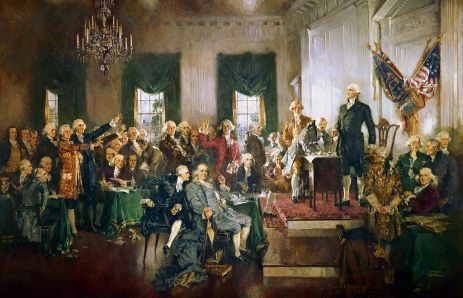
Scene at the signing of the Constitution of the United States - Howard Chandler Christy - Hamilton musical - Brexit

Support Semi-Partisan Politics with a one-time or recurring donation:

Agree with this article? Violently disagree? Scroll down to leave a comment.

Follow Semi-Partisan Politics on TwitterFacebook and Medium.

The Age Of Perpetual Crisis

The Age of Anxiety - Ballet

When every single issue is falsely portrayed as a burning crisis, none of our national challenges will receive the considered attention they deserve

“We would rather be ruined than changed
We would rather die in our dread
Than climb the cross of the moment
And let our illusions die.” 
― W. H. Auden. The Age of Anxiety: A Baroque Eclogue

The housing crisis. The migrant crisis. The productivity crisis. The deficit crisis. The tedious, annual NHS winter crisis. Brexit. Nearly every important issue or event in our politics is portrayed as a pressing, existential crisis, despite few of them even remotely living up to the definition. If you are sceptical, just ask somebody who was alive and situationally aware in 1940 whether any of the issues which excite politicians and newspaper editors today amount to a real crisis, and see what they have to tell you.

And as it is in Britain, so it is across the Atlantic in America. Surveying the present scene, David French writes in the National Review:

In politics, when everything’s a crisis, it turns out that EVERYTHING’S A CRISIS!

We keep reading that Donald Trump is a unique danger to American democracy, a threat we should put aside partisan tribalism to defeat. Then, seconds later, we read that giving Americans the choice to buy health insurance will kill people by the thousands. Seconds after that, we learn that an entirely conventional Republican tax plan will not only kill people but also extinguish American democracy as we know it. Finally, we read that the end of net neutrality — a regulatory doctrine that only the smallest percentage of Americans even remotely understand — will extinguish American liberty.

[..] For the average American, who pays less attention to politics than to his professional and personal lives, all of this is exhausting. It’s numbing to the point where he can’t possibly determine what’s important and what’s not. So he checks out. He throws his hands in the air and gives up. But for the Americans who care the most about politics and drive our public debate, perpetual crisis is invigorating. It provides meaning and purpose.

A nation’s political culture is always defined by the people who care the most, and the people who care the most in our nation have lost all sense of proportion.

Charles Cooke makes a similar point, but at the more personal level, in the same publication:

Ours is a moment in which millions rush breathlessly to exclaim. In defense! In resistance! In bloody-minded persistence! “I will not back down!” we are told, by people who have not been asked to, and could not be compelled to. They won’t be “intimidated” either, nor “silenced,” nor “bullied” nor, it seems, pushed to any form of self-reflection. Indignation, not analysis, is the perennial order of the day, and the tone of our debates is ineluctably Twitteresque. Retweets are points on the board, and hyperbole gets you oodles of them. The worst. Ding! Insane. Ding! Crisis. Ding, ding, ding! Congratulations, you have been promoted to the next level.

I don’t think I have ever read a more perceptive or honest summary of how political Twitter works, and as a denizen of this world I see more than a few of these negative traits in my own work, some due to personal failures but more often because the difficult pathway to being heard and gaining an audience on social media incentivises some pretty negative behaviours.

It is in the nature of those involved in politics – either doing or writing about it – to imbue their work and their passions with an air of existential importance. In many ways, this is understandable – it is hard to get a hearing in the media, or from the People Who Matter, with a piece of sober, rational analysis addressing a long-running issue; harder still when the competition presents every new report or white paper as some kind of magical elixir to the nation’s woes.

Given the choice, most people want to be Neil Armstrong and not the dedicated but overlooked engineers and project managers who made the Apollo Program a reality. Or if politics is showbusiness for ugly people then most players want to walk the red carpet and be photographed, not lurk in obscurity editing screenplays or building sets. This is human nature, but it has the unfortunate side effect of warping our political process, bending it towards flashy but superficial quick fixes and wonder cures rather than holistic analysis and serious reform.

The word “crisis” in particular is used far too readily at present, by people who should know better. The nature of politics and public policy means that nearly every important decision will ultimately have some direct or indirect impact which can be measured in terms of human lives, thus making it existentially important to at least a few people. In fact, the Left in particular rely on this very phenomenon, since their conspicuous compassion policies front-load the emotional benefits of throwing resources at a problem while deferring or even denying the costs – after all, it is easy to win applause and positive headlines by opposing welfare or healthcare reform, but much harder to counsel delayed gratification or highlight the cumulative toll of welfare dependency on the quality and duration of human life.

But in actual fact there are very few actual full-blown crises facing us at the present time, despite the best efforts of opportunistic politicians and the media to suggest otherwise. Rather, there are a series of slow-burning, serious and often intractable problems which need to be tackled, few of which are likely to lead to sudden national ruin but many of which – if left unattended much longer – have the potential to chip away incessantly at our economic prosperity, national security, democratic health or the stability and cohesion of our society.

The appalling failure of successive governments to adopt a sensible housing policy and increase the housing stock will not lead to an explosion in homelessness or destitution overnight, but it will lead to a continuing sense of rage, disillusionment and alienation among younger voters, as it is already doing. Continuing to stand by an immigration system which proudly fails to make skills or likelihood of assimilation and popular consent the key drivers will not lead to riots in the street tomorrow, but it will continue to drive a wedge between the political class and much of the country. Continuing to enshrine the NHS as our national religion and abide by the strict political doctrine of NHS non tangere will not create an immediate spike in death rates, but it will ensure that UK health outcomes continue to further lag behind those countries with the best healthcare systems.

Labelling something a “crisis” suggests imminent peril requiring immediate remedy, even if the resulting damage control ultimately creates other problems or only succeeds in kicking the can down the road. It advocates for quick fixes, which is exactly what we don’t want at this time. In this period of discontinuity, where the old political settlement has broken down and traditional, familiar policy prescriptions neither work effectively nor command sufficient public confidence, what we need are carefully thought-out and mutually supporting policies rooted in an uncompromising, forensic analysis of the precise problems we face. What we absolutely do not need are a bunch of panicked gimmicks and pseudo-policies cooked up in silos by desperate politicians and leaders whose sole objective is to survive the day and avoid negative headlines.

The difficult truth is this: there is no one pressing crisis the resolution of which will solve all our problems and keep us safe and prosperous in a changing world, and there is no universal and comprehensive solution to any of the problems we deem to be crises. Housing cannot be addressed without revising planning rules, but it is also impossible to adequately plan future housing and infrastructure when there is no meaningful control over mass immigration. Low productivity cannot be addressed without looking at corporate governance, secondary and tertiary education, workers’ rights, union power and addressing the weak commitment to R&D. Indeed across the board there is no silver bullet, no quick fix, no political party with all the right answers, no system of government ideally equipped for the challenge. We must forge a new path.

Far from focusing attention and driving positive change, labelling everything a crisis merely creates apathy, causes many voters to check out and encourages many politicians to either view problems in a highly compartmentalised way or else simply consider them insurmountable, facts of life to be dealt with rather than challenges to be overcome – just as many in the British establishment seemed resigned to irreversible national decline in the 1970s, before Thatcherism finally equipped Britain with the tools to dig ourselves out from the last major period of discontinuity this country faced.

Britain emerged stronger from the late 1970s and 80s because after years of paralysing indecision and timid half-measures from Tory and Labour governments alike we finally made a calm, methodical and dispassionate analysis of the problems holding us back – excessive union power, flawed monetary policy, excessive state involvement in the economy – and set about tackling each of these issues in a coordinated way, as part of a comprehensive national turnaround strategy.

We need to adopt just such a process again today in order to overcome this new period of discontinuity and the specific challenges that it brings. And the first step is to stop viewing every last issue as a standalone, burning crisis.


Munch - The Scream

Support Semi-Partisan Politics with a one-time or recurring donation:

Agree with this article? Violently disagree? Scroll down to leave a comment.

Follow Semi-Partisan Politics on TwitterFacebook and Medium.


Will All Those In Favour Of Open Borders Please Stand Up?

No Borders No Nations Stop Deportations protest banner

Will the Left’s unspoken, newly-extremist position on immigration and open borders be their political undoing?

Using Brexit and Trump as a smokescreen, many leftists have quietly moved towards a de facto “open borders” position on immigration without ever actually uttering the words or having the courage to declare their intentions in public.

Whether it is members of the anti-Trump “resistance” in America or bitter defenders of the European Union in Britain, opposition to what they see as an ongoing regressive right-wing coup is prompting many on the Left to adopt an uncompromising, extremely permissive stance on immigration which previously existed only on the libertarian fringes and which many leftists themselves once opposed.

This extremist new position is red meat for many left-wing activists, particularly certain elements of the Hispanic voting bloc whom Democrats need to fire up and turn out on election days (as well as for self-proclaimed “citizens of the world” living in newly-fascist Britain). But is the Left’s closed information loop of outrage causing them to diverge from popular opinion at a time when conservatism is otherwise discredited and electoral gains are there for the taking? By tying themselves so closely and unapologetically to people who came to and live in the country illegally, have left-wing parties put themselves on a collision course with the electorate?

Vox’s Dara Lind chronicles the strange journey on which the Democrats have embarked:

The thing is, about 10 years ago, many Democrats — including, notably, Schumer — would have championed many of the Trump administration’s enforcement proposals, from increased local cooperation with immigration enforcement to a physical barrier on the US/Mexico border, even if they weren’t part of a deal to legalize unauthorized immigrants. And they’d certainly accept them, happily, alongside legalization.

Absolutely. Applying the Left’s contemporary standards, only a decade ago the likes of Chuck Schumer and Nancy Pelosi were supporters of an oppressive, white nationalist agenda – as, in fact, was Hillary Clinton, who once voted to strengthen and expand border fencing between the US and Mexico. This is how far the Left has come on the subject of immigration, in a very short space of time.

More:

But it’s certainly true that Democrats in 2017, in general, tend to criticize the use of immigration enforcement, and tend to side with those accused of violating immigration law, as a broad matter of principle beyond opposing the particular actions of the administration.

This goes beyond simply representing members of their own communities (and potential electoral constituencies). The activist defense of immigrants caught crossing the border, especially the Central American children and families that now make up a large share of people entering the US without papers, has led Democrats to take a much firmer stance in defending them as humanitarian victims who deserve the chance to seek and receive asylum in the US.

In fact, you would be hard pressed to get a Democratic politician to name a single category of illegal immigrant whom they do not consider worthy of amnesty and eventual citizenship. Accusations of racism and oppression come easily to them, yet they are suddenly struck dumb when asked what kind of border security or immigration enforcement measures they would actually support.

And sometimes this leads the Democrats to new heights of extremism:

More broadly, Democrats are no longer as willing to attack “illegal immigration” as a fundamental problem anymore.

That rhetoric, too, came in part from DREAMers, who didn’t like being talked about as victims of their parents’ crimes who came to the US “through no fault of their own.” Instead they’ve portrayed their parents as “the original DREAMers” — a line that Nancy Pelosi followed in September when she said that DACA recipients’ parents “did a great thing” in bringing their children to the US.

Violating US immigration law is now “a great thing”, in the words of the Democratic Party Minority Leader. It is one thing to turn a blind eye to the abuse of the rule of law, as many on the Left have done for some time regarding immigration. But it is quite another thing altogether to praise that lawbreaking and hold it up as a paragon of civic virtue. This position totally undermines any remaining protestations that the Left are interested in any kind of immigration enforcement, and shows that their idea of “immigration reform” basically means unconditional amnesty with not even a token gesture for conservatives.

Lind’s article is worth reading in full, since she delves into some of the structural reasons why immigration activist voices now carry so much more weight within the Democratic Party, particularly the trade union shift from opposing illegal immigration to protect their dwindling memberships to supporting illegal immigration to boost their enrolment. But whatever the cause, the degree to which Democrats have lurched to the Left on immigration is alarming, and of concern to anybody who would like to see comprehensive reform in which amnesty is given only in exchange for a serious boost to future enforcement.

Andrew Sullivan thinks that the Left are marching off a cliff with their newfound extremism on immigration, and says as much in his weekly column for New York Magazine:

This is, to be blunt, political suicide. The Democrats’ current position seems to be that the Dreamer parents who broke the law are near heroes, indistinguishable from the children they brought with them; and their rhetoric is very hard to distinguish, certainly for most swing voters, from a belief in open borders. In fact, the Democrats increasingly seem to suggest that any kind of distinction between citizens and noncitizens is somehow racist. You could see this at the last convention, when an entire evening was dedicated to Latinos, illegal and legal, as if the rule of law were largely irrelevant. Hence the euphemism “undocumented” rather than “illegal.” So the stage was built, lit, and set for Trump.

He still tragically owns that stage. What Merkel did for the AfD, the Democrats are in danger of doing for the Trump wing of the GOP. The most powerful thing Trump said in the campaign, I’d argue, was: “If you don’t have borders, you don’t have a country.” And the Democrats had no answer, something that millions of Americans immediately saw. They still formally favor enforcement of immigration laws, but rhetorically, they keep signaling the opposite.

I was also astounded when the Democrats chose to devote a large section of their 2016 party convention to sharing their stage with confessed and unrepentant illegal immigrants. Though I cannot claim to have predicted Donald Trump’s election victory, in hindsight it is clear that moments like this just killed whatever enthusiasm existed for Hillary Clinton in the key swing states which she went on to narrowly lose.

When you refuse to condemn any form of illegal immigration, make the concerns of illegal immigrants one of your main priorities (often over and above born and naturalised citizens) and actively praise their lawbreaking, you have adopted an open borders position. You just don’t possess the courage to come out and say so, for fear of the political consequences. Apparently the Democrats are quite happy to ignore the concerns of Middle America, but are not yet quite ready to publicly give them the middle finger.

It is not unreasonable for people to ask politicians and political parties who embrace illegal immigration exactly what (if any) immigration controls they would actually accept. In fact, the only reason that Democrats are not routinely put on the spot and shamed into answering this question is because a spineless, complicit Washington DC media tacitly agrees with the new extremist position (or at least is too scared of being called “racist” by social justice activists to do their job).

To be clear: the idea of deporting all (or even most) people currently living illegally in the United States is unworkable as it is cruel – many people in this position did what anyone else would have done, given their situations and the immense pull factors of demand for labour and sporadic enforcement. Moreover, many illegal immigrants have lived most of their lives in America and are effectively Americans in pectore. Many are probably model citizens. Some would likely become the best of America.

But if the rule of law means anything at all, violating US immigration law while others endured stress, incurred expense and lost time following the legal process cannot be rewarded unconditionally. Illegal immigrants should be lifted out of the shadows and freed from a fearful half-life which does nobody any good, but only after following a similar process to legal immigrants. And there must be proper border enforcement in return, so we do not end up back in the same situation in two decade’s time. Immediately upon amnesty being granted to otherwise law-abiding illegal immigrants, the Left must give up their defence of sanctuary cities which make a mockery of the law. Donald Trump’s wall is overly expensive, impractical and largely pointless, but existing fencing should be fortified and new technologies deployed to stop illegal crossings. In other words, there must be a meaningful quid pro quo.

Neither side in American politics has acquitted itself very honourably when it comes to immigration reform, but at present it is the Left who are rapidly lurching toward a more extremist position, led by their activists on a collision course with a more sceptical public.

And going into the next electoral cycle, all the shrieking about Trump’s “racist” wall will not disguise the fact that the Left have something far more radical in mind.


Immigration Reform

Support Semi-Partisan Politics with a one-time or recurring donation:

Agree with this article? Violently disagree? Scroll down to leave a comment.

Follow Semi-Partisan Politics on TwitterFacebook and Medium.

The Best One Percent

https://www.youtube.com/watch?v=Ps5ttDzWBaY

In his brief remarks to the media, General John Kelly, chief of staff to President Donald Trump, momentarily made everybody else in Washington D.C. look small

Good speeches do not always have to be painstakingly crafted well in advance and written down or beamed onto a teleprompter. Neither do good speeches always require a grand event as their backdrop. Sometimes the most stirring speeches can be extemporaneous, or at least appear relatively spontaneous when delivered.

And into this latter category fall the remarks made yesterday by former Marine Corps general John Kelly, chief of staff to President Donald Trump. Kelly was seeking to defend his boss from accusations that the president had been dismissive bordering on callous when making a telephone call of commiserations to the wife of a fallen US soldier killed in an ambush in Niger, a call which was overheard by a Democratic congresswoman and reported to the media.

I make no comment about the individual circumstances of the case here, though many other media organisations have seen fit to voyeuristically pick over what should be an intensely private moment in order to extract political advantage from it. For those interested, the two opposing sides are effectively summarised here and here.

Far more inspirational than this tawdry back-and-forth, however, were the words of Chief of Staff John Kelly, who sought to end the unseemly debate by describing to the press corps in detail the process which takes place when a US service member is killed in action overseas. These remarks range from the very detailed and practical (describing exactly what happens to the body and where it is taken) to the profound, and are worth quoting at length.

Kelly begins:

Most Americans don’t know what happens when we lose one of soldiers, sailors, airmen, Marines, our Coast Guardsmen in combat. So let me tell you what happens:

Their buddies wrap them up in whatever passes as a shroud, puts them on a helicopter as a routine, and sends them home. Their first stop along the way is when they’re packed in ice, typically at the airhead. And then they’re flown to, usually, Europe where they’re then packed in ice again and flown to Dover Air Force Base, where Dover takes care of the remains, embalms them, meticulously dresses them in their uniform with the medals that they’ve earned, the emblems of their service, and then puts them on another airplane linked up with a casualty officer escort that takes them home.

A very, very good movie to watch, if you haven’t ever seen it, is “Taking Chance,” where this is done in a movie — HBO setting. Chance Phelps was killed under my command right next to me, and it’s worth seeing that if you’ve never seen it.

So that’s the process. While that’s happening, a casualty officer typically goes to the home very early in the morning and waits for the first lights to come on. And then he knocks on the door; typically a mom and dad will answer, a wife. And if there is a wife, this is happening in two different places; if the parents are divorced, three different places. And the casualty officer proceeds to break the heart of a family member and stays with that family until — well, for a long, long time, even after the internment. So that’s what happens.

This is made all the more poignant by the fact that John Kelly suffered the loss of his son – First Lieutenant Robert Kelly – in Afghanistan, and presumably experienced this same heart wrenching process, something invisible to most civilians in the age of an all-volunteer professional army.

The brief core of Kelly’s remarks then focus on the fine qualities of the men and women who serve in the US military, before defending the actions of his boss. First, the praise:

Who are these young men and women? They are the best 1 percent this country produces. Most of you, as Americans, don’t know them. Many of you don’t know anyone who knows any one of them. But they are the very best this country produces, and they volunteer to protect our country when there’s nothing in our country anymore that seems to suggest that selfless service to the nation is not only appropriate, but required. But that’s all right.

Goodness me, that’s powerful. Remember, this is a former Marine Corps general and the serving chief of staff to President Trump, and he is saying that the state of the country is such that America is no longer worthy of the sacrifice made by its men and women in uniform. Think on that for a moment.

And then comes the necessary defence of President Trump, in which Kelly references his own painful loss:

So he called four people the other day and expressed his condolences in the best way that he could. And he said to me, what do I say? I said to him, sir, there’s nothing you can do to lighten the burden on these families.

Well, let me tell you what I told him. Let me tell you what my best friend, Joe Dunford, told me — because he was my casualty officer. He said, Kel, he was doing exactly what he wanted to do when he was killed. He knew what he was getting into by joining that 1 percent. He knew what the possibilities were because we’re at war. And when he died, in the four cases we’re talking about, Niger, and my son’s case in Afghanistan — when he died, he was surrounded by the best men on this Earth: his friends.

That’s what the President tried to say to four families the other day. I was stunned when I came to work yesterday morning, and broken-hearted at what I saw a member of Congress doing. A member of Congress who listened in on a phone call from the President of the United States to a young wife, and in his way tried to express that opinion — that he’s a brave man, a fallen hero, he knew what he was getting himself into because he enlisted. There’s no reason to enlist; he enlisted. And he was where he wanted to be, exactly where he wanted to be, with exactly the people he wanted to be with when his life was taken.

That was the message. That was the message that was transmitted.

This next section (which reminds one of Cicero’s exclamation O Tempora, O Mores!) is good too, because it is so obviously heartfelt coming from somebody from an older generation raised in a dignity culture:

It stuns me that a member of Congress would have listened in on that conversation. Absolutely stuns me. And I thought at least that was sacred. You know, when I was a kid growing up, a lot of things were sacred in our country. Women were sacred, looked upon with great honor. That’s obviously not the case anymore as we see from recent cases. Life — the dignity of life — is sacred. That’s gone. Religion, that seems to be gone as well.

Gold Star families, I think that left in the convention over the summer. But I just thought — the selfless devotion that brings a man or woman to die on the battlefield, I just thought that that might be sacred.

Kelly ends with this scathing criticism of politicians such as the congresswoman who saw fit to leak details of President Trump’s telephone call to one of the families:

I’ll end with this: In October — April, rather, of 2015, I was still on active duty, and I went to the dedication of the new FBI field office in Miami. And it was dedicated to two men who were killed in a firefight in Miami against drug traffickers in 1986 — a guy by the name of Grogan and Duke. Grogan almost retired, 53 years old; Duke, I think less than a year on the job. Anyways, they got in a gunfight and they were killed. Three other FBI agents were there, were wounded, and now retired. So we go down — Jim Comey gave an absolutely brilliant memorial speech to those fallen men and to all of the men and women of the FBI who serve our country so well, and law enforcement so well.

There were family members there. Some of the children that were there were three or four years old when their dads were killed on that street in Miami-Dade. Three of the men that survived the fight were there, and gave a rendition of how brave those men were and how they gave their lives.

And a congresswoman stood up, and in the long tradition of empty barrels making the most noise, stood up there and all of that and talked about how she was instrumental in getting the funding for that building, and how she took care of her constituents because she got the money, and she just called up President Obama, and on that phone call he gave the money — the $20 million — to build the building. And she sat down, and we were stunned. Stunned that she had done it. Even for someone that is that empty a barrel, we were stunned.

But, you know, none of us went to the press and criticized. None of us stood up and were appalled. We just said, okay, fine.

So I still hope, as you write your stories, and I appeal to America, that let’s not let this maybe last thing that’s held sacred in our society — a young man, young woman going out and giving his or her life for our country — let’s try to somehow keep that sacred. But it eroded a great deal yesterday by the selfish behavior of a member of Congress.

As a speech, this has pretty much everything. It might not have been the most stirring or poetic, but John Kelly is a blunt, military man and to have spoken in the cadence of John F Kennedy or Barack Obama would have been totally false and out of character. The authenticity of Kelly’s remarks derive from the seriousness of the subject, the dignified way in which a story of personal loss was mentioned (compared to the overt emotionalism of many contemporary speakers) and the workmanlike delivery.

What John Kelly did more than anything else was shame the people who had sought to cynically use a story based on the death of American soldiers for their own purposes – be it Democratic politicians looking for more character flaws in Trump, Republican politicians who sought to defend Trump or the media who saw a potentially juicy mini-scandal which would generate pageviews and ad revenue.

He shamed a group of neophytes and cynics, people who by and large did not serve in uniform themselves, but saw fit to pontificate on the protocol governing military rituals as though they were discussing any old arcane political dispute. Kelly effectively contrasts the quiet, selfless duty of American soldiers with the self-aggrandising behaviour of American politicians. And there can be few among the Washington DC political class, who measure their popularity by the number of their Twitter followers and see themselves as the centre of the universe, who did not come out of that press conference feeling at least slightly chastened.

This can also only be good for the career and reputation of John Kelly himself, who has faced scepticism that he would be able to rein in the excesses of the Trump administration and criticism for those occasions when that superhuman feat eluded him. By briefly lamenting that women are no longer honoured in today’s America (putting aside the fact that such 1950s-style honour was a double-edged sword), Kelly not-so-subtly denounced his own boss, whose record of behaviour towards women is not good. Criticising the politicisation of gold star families during the Democratic National Convention served the same purpose. Thus, Kelly successfully burnished his image as a man serving out of duty to his country and respect for the office of president rather than admiration for the individual who currently holds that office.

I struggle to think of a contemporary British political speech of similar power and worth. Does anybody recall any of the speeches given this party conference season, besides the slow-motion self-destruction of Theresa May? Has there been a British political speech in the last decade which made the heart beat a little faster or brought a lump to the throat?This is made even more depressing when one remembers that John Kelly is not even a politician – he is a retired general pressed into service to steady a wobbling first-year Trump administration.

Kelly’s remarks are a fine example of an effective speech, composed and well delivered under difficult circumstances, with a hostile media audience ready to throw hard-to-defend accusations against his equally hard-to-defend boss. Yet by the time he was done, John Kelly walked out of that briefing room ten feet taller while everyone else visibly shrank in moral stature.

That’s impressive. I would like to import just a fraction of that ability to Westminster.


UPDATE: 21 October

This report from the Washington Post suggests that John Kelly’s account of Representative Frederica Wilson’s speech at the newly-opened FBI building was not accurate. This in no way detracts from the power of the speech or even necessarily mean that Gen. Kelly’s righteous indignation was altogether misplaced, but the record should be corrected.


UPDATE: 22 October

Having sat back rather pleased with myself, thinking I might have written something vaguely original, I discovered today that Jonah Goldberg was simultaneously coming to the same conclusion in his G-file newsletter.

Goldberg sees in Kelly’s speech the same thing that I see – a dignified admonishment to President Trump as much as to the media or the Left:

The trends Kelly alludes to are real and lamentable, and they predate Donald Trump’s arrival on the national political scene. But it strikes me as indisputable that Trump personifies these trends, and if Kelly were not trying to do his job, he would acknowledge that.

Perhaps Kelly was criticizing the Gold Star Khan family in his remarks about the convention. But he could just as plausibly have had the president in mind. We need not rehearse all of the ways in which Donald Trump — who has bragged of his adultery and sexual assaults and who has insulted women’s looks — has less than an exemplary record of honoring the sanctity of women.

I understand that many Christian groups have convinced themselves that Trump is an instrument of God, but let us not delude ourselves that he is also a man of God.

It is also worth pointing out the media’s evident latent, automatic animosity toward any member of the Trump administration, merited or not. When it was shown that John Kelly misreported the content of Rep. Wilson’s speech at the opening of the FBI Academy, nearly all the media ran with a headline about Kelly being wrong, or even lying. They neglected to point out that the video evidence actually also underlined the truth of what Kelly was trying to say – that on the occasion of the dedication of a building to the memory of slain law enforcement officers, the politician present chose to make the occasion about herself.


John Kelly - White House chief of staff - press briefing - Donald Trump call to military families

Support Semi-Partisan Politics with a one-time or recurring donation:

Agree with this article? Violently disagree? Scroll down to leave a comment.

Follow Semi-Partisan Politics on TwitterFacebook and Medium.