While we are on the subject of Americans arguing eloquently in favour of Brexit, here is Doug Bandow, Senior Fellow at the Cato Institute and former special assistant to President Reagan, writing in Forbes:
Some folks, generally more leftish in orientation, like being able to appeal to Europe to override the stodgy British parliament at home. But the majority of Britons are not so happy.
After all, there’s an inchoate sense of sovereignty and self-government. It doesn’t matter who people are. Most everyone prefers to control their own lives. The British don’t care if someone else, whether in Brussels or elsewhere, is theoretically more qualified to govern Britain. (Not likely, but that was the theory of British colonialism for others.) Most Britons want to do the job themselves. Yet the UK government figures about half of economically significant laws originate in EU legislation.
That’s a major transfer of authority and sovereignty to a body which suffers from a “democratic deficit.” The EU has a top-heavy but fragmented—and unelected—executive, with three different “presidents.” The European Parliament is elected, but only rarely do voters choose representatives based on European issues. People usually use their EP votes to punish or reward national parties based on national issues. Moreover, the Brussels elite, a gaggle of bureaucrats, politicians, journalists, academics, businessmen, and more, is determined to impose its views irrespective of the opinions of normal folks. Indeed, the Eurocrats routinely avoid public input and block votes on EU issues. So it’s not surprising that many Britons, as well as citizens of most other European countries, feel alienated from Brussels.
All fair criticism of the EU – my only correction would be that Bandow actually underestimates the number of Presidents of the European Union. Bandow says three, but the real count puts it at five.
In his piece, Bandow asks semi-rhetorically whether Americans should follow Britain’s lead and throw off the yoke of federal government from Washington D.C.:
The British will soon vote on leaving the European Union. There are many reasons people want to quit. Perhaps the most important is self-government. Britons are tired of being bossed around by nameless and faceless bureaucrats in Brussels. Americans should follow the British in reconsidering the wisdom of living under a centralized Leviathan in a distant capital, that is, Washington.
Indeed, the Brexit cause is one which should find sympathy among any people who currently chafe at their present aloof, unrepresentative governments. Obviously America is a single demos – having lived in the United States, I know just how strongly people “feel” American – and so it is right that government sits at that level. One assumes that Bandow is suggesting a renewed emphasis on federalism and states’ rights rather than mass secession from the United States.
Europe, of course, has no such demos – no matter how strongly the EU’s most ardent cheerleaders and apologists try to wish it into existence. In fact, any effort to impose a new identity where none exists before – especially when done at the expense of national identity – is likely to breed far more resistance and resentment than it will create unity. And those who deny the EU’s aspirations to statehood are frankly burying their heads in the sand – the evidence is abundant, and out in the open.
But what’s really good about this piece is that it touches on the fact that the EU is deliberately designed to remove awkward public opinion from the decision making process – that “the Brussels elite [..] is determined to impose its views irrespective of the opinions of normal folks”. And that, of course, is the entire point of supranational government. Aside from being the favoured mechanism for ratcheting the countries of Europe toward their “destiny” of common statehood, it also ensures that decisions are made so remotely, and by people so lacking in democratic legitimacy, that EU leaders are largely free to go about their business unscrutinised.
This is sheer folly. And it is good to see conservatives in America as well as Britain recognise it as such, and see the European Union for what it really is.
–
Agree with this article? Violently disagree? Scroll down to leave a comment.
Personally, I am hoping that the Remain campaign loses. The EU is famously lacking in democratic accountability. If the only way to hold its institutions and leaders in check is by the threat of leaving, at some point one or more of its members has to make good on the threat to leave. Whatever the short-term economic disruption of withdrawing from the EU may be (and I assume there will be some), the case for leaving has always been a political one concerned with the ability of the governed to hold their government to account for what it does. British voters can’t fully do that right now as part of the EU. The Remain campaign has had to resort to constant fear-mongering because it cannot make a positive case for staying a part of a dysfunctional transnational organization for which almost no one feels any real loyalty or affection, and so it has to conjure up nightmare scenarios to frighten voters to their side.
Whatever the result is on June 23, the U.S. should aim to maintain good relations with the U.K. If Britain votes to leave, the U.S. should do what it can within reason to help make the transition easier, and we should do so in recognition that our relationship with the U.K. is a long, well-established, and close one that long predates the EU.
As fair and eloquent a case as you will hear. Though Larison’s expectation of some short-term economic disruption needn’t come true – particularly if we follow the Flexcit model and leave to an interim EFTA/EEA position, maintaining our access to the single market – he is right that the real argument is a democratic one. The crux of the matter is that British voters have no practical way of holding EU leaders to account that is not at least twenty steps removed, relying on other people doing other things. That is no democracy – despite the desperate attempts of some EU apologists to claim that the various elections to EU institutions make the EU a beacon of good governance.
Larison is right too that the United States should and will maintain good relations with Britain after Brexit. For while regained British independence from the EU may thwart the State Department’s dream of having just one telephone number to dial when they want to call Europe, in every important respect – military power, willingness to commit military forces, foreign direct investment, defence cooperation, security cooperation, academic and trade cooperation, cultural affinity – Britain is America’s closest and strongest ally, and in ways which have absolutely nothing to do with our membership of the European Union.
Remainers and EU apologists love to paint Britain as a puny and insignificant nation whose clout only comes about through our membership of international bodies (most of which have existed for little more than half a century, rather undermining the claim), but the special relationship between Britain and the United States is a partnership between two consequential countries which have and will continue to shape world events well into the future – at least if both countries can finally rediscover their national confidence.
And in this fight to make Britain a consequential player in the world again rather than a timid vassal of euro-parochialism, it is good to have the support of Daniel Larison and The American Conservative.
Jonathan Haidt discusses the madness which has taken hold of our colleges and universities
Social psychologist and author Jonathan Haidt has an excellent interview on The Rubin Report, talking about the takeover of universities in the English-speaking Western world by the Cult of Social Justice and Identity Politics.
The full 30 minute video is well worth a watch, but these selected observations in particular stand out.
On the cult-like nature of the new PC movement:
We love to identify something as a sacred object, like a rock or a tree. Traditional religions would make a person or a river, something as sacred. And then we circle around it, we worship it, we make sacrifices to it. And that’s the way religions have always worked.
Well, now that formal religions are fading out, we have these new moralistic religions. So – “fighting racism”. You know, very good cause. But when fighting racism becomes the centre of a religious cult, you get all these extreme policies. And this is what universities have been for several decades – they have been basically been cults devoted to fighting racism. Again, a good aim. But it has been warping research.
And as it applies to racism, so it applies to today’s transgender bathrooms furore in North Carolina and across the United States:
Everybody at university is totally in favour of gay rights, gay marriage, that’s been true for decades. And it’s the most amazing thing that American society just in that twenty years we go from like “no way, never!” to “wow, okay, I guess that’s the law of the land” and most people accept it. So twenty years, that’s amazing.
Okay, but now what’s weird is three years ago nobody knew a transgender person, nobody thought about it – it wasn’t on anybody’s radar. So to make it in three years from that to “You must do this!” – this, I think, is a bridge too far. And this, I think, Obama is going to be remembered for this, I think it’s gonna cause a lot of reaction, because the country was not ready for this and it’s not appropriate for the federal government – I can see why the supreme court would way in on marriage rights because marriage has to be coordinated among the states, I get that – bathrooms? The federal government, bathrooms? Did nobody read The Federalist Papers? Has nobody read the Constitution? This is nuts.
And once this battle has been won by the Social Justice Warriors, new demands will be made:
As certain elements of the social justice Left have been victorious on certain fronts, this is the newest battleground. And so this becomes an object of sort of sacredness and extreme devotion. So the way to understand all these moral movements is as a kind of a crusade that binds people together.
[..] A good moral and political movement needs a good clear enemy. So you must, you must believe that the other side is really strong and is adamant against you, and racism is everywhere, sexism is everywhere, transphobia is everywhere, homophobia is everywhere. So you need a good solid enemy. And even though universities are the most anti-racist, anti-sexist places in the country, but it’s an article of faith that they are institutionally racist, institutionally sexist.
So it’s an incoherent movement if you look at it from the outside, but psychologically it’s very standard sort of Manichean, Us versus Them religion.
And on victimhood culture, and the hierarchy of the oppressed:
What’s happening is kind of a moral movement on campus, where the sort of social justice Left – and you find this on every campus, you find a group, they’ll meet, they’ll often take gender studies courses and intersectionality stuff, all that stuff – so you’ll have a group which is very much in an Us versus Them mindset. And everybody on every side thinks they’re the victim, that’s what’s so interesting here.
[..] So there’s seven. So there’s the big three, which is where almost all the controversy, almost all the stuff on campus is about, so it’s African Americans, women and LGBTs. That’s what almost everything is on campus. Then there’s what you might call the little three – not that they’re small, just less prominent – and that is Latino, handicapped of any kind, and Native Americans. Those are the six that have been around for decades. Just in the last year it’s Muslims. So the Left – and this is very alarming to me, I’m Jewish, and suddenly to say, you know, Jews are oppressors, Jews are evil, so there’s a lot of sympathy on the Left.
Also fascinating is the breakdown by subject – the illiberal, regressive Left has utterly captured some sections of the university while others are holding out far better:
The illiberal Left is a small portion, and then the liberal left – because liberals traditionally believed in freedom, freedom of speech, freedom of thought – so the illiberal Left has everybody else scared. It’s the students overwhelmingly. Because the students – everyone is afraid of the students. Students are afraid of the students, professors are afraid of the students. So the illiberal Left make these demands, they march into the president’s office, they demand this and that, they accuse everybody of racism and sexism, and because everybody is on the Left and everybody is afraid of the students, nobody stands up.
So when the Christakis at Yale [see here for more on the Yale Halloween Costume Drama of 2015] so within three days there was a giant petition, five hundred Yale professors backing the students. Well, I had one of my research assistants find out what departments they’re all in, it was gender studies, film studies, English, it was that stuff. So the humanities, they’re totally onboard with this. The humanities are full of illiberal leftists.
Four weeks later, a small petition, forty names, mostly STEM – mostly scientists. So the natural scientists are still liberals, they believe in openness, they believe in debate. So that’s what you have to keep in mind. The problem comes out of the humanities, the social sciences are in the middle, and the question is where does the illiberal Left have such dominance that the professors are afraid to speak?
And finally, on the nascent fightback:
The methods that the students have demanded – more social justice training, more bias reporting systems, anonymous reporting systems, diversity training – these are going to make things so much worse.
And what I’m really encouraged by is this: outside the university, everyone thinks they’re crazy. And so the first university presidents who just caved in – so Peter Salovey at Yale, Christina Paxson at Brown, the first university presidents who were faced with a mob of angry students just said “woah, you’re right! We’re so racist! Brown is racist, Brown is racist, oh my god! Here’s fifty million dollars!”, Peter Salovey said. A hundred million dollars for diversity! So the first presidents did that.
What happens? The alumni are like, “what are you doing?! What are you doing to our – no. We’re not giving to you any more”. And Missouri, things are way down in Missouri, they’re in big trouble. The first presidents all caved in. But then they started hearing from alumni, they were laughing stocks, everyone was making fun of them, and so now we’re seeing some presidents willing to stand up because they know that if they cave in they are going to be made fun of forever and they care about their legacy.
The same situation has been observed in Britain, with leaders of Oriel College at Oxford University scrambling to backtrack on lavish concessions granted to angry “Rhodes Must Fall” students after being contacted by furious alumni and finding major pledged donations suddenly in calamitous jeopardy.
Haidt’s conclusion:
So I think we have turned a corner. Presidents aren’t just going to lie down and give in any more, that’s one. Alumni are mad as hell, they’re saying “we’re not giving if you do this because we believe in free speech and we don’t want to turn it into a left wing propaganda factory”. And I think we’re gonna see more students rising up, we’re not that yet. I mean, there are conservative groups on each campus but even they are often afraid to speak up. But I think next year we are going to see a lot more students standing up, alumni standing up, so I think the tide is turning.
I hope and pray that this is the case. But as Britain lags a couple of years behind the United States in the progression of the disease, it could well be that remission is similarly further away.
And:
So I think things are going to change when the younger – when the high school kids now, kids who are in high school now, when they join in laughing at these silly campus snowflakes, at students who are afraid to see a photograph or hear a word – so I think mockery and humour is actually the way that honour revolutions happen. So keep up the mockery and humour, I say, good work.
That certainly chimes with the message of this blog – see here and here.
Haidt himself admits to having been pushed from being first left-wing to centrist, and then again to a sometimes libertarian stance by these developments. And one suspects that Haidt is far from alone in this – that many people with absolutely no racist or homophobic tendencies are nonetheless being alienated by a social justice movement which preaches collective guilt and brings shrill charges of heresy against anybody who does not instantly conform 100% to the latest Newspeak.
This relates to the remarkable lack of magnanimity shown by the victors of the culture wars towards those whose only crime was not to be in the vanguard of change, loudly cheering from the front – something picked up onby Andrew Sullivan, among others.
But then Jonathan Haidt and Andrew Sullivan are just middle-aged white males, so what would they know about anything?
On campus and off, the Right are coming under attack in America. And one does not need to approve of Donald Trump to abhor the violence currently being directed at his supporters
Protests outside a Donald Trump rally in downtown San Jose spun out of control Thursday night when some demonstrators attacked the candidate’s supporters.
Protesters jumped on cars, pelted Trump supporters with eggs and water balloons, snatched signs and stole “Make America Great” hats off supporters’ heads before burning the hats and snapping selfies with the charred remains.
Several people were caught on camera punching Trump supporters. At least one attacker was arrested, according to CNN, although police did not release much information.
“The San Jose Police Department made a few arrests tonight after the Donald Trump Rally,” police said in a statement. “As of this time, we do not have specific information on the arrests made. There has been no significant property damage reported. One officer was assaulted.”
In one video circulating widely on social media, two protesters tried to protect a Trump supporter as other protesters attacked him and called him names.
Another video captured a female Trump supporter taunting protesters before being surrounded and struck in the face with an egg and water balloons.
To be sure, there have been instances of Donald Trump supporters behaving aggressively and attacking anti-Trump protesters, too. But the strong trend at present is that of anti-Trump supporters being unable to contain their anger and committing acts of violence and intimidation against Trump supporters.
Worse, though, is the way in which these acts of mob violence are often being blamed squarely on Donald Trump – as though the screaming, egg and punch throwing protesters are utterly blameless and without agency or responsibility for their actions. In this case, the mayor of San Jose was quick to blame Donald Trump for inciting the violence and his beleaguered supporters for bringing it upon themselves.
The mayor, a Democrat and Hillary Clinton supporter, criticized Trump for coming to cities and igniting problems that local police departments had to deal with.
“At some point Donald Trump needs to take responsibility for the irresponsible behavior of his campaign,” [San Jose Mayor Sam] Liccardo said.
How quickly the much-vaunted compassion and tolerance of the Left evaporates when someone they don’t like is in the crosshairs.
And so we have the bizarre spectacle of the mayor of San Jose condemning Donald Trump for daring to hold a rally in the city for his supporters, and in so doing inflame the violent passions of the mob which then duly assembled to attack them. At one time, many on the Left could reliably be found condemning the act of so-called “victim blaming”, but when the victim hails from the radical Right then apparently those rules are inverted and the people cleaning blood and egg from their clothes are exclusively to blame for the behaviour of their attackers.
Or as Brendan O’Neill rightly puts it:
The behaviour of anti-Trump protesters is becoming more and more despicable. Last night in San Jose they physically attacked people leaving a Trump rally. This woman was cornered, spat on and pelted with eggs. Anti-Trump protests are starting to look less like left-wing demands for a more progressive politics and more like expressions of middle-class fury and disgust with the white proles lining up behind Trump. Class hatred disguised as radical politics.
There is a lot of truth in this. Many people have serious objections to Donald Trump and his presidential campaign. That is fair enough – this blog certainly does not want Trump within five miles of the Oval Office. But what we are now seeing in some of these protests goes beyond anger and objection to Donald Trump’s policies and behaviour, and is more an expression of rage and revulsion at those segments of American society which are receptive to the Trump message.
People who think that most voters will see these riots and reason that while the riots are terrible, we have to remember that Trump is worse — they’re deluded. Even if it is true, most people, left and right, don’t vote on the basis of reason. They vote on emotion. They vote on what’s in their gut. These Social Justice Warriors are making lots of people feel in their gut that Donald Trump is the only thing that stands between them and those mobs, and that if Hillary Clinton wins, mobs like that will have their champion in the White House.
Don’t come back to me and say, “It’s ridiculous that anybody would think such a thing.” Maybe it is. But it’s going to happen. A lot of people legitimately criticized the Republican Party and its presidential candidates for not taking Trump seriously enough early on, when they could have stopped him. Now the Democrats are not taking the effect of these anti-Trump rioters seriously enough. If they think Donald Trump is a threat to democracy, then the most important thing for them to do is to do whatever they can to stop street mobs from vindicating Trump’s critique.
[..] I’ll say it again: Trump is a bad man. And the Left is doing its part to put him in the White House by vindicating his critique. The media may think it can control this by downplaying those videos of street violence, but there were many people there recording what actually happened and distributing those scenes on social media. Outside the leftist bubble, those videos are hand grenades.
Is this what the Cult of Social Justice and Identity Politics looks like, outside of the academic university setting? I think Dreher has a point – we are witnessing the more militant wing of the social justice movement.
On campus, there are powerful authority figures who can be co-opted by the Left to shut down “offensive” talks, place limits on free speech, create safe spaces in buildings and trigger warnings in the curriculum to protect students from incurring emotional “harm”. And increasingly, all it takes is a short social media campaign or a quick protest outside the chancellor’s office to bring spineless universities to heel in enforcing the new doctrine.
Outside of academia, it is different. There is no central authority which can be co-opted to make Bad Men with their Scary Ideas go away and silence those who anger the Left – at least not so long as the First Amendment exists. And in this non-academic environment, some people are clearly more used to settling disputes with their fists rather than their words. So perhaps it is not surprising that the same impulse to shut down Donald Trump and his supporters that would have seen No Platform petitions and safe spaces pop up to help traumatised students on campus is leading instead to physical violence in the real world.
Maybe, maybe not – it’s a working theory. But these protests are disturbing, and they show a particularly nasty aspect of the Left. The Tea Party rallies of the early Obama years, for all their tri-cornered hat festooned silliness, were typically not violent. American conservatives disagreed profoundly with the policies of Barack Obama, but they were not moved to rove the streets in gangs looking to beat up Obama supporters heading to one of the president’s re-election rallies. Though there are many obvious exceptions, as a general rule the Right seem better able to tolerate dissent – perhaps through being constantly exposed to liberal trends in the culture.
The Left, by contrast, are struggling at the moment. Whether it is their fortified enclaves in academia or out on the street, the American Left is becoming increasingly unable to tolerate dissenting opinions or to meet offensive speech with reasoned counterargument. Now, they are far more likely to respond with free speech restrictions at best, and outright violence at worst.
This phenomenon is bigger than Donald Trump and bigger than any one election cycle. But it is going to get worse before it gets better. And the real danger is that the Right, already cowed into virtual silence on campus and now under physical attack on the streets, will come to the conclusion that the only way to prevail is to adopt exactly the same tactics as are currently being used on them. And then we will have two sides seeking to ban each other’s guest speakers, restrict one another’s language, shelter in their own safe spaces and feeling entitled to attack other people simply for holding different political views.
Unpleasant? Yes. But unthinkable? Not any more.
In short, the forbearance of the Right – under considerable provocation – may be the only thing preventing serious civil unrest this election cycle.
–
Agree with this article? Violently disagree? Scroll down to leave a comment.
In this excellent excerpt from an old routine, Steve Hughes skewers this baseless assertion and rejects the constant attempts to equate hearing disagreeable words with incurring physical harm.
As Hughes rightly says, when one is offended, absolutely nothing happens. The sky does not fall, pestilence and famine do not rain down on the Earth, one is not physically injured. On being offended, one can either respond and make a stand, or choose to let it go – both are valid options and people are free to choose between them, depending on the individual circumstances.
What is not valid are the attempts to circumscribe free speech – particularly the current fad of calling for “free speech, not hate speech” without realising the inherent contradiction – because the fear of giving or receiving offence is now so great that it overrides our commitment to the principles of a free, democratic society.
But though we must be vigilant in pushing back against these attacks on free speech, with university leaders and professors in particular needing to finally step up and take a stand for academic freedom, it is also worth recalling something which blog pointed out last year:
We must never forget that our best weapon in the fight against these petty, censorious students, these Orwellian tyrants in gestation, is the simple act of ridicule.
The more we take seriously and earnestly debate with these student babies, coming up with detailed arguments as to why it is in everyone’s interests that they tolerate the presence of someone with different ideas on their campus – or why they are wrong to terrify their professors with accusations of supposed microaggressions to the extent that they become unable to properly teach – the more their hysteria can begin to seem like a valid world view.
But of course it is not. Just as nobody takes seriously that diminished rump of eccentrics who maintain that the world is flat, so we should be careful not to take the bait every time some wobbly-lipped student demands the purging of a challenging book from the academic syllabus or the revocation of an honorary doctorate from a partisan figure.
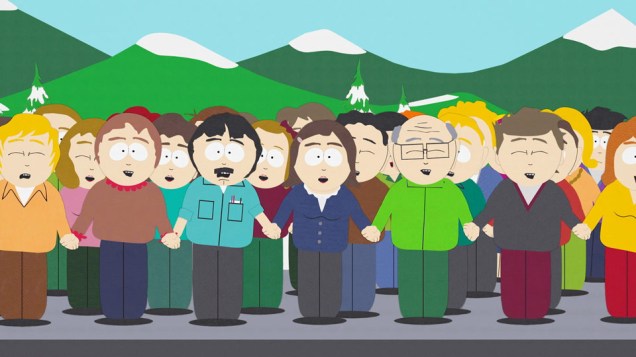
That doesn’t mean that we sit back and do nothing, allowing these baby-faced tyrants to have their way. But it does mean all of us choosing more carefully how and when we pick our battles, and being willing to sit out a few rounds to let Trey Parker, Matt Stone and the good people at The Onion pick up the slack once in awhile.
Sometimes, earnestly engaging with those who seek to curtail freedom of speech and behaviour in the name of protecting the perpetually vulnerable from taking offence can be counterproductive, because deploying the well-trodden earnest arguments in favour of free speech only provides the Identity Politics cultists with another opportunity to state their toxic credo all over again.
Far better, in these circumstances, to keep one’s powder dry and let the comedians do the leg work instead.
–
Agree with this article? Violently disagree? Scroll down to leave a comment.






 Semi-Partisan Politics