–
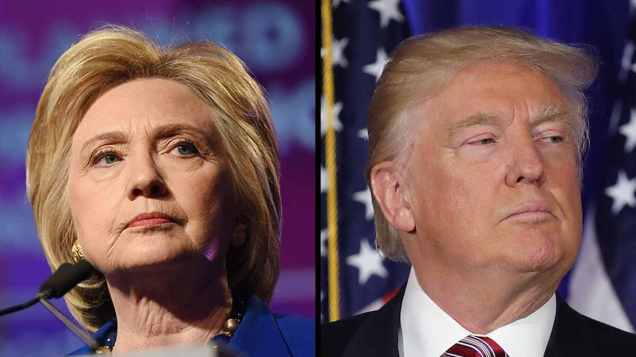
Live Blog: Donald Trump and Hillary Clinton face off in the first of three high-stakes live televised debates
Debate Time: 9PM East Coast / 2AM UK Time
10:42PM New York / 03:42AM London
INITIAL SUMMARY
CNN pundits seem very quick to call this debate for Hillary Clinton. And yes, she won on points (as we knew she probably would). But in terms of what the pundits say vs what the country feels, I can’t help but think that the media class might be getting out ahead of the country, rather like the British media declared the 2014 Nigel Farage v Nick Clegg European Union debates a victory for Nick Clegg, and then had to eat their words as post-debate polling showed the British people considered it a resounding triumph for Farage.
As I said about 45 minutes ago:
To me, this seems very much within the bounds of a normal presidential debate. Sure, it might have been a bit more tetchy in places than Obama-McCain or Obama-Romney, but visually and in terms of subject matter this is relatively unexceptional.
And that is bad, bad, bad for Hillary Clinton. Clinton needs Trump to blow his top and say something really incendiary, insensitive or uncommonly stupid. And he isn’t rising to the bait. Clinton may have had a couple of good pre-canned zingers that Trump lacked, but he has had her on the ropes a couple of times, too. At no point as Trump been stumped for words, and at no point was he pinned down on what people commonly perceive to be his weak points: his taxes, climate change, trade.
Clinton did become more effective during the final 30 minutes, which her campaign will be very relieved about. And did she manage to rile Donald Trump? Yes – but no more than the country is used to seeing after his tussles with Jeb Bush, Marco Rubio or Ted Cruz.
I’ll do a fuller analysis later (bed beckons now…) but my gut says that this was a victory for Hillary Clinton on points, but a score draw in terms of public reception. Time will soon tell.
And that’s me signing off for tonight. Many thanks for following along!
–
10:42PM New York / 03:42AM London
On points, probably, yes. But a points victory is not what Hillary Clinton really needed.
https://twitter.com/PoliticoRyan/status/780597958064607232
–
10:40PM New York / 03:40AM London
And that’s it. The debate ends, and an audience member shouts out loud “Donald Trump, we love you!” Strange to have no real closing statements.
Handshakes and family huddles now.
And let the spinning begin.
–
10:39PM New York / 03:39AM London
Oh, pipe down. As if angry liberals didn’t use the same language all the time to talk about George W. Bush.
–
10:37PM New York / 03:37AM London
Hillary Clinton rightly calls out Donald Trump’s attempt to switch focus from looks (Lester Holt’s original question) to stamina. Hillary Clinton goes for the jugular, rattling off some of the many ways in which Donald Trump has publicly and crassly disrespected women.
–
10:35PM New York / 03:35AM London
Donald Trump reiterates his belief that Hillary Clinton does not have the stamina to be president.
Trump: “You have so many different things you have to be able to do [as president], and I don’t believe she has the stamina”.
Rather set himself up for Hillary Clinton’s well-drilled list of her workload and accomplishments as Secretary of State. Audience cheers.
Trump: “She’s got experience, but it is bad experience. More audience cheers.
–
10:29PM New York / 03:29AM London
Yeah, that was definitely a wobble:
https://twitter.com/timothy_stanley/status/780593902252355584
–
10:27PM New York / 03:27AM London
Clinton: “A man who can be provoked by a tweet should not have his fingers anywhere near the nuclear codes”.
Quite.
Donald Trump responds by reiterating his statement that NATO members that do not pay their fair share should lose US protection. Now, the free rider problem is real and this will go down well with a number of Americans, but it doesn’t suggest the world’s greatest grasp of realpolitik.
–
10:25PM New York / 03:25AM London
This has been the first real, significant chink in Donald Trump’s Teflon armour tonight:
–
10:23PM New York / 03:23AM London
Trump: “By far my strongest asset is my temperament. I have a winning temperament. I know how to win”.
Really?
Okay, perhaps the wheels are starting to come off Donald Trump’s performance in a way that might be favourable to Hillary Clinton, now. She rightly pushes back on Trump’s fanciful plans for NATO by schooling the debate audience on Article 5.
–
10:21PM New York / 03:21AM London
Trump really going to the wall denying that he ever supported the Iraq war – it’s all a figment of the mainstream media’s imagination, apparently. I’m not sure that this is really the hill Donald Trump wants to die trying to storm.
But apparently America needs only to “call up Sean Hannity”, and the Fox News presenter will then provide a cast-iron alibi for Trump…
–
10:20PM New York / 03:20AM London
So Donald Trump wants to use NATO to “knock the hell out of ISIS” now? Not sure how keen the allies will be to embark on a vague, open-ended commitment like that…
–
10:17PM New York / 03:17AM London
Hillary Clinton rightly taking Donald Trump to task for his extreme and unconstitutional plan to halt immigration of all Muslims into the United States. I’m surprised she didn’t go stronger on this – where was the fire, where was the outrage? Trump was allowed to wriggle free with a rambling rebuttal.
–
10:14PM New York / 03:14AM London
Donald Trump’s fair point about the vacuum in which ISIS formed is rather undermined by his false statement that he initially opposed the Iraq war, and his glib plan to “take the oil” in payment for America’s troubles.
–
10:10PM New York / 03:10AM London
Hillary Clinton doing her best to link Donald Trump to Vladimir Putin. Clinton’s hawkishness on Russia is rather offputting. While America’s national interests must absolutely be defended robustly and while Russia’s backsliding into anti-democratic authoritarianism is extremely troubling, Russia is an economically diminished country with a relatively shrivelled military, more concerned with defending its shrinking field of influence than truly grand pretensions on the world stage. Let’s not make more of the threat they pose than is accurate.
–
10:05PM New York / 03:05AM London
Good to see Hillary Clinton rake Donald Trump over the coals for his tawdry birtherism. Despite his attempts to pin the genesis on people in the Clinton ’08 campaign, Donald Trump was the unapologetic face of American birtherism for over a year, keeping incredibly dodgy company and stirring very ugly sentiments.
–
10:00PM New York / 03:00AM London
Good line from Clinton: “I think Mr. Trump just accused me of preparing for this debate. And yes, I did. And you know what else I prepared for? I also prepared for being president of this country. And I think that’s a good thing”.
That effective zinger won a small audience applause.
And another: “Well, just listen to what you heard.”
–
9:59PM New York / 02:59AM London
My thoughts so far, two thirds of the way into the debate with one hour gone and thirty minutes to go. To me, this seems very much within the bounds of a normal presidential debate. Sure, it might have been a bit more tetchy in places than Obama-McCain or Obama-Romney, but visually and in terms of subject matter this is relatively unexceptional.
And that is bad, bad, bad for Hillary Clinton. Clinton needs Trump to blow his top and say something really incendiary, insensitive or uncommonly stupid. And he isn’t rising to the bait. Clinton may have had a couple of good pre-canned zingers that Trump lacked, but he has had her on the ropes a couple of times, too. At no point as Trump been stumped for words, and at no point was he pinned down on what people commonly perceive to be his weak points: his taxes, climate change, trade.
Hillary Clinton has 30 minutes to make Donald Trump seem more unacceptable than Trump has made himself appear throughout the Republican primary process and the general election campaign so far.
–
9:55PM New York / 02:55AM London
Hillary Clinton: “If you are too dangerous to fly, you are too dangerous to have a gun”.
Neat catchphrase, but ignores the fact that there is no due process when it comes to putting someone on a watch list. People will therefore be denied their Second Amendment rights under the Constitution – so more thorny an issue than it looks.
Nonetheless, Trump agrees in principle.
–
9:50PM New York / 02:50AM London
Trump actually making a fair point on the need for better police/community relationships, and the costs of police withdrawal from inner city communities.
I lived in Chicago – a real Democratic Party rotten borough – back in 2010-2011, just as things were about to tip into the current violent lawlessness. Gun control and wall-to-wall Democrat control are not tremendously good for violent crime rates.
–
9:48PM New York / 02:48AM London
Donald Trump predictably takes a more “law and order” stance, and gets to brag about his endorsement from the Fraternal Order of Police.
Trump: “We have to protect our inner cities because African American communities are being decimated by crime”.
–
9:45PM New York / 02:45AM London
A change of pace now, as Lester Holt moves the debate on to the subject of recent police shootings.
Clinton :”Everyone should be respected by the law, and everyone should respect the law. Right now that’s not the case in a lot of our neighbourhoods”.
–
9:43PM New York / 02:43AM London
Trump, explaining his business bankruptcies and refusals to pay suppliers: “I take advantage of the laws of the nation”.
Well, it won’t hurt him among his existing supporters, not sure how that semi-amoral approach will register with the broader country though…
–
9:41PM New York / 02:41AM London
Clinton: “I’ve met dishwashers, painters, architects … who you refused to pay when they finished the work you asked them to do. We have an architect in the audience who designed one of the clubhouses at your golf courses … Do the thousands of people you have stiffed in your businesses not deserve some kind of apologies?”
Good from Clinton, attacking Trump’s unscrupulous business practices.
–
9:40PM New York / 02:40AM London
Hillary keeps pounding away, but Donald Trump keeps deploying his “bemoaning the state of America” evasion, and by and large getting away with it:
–
9:39PM New York / 02:39AM London
Donald Trump, the Shakespeare of our times:
–
9:36PM New York / 02:36AM London
And Hillary Clinton deals with her email “mistake”. She doesn’t sound very contrite, and Donald Trump rightly hammers her for it: “That wasn’t a mistake, it was deliberate … And I think it’s disgraceful”.
–
9:35PM New York / 02:35AM London
And Trump pivots away more successfully by raising the subject of Hillary Clinton’s emails. This raises a loud cheer from pro-Trump factions in the audience, and an admonition to the audience from Lester Holt.
Hillary Clinton: “Well, I think you’ve just seen a classic example of bait and switch”.
And proceeds to goad Trump: “Maybe he’s not as rich as he says he is. Maybe he is not as charitable … We know he owes about $650 million to foreign banks. Or maybe he doesn’t want you to know he has paid nothing in federal taxes … And that means zero for troops, zero for health, zero for schools”.
Ouch.
–
9:32PM New York / 02:32AM London
Aaand Lester Holt asks Donald Trump about his tax returns.
Trump tries to wriggle off the hook by repeating his “I’m under audit” line, immediately pivots away to how America is being “ripped off by every single country in the world”. This is a rather desperate evasion, and if Lester Holt wants to avoid the criticisms levelled at Matt Lauer after the Commander in Chief forum he will ask the question again and demand a better response…
–
9:29PM New York / 02:29AM London
Clinton: “I have a feeling by the end of this debate I’ll have been blamed for everything!”
And her first snide put-down of Trump: “Sure, let’s keep saying crazy things”
–
9:28PM New York / 02:28AM London
Now squabbling about ISIS. Trump says “No wonder you’ve been fighting ISIS your entire life”. What?!
–
9:26PM New York / 02:26AM London
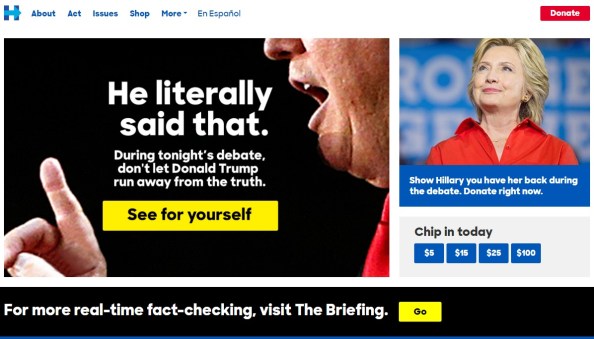
First stunt of the debate – Hillary Clinton has supposedly turned the front page of her campaign website into a “fact-checker” to call out Trump’s lies. And so she has:
–
9:22PM New York / 02:22AM London
Agree with him or not, Trump sounds a lot more confident and almost righteously angry when he is inveighing against NAFTA. And he actually has Clinton on the ropes now. “You called it the gold standard, you called it the finest trade deal you’d ever seen”.
Facts aside, Clinton has a habit of taking credit for things that happened during the Bill Clinton administration or during her term as New York senator while ducking blame for any areas where she is criticised. Was she “in power” then or not? Trump may be on to something by trying to pin Clinton down on this.
–
9:19PM New York / 02:19AM London
Good from Clinton – “Let’s not assume trade is the only challenge we have in the economy”. True. Trump can often sound like a one-trick pony on this.
–
9:17PM New York / 02:17AM London
Andrew Sullivan thinks that Clinton had the brighter start:
9:09 p.m. Trump begins by denying reality – that jobs are leaving the U.S. in droves. He has almost nothing substantive to counter Clinton’s policies, except a massive tax cut. A weak start for the Donald.
If we were scoring on points, I would agree. But Clinton could well win this debate on points, and still lose (or draw, which would be the same thing). Trump just needs to appear calm and acceptable.
–
9:16PM New York / 02:16AM London
So protectionism, basically. That’s what Donald Trump is advocating.
–
9:13PM New York / 02:13AM London
Donald Trump on his politest behaviour: “In all fairness to ‘Secretary Clinton’ – is that okay? I want you to be very happy”.
I hate to say it, but so far Trump looks quite…presidential?
–
9:12PM New York / 02:12AM London
Hillary Clinton seems to have digressed into a lengthy explanation of the process of silk screen printing…
–
9:11PM New York / 02:11AM London
“Trumped up trickle down” – really, Hillary?
Not that Donald Trump offered anything more meaty for Hillary Clinton to sink her teeth into, policy-wise.
–
9:10PM New York / 02:10AM London
Donald Trump begins by doing what Trump always does when asked a question – he spends 90% of the time restating and rephrasing the question in various ways, bemoaning the state of America. “We need to stop our jobs from being stolen from us, we need to stop our companies leaving the United States”. And he runs out his opening 2 minutes without having to offer a real answer beyond “reducing taxes tremendously”. But it’s going to be “a beautiful thing to watch”, apparently.
–
9:09PM New York / 02:09AM London
Decent opening statement from Clinton – gracious to Donald Trump, spoke firmly but in platitudes about the nature of the economic challenge. A steady start.
–
9:06PM New York / 02:06AM London
So we begin with job creation. I’m not sure either candidate has a good answer to this. Easy to talk about “building an economy that works for everyone”, much harder to talk about how to embrace globalisation while helping displaced people and low-paid workers adapt to it.
–
9:01PM New York / 02:01AM London
However this debate goes, one person who will likely get no thanks is moderator Lester Holt. Any perceived favouritism toward Trump or Clinton, however slight (or imaginary) will be immediately jumped on:
–
8:59PM New York / 01:59AM London
How long until Donald Trump declares victory? Not long, predicts Tim Stanley. Indeed, there is speculation that Donald Trump may enter the post-debate spin room himself to help things along in that particular regard…
https://twitter.com/timothy_stanley/status/780572288521469952
–
8:57PM New York / 01:57AM London
Okay, we’re getting underway now. Here goes.
–
8:52PM New York / 01:52AM London
I should bloody well hope so:
No Gennifer Flowers, though.
–
8:49PM New York / 01:49AM London
A reminder that the more conspiratorial fringes of the American Right will be keeping their eyes peeled for any signs of residual illness in Hillary Clinton:
This blog does not share in the extensive conspiracy theories, but Clinton’s dishonesty and downplaying of her pneumonia is part of a broader problem the Democratic nominee has with full and proper disclosure.
–
8:42PM New York / 01:42AM London
We seem to be into the self-congratulatory grandstanding part of tonight’s programme, where the organisers congratulate themselves for having successfully wrangled two egotistical and highly risk-averse presidential candidates onto a stage where they have almost nothing significant to gain and everything to lose.
–
8:40PM New York / 01:40AM London
This from Ben Shapiro sums up the low bar we seem to have set for both candidates:
–
8:32PM New York / 01:32AM London
Well, at least somebody is actually enjoying this spectacle…
–
8:26PM New York / 01:26AM London
Good news – Andrew Sullivan is also live-blogging the debate, for New York Magazine:
Just a heads up that I’ll be liveblogging the debate tonight – and will take a Xanax beforehand.
For those of you who can’t bear to watch, read the liveblog!
For those prepared to watch the republic crumble in real time, join me!
It’s at 9 pm, and at nymag.com.
Know hope
Andrew
Read along here – but don’t forget about me!
–
8:22PM New York / 01:22AM London
Wow, CNN leaking some last-minute spin from unnamed Trump campaign sources, suggesting that they fear their candidate has not prepared enough and *isn’t ready*. This is some masterful expectations-lowering going on here, the culmination of a weeks-long effort to talk down Trump’s chances. At this rate, he’ll be declared the victor if he manages not to fall down.
–
8:20PM New York / 01:20AM London
Just a reminder that as we go into this first presidential debate the polls are essentially tied. From Nate Silver at FiveThirtyEight:
Well, folks, this is getting tight. Donald Trump is in his strongest-ever position in FiveThirtyEight’s polls-plus forecast, which gives him a 46 percent chance of winning the election. Trump’s chances are about the same, 45 percent, according our polls-only forecast, his best standing since it showed him with a 50 percent chance in the midst of his convention bounce.
Our models have been on the move toward Trump for roughly six weeks. But with dozens of polls coming out over the past few days, he’s no longer much of an underdog at all. Hillary Clinton leads narrowly — by 1.5 percentage points — in our projection of the popular vote. But polling weakness in states that Clinton probably needs to win, particularly Colorado and Pennsylvania, makes the Electoral College almost even.
It is hard to think of any other plausible Democratic Party candidate who could be making such a struggle of running against Donald J Trump. Mostly because were it not for Trump’s sky-high unfavourables, Hillary Clinton’s unfavourables would also be setting a dismal record.
–
8:10PM New York / 01:10AM London
The Battle of the Foundations
The Washington Post has a rather forensic exposé of the financial wheelings and dealings of the Trump Foundation:
Donald Trump’s charitable foundation has received approximately $2.3 million from companies that owed money to Trump or one of his businesses but were instructed to pay Trump’s tax-exempt foundation instead, according to people familiar with the transactions.
In cases where he diverted his own income to his foundation, tax experts said, Trump would still likely be required to pay taxes on the income. Trump has refused to release his personal tax returns. His campaign said he paid income tax on one of the donations, but did not respond to questions about the others.
That gift was a $400,000 payment from Comedy Central, which owed Trump an appearance fee for his 2011 “roast.”
The suggestion is that by diverting income through his “charitable” foundation, Trump may have avoided paying income tax – something we will likely never know until (if) Donald Trump finally deigns to release his tax returns.
While Trump’s foundation trickery is of the more overt kind, the ethical concerns surrounding the Clinton Foundation are hazier. This blog’s conclusion:
The point, I suppose, is that a family charitable foundation is a perfectly legitimate option for an ex-president and his family who intend to quit the political game after leaving office. But when this is not the case – when Hillary was pursuing senatorial ambitions and later becoming Secretary of State – conflicts of interest are inevitably going to occur.
When one is as rich and well-connected as the Clintons, acquiring more money becomes of limited interest. Instead, the reason for getting up in the morning after having left the White House often becomes the building of power, influence and legacy – and, of course, keeping the family in the style of living to which they have become accustomed (i.e. minimal contact with ordinary people). A family foundation accomplishes all of these objectives wonderfully. But when one or more members of the family are still politically active it is highly questionable.
It would have been far better, when there are still active political careers in play, for the Clintons to have put ego aside and thrown their support behind an alternative, existing foundation – much like Warren Buffett is giving away much of his wealth to the Bill and Melinda Gates Foundation, recognising that it makes little sense to build up his own philanthropic expertise from scratch and create all the overheads which come from a second foundation when a perfectly good one already exists.
Why did the Clintons not take the Warren Buffett approach? Three reasons – ego, power and prestige. It is great that the Clintons are philanthropically active. But nearly all of their philanthropic work is done through the Clinton Foundation ($1 million to the foundation in 2015 and just $42,000 to another charity), meaning they want to do charity on their terms. It is a few distinct shades further away from pure altruism, and more to do with continuing to exercise power after the White House.
When Bill Clinton’s presidency ended in 2001, like a shark he had to keep swimming or surely die. Sitting at home in front of the television was never an option. But neither was Bill Clinton about to show up to work for Bill and Melinda Gates, or Habitat for Humanity. He wanted the benefits of his charitable work to accrue to him and his family, not to the Gates family or anyone else. And so the Clinton Foundation was born.
And since the Clintons choose to conduct philanthropic activities on their own terms and through their own foundation, in a way which aggrandises the Clinton family name and brings them power and influence, it is perfectly reasonable to ask questions about any other “fringe benefits” which Hillary Clinton pursued while holding the immeasurably valuable bargaining chip of being a senior part of the Obama administration. And when there is smoke, it is not churlish or unreasonable for journalists to have lots of questions about these activities.
In short, there is billowing smoke on both sides. But Trump could very easily go a long way to proving his probity regarding the Trump Foundation by actually releasing his tax returns.
–
7:56PM New York / 12:56AM London
Mike Pence on CNN trying and failing to make the case that Donald Trump epitomises the American Spirit. Eventually the moderator, pitying him, moves on to another question.
–
7:48PM New York / 12:48AM London
It’s worth remembering the context in which this presidential debate is taking place – a stultifying new age of censorship, in which infantilised young students and pandering professors seek to cocoon themselves in an ideological bubble in which Bad Ideas (generally conservatives ones) are prohibited.
MRC TV reports:
Hofstra University has posted a “trigger warning” sign to warn students about the potentially disturbing content that may be discussed during Monday night’s presidential debate.
According to CBS New York reporter Tony Aiello, a sign inside of the student center at Hofstra reads, “Trigger warning: The event conducted just beyond this sign may contain triggering and/or sensitive material. Sexual violence, sexual assault, and abuse are some topics mentioned within this event. If you feel triggered, please know there are resources to help you.”
Utterly pathetic – though it should be noted that this particular trigger warning relates to a previous event which took place on campus, and not the presidential debate.
You can read this blog’s extensive coverage of the trigger warning / safe space / social justice phenomenon here.
https://twitter.com/kyletblaine/status/780513699803045888
–
7:26PM New York / 12:26AM London
This is turning out to be a great interview with Bernie Sanders on CNN right now. The vapid talking head / presenter keeps trying to switch the focus to style and appearance rather than policy content and character, and Sanders keeps swatting down that assertion.
“But we all know that style matters a lot –” says the presenter, trying to drag the interview onto the petty, personality-based politics which is CNN’s only real strength.
“No, no, I don’t agree” says Senator Sanders, sticking to his guns.
This is partly a self-fulfilling prophecy. The more that pundits and cable news channels obsess over style and appearances, the more they will be magnified in importance – and vice versa.
–
7:22PM New York / 12:22AM London
“This is not a night of entertainment. This is not the Superbowl, this is not the World Series…” – Senator Bernie Sanders, Hillary Clinton’s defeated Democratic primary foe, making what should be (but sadly isn’t) a very obvious point on CNN right now.
UK readers can view a CNN live stream on YouTube.
–
7:18PM New York / 12:18AM London
This reference to Hillary Clinton’s description of half of Trump supporters as “deplorables” should serve as a timely reminder that sneering disdain and condescension toward Donald Trump supporters during the upcoming debate will only harden Trump’s support and win Clinton no new fans:
This debate is many things, but it is absolutely not a wise moment for Hillary Clinton to play to the gallery of smug, virtue-signalling leftists.
–
6:59PM New York / 11:59PM London
Jonathan Chait is panicking, and thinks that you should be, too:
Should the wisdom of the markets comfort Democrats, non-authoritarian Republicans, and other people who are fond of life on Earth as we know it? No, it probably shouldn’t. Betting markets do not appear to have any special knowledge. The prediction markets badly missed the outcome of the Brexit vote. Markets also gave Trump less than a 50 percent chance of securing his party’s nomination in February, and less than a 60 percent chance as recently as April. In both of these cases, prediction markets diverged from what the polling suggested, and the polling proved correct. The other commonality between these events is that conventional wisdom reflected the preferences of social and economic elites, who refused to take seriously beliefs held by very few people in their own circles.
So what do the polls say? FiveThirtyEight, Silver’s site, gives Clinton a 51.5 percent chance of winning. The Upshot, the New York Times calculator, gives her a 69 percent chance. (Both forecasts are based mostly on polling results.) Silver’s forecast makes Clinton the equivalent of a football team that is a 1-point favorite. The Upshot’s forecast makes her the equivalent of a 5.5-point favorite.
If your football team is either a 1-point favorite or a 5.5-point favorite, then you should be deeply concerned about the chance of losing. If the outcome is not a football game but the chance that the Executive branch falls under the control of a bigoted, uninformed, dictator-admiring man-child, you should be more than concerned. You should be freaked out.
Jeremy Corbyn. Brexit. Who is still going to offer swaggering, cast-iron certainties given this year of huge and unexpected political turmoil?
–
6:37PM New York / 11:37PM London
From Daniel Larison’s preview in The American Conservative:
Trump has never been interested in outlining policy proposals in any detail during debates, and he isn’t going to start now. That gives him a slight advantage in that most voters don’t especially care about policy specifics, and tend not to react well to candidates that are absorbed with them. If there is one thing Trump knows about, it is how to perform on television, so I don’t know that it matters so much that this will be the first head-to-head debate he has done as a candidate. Clinton has considerably more experience with these formats from both her Senate and presidential campaigns, but she has never faced off against an opponent quite as shameless and unconventional as Trump. Clinton probably has the edge in being able to give the canned, scripted answers that these events demand. Trump’s willingness to say almost anything means that he may surprise her with an attack or proposal that she isn’t anticipating.
The debate “topics” that have been announced in advance are very vague, but I assume “securing America” will be the section of the debate related to foreign policy and national security. Because of her tenure at the State Department, this is the section during which Clinton will be expected to dominate Trump, who knows little and understands even less about the rest of the world. However, because of her record of poor judgment on foreign policy, especially as it relates to military intervention, Clinton will be vulnerable to attacks that Trump won’t hesitate to make regarding the Iraq and Libyan wars. Trump may be a lousy messenger for these criticisms, but they are attacks that she was mostly spared during the primaries and for that reason she hasn’t had much practice in defending against them. This section of the debate seems likely to serve as a microcosm of the election as a whole: Clinton has experience but also has lousy judgment, while Trump is a shameless opportunist who doesn’t know much except for how to take advantage of his opponents’ poor records.
Hard to disagree with this assessment. Despite all the hype, I anticipate a tense and nervous affair in which both candidates attempt to limit their exposure and avoid any kind of genuine, extemporaneous thinking that may result in a “gaffe”. The winner will be the candidate who avoids going out on a limb.
–
6:04PM New York / 11:04PM London
The National Review’s Ian Tuttle is pessimistic about the debate, saying that it cannot possibly reveal anything we don’t already know – that both candidates are terrible:
At 9 p.m. EST tonight, the two major-party presidential candidates will take the stage for the season’s first general-election debate. One candidate is a pathological liar and egomaniac. The other is Donald Trump.
Whether their sparring match will actually matter is an open question. Political scientists are more skeptical than pundits about the influence of presidential debates, several studies having shown that even the most memorable debates occasioned only small polling shifts. Nonetheless, tonight is being billed as a potentially “epic” “battle royale.” The Washington Post suggests that 80 to 100 million people — that is, a quarter or more of the country — could tune in for at least part. That would make the debate not just the most-watched political event in modern American history but quite possibly the largest communal act of masochism in human history.
Tuttle concludes:
In other words, there are no good outcomes to this. It’s a contest to determine which candidate we’d be marginally more chagrined to see devoured by crocodiles, or stricken by plague. There’s the candidate who silences sexual-assault victims, or the candidate who calls women “dogs” and “pigs”; there’s the candidate who hides from the press, or the candidate who wants to sue them; there’s the candidate who “Hispanders,” or the candidate who calls Mexicans “rapists.” Take your pick.
I think he goes too far. While Hillary Clinton is certainly a flawed candidate and no conservative’s obvious choice for president (what with being a Democrat ‘n all), she is a known quantity, and whatever questions may exist about her judgment she at least understands the machinery of government.
Besides, I simply don’t buy the most egregious alarmism about Clinton from the American Right. They say that she is gunning for the Second Amendment. Well, Republicans made exactly the same accusation of President Obama. Each year was supposed to be the year when the Evil Marxist Kenyan would finally reveal his true colours and begin confiscating America’s guns. This whipped-up paranoia manifested itself in higher gun and ammunition sales across America. And yet with only 115 days of his presidency left, he really is waiting until the last minute.
And when conservatives overreach like this for political gain (making Americans fear unnecessarily that the Second Amendment is about to be “abolished”, as though that were possible with this Congress and Supreme Court) it calls into question some of their other more shrill accusations against Hillary Clinton.
So yes, both candidates are bad. But Hillary Clinton’s sins are grey ethics and a lack of vision, while Trump’s are unknown and potentially far worse. Given the choice, is reluctantly endorsing Clinton not the real conservative thing to do?
–
5:45PM New York / 10:45PM London
Why is politics so bitterly partisan yet so emptied out of meaningful, ideological policy discussion? Well, it doesn’t help when the news channels promote a presidential debate as though it were Wrestlemania rather than a serious, sober public event:
Next up on CNN: a re-enactment of the Lincoln-Douglas debates, in 3D IMAX.
–
5:37PM New York / 10:37PM London
The Atlantic’s Conor Friedersdorf ruminates on Donald Trump’s unnervingly cruel streak:
In national politics, harsh attacks are to be expected. I certainly don’t fault Trump for calling Hillary Clinton dishonest, or wrongheaded, or possessed of bad judgment, even if it’s a jarring departure from the glowing compliments that he used to pay her.
But even in a realm where the harshest critiques are part of the civic process, Trump crossed a line this week when he declared his intention to invite Gennifer Flowers to today’s presidential debate. What kind of man invites a husband’s former mistress to an event to taunt his wife? Trump managed to launch an attack that couldn’t be less relevant to his opponent’s qualifications or more personally cruel. His campaign and his running-mate later said that it was all a big joke. No matter. Whether in earnest or in jest, Trump showed his tendency to humiliate others.
And concludes:
People disagree about the ideal traits to have in a leader. But almost no one wants a president who has proven himself an addict to being cruel, mean-spirited, and spiteful. For decades, Trump has been deliberately cruel to others, often in the most public ways. He behaves this way flagrantly, showing no sign of shame or reflection.
What kind of person still acts that way at 70? A bad person.
It is that simple.
Giving a cruel man power and expecting that he won’t use it to inflict cruelty is madness. To vote for Trump, knowing all of this, is to knowingly empower cruelty.
Better to recoil in disgust.
Even if every single ethical allegation against Hillary Clinton were definitively proven true, it would do nothing to set at rest this blog’s gnawing unease that Donald Trump either suffers from some undiagnosed personality disorder or is literally just so coarse and brutish that he will humiliate friend and foe alike for his passing amusement.
–
5:20PM New York / 10:20PM London
The expectations game
David Graham at The Atlantic notes the effective job done by the Trump campaign in lowering expectations:
It’s well-established that Donald Trump’s campaign doesn’t do most of the things a traditional political team does. There’s scarcely any policy, weak fundraising, and no ground game. But in one classic area of political positioning, the Trump team has proven it is historically great at one classic tactic: expectations setting.
With a few hours to go before the first presidential debate, it’s hard to see what the Republican nominee could do to avoid the meeting being judged at least a tie. Through a combination of months of campaigning, leaks about his debate prep, and aggressive working of the referees, Trump has set expectations so low that it’s hard to imagine how he finishes the debate without getting positive reviews from mainstream commentators.
[..] Separately, aides told Politico that Trump’s team has constructed an elaborate psychological profile of Clinton that he’s using to prepare. It’s hard to tell what is a psych-out and what’s real, but the effect of the balance of these leaks is to present Trump as so bumbling that simply standing up straight is an achievement.
We’ve seen all this before, of course. Famously weak debater George W. Bush went to great pains to raise expectations of his opponent John Kerry, with one Bush aide going so far as telling the media – with a straight face – that the rather staid, wooden Kerry was “the best debater since Cicero”. It seems that no hyperbole is too ludicrous when it comes to trying to give your candidate an edge.
While we have had no individual statements or acts of expectation-setting as ridiculous as the Kerry-Cicero comparison, the cumulative effect of the Trump campaign’s expectations-lowering has likely been greater. As the anti-establishment challenger, Trump has been held to a different standard since he first launched his campaign. But now, for the first time, Hillary Clinton’s much-vaunted experience – the “most qualified candidate ever to run for president”, we are continuously, implausibly told – will be a dead weight around her neck.
If Trump can avoid self-immolating and land one or two punches, that may well be enough to count as a “victory” or at least a draw, even if Hillary Clinton wins on points (as she almost certainly will). In other words, being graded on a very generous curve could well be to Donald Trump’s great advantage.
–
5:06PM New York / 10:06PM London
Putting my cards on the table
I’m a small government conservative, but I won’t vote for bold-faced authoritarians or unashamed ignoramuses just because they cloak themselves in the mantle of conservatism. This blog supported Barack Obama over John McCain in 2008, because John McCain fatally compromised his own judgment and principles by choosing Sarah Palin as his running mate and unleashing that force on an undeserving world.
On the same grounds, this blog cannot support Donald Trump, a man who makes George W. Bush’s mockery of fiscal conservatism look like the strictest observance, whose ignorance of policy is matched only by his disregard for the Constitution and whose temperament and character flaws make him a reckless choice in an unstable world.
That said, this blog is no fan of Hillary Clinton – as outlined in this rather tortured explanation of my decision to support her candidacy over that of Donald Trump. Hillary Clinton is nothing if not a continuity candidate, which is fine for those who are currently prospering under the status quo but dreadful for those who are struggling. There are real concerns of character and ethics too, which would be disqualifying if her Republican opponent were anyone but Donald Trump. But we are where we are.
And this blog believes that it is not enough for fellow conservatives against Trump to quietly sit on the sidelines out of some perverse, unearned loyalty to the Republican nominee. While one has to respect the mandate bestowed by GOP primary voters, that does not mean suppressing dissent or deserved criticism. And while the 2016 presidential election offers a most unpalatable choice, principled conservatives should have the courage to declare their intention to vote for the least worst option, Hillary Clinton.
Here’s my reasoning:
A Hillary Clinton presidency gives the Republican Party four more years to come up with a more palatable option than John McCain, Mitt Romney and Donald Trump. In those four years, precious little will happen to fill conservative hearts with glee. But it is also highly unlikely that anything cataclysmicly, unfixably awful will happen either. That, to this blog, seems like a much better deal than letting Donald Trump loose on the Oval Office and potentially having him tarnishing the conservative and Republican brands even more than he has been able to as a presidential candidate.
Many of Trump’s desperate apologists try to trip up the #NeverTrump brigade by pouring scorn on the idea that Hillary Clinton is more conservative than Trump (see Ace of Spades’ sarcastic description of Clinton as “the One True Conservative in the race”). This misses the point. Many of us see Hillary Clinton exactly for what she is – namely a very calculating centrist with no core political convictions whatsoever. She was never the swivel-eyed leftist that Newt Gingrich tried to suggest – witness her glacial movement on gay marriage, only cautiously signalling her support once she was sure that Joe Biden and Barack Obama had not done themselves any political damage.
So the question is not one of whether Hillary Clinton is “more” of a conservative than Trump (though Donald Trump certainly is no conservative). The question is one of temperament and basic competence to execute the job. And while Hillary Clinton may be dogged by many legitimate ethical questions, few doubt that she could handle the levers of government, if only to maintain America on its present course.
Donald Trump, by contrast, is a complete unknown quantity, and a hugely volatile one at that. When he goes off-script he is liable to say or do anything (insulting the most sympathetic of characters or getting into Twitter wars with D-list celebrities) which comes to mind, and when he is on-script (as at his recent summit with Mexican president Enrique Peña Nieto) he sounds like he has been lobotomised. I have about as much confidence that Donald Trump has read, understood and respects the US Constitution as I believe his claim that “nobody reads the bible more than me“.
The choice, then, is not between a leftist ideologue and an honest, hard-workin’ conservative whose only crime is to be a bit politically incorrect sometimes, as Trump’s loyal cheerleader Sean Hannity loves to put it. The choice is between an ideologically rootless centrist who will likely maintain the status quo because she and her family have too much vested in it to see it fail, or a madman.
So that’s where I stand. This blog is opposed to Donald Trump, though I respect and sympathise with many Americans who are drawn to his candidacy. But that does not make this an ardently pro-Hillary blog – I will continue to call out shortcomings and failures as I see them.
And that’s how I’ll be live-blogging the debate tonight, and covering the remainder of the election in general. With scepticism and no small amount of disillusionment directed at both sides.
–
4:00PM New York / 9:00PM London
Welcome to the Semi-Partisan Politics live blog of the first 2016 presidential debate between Hillary Clinton (Democrat) and Donald Trump (Republican).
For newcomers to this blog, I write from the perspective of a British guy and future American citizen married to a proud Texan girl, currently living in London but ultimately destined to move back to the United States (timing potentially dependent on the outcome of this election!)
I have lived and worked in Chicago and the Mid West, travelled widely throughout America, follow American politics as closely as British, and so feel more than justified in weighing in with my many opinions. Those still in doubt can read my brief bio here, and a more long-winded version here.
Politically, I lean classically liberal or (depending on the definition) conservatarian. My positions in a nutshell: Catholic, small state, maximum personal liberty, pro civil liberties, free speech, pro-Second Amendment (with common sense gun control), anti-death penalty, separation of church and state, pro-legal immigration, anti attempts to ennoble illegal immigration, anti identity politics, anti-SJW. If it’s remotely socialist, I generally oppose it.
Click on US Politics or US Current Affairs for my American coverage.
–
Support Semi-Partisan Politics with a one-time or recurring donation:

–
Agree with this article? Violently disagree? Scroll down to leave a comment.
Follow Semi-Partisan Politics on Twitter, Facebook and Medium.







 Semi-Partisan Politics