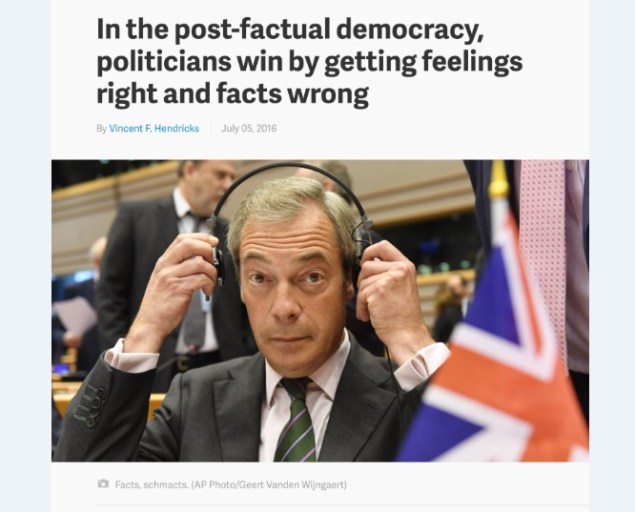
The Myth Of Post-Factual Politics

post-factual-post-truth-democracy

The term “post-truth politics” is starting to become an emotional comfort blanket for those people unwilling to examine the reason for legitimate electoral failure

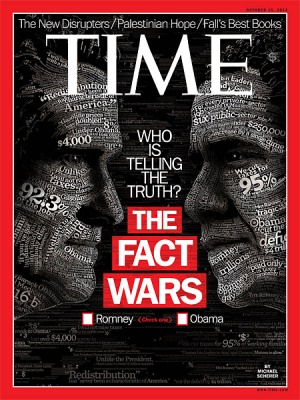
In these interesting times, a lot is being made of the idea that we live in a supposedly “post-truth” or “post-factual” society, where political debates take place and elections are swung not on the basis of evidence and rationality but rather on the basis of bluster and superstition.

Even those of us who supported either Brexit or the election of Donald Trump (this blog was strongly in favour of the former but against the latter) should acknowledge that there is a degree of truth to this criticism of the modern media landscape. As this Buzzfeed article makes clear, when there is a whole industry comprised of people producing inflammatory, fake pro-Trump news articles to earn ad revenue from the clicks of credulous partisans eager to have their existing biases confirmed, something is clearly awry.

But it is also true that dismissing electoral losses as the result of dumb people being duped in a lamentably post-factual world – just as some Trump supporters prepared for defeat by insisting that losing to Hillary Clinton could only be the result of a shadowy conspiracy – is an emotional comfort blanket too easily seized by people who don’t want to do the hard work of understanding why their own ideas were rejected by the public.

I recently attended the debate marking the launch of the 2017 Orwell Prize in London, where the panel – including Polly Toynbee and the excellent Christopher Snowdon – debated the role of the media and of “experts” in the recent EU referendum. Snowdon gives an excellent summary of his own remarks here, and concluded his speech:

Lying may be more morally objectionable, but bullshit is more common and it is just as damaging to public understanding of the world we live in. My argument is not that we are living in a truthful age. On the contrary, there is bullshit everywhere but deliberate political lies make up a very small portion of it – and that portion is not growing.

As long as people have an appetite for having their biases confirmed, newspapers will continue printing bullshit. As long as people think they can get away with it, they’re going to mislead the public. I don’t think we live in the post-truth era because I don’t think there was ever an era of truth. We are still in the pre-truth era and probably always will be.

As the other panellists – Toynbee most forcefully, of course – lamented the way in which the Evil Murdoch Press had supposedly manipulated its uniquely gullible readership with lies and disinformation while Evil politicians like Michael Gove encouraged people to ignore the pro-Remain advice of self-described “experts”, thus causing Brexit, I felt the need to take a stand. So at the appropriate time I seized the microphone and pointed out that wheeling out expert after expert to repeat the establishment line that Brexit would ruin the British economy (as though none of these experts didn’t let their personal biases and preferences colour their opinions) made all other aspects of the decision secondary considerations.

Sky News and the BBC had an endless parade of self-described experts talking about the theoretical economic consequences of Brexit, yet hardly any time was given to experts on governance, democracy, history or constitutional matters. At some point a decision was made that this debate would be All About Economics, and nothing else. One can dispute the dismal predictions of the Remain campaign’s economic “experts” – this blog certainly did – but at least we discussed economics. There was barely a proper discussion about democracy or the constitutional implications of staying or leaving the EU.

This was unfortunately taken by the debate’s moderator to mean that “feelings matter too”, which is not what I was saying at all. My point was that qualitative facts are every bit as important as quantitative ones, and often even more so. I would have expected more sympathy for my viewpoint – among the trendy-lefty, pro-Corbyn crowd at the event were countless people who clearly spend much of their time railing against free markets and capitalism, yet who seem to unquestioningly believe that the slightest potential threat to future GDP growth would make seceding from the European Union in pursuit of democratic renewal a calamitous idea.

When it comes to British membership of the EU, the Remain campaign’s Project Fear spoke only about numbers (and skewed ones at that), with only the occasional bit of fluff about “friendship ‘n cooperation” thrown in as a rhetorical garnish. My point was that in voting for Brexit, it is not that the British people disregarded the numeric facts entirely, but rather that they cared more about other, qualitative facts. Facts to which the Remain campaign never sought to acknowledge, let alone tackle.

The facts vs emotion reduction which met my contribution to the Orwell debate and which now colours nearly all of the media coverage of our supposedly “post-truth society” is therefore a bit too simplistic. There are quantitative facts but there are also qualitative facts – truths which are not based on emotion or hunch or prejudice, but which nonetheless cannot be added up in an Excel spreadsheet, slapped on an infographic and shared on social media.

I voted for Brexit because I believe that the EU actively harms and undermines the democracies of its member states, by deliberate design. I marshalled many facts to back up this position during the campaign – from primary and secondary historical sources, the stated positions of current EU leaders and various other proofs. Just because they are not quantifiable and I could not declare (for example) that leaving the EU will make Britain 11.2% more democratic and give the people 8.4% more control over the decision makers does not make the facts on which I argued my case untrue. And reducing those qualitative facts about democratic control, accountability and the known history and trajectory of the EU as mere “emotion” unfairly diminishes those facts.

When Brexiteers present quotes from EU “founding fathers” speaking of their vision for a federal Europe and tie them to quotes and draft bills from contemporary EU politicians pushing towards the same goals, these are facts. They are not quantifiable, but they are solid facts, much more than mere emotion. And they deserved to be considered and engaged with, yet by and large they were not during the campaign.

Modern politics has become excessively numbers driven. But when the Overton Window is so narrow, the range of policy options so constrained and politics largely reduced to the technocratic management of our public services then that probably becomes inevitable. And we must counter this trend by giving more of a focus to narratives and general principles again. That will lead to greater political engagement.

At present there is far too much self-satisfied criticism of “post-factual politics” in which defeated pro-EU supporters express alarm that people supposedly ignored the only facts available to them and made irrational decisions against their own self interest, and this is not so. There were other, unquantifiable facts which moved people to vote for Brexit. And these pivotal criteria deserve to be acknowledged as legitimate facts, not dismissed as mere emotions.

It is easy and comforting to believe that one’s own side thinks and acts according to reason, logic and evidence while one’s opponents are moved by base emotion, superstition or prejudice. But the divide is very rarely so clear.

And if the “post-truth politics” crowd do not soon realise this and practice some humility, that emotional comfort blanket could all too quickly become a funeral shroud when they next face the electorate.
 

time-magazine-the-fact-wars

Support Semi-Partisan Politics with a one-time or recurring donation:

Agree with this article? Violently disagree? Scroll down to leave a comment.

Follow Semi-Partisan Politics on TwitterFacebook and Medium.

Oh, So Now You’re A Liberal?

liberalism

The vote for Brexit and Donald Trump’s presidential election victory seems to have wrongly convinced an entire army of snarling, leftist authoritarians that they are actually the virtuous defenders of liberalism

Is anybody else getting mighty sick of the constant parade of left-wing, Big Government-supporting authoritarians suddenly rushing to cloak themselves in the veil of “liberalism” as they struggle to process what they see as successive defeats in the EU referendum and the US presidential election?

I can’t think of a word that has been more overused by pundits since everybody got together a couple of years ago and decided that the related N-word (neoliberalism) was this season’s hottest fashion statement, and started accusing everybody whose views they dislike of being an Evil Neoliberal, as though it were some devastatingly intellectual insult.

Here’s the FT, weeping into their cornflakes about the supposed death-throes of liberalism:

Mr Trump’s victory, coming after the Brexit referendum vote in Britain, looks like another grievous blow to the liberal international order. Mr Trump must decide, by his actions and words, whether he intends to contribute to the great unravelling, at incalculable cost to the west.

And the Independent:

Democracy is changing, and not for the better, but those who believe in liberal values, tolerance and protecting the environment can learn from this setback and fight back.

The Independent, of course, promotes liberal tolerance through its courteous and magnanimous treatment of those who dare to dissent from its positions on social issues, climate change and global governance.

Here’s the Spectator:

In her concession speech, Clinton said her goal had been ‘breaking down all the barriers that hold any American back from achieving their dreams‘. This is the dream of liberalism, which seeks freedom from any social or economic constraint. Elites like Clinton feel confident that they can navigate a deregulated society in which class, gender, and race are all fluid. They support deregulated markets as well, confident that free trade and open borders will serve their own interests in the near term and the whole country’s in the longer term.

Freedom from any social constraint? Only if one happens to agree with the elite.

And the Spectator again, covering itself in even more glory:

The challenge to liberalism is still seen as an argument to be won rather than an irreversible sea-change. But, if anything, the scale of the problem has been understated. The core tenets of liberalism are freedom and equality, ideas that are under siege.

Oh, and let’s not forget the prime minister herself, Theresa May, speaking at the Lord Mayor’s banquet on Monday evening:

Change is in the air. And when people demand change, it is the job of politicians to respond.

But it’s also the job of all those in positions of influence and power – politicians, business leaders and others – to understand the drivers of that demand too.

And I think that if we take a step back and look at the world around us, one of the most important drivers becomes clear – the forces of liberalism and globalisation which have held sway in Britain, America and across the Western world for years have left too many people behind.

Let’s be clear: those forces have had – and continue to have – an overwhelmingly positive impact on our world.

It really has come to something quite strange when Theresa May – a flinty eyed authoritarian who gives me pause any time I check a book out of the library, lest her government use my borrowing history as a pretext for throwing me in jail next week – seeks to wrap herself in the mantle of small-L liberalism.

But now everyone seems to be at it, suddenly claiming that they are terribly “liberal” while the people they dislike are not. Politicians and pundits who only months ago could be found calling for people to be banned from entering the country due to their political beliefs are now rending their garments at the election of a man who suggested that people should be banned because of their religious ones. And in so doing, they declare themselves to be the defenders of liberalism, while utterly oblivious to the irony of it all.

People who wanted to usher in national ID cards, strengthen the surveillance state, extend pre-charge detention, ban UKIP voters from fostering or adopting children, throw people in jail for their Facebook and Twitter posts, arrest people for singing the wrong songs at a football match, ban advertisements for being offensive, hike taxes even higher on cigarettes or alcohol or ban them altogether, levy regressive taxes on soft drinks, erect safe spaces on university campuses, slap trigger warnings on academic syllabuses, shame or punish people for the Halloween costumes that they choose to wear, get people fired from their jobs for holding or expressing the wrong opinion, strangle religious freedom and force people to violate their faiths by positively affirming the actions and lifestyle choices of others – these people are suddenly all over the airwaves, lamenting that it is actually those Evil Brexiteers and Donald Trump supporters who have supposedly brought our previously-idyllic liberal age crashing down in flames.

Well sorry, but this pious, self-aggrandising argument is complete baloney. I can’t speak for Donald Trump supporters, not being one myself, but I am very adamant that my vote for Brexit was a liberal vote for strong, globally-engaged nation state democracy. I and millions of others voted to leave the European Union because it sought to impose a degree of supranational government upon us which far outweighs the limited extent to which most Britons consider themselves European and consent to such governance. I did so because I judged that my inalienable rights to life, liberty and the pursuit of happiness are to this day best defended by a strong nation state with a reinvigorated national democracy, and not a remote supranational union with some of the superficial trappings – but none of the spirit – of democratic accountability. Voting for Brexit was perhaps the most profoundly liberal thing I have done on my thirty-three years on this good Earth.

And yet now I am supposed to sit back while every two-bit authoritarian with a newspaper column publishes tedious identikit dirges alleging that I, a staunch libertarian conservative, am supposedly at the vanguard of a dystopian new illiberal movement sweeping across the world and shrouding humanity in darkness and uncertainty? Hell no.

If liberalism is so great – and by and large, it is – then it would be nice if some of liberalism’s new fair-weather friends tried to remember the ideology’s core principles once they have finished weeping about Trump and Brexit and turned their attention back to more mundane political events. Perhaps they might care to remember the term they so glibly appropriated next time they call for something they disagree with to be banned, or for somebody who offends them to be punished by the criminal justice system. What do you think are the chances that this will happen?

After a week of this incessant, tedious refrain about the “death of liberalism” from the commentariat, I have just about had enough of my liberalism being culturally appropriated by the snarlingly authoritarian Regressive Left. It is only in the reflection of Donald Trump or Nigel Farage’s wildest rhetoric that their own paternalistic, control-freakish, coercive instincts can be even semi-plausibly pitched as being remotely liberal, and those of us with long memories and functioning brains know these pearl-clutchers for what they really are – persistent, deadly enemies to true liberalism.


Postscript: In this excellent piece, Pete North slaps down the idea that the West is somehow turning its back on liberalism, drawing a crucial distinction between genuine small-L liberalism which is as popular as ever and its decadent, identity politics and victimhood culture-infused cousin which has indeed been rejected by the electorate.

Money quote:

In a liberal society we appreciate that we all have our distinctions and limitations and we recognise that nobody should endure discrimination or punishment for those facets which cannot be changed. Gender, sexual preference, skin colour. But it goes further than that. We try to open doors for people os that people can break out of predetermined roles and destinies. That to me is social progress, where nobody is limited by class and physical attributes.

But when liberals begin to attack the very foundation of our morality and our values and seek to replace them with an ultra-permissive, anything goes morality we lose any kind of cohesion and moral authority. Moral relativism takes hold to such an extent that we can no longer defend those things we value.

What the left have done is to identify all social norms as inherently evil – which has given rise to the cult of the self which in turn has spawned the now toxic brand of feminism we see on the internet and the perverse social justice movement which processes everything through the prism of identity. It centres around a certain narcissism whereby individual rights become entitlements on the basis of one’s sense of victimhood. From this is born the right not to be offended or triggered – and with that goes the death of free speech. Opposition is inherently oppression it seems.

And this is why the culture war of the last decade goes so heavily with what is happening on a more visible level in politics. In what is now seen as a backlash against political correctness, there is something more seismic happening.

And North’s conclusion:

But then this tyranny of what is laughingly known as progressivism is on borrowed time. It always was a moral and intellectual perversion and it was always a minority view. How it came to be one of the most powerful ideas of a century is for the historians but now it seems the majority have finally lost patience and stood up to the left. In this we are not turning our backs on liberalism. We are merely putting an end to the gradual erosion of those, dare I say it, traditional values on which our modern and open society is built. I think this is what makes Theresa May, herself a church and shires Conservative, the right lady at the right time.

The sad part of this is that there will inevitably be a tiny minority who think we are going back to the old days where rampant and open homophobia is acceptable and we will no doubt see an unfortunate spike in racist incidents. But it is a typical left wing lie to say that mainstream society has suddenly become intolerant and racist. That trick might have worked for the last twenty years but the election of Trump tells you that the majority no longer care what you call them. The more offensive to the left the better.

And it is so telling that across the USA we now see the left spitting venom. We now see the true face of the “tolerant” left in all its bile. We can see that it was never about advancing a better society for all. It was about the minority wielding power over the majority – to impose a twisted morality on society without its consent – from the United Nations to the local primary school.

I repeat: genuine, small-L liberalism has not been rejected by the people, and is only under marginally more serious threat from ignorant authoritarians like Donald Trump than it has been over the past decades from highly learned progressives who sought to impose their “progressive” worldview on an uncertain population while actively criminalising dissent.

Those weeping most loudly today about the supposed death of liberalism have often themselves done as much as anyone to damage liberalism themselves through their decidedly illiberal and intolerant past behaviour.


liberalism-john-stuart-mill

liberal-definition

Support Semi-Partisan Politics with a one-time or recurring donation:

Agree with this article? Violently disagree? Scroll down to leave a comment.

Follow Semi-Partisan Politics on TwitterFacebook and Medium.

Donald Trump Victory Reaction: Clutching At Normality In The Age of Trump

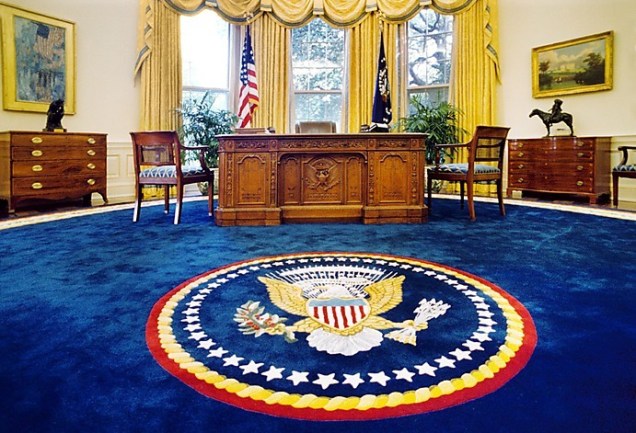
white-house-oval-office-carpet

Using positive reinforcement to steer Donald Trump in a better direction might just work, but only if we stop the blanket hysteria

It is fair to say that the New York Times – which, it always pleases me to remember, not so long ago showed such fawning deference to executive power that they forced their journalists to warp the English language, describing the same actions as “torture” when committed by swarthy foreigners but merely “enhanced interrogation” when conducted by Our Boys – has not taken well to the election of Donald Trump as 45th president of the United States.

But the preface to today’s Opinion Report from the Times, written by David Leonhardt, strikes the right tone and gives some sound advice:

If you opposed Donald Trump’s candidacy, it’s easy to be angry about almost everything he now says or does. When he does something outrageous — like appoint a promoter of racism to a top job — it confirms your fears. And when he does something reasonable — like say he wants to improve the lives of all Americans — it feels hypocritical.

Yet I would still urge people to welcome any step he takes toward democratic normalcy, including those that feel hypocritical.

Trump ran a campaign that was opposed in important respects to American democratic values — and he won. The question that now confronts us is whether our values will change or whether Trump will begin to change.

One of the main reasons that President Obama and Hillary Clinton have reacted to his victory as positively as they have is their desire to move the country back toward democratic normalcy. It’s the right instinct.

I think this is good advice. The endless catastrophisation of Donald Trump’s victory – extending well beyond those areas where we have good reason to fear a Trump presidency toward those where there are no suggestions he intends to make backward steps – is now in danger of doing real harm, not only to the reputations of some of Trump’s most hysterical critics (those who railed against Trump for not committing to accept the election result, and are themselves now refusing to accept the election result) but more importantly to Americans’ faith in their own democracy and electoral system.

During the press pool at their first White House meeting, one could sense the look on Donald Trump’s face that the realisation of what he has wrought is now finally starting to hit. The man who probably didn’t seriously believe he would be in this position, either on the day he announced his candidacy or the day before the election, is rapidly coming to terms with the vast amount of institutional and bureaucratic machinery which he must master, and which will inevitably constrain whatever plans made during the campaign he was serious about enacting.

The mere fact that President Obama spent 90 rather than 15 minutes in that initial meeting walking Donald Trump through the basics (oh to have been a fly on the wall during that American Government 101 session) and plans to hold many more such remedial governance classes with an apparently grateful Trump suggests that the president-elect is finally beginning to accept that there are many things he does not know, and many areas where his administration will need to be guided by the advice and precedent left by history.

And as a reader of this blog pointed out, Americans (and the world) have thrown themselves into a panic before about incoming Republican administrations – with similar accusations of naivety, ignorance and incompetence – only to later have to grudgingly concede that the resulting presidencies were quite good, even historic.

Now, to be clear: I have no such expectations of Donald Trump, who is a tiny fraction of the man that Ronald Reagan was, and certainly nowhere near as faithful a friend to conservatism or the cause of liberty. Real, visceral concern about Trump’s presidency is entirely warranted, especially where it can be eloquently articulated (as opposed to inchoate paranoia) and particularly where its expression closes off doors to some of the more obviously dangerous Trumpian flights of fancy. And of course public protest has an important place in expression opposition to the Trump agenda. But let’s spare the sackcloth and ashes, particularly those of us with public platforms either large or small.

If the goal (for everybody) is to survive the next four years intact and to make Donald Trump’s presidency a successful one for America in spite of the man himself, then we need to ask whether mass hysteria, Trump catastrophisation and total implacable opposition to everything the new administration tries to do is really the best approach, or whether it might be better to provide affirmation and support where Trump does something right combined with forceful dissent and opposition where he or his team stray from an acceptable path, in the hope of teaching the new president some boundaries.

It is quite clear to this blog which is the better option. Keep screaming that everything Trump now does is tantamount to fascism will be like crying “wolf!”, causing the president-elect himself to block out the just criticism along with the superficial, and his supporters to harden in their support for him. We saw just how well that approach worked during the election campaign. Let’s not now make the same mistake during the transition and on into the new administration.

Where Trump does the right thing – even if it means walking back on previous, extreme campaign positions – it wouldn’t hurt to try giving credit where credit is due, at least for a trial period. If we know anything of Donald Trump’s character, it is that while he will take any publicity, good or bad, he much prefers people to think well of him.

And while the Democratic Party and intra-GOP opposition take their time to get organised, Donald Trump’s desire to be admired and respected may turn out to be a very useful constraining factor on his behaviour on office.

Those of us with real concerns about Donald Trump’s presidency should not throw away that potentially vital lever of control in our haste to criticise absolutely everything about the incoming president.


donald-trump-presidential-election-victory-speech-2

Support Semi-Partisan Politics with a one-time or recurring donation:

Agree with this article? Violently disagree? Scroll down to leave a comment.

Follow Semi-Partisan Politics on TwitterFacebook and Medium.

After Hillary Clinton’s Defeat, The Battle For The Democratic Party’s Soul Begins

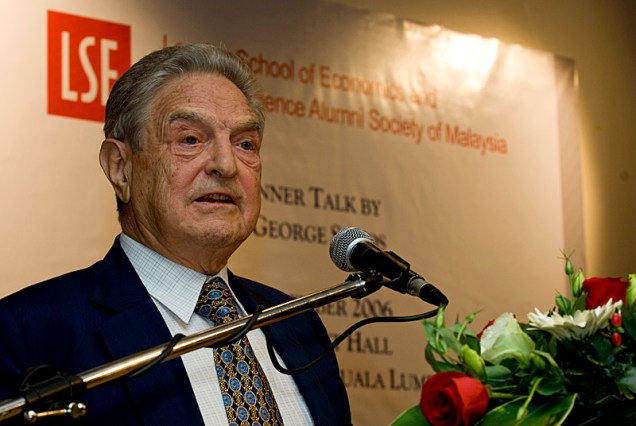
george-soros

Wealthy Liberal donors to the Democratic Party are debating whether to double down on their identity politics and victimhood culture-based strategy or to attempt meaningful outreach to the white working classes whom they so conspicuously cut adrift in 2016

And so the post-election autopsy begins, as analysts slice open the carcass of Hillary Clinton’s failed presidential campaign and methodically pick through the vital organs to determine what possible failure allowed a well-funded presidential campaign that has effectively been running for over a decade to go down in flaming defeat at the hands of Donald Trump.

Politico reports that the hilariously named Democracy Alliance (a group of mega-rich Democratic Party donors using their wealth to tilt the scales of genuine democracy every bit as much as the “evil” Koch brothers) is holding an emergency meeting at the Washington DC Mandarin Oriental hotel to thrash out the issues:

George Soros and other rich liberals who spent tens of millions of dollars trying to elect Hillary Clinton are gathering in Washington for a three-day, closed door meeting to retool the big-money left to fight back against Donald Trump.

The conference, which kicked off Sunday night at Washington’s pricey Mandarin Oriental hotel, is sponsored by the influential Democracy Alliance donor club, and will include appearances by leaders of most leading unions and liberal groups, as well as darlings of the left such as House Democratic leader Nancy Pelosi, Sen. Elizabeth Warren and Congressional Progressive Caucus co-chairman Keith Ellison, according to an agenda and other documents obtained by POLITICO.

The meeting is the first major gathering of the institutional left since Trump’s shocking victory over Hillary Clinton in last week’s presidential election, and, if the agenda is any indication, liberals plan full-on trench warfare against Trump from Day One. Some sessions deal with gearing up for 2017 and 2018 elections, while others focus on thwarting President-elect Trump’s 100-day plan, which the agenda calls “a terrifying assault on President Obama’s achievements — and our progressive vision for an equitable and just nation.”

However, there are now murmurings of discontent among some of the Democrats present, who claim that persisting with the same tired, clapped out old ideas and electoral strategies will not reverse their sliding fortunes:

Yet the meeting also comes as many liberals are reassessing their approach to politics — and the role of the Democracy Alliance, or DA, as the club is known in Democratic finance circles. The DA, its donors and beneficiary groups over the last decade have had a major hand in shaping the institutions of the left, including by orienting some of its key organizations around Clinton, and by basing their strategy around the idea that minorities and women constituted a so-called “rising American electorate” that could tip elections to Democrats.

That didn’t happen in the presidential election, where Trump won largely on the strength of his support from working-class whites. Additionally, exit polls suggested that issues like fighting climate change and the role of money in politics — which the DA’s beneficiary groups have used to try to turn out voters — didn’t resonate as much with the voters who carried Trump to victory.

“The DA itself should be called into question,” said one Democratic strategist who has been active in the group and is attending the meeting. “You can make a very good case it’s nothing more than a social club for a handful wealthy white donors and labor union officials to drink wine and read memos, as the Democratic Party burns down around them.”

This blog (and many others) have already written extensively that the cynical decision by the Democrats and the American Left in general to wage a relentless identity politics war against the Right is not only misguided, but actively polarising the country, as continued efforts to label working class white people as privileged “oppressors” will only further encourage them to form into a cohesive identity group of their own – the very one which elected Donald Trump as the next president.

Obsessing endlessly about the politics of race, gender and sexuality at a time when many Americans are either suffering economically or teetering on the brink of real economic insecurity is a privilege only available to the type of people who meet at the Mandarin Oriental to naively ask one another how anybody could possibly not have wanted Hillary Clinton to be the next president. To anybody else, the narrow interests and shrill, hectoring tone of the Democratic Party are an irrelevance at best and a source of supreme annoyance and alienation at worst.

People living in towns decimated by the loss of skilled manufacturing don’t want to be told that it is actually a good thing that their air pollution-causing factory closed down and took their job with it, or that they are borderline racists and bigots for not immediately adopting the latest social justice buzzwords spewing out of the university system. Yet the Democrats had little of value to say to the white working classes, the candidate herself clearly much more at home among the Wall Street and progressive celebrity class, spending the night before the election partying with the likes of Beyoncé rather than showing any empathy for struggling voters in the so-called rust belt.

Unfortunately, other delegates seem so wedded to the present profile of the Democratic Party that they believe that change is neither necessary nor desirable.

The Politico report continues:

“We should not learn the wrong lesson from this election,” said the operative, pointing out that Clinton is on track to win the popular vote and that Trump got fewer votes than the last GOP presidential nominee, Mitt Romney. “We need our people to vote in greater numbers. For that to happen, we need candidates who inspire them to go to the polls on Election Day.”

In other words – keep pursuing the SJW vote, even though many of these people have proven that the limit of their political activism is sharing a smug little meme on social media rather than taking the trouble to actually walk to their local polling place and participate in democracy.

This is abysmal advice, not only because it places the future hopes of the Democrats on the shoulders of people who have never once come through for the party, while many of those young people who were politically engaged are probably still smarting from the party’s frantic efforts to thwart Bernie Sanders and allow the coronation of Hillary Clinton as the eventual presidential candidate. That’s one very valid reason, but the other reason is that no party should actively seek to write off the votes of such a large constituency as the white working class. Even if the Democrats could win without the core of America, what does it say about the party that they don’t even bother with meaningful outreach?

Of course, one could level exactly the same criticism at the Republican Party, who for too long have been more than happy to cede the black and growing Hispanic vote largely to the Democrats rather than highlighting the many ways that conservative policy actually often meshes far more closely with some of their concerns (e.g. the Hispanic focus on the family). Indeed, the 2012 Growth & Opportunity Project report outlined a path toward better engagement with these communities and might have started to pay dividends in 2016 had the party not decided to tear it up and focus on complete obstructionism toward Barack Obama instead.

But while it is undeniable that the Republican Party has serious issues of its own – not only relating to minority outreach, but also a more fundamental question of how much to accommodate or push back against president-elect Trump’s authoritarian, big government instincts – it is the Democrats who snatched defeat from the jaws of victory, and who twice in two decades managed to lose a presidential election despite winning the national popular vote. The onus is on the Democrats first and foremost to work out what they stand for in 2016.

More encouraging than the billionaire talking shop underway at the Mandarin Oriental – a sign of just how disconnected the modern Democratic Party has become from its former roots – is defeated primary candidate Bernie Sanders’ efforts to wrest control of the party away from the dull, visionless centrists who have nothing to offer once you strip away the thin veneer of jealous identity politics.

In another Politico piece entitled “Bernie’s Empire Strikes Back“, we learn:

Supporters of Bernie Sanders’ failed presidential bid are seizing on Democratic disarray at the national level to launch a wave of challenges to Democratic Party leaders in the states.

The goal is to replace party officials in states where Sanders defeated Hillary Clinton during the acrimonious Democratic primary with more progressive leadership. But the challenges also represent a reckoning for state party leaders who, in many cases, tacitly supported Clinton’s bid.

“I think the Bernie people feel very strongly that they were abused, somehow neglected during the primary process and the conventions,” said Severin Beliveau, a former Maine Democratic Party chairman who supported Sanders in the primary. “In Maine, for instance, where Bernie got 70 percent of the caucus vote, they are emboldened and in effect want to try to replace [Maine Democratic Party chairman] Phil Bartlett, who supported Clinton.”

[..] The movement outside Washington to install new leadership — especially new leaders whose progressive credentials include support for Sanders’ presidential bid — mirrors the battle in the nation’s capital for the Democratic National Committee chairmanship in the wake of the devastating Clinton defeat and congressional elections where Democrats failed to win back either the House or the Senate. Sanders has endorsed Rep. Keith Ellison, leading House progressive and a prominent backer of his presidential campaign, to be the next permanent DNC chairman.

While this blog disagrees with Bernie Sanders on nearly everything, Hillary Clinton’s defeated primary opponent does at least correctly identify many of modern America’s ailments and propose more authentically (if flawed) left-wing solutions to them. And one can plausibly argue that Sanders has a greater ability to reach out to unionised or working class America than Clinton displayed (though one can only wistfully imagine how much better Joe Biden would have been in this role).

Better still, Bernie Sanders seemed to have comparatively little time for peddling in divisive identity politics. Rather than seeking to fracture America into a thousand competing victimhood groups, each one jealously guarding its own unique set of grievances against the common oppressor, Sanders has consistently more interested in the wealth divisions in society. And while playing rich and poor off against one another in quite such an overt way as the openly socialist Sanders comes with its own set of problems, on balance it is probably much less harmful to the fabric of America than seeking to divide and stoke up fear based on race, gender or sexuality.

Indeed, the fact that Bernie Sanders frequently found himself on the wrong side of Black Lives Matter and the gun control lobby only proves his resonance with the great core of working class America rather than the ultra-progressives. If only Sanders didn’t hug the S-word (socialism) quite so tightly in a country where people are (rightly, in this blog’s view) raised to be automatically suspicious of it, he might have prevailed over Clinton in the primary and taken the fight to Donald Trump on a number of very different fronts.

In short, as during the primary season, none of the options facing the Democratic Party are greatly appealing. Having taken conspicuously little interest in white working class concerns throughout the 2016 presidential election cycle, any efforts to restart outreach will be met with scepticism at first, and take time to pay dividends.

But for their own sake, the Democrats must persist. The alternative – doubling down on their toxic identity politics strategy and continuing to carve America up into competing victim groups and seeking to make them all fear the Evil Republicans – will only inspire an equal and opposite reaction among America’s largest minority group, the white working class.

In 2016, this strategy brought us president-elect Donald Trump. Do the Democrats really want to roll the dice and bet that the same inputs will deliver a better outcome in 2020?


donald-trump-presidential-election-victory-speech-2

Top Image: Wikimedia Commons

Support Semi-Partisan Politics with a one-time or recurring donation:

Agree with this article? Violently disagree? Scroll down to leave a comment.

Follow Semi-Partisan Politics on TwitterFacebook and Medium.

U2’s Bono Named Woman Of The Year

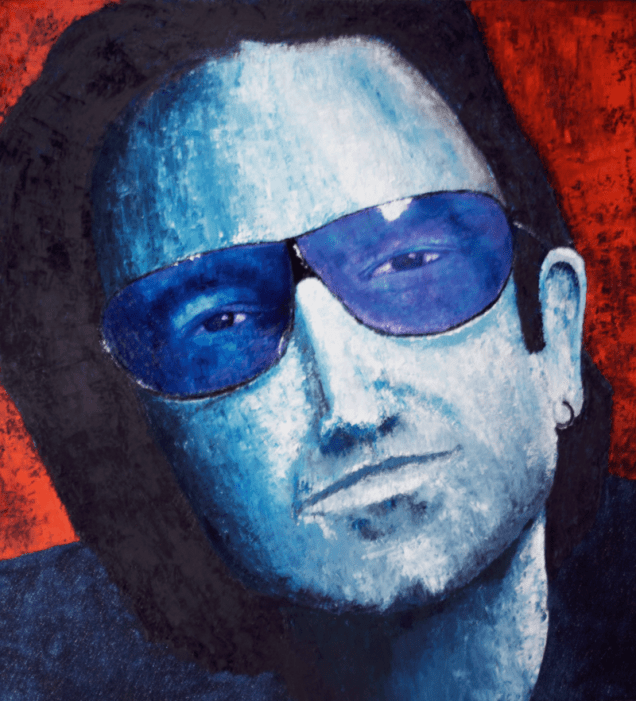
bono-glamour-woman-of-the-year

Glamour magazine is so hard-stretched to find enough worthy female candidates for its Women of the Year shortlist that any progressive male with a decent track record of philanthropy is now in with a shot of winning the prize

Meanwhile, back in SJW-land, life goes on as normal… Glamour magazine has named Bono as one of its Women of the Year.

Now, parents can tell their daughters that one day they too can grow up to be Bono, that designer stubble-sporting, wraparound sunglasses-wearing crooner. Though of course in the age of identity politics, this was always self-evidently the case – it simply involves standing up, declaring that “I identity as the lead singer of Irish rock band and celebrity philanthropist U2” and then demanding that everybody else bow down and play along with your delusion, lest they be accused of intolerance or oppression.

But of course Glamour magazine is doing this to make a Worthy Point, and so we must all nod our heads at their little stunt and murmur “how provocative and brave”.

Christiane Amanpour gushingly writes in the magazine:

When humanitarian and rock icon Bono learned that he was being honored by Glamour as the first-ever Man of the Year, he called his wife of 34 years, Ali Hewson, to give her the news. “I asked did she think I deserved it. She wasn’t sure,” Bono tells me with a laugh. “She said I’ve work to do!”

U2’s front man has no doubts. “I’m sure I don’t deserve it,” he says. “But I’m grateful for this award as a chance to say the battle for gender equality can’t be won unless men lead it along with women. We’re largely responsible for the problem, so we have to be involved in the solutions.”

I’m on Glamour’s side: I think Bono is the perfect choice for this first-time honor because, now 56, he’s been trying to do good for as long as he’s been making music. I first met Bono, born Paul David Hewson, in Sarajevo over New Year’s 1996, shortly after peace accords ended the Bosnian civil war that November. It was the first time in four years that the guns were silent and the people of that beautiful city could celebrate by taking to the concert halls and cafés. I got pulled into a crowded car one night, heading for a party, and there was Bono. Our two-decade humanitarian friendship was launched.

And while my friend has sold 170 million albums and won 22 Grammys, what I admire most about him is his extraordinary talent for tackling problems that seem intractable—and making mighty and measurable gains. It’s not every superstar (or, for that matter, statesman) who can bring about $100 billion in debt cancellation for 35 of the world’s poorest countries, or persuade the U.S. government to pony up the largest contribution ever for lifesaving AIDS drugs in Africa, as President George W. Bush did in 2004.

Now Bono has created Poverty Is Sexist, a new campaign specifically aimed at helping the world’s poorest women—those who survive on less than $2 a day. “Women bear the burdens of poverty,” Bono says, meaning they are far less likely than men to have access to food, clean water, education, and health care; laws in many parts of the world don’t protect them from sexual violence or allow them to own the land they work. By establishing Poverty Is Sexist, Bono is making it clear that powerful men can, and should, take on these deep-rooted issues.

Poverty is sexist? Give me a break. By this alarmist logic, anything impacting men and women differently is inherently sexist, and therefore in need of immediate corrective action by government or other actors. Pregnancy? Utterly outrageous that women are left to bear the burden alone. Money should be poured into womb transplant research and artificial gestation technology so that men can either be surgically forced to bring 50 percent of new life to term themselves, or all of humanity can outsource the job to technology in the name of equality.

Real, grinding poverty – better thought of as the absence of wealth – is debilitating and responsible for nearly all of Beveridge’s famously identified Five Giant Evils. It should be tackled on that basis, not devalued and politicised by slapping an additional identity politics label onto poverty, as though calling it names will make it go away.

But a man winning an award designed for women?

The Telegraph’s Radhika Sanghani is unconvinced:

Glamour’s editor-in-chief Cindi Leive, tried to justify the decision: “We’ve talked for years about whether to honour a man at Women of the Year and we’ve always kind of put the kibosh on it. You know, men get a lot of awards and aren’t exactly hurting in the awards department. But it started to seem that that might be an outdated way of looking at things and there are so many men who really are doing wonderful things for women these days.”

Yes, there are. And none of these men who do “wonderful things for women these days” become women themselves by doing so.

Sanghani continues:

I know these decisions come from a good place. The UN’s appointment was probably meant to be a symbol to raise awareness, while Glamour referenced the #HeForShe movement as part of their reasoning for choosing Bono – saying gender equality will never be achieved unless privileged white men get on board.

Yet underneath the humour (see Tweet embeds for the best Bono jokes going around today) there is an uncomfortable feeling that no woman was good enough for the position. That Glamour couldn’t find a tenth inspiring woman deserving of the award, while the UN couldn’t find another Emma Watson to make empowerment appealing to the masses. Even Bono, gets it, telling the magazine: “I’m sure I don’t deserve it.”

There you have it; straight out of the 2016 Woman of the Year’s mouth – a man doesn’t deserve to have an award celebrating women. Who would have thought it?

I am less confident that these decisions come from a good place.

When Caitlyn Jenner won Glamour’s Woman of the Year award last year, at least the former Bruce Jenner made the effort to physically transition from male to female and begin living as the latter before being given her award. But those who worried about excessive fluidity in gender identity didn’t realise how quickly things would develop. Fast-forward just one year and now one might find oneself publicly declared a different gender just for doing a bit of charity work.

Together with some other individuals from my old firm, I once spent a day re-painting a community centre for elderly residents in east London, and another day teaching employment and job-searching skills to young NEET (not in employment, education or training) teenagers. Does that entitle me to be named as a contender for either Septuagenarian or Disadvantaged Kid of the Year?

We can trace this kind of stunt back to Bill Clinton – he who spoke of “super-predators” and did as much as anyone to promote mass incarceration – being lauded as the “first black president” back in 2008.

At one time we could dismiss stunts such as this from the Congressional Black Caucus as isolated incidents. But we seem to have reached critical mass with this phenomenon where it is now considered hip, edgy and provocative to deliberately misgender people, both as a way of generating controversy to keep public attention fixed on something increasingly irrelevant (print magazines) and to further undermine the idea of biological gender altogether.

This is becoming ridiculous. It is one thing for grown adults to declare that they wish to identify as a different gender – to which the polite response should be to comply with their request, no matter one’s personal stance on transgender issues. But it is another thing entirely for the media to start bestowing new gender identities on unwitting people as a signal of approval of their actions.

Gender is innate, and means far more than simply being a pat on the head for good work, even for a lifetime of charitable service. If U2’s Bono actually wants to be a woman, there is a clear and well-trodden path laid out for him to do so and many people will light the way with glowsticks and strew it with petals.

But assuming that he does not in fact want to become a woman, Bono should demonstrate real respect for women by refusing to participate in this insidious game, and decline the Glamour award.


glamour-women-of-the-year

Top Image: Rene Romero, Wikimedia Commons

Support Semi-Partisan Politics with a one-time or recurring donation:

Agree with this article? Violently disagree? Scroll down to leave a comment.

Follow Semi-Partisan Politics on TwitterFacebook and Medium.