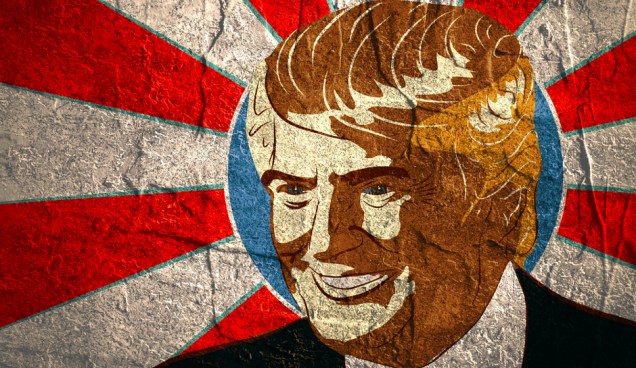
The Abnormalization Of President Trump

Abnormalization of Donald Trump

Donald Trump is not the first US president to ride roughshod over the Constitution or flout the checks and balances on executive power – and an honest media with any credibility would acknowledge as much

In highlighting the latest craven example of oversensitive American university students and administrations rescinding invitations to prominent conservative-leaning speakers, the Washington Post reports:

Once reserved for cheesy senior photos at campus landmarks, college commencement exercises have graduated into something different six months after Donald Trump was elected president: a battleground for protesting conservative policies and the people who promote them.

This is incredibly disingenuous. The trend of academic institutions and strident students refusing to tolerate the presence of anybody whose opinions diverge from the current leftist, social justice orthodoxy has been on the ascendance for well over a decade now, has accelerated rapidly in the last five years and has been widely commented on, written about and discussed – not least on this blog.

And yet here the Washington Post seeks to present the “student snowflake” syndrome as a new development which only now is rearing its head “six months after Donald Trump was elected president”. This comes perilously close to excusing the rising tide of illiberalism as merely a symptom or reaction against Trump’s unexpected victory, when in actual fact anybody with a functioning brain knows that Donald Trump’s victory was largely the symptom or reaction against the illiberal, intolerant Control Left.

But we are now witnessing a trend of articles and Op-Eds such as this, all seeking to portray every last one of Donald Trump’s actions as US president as being extreme and unprecedented in recent history. On foreign policy, domestic policy, constitutional matters and social issues, critics of Donald Trump (including the prestige Washington media) often seek to portray Trump as far more extreme than he has thus far shown himself to be, at least as far as policy initiatives and executive actions are concerned.

None of this is to support Donald Trump or excuse the atrocious start he has made to his presidency, which has been characterised by one largely self-inflicted political wound after another. Rather, the point is that by falsely pretending that every time Donald Trump breathes he is gravely wounding the Republic in ways unmatched by any previous president, Trump’s critics and the media inadvertently excuse serious failings in US policy and of past US administrations which deserve to be studied, criticised and rectified rather than merely glossed over.

Nicole Hemmer picked up on some of these areas as part of an article in Politico Magazine:

Many journalists covering the White House have lapsed into a practice of “Trump exceptionalism,” a tendency to assume each move the administration makes is new and nefarious. This assumption comes from a well-meaning place—a worry that they will be complicit in normalizing dangerous behavior in an American leader. But there are real risks, too.

First, it leads to quick-trigger panic over events that are normal. Take the reaction to the administration’s dismissal of 46 U.S. attorneys. Journalists framed it as a purge, and the panic escalated when one of those attorneys, Preet Bharara, refused to resign and was subsequently fired. But the dismissal of U.S. attorneys has been standard practice since the 1990s. The novel behavior here was Bharara’s. There’s a cost to getting this wrong: Cry wolf too many times, and readers are less likely to listen when the real dangers appear.

But perhaps the more important consequence of Trump exceptionalism is that it encourages journalists to overlook continuities. Trump is an abnormal president, unprecedented in many ways. But he is not sui generis. His anti-Muslim policies, hard-line anti-immigration stance, even his economic populism and free-trade skepticism all have long histories—even within mainstream conservatism. His nomination of Neil Gorsuch to the Supreme Court was as straightforwardly Republican as it gets.

One can quibble over the wording and focus of Hemmer’s argument – hysterically and disingenuously talking about Trump being “anti-immigration” when he has expressed no clear reservations whatsoever about legal immigration, for example. But her basic point is correct – inexperienced and superficial DC journalists have been too eager to cram every piece of news into their “Trump is unprecedented” narrative, whether each individual action happens to fit the mould or not.

When it comes to the Trump administration’s recent overtures to more authoritarian regimes (including Saudi Arabia and Turkey’s dictator-in-gestation Recep Tayyip Erdoğan), Glenn Greenwald does a far better job counting the ways that US support for morally questionable allies is far from unprecedented:

Since at least the end of World War II, supporting the world’s worst despots has been a central plank of U.S. foreign policy, arguably its defining attribute. The list of U.S.-supported tyrants is too long to count, but the strategic rationale has been consistent: In a world where anti-American sentiment is prevalent, democracy often produces leaders who impede rather than serve U.S. interests.

Imposing or propping up dictators subservient to the U.S. has long been, and continues to be, the preferred means for U.S. policymakers to ensure that those inconvenient popular beliefs are suppressed. None of this is remotely controversial or even debatable. U.S. support for tyrants has largely been conducted out in the open, and has been expressly defended and affirmed for decades by the most mainstream and influential U.S. policy experts and media outlets.

The foreign policy guru most beloved and respected in Washington, Henry Kissinger, built his career on embracing and propping up the most savage tyrants because of their obeisance to U.S. objectives. Among the statesman’s highlights, as Greg Grandin documented, he “pumped up Pakistan’s ISI, and encouraged it to use political Islam to destabilize Afghanistan”; “began the U.S.’s arms-for-petrodollars dependency with Saudi Arabia and pre-revolutionary Iran”; and “supported coups and death squads throughout Latin America.” Kissinger congratulated Argentina’s military junta for its mass killings and aggressively enabled the genocide carried out by one of the 20th century’s worst monsters, the Indonesian dictator and close U.S. ally Suharto.

Nor is Trump’s foreign policy behaviour a particular departure from more recent US administrations:

U.S. devotion to the world’s worst dictators did not end, or even recede, upon the end of the Cold War. Both the Bush and Obama administrations continually armed, funded, supported, and praised the world’s worst dictators.

In 2009, then-Secretary of State Hillary Clinton actually said of the murderous Egyptian dictator supported by the U.S.: “I really consider President and Mrs. Mubarak to be friends of my family.” When Egypt’s defense minister, Gen. Abdel-Fattah el-Sisi, overthrew that country’s first elected government, Clinton’s successor, John Kerry, hailed him for “restoring democracy,” and as Sisi became more brutal and repressive, the Obama administration lavished him with more weapons and money. The U.S. government did the same for the human-rights abusing dictators in Bahrain.

And of course this is to say nothing of Saudi Arabia.

It is bad enough having a US president who seems to suffer from self-delusions. That the Washington media and commentariat are engaging in fantastical delusions of their own is doubly dangerous for American democracy and policy.

To read the combined output of the American media, one would be forgiven for thinking that the George W. Bush administration never sanctioned the illegal torture of prisoners through dubious legal memos, and that the Obama administration never once decided to blast American citizens off the face of the earth with drone strikes, maintaining a “kill list” of US citizens who could be zapped without any due process.

No, apparently all of these sins are now forgiven – to the extent that the servile, sycophantic Washington media bothered to hold past administrations or senior officials accountable for their actions in the first place, generally preferring to party and intermarry with the political elite rather than be remotely adversarial.

In fact, the harsh truth is this: the only reason that Trump administration officials are being dragged over the coals for their own skirting of the Constitution and departures from US diplomatic and international norms are that Donald Trump has refused to cozy up to the Washington media class in the manner typical to all previous presidents, and so has failed to build up the traditional reserves of goodwill which would otherwise lead to effective immunity from scrutiny or criticism of himself and his administration.

This is a real and pressing problem, because every instance when the mainstream US media freaks out and acts as though Donald Trump is breaking new ground in authoritarianism by simply behaving in the same way as his predecessors only serves to drive a wedge between those media outlets and Trump-sympathising voters who already widely distrust the mainstream media – often with good reason.

Trump supporters need to be legitimately informed of occasions when the US president is acting in an unprecedentedly negative way, and examples of such behaviour – like the firing of FBI director James Comey for an ever-changing kaleidoscope of official reasons – are already rapidly mounting up. But their impact is massively diluted when Trump supporters have legitimate reason to believe that the media, angry at their rude treatment by the White House, is deliberately whipping every story into a major scandal, regardless of individual merit.

And the same goes for the rest of us, too. It does dissenting Republicans, Democrats and independents no favours when their every prejudice about Donald Trump is endlessly reconfirmed by an hysterical media which was only too happy to overlook some of the same faults, vices and mistakes in his predecessors of both parties. This behaviour by the media is not new, but the partisan debasement of political journalism has certainly sunk to new lows since Donald Trump took office.

A strong, almost irrefutable argument can be made that Donald Trump has brought the US presidency to an historical nadir through his personal coarseness, egotism, vengefulness and sheer inability to get to grips with public policy. The degree to which Trump’s political radar – so astute in helping him triumph over the establishment in the Republican primaries and general election – has now deserted him as he seeks to manipulate the levers of power in Washington D.C. is remarkable, if somewhat predictable.

Last week, a journalist was arrested in Washington D.C. for questioning Donald Trump’s Health & Human Services secretary, Tom Price, supposedly too aggressively. The alarming story was widely covered in American media at the time, but it has not driven the news cycle to nearly the same extent as other events which have ultimately proved to be little more than Donald Trump following the precedent set by previous administrations.

Why? Because too many in the media are ready and eager to go to DEFCON 1 every time that Trump opens his mouth, rather than cross-checking to see whether the latest presidential pronouncement or action is genuinely unprecedented or merely a more coarsely-worded rehash of something which would have gone unreported during the Clinton, Bush or Obama years.

Those of us with an active interest in the US media repairing and retaining its credibility in the wake of Donald Trump’s presidency should demand better from journalists, pundits and TV talking heads who currently paint every decision made by the Trump White House as an unprecedented step down the road to dictatorship.

The prestige media pretending to its audience that Donald Trump’s upcoming meetings with authoritarian dictators like Turkey’s Recep Tayyip Erdoğan are somehow unprecedented in American history is every bit as “fake news” as the ludicrous stories on the fringe Right about President Obama operating a paedophile ring out of the White House – only the prestige media’s lies and distortions are ultimately far more damaging, being read and believed by people with real power and influence in American society.

In short, Donald Trump is providing enough fresh new worrying material for us all. There is no need for the media to add to the drama by inventing more.
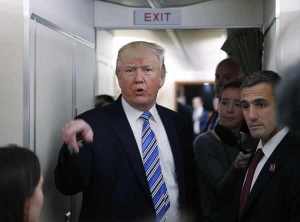
 

Donald Trump speaks to reporters

Support Semi-Partisan Politics with a one-time or recurring donation:

Agree with this article? Violently disagree? Scroll down to leave a comment.

Follow Semi-Partisan Politics on TwitterFacebook and Medium.

At The White House Correspondents’ Dinner, The Political Media Circle-Jerk Proceeded Minus Donald Trump

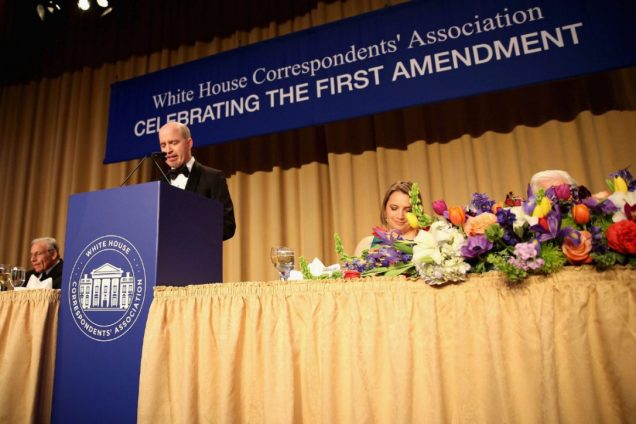
White House Correspondents Dinner - First Amendment - Washington Political Media

At the annual Washington D.C. bash, the political media class were more concerned by the lack of Hollywood celebrities to ogle than the fact that half the country holds them in contempt, feels deliberately misunderstood and distrusts nearly everything that they have to say

The Washington Post reported today on the fact that brave members of the Washington D.C. political media class somehow managed to soldier on and enjoy themselves at the annual White House Correspondents’ Dinner and associated glitzy after-parties despite President Trump’s cruel boycott of the event (Trump decided to hold another one of his dubious rally-style events in Pennsylvania).

Without a single hint of self-awareness, the Post reports:

His voters sent him to Washington to break stuff, and this weekend Donald Trump tried to break the annual dinner of the White House Correspondents’ Association. As with some of his business ventures, he was not wholly successful.

“They’re trapped at the dinner,” the president boomed at a rally in Harrisburg, Pa., celebrating his first 100 days in office. “Which will be very, very boring.”

Instead, it was just fine. It happened. There’s an inertia to these Washington traditions, and a determination to soldier on in the face of — whatever it is we’re facing. Everyone survived this weekend without the president, or without the crush of Hollywood celebrities who for years had been decorating the dinner in ever-increasing density, until now.

It was a bit like an off-year high school reunion: diminished numbers and fewer crazy stories but still no shortage of hors d’oeuvres and dancing and gossip. Everyone settled for sightings of Michael Steele and Debbie Dingell instead of Jon Hamm or a Kardashian. In past years, virtually the entire cast of “Modern Family” would come to the dinner; this year, United Talent Agency only secured the kid who plays Luke.

Well, now we can all sleep easy in our beds. Despite the president of the United States refusing to perform the traditional routine of being self-deprecating and massaging the egos of the people supposed to hold him to account, the Washington press corps somehow managed to rescue the evening and enjoy themselves. Despite being deprived of the opportunity to rub shoulders with Hollywood royalty, the assembled journalists and media executives still managed to mingle, network and slap each other on the backs for a job well done serving the interests of American democracy.

Aren’t you relieved? I know that I am.

More:

Was it only a year ago that Barack Obama dropped the mic, literally, at his final correspondents’ dinner, as if to put an exclamation point on eight years of media savvy and pop-culture propaganda? He knew his role in this circus. It was Obama’s yearly chance to inspire a meme, rib a rival, come off as folksy royalty, remind the public that the media was not the enemy. His cool factor iced out the haters, smudged away red lines, papered over unkept promises. Afterward, the French ambassador’s mansion would swell with swells — both conservatives and liberals, all buddy-buddy in private, united by the daytime charade they pulled off together on TV.

As yes, good old Obama knew his place, knew his role in the “circus” – to dance like a performing seal in an attempt to make the self-satisfied hacks chuckle. Sure, Obama was more successful than most – thanks to a largely uninquisitive media he managed to maintain the “cool factor” right to the end of his presidency – but he stayed firmly within the tramlines of what was expected of him.

And what was that role? What has it traditionally been for administration after administration? Nothing more than making the media class look noble for one evening a year when they spend the other 364 making themselves look tawdry and partisan. Fudging important ideological questions and reducing them to laughing points. Papering over “unkept promises” as the trivialities that they are to the Washington political class – little frauds perpetrated on the American voters, some of whom are naive enough to expect political promises to be kept.

But the Washington Post is certainly in no mood to dwell on the accumulated failure of prestige American news outlets to hold leaders to account or properly represent the range of interests and opinion in the country. After all, the Post are enjoying a bumper season of increased subscriptions and web traffic thanks to the Trump presidency, drunk not on $25 cocktails but on their own sense of nobility (as evidenced by their hilariously overwrought “Democracy Dies In Darkness” motto).

Indeed, the Washington Post seems most anxious for us to know that this year’s event was a dud because Trump might have attended, not because he ultimately chose not to do so:

The guest list suffered not because Trump sent his regrets but, more likely, because of the chance he might attend; he remains dauntingly unpopular with the New York and Hollywood A-list that he had long aspired to join. The pre-dinner receptions, hosted by outlets such as the Wall Street Journal and The Washington Post, were staid and perfunctory, absent the usual angling for a sighting of a “Game of Thrones” star.

Apparently at no point has it occurred to the Post or other such outlets whether the presence of Hollywood celebrities at a political media event might actually be a bad thing rather than something to be celebrated and missed in its absence. It is merely taken for granted that the presence of numerous multimillionaires from the entertainment industry is some kind of sign that the health of American political journalism and culture is in fine fettle.

The focus of the stripped-down event was on defending free speech and celebrating the importance of a free press guaranteed under the First Amendment, something which we can certainly all applaud but which rarely merited such prime-time coverage when the Obama industry was, say, prosecuting whistleblowers with uncommon zeal. Has Trump made numerous troubling statements with regard to freedom of the press, libel laws and freedom of speech and association in general? Absolutely.  But it is telling that much of the media is happy to trumpet the issue now, when it costs them little reputationally or financially, but maintained a pained silence under a more popular “liberal” president.

More:

The dinner itself featured a dutiful pep talk by Watergate legends Bob Woodward and Carl Bernstein.

“Mr. President, the media is not fake news,” Woodward said from the dais, and the media elite applauded.

“CNN and MSNBC are fake news,” Trump said in Pennsylvania, and some of the 97 percent who say they’d still vote for him applauded.

Two worlds, talking past each other, from 100 miles apart. The latest prime-time iteration of POTUS vs. Beltway.

Only it isn’t just POTUS vs Beltway. It is half of America versus the Beltway news outlets and punditocracy. The cosseted Washington media class is so busy being angry at Donald Trump for his bombastic insults and threats that they remain largely unable to look beyond the president to see the many Americans who may not agree with Trump but who share his hatred of the people who filter and report the news.

As this blog has previously discussed, the mainstream American news media is indeed not “fake news” inasmuch as the likes of CNN or the New York Times do not routinely print sensationalist and patently false accounts of fabricated events designed to excite partisan zealots. But they have other far more insidious and effective methods of shaping the narrative through their editorial stances and very deliberate use of language.

As I wrote last year:

Fake news can incorporate false facts, but also correct facts which have been deliberately misinterpreted or spun. And far more insidious than any one fake news story, no matter how egregious, is the way in which language is often used to subtly change public perceptions over time – note how we now speak about “undocumented” rather than “illegal ” immigrants, a change adopted by nearly all of the mainstream media in America, and now in Britain too.

When the media is secretly complicit in ideologically-driven agendas, trust in the more reputable media is rightly weakened. But this leaves people more vulnerable to peddlers of deliberately fake news, as they search for alternatives. The obvious answer is for mainstream prestige outlets to rediscover their integrity and stop forcing readers away with ideologically skewed coverage, but they will not desist, and so they fuel the exodus of readers away to the fringes of the internet, a place where the more outrageous a story sounds, the more people will read it.

But there they all sat, facing a stage emblazoned with the words “Celebrating the First Amendment” and no doubt feeling inordinately pleased with themselves for the stellar work they believe they are doing in standing up to the Trumpian dystopia, unaware or more likely just unconcerned by just how hated and distrusted they are throughout vast swathes of their own country.

The New York Times had an interesting feature article today looking at the upcoming final round of the French presidential election between centrist empty-suit Emmanuel “status quo” Macron and depressing protectionism advocate Marine Le Pen. The piece focuses on the struggling northern town of Calais, a place I know quite well through many visits during my adolescence, and is actually quite fair in its examination of the erosion of the town’s biggest industry in the face of global competition and the lack of political answers

For a piece of New York Times journalism, it is pretty good – especially compared to their godawful “Will London Fall?” hitpiece on Britain and their generally hysterical and uncomprehending coverage of Brexit.

The only problem? The New York Times has to send reporters on expeditions into towns like Calais in order to talk to the locals and get to know their concerns, just as American reporters descended with newfound intensity on Trumpland after the US presidential election trying to figure out what went wrong, and just as shellshocked London political journalists stumbled shellshocked beyond the great metropolis in a bid to understand what Middle England was thinking.

The New York Times article’s author, Liz Alderman, is naturally based at the newspaper’s Paris bureau. Unless she makes a conscious effort, nearly every human interaction she makes will be likely with somebody who intends to vote for Macron in the second round. This is not to impugn Alderman’s work or journalistic ethics – the Calais piece proves that she does seek out contrary opinions in the unloved regions of France when required. But when the majority of your professional and social life is spent among people who hold one set of values, the occasional field trip to the other side of the tracks cannot make up for deep-rooted understanding of – and empathy with – the more pro-globalism, pro-EU, pro-market side.

And so it is in Washington D.C. The people who gather each year for the White House Correspondents’ Dinner (and then grumble about how they no longer get to rub shoulders with Hollywood stars thanks to the big bully in the White House) may make the occasional foray into Trumpland if the needs of a story require it. But the vast, vast majority do not live the lives of Trump supporters, nor live among them, nor count such people among their friends or family. And you simply cannot report fairly, accurately or honestly about people whom you have to interview to get any kind of sense of who they are or what their hopes, dreams and fears may be.

The White House Correspondents’ Association clearly does not care. They have calculated that they can prosper just fine by continuing to swagger around like noble seekers of truth, bellowing about free speech and holding President Trump to “account” (while furiously ignoring just how much their lust for TV ratings and pageviews fuelled his rise in the first place). But should one of the tuxedoed dinner attendees ever stop to wonder how Donald Trump is able to effortlessly turn a crowd of people against the media at a campaign rally, this is the reason.

Trump’s non-attendance was the perfect excuse to cancel a sleazy and tawdry annual event which should have been axed many years ago, if only the bipartisan ruling class had any self-awareness or a care for how they appeared to the rest of the country.

But even now they party on, while America burns.


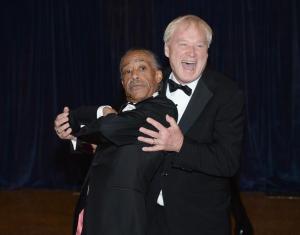
Chris Matthews - Al Sharpton - MSNBC

Support Semi-Partisan Politics with a one-time or recurring donation:

Agree with this article? Violently disagree? Scroll down to leave a comment.

Follow Semi-Partisan Politics on TwitterFacebook and Medium.

Social Justice Watch: Bill Nye’s Junk Science And Rachel Bloom’s ‘Sex Junk’

The Cult of Social Justice and Identity Politics is metastatising throughout popular culture – this is not a problem safely confined to university campuses

When I watch videos like this and think to myself “This is it; this is the end of Western civilisation, the acceleration of the fall of Rome”, am I on the money, or am I overreacting just as cantankerous old men once ardently believed that rock ‘n roll was corrupting the kids?

I honestly don’t know any more. Some people seem to be clapping along and cheerfully encouraging this quadrillion gender + ‘satisfy any passing whim that pops into your head’ worldview and its metastatisation throughout the culture, as though it is the most positive and welcome development in the world. A smaller number of people (such as myself) are sounding notes of caution to varying degrees, though perhaps not loudly enough. But the bulk do not seem to believe there is an issue at all.

And now we must suffer the perverse spectacle of Bill Nye the “Science Guy” bestowing the imprimatur of science and rationality on avant-garde gender theory by bopping along while actress and singer Rachel Bloom frantically cavorts, declaring:

‘Cause my sex junk is so oh, oh, oh
Much more than either-or, or, or
Power bottom or a top off
Versatile love may have some butt stuff
It’s evolution, ain’t nothing new
There’s nothing taboo about a sex stew

And:

Sexuality’s a spectrum, everyone is on it
Even you might like it if you sit up on it
Drag queen, drag king, just do what feels right
You’re a tall pansexual flirty wood sprite

Sure, why not? After all, it’s science.

Rod Dreher seems pretty clear in his verdict:

Keep in mind that Bill Nye is considered a pop culture icon by the rationalist crowd intent on demonstrating what poltroons religious people are. And yet, this trash makes “Veggie Tales” play like the Oresteia.

[..] Crazy people. Batsh*t crazy.

I think I’m with Rod.


Teachers for Social Justice

Support Semi-Partisan Politics with a one-time or recurring donation:

Agree with this article? Violently disagree? Scroll down to leave a comment.

Follow Semi-Partisan Politics on TwitterFacebook and Medium.

Tales From The Safe Space, Part 52 – Gustavus Adolphus College, Illegal Immigration And A Failure Of Intellectual Curiosity

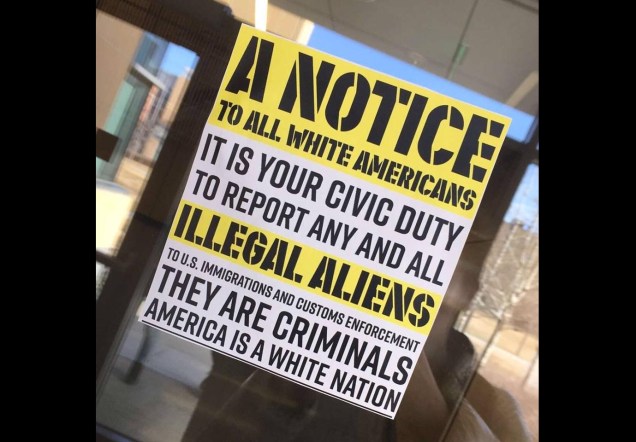
Illegal Immigration - White Supremacy - Gustavus Adolphus College - Poster

The Cult of Social Justice and Identity Politics takes a fierce, perverse pride in refusing to understand the arguments of anyone who holds alternative ideas

What genuine attempt at political dialogue begins with a deliberate effort to misunderstand and mischaracterise the opposing side, misrepresent their motives and impugn their morals?

The answer, of course, is none. No respectful or productive discussion is possible when one side deliberately poisons the well in such a manner. Yet this is exactly what the Diversity Leadership Council at Gustavus Adolphus College did when they posted a series of fake, deliberately racist anti-illegal immigration posters around campus to spur a discussion and supposedly “educate” people about racism.

Campus Reform reports:

The “Diversity Leadership Council” at Gustavus Adolphus College has admitted to posting racially offensive posters around campus after the school’s Bias Response Team received multiple reports on the matter.

The signs, which are now being labeled a social experiment, notified “all white Americans” to report “any and all illegal aliens to U.S. Immigration and Customs Enforcement” because “they are criminals.”

Provocatively declaring that “America is a white nation,” the flyers assert that it is the “civic duty” of white Americans to turn illegal immigrants in to law enforcement.

Because the only people who could possibly concerned about illegal immigration are white people, right? Nobody of any other skin tone or ethnicity could have a problem with turning a blind eye toward those who either illegally cross the border, overstay their legitimate visa or otherwise flout federal immigration law and then seek to use the length of their lawbreaking as an emotional cudgel to lobby for the normalisation of their status. Only racist white people.

Of course, as the predictable outrage crested and the Bias Response Team’s switchboard melted down under the sheer volume of calls from triggered students, it turned out that the whole thing was a fake. The Diversity Leadership Council coming forward with this smarmy statement:

At approximately 10 a.m. this morning, the Diversity Leadership Council (DLC), a student-run organization that represents 21 student groups on campus, posted signs in Beck and Olin Hall which attacked “Illegal Aliens” by suggesting that “they are criminals.” These posts were quickly torn down and shared with members of the campus community via the Facebook Group, Overheard at Gustavus.

It is the mission of the Diversity Leadership Council to formulate a collective voice when our organization recognizes the need to promote, preserve, and protect on-campus diversity. Thus, a subcommittee of the DLC, in collaboration with social justice theatre troupe I Am We Are, posted these signs and accompanying A-frames with bystander intervention tips in academic buildings on campus in an effort to help educate our peers and campus community about issues of bias, and the importance of being an active bystander.

We want to help put an end to bias-related incidents that happen on our campus, social media, and in our communities by forcing individuals to have dialogues about forms of hate and bias.

Social justice theatre troupe? Kill me now.

And so with a straight face, the Diversity Leadership Council of Gustavus Adolphus College told the student body and the wider public that their little stunt – portraying concern over illegal immigration as the exclusive preserve of white nationalists – was intended to foster “dialogue”.

The National Review’s redoubtable social justice beat reporter, Katherine Timpf, thunders:

Hey, kids? If you want to “help put an end to bias-related incidents that happen on our campus,” how about you address those incidents instead of distracting from them by making up a fake one? Seriously — just what is bringing awareness to a fake issue going to solve? It’s not going to help solve that issue, because — and sorry if I’m blowing your mind here — a problem has to actually exist in order for you to be able to solve it.

Now, I am not sure exactly what kinds of “bias-related incidents” are happening on that campus, but I do know that there being people on campus who felt so strongly that only white people should live in America that they were running around posting “AMERICA IS A WHITE NATION” flyers to help achieve that would be a serious one indeed. Presumably, this fake incident is on a completely different level from anything that is actually happening on that campus, which means that any “dialogues” related to it are on a completely different level, too. No doubt, these flyers must have left a lot of people feeling freaked out and threatened based on a false issue, all for the sake of having a discussion about something that didn’t even exist — and that’s about as disgusting as it gets.

Timpf’s objection is all well and good, but the real problem is not the fact that demented SJWs have now taken to crying “wolf” when starved of more legitimate opportunities for outrage (depressing though that is), but rather the fact that these campus leaders and activists are studying at university yet seemingly totally incapable of understanding the alternative arguments and perspectives which they so vociferously oppose.

One does not need to be a white nationalist to oppose illegal immigration. In fact, the vast majority of those who choose not to celebrate illegal immigration are perfectly welcoming and tolerant of immigrants, provided that they a) settle in America through the proper legal process, and b) assimilate into general society once they arrive. Are there racists and white nationalists as well? Of course there are. But while all white nationalists may object to illegal immigration, not all people who object to illegal immigration are white nationalists. Not even a plurality of them.

And yet rather than encouraging students to deeply understand an issue or argument from all sides, universities today seem to openly encourage an outcome-based approach to thinking about certain issues – for students to start at their desired endpoint (open borders and the normalisation of all current illegal immigrants) and then choose the facts (or Trumpian alternative facts) to back up that position.

I was always taught that in order to properly debate with somebody, let alone stand a chance of winning an argument against them, one must first seek to fully understand and be able to properly articulate the opposing argument, from the opponent’s perspective. Only armed with this knowledge can one properly analyse, refute and undermine the premises of their argument in order to comprehensively attack their conclusion.

By contrast, today’s campus activists – raised on the dogma of the Cult of Social Justice and Identity Politics – lack the capacity not only to understand opposing viewpoints in order to argue properly, they also seem unable even to assume the good faith of those who hold alternative views. They are so high on their own sense of self-righteousness that they lack the basic intellectual curiosity to seek to understand why somebody might disagree with their position. Hence objection to illegal immigration is described in the posters at Gustavus Adolphus College as being of concern only to white Americans who believe that “America is a white nation”.

But the truly depressing thing is that while the Social Justice Star Chamber of Gustavus Adolphus College may have gone slightly further than most in terms of fabricating fake racist posters to get outraged about “promote a discussion” about their pet topics, the simplicity of their thinking is mirrored across a vast portion of society and the media.

How harshly can one really criticise the social justice zealots at Gustavus Adolphus College when the American mainstream media is also in the business of deliberately conflating legal and illegal immigration so as to portray opposition to the latter as racist-inspired hostility to the former?

How strongly can one denounce the student activists when the leadership of the Democratic Party sees fit to welcome a succession of illegal immigrants onto the stage at their quadrennial party convention to soak up the admiring applause of party delegates?

What the Diversity Leadership Council did was bad, but in many ways it was no worse than similar insidious efforts made by politicians and the media to normalise illegal immigration and portray anybody with legitimate concerns as either heartless or a dangerous extremist. And at least it is clear – by virtue of their limited intelligence and rank amateurism – what the Gustavus Adolphus activists are up to with their tawdry little campaign. The bias of political officials and supposedly objective journalists is often far more subtle, and therefore harder to detect.

The same cannot be said of the mindless open borders stance of the Gustavo Adolphus activists, and the naked stupidity and bad faith currently on display at that Minnesota college.


Safe Space Notice - 2

Support Semi-Partisan Politics with a one-time or recurring donation:

Agree with this article? Violently disagree? Scroll down to leave a comment.

Follow Semi-Partisan Politics on TwitterFacebook and Medium.

Andrew Sullivan On The Importance Of Rediscovering Healthy Patriotism

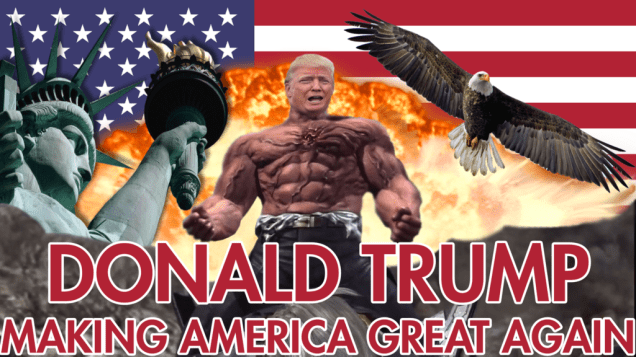
donald-trump-make-america-great-again-patriotism-nationalism

To move beyond Trumpism, Democrats (and forward-thinking conservatives) must look to embrace a healthy and inclusive patriotism, and end their love affair with a cold form of globalism which undermines nation states, communities and livelihoods

Andrew Sullivan remains my blogging hero and inspiration, but I must confess that until very recently I have not greatly enjoyed his recent return to semi-regular online writing for New York Magazine. The thinking and prose is generally as fine as ever, but Sullivan’s excessive hysteria (not to say that real concern is unwarranted) in the face of Donald Trump’s election victory and the start of his presidency has been offputting, as has his continued slow drift away from conservatism and overly-enthusiastic embrace of Hillary Clinton during the 2016 election campaign.

That being said, last week’s Interesting Times column/diary is vintage Sullivan – beautifully poetic, well argued and undeniably valid.

Sullivan writes of globalisation and urbanisation’s losers, and in praise of patriotism:

I’ve always been unusually attached to places. It’s one reason I still call myself a conservative. Travel doesn’t attract me. I’ve now lived in the same loft in D.C. since I bought it, in 1991 (apart from an ill-fated year and a half in New York City); I’ve spent 20 consecutive summers in the same little town at the end of Cape Cod, and have no desire to go anyplace else. Even when I go home to England, I tend to spend around half my time near where I grew up.

I wouldn’t go so far as Malcolm Muggeridge, who famously said: “Travel, of course, narrows the mind.” (Don’t you love that “of course”?) But I would say that the reverse can also be true. Staying put allows you to really get to know a place deeply at different times and in different seasons, to capture, often serendipitously, a small detail you’d never seen before, or arrive at a street corner and suddenly remember that this was where you first met an old friend.

But staying home brings grief with it as well. Everything changes, and when your beloved tree at the end of the street is cut down, or a new Safeway replaces the corner baker, or, more fatally, the factory that used to be the linchpin of the place lies empty and crumbling, it stings and wounds and demoralizes. When I’ve visited my own hometown in England, so much is the same. And yet, on closer inspection, many of the once-vibrant shops are selling secondhand clothes, or given over to real estate offices. My old church has a broken window where the rain comes in. The services have dwindled to near nothing. Maybe it’s being away for so long, but it seems familiar and yet a little empty, as if something in it has somehow died, a continuity somehow lost.

And more and more, I suspect, the shifting winds of this merciless global economy and the impact of mass migration are bringing about similar changes all over the West. This beautiful but deeply sad story about how a provincial town in France has slowly died — as its young people flocked to cities, as its shops were supplanted by a supermarket, says a lot about the moment we are in: “Down another street is the last toy store, now closed, and around a corner is the last independent grocery store, also shuttered. Walk down the empty, narrow streets on some nights and the silence is so complete that you can hear your footsteps on the stones.” The town, Albi, is not alone.

In America, as Charles Murray has shown in his extraordinary book, Coming Apart, the young and the smart and the talented — the people who would once have formed the core of these small towns — have long since fled to distant colleges and cities. They don’t come back. They would once have been the police chief or the town librarian or the school principal. They once helped make the town a well-run place with a clear identity, where the same families and networks lived together, died together, belonged together. These connections have attenuated … as economics supplants culture, as efficiency erases the individuality of inefficient places, as Amazon rips the heart out of shopping districts, as the smartphone removes us from physical space, and as many more immigrants and their culture alter the feel of a place in ways that disorient those with memories and loyalties.

I don’t think we can understand the politics of this moment — Brexit, Trump, Le Pen — without noticing this abiding sense of loss. The middling city and small town are going the way of the middle class. Patterns of farming in rural America are being devastated. I loved this English farmer’s account of the changes he is seeing: “The future we have been sold doesn’t work. Applying the principles of the factory floor to the natural world just doesn’t work. Farming is more than a business. Food is more than a commodity. Land is more than a mineral resource.”

Jobs are vital not simply because of money — but because they give lives meaning, a meaning that now seems so remote people medicate themselves with opiates. People are grieving for a lost way of life. This is not racist or retrograde or even backward. It is, rather, deeply human. For it is in these places that a deeper identity forms, that Americanness, Britishness, la France profonde, endures. And what we’re seeing right now, across the developed world, is a bid to retain the meaning of a culture and a way of life in the headwinds of faceless, placeless economics.

And Sullivan’s conclusion:

Nationalism is one response. The answer to it is not globalism, which is as cold as it is remote, but patriotism, that love of country that does not require the loathing of other places or the scapegoating of minorities or a phobia of change, that confident identity that doesn’t seek to run away from the wider world but to engage it, while somehow staying recognizable across the generations. If the Democrats hope to come back, that patriotism is going to have to define them once again. But can they get past their racial and sexual and gender obsessions and reach for it?

This is the distilled question of our times.

The answer is not globalism – Sullivan is quite right. This does not mean a rejection of capitalism, globalisation and international free trade, on which our prosperity depends, but it does mean acknowledging that there are negative externalities to all of this aggregate economic progress. We accept that this is the case with the environment, and take measures to restrict environmental damage caused by economic activity, but until now governments have scarcely acknowledged the impact of globalisation on local communities, national identity and cohesiveness, let alone formulated meaningful ways to protect what we are unwilling to lose while still unleashing the best that globalisation has to offer.

This is a challenge – as I have repeatedly acknowledged on this blog – which falls hardest upon conservatives and small government advocates such as myself, who traditionally envisage a very limited role for the state in our lives. If corporations and cross-border economic activity create negative externalities as well as create wealth and material abundance, who if not the state will keep those externalities in check? Left-wing politicians can simply wave their hands and promise new economic programs to retrain workers or encourage labour mobility, inefficient or fruitless though they may ultimately prove to be. We on the Right have a more difficult job, relying as we prefer to do on individuals and the institutions of civil society.

And this is why Sullivan’s enthusiastic embrace of Hillary Clinton during the 2016 presidential campaign depressed me so. I also preferred Clinton to Trump because of the latter’s self-evident deficiencies in temperament, knowledge and ideological sincerity. But Sullivan was strongly for Clinton, and I found that fervour to be inexplicable. As Sullivan rightly notes in his latest column, the answer to nationalism is not more cold globalism. And yet that is precisely what Hillary Clinton and Democrats of her type offered. It is still all they offer – she who spoke openly of her desire for a borderless world where plane-hopping elites treated global megacities as their playground while the impoverished servant class were rooted to their dying towns.

Sullivan is quite right that patriotism – “that love of country that does not require the loathing of other places” – must be embraced again by all sides, not weaponised as a unique virtue by the Right or demonised as evidence of inherent racism by the Left. But right now we are moving away from that goal.

For as long as so many Republicans remain seemingly in lockstep with the Trump agenda, despite the president’s frequent deviations from conservative principle (let alone the normal standards of presidential decorum and basic decency), they effectively lend their tacit support to the administration’s more uncomfortably nationalist behaviour and rhetoric. And for so long as the Democrats and others on the Left choose to double down on their repellent formula of Maximal Globalism + Identity Politics, putting forward candidates like Hillary Clinton who are utterly incapable of speaking authentically to Middle America and the suffering working classes, their actions will continue to signal that they view rural and small town America as expendable so long as wealth and opportunity continue accruing to the urban, coastal elites.

For better or worse, the Republican Party seem to have made their choice. Though they may grumble about the ObamaCare repeal and replacement (or RyanCare, as some Trump loyalists insist on calling it) and some of the administration’s other ideas, it is hopeless to look to the GOP for an alternative to Trumpism so long as their man occupies the White House and they hold both houses of Congress.

That leaves it to the Democrats. The ideologically bankrupt, morally compromised Democrats, whose first response to a stunning repudiation by voters at the ballot box was to swiftly reconfirm all of the main architects of that defeat back into their gilded leadership positions, and who are too busy worshipping at the altar of identity politics to pay attention to the fears and aspirations of Trump’s America.

In short, embracing a healthy new sense of patriotism seems like a grand idea, and a necessary one – but Lord knows who in the American political and media class possesses the wisdom, foresight and bravery promote it.


US Flag - Fourth Of July Cake - Independence Day - Baking - Let Freedom Ring

Support Semi-Partisan Politics with a one-time or recurring donation:

Agree with this article? Violently disagree? Scroll down to leave a comment.

Follow Semi-Partisan Politics on TwitterFacebook and Medium.