This Weak Conservative Government Refuses To Get Tough With The Unions

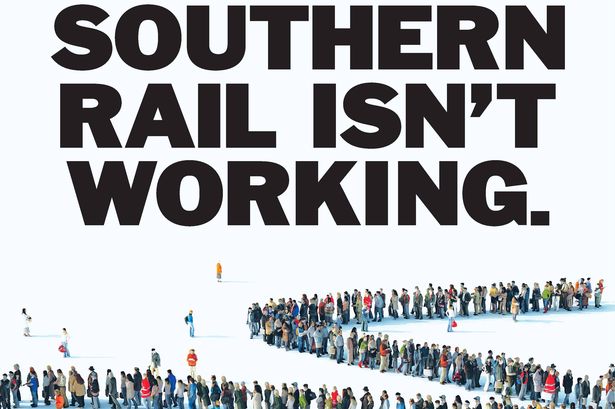
Southern Rail Isnt Working

When even staunch New Labour grandee and columnist John McTernan thinks the Tories are behaving like a weaker version of the Labour Party, British conservatism is in real trouble

As the RMT union’s strike on Southern Rail enters its third consecutive day, inconveniencing hundreds of thousands of commuters while a dithering Tory-lite government watches on, wringing its hands, former New Labour political adviser John McTernan uses his Telegraph column to tear into the Conservative Party.

McTernan writes:

We are in the middle of a five-day rail strike on Southern Rail. Commuters are being massively disrupted. And this is just the latest stage in a dispute in which the Luddite RMT union has made it clear that it is fully committed to fighting against the future.

What about the Government? Where are they in this dispute. It is a crystallisation if all their key themes: investment, modernisation, innovation and productivity. But they are silent.

Well not quite. What we have actually seen is the resignation of the then rail minister Claire Perry, who said:  “I am often ashamed to be the Rail Minister.” And so she should have been – just for her pathetic capitulation to the RMT. This, of course, is just what you would have expected from a Miliband government; but this is a Tory government, with a majority.

There is a famous scene in The West Wing episode about President Bartlet appointing a member of the Supreme Court. He meets Justice Joseph Crouch, whose retirement creates the vacancy, and is angrily addressed by Crouch: “I wanted to retire five years ago. Five years. But I waited for a Democrat. Instead I got you.” The Southern Rail dispute is just like that. Commuters in the Home Counties could be forgiven for thinking: “I waited 23 years for a majority Tory government. Instead I got you.” Where are the core Tory values? Where is the support for management’s right to manage?

This is utterly stunning criticism – shocking not only because it is self-evidently true (the Conservatives in government are a shadow of their glorious best under Margaret Thatcher) but because they are now so bad at governing in a conservative fashion that it has fallen to a former New Labour apparatchik to set them straight.

Why on earth has it fallen to a Labour Party grandee to inveigh against the more militant trades union? Where is the useless europhile Greg Clark, supposedly Secretary of State for Business, Energy and Industrial Strategy during this whole dispute? Where is Chris Grayling, Transport Secretary? Have they all taken lessons from their new boss in the art of disappearing and avoiding the media during scandals affecting their ministerial briefs?

This criticism is particularly damning:

Where are the core Tory values? Where is the support for management’s right to manage?

Where indeed. This blog has wondered the same thing, as the Tories in government behaved like centralising statists, presided over an unprecedented weakening of our national defence, dithered over the housing crisisfailed to get to grips with the nation’s finances, alienated principled conservatives, and as the leader of a supposedly eurosceptic party did all he could to cheat his way to victory for the Remain camp in the EU referendum. Where are the core Tory values?

A Thatcherite government would have stood boldly on the side of consumers over producers, and thus would have been unafraid to plant its flag squarely in the same corner as Southern Rail’s unfortunate commuters. And unlike the Cameron approach to industrial disputes (seemingly applying maximum pressure on businesses to capitulate to union demands, as seen with the London Tube strikes) a Thatcherite government would have recognised the offensive absurdity of the union demands and unashamedly sided against them.

Needless to say, we do not have a Thatcherite government – despite all of the ingredients being in place for another properly ideological right wing government to flourish. The left-wing opposition is hopelessly divided. The Conservatives are under new leadership for the first time in a decade. Boundary review looks set to help the Tories by correcting decades-old biases in favour of Labour, potentially gifting the Tories tens of additional seats. All of these factors stand ready and waiting to be exploited by a radical Conservative government which understands that it has a duty to do more than hold power for the sake of it.

And yet at every turn, the Tories triangulate and tack to the centre. They did so under coalition government (when they had a modicum of an excuse) and they continue to do so now, when they have none. Right now, there is effectively no opposition. A conservative government right now could make a fair stab at privatising pensions and the NHS, and still not be forced out of office so long as the Corbynite and centrist wings of the Labour Party continue their childish tussle for power. The political landscape is ripe for a radical conservative reduction and reshaping of the state, yet there is almost zero evidence that Theresa May’s government intends to attempt any such bold enterprise.

And for what? Will being a centrist clone of New Labour win the Tories any new fans? Of course not. The swivel-eyed Left have long ago convinced themselves that all Tories are “evil” and “vermin”, no matter what they actually do in government.

https://twitter.com/MomentumRugby/status/763072811627872256

We shall win no new fans by trying to adopt the cuddly persona of a young Tony Blair. We will never be liked. Therefore we should focus on being effective, without giving a second thought to winning over the admiration and votes of people who have been raised since birth to despise us. That’s what Margaret Thatcher taught us. And that is the lesson which we seem determined to cast aside in our feverish pursuit of the focus group’s favour.

John McTernan’s quote from The West Wing is very apt. Many conservatives have indeed been waiting for years – since Margaret Thatcher was forced from office, in fact – for another strong Tory leader; somebody committed to conservative, small government principles and willing to fight for them.

Conservatives waited thirteen long years of New Labour government only to get David Cameron. We then endured six years of Cameronism before being presented with the authoritarian Theresa May, foisted on the party in the confused wake of the EU referendum. And whatever electoral success Theresa May enjoys, she may well end up being every bit as much of an ideological disappointment as her predecessor.

But maybe this criticism is premature. Maybe the autumn Conservative Party conference will give birth to a conservative policy platform actually worth voting for. And to be fair to the new prime minister, even Margaret Thatcher bottled her first confrontation with the National Union of Mineworkers, staging a tactical retreat before coming back to finish the job in 1984-85.

But right now, British conservatives are in the ludicrous and humiliating position of being upbraided by a Labour Party grandee – someone from the party of Jeremy Corbyn and Owen Smith, for heaven’s sake – for being insufficiently dedicated to conservative principles.

And when it falls to Tony Blair’s right hand man to tell the Tories how to get tough with the unions, something is clearly rotten with the state of British conservatism.


David Cameron - Coke Zero Conservative - I Cant Believe Its Not Miliband

Support Semi-Partisan Politics with a one-time or recurring donation:

Agree with this article? Violently disagree? Scroll down to leave a comment.

Follow Semi-Partisan Politics on TwitterFacebook and Medium.

America’s Armchair Psychiatrists: Go To Town On Donald Trump, But Lay Off His Supporters

Donald Trump supporters - idiots

Donald Trump opponents should spend less time psychoanalysing Trump supporters and more time reflecting on the reasons for their own deep unpopularity

Sometimes, one wonders whether the American left actually want to defeat Donald Trump at all, or if they are more interested in parading their superior moral virtue for others to see. Certainly, the way that they are behaving in the media at present suggests that defeating Trump has become less important than using him as a mirror to reflect their own supposed holiness.

What else could excuse the rash of execrable articles openly mocking Trump supporters and suggesting that they are morally and intellectually defective?

First, a sanctimonious piece in the Washington Post explaining to it’s oh-so-enlightened readers why “facts don’t matter to Trump’s Supporters“:

How did Donald Trump win the Republican nomination, despite clear evidence that he had misrepresented or falsified key issues throughout the campaign? Social scientists have some intriguing explanations for why people persist in misjudgments despite strong contrary evidence.

Trump is a vivid and, to his critics, a frightening present-day illustration of this perception problem. But it has been studied carefully by researchers for more than 30 years. Basically, the studies show that attempts to refute false information often backfire and lead people to hold on to their misperceptions even more strongly.

This literature about misperception was lucidly summarized by Christopher Graves, the global chairman of Ogilvy Public Relations, in a February 2015 article in the Harvard Business Review, months before Trump surfaced as a candidate. Graves is now writing a book about his research at the Rockefeller Foundation’s Bellagio Center in Italy.

Graves’s article examined the puzzle of why nearly one-third of U.S. parents believe that childhood vaccines cause autism, despite overwhelming medical evidence that there’s no such link. In such cases, he noted, “arguing the facts doesn’t help — in fact, it makes the situation worse.” The reason is that people tend to accept arguments that confirm their views and discount facts that challenge what they believe.

This “confirmation bias” was outlined in a 1979 article by psychologist Charles Lord, cited by Graves. Lord found that his test subjects, when asked questions about capital punishment, responded with answers shaped by their prior beliefs. “Instead of changing their minds, most will dig in their heels and cling even more firmly to their originally held views,” Graves explained in summarizing the study.

Entirely missing from this “analysis” is any acknowledgement that the phenomenon works both ways, and that Trump supporters are not the only ones prone to confirmation bias, that entirely human instinct to search out more corroborating evidence when attacked rather than accepting the potential validity of the criticism.

The same charge could just as easily be levelled at Hillary Clinton supporters who aggressively dismiss questions around the ethics and competence of the Democratic Party nominee. And while this blog believes that many of these concerns have more to do with a good old fashioned witch hunt than principled criticism (note how Hillary Clinton was previously dismissed by many as a far-left ideologue and is now criticised by the same people, correctly, as a triangulating centrist) the reaction of hardcore Hillary Clinton defenders to criticism of their candidate is no different than the way that Donald Trump’s supporters defend their man.

Unfortunately, this Washington Post article (especially its headline, which in fairness to author David Ignatius was probably not of his creation) makes it seem as though it is only Donald Trump supporters who are susceptible to the trait of confirmation bias, when this is absolutely not the case. It is, in effect, another part of the grubby effort to dismiss the concerns of Trump-supporting Americans, suggesting that their views and political preferences are the result of defective thinking rather than legitimate grievances and concerns.

Even worse than the Washington Post piece, though, is this article from Raw Story, in which neuroscientist Bobby Azarian attempts to remotely diagnose supposed abnormalities found in the brains of Donald Trump supporters.

The piece (the cover picture of which shows a Trump supporter’s face frozen mid-gesture, all the more to make her look stupid) alleges:

The only thing that might be more perplexing than the psychology of Donald Trump is the psychology of his supporters. In their eyes, The Donald can do no wrong. Even Trump himself seems to be astonished by this phenomenon. “I could stand in the middle of Fifth Avenue and shoot somebody, and I wouldn’t lose any voters, OK? It’s, like, incredible.”

[..] So how exactly are Trump loyalists psychologically or neurologically different from everyone else? What is going on in their brains that makes them so blindly devoted?

Again, here we see the same arrogance which wrongly presumes that other partisans would behave differently when confronted with evidence that “their” candidate is in some way unacceptable. Yet anybody with eyes and a functioning brain knows that “Hillary Bots” and “Bernie Bros” were likewise called out for blindly supporting their chosen candidate regardless of new information presented.

The article then goes on to list various potential theories which may explain the supposedly uniquely abnormal thinking of Trump supporters:

Some believe that many of those who support Donald Trump do so because of ignorance — basically they are under-informed or misinformed about the issues at hand. When Trump tells them that crime is skyrocketing in the United States, or that the economy is the worst it’s ever been, they simply take his word for it.

[..] The Dunning-Kruger effect explains that the problem isn’t just that they are misinformed; it’s that they are completely unaware that they are misinformed. This creates a double burden.

Studies have shown that people who lack expertise in some area of knowledge often have a cognitive bias that prevents them from realizing that they lack expertise. As psychologist David Dunning puts it in an op-ed for Politico, “The knowledge and intelligence that are required to be good at a task are often the same qualities needed to recognize that one is not good at that task — and if one lacks such knowledge and intelligence, one remains ignorant that one is not good at the task. This includes political judgment.” Essentially, they’re not smart enough to realize they’re dumb.

And if one is under the illusion that they have sufficient or even superior knowledge, then they have no reason to defer to anyone else’s judgment. This helps explain why even nonpartisan experts — like military generals and Independent former Mayor of New York/billionaire CEO Michael Bloomberg — as well as some respected Republican politicians, don’t seem to be able to say anything that can change the minds of loyal Trump followers.

There is a kernel of truth here, inasmuch as that the Dunning-Kruger effect is certainly real, and does in some way explain the behaviour of Trump supporters (others have used it to similarly belittle Fox News viewers). But Azarian seems to be suggesting that Donald Trump supporters are particularly liable to this erroneous thinking, while providing absolutely no evidence to back this up.

Azarian would have us believe that Hillary Clinton supporters are wise oracles, high-minded arbiters of truth and wisdom, who dispassionately compare various politicians against their entirely rational criteria before coming to support their candidate. One can be quickly and easily disabused of this notion by actually speaking to a particularly committed Clinton supporter.

We also see creeping into Azarian’s analysis the same bias in favour of a “tyranny of the experts” which we saw in Britain’s EU referendum, where a whole parade of economists and members of the economic and political elite lined up to bully Britons into voting to remain in the European Union. When Britain rejected the threats of the Remain campaign and voted for Brexit, many commentators have had a complete meltdown, unable to understand how their compatriots could be so “stupid” as to reject the advice of so many self-described experts.

But what they failed to realise is that Brexiteers were not judging the question of Britain’s membership of the EU in the same terms as the experts. The experts, nearly all sinecured members of the establishment, had a post-patriotic mindset in which democracy and self-determination were irrelevant while economic stability and minimising disruption for current economic winners was all that mattered. Brexiteers, by contrast, actually cared about democracy and freedom, and having control over the decisions which affect their lives (as backed up by opinion polling in the immediate aftermath of the referendum). Seeing yet another EU-funded university professor wail that Brexiteers were “racist” and that leaving the EU might cause short term economic uncertainty left us entirely unmoved – to Brexiteers, such uncertainty is a price well worth paying to be free of an organisation as offensively antidemocratic as the European Union.

We see this same arrogance at work in Azarian’s lament that Trump supporters continually disregard the advice of military experts and their economic betters. One does not need to be a Trump supporter – this blog certainly is not – to understand that in the eyes of many Americans, the experts feted by the anti-Trump crowd are the very same people who presided over two very questionable wars and the greatest recession since the Great Depression. In other words, their advice simply doesn’t count for much in the eyes of Trump supporters – and often, the “experts” have only themselves to blame.

Azarian concludes:

So what can we do to potentially change the minds of Trump loyalists before voting day in November? As a cognitive neuroscientist, it grieves me to say that there may be nothing we can do. The overwhelming majority of these people may be beyond reach, at least in the short term. The best we can do is to motivate everyone else to get out to the booths and check the box that doesn’t belong to a narcissistic nationalist who has the potential to damage the nation beyond repair.

Well, congratulations – this article has contributed to a toxic atmosphere of derision against Trump supporters which will have only hardened his support (as even Azarian recognises at one point during the piece). By penning yet another unbearably sanctimonious piece absolving the political establishment of any responsibility for the rise of Donald Trump and suggesting that his supporters are uniquely prone to confirmation bias and other cognitive flaws, the anti-Trump forces are given more license to think of themselves as uniquely rational and virtuous, and to look down on the significant minority of their fellow Americans who prefer Trump to the rotten establishment.

If Donald Trump is to be halted (or the poison taken out of a narrow Trump defeat), the only words this blog wants to see running through the minds of moderate Republicans and Democrats are “how have I enabled the rise of Donald Trump?” and “what can I do differently to stop enraging so many ordinary decent voters, and pushing them into the arms of a demagogue with such questionable policies, morals and temperament?”.

The easy option for the #NeverTrump crowd is to sit back, bask in their own moral virtue and clutch their pearls while looking at horror at the ill-educated, uncouth white trash who give Trump the time of day. That way risks the world waking up to President-Elect Trump on 9 November.

The harder, more virtuous task is to engage in some real introspection, and think hard and uncompromisingly about how years of Democratic and Republican government and opposition have generated such disillusionment and outright hatred of the political class that ordinary, decent people are willing to vest their hopes in Donald Trump.

If the political class are to succeed in preventing a Donald Trump victory, they must demonstrate a willingness to change. Cheerleading for the status quo while angrily demonising those people who refuse to accept it is simply not good enough. Not this time.

Now is the time for the American political class to show that they are capable of humility and change, not simply to engage in anti-Trump moral grandstanding. Donald Trump did not become the Republican Party’s presidential nominee in a vacuum. The flame of Trumpism only burns bright because it is sustained by the hot air of establishment Democrats and Republicans who fight their furious pitched battles in Washington D.C. while too many Americans have seen zero change in their own personal circumstances.

So by all means, America’s smug armchair psychiatrists among the #NeverTrump political establishment should go on diagnosing Donald Trump all they want. This blog certainly believes that anyone who gets into Twitter spats with Gold Star parents and D-list celebrities while running for president is dangerously emotionally unstable at best.

But there is nothing to be gained from going to war with Donald Trump’s supporters, many of whom have been repeatedly let down by the moderate, establishment politicians we tend to respect, and whose anger deserves to be acknowledged.


Donald Trump - Occupy Democrats

Trump Supporters - Mad as hell

Donald Trump Hosts Nevada Caucus Night Watch Party In Las Vegas

Support Semi-Partisan Politics with a one-time or recurring donation:

Agree with this article? Violently disagree? Scroll down to leave a comment.

Follow Semi-Partisan Politics on TwitterFacebook and Medium.

Police Should Spend Less Time Persecuting Citizens For Free Speech Offences And More Time Serving Communities

Rome Police - Old Age Loneliness - Questura di Roma

Our police forces should be knitting communities together and keeping them safe, not prancing around in military gear and threatening citizens who dare to express themselves on social media

A heartbreaking (or heartwarming, depending on your perspective) story from Rome forces us to ask stark questions of our own society, the way we treat our elderly compatriots and the proper community role of the police.

From the Evening Standard:

Kindly police officers came to the aid of an elderly Italian couple after neighbours called emergency services when they were heard crying in their apartment – because they were so lonely.

Officers rushed to the flat in the Appio area of Rome after nearby residents heard shouting and crying coming from inside, and found and 84-year-old Jole, and her 94-year-old husband Michele.

The couple said they had not been victims of crime, but were overcome by emotion after watching sad stories on the news.

The pair, who have been married for 70 years, said they had not had visitors for a long time and were very lonely.

While they waiting for an ambulance to arrive to check the couple over, the officers prepared a hot meal.

They then sat down to have a chat while the elderly couple ate the spaghetti with butter and parmesan they had prepared.

More:

The police force said on its Facebook page: “Especially when the city empties and the neighbors are away on holiday, sometimes loneliness dissolves into tears.

“It can happen, as this time, that someone screams so loud from despair that eventually, someone calls the State Police.

“There is not a crime. Jole and Michele are not victims of scams and no thief entered the house – there is no one to save.

“This time, for the boys, there is a more daunting task – two lonely souls who need reassuring.”

Meanwhile, what do our police spend their time doing?

Well, no day is complete without threatening members of the public. Greater Glasgow Police in particular love to ostentatiously warn people that they are lurking on Twitter and Facebook 24/7, ready to pounce the moment anybody posts something deemed the least bit capable of causing offence.

And London’s own wonderful Metropolitan Police also love nothing more than turning up on the doorstep of people who dare to tweet the “wrong” opinions and sentiments, hauling them away to the police station and delivering them to the hands of the criminal justice system.

But never let it be said that the Met Police never leave their comfortable office desks. A new batch of them have recently acquired dystopian-looking, military grade combat uniforms and strutted their stuff before Britain’s news cameras in some kind of perverse authoritarian fashion parade. Ostensibly this new armed response unit is intended to keep us safer from Islamist terror attacks mentally ill people, though doubtless we will soon see the same militarised response to other, less violent incidents too. As is so often when it comes to the militarisation of the police, where America leads, Britain duly follows.

Counter Terrorist Armed Police - London

Meanwhile, communities go unpatrolled and some become no-go areas. Local police, either swamped with paperwork or too busy hounding innocent citizens for daring to exercise their right to free speech online, refuse to show up to cases of reported vandalism or burglary (though they mysteriously appear within minutes if a speech or thoughtcrime is reported by some beady-eyed public collaborator).

And to add insult to injury, we now live in a country where the idea of the police carting you away for something you write on Facebook seems perfectly normal, while the idea of the police coming to cook a meal for a lonely elderly couple is so rare that it makes the news headlines when it happens in another country.

Local Police and Crime Commissioners do not seem to have had much of an effect, though at this early stage it is difficult to be sure whether this is due to a lack of powers, regulatory capture by the police forces they are supposed to control or garden variety incompetence. And so here we are.

Is this the police force that we really want?

Is this the policing strategy that actually knits communities together, making them happier and safer?

Absolutely not. It would be very interesting to see a force-by-force breakdown of the number of police officers, civilian staff and other resources devoted to monitoring and curtailing the free speech rights and other civil liberties of Britons. And then immediately shutting down those statist, authoritarian programmes and diverting all of the freed resources to more worthy causes, like helping to tackle old age loneliness.

We’re not talking about police officers cooking roast dinners instead of catching criminals, but surely it should not be beyond the wit of man for police to act as an intermediary, perhaps connecting isolated elderly couples they come across in their work to suitable neighbours who could check in with them once in a while, or provide much needed regular social visits. The police already work with AgeUK to tackle scam criminals and improve home security. There is no reason why this collaboration could not be greatly extended.

At present, we have a police force of two extremes – small numbers of highly militarised officers, armed to the teeth with every counter-assault weapon one can possibly imagine, and a much larger force who seem unable to respond to garden variety crime in an acceptable way, and who are all too rarely visible on the streets.

If local, county and national government is serious about improving police-community relations, they could do far worse than by immediately ordering a halt to the nasty, frivolous and often arbitrary persecution of individuals on free speech and “hate crime” grounds and diverting those funds and resources to a much more worthy cause – helping to tackle the growing problem of old age loneliness in our society.


Postscript: You can donate to Age UK here.


Greater Glasgow Police - THINK - Social Media - Police State - Free Speech

Middle Image: BT

Support Semi-Partisan Politics with a one-time or recurring donation:

Agree with this article? Violently disagree? Scroll down to leave a comment.

Follow Semi-Partisan Politics on TwitterFacebook and Medium.

On Left And Right, British Politics Is Characterised By Pitifully Small Thinking

Grammar Schools - Conservative Party - Theresa May

Grammar schools and OBEs – anything to distract ourselves from the real, serious political issues facing modern Britain

Of all the issues and circumstances which afflict modern Britain, what policy do you think would make the single most positive difference? Ensuring that Brexit takes place and that we positively reshape our relationship with Europe and the world? Comprehensive healthcare reform? Constitutional reform to reinvigorate our democracy? Freeing higher education from the dead hand of government funding and control? Sweeping simplification and reform of the tax code?

One could debate endlessly (though this blog would prioritise Brexit above all else). But two things almost sure not to make the list would be the two political stories dominating the news this weekend – Labour leadership contender Owen Smith’s ostentatious vow to ban the bestowing of new honours for five years if he becomes leader, and indications that Theresa May’s government is on the verge of overturning New Labour’s spiteful and vindictive ban on the opening of new grammar schools.

From the BBC:

Labour leadership challenger Owen Smith says honours will not be bestowed upon Labour donors, MPs, advisers and staff for five years if he wins the contest.

Mr Smith, who is challenging leader Jeremy Corbyn, said he wants an honours system that rewards “selfless acts, not political and personal patronage”.

Mr Smith, MP for Pontypridd, said Mr Cameron’s list – which included many Downing Street staffers and Conservative donors – was put together with “blatant cronyism”.

“David Cameron’s resignation honours list has brought the system into disrepute and deepened people’s mistrust of politics.

“It’s simply not good enough for [Prime Minister] Theresa May to turn a blind eye to this situation – we need fundamental reform of the honours system so it can reward good deeds and restore people’s trust in politics.”

He also said his proposed five-year honours ban would stay in place until a total overhaul of the system was completed.

This blog does not dispute the fact that the British honours system is hopelessly corrupt and abysmal at recognising exemplary virtue. If Samantha Cameron’s personal stylist is worthy of career-boosting recognition in a gross act of cronyism, what possible grounds are there to deny an honour for every single member of the British armed forces, all of whom risk their lives for very little financial reward compared to that which they could receive in other private sector careers?

While there are many aspects of British imperial tradition which are worth carrying into the present day, the byzantine honours system, with its multiple levels and incomprehensible initials, is not one of them. In fact, it is the ultimate expression of inward-looking elitism, a Country Club tiered membership system which allows its wealthy and well-connected members to compare themselves with one another while excluding thousands of people whose lifetimes of service make them far more deserving of public recognition.

So scrapping the honours system altogether and replacing it a flattened and simplified system – perhaps just one award for civilian life, like a stripped down variant of the Order of Australia – would be a worthy goal, though hardly mission-critical for UK prosperity. Far less impressive, though, is Owen Smith’s dismal suggestion of an arbitrary five-year pause to supposedly review the system.

This is a typically British muddle. When faced with an unacceptable scandal or unethical situation, the establishment’s typical response is to launch a meandering and ultimately fruitless inquiry, kicking the issue into the long grass until public outrage has died down sufficiently that things can go on unchanged. The only way that the rotten system will ever change is either for firm and immediate action to be taken, or for the issue to be folded into a package of further-reaching constitutional reform (by far the better, though less likely option).

Owen Smith, last gasp of the Labour centrists, clearly has no interest in serious reform – of the honours system or anything else. His proposed five-year moratorium is a quintessentially New Labour device, assuaging public anger with a big flashy gesture while doing absolutely nothing to tackle the underlying issue or inequality. This isn’t bold new leadership from somebody worthy of succeeding even Ed Miliband and Jeremy Corbyn. And this is the man who believes he is uniquely gifted to carry Labour back into government?

Not that the Conservatives are any better.

The main news emanating from the Conservative Party this weekend has been the leaked suggestion that Theresa May is planning to announce a repeal of New Labour’s ban on the building on new grammar schools – not unpleasing news, certainly, but concerning (and highly vulnerable to political attack) when not placed in the clear context of wider education reform with a laser focus on raising standards and improving social mobility.

The Guardian reports:

Theresa May has been warned she will face stiff opposition to plans for new grammar schools from some senior Tory MPs as well as Labour and the Liberal Democrats.

The prime minister was facing a backlash after the Sunday Telegraph reported that she will announce a return to more selective schools in England as early as the Conservatives’ autumn conference.

Downing Street made no attempt to dampen speculation that an extension of selection in schools is on the government’s agenda, releasing a statement on Sunday that said: “The prime minister has been clear that we need to build a country that works for everyone, not just the privileged few.

“Every child should be allowed to rise as far as their talents will take them and birth should never be a barrier. Policies on education will be set out in due course.”

The suggestion that May, a former grammar school pupil, will opt for new selective schools after an 18-year ban delighted many Conservative backbenchers. More than 100 Tory MPs are said to support a campaign by ConservativeVoice, a group endorsed by senior cabinet ministers Liam Fox and David Davis in 2012.

In many ways, seeking to lift the ban on new grammar schools is commendable – the ban is a grotesque piece of spiteful, anti-aspirational Labour Party downward social engineering, in which “equality” was to be achieved by hacking away at the ladders to success in favour of dull, uniform mediocrity.

But as a first major flagship Conservative policy under Theresa May, it is disappointing. Yes, it shows more grit than was ever displayed by David Cameron, and yes it will keep restive Tory backbenchers happy – essential if May’s government is to survive the next four years with a notional majority of just 8. But in terms of the overall education reform which Britain needs, grammar schools are but a drop in the ocean.

The proportion of pupils in grammar schools has been under 5% since the late 1970s. Even assuming an aggressive policy of encouraging new grammar schools, it is hard to see this figure substantially increasing within, say, the next decade (i.e. in time to make a measurable difference in the productivity and quality of the British workforce).

Academic selection can be beneficial, and we should certainly aim to stretch the most talented pupils and appropriately enrich their education wherever possible. As a former state school pupil, my own education was in no way enhanced by being grouped together with other children of decidedly mixed ability (and this despite streaming). And I strongly doubt that the less able students benefited greatly from my presence either.

But the real issue in British education is the stunted curriculum, unambitious targets and wildly excessive early focus on specialisation. As a state school student, I had no opportunity to learn Latin, or philosophy or the classics. And no matter what steps I have taken in adult life to fill the yawning gaps in my knowledge, nothing can replace exposure to these topics at an early age. Why should these subjects be the preserve of expensive fee-paying private schools, simply because some dull left-wing bureaucrat decided that “ordinary” students do not need exposure to the classics and the Western canon in order to get jobs working in factories which no longer exist?

Why, too, are fourteen-year-olds expected to know what they want to be when they grow up, and begin dropping subjects like hot potatoes as they begin studying for their GCSE examinations? How on earth is a young teenager, who has perhaps only ever had one teacher in history or geography or modern languages, supposed to know for sure that they will never need whole areas of knowledge in their future lives? For this is exactly what we demand of our young people today.

At a tender age (when frankly, issues of popularity or boredom come into play as much as anything else) we expect young people to drop subjects and constrain their life choices first at fourteen, when they start preparing for GCSEs, and again at sixteen (if they haven’t been encouraged to abandon school altogether by pandering government agencies) when they begin preparing for A-levels. This is ludicrous – and the idea of dropping subjects which one finds difficult hardly instils young minds with a positive attitude towards dealing with life’s inevitable challenges.

Rather than continuing to shoot for the middle with our education policy, contenting ourselves when we just about keep pace with other middle-ranked nations, we should set our sights higher as a country. We should be looking to match and outdo countries like Japan, Finland and South Korea from their perch at the top of world tables in educational outcomes, and improving our schools so that it is no longer just our elite private schools and Oxbridge which are the envy of the world.

Would this be easy? Of course not. Many factors are involved, from daycare and early pre-school education, relative poverty and tackling an often lukewarm culture of aspiration. In some of these areas (particularly around the culture of aspiration and delayed gratification) we can clearly do much more. In other areas, there may be difficult questions over infringement on personal choice and the proper role of the state. But we should at least have the debate and talk about how much power we are prepared to concede to different levels of government (or determined to take back from government) in order to drag ourselves up the educational league tables.

But these are all discussions which will never take place if the focus is taken over by a debate about grammar schools, which make up just one weapon in the fight to improve educational outcomes. We will never have the broader discussion and the complete policy review if Theresa May’s government expends a vast amount of political capital fighting furious Labour and LibDem MPs to an impasse and ends up being defeated in the Commons by a jubilant Jeremy Corbyn.

So here we are – well over a month after the EU referendum, and here we are talking about grammar schools and the honours system.

Of course the machinery of government must grind on, Brexit or no Brexit. And of course this is the slow summer season, when MPs and journalists normally take a break, promising each other that nothing momentous will take place while they try to grab some quality beach time. But the fact that the Labour Party is consumed by yet another leadership election with a challenger whose key selling point is promising to spend five years thinking about changing the honours system, while the Tories play to the backbenches by choosing to fight and die on the hill of grammar schools, is not encouraging.

Maybe party conference season and the return of Parliament will provide more context, or some other sign of hope that Theresa May’s government plans to do more for social mobility than re-litigate a battle from the 1970s, or that Labour’s childish centrist MPs will either accept four more years in the wilderness or finally show some courage and strike out on their own.

Because at present, the policies and preoccupations of Britain’s leading politicians do not seem remotely equal to the scale of the challenges at hand.


Grammar Schools

Grammar School - Conservative Party

Support Semi-Partisan Politics with a one-time or recurring donation:

Agree with this article? Violently disagree? Scroll down to leave a comment.

Follow Semi-Partisan Politics on TwitterFacebook and Medium.

Enough Carping About Gender Pay Inequality In Sports – End Segregation And Let The Market Determine Wages

Olympic Games - Rio de Janeiro - Gender Pay Equality - Sports - Athletics

As the Olympic Games get underway in Rio de Janeiro, in place of the usual social justice nonsense about gender pay equality here is a bold proposal to make gender equality in sports a reality

As Olympic fever starts to build in the run-up to the opening ceremony of the Rio summer games, the New Statesman is distracting itself with a long meditation on why female athletes are usually paid far less than men.

Tim Wigmore ponders:

In March, male and female cricket teams from across the world descended upon India, where the men’s and women’s World Twenty20 competitions were played simultaneously. The International Cricket Council funded all the men’s teams to fly business class, but only paid for the women’s teams to fly economy class.

The integration of the men’s and women’s tournaments only highlighted how differently competitors were treated. The total prize money for the men’s event was $5.6m – 16 times the $400,000 for the women’s tournament.

[..] Women’s treatment in sport has always been a manifestation of wider gender inequality and, as sports evolved and professionalised, became self-perpetuating. The huge funding disparity between male and female sport means that women have had fewer opportunities to play sport, have suffered from inadequate coaching and facilities compared with those enjoyed by men, and have been paid meagre sums, even for playing international sport. This has damaged the quality of sport – and therefore the attractiveness of the product to fans and broadcasters – in two ways. Those that have played have often not been professional, so had less chance to hone their skills; and the lack of financial rewards mean that many leading players have retired prematurely.

Women’s sport has been shaped by administration being almost exclusively a male preserve. This explains why, from 1928 to 1960, women were not allowed to compete in races of more than 200 metres, because it was felt that running for longer made them too tired. It took until 1984 for women to make up one-fifth of competing athletes in the Olympics.

But surely if we are going to look at issues of funding at the school and amateur level (Title IX issues, to an American audience) then we should be more animated about improving equality of opportunity at the grassroots rather than tearing our hair out because Serena Williams (a millionaire many times over) is paid less than Roger Federer?

If we could drop the leftist insistence on equality of outcome then it might be possible to have a meaningful discussion about precisely how the issues raised  by Tim Wigmore (inadequate funding, male domination of sports administration bodies etc.) actually filter through in terms of take-up of sport and the technical levels achieved. And we could then consider if measures should be taken upstream to address the gender disparity, and what (if any) role the state should play in correcting the imbalance, considering that this is supposedly a time of “austerity”.

But time and again the discussion seems to drift back to the question of prize money awarded at top professional events, which is frankly ridiculous. Wigmore continues:

Yet the most lucrative sports remain far away from equalising renumeration. Even in sports with equal prize money for marquee competitions, there are often huge discrepancies lower down. In tennis, Novak Djokovic, the men’s number one, earned twice as much as Serena Williams, the women’s number one, last year – although both won three of the four grand slams, the less prestigious men’s tournaments pay far more than the women’s events. In football the differences are even starker: there was £22m in prize money for the last men’s football World Cup, but only £630,000 for the women’s tournament.

The differences are far greater in club competitions, in which women’s teams have struggled to gain a following. The total attendance for the last season of the Women’s Super League was 57,000; for the Premier League, it was 13 million. The stark discrepancy explains why Steph Houghton, the best-paid female English player, earns around £65,000 a year, while Wayne Rooney receives £300,000 a week. Similar forces are at work in professional basketball in the US: last season, the maximum salary for a female player was $109,500; for men’s players, the minimum salary was $525,093, and the maximum $16.407m.

Wigmore answers his own question here by citing the attendance differentials between the men’s and women’s leagues in British and American football (soccer). The gulf in public interest between the two leagues is huge (even if unjustified – one of the most entertaining football matches I have seen was a women’s game at the 2012 London Olympics). If we are to break the link between popularity and pay, why should the link between talent and pay not be similarly abolished? Why not pay every football player, male or female, a flat salary regardless of which league they play for and which position they play in? If teams can no longer set wages based on value added then we essentially end up with communism.

If more people watch the male version of a sport (generally because it is played at a higher level in terms of physical capability and endurance, if not technical skill) then surely this should be reflected in the prize money awarded? Prize money, after all, comes from ticket sales and television revenues and commercial opportunities. If male players draw in a disproportionate amount of total revenue, why should the fruit of their labour be redistributed to women?

Equal Pay Sports - men and women

The New Statesman even concede the point here (my emphasis in bold):

The greatest cause for optimism is in the rising quality of female sport: the gradual increase in spending on women’s sports is now being reflected in a product that more spectators want to watch. When England Women played Germany at Wembley in November 2014, the match was a 55,000 sell-out. Dramatic improvements in the standard of women’s cricket led to the England team turning professional in 2014.

Rising quality. Dramatic improvements. These are blatant concessions that the current (or past) standard of female sport has in many cases not yet reached the level of the men’s game. But even if it did, and there was no discernible difference in terms of technical standard between men and women, why should privately owned sports leagues and teams be compelled to pay the same wages if attendance and viewing figures have not also equalised?

And here we are back to the leftist mindset of wanting to control how people think. Men and women are of inherently equal value, that much is indisputable. But the leftist believes that they must be equal in all regards and at all times, including in the outcomes they experience (such as prize money at top sports tournaments). And if the market does not value the women’s game as highly because the technical standard or endurance is lower, then the market (and the people who make up the market) are wrong and their views should be overridden in the name of equality of outcome. Until we all hold hands underneath a rainbow, singing Kumbaya and assigning equal worth to unequal products in the name of gender equality, the People Who Know Best must step in and set equal wages.

But when has the  coercive approach ever actually truly worked? When has it done anything more than patch over inequalities rather than truly removing them?

Would not the better approach to tackling “inequality” be for sports governing bodies to look at the potential for growth in the female game and then chart a practical, ambitious path to increase female participation and retention in the various sports from school and grassroots level upward, therefore feeding the pipeline with more future stars who would in turn attract more earned revenue?

The danger is that by doing what Wimbledon bosses did and unilaterally setting equal prize money for men and women (despite the fact that women play a maximum of three sets while men play a maximum of five in grand slam tournaments), we not only perpetuate an injustice (male players have to work harder for the same monetary reward) but we also take our foot off the pedal of change; we feel satisfied that we have “tackled” gender pay inequality before we have even looked at the systemic issues which create it in the first place.

So here’s a genuinely egalitarian idea (which the New Statesman will likely never go for, obsessed as they and nearly all leftists are with identity politics and competitive victimhood) – how about we scrap male and female segregation altogether and have mixed teams and leagues based purely on sporting ability and merit?

Sure, there would likely be fewer women than men on the field at, say, the football World Cup, but those who did take the field could say without dispute that they earned their place and their (equal) prize money. In some cases (or at least in some positions in team sports), women may even possess an advantage over men and drive them out of the top leagues and pay grades altogether. Why not find out?

When it came to racial segregation, those fighting for equality through history never satisfied themselves with “separate but equal”. The racist Jim Crow laws had to be fought and overturned and the Civil Rights Act passed in order for the American Founding Fathers’ decree that “all men are created equal” to be deepened and fulfilled in practice as in spirit. Why should we settle for any less when it comes to gender discrimination?

In the workplace, the just cry from those campaigning against pay discrimination is “equal pay for equal work”. So let’s make it a reality in sports. No more bleating for unfair privilege (equal pay for less-watched female athletes, playing at a lower technical level). If we are to be truly blind to gender, let us abolish gender segregation in professional sports altogether, and let women compete with men for places in clubs and teams, and for the top rankings in integrated professional leagues. And let every one succeed according to their merit.

But of course the leftists and the Social Justice Warriors don’t want that. They don’t want people to be blind to race or gender or any other characteristic, but rather want us to exalt in our identities as variously oppressed minority classes. The SJWs derive all their power from policing the boundaries and arbitrating the disputes that inevitably arise from the very toxic culture of competitive victimhood they perpetuate – and if we strip it away then they, together with the entire equality industry, suddenly lose their raison d’être.

But all people are created equal. So let us do what we can and what we should to ensure equality of opportunity in sports (commensurate with interest and good sense), and then end gender segregation in sports to unleash the world’s best female athletes to compete at the very highest level of the game. That would be the egalitarian thing to do.

Let anyone who opposes this step now come forward and explain why they believe women are too fragile and vulnerable to thrive in integrated sports, and why they should continue to be patronised and humiliated by being given unearned equal pay in segregated teams and leagues.

Let the equality campaigners Social Justice Warriors come forth and make their tawdry, outdated and morally dubious argument for the status quo.


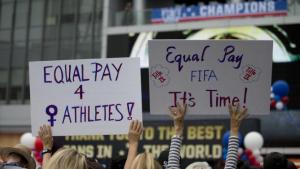
WWCup Los Angeles Rally

Top Image: BBC

Support Semi-Partisan Politics with a one-time or recurring donation:

Agree with this article? Violently disagree? Scroll down to leave a comment.

Follow Semi-Partisan Politics on TwitterFacebook and Medium.