Jeremy Corbyn’s Labour Party – No Home For Centrists

jeremy-corbyn-rally

Jeremy Corbyn and his supporters vastly outnumber the Labour centrists. So whose party is it really?

Very slowly – journalist by journalist, publication by publication – the realisation is beginning to dawn that the unwelcome outsiders in the Labour Party are now the centrist members of the PLP, and not Jeremy Corbyn and his leftist support base.

From the Spectator (my emphasis in bold):

A few months ago, Watson and his fellow MPs thought Corbyn was the anomaly. That if he was dislodged, the natural balance of the Labour Party would be restored. Now it’s clear that there are tens of thousands of Corbynites who now hold party membership cards and are itching to use them. Labour MPs are starting to ask if they are the anomaly. And an anomaly that the new far-left members will seek to correct when Westminster boundaries are redrawn and MPs are selected.

Slow hand clap.

Yes, centrist MPs are indeed now the anomaly, just as centrists should always be the pitiable, wishy-washy anomaly in a political party. Finally, realisation dawns that maybe it is the centrist machine politicians who are the parasites in the so-called Labour Party, and not the socialists.

A political party is nothing if not the voice and champion of its members. Any other arrangement – such as the noxious idea that MPs, once selected, should have license to ignore their local party at will while being at no risk of ever losing their seat – makes the party membership little more than a fan club for some generally rather unremarkable career politicians. And under Jeremy Corbyn, the Labour Party is finally becoming less of a fan club and more a champion of its members.

Naturally, there are losers in this reconfiguration, namely the centrist MPs who have enjoyed utter dominance since the late 1990s, who suddenly find themselves out of favour and at theoretical risk of deselection. But what is the alternative? That Blairite and Brownite machine politicians, despised by the very constituency associations who will be tasked with pounding the pavements and handing out leaflets to get them elected, have the right to a “job for life”?

This is why we need to radically re-examine the way in which MPs are selected and removed from office. We need real powers of recall, so that constituents (on gathering a sufficient threshold of signatures in a petition) can recall from Westminster an MP who is underperforming, betraying their election pledges or dishonouring themselves and Parliament through scandal. But more than that, we need to move toward to mandatory re-selection and a competitive primary system.

As this blog recently pointed out:

This would bring Britain into line with other countries like the United States, where Representatives and Senators do not have “jobs for life” and must compete in party primaries if they wish to run for their seat at the next election. Such a move would put the wind up an often self-entitled political class, forcing MPs to justify their worthiness of a place on the ballot at regular intervals and forcing many of the older, less useful bench warmers off into retirement.

No constituency should be lumbered with a doddering old MP who doesn’t care any more, or a sharp-elbowed go-getter who ignores their constituency as they focus on climbing the greasy pole. Mandatory reselection goes a long way to solving those problems.

The current system, by contrast, is an abomination – incumbent MPs, often initially selected to stand for parliament in their constituencies through dubious, opaque or even downright corrupt means are then largely free from scrutiny by their own party for the rest of their career. As soon as they enter parliament they are enveloped in the Westminster self-protective cloak which serves to insulate parliamentarians from the consequences of their behaviour and political decisions.

If you know that nothing you can do will ever get you fired – if there is no political betrayal (like, say, pretending to be a eurosceptic during selection and then turning around and supporting the Remain campaign) for which you will ever be held to account – then there is every incentive to lie about your real political beliefs and motivations during selection, and then behave in as abominable and self-serving a way as you please as soon as your are elected to the Commons.

The Labour Party now has two choices if it wants to avoid a permanent schism:

  1. Rig the leadership election process (deceptively known as “restoring the electoral college”) to ensure that pesky party members and their awkward convictions never again elect an ideological leader, or
  2. Embrace a system of mandatory contested primaries, where sitting MPs have to win a party primary in order to stand as the Labour candidate for their constituency at each general election

Failure to adopt one of these two solutions (and this blog strongly favours the second) will ensure that the party remains permanently vulnerable to irreconcilable differences between the directly elected leader and the PLP, thus rendering Labour ungovernable.

Either it must be made harder for ordinary party members to choose the leader they want, or it must be made significantly easier for party members to remove MPs who prove themselves unwilling to work constructively with that elected leader.

The past year has been a viscerally painful case study in what happens when the can is endlessly kicked down the road and people pretend that some other magic solution will offer itself, saving them from having to pick one of these harsh medicines. And whatever harm Jeremy Corbyn’s left-wing positions may have done to Labour’s electoral fortunes pales in comparison to the harm inflicted by the centrist-led campaign to undermine and destabilise their leader.

Either the centrist Labour MPs must take a hike (at least resigning themselves to a few years of quiet irrelevance on the back benches) or the hundreds of thousands of new party members must take a hike, for they have proven themselves incapable of co-existing.

And while this blog disagrees with nearly the entire Corbynite platform, I side strongly with the ordinary Labour Party members who are about to overwhelmingly re-elect their man.


Jeremy Corbyn - PMQs

Top Image: Mirror

Support Semi-Partisan Politics with a one-time or recurring donation:

Agree with this article? Violently disagree? Scroll down to leave a comment.

Follow Semi-Partisan Politics on TwitterFacebook and Medium.


Politicians Aren’t Entitled To Their Own Facts, But Neither Is The Media

An independent political press corps with the knowledge and authority to call the shots and confidently call out lies when politicians tell them – rather than giving equal credence to two diametrically opposed crazy positions – is a great idea. If only our media was sufficiently trustworthy and capable of performing such a nuanced, sensitive role

Something funny seems to have happened to the New York Times.

For the past week or so, the newspaper which once twisted itself into a risible-looking pretzel trying to justify calling the practice of waterboarding “torture” when inflicted by America’s enemies but “enhanced interrogation” when conducted by American forces has discovered a new passion for clarity and bold truth-telling.

Peter Beinart explains, over at The Atlantic:

Last Saturday, The New York Times published an extraordinary story. What made the story extraordinary wasn’t the event the Times covered. What made it extraordinary was the way the Times covered it.

On its front page, top right—the most precious space in American print journalism—the Times wrote about Friday’s press conference in which Donald Trump declared that a) he now believed Barack Obama was a US citizen, b) he deserved credit for having established that fact despite rumors to the contrary and c) Hillary Clinton was to blame for the rumors. Traditionally, when a political candidate assembles facts so as to aggrandize himself and belittle his opponent, “objective” journalists like those at the Times respond with a “he said, she said” story.

Such stories, according to the NYU journalism professor Jay Rosen, follow this formula: “There’s a public dispute. The dispute makes news. No real attempt is made to assess clashing truth claims in the story … The symmetry of two sides making opposite claims puts the reporter in the middle between polarized extremes.”

[..] But the Times, once a champion practitioner of the “he said, she said” campaign story, discarded it with astonishing bluntness. The Times responded to Trump’s press conference by running a “News Analysis,” a genre that gives reporters more freedom to explain a story’s significance. But “News Analysis” pieces generally supplement traditional news stories. On Saturday, by contrast, the Times ran its “News Analysis” atop Page One while relegating its news story on Trump’s press conference to page A10. Moreover, “News Analysis” stories generally offer context. They don’t offer thundering condemnation.

Yet thundering condemnation is exactly what the Times story provided. Its headline read, “Trump Gives Up a Lie But Refuses to Repent.” Not “falsehood,” which leaves open the possibility that Trump was merely mistaken, but “lie,” which suggests, accurately, that Trump had every reason to know that what he was saying about Obama’s citizenship was false.

In other words, the New York Times has sporadically started to report objective facts and truth, rather than doing what has long been traditional among the political press corps – walking a neutral tightrope between two partisan positions of staggeringly obvious falsehood or stupidity.

Despite his protestations and evasions, Donald Trump has been one of the key players in the birther movement from the beginning – picking up from the memorably loopy Orly Taitz – and has certainly been the conspiracy movement’s most public face. I remember blogging about it over four years ago, back in 2012.

Given the context of a presidential election and the extra scrutiny on media bias, it is surprising and rather heartening to see the Times displaying the courage to report fact rather than controversy; the same headline a month ago might easily have read “Trump Withdraws Birther Allegation”, with no reference to the established facts and outcome of the story.

Jon Stewart (formerly of The Daily Show) must be smiling. Since 2004 and even earlier, Stewart railed against political coverage which ginned up conflict in pursuit of ratings and incessantly reported issues through the prism of Left vs Right, Democrat vs Republican without ever seeking to either restrict coverage to facts or move beyond partisan talking points to get to the truth. The video at the top of this article shows Stewart’s memorable appearance on CNN’s Crossfire show, in which he castigated the hosts for “hurting America” by injecting partisanship and sucking nuance out of the political discourse.

Obviously the New York Times does not inhabit quite the same infotainment space as Crossfire, but the basic operating principle has been very much the same of late – present two or more strongly opposing partisan viewpoints, let the talking heads (or journalistic sources) slug it out in defence of their respective positions, and then move on without ever really applying any kind of judgment as to the respective merits of the contrasting positions.

Nowhere is this approach better summed up than the slogan of the Fox News Channel – “we report, you decide”. It is a relativist worldview which suggests there is no truth in even quite straightforward binary debates, and that we are free to pick our own facts and construct our own reality in accordance with our personal biases and interests.

Now, there is yet more evidence that the New York Times is moving away from this risk-averse and rather cowardly stance – yesterday the newspaper described as “false” Donald Trump’s claims that Hillary Clinton has sinister plan to destroy the Second Amendment:

In justifying his remarks, Mr. Trump falsely claimed that Mrs. Clinton wants to “destroy your Second Amendment,” apparently a reference to her gun control policies.

My emphasis in bold.

At face value this is a good development – the “he said she said” approach to political coverage is what has enabled so much of the spineless print journalism and sensationalist, conflict-stoking television news reporting in Britain and America. Seeing a “respectable” institution finally buck that trend and push back against the toxic idea that reality is malleable and truth exists only in the eye of the super-partisan beholder is, in theory, a very good thing.

Peter Beinart certainly seems to think so:

A certain etiquette has long governed the relationship between presidential candidates and the elite media. Candidates stretch the truth, but try not to be too blatant about it. Candidates appeal to bigotry, but subtly. In turn, journalists respond with a delicacy of their own. They quote partisans rather than saying things in their own words. They use euphemisms like “polarizing” and “incendiary,” instead of “racist” and “demagogic.”

Previous politicians have exploited this system. But Trump has done something unprecedented. He has so brazenly lied, so nakedly appealed to bigotry, and so frontally challenged the rule of law that he has made the elite media’s decorum absurd. He’s turned highbrow journalists into referees in a World Wrestling Entertainment match.

Last Saturday, the Times answered Trump’s challenge. He’s changed the rules, so it did, too.

But this analysis only holds if one has reasonable grounds to trust the journalistic institution or media outlet doing the reporting; will they reserve their merciless news analysis features for instances when there really is a right and wrong binary perspective, or will editorial judgment and personal bias cloud the picture?

Remember, the New York Times was happy to characterise the EU referendum and the Brexit campaign as being motivated not out of concerns for democracy and sovereignty but primarily by xenophobia and anti-immigrant prejudice. And while there were highly visible elements of the latter, under the “News Analysis” model what would prevent the Times deciding that the entire Leave campaign was based on racism and then reporting this skewed perspective to their readers as simple, self-evident “truth”?

While the “he said, she said” ra-ra approach may be divisive and unseemly, it at least offers a right of reply to those whose views are misinterpreted or deliberately slandered by shameless opponents. And while conventional wisdom might hold that it is more often conservative voices who live in a sealed bubble of their own facts, in reality we would all be vulnerable to a style of news reporting in which reporters and editors are given sweeping new authority to pass what often amount to value judgments on behalf of readers. At some point in the future, any one of us could find our unpopular, minority opinion almost entirely  frozen out of the public discourse.

So this blog will cautiously cheer along with Peter Beinart at the New York Times’ sudden willingness to call out lies – provided that this is to be genuinely bipartisan new scrutiny rather than merely a one-sided club with which to bash the Trump campaign.

But we should be aware that we are at the top of a slippery slope here. Smacking down candidates and their statements is a positively good thing when we are dealing with easily proven questions of who said what, and when. But the temptation to apply this swashbucklingly assertive style of journalism to more subjective debates (like economic policy, immigration or foreign affairs) may prove to be irresistible for journalists with human biases and editorial boards with agendas.

In case they hadn’t noticed, the mainstream media doesn’t presently enjoy a particularly enviable trustworthiness rating among the general public. Abuse “news analysis” by using it as a blatantly partisan cudgel and they will drive that rock-bottom rating still lower.


donald-trump-fox-news

Support Semi-Partisan Politics with a one-time or recurring donation:

Agree with this article? Violently disagree? Scroll down to leave a comment.

Follow Semi-Partisan Politics on TwitterFacebook and Medium.

No, Donald Trump Did Not Call For Hillary Clinton’s Assassination (This Time…)

Donald Trump already provides ample evidence that he is temperamentally unsuitable to be US president without the biased, pro-Hillary American media putting words in his mouth

There is a particularly pernicious story making the rounds at the moment that Donald Trump supposedly called for the assassination of Hillary Clinton (again).

From the New York Times:

Donald J. Trump once again raised the specter of violence against Hillary Clinton, suggesting Friday that the Secret Service agents who guard her voluntarily disarm to “see what happens to her” without their protection.

“I think that her bodyguards should drop all weapons,” Mr. Trump said at a rally in Miami, to loud applause. “I think they should disarm. Immediately.”

He went on: “Let’s see what happens to her. Take their guns away, O.K. It’ll be very dangerous.”

In justifying his remarks, Mr. Trump falsely claimed that Mrs. Clinton wants to “destroy your Second Amendment,” apparently a reference to her gun control policies.

[..] On Friday night, breaking from his prepared remarks and turning his gaze from the teleprompters, Mr. Trump looked straight into the crowd as he made the insinuation about Mrs. Clinton’s safety. He gestured emphatically with his hands as he spoke, at one time pointing to a member in the crowd to find agreement.

And the US Guardian:

In a sometimes bizarre 45-minute speech on Friday night, which opened with the unfurling of a new “Les Deplorables” battlefield flag backdrop, the Republican nominee went off-script to call for his opponent’s bodyguards to “disarm immediately” – adding, “Let’s see what happens to her.”

“Take their guns away!” Trump demanded to loud cheers during a section of the speech in which he said his rival wanted to “destroy your second amendment” and he accused Clinton of “arrogance and entitlement”.

In a statement, Clinton campaign manager Robby Mook denounced Trump’s comments: “Donald Trump, the Republican nominee for President, has a pattern of inciting people to violence. Whether this is done to provoke protesters at a rally or casually or even as a joke, it is an unacceptable quality in anyone seeking the job of Commander in Chief.”

“But we’ve seen again and again that no amount of failed resets can change who Donald Trump is.”

The call to leave the Democratic nominee protected by unarmed secret service agents, first made by Trump in May, raised eyebrows as a reversion to the undisciplined candidate of the primaries rather than the more scripted one of recent weeks. Trump also suggested in August that if Clinton was elected president, “the second amendment people” might be able to stop her from appointing judges. That statement was widely interpreted as a veiled assassination threat as well at the time.

The tone and inference of both of these articles are shockingly misleading.

The point that Donald Trump was making was that it is rather hypocritical of Hillary Clinton to advocate for stronger gun control laws which potentially limit the ability of the citizenry to defend itself when she herself is surrounded by the best trained and equipped armed guards in the world, and does not have to worry for her own safety. Trump was suggesting that were Clinton’s Secret Service protection revoked, forcing her to provide for her own personal security, she might not be so keen to limit the types of weapons available to private citizens.

Now, one can disagree with the premise of Trump’s point and poke all kinds of holes in the logic (though this blog considers the basic thrust of the argument to be quite sound), but by no stretch of the imagination does this amount to a snide assassination threat. It does not even amount to a charge of inciting his supporters to imagine the horrific scenario of an assassination. It is merely a reductio ad absurdum argument intended to make the point that well-protected senior members of the US government should perhaps refrain from dictating to ordinary Americans the manner in which they can defend themselves.

John Hinderaker of the Powerline blog makes the same point:

Trump obviously was making the point that he and countless others have made many times before: liberals like Hillary Clinton, who are protected 24/7 by armed guards, are deeply hypocritical when they try to disarm millions of Americans who don’t have taxpayer-funded protection and rely on their own firearms for self-defense. The point is a powerful one, which is why liberal reporters don’t want to acknowledge it. Instead, they absurdly pretend that Trump was hinting that Hillary should be assassinated.

This kind of thing fools no one. Millions of Americans are quietly fuming over the press’s overreach, going over the top, day after day, to defeat Donald Trump. The blowback is building, and will continue building until election day.

At one point, when I was opposing Trump during the GOP primaries, I said to the press: Stop attacking Trump! Liberal reporters often began with a valid point, but their hysterical hatred for Trump caused them to go too far, making arguments that were patently unfair and unsustainable. Therefore, the more they attacked Trump the more his support grew. The same thing is happening now: most Americans have a pretty good sense of fair play, and they know that Trump is being treated badly by the establishment–a group for whom most Americans have no great affection.

But the media, always on the lookout for the next Trumpian outrage, refused to see reality in these terms. Rather than reporting Trump’s rather simplistic but sound argument – one which was worthy of discussion and a response – many media outlets instead chose to claim, with no evidence, that Trump had done something far worse.

This blog has no problem calling out Donald Trump’s extreme and unacceptable language when he actually says something bad – the infamous “second amendment remedies” comment in August being of another order altogether. But on this occasion, Trump was not making an extremist or reckless point, though the media chose to report the two stories with the same level of outrage.

And it is this behaviour, right here, which erodes public trust in the mainstream media. It is tawdry, opportunistic media overreaches like this, so clearly betraying a seething partisan agenda, which drive decent but concerned citizens into the arms of the extremist fringe and the conspiracy theorists.

Sometimes, to watch the American media openly campaign for Hillary Clinton, one wonders if everybody else inhabits a slightly different universe. We all witnessed disturbing footage of Clinton’s lifeless body being dragged into the back of her waiting secret service van on the occasion of the 9/11 memorial in New York City, yet the chirpy presenter on MSNBC that afternoon casually announced that she merely “stumbled” a little – the definition of “stumbled” having been temporarily extended to include loss of motor control and even consciousness. What we see with our own eyes and what the media choose to report are increasingly two very different things.

And while Donald Trump has a treasure trove of past incendiary statements positively bulging with potential scandal, that is apparently not enough for the media – they must also twist Trump’s words and breathlessly and falsely report to the public that the Republican presidential nominee just called for the assassination of his rival.

You don’t need to admire or support Donald Trump to be outraged at the lazy, biased journalism on display here. This blog is certainly no Trump fan. But if someone does happen to support Trump then these unnecessary extra efforts by the media to demonise the candidate and his supporters will only harden their support and erode what little trust is left in the media.

Those perpetually outraged American liberals in the media, on the hunt for their next anti-Trump scandal, should bear in mind that hysterical and obviously-inflated charges will not have the effect of somehow “bringing Trump supporters to their senses”. On the contrary, it will simply drive Trump loyalists and even wavering voters to alternative, less scrupulous sources which echo rather than castigate their beliefs.

Lying to the American public and pretending that Donald Trump’s remarks were a de facto call for Hillary Clinton’s assassination will not cause a single person to flip from supporting Trump to supporting Clinton. But it will ensure that a number of readers wave goodbye to the New York Times and the Guardian, instead placing their trust in pro-Trump outlets like InfoWars or Mike Cernovich.

Now, is the catharsis of manufactured outrage and liberal media grandstanding really worth the potential risk of shoring up Trump’s base?


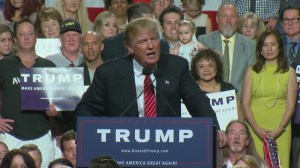
Donald Trump Rally

Support Semi-Partisan Politics with a one-time or recurring donation:

Agree with this article? Violently disagree? Scroll down to leave a comment.

Follow Semi-Partisan Politics on TwitterFacebook and Medium.

Music For The Day

Definitely not Gilbert & Sullivan

“The Lost Chord”, a song by Sir Arthur Sullivan, setting to music a poem by Adelaide Anne Procter. In this 1939 recording, the song is performed by British tenor Webster Booth.

The song was immediately popular on its publication in 1877, and was memorably performed by Italian tenor Enrico Caruso at a benefit concert for the families of the victims of the Titanic sinking at the Metropolitan Opera in New York on 29 April 1912.

The song is also performed movingly in the Mike Leigh film “Topsy Turvy”, focusing on the famous and often fraught partnership between Arthur Sullivan and his librettist WS Gilbert.

Almost achingly Victorian in style, The Lost Chord has more than a shade of morbidity to it, together with that 19th century greater ease and familiarity with death and loss, which 140 years of medical advances have incrementally, thankfully, deprived us.


The Lost Chord

Seated one day at the organ, I was weary and ill at ease,
And my fingers wander’d idly over the noisy keys;
I knew not what I was playing, or what I was dreaming then,
But I struck one chord of music like the sound of a great Amen.

It flooded the crimson twilight like the close of an angel’s psalm,
And it lay on my fever’d spirit with a touch of infinite calm.
It quieted pain and sorrow like love overcoming strife,
It seem’d the harmonious echo from our discordant life.

It link’d all perplexèd meanings into one perfect peace
And trembled away into silence as if it were loth to cease;
I have sought, but I seek it vainly, that one lost chord divine,
Which came from the soul of the organ and enter’d into mine.

It may be that Death’s bright angel will speak in that chord again;
It may be that only in Heav’n I shall hear that grand Amen!


the-lost-chord-sir-arthur-sullivan

Image: Gilbert and Sullivan Archive

Follow Semi-Partisan Politics on TwitterFacebook and Medium.

A Crisis Of Identity: When Global Elites Forget How To Be Patriotic

global-elite

The global, liberal elite are increasingly transcending any lingering commitment to patriotism and national identity, setting them on a collision course with the small-c conservative majority

Michael Lind has an unmissable essay in the National Review this week, entitled “The Open-Borders ‘Liberaltarianism’ of the New Urban Elite“, which manages to explain so much about the rise of Donald Trump and the growing inability of political elites in America and Britain to speak to whole swathes of the country they supposedly control.

The crux of Lind’s argument seems to be that the educated, liberal (to use American parlance) inhabitants of the large cities have increasingly taken on what were always fringe libertarian ideas about open borders and the irrelevance or undesirability of the nation state, leading them to pursue policies and espouse values which alienate the more suburban and rural population.

Key quote:

To date, the public conversation on both sides of the Atlantic has been dominated almost entirely by the elite inhabitants of Densitaria, interrupted only by occasional populist revolts such as the Trump phenomenon or the Brexit vote. In a relatively short period of time, a new elite ideology has emerged that contrasts the dynamic, multicultural, libertarian city-state with the allegedly anachronistic and immoral nation-state. This ascendant worldview unites the open-borders economics and cosmopolitan, utilitarian morality of old-fashioned libertarianism with an idealization of the largest cities and their denizens.

In the 1970s and 1980s, libertarians made all of the major arguments heard from globalists since the 1990s: Favoring citizens over foreign nationals is the equivalent of racism; national borders impeding the free flow of labor and goods are both immoral and inefficient; the goal of trade and immigration policy should not be the relative security or relative wealth of particular countries, but the absolute economic well-being of all human beings.

Until the 1990s, this was an eccentric minority perspective in the U.S. and other democracies, encountered only in small-circulation libertarian journals or in the work of the occasional unworldly academic theorist of cosmopolitan ethics. But in the 2000s, as affluent whites from the professional class and their Latino, immigrant, and black allies displaced working-class whites as the base of the Democratic party, the traditional labor-liberal opposition to low-wage immigration and offshoring of industry was replaced by a new open-borders progressivism distinguishable from traditional libertarianism only by its unworkable combination of support for unrestricted immigration with a generous national welfare state.

This certainly accounts for one of the main reasons behind the Labour Party’s civil war in Britain – from the Blair era onward, Labour has been entirely captured by the open-borders progressives and increasingly turned its back on its former working class voter base. Even under the current Labour leadership election, both candidates hold open borders convictions to their core, even if only Owen Smith is stupid enough to rant about overturning the EU referendum result in public.

It also accounts for the increasing public rage (among non-progressives) about immigration in America, where the Democrats are proud and unrepentant in their support for illegal immigration while the Republicans have talked a tough talk for decades yet done nothing, precisely because the Republican political elites benefit from the current immigration status quo as much as anyone. Enter Donald Trump to an arena where nobody else is even seriously talking about the impact of mass immigration on wages and cultural cohesion, and one cannot be surprised when his crude, simplistic solutions gain political traction.

More:

The combination of open-borders “liberaltarianism” and trendy urbanist hype might lead one to wonder whether leagues of dynamic city-states should replace moribund modern nation-states. Benjamin Barber has published a book titled If Mayors Ruled the World: Dysfunctional Nations, Rising Cities. Barber is one of the founders of the Global Parliament of Mayors, which, according to his website, can help “fill the void left by nation states who [sic] are increasingly dysfunctional.” The economist Paul Romer has proposed boosting Third World development by means of semi-autonomous “charter cities,” which to his critics look remarkably like Western colonial enclaves.

Not even Barber and Romer propose actual urban independence. While cities may teach one another best practices, there is not the slightest chance that leading American cities will secede from the United States, link up with other city-states around the world, and form a new, global version of the Hanseatic League or the Delian League.

We saw the same loose talk after the EU referendum vote, with many Londoners (most of whom have no conception of what the EU really is or how it works) furious at having part of their cosmopolitan identity ripped away from them (as they see it) suggesting that London should somehow secede from the rest of the “backward” United Kingdom and become its own independent city state.

Of course this would never actually happen, but it shows just how disconnected the metropolitan elites are becoming from the country as a whole, and the sheer contempt with which they regard other regions which dared to express their patriotism and belief in self-determination by voting for Brexit. It is also misplaced arrogance of the worst sort – the lights would go out and people would begin to starve in London within days were it not for the arterial links of people and goods from the supposedly terrible and backward rural and suburban regions.

And it is this continual feeling of disrespect, I think, which does so much to drive populist insurgencies like the rise of Donald Trump, and (if I am honest) even those populist causes that I actually agree with, like Brexit. People in the industrial and commuter heartlands, as well as rural folk, are getting increasingly sick of being told that they are too backward, too intolerant, too racist, that their own priorities and concerns do not matter and that they should be led in all regards by an urban elite who don’t even seem terribly attached to the country that gives them life and liberty, and who find the slightest display of national pride or patriotism almost painfully embarrassing.

I’m fortunate. I got into a good university and managed to embark on a career which has seen me work in numerous countries across three continents. But if this had not been the case – if, like many of my peers, an international business career was either never on the cards or simply not what I wanted to do – then I would probably be quite put out by people whose interest and commitment to any one country seems transitory at best telling me what I should think about immigration, global governance and democracy.

Now living in remain-voting West Hampstead, I am surrounded by the kind of people who are aghast at the Brexit vote and who consider it a calamity brought down upon the heads by the kind of ignorant, unwashed oiks whom they would never normally speak to unless they were fixing their car or serving them a burger. I can see how it must grate with Middle England, because it grates with me.

Lind goes on to touch on this point:

What appears to be a debate among globalists and nationalists, then, is really a debate about the structure of the 21st-century nation-state. There are real dangers associated with the coalescing elite ideology of post-national globalism or, to be precise, national-elite pseudo-globalism.

One danger is groupthink resulting from the attempt by the new globalists to equate even enlightened and civic nationalism with racism. When the economist Larry Summers, nobody’s idea of a pitchfork-waving populist, tentatively called for “responsible nationalism,” he was criticized by The Economist, whose open-borders libertarianism, once eccentric, has become near-orthodoxy among the trans-Atlantic elite.

And closes with this stark warning:

The most significant threat is the possibility that the abandonment of national patriotism by many elite citizens of the nation-state for make-believe cosmopolitanism will weaken national unity, to the benefit of sub-national racism, ethnocentrism, and regionalism. The loyalties that succeed national solidarity are likely to be narrower, not broader. If history is any guide, the victims of tribalism and illiberal populism are likely to include would-be citizens of the world who despise the nation-states that make possible not only their wealth but also their security.

Absolutely. This blog has been banging on for years about the continued importance of the nation state as the final guarantor of most of our most precious rights and freedoms. But the nation state is also, in the democratic age, a relatively harmless way of allowing people to feel and express a sense of belonging and community pride without tipping over into other, much darker expressions of identity.

Those weepy europhiles mourning Britain’s imminent departure from the EU because they consider themselves “European citizens” might want to pause and think through the consequences of further undermining the nation state, which is the primary aim of their beloved project. Because enlightened, one-world government is a few centuries away yet, and whatever crops up to replace the nation state that they so eagerly undermine will likely be unpleasant, even violent.

And while it may not be purely libertarian, this blog would much rather live in a world of moderate, familiar nationalist rivalry than descend into the known horrors of ethnic or religious sectarianism. We already see the early fruits of this blinkered commitment to “multiculturalism” in self-segregated and un-policed communities here in Britain among certain immigrant populations. We don’t need to extend those delights to the entire population.

What is the solution? Michael Lind does not offer one, and this blog does not see an easy fix either. But when global elites (Davos Man and the like) and the next tier down (those with international lives and careers) have more in common with each other than with those of other socio-economic groups and communities in their own countries, it is a recipe for political alienation and the eventual fracturing of our civic life.

To avoid disaster and a true crisis of democracy, our ruling elites in the political and commercial sphere must somehow learn to be patriotic again – for if the nation state has no champions it will go on being relentlessly undermined on all fronts. But right now there is little evidence that they are remotely interested in bridging the growing chasm between their own interests and those of the people they supposedly “serve”.

This leaves the field wide open for the likes of Donald Trump and UKIP 3.0 to make inroads with voters left cold by the other options available to them. And the time may soon come when the political elites sorely regret ceding this territory.


globalism-versus-culture

Bottom Image: Stefan Molyneux, Globalism versus Culture

Support Semi-Partisan Politics with a one-time or recurring donation:

Agree with this article? Violently disagree? Scroll down to leave a comment.

Follow Semi-Partisan Politics on TwitterFacebook and Medium.