Remainers: You Can Stop Pretending To Be Patriotic Now

Jonn Elledge - Democratic World Superstate - Brexit

A rare moment of honesty from an arch-Remainer

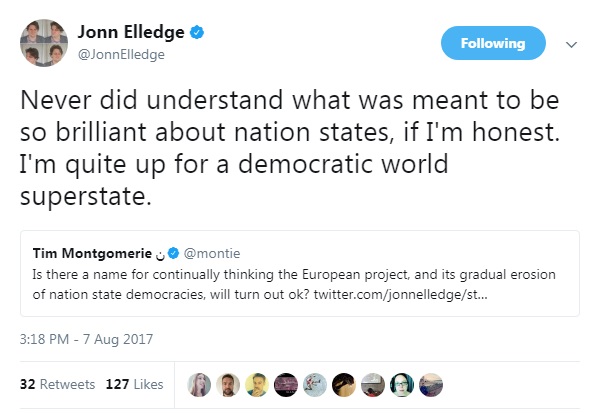
New Statesman staff writer Jonn Elledge – whom I recently described as “worse than a garden variety xenophobe” for his heinous statements about elderly Brexit voters, much to his indignant outrage – has been engaging in a minor Twitter spat with Tim Montgomerie this afternoon about the nature of Brexit.

This would be utterly unremarkable, but for one inadvertently revealing tweet in the exchange in which Jonn Elledge revealed in a moment of strange candour the real reason that establishment Remainers love the European Union and cannot conceive of a life outside of its cloying embrace.

Pressed by Montgomerie, who asked “Is there a name for continually thinking the European project, and its gradual erosion of nation state democracies, will turn out ok?”, Elledge replied, simply and honestly (for once) “Never did understand what was meant to be so brilliant about nation states, if I’m honest. I’m quite up for a democratic world superstate”.

This is an appallingly ignorant and historically illiterate statement, the kind of sentiment that could only be uttered by somebody who enjoys all the benefits of living in the age of the modern democratic nation state without pausing for a moment to consider the true source of all his comfort (hint: not the EU). Would Elledge at least concede that the nation state is a slight improvement on the city state? The multiethnic empire? The dynastic kingdom? Marauding tribes? He is at pains not to say, and yet is quite ready to roll the dice, jack in the nation state and try something new without really giving it a moment’s thought.

And there it is, ladies and gentlemen. Finally, a moment of honesty from the arch-Remainer side of the argument. Of course, those of us who followed the EU referendum debate closely and saw through the paucity and desperately narrow scope of the Remain side’s argument (focused almost entirely on negative scaremongering about trade with occasional rhetorical flourishes about “cutting ourselves off from the world”) knew that something deeper was motivating the EU’s loudest cheerleaders.

But of course Jonn Elledge and his co-conspirators could not admit their dirty desire in public during the referendum. They could not simply admit the truth – that they have no respect or appreciation for the nation state and its role in guaranteeing our core freedoms and liberties, and that they would sooner consign nations to the grave so long as they and their ilk could preserve their current perks and become true citizens of the world.

To admit their scorn for the nation state and eagerness of its demise would have been suicide during the EU referendum. Thus their only hope was to pretend to be patriotic and to have a love for this country and its many positive qualities (some of them are still continuing the pretence to this day to maintain their credibility in the hope of winning a potential second referendum) while secretly loving the EU precisely because it actively undermines nation states by design.

But of course the one world government (or “democratic world superstate”) longed for by Jonn Elledge (and no doubt many other Remainers in the secrecy of their own hearts) is totally impractical in any case, working against human nature rather than with it, as all Utopian left-wing pipe dreams tend to do.

Consider the case of the United States of America, fifty states combined into one great nation, bound together under the motto E Pluribus Unum (out of many, one). When it comes time for presidential elections, Americans do not stubbornly vote only for candidates from their own state, but instead choose from the candidate whose policies they prefer from any of the fifty states. A Californian might vote for a candidate from Illinois without so much as a second thought, knowing that the candidate will represent all of America if elected. Americans can do so in confidence because their sense of being American is stronger than their sense of being an Iowan, New Yorker, Nevadan or even Californian or Texan, the two states with the strongest sense of separate nationhood.

Now imagine an election for Leader of the World. Do you think that people from countries as diverse as Britain, Mexico, Malaysia, Russia, Greece, Kenya and Japan would vote high-mindedly for the candidate who offered the best suite of policies, regardless of his or her nationality? Would it even be likely that a candidate would offer a fair suite of policies rather than a manifesto geared toward benefiting his or her home nation? Of course not. Cultural differences are far more significant across national borders (despite the furious efforts of pro-EU “citizens of the world” to pretend otherwise), and out of protectionist instinct people would inevitably want to vote for a candidate from their own country, or at least a sympathetic country.

And who can say that they would be wrong to do so? Is Jonn Elledge seriously contending that he would be happy for the world to be led by a member of the Chinese Communist party? Or by a Putinesque Russian oligarch? Or a theocratic Saudi cleric? Of course he wouldn’t. Elledge, in his disdain for the nation state and desperate need to virtue-signal his abhorrence of patriotism, paints a fraudulent world of rainbows and unicorns where all cultures are equally praiseworthy and deep-seated cultural and religious differences are non-existent. Again, working doggedly against human nature rather than working practically with it.

There can be no world government because there is, as yet, no world demos. One day, probably quite far in the future, this may change. And that may be a good thing when it eventually happens. But we are not there yet, and to pretend that a “democratic world superstate” is either viable or desirable is foolishly naive as well as being oxymoronic – you can either have democracy or a world superstate, but not both.

I wrote about the ongoing importance of the nation state at some length back in 2015:

The liberties and freedoms we hold dear today can very easily slip away if we do not jealously guard them. By contrast, power is generally won back by the people from elites and powerful interests at a very heavy price – just consider Britain’s own history, or the American fight for independence from our Crown.

If we want to have a say in designing the new institutions that will govern our politics, trade, intra-bloc affairs (for we soon may not call it “foreign relations”) and other issues, we need to put the brakes on the demise of the nation state while we take stock and think about the future that we want, so that we do not end up in the future that our leaders and elites are building now in secret, without our consent.

Even if you find patriotism silly and the importance that conservatives attach to symbols and rituals to be absurd, it is still in your interests to slow down the juggernaut of European integration so that you too can help design the world our descendants will inhabit. You may laugh at the latest sensationalist Daily Mail headline, or think Nigel Farage a fool when he stands in his local pub, resplendent in tweed, drinking a pint of English ale. And that’s fine, you can laugh.

But think about what the world will be like in one hundred years, with its new technologies and services and ideas. Think about what innovations there will be in healthcare and banking and computing (and data collection) and travel. And then think about how much oversight and control we have over any of these things even today, in 2015. It it enough?

Imagine, then, the world of 2115. What institutions will then exist to safeguard our children’s  interests, and which bodies and authorities will they petition for redress of grievances? Who will control foreign relations between whatever nation states or multinational trading blocs remain, and who will decide whether to wage war using whatever unimaginable weapons we have conceived a century from now?

Do you entrust the EU with these powers? The World Trade Organisation? The United Nations?

The answer to this final question is apparently a resounding “yes!”, at least as far as Elledge is concerned. Any international or supranational institution is brimming over with legitimacy and ability to solve “a lot of stuff the nation state can’t do” in the mind of hardcore ideological Remainers, while the despised nation state offers nothing but insularity, bigotry and nationalism.

The naivety on display here is quite simply off the charts. Obviously it is one of the defining characteristics of those on the Left to leap towards radical change without stopping to think through the consequences, but to show a willingness to do so with something as fundamental as abandoning the nation state as the basic building block of human society is reckless indeed. Especially since neither Jonn Elledge or anybody else has proposed a viable alternative.

It is one thing to rage against the status quo and advocate for radical change. But to sneer at the nation state, close one’s mind to the stability and prosperity it has delivered and advocate for One World Government without even beginning to think through the consequences and practicalities should destroy once and for all whatever credibility Jonn Elledge and his ideological brethren have left.

And still we should be grateful. For too long, ideological establishment Remainers have walked a tightrope, angrily proclaiming that they are as patriotic as the next man (and taking great offence when the impossibility of this statement was pointed out to them) while doing everything in their power to ensure that the nation state is weakened, together with the fraying bonds which hold our society together. Now, finally, the mask is slipping. Whether through a moment of frustration or deliberate design, the real motivations are now being unmasked.

Now we see the hardcore ideological Remainers for what they are.

 

European Union - United Kingdom - Britain - Flags

Support Semi-Partisan Politics with a one-time or recurring donation:

Agree with this article? Violently disagree? Scroll down to leave a comment.

Follow Semi-Partisan Politics on TwitterFacebook and Medium.

Peter Hitchens Demands A Real Conservative Alternative To Jeremy Corbyn

Margaret Thatcher hologram

The current cast of characters jockeying to replace Theresa May are almost as underwhelming as the prime minister herself. British conservatives of all shades need to have a full and open debate about how best to move the Conservative Party and the country forward, and then find a future leader with the charisma to take on Jeremy Corbyn in the battle for hearts and minds

Exactly two years ago, I wrote a rather despairing piece asking “Where is the Conservative Party’s Jeremy Corbyn?” Now Peter Hitchens is rightly asking the same question, having long ago despaired at the direction of the Conservative Party and its accommodation with Blairite, centrist managerialism.

Back in August 2015 I wrote:

I want a standard bearer for the Right who actually makes me feel excited, not resigned, when I enter the polling booth. I don’t necessarily expect that person to be elected by a landslide on the first attempt, and to immediately implement their entire agenda in full. But neither do I expect – as presently happens – all of the soul-sapping compromising and watering-down of core principle to take place before the candidate even gets their name on the ballot paper.

Jeremy Corbyn has not done all of his compromising upfront – he is proud of his beliefs, and does not seek to apologise for them. And he doesn’t talk and answer questions as though he is responding to the twitches of a focus group’s instant polling dial. That’s why he is surging in the polls. That’s why previously dejected Labour activists who support Corbyn are suddenly walking a little taller again. That, I think, is why Owen Jones is walking round with such an infuriatingly wide smile on his face at the moment.

It cannot remain this way if we are to be successful in advancing the cause of smaller government and greater individual freedom and autonomy. We cannot allow the Left to monopolise inspiration and ambition, however far-fetched, while we conservatives occupy and embody the dull, managerial, technocratic and remote politics of austerity.

And conservatives will never win a real mandate for change so long as we are content to be the party of last resort, the failsafe option voters pick when all of the other choices are too wacky or offensive to contemplate.

I concluded by asking:

If David Cameron’s Conservative Party was voted out of office today, what will future historians and political commentators say about this government fifty years from now? What will be the Cameron / Osborne legacy? What edifices of stone, statute and policy will remain standing as testament to their time in office? Try to picture it clearly.

Are you happy with what you see?

Substitute Theresa May’s name for David Cameron’s, and pose the same question to yourself. Is the answer any clearer or more satisfactory than it was two years ago?

Clearly not. And now Peter Hitchens has arrived at the same conclusion, writing in the Mail on Sunday:

If (like me) you have attended any of Mr Corbyn’s overflowing campaign meetings, you will have seen the hunger – among the under-30s and the over-50s especially – for principled, grown-up politics instead of public relations pap.

Mr Corbyn reminds mature people of the days when the big parties really differed. He impresses the young because he doesn’t patronise them, and obviously believes what he says. This desire for real politics isn’t just confined to the Left. Ken Livingstone is right to call Mr Corbyn Labour’s Nigel Farage. Ukip appeals to a similar impulse.

Millions are weary of being smarmed and lied to by people who actually are not that competent or impressive, and who have been picked because they look good on TV rather than because they have ideas or character.

Indeed, ideas or character are a disadvantage. Anything resembling a clear opinion is seized upon by the media’s inquisitors, and turned in to a ‘gaffe’ or an outrage.

Actually, I dislike many of Mr Corbyn’s opinions – his belief in egalitarianism and high taxation, his enthusiasm for comprehensive schools, his readiness to talk to terrorists and his support for the EU. Oddly enough, these are all policies he shares with the Tory Party.

But I like the honest way he states them, compared with the Tories’ slippery pretence of being what they’re not.

I have indeed attended one of Jeremy Corbyn’s massive rallies, in which the Labour leader (then fighting to cling on to leadership of the party in the face of a challenge from the hapless Owen Smith) managed to pack out the vast Kilburn State theatre in North London with excited and motivated activists of every age. It was quite a remarkable sight to behold, with energy levels more like those you would see in a hard-fought US presidential primary than a dour Labour Party leadership contest.

Contrast this with the pathetically phony photo opportunities orchestrated by Theresa May’s hapless 2017 general election campaign, with a small huddle of telegenic young activists, clearly bussed in from London, holding up professionally printed placards in front of the Tory campaign bus while the prime minister grated her way through that godawful “strong and stable” stump speech. There was no authentic grassroots enthusiasm for May or her policies, to the extent that CCHQ was terrified to allow the prime minister to get into any kind of unscripted interaction with the public, let alone a televised debate.

Theresa May - conservatives - campaign rally crowd


There may well be an appropriate time for dull managerialism and “steady as she goes” leadership, but Britain in 2017 is not it. Obviously Brexit must be handled with skill and sensitivity (not that the government has shown either of these attributes), but in every other respect Britain requires radical solutions to deep-seated problems rather than Theresa May’s brand of denial and incompetence. Whether it’s low productivity, education, the housing crisis, a failing nationalised healthcare system, dangerously pared-down national defence or a society fractured by toxic identity politics, this is a time for bold and unapologetically conservative solutions. But instead we have a weak prime minister at the head of an incoherent government, terrified of proclaiming conservative principles and desperate to move closer to the Labour Party on nearly every issue.

Hitchens goes on to describe what he sees as the ideal future Conservative leader:

My hope, most unlikely to be realised, is that a patriotic, conservative and Christian equivalent of Mr Corbyn will emerge to take him on, and will demonstrate, by his or her strength of conviction, that there is an even greater demand for that cause than there is for old-fashioned leftism. In any case, I think any thoughtful British person should be at least a little pleased to see the PR men and the special advisers and the backstairs-crawlers of British politics so wonderfully wrong-footed by a bearded old bicyclist.

Patriotic and conservative would be a good start, but I don’t think that this is specific enough. Theresa May, for example, ticks all three of Peter Hitchens’ boxes (one can make a valid argument that May represents a serious thread of conservative thought) yet is completely and utterly unequal to the role of prime minister, ideologically and temperamentally.

And as far as being Christian is concerned, Theresa May is a practicing Christian and famously the daughter of a vicar, and yet she has shown no real impulse to halt the suppression of legitimate religious expression where it comes into conflict with the free speech-averse forces of social justice and identity politics, for example. What, then, is the point of cheerleading for a Christian prime minister when they fail to defend religious freedom when in office? I would much rather have a prime minister who is secular-liberal when it comes to religion, eager to separate church (and faith) from state as far as possible while simultaneously protecting the right of British citizens to worship freely.

When it comes to choosing the ideal future Conservative prime minister, I maintain that the Tories could do far worse than select somebody who fits the profile I set out shortly before the disastrous general election back in June:

Ex armed forces (of either gender), mid to senior rank, with an illustrious overseas deployment history. Someone who exudes unapologetic patriotism yet never lapses into cheap jingoism, and whose commitment to defence, national security and veterans affairs is beyond question.

Followed up by a successful later career, possibly in the third sector or the arts but better still in the private sector, having founded a stonking great big corporation that also gives back to the community by employing ex-offenders or partnering with charities to do meaningful work in society.

A solid and consistent record (at least dating to the start of the EU referendum campaign) on Brexit, able to tell a compelling story about how Brexit – properly done – can be good for our democracy and at least neutral on the economic front.

A person who believes that until somebody comes up with a viable alternative to (or augmentation of) the democratic nation state, this institution remains the best method yet devised of ordering human affairs, and that consequently we should not needlessly undermine and vandalise it by vesting power in antidemocratic supranational organisations or pretending that we can sidle our way into a post-patriotic world by stealth rather than with the consent of the people.

Somebody who will not bargain away our civil liberties chasing the chimera of absolute security from terrorists and madmen – particularly while refusing to face down radical Islamism as an ideology to be confronted and defeated – but who will also stand up to expansionist, nonsensical definitions of human rights and an identity politics / political correctness agenda that values hurt feelings more than freedom of expression.

Somebody with the articulateness, gravitas, sincerity and quickness of thought capable of doing the near impossible in 2017: single-handedly turning the tide away from the vapid, broken politics of me, me, me. Somebody willing to ask – as John F. Kennedy once did – not what our country can do for us, but what we can do for our country. Somebody who dares to call us to a higher purpose than merely living in a country with “good public services”, deifying “Our NHS” and having the goddamn trains run on time.

Somebody who chooses for us to go to the moon (or rather its current day equivalent in terms of spectacular human achievement) “and do the other things, not because they are easy, but because they are hard, because that goal will serve to organize and measure the best of our energies and skills” (John F Kennedy).

Doubtless my idea of the ideal conservative prime minister and Peter Hitchens’ conception will differ somewhat – Hitchens is more socially conservative than I, while I see myself as more of a conservatarian with pragmatic, tempered libertarian instincts.

But these differences of opinion only make it all the more important that we have a full and open debate about the future of conservatism, and what kind of leader would be best placed to move the conservative movement and the country forward. And far better that this conversation first take place in the abstract, as a discussion of principles and ideology, so it does not immediately descend into personality-based infighting and jockeying for position among Theresa May’s likely successors.

And at the risk of sounding like a broken record, it is also vitally important that conservatives (I deliberately speak of small-C conservatives rather than the often toxic and inept Conservative Party) find a way to re-engage with a youth vote that the Tories have been shamefully quick to write off and cede to the parties of the Left. This abandonment of the youth vote is absolutely untenable going forward, and is yet another reason why the next Tory leader needs to have sufficient charisma and authenticity to cut through anti-conservative prejudices among young people that have often been baked into their consciences since they first became politically aware.

Until the Conservatives figure out who and what they actually want to be, both Peter Hitchens and I are likely to remain underwhelmed and disappointed. An urgent reckoning needs to take place in order to answer this question: Has seven years of Cameron/Osborne/May-style accommodation with centrist Blairism delivered any real tangible improvement to the trajectory of Britain, or are we largely treading water? And if the latter, is the solution to move even further to the left, as Theresa May and her political spirit animal Nick Timothy seem to want, or is it wiser and better to bring real conservative values to bear on 21st century problems?

As far as I am concerned, the choice is self-evidently clear. The Tories can stubbornly cling to their current philosophy and hope at best to remain in office but not in power for a few more years as they desperately scamper after the Labour Party in their march to the hard left, or they can renew themselves, stop apologising for their conservatism and start enacting it instead.

But in the meantime, let’s start the debate.


Theresa May cabinet - Tory conservative leadership

Top Image: NewsThump

Support Semi-Partisan Politics with a one-time or recurring donation:

Agree with this article? Violently disagree? Scroll down to leave a comment.

Follow Semi-Partisan Politics on TwitterFacebook and Medium.

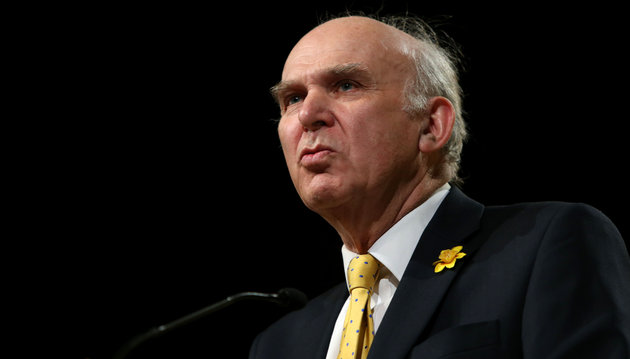
Vince Cable Joins The Anti-Brexit War On The Elderly

Vince Cable - Brexit

Remainers love to claim that the EU referendum “divided Britain”. But many prominent Remainers are perfectly happy to stoke divisions of their own in order to thwart Brexit

While any measured, rational human being ought to be immediately capable of seeing through YouGov’s recent flawed opinion poll – which was constructed to give the misleading impression of elderly Brexit voters being selfish extremists – new LibDem leader Vince Cable is happy to stoke intergenerational conflict in order to feed his desperate pro-EU confirmation bias.

Writing in the Mail on Sunday (surprising enough in itself, considering most bien-pensant elites view that paper as little more than a fascist propaganda newsletter), Cable moans and wails about how the older generations have supposedly “shafted the young”.

Cable writes:

The Remain argument about economic damage is now largely accepted. Mounting evidence of a slowing economy and rising inflation give substance to earlier warnings. The issue has become one of how to minimise or postpone the damage. And instead of countering the arguments, more and more Brexiteers are embracing economic pain as a price worth paying for ‘taking back control’: almost as a badge of honour.

This attitude has reached worrying proportions. Press stories refer to ‘martyrs for Brexit’ based on a YouGov survey suggesting 61 per cent of the public would accept ‘significant damage to the economy’ from Brexit and 39 per cent ‘don’t mind losing their job’. These figures seem wildly implausible.

I don’t encounter people running around saying ‘please make me poorer’ or ‘please sack me’. These figures are also difficult to reconcile with polling which shows 66 per cent of voters wanting to remain inside the single market.

Of course, as I explained at length in my response to an equally idiotic piece in the New Statesman, there is in fact no contradiction here. It has nothing to do with being a “martyr”, or acting irrationally against one’s economic self interest. Rather, elderly voters simply understand that there are other motivations and considerations besides short term economic gain.

Having grown up in the post-war years and through the Cold War, older voters tend to appreciate the value of democracy and self-determination more than young voters who have never faced existential threat and for whom the EU has been an ever-present reality and an unquestioned positive force. And Vince Cable probably knows this full well, but it suits his purposes to portray those with differing political opinions as somehow unhinged or even malevolent.

Ironically, immediately after impugning the motives and morals of older Brexit voters, Vince Cable then goes on to make a plea for tolerance and mutual respect:

But the last thing the UK needs is further polarisation. There is already more than enough bad-mouthing of opponents and questioning of the patriotism of those who criticise the Government.

The gall of these establishment EU-defenders is absolutely off the charts. Where once a senior politician might have felt a degree of shame that would have prevented him from contradicting himself so completely in an Op-Ed, Cable does so proudly, fully expecting not to be picked up on it. This is how little establishment centrist politicians think of voters and their capacity to understand political or rhetorical arguments. But it is also a sign of the desperation in the Remain camp, as the dream of thwarting Brexit altogether recedes further and further into the distance.

And it gets worse:

To describe such masochism as ‘martyrdom’ is dangerous. We haven’t yet heard about ‘Brexit jihadis’ but there is an undercurrent of violence in the language which is troubling. We have already had the most fervent of Brexiteers, such as Nigel Farage, warning of civil unrest if the ‘will of the people’ is frustrated.

Brexiteers may well be frustrated since the practical difficulties of Brexit, as well as the costs, could result in Brexit never happening.

This is a clever little construction of Cable’s, writing that we haven’t yet heard about “Brexit jihadis” while simultaneously inserting what he clearly hopes will become the Left’s new insult of choice into the public discourse. Let’s be clear – the leader of the Liberal Democrats, that party which considers itself so rational and pragmatic, has just compared Brexiteers who dared to weigh considerations other than economic gain when voting in the EU referendum to jihadis. To murderous Islamist terrorists who maim and kill.

At what point do we stand up to the establishment’s collective hissy fit over Brexit? At what point do decent people refuse to be thus insulted by what Tim Montgomerie called the very “greybeards” who only recently urged further EU integration and the Euro on us even as these failing policies devastated the younger generation, particularly in southern Europe?

That’s not to say that Vince Cable is wrong in many of his warnings about Brexit. In many ways he is right to warn about the implausibility of hammering out a bespoke deal with the EU by 2019, and to urge a slower, managed transition which maintains current access to the EEA. But all of these sensible warnings are completely overshadowed by the overwrought, flowery language suggesting that Britain’s grey-haired voters are supposedly full of hatred and malice towards the children that they raised.

Are the older generations completely innocent? Of course not. Valid arguments can be made that they have been too sheltered from “austerity” and the consequences of the Great Recession thanks to universal benefits and the “triple lock” on pensions. And certainly, as a demographic with a high propensity to vote, the retiree lobby has been very successful in seeing their interests turned into government policy.

But Vince Cable’s over-the-top attack on older voters immediately turns them back into sympathetic characters, and only makes it harder to question the privileges that they have accrued through successive government policy. Comparing decent people who have worked their whole lives and done so much to build the country in which we live today to radical Islamist terrorists is so heinous, so wildly excessive, that sensible discussion becomes impossible.

This kind of behaviour might be just about acceptable from someone like me – a relatively unknown political blogger perhaps looking to make a splash by saying something outrageous or provocative (see Abi Wilkinson’s clickbait call for a 100% inheritance tax in the Guardian). But Vince Cable is not an obscure political commentator. He is leader of the Liberal Democrats, a political party which still purports to be taken seriously.

In reality, most people vote both for reasons of self interest and for the perceived good of society. The truth about the elderly Brexit vote probably lies between Brendan O’Neill’s lionisation of these voters and Vince Cable’s haughty dismissal.

O’Neill has been effusive in his praise:

I find it deeply inspiring, moving even, that my fellow Brexiteers are willing to have it rough in the name of democracy, in the name of bringing law-making back to where every progressive of the modern, Enlightened era believed it should be: in the nation, under a people’s oversight.

I straight up got a lump in my throat when I read the bit of the YouGov research that says many Leave voters would even be okay with losing their own jobs, or seeing a family member lose a job, in the name of Brexit. Thirty-nine per cent said such personal hardship would be a price worth paying, against 38 per cent who said it wouldn’t be. Now that’s devotion. That’s idealism. And if it seems alien to us, that only goes to show what a flat, grey political era we live in.

Indeed, the rather elitist alarm that has greeted the revelation that people are willing to suffer for their democratic ideals sums up what a baleful influence technocracy has had on our political imagination. In the technocratic era, when politics has been drained of big ideas and reduced to a box-ticking exercise that is all about managing society, its inhabitants and their aspirations, political passion can seem threatening. Strong feelings, democratic devotion, self-sacrifice – these have become foreign bodies in a time when politics is about making things chug along as uncontroversially as possible. To the technocrat, to the EU suit who drafts laws far from the madding demos, the utterance ‘I am willing to go through hardship for what I believe in’ seems perverse. It’s disruptive. It is because we inhabit such a beige world of spun, small politics that the willingness of us Brexiteers to suffer for our beliefs can look like ‘extremism’.

I get where O’Neill is coming from, even though I think he goes a little too far, reading something that both he and I desperately want to see (a return to conviction politics and commitment to ideology rather than fudged centrist compromise) into a vote whose motivations were more nuanced than either extreme.

In truth, elderly Brexit voters are neither selfless heroes nor foaming-at-the-mouth jihadists. But as far as the media is concerned, the narrative about older voters being selfish is too convenient to ignore. Unfortunately it reveals a gulf of misunderstanding, as Vince Cable makes clear:

The old have comprehensively shafted the young. And the old have had the last word about Brexit, imposing a world view coloured by nostalgia for an imperial past on a younger generation much more comfortable with modern Europe.

If I had a pound for every time some sanctimonious Remainer airily asserted that Brexit was motivated by “nostalgia for an imperial past” then I would never need to work again. In reality, the Lord Ashcroft poll taken in the immediate aftermath of the EU referendum clearly showed that the principle motivating factor for Leave voters was “the principle that decisions about the UK should be taken in the UK”. Perhaps this lacks nuance and an understanding of modern day interdependence in the regulatory environment, but it is also a clear and unambiguous call for the same kind of autonomy enjoyed by countries far smaller than ours in terms of GDP such as Australia, Canada or Korea. This is by no means unreasonable, and cannot be fairly caricatured as some kind of imperial nostalgia.

So why pretend that it is? Either Vince Cable is so full of self-hatred for his own country and its history that he believes that our dissolution as an independent nation state into an increasingly federal EU is somehow appropriate “payback” for our transgressions in the days of empire, or he knows full well that the Brexit vote was not motivated by imperial nostalgia but simply finds this to be a convenient trope with which to whip up his own supporters.

For now I will do Vince Cable the courtesy of assuming the latter rather than the former – that he is in fact not a self-hating Brit, but rather just a cynical old politician like so many others. But the longer this tantrum against anyone and everyone who voted for Brexit goes on, the harder it becomes to assume good faith on the part of the furious Remainers.

At some point the Vince Cables of this world have to either engage with the real substance of Brexiteer arguments, attitudes and motivations, or else just admit that they don’t care – that they simply feel blind, unthinking hatred towards those who disagree with them and have no interest in rational discussion.

It might actually prove quite cathartic; rather than having to make increasingly ludicrous arguments that people voted for Brexit somehow want to bring back the Empire, Vince Cable and his ilk could simply have their Two Minutes Hate every day and be satisfied.


Vince Cable - Brexit - EU

Support Semi-Partisan Politics with a one-time or recurring donation:

Agree with this article? Violently disagree? Scroll down to leave a comment.

Follow Semi-Partisan Politics on TwitterFacebook and Medium.

Tales From The Safe Space, Part 54 – Mr. Prager’s Opus

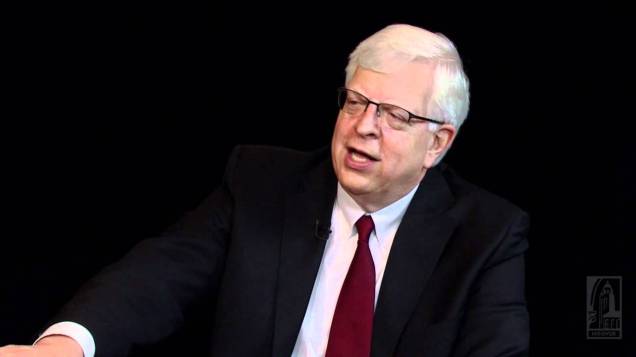
Dennis Prager

When a prominent conservative speaker cannot conduct a symphony orchestra without attracting protest from social justice warriors in the arts world, we should take note; the regressive left will not rest until they have driven all conservative thought criminals from the public square

Conservative author and talk radio host Dennis Prager recounts a disturbing tale in the National Review this week.

Some background: for many years, Dennis Prager – a long time classical music aficionado – has conducted various provincial symphony orchestras in the United States, indulging his passion while raising much-needed funds for those orchestras and introducing new people to the world of classical music. As an amateur, Prager has never accepted a fee for conducting; he purely does so out of love of the music and a desire to introduce classical music to a wider audience.

These events actually look really fun – Prager participates only in the first half of the concerts, conducting a symphony and then doing a Leonard Bernstein-style “Young People’s Concert” format where he breaks down the symphony under discussion, revealing the inner workings of the music and interviewing members of the orchestra to get their insights. The second half is then conducted by the orchestra’s usual music director, a kind of 50/50 split between amateur and professional. In short, what’s not to like?

Anyhow, Prager was recently invited by the music director of the Santa Monica Symphony Orchestra to perform Haydn’s symphony no. 51 with that ensemble at the iconic Walt Disney Concert Hall in Los Angeles. Prager has a particular affinity for the music of Haydn, as Santa Monica Symphony Orchestra music director Guido Lamell notes:

“On his radio program he often talks about the glories of music. His bumper music that introduced his program every day was a Haydn symphony in F major. He has studied this composer more deeply than anyone I have met. We classical musicians saw then in Dennis and continue to see the greatest and most vocal supporter of classical music on earth.”

Therefore this would seem like the perfect fit – a rarely heard Haydn symphony conducted by someone recognised by other musicians as an expert in the field, performed in a true world-class venue. This invitation must have been a dream come true for the amateur conductor, who called it “one of the great honors of my life”.

And that’s when the story took an ominous turn:

About a month ago, however, a few members of the orchestra, supported by some Santa Monica city officials, decided to lead a campaign to have me disinvited.

As I said, this is a new low for the illiberal Left: It is not enough to prevent conservatives from speaking; it is now necessary to prevent conservatives from appearing even when not speaking. Conservatives should not be even be allowed to make music.

To its great credit, the board of directors of the Santa Monica Symphony Orchestra, composed of individuals of all political outlooks, has completely stood by their conductor and his invitation to me.

But the attempt to cancel me continues. It is being organized by three members of the orchestra, each of whom has refused to play that night. Readers will not be surprised to learn that two of the three organizers are college professors. Michael Chwe is a professor of political science at UCLA, and Andrew Apter is a professor of history and director of the African Studies Center at UCLA.

In an open letter to the symphony’s members, the three wrote: “A concert with Dennis Prager would normalize hatred and bigotry. . . . ”

And why?

Examples of my hatred and bigotry include my belief that in giving a child over for adoption, adoption agencies should prefer a married man and woman before singles and before same-sex couples. Another example – my favorite – is my having said that, if there is no God, ethics are subjective, will offend atheist members of the orchestra.

This is insane.

Music is supposed to bring people together, to bridge even bitter differences of opinion. The musicians of Daniel Barenboim’s acclaimed West-Eastern Divan Orchestra – comprised of musicians from countries not always on the best of terms, including Egypt, Jordan, Syria, Lebanon, Iran and Israel – manage to sit down next to one another and perform amazing, transcendental music together. I know – I heard them play Beethoven and Tchaikovsky with great authority at the BBC Proms in London.

And yet three American musicians, including two coddled academics from UCLA, feel unable to perform Haydn with a fellow countryman because of relatively minor political differences, primarily relating to Prager’s social conservatism. Because his presence would allegedly cause them, or various other people for whom they claim to advocate, some grave and irreparable offence.

This reflects so badly on the individuals concerned that there are almost no words to describe it. What wouldn’t the members of the West-Eastern Divan Orchestra give if the only point of issue between their respective countries, between Israel and Palestine, was a debate over adoption laws or a philosophical question about whether or not an objective ethical code can exist without God? The ancient grudges, resentments and enmities which divide the Middle East are far greater than those which divide Red and Blue America, and yet it is in the cloistered halls of American pseudo-liberalism where true intolerance can now be found.

More:

Not to be outdone by these professors, a former mayor of Santa Monica and current councilmember, Kevin McKeown, wrote: “I personally will most certainly not be attending a concert featuring a bigoted hate-monger. The judgement (or lack of) shown in inviting Prager may affect future community support for the Symphony.”

This sounds an awful lot like a threat, and a very thinly-veiled one at that. This is worse even than the heckler’s veto, deployed with such success by Social Justice Warriors, Antifa protesters and others to shut down speech or events which they do not want to proceed for ideological reasons. Such thuggery as we have repeatedly seen on university campuses is bad enough, but now we apparently have a serving city councilmember threatening the funding or “community support” of a local symphony orchestra unless that ensemble bends to her will and disinvites a fellow musician.

I take this story quite personally because like Dennis Prager – albeit in a far, far smaller capacity – I too have attempted to support the arts by giving time and financial support to make the amazingly rewarding heritage of classical music more accessible to people who otherwise might not have had the opportunity, or even the idea, to go to an orchestral concert. The thought that one day I might be banned from doing so because of the political beliefs I hold is as unbearable as it is outrageous.

I have a passing familiarity with Mr. Prager’s biography, work and political positions, some of which I agree with and some of which I do not. But that doesn’t matter – there should be no ideological or political test when it comes to participating in the artistic life of one’s community or country.

I wrote on this same subject over three years ago, when Russian maestro and then principal conductor of the London Symphony Orchestra, Valery Gergiev, was facing calls to resign because of his pro-government stance on Ukraine. Music is one thing that we all have in common, one of the best bridge-building tools that we have. If the New York Philharmonic can go on tour to North Korea then a couple of coddled academics from California can swallow their tremulous objections and make music with Mr. Prager for sixty minutes.

I feel tremendous sympathy for Dennis Prager as he attempts to pursue his hobby and give back to society while under assault by the intolerant regressive left. But let us be under no illusion – stories like this will only become more common, not less, until the Right regroups and finally stands up to the Left’s assault on freedom of thought, expression and speech. Today it may be a high-profile talk radio host and author who finds himself being hounded out of his life’s passion by censorious opponents of his politics; tomorrow it could be any of us.

Whether you have written a blog, attended a march, donated to an election campaign, posted something political on social media or expressed yourself in a thousand other ways and mediums, we all leave a trail of evidence in our wake which can later be used to accuse you of thoughtcrime, declare that your renegade opinions represent a threat to the mental or physical safety of others, and ultimately see you excommunicated from whatever it is that you like to do the most – your dream job, your favourite hobby, your book club, your gym. Even your family.

This is where it’s going unless we begin fighting back – not just making snide jokes about SJWs and liberal tears, but actually going out and forcefully making the case for freedom of expression and diversity of political opinion. We need to win the argument or risk being silenced forever in all the ways that matter most.

For the love of music, for the protection of our freedom of expression and as a means of preventing society from fracturing any further into two Americas divided by mutual incomprehension, Mr. Prager’s Opus must be heard.


Mr Holland's Opus - Richard Dreyfuss - 2

Support Semi-Partisan Politics with a one-time or recurring donation:

Agree with this article? Violently disagree? Scroll down to leave a comment.

Follow Semi-Partisan Politics on TwitterFacebook and Medium.

I Watched The Mash Report So You Don’t Have To

The Mash Report - Nish Kumar - BBC - Satire - Comedy - Bias - Leftism

The world of comedy is almost uniformly left-wing and progressive, especially on British television. But will new satirical show The Mash Report be brave enough to confound expectations and take potshots at everyone, not just conservatives?

When a friend first introduced me to British satirical news website The Daily Mash back in 2010, I lost two full days of productive work time, ravenously reading back through their archives and laughing until it hurt. At its best, the Mash is a very funny publication, and a worthy and uniquely British answer to the great American satirical newspaper The Onion.

After the Tories (kind of) won the 2010 general election it was inevitable that the Mash’s unforgiving gaze would fall more heavily on conservatism than it did in the dying days of Gordon Brown’s tragicomic administration, and that we on the Right would be subject to a lot more ribbing than before. That is as it should be – good satire should devote much of its energy to mocking and belittling those in power, and taking them down a peg or two. And Lord knows that the Cameron/Osborne/Clegg trio – and now Theresa May’s clown show of an administration – have given the Mash more than enough prime material.

Sure, if one surveys the overall output of the Mash in recent years one gets the clear sense that their “normal” – the political reference point from which any departure triggers satirical mockery – sits somewhere on the centre-left. But I never really had an issue with their output until the EU referendum, where the Mash firmly planted its flag with the Remain camp on the side of the powerful establishment, subjecting Brexiteers to every lazy insult in the book while making it clear that only Remainers could be deemed “normal” and allowed to be in on the joke.

As I wrote a couple of months ago, in exasperation:

The worn-out old stereotype of Brexiteers as scarlet-faced, tweed-bedecked retired colonels hankering after a bygone age is self-evidently false. It fails the common sense test – over 17 million voters opted for Brexit, and there just aren’t enough retired colonels out there to deliver that kind of result.

But rather than actually take the time to understand Brexiteers and work out what makes them tick so as to better lampoon them (humour, after all, is always better when it is closely observational), publications like The Daily Mash sit back smugly and fall back on the familiar narrative of grumpy old men hankering for empire.

And that, of course, is their right. Nobody has to read The Daily Mash, and despite Britain’s increasingly tenuous commitment to free speech they can mock and lampoon whoever they like, as should be the case.

But how much better would their comedy be – how much wryer and punchier their humour – if the Mash writers actually took the time to really get to know a few more Brexiteers (so as to at least make fun of them for the right reasons), or even (heaven forfend) turn that caustic wit back on their own side once in a while?

A reasonable request, I think, but one which the Mash did not heed. Since I wrote those words in early March, the Mash has doubled down on its Brexit mockery, letting numerous establishment cretins off the hook for their mistakes, evasions and foibles as its wittiest writers spend their time skewering the good-hearted but sometimes inarticulate people who dare to express their support for Brexit.

And now the BBC is launching a new satirical television programme fronted by comedian Nish Kumar, entitled The Mash Report. The idea was partly to transpose the successful Mash format from internet to television, but it is also a very conscious effort to introduce the late-night, US-style satirical show made so popular in America by The Daily Show, The Colbert Report and John Oliver’s Last Week Tonight.

The British Comedy Guide trumpeted before the launch:

Nish Kumar will host the 10-part series, described as “an up to the minute, satirical news show”. Overseen by Princess Productions, it is being produced in conjunction with satirical website The Daily Mash, dubbed “Britain’s most popular original comedy website”.

Kumar has experience at hosting topical comedy, having previously helmed Radio 4 Extra sketch show Newsjack. He now presents Spotlight Tonight With Nish Kumar, a Radio 4 topical comedy which will end its current series next week.

Continuing:

BBC Two boss Patrick Holland says: “I am delighted that we are announcing this new topical comedy entertainment series from Princess. It is whip-smart, hugely timely and driven by some great new talent. I’d like to thank all the teams who contributed to the different pilots. The standard was exceptionally high, but we were drawn to The Mash Report’s blend of great satire allied with the surreal. It feels really innovative.”

It doesn’t take a genius to understand what the BBC’s Patrick Holland means when he says that The Mash Report is “hugely timely”. This is basically code for “Oh my god, what a dystopian age we live in now that Brexit is upon us, the Evil Tories are still in government and Donald Trump is president of the United States! Now more than ever we need a condescending new establishment-approved comedy show to fight back against the populist menace on behalf of the elites and put those Leave-voting troglodytes in their place”.

I hoped against hope that it would not be so. I did not want to be proven right – which is partly why I refrained from writing about the show until a couple of episodes had aired. But I can now officially say, having watched The Mash Report so you don’t have to, that it lives down to the very lowest of expectations.

The first anti-Brexit joke occurred three minutes and forty seconds into the show, after the opening pleasantries by host Nish Kumar (who channels John Oliver rather than Jon Stewart in overall tone). Now, one can’t be too angry about this one, aimed as it was at Boris Johnson, a man who is deserving of endless mockery. But still, this first jab confirmed some early suspicions and set the tone for what was to come.

The first identity politics joke – “I’m the first Asian comedian hosting a prime time comedy show, and now we’re coming for all your jobs! This is PC gone mad” (cue inexplicable delirious screaming from the audience) – occurred four minutes and fifty seconds into the show.

There then came a joke about the opening ceremony of the London 2012 Olympic Games in the context of Brexit, pleading for director Danny Boyle to come and take over the Brexit negotiations. As footage of the ceremony played, Kumar intoned “This is the last time any of you will be happy!”. Yes of course, because watching North Korean-style propagandists prance around in nurses’ uniforms deifying a failed socialised healthcare system is deliriously fantastic, while seeking to reclaim democracy and self-determination, and make political leaders properly accountable to the UK electorate again, is just awful beyond measure.

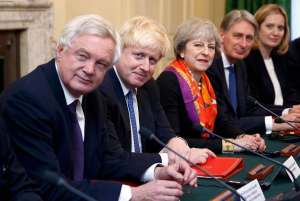
There was then a short interlude while The Mash Report made fun of David Davis’ name, while Boris Johnson was implausibly described as having the “political outlook of a Victorian man”. Seriously? Have the Mash Report writers ever seen Boris Johnson? Clearly not – but they are in no short supply of lazy, sixth form-style anti-conservative put-downs.

In the same week – particularly given that much of the show is given over to quickfire, Have I Got News For You-style picture caption jokes – the Mash Report could have spent thirty seconds making fun of this hilarious cover of The Green Parent magazine:

The Green Parent cover

God help that baby, particularly because the socially conscious father seems to be preparing to attempt to breastfeed (#SomeMenLactate). But no. The Mash Report – and the BBC in general – know exactly who their core audience are, and which demographics must be coddled and protected from offence at all times (yes, trendy green types very much make the list). The Mash Report already knows exactly who to flatter and who to insult mercilessly without fear of blowback for the naked bias on display.

Later in the show we are introduced to the show’s “religious affairs correspondent”. Already you know exactly where this is going – and indeed, precious minutes were spent laughing at the most unhinged of US evangelical Trump supporters and interviewing a rather loopy-looking Church of England minister who claimed that Jesus would have voted to Make America Great Again.

But perhaps I am being unfair. Even though this first outing was spent skewering Donald Trump and the American religious right, I’m fully confident that in future episodes we can expect all faiths (and none) to come in for equally barbed and scornful criticism. Right? Naturally if Hillary Clinton were currently president, the Mash Report would be mocking the Left’s overenthusiastic zeal for abortion and eagerness to make incursions on religious freedom.

One might have thought that a brand new satirical current affairs show could have something to say about the way that politicians and misguided apologists dither and prevaricate while Islamist extremists mercilessly butcher and wound innocent people going about their daily lives. But no – tumbleweeds. Let’s just bash a few crazy evangelical Christians and call it a job well done. That’s surely the only job of a religious affairs correspondent on a national late night comedy show.

And yet despite these many failings there were a few genuinely funny moments in the Mash Report. The recurring feature parodying the way that 24-hour news networks are desperate to broadcast viewers’ observations sent in via social media was accurate and very well done. The show generally worked best when riffing on non-political stories, like the Love Island reality TV phenomenon. It was also good to see some of the familiar recurring Mash vox-pop names crop up – hi, Tom Booker.

But the format often felt awkward and strained, an uncomfortable hybrid between the whip-smart Daily Show-style interactions between host and correspondent in one moment and much more clipped, Have I Got News For You-style dry witticisms and fake headlines the next. Though the blend was new, ultimately there was nothing original in either style or content – particularly not the near-constant left-wing preachiness.

The closest that The Mash Report came from escaping the gravity of bien-pensant leftist groupthink was a segment entitled “Bursting the Bubble”, featuring rare conservative comedian Geoff Norcott. For a moment my heart filled with hope – titling the segment “bursting the bubble” suggested an acknowledgement that all that had come before was rather one-sided, and that maybe now things would change. But no. The mere fact that the bubble is left-wing while the exterior is right-wing says it all about the show’s deep-rooted bias. The country may be divided nearly 50/50 but the BBC and the Mash Report see fit to ghettoise conservatives into a four-minute slot at the end of the episode, much like Maybelle Stubbs’ monthly Negro Day on the Corny Collins Show in Hairspray.

And even Geoff Norcott proved to be something of a turncoat, choosing to play the role of performing seal for the ogling leftist audience rather than attempting to hit back and mock any progressive, left-wing shibboleths. For example, when discussing Our Blessed NHS, Norcott cited the fact that “people live” (rather than dying before old age) as a problem which vexes Evil Conservatives like him.

“The elderly, Nish – they should be dead by now. Just sitting it out, hanging on in there…” Norcott moaned to the show’s host, while the bovine leftist audience clapped gleefully as every single one of their anti-conservative prejudices were confirmed before their very eyes. How exactly is this “bursting the bubble”? If anything Norcott’s role in the Mash Report was more like Samuel L Jackson’s in Django Unchained, the obedient slave performing for Leonardo DiCaprio and hamming up the servile stereotypes as much as possible. The Guardian approves of his comedy act because he is willing to debase himself and play the Evil Tory stereotype. But any real conservative who watched Norcott’s first cringe-inducing segment on the Mash Report must despise the man. I certainly do.

What didn’t we see in the show? Well, there was nothing substantive about the Labour Party, Jeremy Corbyn, the Liberal Democrats, the SNP or the Green Party for a start. Nothing about how so many of Jeremy Corbyn’s inner court have fallen over themselves to praise Venezuela in recent years, even as socialist policies pushed that country toward its current precipice. And you can be sure that all of these people will be largely protected from satirical scrutiny as the series progresses. If they are ever criticised it will be in the context of their ineptitude in thwarting the conservative agenda (whatever that may be) rather than because of the nature of their own beliefs.

But the show did go out with a bang, with a field report about a traumatised middle class family who – gasp! – had to ride the Megabus coach to London rather than travelling in the style to which they were accustomed. Again, nothing wrong with the individual joke – and to be fair, the Mash makes fun of Waitrose shoppers as much as they do people who buy their lunch at Gregg’s. But place it in the context of the overall show and the Mash Report’s emerging worldview is quite clear.

And so is the message about who this new comedy show is designed to amuse. Basically, if you are conservative, working class, a Brexiteer, a Christian, a social conservative, a traditionalist or (heaven forfend) a Ukipper then don’t bother tuning in unless you want to be the butt of every joke for twenty-six minutes, the only respite being the other four minutes where a two-dimensional cartoon parody of you cavorts in the guest seat, pastiching your sincerely-held views for the amusement of host Nish Kumar and his bovine left-wing audience.

In short The Mash Report is exactly as bad as I feared, and as you probably expected. What a letdown. What a squandering of comedic potential. What a great pity.


The Mash Report - Nish Kumar - BBC - Satire - Comedy

Support Semi-Partisan Politics with a one-time or recurring donation:

Agree with this article? Violently disagree? Scroll down to leave a comment.

Follow Semi-Partisan Politics on TwitterFacebook and Medium.