Jacob Rees-Mogg vs Leftist Thugs, And Another Depressing Weekend For British Conservatism

The Conservative Party would deserve more sympathy when their MPs are shouted down by leftist thugs if the prime minister herself were not such an enthusiastic suppressor of free speech

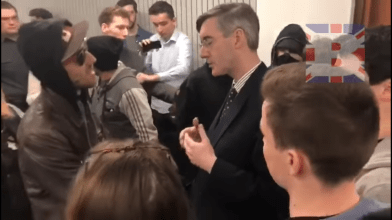
By now I assume everybody has seen footage of the impressively unflappable Conservative MP Jacob Rees-Mogg attempting to break up a physical altercation after an event in which he was speaking was stormed by leftist, Momentum-aligned protesters.

This is the kind of scene we have come to expect from American university campuses, where roving bands of masked Antifa-style goons, wearing their intolerance for diversity of thought like a perverse badge of honour, now routinely storm the meetings and public events of student organisations or external speakers they consider to be haram.

University campuses in Britain, by contrast, tend to be far more sedate places with much less visible security. Since we are fortunate enough in this country not to have to pause every couple of months to mourn another deadly mass shooting incident in an educational establishment, our university campuses do not have their own dedicated police forces as is sadly necessary in America. Neither is there some kind of private security guard for every three or four students.

This, however, may need to change if Members of Parliament and other speakers, people routinely invited onto university campuses to give talks or participate in student debates, find themselves pitched into the middle of violent confrontations with balaclava-clad goons whose devotion to the Cult of Social Justice and Identity Politics leads them to shut down the expression of any opposing thought.

On this occasion, the situation was defused before any real violence could take place, but Jacob Rees-Mogg has experience of standing up to aggressive leftist protesters and bravely stood his ground. Other MPs or public figures might understandably be less keen to put themselves in harm’s way while security guards or police are called to quell a developing problem.

And be assured, this will happen again – not because the speakers invited onto campus are becoming any more controversial or provocative, but because those opposed to their presence are becoming ever more sensitive to what they see as heresy – and too often are being indulged in their precious sensitivity by leftist academics, university administrators and politicians. The protesters cannot be reasoned with, and will not engage respectful debate when offered the chance, so the only way to preserve and protect freedom of expression on university campuses is to have a heavy security presence ready to haul out disruptive people who would censor events with their incessant yammering.

Unfortunately, what we saw from the Conservative Party in response to these events at the University of West England was not a muscular defence of free speech and a commitment to ensuring that universities which take public money also take seriously their responsibility to crack down hard on would-be student censors; rather, we saw a whinnying display of self-pitying victimhood:
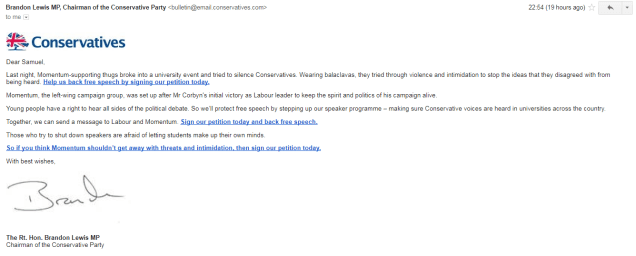
Brandon Lewis - Conservative Party email - free speech petition

In wheedling tones, the new Conservative Party chairman writes:

Last night, Momentum-supporting thugs broke into a university event and tried to silence Conservatives. Wearing balaclavas, they tried through violence and intimidation to stop the ideas that they disagreed with from being heard. Help us back free speech by signing our petition today.

Momentum, the left-wing campaign group, was set up after Mr Corbyn’s initial victory as Labour leader to keep the spirit and politics of his campaign alive.

Young people have a right to hear all sides of the political debate. So we’ll protect free speech by stepping up our speaker programme – making sure Conservative voices are heard in universities across the country.

Together, we can send a message to Labour and Momentum. Sign our petition today and back free speech.

To whom is this petition addressed? The Conservatives are in power, for pity’s sake. Are we to waste our time signing a petition at the request of the party of government, encouraging the party of government to do something which it could and should have been doing all along? A government which has to pass around tear-stained petitions encouraging their own ministers to do their jobs does not deserve to hold office.

The title of the email is “It’s not ok”, which is exactly the same scolding, infantilising kindergarten phrase used by the Social Justice Left in America to describe behaviours which they deem to be “harmful” or “oppressive”. And so rather than taking the fight to those who would shut down free speech in this country, the Tories instead prefer to flaunt their scars in an appeal for public pity and then ask us to sign a petition calling on them to do something about the very problem over which they have so ineptly presided.

This is untenable stupidity. As Home Secretary, Theresa May did as much as anyone else to suppress freedom of expression in numerous forms, using exactly the same arguments as the Social Justice Warriors – to protect the supposedly weak-minded citizenry from corruption or offence from undesirable sources.

As Brendan O’Neill noted in 2016, soon after Theresa May ascended to the office of prime minister:

May and the student Safe Spacers she’s railing against are one and the same in their belief that bad or eccentric ideas are best dealt with by censorship. May bans a pastor who has a problem with the Koran; students ban secularist critic of Islam Maryam Namazie. May bans Tyler, the Creator for being sexist; 30 students’ unions ban Robin Thicke’s ‘Blurred Lines’ for being sexist.

And both use the Stalinist language of ‘safety’ or ‘the public good’ to justify their speech-strangling antics. Students’ unions claim, with spectacular paternalism, to be protecting the ‘mental safety’ of their student charges; May says she bans people who say weird things because they aren’t ‘conducive to the public good’. It’s almost funny: student leaders fancy themselves as anti-Tory, yet ape Tory intolerance of difficult ideas; May positions herself as a critic of Safe Space nonsense, yet she’s Britain’s Safe-Spacer-in-chief, treating not only students but all of us as infants to be guarded from controversy.

You cannot busily construct a Safe Space at the national level – a dystopian society where people are woken up in the middle of the night and dragged off to jail for placards they create, songs they sing or words they publish on social media – and then be overly surprised or outraged when a gang of young college thugs, raised in a society where it is constantly preached that people have the divine right not to be offended, decides to take matters into their own hands.

As this blog has repeatedly pointed out, the battle for free speech is won or lost at the margins – it is only by defending the vile and unconscionable speech of extremists that a firewall is created to protect mainstream political discourse. Sadly for Britain, the battle for free speech was never even fought at the margins – the government instead chose to unilaterally surrender on all of our behalfs, and restrict speech considered offensive by nearly every designated victim group or professional offence-taker in the land.

Now the barbarians are at the gate, and it is not just “extreme” language or opinion under threat, or even loud-mouthed and controversial provocateurs like Katie Hopkins, but mild-mannered right-of-centre politicians like Jacob Rees-Mogg. And now that the Faith Militant of the Cult of Social Justice and Identity Politics threatens the physical safety of Conservative MPs as they address perfectly respectable student organisations, finally the government is stirring lazily to action, unjustifiably offended that anyone other than the police might seek to enforce the very cultural and linguistic taboos that in their incompetence they allowed to spread unchecked across the land.

Well sorry, but this is too little and too late. The idea that a government led by the same authoritarian zealot who waged war on civil liberties in this country for six years as Home Secretary is suddenly going to bravely fight for freedom of thought and expression on university campuses or elsewhere is utterly risible. Even if she were to totally flip-flop on the issue, devoid of any other ideological backbone as she is, the prime minister no longer has the political authority to take a serious stand on a domestic political issue.

The litany of political failures which can be chalked up to the Conservative Party since 2010 – failures of ambition, vision, intellect, principle and courage – is growing too long to recount in any one blog post or article. But ending up in the same ideological hemisphere as masked thugs who threaten the physical safety of their own MPs surely has to rank near the very top of the list.
Jacob Rees-Mogg - University of West England - Momentum leftist protesters

Support Semi-Partisan Politics with a one-time or recurring donation:

Agree with this article? Violently disagree? Scroll down to leave a comment.

Follow Semi-Partisan Politics on TwitterFacebook and Medium.

Journalists Buying Fake Twitter Followers, Another Symptom Of Institutional Decay

Journalists buying fake Twitter followers - fraud

Some journalists and political pundits choose to buy artificial Twitter followers because being good at their job matters (and is incentivised) less than appearing like the Next Hot Thing.

I’ll admit it – in earlier years, in my weaker moments as a struggling political writer, I have idly thought about purchasing Twitter followers. But I have not and never will do so, and deplore those in journalism and politics who choose to sell out in this way.

The New York Times recently reported that a company called Devumi was offering dummy Twitter followers (either fabricated individuals or the fruits of identity theft) to those seeking to boost their social media stature for mere cents per follower. A whole swathe of celebrities were implicated (most of whom promptly rolled over and blamed their managers or PR people) but so too were a number of journalists at supposedly respectable outlets of the legacy media.

From the New York Times:

Genuine fame often translates into genuine social media influence, as fans follow and like their favorite movie stars, celebrity chefs and models. But shortcuts are also available: On sites like Social Envy and DIYLikes.com, it takes little more than a credit-card number to buy a huge following on almost any social media platform. Most of these sites offer what they describe as “active” or “organic” followers, never quite stating whether real people are behind them. Once purchased, the followers can be a powerful tool.

“You see a higher follower count, or a higher retweet count, and you assume this person is important, or this tweet was well received,” said Rand Fishkin, the founder of Moz, a company that makes search engine optimization software. “As a result, you might be more likely to amplify it, to share it or to follow that person.”

Twitter and Facebook can be similarly influenced. “Social platforms are trying to recommend stuff — and they say, ‘Is the stuff we are recommending popular?’” said Julian Tempelsman, the co-founder of Smyte, a security firm that helps companies combat online abuse, bots and fraud. “Follower counts are one of the factors social media platforms use.”

In some ways, this temptation is just one of many ways that using social media can warp our behaviours and motivations, as Jacob Brogan writes for Slate:

Twitter is a machine designed to generate ugly feelings. Here everything is subject to quantification: the number of people who like the things you tweet, the number who share your words with their own followers, and, perhaps most of all, the number who follow you. If you spend too much time on the platform, those numbers quickly become an index of your own self-worth, and no matter how high they get, they will always be too small.

Purchasing fake followers is thus rather grubby and slightly pathetic, but perhaps still fair game if you are a TV star looking to make a bit more money sending promotional tweets for haemorrhoid cream. But what if the person deceiving the public is somebody whose job it is to inform, educate and tell the truth? Surely then it becomes quite unambiguously wrong?

Well, lots of political journalists clearly don’t think so, according to NBC News:

Big media outlets have embraced Twitter as a distribution platform but still struggle with how reporters and editors use the social media service, particularly when they appear to be breaching journalism ethics.

This sizable gray area came into clearer focus this week, after a New York Times exposé revealed that more than a dozen news media figures had paid to artificially pump up the number of followers they have on Twitter.

Journalists and commentators, who presumably joined the platform to enhance their stature, instead found themselves grasping to explain why they had paid for counterfeit supporters. When contacted by NBC News, the journalists identified by The Times as having bought Twitter followers had a range of responses: Many ducked requests for comment, others blamed associates, while just one sounded chastened.

This practice doesn’t bother me so much when it takes place in other fields; if you’re a mediocre provincial stand-up comedian who wants to pretend you have an audience of half a million eager people hanging on your every word, so be it. Good luck to you. Same if you’re a B-list actress, a celebrity chef, an unremarkable footballer or a giver of lousy TED-style talks about personal development. I expect no realism from such people, and personalities from these fields who choose to over-inflate their popularity do no real harm.

Not so with journalists and political commentators, both those who parade around beneath the banner of the blue-tick Twitter verified logo and those scrambling for the Ultimate Recognition. Political Twitter is a nasty swamp of obnoxiousness at the best of times, but those of us who choose to lurk within it do so in the vague hope of coming across useful information or commentary once in awhile. And since nobody has time to vet every account that crosses one’s timeline to determine whether they deserve a follow or a clickthrough, a quick glance to see whether they have a decent (or at least a baseline) level of followers is a useful first line of due diligence.

Is this person for real? Well, their profile picture is the default egg icon and they have eleven followers. Hmm, probably not going to click that link or believe their sensational “report” about Theresa and Philip May using a ouija board in the Downing Street basement to seek inspiration and advice from Britain’s failed prime ministers of the past (plausible though that one actually sounds).

Buying Twitter followers makes a mockery of what the rest of us are trying to do, and undermines one of the few metrics left for gauging success (financial reward having long since ceased to be either a possibility or a useful indicator). I have a mere 2,500 followers on Twitter. However, unlike the cheaters, I earned my entire following by providing consistently useful or entertaining (intentionally or otherwise) content to my audience. Whether it is links to my blog, links to bloggers in my circle, flagging news articles of interest, engaging in feuds with trolls or writing in-depth threads on a particular topic, around two thousand people care enough about what I have to say to stay tuned on an ongoing basis (I imagine that many of the remaining 500 are either businesses or largely dormant accounts).

A study from 2016 suggested that of those people who had tweeted once within a six month period, their average number of followers was 707. This figure seems a little high to me, as I routinely interact with people whose following/follower figures are only in the double figures – but this may be a function of swimming almost exclusively in the political niche rather than venturing out into the deeper oceans of celebrity Twitter. Anyhow, the study would suggest that anything over 707 is then a pretty good sign, and in lieu of an affirmative action-gifted writing gig for The Spectator I am proud of my 2,500 followers as a sign that my hours in front of the keyboard are not entirely wasted.

Ultimately, all this predictable scandal tells us is what a fraud so much of journalism and political commentary has become. Portentously spewing words into the void of Twitter knowing that most of your audience is actually imaginary can’t bring positive feelings of journalistic pride, since one would be aware of the fraud. All that those followers can do is burnish one’s reputation and make one seem like an important person to get drinks with or be seen talking to at one of the many insufferable events that take place every day in Westminster or Washington, D.C.

And the problem is that for those journalists who buy Twitter followers, that’s just fine. They don’t want to organically build an engaged audience of followers who find what they say to be genuinely insightful. They may not object were it to happen, but actual professional accomplishment is clearly no longer the prize to these people. What they want is the aura of success, to be seen as uniquely knowledgeable, titillating or controversial without putting in the labour to do it themselves.

We see the same thing with many of our politicians. Twenty months on from the EU referendum and the number of MPs who have even a basic grasp of the technical issues relating to trade arising from Brexit can probably be counted on two hands. An even smaller number have paid much thought to the constitutional ramifications and the opportunities and threats to our future governance, if any at all. The most significant political development to happen in Britain in decades, and only a handful of our parliamentarians have bothered to stop spouting slogans from the referendum campaign to actually master the issues at hand.

Why is this? Because sitting down with books and consulting advisers in a spirit of humility and willingness to learn is boring and unsexy. The personal payoff just isn’t there, particularly when one can do so much more for one’s career by bleating an angsty speech about the Evil Tor-ees in the Commons chamber or going viral on social media with a well-timed quip on Question Time. And the only reason that our star journalists – the ones who pull in the big bucks and now get terribly worked up at the thought that their celebrity pay packets might not be “equal” – have not rumbled the politicians and revealed the extent of their ignorance is because much of the legacy media is in an equally benighted state.

The whole reason our politics are currently so dysfunctional is that being good at your actual job is no longer adequately incentivised. Looking good and frantically maintaining all the appropriate outward signs of success and positive momentum are what matters most, not solid work diligently performed in the spirit of self-improvement. That’s why people cut corners and do things like participate in Twitter follower-purchasing frauds – because they believe, often correctly, that the rewards which flow from mastering an issue or having an original idea are far less than those which flow from being on some insufferable “Westminster’s 100 people to watch in 2018” list.

You can write for months or years before establishment journalists (as I did) that the Tories were going on an ideology-free jaunt into political oblivion, or that Jeremy Corbyn ought to be taken seriously because the public responds to conviction and consistency, but it doesn’t matter. You won’t get the slightest credit, because nothing has officially been thought or written until it has come from certain approved sources within the Westminster Bubble. And even within the bubble exists a hierarchy, with all of the attendant temptations to level-up by artificially boosting one’s standing.

And that’s why I never have and never will buy Twitter followers. It represents everything that is rotten, sleazy and stupid about modern politics, and the alarming frequency with which people who shouldn’t be within ten promotions from the top of their respective fields end up prancing around at the pinnacle, lording it over the rest of us (be that the prime minister, whole swathes of Parliament, the editors of several newspapers, numerous television news personalities and various assorted celebrity columnists).

We will never live in a perfect meritocracy, and it is stupid to set unrealistic goals which ignore human nature. But one thing you ought to be able to trust in this day and age is that the Very Serious Journalist with the blue “verified” tick next to their Twitter account name is not perpetrating a fundamental fraud every time they broadcast their news, analysis and opinions.

I earned my Twitter audience, and my follower count rises and falls according to the value I deliver. Anything short of this basic standard of behaviour is akin to selling a used car having first tampered with the odometer. And while social media juicing may not be illegal, we should look upon those who engage in it with the same scorn and distrust one might reserve for a convicted fraudster.


Twitter for journalists

Support Semi-Partisan Politics with a one-time or recurring donation:

Agree with this article? Violently disagree? Scroll down to leave a comment.

Follow Semi-Partisan Politics on TwitterFacebook and Medium.