A complete performance of Concerto in F for piano by George Gershwin, performed here by Marc-André Hamelin with the Radio Philharmonic Orchestra under Leonard Slatkin.
This is one of those more classical/less jazzy performances of the work, which I actually quite like – I went so far as purchasing the score and trying to get to grips with the piano part back in my Cambridge days, when I had regular access to a Steinway model B and D.
While the Tin Pan Alley heritage of the work is important, one can sometimes make it swing too much, I think, and many modern performances seek to emphasise the jazz aspect over the work’s classical structure and elements. Such performances overlook the fact that Gershwin wrote the concerto in part to burnish his credentials as a “serious” composer rather than a mere songwriter, going so far as to take lessons in orchestration rather than relying on Ferde Grofé to translate from a two-piano version (as he did for Rhapsody in Blue).
The Concerto in F was a more ambitious project than the Rhapsody and took the composer several months to complete. The work was given a trial performance before its formal premiere in 1925 by Walter Damrosch and the New York Symphony Orchestra at the Aeolian Hall, with Gershwin at the piano. The critic Samuel Chotzinoff wrote “Of all those writing the music of today…he alone actually expressed us.” Like the Rhapsody, the Concerto also uses sharp contrasts but its integration through cyclic form and thematic transformation reflect Gershwin’s study of 19th century techniques. More than the earlier Rhapsody, the Concerto forms a convincing whole, the impact of which derives as much from its entire structure as from its separate parts.
The exposition of the opening Allegro of the F major Concerto is a perfect example of the perception of sonata form. The components of the second lyrical theme recall the 18th century and is made up of a series of of ideas rather than a single theme. Gershwin varies these ideas with great resource and creativity, restating them and extending them into new shapes throughout the duration of the Concerto. These consist of three motifs: a wind and percussion fanfare, a Charleston melody and a dotted arpeggiated figure. These themes are expanded almost immediately, are filled with contrast, and no portion is thematically irrelevant. The development returns to F major and the Charleston motif, which eventually becomes its own subject in a miniature Moderato cantabile. The recapitulation is introduced unambiguously with a reprise of the second theme and closes with a quodlibet that made up the first theme. As in conventional sonata form, the two main themes are now stated in the tonic in a transposition that is formed by adding the subdominant to itself.
The Adagio second movement is a song form set as a rondo in A-B-A-C-A. In the context of faint praise, in the New York Times review of the first performance, Olin Downes managed to cite the refrain theme, “a stopped trumpet playing a ‘blue’ melody against a sensuous harmonic background,” as being “perhaps the best part of the concerto.” The lush melodies of the Adagio, paired with the lilting rhythm of the strings illustrate both similarities to the Rhapsody in Blue, yet still exhibit progressive composition not seen until Gershwin’s Porgy and Bess.
The connection between the Adagio and the Finale, marked Allegro agitato is very strong. Within this Finale, the composer shows us a rondo form from a more rhythmic point of view. In its form of an almost-classic rondo, the orchestra opens with a furious theme in G minor. Without any indication of modulation, the piano enters on F, initiating the second statement of the rondo refrain, now its home key. Gershwin employs the highly regarded “new” American technique of a dazzling stretto with bursts of technical wizardry before returning to the rondo of the second movement. The Finale reintroduces the initial theme to form its own climax before closing on a brief coda.
My favourite studio recording of this work remains the André Previn / LSO recording featuring then-principal trumpet Howard Snell in the second movement – again, a performance that I would consider more toward the classical end of the spectrum, despite Previn’s proficiency in jazz. The LSO brass were on their usual top form throughout this excellent recording, though some of the percussion is unfortunately drowned out at times.
At a time when many stunned Democrats still seem inclined to respond to Donald Trump’s election victory by doubling down and giving the electorate more of the same (i.e. petulant, finger-wagging lectures), Bill Maher gets it:
The Democratic Party – back me up on this, guys – sort of lost the white working man. That’s what they used to have. And they made the white working man feel like your problems aren’t real. Because you’re mansplaining, and check your privilege. But you know what? If your life sucks, your problems are real. And c’mon, what should I do, cut my dick off and check my privilege?
[..] If there is a silver lining for me personally, it is that the two issues I have been on the case of liberals for – and they’ve been booing me about this for years, and maybe they’ll listen – one is political correctness, I think I did a show about that for nine years, you’re outrageous with your politically correct bullshit and it does drive people away.
This is a little condescending, but not wholly inaccurate. It’s not necessarily a question of Trump voter’s lives “sucking”. Yes, some have been hit hard by the modern globalised economy, or feel their own jobs and industries teetering on the brink of the same insecurity and decline that has befallen manufacturing. But it is not a question of being dirt poor. It is a question of not being listened to, and yes, one of respect.
Bill Maher, of course, has been a strident critic of the American Left’s takeover by the Cult of Social Justice and Identity Politics (well, at least the latter part) for some time. Perhaps his words will now start to carry more weight, as the dust settles.
–
Support Semi-Partisan Politics with a one-time or recurring donation:
–
Agree with this article? Violently disagree? Scroll down to leave a comment.
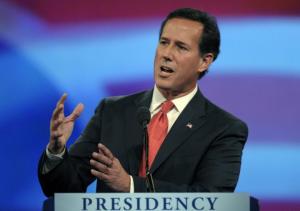
Former Republican presidential primary candidate Rick Santorum, siren of the white working classes back in 2012, ran a campaign which laid the groundwork for Donald Trump’s insurgency in 2016, and ultimately prophesied his victory
For several months now I have been waiting for somebody to make the connection between Rick Santorum‘s strong running in the 2012 Republican primaries and the playbook which took Donald Trump all the way to the White House.
Way back during the 2012 campaign, I noted that Santorum was singing a siren song to the “white working classes” of rust belt America, responding to their very real and valid concerns with reassuring but unrealistic promises that the tide of globalisation could (and should) be turned back, thus sparing them the need to adapt to the new America.
Back then I labelled Rick Santorum the “Pied Piper of Pennsylvania“, a reference to the way in which the former Pennsylvania senator accumulated a large, trusting and often sympathetic audience of followers, but whom he would ultimately lead off the edge of an economic cliff:
Barring certain specific exceptions, the manufacturing jobs that America has lost will simply never return.
And perhaps among all of the things that Rick Santorum says that rile me up, this one makes me the most angry. He is peddling a Pleasantville-style, black and white, 1950s vision of a country where once again it is possible to live a comfortable middle class lifestyle with a decent sized family home and a couple of cars, paid for by the wages earned from assembling televisions, or refrigerators, or cars. And Republican primary voters, many of whom are in the squeezed middle class and have been let down by successive administrations, are listening to Santorum’s claims and gaining hope, and voting for him, even though he cannot in actual fact turn the clock back fifty years, even if he does actually want to.
Whether he wins or loses the Republican primary and the general election, the persistence of this argument – and the belief that a few tweaks to the tax code and the drilling of a few more oil wells will spur a resurgence in unskilled and semiskilled manufacturing – simply dooms another generation of people to a life of stagnating or falling living standards.
People trust Santorum because, unlike the other main Republican candidates, he is so genuine. Why would he advocate policies that would hurt them, when he was one of them? And yet the policies that he proposes would either do little to bring back more unskilled or semiskilled manufacturing jobs, or would make the US population even less qualified to perform those jobs which already exist. And all the time that people hold out hope that a Rick Santorum or another politician like him can work this magic, it is time that they are not spending going back into training, or into college or university, and reskilling themselves for the jobs of tomorrow’s economy.
Rick Santorum says all of the things that the Republican Party’s blue collar base want to hear, but in many ways he is just a modern day Pied Piper, promising them a brighter future while marching them off a cliff.
Globalisation cannot be rolled back, nor should it be. The challenge – which falls hardest upon Republicans and small government, small-c conservatives like myself, who generally do not foresee an active role for central government in the lives of citizens – is to find a way of reaping the fruits of globalisation while bringing these disrupted communities with us instead of callously leaving them behind.
And we should be honest: conservatives are at a disadvantage here. Leftists have the luxury of simply waving their hands and promising new government programmes for the mass retraining of millions of people in new, higher value-added jobs and careers. But no matter how costly or inefficient those schemes may prove, those on the right have an even harder job persuading voters, and no one party or politician on either side of the Atlantic has yet arrived at a fully convincing solution.
The inability to satisfactorily answer these questions and convince enough people of his ability to deliver the fruits of globalisation with none of the adverse consequences -together with the establishment reluctantly falling firmly behind Mitt Romney – ultimately saw Rick Santorum fall by the wayside back in 2012. But four years later, Donald Trump came charging along with almost the exact same message, and stormed all the way to the White House. And during this extraordinary journey, none of his supporters seemed to realise or care that Trump has been every bit as unable as Rick Santorum was to answer the question of “how?”, beyond his usual barnstorming bluster and well-worn pledge to Make America Great Again.
Now Bill Powell from Newsweek magazine has also picked up on the similarity between the two men, with a new piece entitled “How Rick Santorum helped Donald Trump win the White House” in which he argues that to a large extent, Donald Trump merely honed and executed a playbook originally written by Santorum.
In the spring of 2015, [Trump] was talking to a few family members and confidantes about running for president. And he wanted to get in touch with a former Republican senator from Pennsylvania, Rick Santorum, who had served two terms before losing big in 2006. In 2012, he was the runner-up to Mitt Romney in the Republican presidential primaries. Ensconced since then in a Washington, D.C., law firm, Santorum had written a book that attracted little attention: Blue Collar Conservatives, Recommitting to an America That Works. But Trump had read the book, very carefully, in fact, and was intrigued. He called Santorum and asked if he would come to Trump Tower for a visit. Santorum was a bit surprised by the invitation but said yes.
Santorum didn’t know what to expect. He had never met Trump and, like millions of Americans, knew of him only from his long-running NBC reality show, The Apprentice. Trump got right to the point. He had loved Santorum’s book and believed it could unlock the White House for a GOP candidate who ran a campaign based on reaching the working-class voters throughout the industrial Midwest that, Trump said, Democrats take for granted.
Santorum agreed, of course—he was thinking of making another run at the White House, using that playbook. (He did, but got bum-rushed early in the primaries.) Trump then surprised Santorum even more by questioning him on details of his book and economic policy in general. What could be done with trade policy to help the working class? Was there any way to turn around the massive bilateral trade imbalance with Beijing? Could the White House be used as a bully pulpit to pressure American companies to stop sending manufacturing offshore? On and on they went, and Santorum left the meeting wondering what might happen if you mixed the power of celebrity with a blue-collar tent revival.
We now know the answer. Trump’s improbable run to the presidency—which was nearly derailed on several occasions by his lack of discipline—was guided by a conviction that he could, as political consultant and longtime Trump adviser Roger Stone said last year, “rewrite the [electoral] map” by smashing the “great blue wall” of Midwestern Democratic states. And smash it he did.
Something happened (or continued to happen) between 2012 and 2016 which made more people receptive to the Santorum message of economic populism and protectionism, and the failure of the Obama administration to change the economic trajectory of those people already suffering the fallout from globalisation (or nervously waiting for it to impact their industry and their jobs) clearly played a large part.
But even then, Trump’s victory could probably have been prevented had prominent Democrats like Hillary Clinton and President Obama not been so blasé about the economic challenge facing millions of Americans while they were campaigning. Hillary Clinton in particular took every opportunity to criticise Trump’s “Make America Great Again” slogan, neglecting to consider that from many people’s perspective, America is only as great as their own present circumstances. But while sanctimoniously lecturing Donald Trump and his supporters that “America is already great” may have been factually true, it also felt a lot like the establishment dismissing the legitimate concerns of suffering people.
Sure, America is pretty darn awesome if you are one of the Wall Street bankers to whom Hillary Clinton loved to give speeches, one of the celebrities attending her fundraisers or just a prosperous coastal professional whose job and career is not about to be eradicated through automation or outsourcing. But if you do not fall into one of these categories, America can feel a lot more precarious than great. And having the Democratic Party’s presidential nominee continually insisting that everything is wonderful and that anyone with concerns or complaints is somehow “deplorable” was about the most stupid and politically tone-deaf way for a candidate to behave.
And of course we all know the outcome:
The Trump high-command members knew then they had an opening. The crowds Trump was drawing were enormous, and even before [FBI director James] Comey’s announcement [about the reopening of the investigation into Hillary Clinton’s email server], their internal polls said the race was tightening, but not enough to make many of them believe he would win. Now, though, they thought they had a shot. Trump remained focused, and the campaign laid on rally after rally—up to five per day in the last days of the race. Trump went back to Pennsylvania and Michigan and Wisconsin again and again. He even made a trip to Minnesota, the bluest of blue states, because—stunningly—polling had him drawing close even there. The Santorum strategy was playing out just as Trump had bet it would so many months before.
[..] “Those states—Pennsylvania, Michigan, Wisconsin—were the targets,” [Trump campaign manager Kellyanne] Conway would later say. “[Trump] had a `theory of the race,’ and when it became clear that he had tapped into something very big, he rode it. And that is what good candidates do.”
Bill Powell is right – to a large extent, Donald Trump picked up the mantle from Rick Santorum, amending it by ditching some of the niche social conservatism (an integral part of Santorum’s Catholic traditionalism) and ramping up the economic populism even further.
While Santorum spoke of the pain of those whose manufacturing jobs were disappearing and promised help through the corporate tax code, Donald Trump identified a specific bogeyman in the form of China and other countries who supposedly always get the better of America, and then promised to confront these foreign economic enemies. While Rick Santorum railed against the coastal intellectual elites and dismissed aspiring to go to college as “snobbery”, Donald Trump insulted and belittled those Ivy League experts and elites day after day.
In many ways, watching Donald Trump on the campaign trail was like watching an incredibly vulgar, amoral and less eloquent version of Rick Santorum, with the brightness and volume dial turned up to max. And it worked. The economic message that Santorum road-tested in his 2012 campaign and in “Blue Collar Conservatives” was a beguiling one, as I acknowledged four years ago. But when it was hitched to a television celebrity phenomenon and fuelled by a combustible blend of identity politics backlash and the Democratic Party’s seeming disdain for middle America, it became immensely powerful.
Of course, this leaves President-elect Trump in a far worse place than Rick Santorum. Santorum was able to rack up Republican primary votes and victories against Mitt Romney, but his ultimate defeat saved him from having to make good on his campaign rhetoric and unrealistic promises to insulate middle America from the negative consequences of globalisation. Donald Trump has made it all the way to the White House, and the people who put him there will now expect him to deliver.
Which means that it falls to Donald Trump – of all the unlikely people – to do something that no right-wing politician anywhere in the world has successfully achieved: find a way to reap the benefits of globalisation while mitigating the negative side effects.
My gut feeling: assuming that Trump even tries to address this challenge, it will only be by enacting economically ruinous levels of protectionism or by abandoning any pretence of conservatism and embracing some kind of mass worker retraining program, either in a massive expansion of the federal government or else delivered by the states through federal block grants. And given the dynamics in Congress, it is by no means certain that any such measure would pass.
Make America Great Again – so easy to say, so hard to deliver for millions of struggling Americans.
–
Support Semi-Partisan Politics with a one-time or recurring donation:
–
Agree with this article? Violently disagree? Scroll down to leave a comment.
Here is James Taylor, performing “America The Beautiful” at the second inauguration of President Barack Obama on January 21, 2013.
And perhaps, at this rather fraught and contentious time, we might all do well to take particular inspiration from the oft-overlooked second verse, too:
O beautiful for spacious skies,
For amber waves of grain,
For purple mountain majesties
Above the fruited plain!
America! America!
God shed His grace on thee,
And crown thy good with brotherhood
From sea to shining sea!
O beautiful for pilgrim feet
Whose stern impassioned stress
A thoroughfare for freedom beat
Across the wilderness.
America! America!
God mend thine ev’ry flaw,
Confirm thy soul in self-control,
Thy liberty in law.
–
Support Semi-Partisan Politics with a one-time or recurring donation:
–
Agree with this article? Violently disagree? Scroll down to leave a comment.
The Everyday Feminism “Post-Election Thanksgiving Fact Sheet to Help You Prove Oppression Exists” is so deliciously beyond parody that it almost defies analysis too.
Kim Tran, who is “finishing her Ph.D in Ethnic Studies at UC Berkeley” (naturally), writes:
“Thanksgiving” is a weird time when we get stuck with conservative family members who might trigger us so much that it feels almost impossible to formulate a sentence.
Especially this year – when the entire election cycle seemed dominated by not just sexism, but sexual assault and not just “colorblind” racism, but racial terror – we may find ourselves at a loss for how to make an appeal to our conservative uncles, cousins, and parents.
Trust me when I say I know how hard that can be.
Yes, there will be thousands of people twitching uncontrollably on the floor around the Thanksgiving dinner table this year, having been exposed to unwanted contradictory opinions and triggered beyond all endurance.
I’m not quite sure what Thanksgiving has done to deserve the special quotation marks in Tran’s introduction, though. Perhaps this is an allusion to the fact that the SJWs who read Everyday Feminism have little to give thanks for at the present time. And truly, one should feel sympathy for them. Previous generations of Americans who lived through the Civil War, the Great Depression, the Dust Bowl, two world wars and Jim Crow and still managed to celebrate Thanksgiving have no idea just how hard today’s pampered young millenials have it, or how very little they have to give thanks for now that Donald Trump is about to take possession of the White House.
Oh, and let’s note Tran’s acknowledgement of “conservative uncles”, but not of conservative aunts. What’s this? Erasing the identity and lived experience of conservative women? Tut tut, very oppressive.
I’m definitely not saying to cross boundaries of physical or emotional safety. I am, however, hoping white allies can show up really hard right now because, well, we need you. We need you to be uncomfortable so that queer folks, undocumented people, Muslims, survivors, and countless others can feel safe.
Lord, have mercy. If I was a white person in Kim Tran’s acquaintance I would sooner spend Thanksgiving shut away on my own with a cheerless $1 microwave meal for dinner than spend one of the most beautiful holidays in the American calendar being lectured by some screechy SJW about how I’m not doing enough to make people who broke federal immigration laws feel sufficiently warm, fuzzy and safe.
But it gets better:
So particularly, if you are one of the few of the cohort of white progressives/radicals/do gooders, we need you to go ahead and call-in Randy, Travis, and Becky. I’ll even give you the cold hard facts to help you feel more comfortable doing it.
Woah. So let me get this straight. Kim Tran lives and studies at the prestigious UC Berkeley in California, the golden state, finishing a PhD in “Ethnic Studies” which would be utterly useless in the real world, but will equip her perfectly for a lifetime of tenured service on a university faculty perpetrating the Cult of Social Justice and Identity Politics. Basically, she has it made. And from this lofty position she sees fit to mock people called Randy or Travis, all of whom must (to her mind) be backward, ill-educated, prejudiced, tobacco-chewing hillbillies whose presence has is graciously tolerated, once a year, by the socially and morally enlightened readers of Everyday Feminism.
In other words, Kim Tran is stuck so far up her own backside that she openly mocks and belittles other people with more Southern-sounding names and zip codes, yet still considers herself the oppressed minority in America. It doesn’t occur to her that living in the Golden State and embarking on a career where she will be paid – paid! – to churn out meaningless identity politics drivel might, just might mean that she is more privileged than the stereotypical white male trailer park inhabitant in Appalachia whom she so evidently despises. Marvellous, absolutely marvellous.
The rest of the Thanksgiving Fact Sheet is the usual blend of lies and distorted propaganda pumped out by the SJW brigade – like the idea that one in five women will be raped in their lifetime, and one in four sexually assaulted at college, both of which statistics have been debunkedmore times than one can count.
Then we get airy assertions about illegal immigration, like:
Lots of immigrants do different jobs from natives because they have limited English language or technical skills, or because they have insufficient exposure to the US workplace. For instance the most popular occupation for undocumented workers is “maids and housekeepers,” while the most popular occupation for native workers is “cashier.”
My emphasis in bold.
Note the insidious switching between talking about “undocumented ” workers and immigrants in general, all part of the SJW masterplan to normalise illegal immigration.
Then we get damaging claims that oppression is somehow so endemic that “people of colour” (what a stupid term – and being one myself, I can say so) shouldn’t even bother trying to succeed on their own merits:
Pulling Yourself Up By Your Bootstraps Is Almost Impossible (If You’re A Person Of Color).
The idea behind the American Dream goes a little something like this: if you work hard, you can achieve economic success and comfort. Unfortunately, that’s not true for the vast majority of people of color.
One of the first steps to this kind of “success” is school and the school to prison pipeline predetermines students of color “as violent and in need of reform.”
Note how Kim Tran strips “people of colour” (ugh) of any agency or responsibility for their own lives, decisions and circumstances. This is the true tyranny of low expectations, and will succeed only in bolstering some people’s sense that they belong to a permanent victim class, focused largely on historic injustice rather than present opportunity.
And then for dessert:
Climate Change Is Real And It Affects Communities Of Color The Most
It’s important to mention that communities of color are most impacted by climate change and human-created environmental racism.
Three quarters of hazardous waste landfill sites are in Black and Latinx neighborhoods. Moreover, during natural disasters like the recent hurricane in Haiti, women are often the last to escape, because they tend to prioritize the safety of their family and children.
I hope you are in a good mood to celebrate Thanksgiving now, having been lectured by Kim Tran and Everyday Feminism about how everything you are, everything you do and everything you love is basically evil and oppressive. And I know that “factsheets” like this one will make you really want to reexamine your own beliefs and reach out to the other side in a spirit of mutual trust and understanding. I know I sure do. Or maybe not.
This year, #JeSuisTravis.
–
Support Semi-Partisan Politics with a one-time or recurring donation:
–
Agree with this article? Violently disagree? Scroll down to leave a comment.








 Semi-Partisan Politics