What Conservative Government? – Part 1

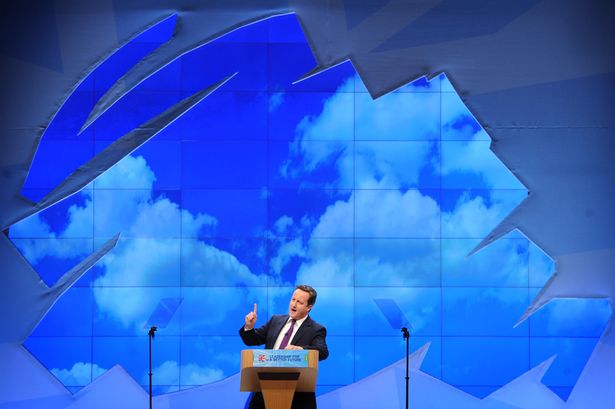
David Cameron - Conservative Party - Tree Logo - Coke Zero Conservatism

The Left may love to rail against the Evil Tory government inflicting untold harm on the defenceless people of Britain in service to their extreme, worse-than-Thatcher ideology. Of course, it’s all just hysterical, hyperbolic nonsense. This “What Conservative Government?” series will highlight multitudinous examples showing that David Cameron’s rootless, centrist Conservative Party is an authoritarian, Big Government carbon copy of Tony Blair’s New Labour.

Last week, I had the opportunity to debate the Conservative Culture Minister, Ed Vaizey, on the infantilisation of today’s students and their ludicrous demands for trigger warnings, safe spaces and the suppression of free speech.

This week, Vaizey pops up in Conservative Home, defending the government’s record on public libraries from left-wing attack (my emphasis added):

When I first became a Minister, we abolished the libraries quango and moved responsibility to the Arts Council.  We wanted to join up our cultural strategy with libraries.  This decision has been thoroughly vindicated.  The Arts Council has made £6 million of new Lottery funding available to libraries to host cultural events and realise their role as important community spaces.  Yesterday, they announced a further investment of more than £1.5 pounds, which will help library authorities work better together, and will support a range of national initiatives covering reading, digital literacy and health.

[..] Councils have a legal obligation to provide comprehensive and efficient library services, and must consult with the local population on plans. We are the first Government to review every closure. Central government can and will intervene if a council is planning dramatic cuts.

There is a serious point here, which is that the Labour Party are utterly disingenuous to attack the Conservatives for library closures, when only 11 of 79 library closures in the past five years have been ordered by Conservative councils. And there is probably merit to the implied suggestion that left-wing Labour councils are publicly rending their garments and spitefully shutting down high profile services as a kind of self-immolating protest against the Evil Tories in Westminster.

But what kind of conservative government obsesses about the “national initiatives” feeding into their “cultural strategy”, and watches over the shoulder of every local authority in the country, demanding the right to sign off on every single building closure? Certainly not any government that truly believes in smaller, leaner government or a renewed emphasis on localism and individual liberty.

Now, this centralise-first instinct in British politics is not new. And ironically, it is partly the legacy of the Thatcher government, which faced implacable resistance from rabidly left-wing local councils and believed that the only way to implement its agenda was to circumvent and/or neuter local authorities. But the New Labour governments of Tony Blair and Gordon Brown did nothing to reverse this process, and David Cameron’s Coke Zero Conservatives are in no hurry to undo the process.

But the over-centralisation of government is one of the biggest problems in British politics and civil life. It kills any attempt at radical experimentation or bold new policy initiatives in the crib, since everything must conform to the same national standards, either by legal requirement or the fear of endless angry “postcode lottery!” headlines in the press.

Why should the four home nations of the UK not have the ability to vary tax rates and bands as they see fit, according to local priorities, so long as all four pay the correct proportional share of their revenue to Westminster for UK-wide shared obligations such as foreign policy and defence?

Why should local authorities not be able to raise (or lower) sales taxes autonomously, in place of a fixed (and brutally high) VAT rate of 20%, returning funds to taxpayers or spending the revenues as local communities see fit?

Why should city councils not be permitted to implement hotel room taxes, as in nearly every major city around the world outside the UK, and use the revenue to promote local tourism in the provinces and regions?

(The one policy standing in David Cameron’s favour is the creation of local Police and Crime Commissioners – though it has been hard to generate any real enthusiasm for this form local control when it is not replicated in other areas of our lives).

A truly radical, campaigning conservative government would be asking these questions, developing policies to answer them, and then boldly implementing them across the nation. And now, after five years of Conservative government, Britain might be starting to feel the benefit of re-embracing liberty, individualism, localism and regional variation.

But of course, all of this would require the Conservative Party to actually govern like a conservative party.


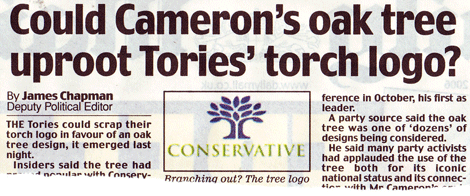
Conservative Party Logo - Cameron - Oak Tree

Agree with this article? Violently disagree? Scroll down to leave a comment.

Follow Semi-Partisan Politics on TwitterFacebook and Medium.

David Cameron And Martin Schulz – Bad Cop / Bad Cop Anti-Brexit Strategy

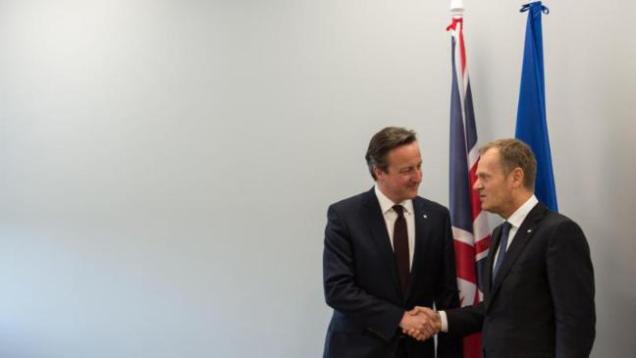
Martin SCHULZ - EP President , David Cameron - British Prime minister

After David Cameron and Donald Tusk’s arrogant two-finger salute to the British public comes Martin Schulz’s risible Bad Cop routine

It has been a couple of days now, and the anger about the government’s unchanging approach to the EU has started to dissipate – only to be replaced by a dull sense of abandonment and cynicism.

Of course David Cameron was not going to announce any kind of meaningful deal with the European Union – expecting Dave to represent our interests in a negotiation with Brussels is like being on trial, spilling your guts to the chief prosecutor and still expecting him to bend over backward to get you acquitted. That is, it’s implausible because of a flawed assumption about whose side they are on.

This was not a renegotiation between Britain and the other member states of the European Union; rather, it was a game of wits with the prime minister and his fellow EU leaders on one side, and the British people on the other side. The objective was not to present British demands to Brussels and seek to win as many concessions as possible; on the contrary, the aim from Day One was to identify how little the British people could be persuaded to accept as crumbs from the EU’s table while still doing what they were told.

When you realise that democracy and the restoration of national sovereignty were never on the table, everything makes a lot more sense. And yet David Cameron is clearly stretching his luck. The few meagre statements of intent in Donald Tusks’s formal response to the British letter are completely irrelevant, and certainly will do nothing to address the concerns of most people. And the press has realised, and duly given the prime minister a roasting for his feeble negotiating skills.

Thus there is still a possibility – however slight – that if the referendum goes ahead on the accelerated timescale in June this year, the Leave side may be able to squeak a victory by painting David Cameron’s half-hearted renegotiation as part of a bipartisan establishment conspiracy of the political elites against the British people, to keep us in the European Union come hell or high water.

Or as this blog noted yesterday:

With nearly every authoritative voice in Britain about to begin earnestly intoning the many benefits of Brussels, our most potent weapon may be the British people’s strong sense of fair play, and their likely discomfort at seeing the Leave campaign being outspent, outmanoeuvred, outgunned and shouted down. We have been weak and ineffectual enough thus far – so we may as well ham it up for the cameras and work to build the narrative that this referendum is in fact The Establishment vs The People.

Bearing all this in mind, what the Remain campaign could really do with to twist the knife would be for a senior EU politician to come out swinging and playing Bad Cop to David Cameron’s Useless Cop. What they really need is for one of the EU’s big beasts – preferably someone with a suitably scary Teutonic name – to barge onto the scene and warn Britain that we are testing his patience with our pesky demands for sovereignty and self-determination, and that unless we soon shut up and accept what we are being offered, he and his chums can make no guarantees for our safety.

Step forward president of the EU Parliament Martin Schulz, who used a speech in London today to do just that. Schulz said:

Europe needs the UK with its foreign policy experience and clout, its open market policies and its trade track record if we want to have hope of solving any of these crises – and even more so, if we want to maintain the global security architecture and shape the future world order.

This is why personally I am a strong supporter of the UK remaining in EU. And this, despite the fact – and I admit this quite frankly – that the British often test our patience and good will with their continuous demands.

They are demanding. They push hard. They insist. They just don’t let go. Many of my colleagues say behind closed doors: ‘Don’t stop a rolling stone. If the Brits want to leave, let them leave.’

I do not support this line that just because the UK can be frustrating it would be in our interest to let it go. I believe we need the UK to make the EU stronger and better. And to make something stronger and better sometimes it’s necessary to push hard and be critical.

In other words: “Hey, you know I love you, Britain. You’re great, I would do anything for you. But some of my friends have had enough; they think you are getting ideas above your station. In fact, they think that you are itching to be taught a lesson in humility. Not me, of course. I think you’re just swell. But what say we put this whole silly euroscepticism business behind us and carry on as normal? I think that would be much better that way. And I wouldn’t want anything bad to happen to you…”

Basically, this is a threat dressed up as friendly concern.

My first thought on reading this was: is Martin Schulz confusing the UK with another country – one which is actually assertive in standing up for its national interest and kicking up a fuss when it doesn’t get its way? Because this description doesn’t sound anything like the Britain I recognise.

What “continual demands” has Britain been making of the European Union? And which demands have been conceded by a reluctant Brussels which supposedly feels bullied and taken advantage of by our selfish stance? You would think that if Britain had such a notable track record of standing in the way of EU goals and projects, that a nominally eurosceptic government like David Cameron’s would be busy talking up all of these filibustering victories to buy some credibility from a sceptical public. You would think that David Cameron’s stump speech would be littered with Brussels pet projects which he thwarted for the good of the taxpayer and in defence of Britain’s national interest.

So where are those success stories? Where are the examples of Britain “pushing”, “insisting” and “not letting go”? Does Martin Schulz mean the time that Britain was presented with a £1.7 billion supplementary bill from the EU as a penalty for economically outperforming the Eurozone? Because if my recollection serves me correctly, our prime minister gave a red-faced, foot-stamping press conference in which he insisted that Britain would not pay a further penny, before quietly authorising George Osborne to pay the entire sum as soon as the general election is out of the way. Is this the kind of obstructionism that Martin Schulz means? The totally illusory kind?

But what of France and its angry insistence on violating the EU stability and growth pact, for reasons both real and confected? If the rules were put in place for the benefit of all, what does it say about France that they rage against the European Commission for daring to point out their lack of compliance? Is this not being “demanding” and “pushing hard” to get their own way?

And what about Germany’s constant, selfish running of a current account surplus in excess of the maximum 6 per cent allowed under the Macroeconomic Imbalance Procedure (MIP)? Where is the European solidarity there? And what might Martin Schulz have to say about the stubborn behaviour of his own compatriots? Don’t expect an answer any time soon.

The truth is that by most measures, you could not find a more pliable, easy-going and constructive member of the European Union than Britain. We pay our dues, enforce and abide by the rules and laws a lot more rigorously than many other countries, and while the public may complain a lot, our elected representatives hardly ever filter that dissatisfaction upward to disturb the smooth running of EU summits.

The only way that your average EU leader or bureaucrat could possibly be troubled by British euroscepticism is if they were to spend their days clicking through the comments sections of the Daily Mail website – which presumably they have no time to do, what with being such busy and efficient people. They certainly have not encountered any euroscepticism from Downing Street for thirteen years of New Labour or five subsequent years of rootless Cameronism.

But how well it aids the Remain campaign for a prominent EU leader to come to London with the message that Brussels is getting sick and tired of our irritating demands for national sovereignty, that the world is a scary and unpredictable place, and that we wouldn’t want to find ourselves in their bad books just in time for a big Chinese economic slowdown. What absolutely marvellous timing. Really, you couldn’t have co-ordinated it any better if you wanted to orchestrate an event to distract attention from the fact that Cameron and the EU are standing before the British electorate absolutely stark naked.

But we should see this for what it is – a cheap and tawdry act of scaremongering from a political establishment (and assorted allies such as Schulz) who are utterly incapable of making a bold, unabashed and unambiguous argument in favour of the EU as a good model for future human governance and the preservation of democracy.

In place of any attempt (however foolhardy) at real, tangible reform of the European Union, taking into account some of the actual concerns of the British people, instead we have David Cameron’s big bag of nothing followed by Martin Schulz issuing sinister threats wrapped in faint praise.

Having the prime minister announce a renegotiation “outcome” so pitifully short of addressing even his own original and desperately unambitious areas for discussion is bad enough. But to then be on the receiving end of passive-aggressive threats from the EU aristocracy, chiding us for being “demanding” – really the pot calling the kettle black with this supranational group of obstinate prima donnas – is an insult too far.

As always, we are denied the big picture and forced to operate in the blind because the leader of our country does not view us as fellow citizens with a right to have a say on Britain’s future based on full and complete information, but rather as a potentially dangerous mob whose every thought and sentiment must be carefully curated by our betters, to guide us toward the “correct” decision.

We never had any reason to believe that it would be otherwise. But it is still galling to experience this intellectual, emotional and psychological manipulation strategy unfolding in real time.
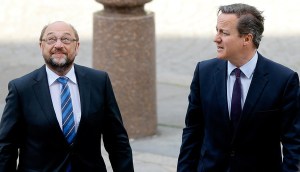
 

David Cameron - Martin Schulz - 2

Agree with this article? Violently disagree? Scroll down to leave a comment.

Follow Semi-Partisan Politics on TwitterFacebook and Medium.

Dreams Of The Rainbow Coalition

bbc-challengers-debate-leaders-debate-general-election-2015-nigel-farage-stands-alone

Left-wing collusion to lock the Conservatives out of power will not work, and would massively backfire were it even attempted

Remember Nicola Sturgeon’s dream of a rainbow coalition of left-wing political parties putting their differences aside and coming together to lock the Evil Tories out of government and usher in a new era of endless abundance for all, courtesy of the Magic Money Tree?

It hasn’t gone away. That insufferable, sanctimonious, morally superior dream has still not died. Here’s Brian Barder, writing in LabourList as though it were still May 6, 2015:

If the Tories, under a new leader enjoying a honeymoon, are to be dethroned, and if Labour alone can’t dethrone them, it’s simple logic that the job can be done only by an alliance of the progressive parties, led by Labour as the biggest of them. Such a multi-party association can take several forms: a loose alliance supporting a minority Labour government, or a slightly more formal ‘confidence and supply’ understanding with the other progressive parties, or a formal coalition of some or even all of them, each represented in a government of the broad left.

Similarly, the policies of a broad progressive alliance to replace the Tories in office can be agreed before an election (or even after it, as in 2010) in a detailed agreed document, or there can be a more general understanding in support of a progressive programme whose core elements all the progressive parties agree to support, or the other parties can be free to decide ad hoc which policies of a minority Labour government they will support as they go along.

This is all a response to the dawning realisation that whatever his arguable virtues (and this blog has been a cautious fan), Jeremy Corbyn is not currently positioning himself to sweep Labour back to power in 2020.

To his credit, Brian Barder is not panicking, and is instead trying to come up with a pragmatic way for the Left to make an impact without relying on overly sunny predictions about getting rid of Jeremy Corbyn any time soon. That much is good. But Barder’s solution and call for a left-wing coalition is no less silly than the calls for the Parliamentary Labour Party to split from the national party, pick their own leader and form a self-serving Westminster caucus without a local or national support base.

“So what if Labour can no longer enthuse enough people to march to their polling station to vote the party back into government”, goes this line of thinking. “There are enough other people out there vaguely like us that if we all band together in a cynical and self-serving coalition, we will be able to deny the British people the government that the electoral system should have produced and do the job ourselves, even though individually we are about as popular as a swarm of Brazilian mosquitoes”.

In other words, it’s complete nonsense. The general election we had just nine months ago proves that there is no great and silent left-wing majority in Britain. If there were, Labour would not have been decimated throughout south-east England, and the Greens and Liberal Democrats would have won enough seats between them to make ganging together to force Ed Miliband on a reluctant Britain politically viable. But they were decimated, and Ed Miliband is now making tedious speeches from the back benches.

Yet the denial is strong. In even proposing such a left-wing collaboration, Brian Barder reveals that he clearly spends his time percolating in the same confirmation bias-reinforcing ideological echo chambers as many others on the Labour left, and has mistaken a Twitter timeline full of David Cameron pig jokes and anti-Tory human rights hysteria for a representative sampling of the British public.

Or as blog said on 8 May, immediately after the election, which still holds true now:

Until the exit poll came in, it was simply inconceivable to many on the left that there could be any result other than a rainbow coalition of Britain’s left wing parties, coming together to lock the Evil Tories out of Downing Street and immediately get to work cancelling austerity and providing everyone with material abundance through the generosity of the magic money tree.

It is simply unthinkable to the like of Barder that the people of Britain might actually reject left-wing dogma and prefer David Cameron’s eminently pragmatic, reassuringly non-ideological form of watered down conservatism. Clearly the British people need saving from an Evil Tory government that they did not want, and therefore any electoral machination to achieve this end would be justified.

Except that it wouldn’t. The quietly patriotic, un-ostentatiously self-sufficient real majority in this country already believe that they are the victims of an establishment stitch-up when it comes to issues like Europe and immigration, where there was (rightly) perceived to be a false consensus among political parties, shutting down an important debate and denying millions of people the opportunity to have their voices heard and listened to.

How much worse, then, would the public’s reaction be if the next election sees an arrogant multi-party coalition of left-wing losers band together to lock the largest party out of power? How much rage would such a presumptive move cause?

Yet Barder (and others) are deadly serious in their daydreaming for a rainbow coalition of left-wing parties:

The first cautious step is for a group of the Labour leadership representing all its main strands of opinion to start private and non-committal talks with the leaders of the other progressive parties, to explore their attitudes to some form of possible progressive alliance. If these produce a positive response, the next step should be meetings to identify common policy ground which all concerned could agree to support.

We are not yet one year into the first term of the first all-Conservative government in eighteen years, and already fantasy plans are being drawn up for furtive meetings leading to grand summits between Jeremy Corbyn, Angus Robertson, Caroline Lucas and whoever now leads the Liberal Democrats.

The seductive dream of a united left-wing coalition against the Tories simply will not die. But that says far more about the Left’s unhinged and hysterical response to David Cameron’s bland, centrist government – and its relentless seizing of the middle ground – than it does about the possibility of such an odious coalition delivering a Labour prime minister in 2020.


Labour Party - General Election 2015 - Ed Miliband Resignation

Agree with this article? Violently disagree? Scroll down to leave a comment.

Follow Semi-Partisan Politics on TwitterFacebook and Medium.

Cameron’s EU Deal: An Establishment Stitch-up, But The Fight Goes On

David Cameron - Donald Tusk - 3

What cause for hope?

I have refrained thus far from commenting on the outcome of David Cameron’s pitiful re-upholstering of the status quo when it comes to our membership of the European Union.

Suffice it to say – for now – that it does not feel tremendously good to live in a country where the prime minister is actively engaged in manoeuvres to hoodwink, short-change and circumvent the people he is supposed to represent.

Oh, of course Tony Blair or Gordon Brown would have done the same thing, fudging the debate, spinning non-existent concessions into giant victories and generally taking us for fools. But history gave David Cameron the torch of liberty to stub out, and so most of my anger remains directed at the man who prances around falsely calling himself a conservative.

But more than any one single betrayal, what is most disheartening for Brexiteers is the constant drip-drip of defections, compromises and unfriendly fire coming from within the supposedly eurosceptic segment of the Westminster elite. I never thought for a moment that David Cameron was anything other than a fully paid-up europhile and an eager servant of Brussels; his treachery stings my sense of honour and democratic sensibilities, but it was in no way surprising. I had factored the government and the media unfairly tilting the scales from the start – their antics do not wound.

What does hurt are the smaller, incessant letdowns inflicted on our side since David Cameron won his unexpected majority last May and offered the referendum through gritted teeth. What hurts are all of the members of the Conservative eurosceptic aristocracy – people like Theresa May, Boris Johnson, Michael Gove, some (though not all) of whom I once respected – whose professed commitment to British sovereignty and self-determination has mysteriously gone AWOL now that eurosceptic words must be matched with deeds.

What hurts are the other high-profile eurosceptics – including some, like Nigel Farage, without whose courage and tenacity we would not be having this referendum in the first place – who it turns out had barely given a thought to how Brexit might actually happen, how it should best take place and what a post-Brexit Britain might look like in one, two, five, ten and twenty years’ time. And what hurts is when these unexpectedly ignorant people spread false platitudes and easily-debunked talking points among their large online followings.

Our only hope is that the majority of Britons have not yet fully tuned in to the debate. While we in the bubble and the Twittersphere feel every ebb and flow of online sentiment, there are many, many more who have not been paying attention and whose first main newsflash of the year will have consisted of David Cameron receiving an all-round roasting for failing to stand his ground in his negotiations with the EU. This may yet work in our favour.

This leads me to perhaps the most simultaneously cathartic and infuriating article yet written about David Cameron’s underwhelming “new deal” with the EU, by Allister Heath in the Telegraph.

Heath begins well enough:

It is at times like these that even people of a conservative disposition begin to rage against our establishment. We are all used to stitch-ups from the political class, but the closing of ranks around the European question is breathtaking in its scope and scale.

In five months’ time, we will be asked to make a historic decision about who governs us, and how; the outcome could be of far greater importance than most general elections. The Prime Minister’s renegotiation has failed to nudge the dial by even one millimetre, and it’s likely that at least 40 per cent of the public, more than voted Tory in May, will end up backing Brexit. It’s therefore still conceivable, just, that a majority will vote to leave, sending shockwaves around the world. And yet these people – millions and millions of them, and by all accounts a majority of Tory voters – have been almost completely abandoned by an establishment which now refuses to represent their views.

How can that be right? And how can it be good for our political institutions for such a large proportion of the electorate to feel ignored or even despised by those supposedly elected to represent them?

Indeed. It is bitterly ironic that at a time when Britain’s left wing finally have in Jeremy Corbyn a leader who (regardless of his electoral viability) makes them excited to get out of bed in the morning, conservatives are landed with an arrogant centrist who believes in nothing and quite probably laughs at their expense every time he disappoints them by tacking further to the supposed middle. And this betrayal is evident nowhere more so than on the subject of Europe, where the Tory leadership only rediscovered their respect for eurosceptics when the rise of UKIP in 2014/2015 raised the prospect of mass defections.

It was not good when a near-unanimous political consensus refused to talk about immigration and reflect the genuine concerns and fears of the British people – and this craven refusal to have an honest discussion with the British people led in no small part to the rise of UKIP. Nobody really says it, but it is not good when there is a cross-party consensus in favour of preserving the NHS in aspic rather than asking anew how best to deliver healthcare in the twenty-first century. That kind of lazy self-satisfaction leads us to crow about the fact that Britain is the best place in the world to die, while failing to question why we are not the best country if you actually want to recover from illness or injury. And it is not good when a stultifying political consensus conspires to keep Britain inside the European Union at any expense.

Heath goes on to make the not unreasonable point that the British establishment’s relative pragmatism might in fact handle Brexit rather well, ensuring that Britain remained open and tolerant where a similar seismic event taking place in (say) France could have far worse ramifications:

The establishment is wrong about the EU, but it’s not wrong about everything. Its interests and beliefs, by and large, are pro-globalisation, supportive of property rights and of the rule of law; its power and determination has helped ensure that we have stuck with these broad principles regardless of who has been in power. By the standards even of much of the developed world, it is astonishingly uncorrupt. Its instincts are far superior to those of many other ruling elites: the French equivalent, for example, is far more detached from reality, immeasurably more statist and doesn’t really grasp market economics.

If Britain were to vote to leave the EU, our establishment would make sure that we remained an island of economic liberalism, at least relatively speaking, and a safe haven for capital and talent; by contrast, France would embrace hard-Left economics and protectionism were it to leave.

Brexit is thus far less risky than its opponents would have us believe. We would remain fully engaged in trade and the international economy, even if treaties would change. Our elite’s power, its ability to absorb political change and its adaptability would ensure that it soon turned a Leave vote to its advantage, just as it always makes the most of all periods of intense change.

Again, no real argument here. Self-serving as all elites are by definition, the British establishment is far less insular than many others.

But here is where Heath loses (and infuriates) me. Having condemned the arrogant behaviour of David Cameron and his rootless Conservative Party, and railed against the establishment stitch-up currently in progress, Heath concludes:

As soon as we were to vote Leave, the establishment would go into overdrive to regain control of the changed reality. A new deal with the EU would be cobbled together; we would be given some sort of associate membership, a much looser relationship that allowed the EU to pretend to the outside world that it wasn’t disintegrating. The electorate would buy it in a second referendum: having showed who is really in charge, its anger would have been satiated. The EU would have no choice: its negotiating position is far weaker than we generally realise.

In the same way that the House of Lords is still full of barons, even though most of the aristocrats have left, or that the Church of England remains our established church, despite having become largely irrelevant, our relationship with the EU would have changed radically yet everything would still look the same when it came to trade or travel. Some hardcore Eurosceptics would be angry, but it would be a very British compromise. If we vote to leave, against the wishes of the establishment, we can surely count on it to pick up the pieces and help make the new order work.

Having displayed such seemingly strong eurosceptic credentials throughout the piece, why does Heath then pivot to making a plug for “associate membership” to be formally agreed in a second referendum? Why reintroduce these two half-baked ideas from the past into the present discourse? Have we not comprehensively proven that associate membership of the EU is a misleading scam?

Where Allister Heath is absolutely correct, though, is when he describes the way in which senior figures from the establishment are “closing ranks” on the question of Europe, and when he highlights the sheer duplicity of those politicians who built comfortable little careers on the back of their professed euroscepticism only to embrace party conformity when it matters most.

I don’t see it ending well. And I think that David Cameron and the Conservative Party could come to regret the betrayal of their more eurosceptic party base even more than Nick Clegg must have regretted his famous pledge not to raise university tuition fees.

What David Cameron & co fail to realise is that the reason people “bang on” about Europe is because it is absolutely central now to our governance and what’s left of our democracy. An awful lot rides on the outcome of this EU referendum, and will have potentially profound consequences for how Britain and the world trade and co-operate in future. If we find this subject fascinating, it does not make us cranks and obsessives, as we are often sneeringly dismissed – rather, it makes us informed and conscientious citizens.

Pete North concurs:

If by now you don’t have a quietly burning loathing of the media, the political class and the polite society that rules the roost then you’re just not paying attention. If the fact that every corrupt corporate, every subsidy sucker, rent-seeker and grant chaser is now shilling for Brussels doesn’t offend you, then nothing will. Quite simply you are happy to be taken for a fool and used as a cash cow. So too are you content to be managed like cattle rather than considered as a sentient, participating citizen with hopes, dreams and ambitions.

If by now you are not seeing through the veneer of corporate and state propaganda like a pair of x-ray glasses from They Live then there is absolutely no hope for you at all. If by now you think the EU is a democracy and it responds to the wishes of the people of Europe then you’re on another planet. If you think these MEPs and policy wonks are in it for anybody but themselves, feathering their own nests, stroking their own egos and building their own delusional little empires, then you are quite, quite mad.

Conservative eurosceptics have a long memory, and will not soon forget this betrayal by David Cameron. Assuming that the combined forces of David Cameron’s bully pulpit, extensive Brussels funding of the Remain camp and the failure of Brexit supporters (thus far) to read and assimilate the only Brexit plan which stands up to rigorous scrutiny, Cameron remains on course to triumph in the referendum. But spurned local Conservative associations and individual party members will extract a heavy price.

Tory activists may either defect en masse to a reconstituted UKIP or simply stay home on polling day. And who could blame them, considering the way in which they have been treated by David Cameron? Not only could the Conservative Party end up splitting amid partisan rancour (caused by europhile Tory ministers and MPs being given license to campaign freely while those supporting Brexit are sorely constrained), a diminished Tory party could see a left-wing coalition of Labour and assorted socialist chums slip past them and back into power.

But right now, it still feels as though a piece of the puzzle is missing. Cameron’s “deal” appears far too weak, and my mind cannot help but speculate that there will be some long-ago decided but as-yet unannounced additional rabbit pulled from the hat to sweeten the deal, assuming that David Cameron is able to win unanimous support at the coming EU summit later this month.

The Brexit Door is of the same view:

So the deal has been announced and the press and other media outlets have had their first run at the news. It hasn’t been the overwhelmingly positive response that maybe Mr Tusk and Mr Cameron had been looking for.

That leads me to believe that there must be a rabbit somewhere, waiting to be pulled from the hat. Because it’s either that, or Cameron is going to ride roughshod over the Electoral Commission’s advice about the shape and timing of the process for both designation and the campaign itself and go for June 23. His primary motive would be to give the Leave campaign as little time as possible from designation to vote – because he knows that the fight for the ‘Leave’ designation is incredibly important and has been so far taking up a lot of our energies.

One thing is becoming clear to me – the pathway to victory in this referendum is terrifyingly narrow. And it will be won or lost depending on whether Brexiteers can leverage the fact that nearly everybody in the British political establishment has come out in support of staying in the European Union.

Yes, having a proper plan and strategy for Brexit is important. Flexcit is important. But with nearly every authoritative voice in Britain about to begin earnestly intoning the many benefits of Brussels, our most potent weapon may be the British people’s strong sense of fair play, and their likely discomfort at seeing the Leave campaign being outspent, outmanoeuvred, outgunned and shouted down. We have been weak and ineffectual enough thus far – so we may as well ham it up for the cameras and work to build the narrative that this referendum is in fact The Establishment vs The People.

We must turn our current weakness – and it is a great weakness indeed – into our strength. That is the only prospect for victory that I can see right now. That is the only light at the end of the tunnel.

Europe - EU Flag - Brexit - Eurosceptic - Fading Flag

Agree with this article? Violently disagree? Scroll down to leave a comment.

Follow Semi-Partisan Politics on TwitterFacebook and Medium.

Left Wing Hate Watch, RMT Edition

In Assistant General Secretary Steve Hedley, the RMT union have found a worthy successor to Bob Crow

With the entire country focus transfixed on Europe and David Cameron’s spectacularly poor negotiating skills, there has not been much emphasis on the Evil Tories in the media of late. Some nervous Tories, coming out of hiding for the first time since the Conservative Party Conference in Manchester, may have even considered themselves safe.

They were wrong. Steve Hedley of the RMT union is actively gunning for them using the most violent rhetoric imaginable, as he demonstrated in an interview on LBC today.

LBC reports:

RMT leader Steve Hedley has claimed the Tory government are “murdering” people, then called for them to be “taken out and shot” in an extraordinary LBC interview.

[..] “I think all the Tories are an absolute disgrace, they should be taken out and shot to be quite frank with you,” said Hedley, Assistant General Secretary of the RMT union.

“Oh Steve!” responded [presenter] Shelagh. “I’m not going to let you say that, so don’t repeat it…if your job is to represent your workers, and I was one of your workers, I would want you to represent me without resorting to things like that.”

Hedley then claimed that the government was “killing three disabled people a week by their cuts.”

Everything changes, and everything stays the same. The Labour Party have a new leader, and Jeremy Corbyn’s admittedly haphazard opposition has thus far been mostly principled and courteous. Politically, Corbyn may be quite far from David Cameron (though not as far as he would be from a real conservative), but in his speeches he is more likely to forget that the Tories exist than indulge in an angry tirade against them. But same cannot be said for the people under him in the Labour Party and in the wider left-wing movement.

As we have repeatedly seen, many of these people are ready and willing to engage in the most overheated, provocative rhetoric against their political opponents on the right, continually implying that those who disagree with them are not just intellectually wrong but morally evil. And it is no longer just grassroots activists at fault – MPs and union leaders are increasingly getting involved too.

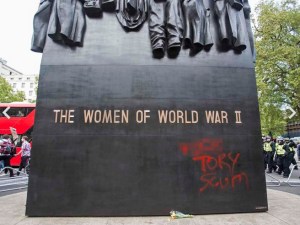
Whenever I write about the latest high-profile instance of left-wing anti-Tory bigotry and intolerance, I usually receive a number of comments chiding me for taking the intemperate war memorial-defacing actions of a few angry lunatics and claiming that they represent the Left as a whole.

That’s not what I am trying to do, though the way that some on the Left are so quick to take such criticisms personally suggests that in some cases, I may be striking a little too close to home. After all, since nobody suggested that all left-wingers are angry, screaming, spitting hate mobs, the fact that the likes of Owen Jones take the time to pen articles refuting this non-accusation can be taken as a sign that the criticism is hitting uncomfortably close to home, and that there may be a deep-seated, half-subconscious approval for these distasteful acts of protest.

But the purpose is not to hold up instances where left-wing activists go too far just to act outraged. It is to point out (rather wearily at this point) that there is a poison within the Left which encourages adherents to believe themselves to be the sole possessors of compassion and virtue in a world where anybody different is immediately labelled “Tory Scum”. And until this poison can be sucked out of the Labour Party – or an adequate antidote found – the Left will continue losing elections by spending more time shouting angrily at the country for our supposed moral shortcomings than they spend presenting an attractive, cohesive alternate vision for government.

Steve Hedley is not your average left-wing grassroots activist, sharing Corbyn memes on Twitter and raging against the Tories on Facebook. He is the assistant General Secretary of the RMT, one of the most powerful (and high profile) trade unions in the country. He is the voice of organised Labour, which in turn increasingly claims to be the voice of the Labour Party. And when he angrily parrots the same drivel about the Evil Tories wanting to kill disabled people as the most zealous online activist, then it is no longer possible to say that this is an isolated problem of passionate ordinary folk getting a bit too carried away.

If the political Right has a problem in Britain (and it does; small-c conservatives are utterly underwhelmed and uninspired by the rootless premiership of David Cameron, no major conservative legislation has been enacted in the precious months following the 2015 general election victory, and the only motivated people online seem to be the ones churning out bigoted memes about migrants) then the Left should realise that they have a problem, too.

It may have started innocently enough, with Ed Miliband and his MPs turning a blind eye toward (and thus tacitly encouraging) overheated anti-Tory rhetoric as the coalition government found its feet back in 2010. And there may have been every good reason in the world to let demoralised Labour activists blow off steam by promoting the notion that this utterly unremarkable, centrist government is actually on an ideologically charged “more Thatcher than Thatcher” mission to roll back the state (if only it were true).

But the time has come to admit that the experiment has gotten out of control, and that the swivel-eyed anti-Tory hysteria has metastasised and started to re-infect the very left-wing political elites who first let it loose back in 2010. We see it in the ferocity with which some Jeremy Corbyn supporters attack their (far from blameless) centrist colleagues, calling them Red Tories. And now we see it in the shape and form of a senior trade union leader calling for Conservative supporters to be rounded up and shot.

I don’t spend much of my time worrying about what is best for the Labour Party or the British left-wing movement in general, but in this case I am writing out of genuine concern over what is happening to one side of the political debate in this country – the side which now finds itself represented by spokespeople like the RMT’s Steve Hedley.

Calling for all Tories to be “taken out and shot” is a juvenile piece of rhetoric from a half-baked political mind. It’s not a serious threat – let’s not go down the censorious road of calling the police on anybody who ever utters a mean word about us – but neither is it evidence of a person or political philosophy capable of showing respect, understanding nuance and thinking in colour, the kind of behaviour required of a movement which aspires to lead.

The closer Steve Hedley is to mainstream left-wing thought, the further the Left will be from tasting power again. Which is why any Labour politician with an ounce of sense must now furiously disassociate themselves from Hedley’s inflammatory remarks.


Tory Protests

Agree with this article? Violently disagree? Scroll down to leave a comment.

Follow Semi-Partisan Politics on TwitterFacebook and Medium.