Small Minds Discuss People: The Media’s Coverage Of The EU Referendum

Boris Johnson - Theresa May - EU Referendum - Brexit - Conservative Party

The EU referendum is about the British people, not the Westminster game of thrones

Another day brings another tiresome round of court gossip about which Conservative ministers might potentially campaign for Britain to leave the European Union in the coming referendum.

This time the breathless gossip is reported in Guido Fawkes:

A co-conspirator tucking into his ravioli in Westminster’s Quirinale restaurant looked up to see Theresa May and Liam Fox settling down to lunch. An hour earlier Fox had asked the Home Secretary for assurances over the government’s line on Russia, so you can bet that was on the menu. Though the main topic for discussion will almost certainly have been Europe.

There has been speculation that May has been meeting with leading Eurosceptics as she keeps her options open ahead of the referendum. Where better for Dr Fox to lobby her to lead the Out campaign than one of the pricier Italian restaurants in SW1? 

While the Evening Standard gushes about Boris Johnson:

What vexes the fledgling campaign to stay in the EU is the prospective behaviour of Boris Johnson and Theresa May: in the words of one Westminster insider, “they are the only players who could change the weather”.

True enough. Boris has the popular appeal to make the Out campaign blossom with optimism and good cheer, ridding it at a stroke of its negative, wintry disposition. May, on the other hand, would bring the authority of a great office of state to the Brexit campaign. Both politicians are taken seriously within the Tory tribe as prospective successors to Cameron. Small wonder that their every move is being scrutinised so closely.

Seasoned Boris-watchers (or Bozzologists) admit that his behaviour is presently inscrutable. Those I have spoken to incline — just — to the view that he will decide eventually to stick with the In camp, though without much conviction.

Before going on to say of Theresa May:

In 2010 May was startled to be given such a senior brief. Since then she has become incrementally persuaded that she has what it takes to succeed Cameron. Like Boris, she knows her leadership prospects are intimately entangled with her conduct in the EU referendum. But if she is serious about taking on the boys for the top job, she should give the Out camp a wide berth.

As Michael Heseltine used to say as he prepared his challenge to Margaret Thatcher, most contenders only have one bullet in the chamber. If May aligns herself with the Out movement, she will be handing the gun to others and inviting them to do as they please with her accrued political capital. So if her head has indeed been turned by the flattery of the Brexit crew, it should be turned back — and fast.

Because we all know that the really important thing in this referendum is not the profound and historic choice that the British people will make about how we wish to be governed in the twenty-first century, but rather the salacious court gossip over which cabinet ministers and wannabe future Tory leaders will risk their bright young (or not-so-young) careers by allying themselves with the Brexit cause.

Never mind that awkward S-word, sovereignty. That’s boring. Never mind a detailed and difficult discussion about the realities of global governance. That would require research. Proving the adage that great minds discuss ideas, average minds discuss events and small minds discuss people, most of the British media is happy to talk about people and the petty personalities involved in the public debate, to the near total exclusion of everything else.

If you want serious, granular analysis and argument on either side of the referendum debate, there is no point looking in the pages of the Times, the Telegraph, the Guardian, the Spectator or any other publication claiming prestige. All you will find there are thinly veiled press releases from one or other of the groups squabbling for lead designation, or worryingly naive editorials from household name commentators who sound suspiciously like they have done no independent research of their own. Very unimpressive.

No, for serious analysis you have to turn to the blogosphere, and sites like eureferendum.com and Leave HQ on the Brexit side, or Hugo Dixon on the Remain side. And the difference is like walking from a junior school classroom to a tutorial room at Oxford or Cambridge. Absent are the mindless platitudes and stale (often long-ago disproven) talking points that are so often repeated on television and in the broadsheets, and in their place are references to the real, murky world of global regulation – a world which, once discovered, proves that the EU is not the “top table” as europhiles blithely claim, but also that an orderly Brexit would not lead to an instant “bonfire of the regulations” as some on the Leave side stubbornly insist.

Some eurosceptics and Brexiteers would say I am wasting my time by even bothering to mention low-grade newspaper gossip such as the Boris Johnson vs Theresa May game of thrones. And they have a good point, to a degree. This referendum is about the British people and what they think is best, not what government ministers, opposition politicians or establishment media figures may want. Fair enough.

But you can’t just look at these shenanigans in isolation. Is the coming Brexit referendum the most important thing to happen politically in a generation? Yes, absolutely. But that does not mean that we should focus on the referendum outcome to the extent that we ignore the failings and misdeeds of the political class who were here before the referendum became a reality and will (sadly) be here long after it is but a footnote in history.

There is the future stewardship of the country to think about. And I want Britain’s future political leaders to be (so far as possible) principled people with the courage of their convictions. If they claimed to hold a certain view on an important issue like Britain’s membership of the European Union to get elected, they should then follow that through once in office.

Consequently, this blog will be taking a very dim view indeed of any Conservative politician who wrapped themselves in the cloak of euroscepticism to win selection, only to run loyally to David Cameron’s heels like an obedient dog and campaign for a “Remain” vote when it really counts.

This debate should be about ideas first and foremost. That is where this blog will focus. However – and maybe this a sign that I lack a great mind – I for one will certainly remember those people who put their personal careers ahead of their commitment to democracy when it comes to this existential referendum.
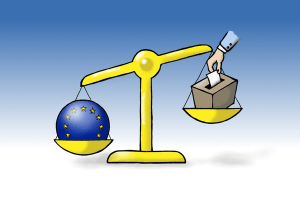
EU Democracy - Brexit

Agree with this article? Violently disagree? Scroll down to leave a comment.

Follow Semi-Partisan Politics on TwitterFacebook and Medium.

The Daily Toast: Peter Oborne, A Fellow Jeremy Corbyn Admirer

Peter Oborne is a journalist of uncommon principle; what he says should be taken seriously and treated with a measure of respect. But Peter Oborne has publicly stated his admiration for Jeremy Corbyn…

This blog has often felt like something of a voice in the conservative wilderness for not viewing Jeremy Corbyn as an unmitigated disaster for British politics.

One does not have to agree with Jeremy Corbyn’s sometimes loopy policies to admire the way his unexpected leadership of the Labour Party has shaken up a dull, lumpen, self-satisfied consensus among the Westminster elite, and put the fear of the voters back into a good many Members of Parliament who were more focused on the smooth progression of their own careers than the trifling concerns of the electorate.

That’s where this blog stands. I’m the first to criticise Jeremy Corbyn for his particularly crazy policies (like building a paper tiger nuclear deterrent with all the expensive submarines minus the all-important warheads) and his naive political operation (as embarrassingly revealed during the so-called Revenge Reshuffle). I’m also willing to give credit where credit is due, such as the holistic way Corbyn looked at education during the Labour leadership contest (and his proposed National Education Service).

What I don’t understand are conservatives who endlessly criticise Jeremy Corbyn because he doesn’t think or say all the same things as David Cameron or Tony Blair (and who could pick those two apart if blindfolded?)

Surely having two party leaders who think and say different things is the point of democracy. The fact that Britain has increasingly been afflicted with party leaders who say and think nearly identical things (once the rhetorical embellishment is stripped away) since Margaret Thatcher left office is the root of our current centrist malaise, and one of the primary reasons why a third of the electorate don’t show up to vote at general elections.

What’s the point in voting if the choice is between Prime Minister Bot A and Prime Minister Bot B, both of whom will automatically praise the NHS without looking more seriously at fixing healthcare, both of whom will tinker around the edges of welfare reform to get the Daily Mail off their backs but without doing anything substantive to fix our broken non-contributory system, both of whom are achingly politically correct at all times (“It’s Daesh, not ISIS! I can’t believe you called it Islamic State!“) and both of whom have so little faith in Britain’s ability to prosper as an independent, globally connected democracy that they strive (overtly or covertly) to keep us yoked to the European Union?

I’m a conservative libertarian. I have enough of a task on my hands trying to push the Conservative Party in a less authoritarian, more pro-liberty direction without worrying about what the Labour Party is doing every minute of the day. And I have enough confidence in my political worldview that I believe conservative principles will win the battle of ideas when promoted and implemented properly (hence my ongoing despair with the current Tories).

But many of my fellow conservatives, particularly those in the media, are in despair at the rise of Jeremy Corbyn and the return of real partisan politics. Why? Their professed concern that Britain have a “credible” opposition (meaning one almost identical to the governing party in all respects) stretches belief to breaking point and beyond. I can only think that their fear of Jeremy Corbyn reflects some personal doubt that their own political ideas and philosophies might not be superior after all – that Jeremy Corbyn might actually win people over in large numbers and have a shot at taking power.

I have no such fear. I believe that the principles of individual liberty and limited government beat discredited, statist dogma hands down, every day of the week. And I believe that the rise of Jeremy Corbyn might force conservatives to remember why they hold their views in the first place, and even refine and improve their own ideas through rigorous debate – if only they could get over their collective outrage that a socialist is in charge of the Labour Party.

In this spirit, I share the video of Owen Jones’ recent conversation with former Telegraph columnist Peter Oborne – see above. Oborne is an articulate writer, an unapologetic conservative and a thoughtful journalist of real integrity. That Peter Oborne also finds something to admire in Jeremy Corbyn (despite disagreeing with him politically) is helpful reassurance that I am not alone.

I don’t agree with everything that Oborne says in the video. But on the near-conspiracy of the political class and the media to undermine Corbyn (not to merely disagree with him but to portray his ideas as “unthinkable”) and on foreign policy (castigating our closeness with Saudi Arabia, an odious regime with whom we fawningly do business and lend our diplomatic legitimacy in exchange for oil and intelligence) he is spot on.

And I think that’s what makes Jeremy Corbyn’s detractors so angry. No man can be consistently wrong about everything all the time, and on rare occasions Jeremy Corbyn gets it conspicuously right – such as with his criticism of our closeness with the Saudi regime. People accustomed to either being in power or just one election away from power look at somebody who (whatever other baggage he may have) is unsullied by the continual act of compromise and ideological drift, and it makes them mad. It forces them to ask themselves how many of the compromises, reversals and deals from their own careers were strictly necessary, and how many resulted either from failures of courage or pursuing power for its own sake.

Sometimes, the haters were probably right to do what they did. Governing a diverse nation of 65 million people is not possible without the art of compromise, as Jeremy Corbyn would soon discover if the impossible happened and he became prime minister. But sometimes they were not. And the cumulative effect of all of these small compromises by Labour and the Conservatives over the years were two very slick but ideologically bankrupt political parties that looked and sounded nearly exactly the same on a whole host of issues. Issues (like the EU) which the political class had arrogantly deemed to be settled once and for all, though the voters had other ideas.

I understand this. I sense that Peter Oborne understands this. And if that means there are still only two non-Corbynites in Britain who don’t think that Jeremy Corbyn’s leadership of the Labour Party is an unmitigated disaster – well, at least I’m in good company.

Jeremy Corbyn - Labour Party - Andrew Marr Show - BBC

Agree with this article? Violently disagree? Scroll down to leave a comment.

Follow Semi-Partisan Politics on TwitterFacebook and Medium.


Lost In The Media’s EU Referendum Coverage: Any Mention Of Democracy

EU Referendum - Brexit - Democracy

The media’s fixation with personality politics and the petty ups and downs of individual political careers distracts us from the only thing that matters when it comes to the EU referendum – the future of our democracy

The Times’ Red Box briefing email today leads with more sneering commentary about the supposed shortcomings of the broader anti-EU, pro-democracy Leave campaign:

Maybe it’s a stunt to show how difficult it is to work together for the greater good, thus undermining a key argument for staying in the European Union.

Or maybe the campaigns to leave the EU are a total bloody shambles.

While Remain was pumping out letters to ten million homes yesterday, the Outers were out to get each other. Again.

The briefing continues:

The infighting is also causing another problem: who would want to join this rabble?

Lord Lawson, the former chancellor, has suggested that a senior cabinet minister will eventually lead the Out campaign, though refused at the weekend to say who that might be.

There are suggestions that Chris Grayling and Theresa Villiers are not high profile enough, and the likes of Michael Gove will fall in line and support the PM.

Which leaves Iain Duncan Smith, a former Tory leader who remains popular in some parts of the party and has long argued against staying in the EU.

Yet he too has history with Cummings, who was his director of strategy during his ill-fated leadership before quitting and later declaring: ” Mr Duncan Smith is incompetent, would be a worse prime minister than Tony Blair, and must be replaced.”

Because of course that is the most important question in this whole debate – whose reputation and political prospects will be most enhanced or damaged by the stance they take on the future of British political governance.

What ambitious, self-respecting politician would want to associate their glittering career with the grubby and laughable concepts of national sovereignty and democracy? Which of the petty, superficial personalities who pass for statesmen today will win a coveted promotion, and which will find their career progression halted because they pick the wrong horse in this race? The sheer superficiality of the media’s EU referendum debate coverage absolutely beggars belief.

Is there currently a lot of unseemly (to outward appearances) infighting among the eurosceptic, pro-Brexit crowd? Yes. But a lot of this is necessary fighting. Though our first instinct may be to separate the squabbling factions with cries of “can’t we all just get along?”, in actual fact this fighting serves an important purpose.

Many people and organisations who purportedly oppose the European Union are actually either ambivalent about leaving, or busy spewing out contradictory and uninformed messages which will ultimately harm the Leave campaign and provide the Remain side with plentiful campaign fodder. This harms the Brexit cause, and so must be confronted and dealt with if the Leave campaign is to win the referendum.

Vote Leave in particular is filled to the brim with people who don’t actually want Britain to leave the European Union, but simply want the government to use a “leave” vote as a bargaining chip to extract concessions from Brussels. Meanwhile, UKIP and others are often guilty of promoting an overly simplistic view of Brexit, conjuring a fantasyland where Britain quits the EU on Day 1, bans all immigration on Day 2, and holds a big Bonfire of the Regulations on Day 3.

None of these things are possible, nor even desirable. And pretending that they are achievable reflects badly on the entire Brexit movement. And so while it may appear unseemly to outsiders and the half-interested media, it is essential that eurosceptics have these essential debates now, while relatively few people are watching, so that we go into the campaign with the message that carries the greatest chance of success.

As Ben Kelly points out over at The Sceptic Isle:

[..] it is impossible for everyone to agree and therefore impossible to have one unifiedLeave campaign. The Remain campaign is entirely based on disseminating fear, uncertainty and doubt amongst the populace and propagating myths about Brexit. Thus, as a movement Remain is easy to unify; Europhiles are unified in their duplicity, unjust smugness, their lack of faith in democracy and their inability to stop clinging to an archaic ideology and an ideal that is redundant and bad for Britain.

The debate over leaving the EU is more nuanced and therefore necessarily divided; this makes the europhiles positively gleeful because they see it as an advantage. It isn’t. Those of us who want to leave the EU are now involved in a great competition, a battle of ideas, over how exactly we achieve Brexit both in terms of convincing the public, winning the referendum, and the plan for what we should do with our independence.

Remember, this referendum is the europhiles’ to lose. They have the government on their side, nearly the entire political establishment, the European Union itself and the lion’s share of the funding. They also have the most powerful advantage of all – the incorrect perception, fuelled by the media, that this referendum is a contest between staying in the EU as it is now (the “safe” status quo), and taking some deathly plunge into the unknown. Both of these axioms are utterly wrong, but they are widely believed and toxic to the Brexit cause.

Of course, in reality there is no status quo when it comes to the European Union. The EU is but a process, set in motion half a century ago, whose end destination is a single European state. And frankly, I am getting tired of pointing this out when the EU’s founding fathers and today’s euro-federalists have repeatedly said so in their own words.

At this point, it is for the pro-EU campaigners to explain why a humble organisation that supposedly only wants to promote free trade and co-operation requires a parliament, a judiciary, a flag and an anthem in order to accomplish these basic tasks. It is most certainly not for me to continually explain why the person pointing a gun in our face and demanding that we hand over our cash is in fact a mugger, and not a kind-hearted charity collector.

But it is hard to promote any kind of message about democracy, governance or anything else when all of the oxygen in the debate is sucked up and wasted on breathless speculation about whose careers will be helped or hindered by their eventual stance on the Brexit question.

I couldn’t care less whether Boris Johnson biding his time is a smart move in terms of his Tory leadership ambitions, or whether the likes of Theresa May and Sajid Javid are wise to lie low and obey David Cameron’s command for eurosceptics to keep quiet while his pro-EU ministers are given free reign to sing endless hymns of praise to Brussels. It doesn’t interest me. The only abundantly clear thing is the fact that none of the supposed Conservative eurosceptics truly care about safeguarding our democracy and sovereignty, because if they did they would be promoting Brexit for all they are worth rather than weighing up the options and deciding whether campaigning for Brexit might hurt their careers.

I know it is hard for the legacy media to remain focused on issues rather than personalities for any length of time, but given the gravity of this particular debate – and its profound, far-reaching consequences for how the British people will be governed in ten, twenty, thirty years’ time – it would be nice to see more than the usual token effort.

The current gossipy, high school style fixation with personality politics and the petty ups and downs of individual reputations and political careers is more toxic than all of the Remain campaign’s lies, distortions and evasions put together. For it distracts us from the only thing that matters in this referendum: democracy, and whether we surrender it out of fear, or stand and fight for it.

Britain - UK - European Union - Referendum - Brexit - Punishment Beating

Agree with this article? Violently disagree? Scroll down to leave a comment.

Follow Semi-Partisan Politics on TwitterFacebook and Medium.

Who Is To Blame For The NHS Junior Doctors’ Strike? Look In The Mirror

NHS Junior Doctors Contract Strike

By reflexively worshipping the NHS, vilifying people who don’t and rewarding politicians who tell us only what we want to hear, the junior doctors’ strike – and everything else wrong with the health service – is our fault, and ours alone

Who is to blame for the NHS junior doctors’ strike?

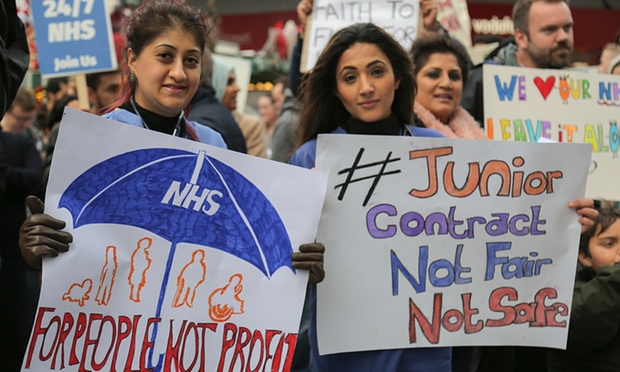
Is it heartless Jeremy Hunt, that doctor-hating, treatment-denying Conservative villain at the Department of Health? Is it the Evil Tories in general, with their single-minded obsession (mysteriously never realised despite all their accumulated years in power) with privatising and destroying Our Precious NHS? And if not them, who could it be? The capitalists? The bankers? Katie Hopkins?

Surely anyone and everyone is to blame, apart from ourselves.We love Our NHS. We are good people who believe that healthcare free at the point of use is one of the fundamental rights of citizenship. We stick up for the NHS at every turn, demanding that politicians pay obsequious lip service to the organisation every time they run for office. We’ll happily slap the NHS logo on our Facebook profile picture, paint it on our faces, wear it on a badge, lapel pin or t-shirt. You name it, we’ll do it to virtue-signal the love we have for Our NHS.

And that, right there, is the problem. Not Jeremy Hunt, not the Evil Tories, not Katie Hopkins. Us.

We don’t want elected officials who take a hard, uncompromising look at changes in medical treatments, life expectancies, the public finances and best practice from overseas to continually assess whether the NHS – that uniquely British solution to healthcare coverage – is still fit for purpose in the twenty-first century, and what changes may be beneficial or necessary.

We don’t want elected officials who tell us that difficult decisions might have to be made – that providing the latest treatments to an ageing, fattening population will cost all of us more in taxes, require radical overhaul of the NHS model, or both. We want our politicians to find the money to provide a world-class health service without disrupting other areas of public spending, or the fatness of our own wallets.

And we certainly don’t want elected officials who do anything to upset the NHS-Industrial Complex – that vast network of people, organisations and vested interests who are first to squeal and protest (always in the name of “public safety”) when their own livelihoods or ways of working are threatened. Like children listening to a trusted school teacher, we innocently take the words of such people as gospel.

Of course, this situation is quite unsustainable. And when any one element of this vast human bureaucracy reaches breaking point – whether that is manifested in industrial action, hospital death scandals or longer waiting lists – we will look for anyone to blame and attack for the fact that these problems have gone unaddressed. Anyone other than ourselves.

The Economist reaches the same conclusion in a very welcome “plague on all their houses” review of the context behind the first junior doctors’ strike:

[..] there is a more serious way in which the public is to blame for the sickness of the health service. The electorate that notionally adores “our NHS” and propels a saccharine song by health workers to the top of the Christmas charts shows remarkably little willingness to pay more in tax towards what remains a relatively cheap system. Without extra money and facing ever wider and wrinklier patients, the NHS must tighten its belt by £30 billion ($43 billion), or about one-fifth, by 2020. It is in this context that Mr Hunt is trying to expand services to evenings and weekends. Pity the well meaning health secretary, pity the hardworking doctors—and blame the sentimental but hypocritical British public.

The famous maxim says that people get the politicians and leaders that they deserve. Well, the same can be said for healthcare, too. We refuse to look difficult truths in the eye, preferring to ignore them in the risible hope that a healthcare system built in 1948 can still be fit for purpose in 2016, if only we pump a bit more money into it. And a bit more. And a bit more again.

We deserve the NHS we currently have, with its air of permanent crisis, in all its faded glory. It is the sum total of all our misplaced pride, boastfulness, smugness, ignorance, fear of change, intellectual laziness and lack of vision.

We have become self-entitled public service consumers rather than thinking citizens, demanding easy answers and instant results from our elected leaders, while rewarding all of the wrong behaviours when it comes to healthcare policymaking.

We have become the kind of intellectually dull society that will happily produce a cheesy Christmas hymn to the NHS and then propel it to Number 1 in the charts, but prefers to sit and vegetate in front of Britain’s Strictly Come Bake-off On Ice rather than question whether the organisation we were just singing about is fundamentally fit for purpose.

On this rare occasion, the Economist’s editorial line is quite correct. When it comes to the failings and shortcomings of the NHS, the government, the health secretary of the day and individual NHS staff are comparatively blameless.

It is we, the British people, who are most at fault for singing worshipful hymns of praise to a healthcare system we will neither properly fund, nor meaningfully reform.

NHS Choir - Harriet Nerva - 2

Agree with this article? Violently disagree? Scroll down to leave a comment.

Follow Semi-Partisan Politics on TwitterFacebook and Medium.

Jeremy Corbyn’s Yellow Submarine Policy

Trident Nuclear Submarine - Faslane Naval Base

Jeremy Corbyn’s yellow submarine proposal is nothing but a white elephant, with all the cost and none of the benefits of nuclear deterrence

Spare a thought for those in peril on the Labour Party’s Trident renewal commission. As they seek to square their leader’s avowed nuclear disarmament stance with the parliamentary party’s broad support for Trident renewal, they are being forced to consider – and publicly discuss – ever more ridiculous potential compromises.

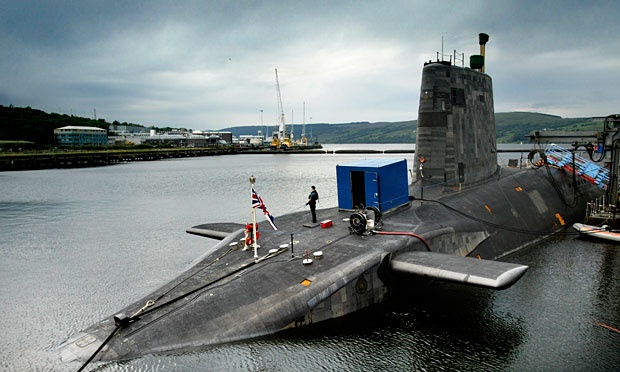
Jeremy Corbyn’s latest proposal is particularly bad, and would involve spending billions of pounds designing and building the next generation Trident submarines, but – crucially – not arming them with any new weapons.

The Guardian reports:

Jeremy Corbyn has suggested the UK could have Trident submarines without nuclear weapons, a move that would mean disarmament while protecting defence jobs in Scotland and Cumbria.

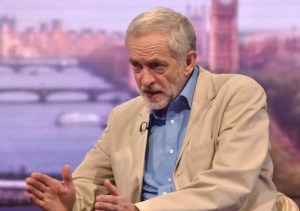
The Labour leader raised the idea on the BBC’s Andrew Marr Show as a possible compromise between his opposition to nuclear weapons and the position of the trade unions, which want to protect the jobs of workers who will build replacement Trident submarines.

In an interview over the weekend, the Labour leader argued it was not a binary decision on whether to replace Trident submarines, suggesting a possible compromise. Pressed on the Marr Show as to what this meant for Trident, Corbyn said: “They don’t have to have nuclear warheads on them.”

[..] Asked again whether he was suggesting that new submarines could be built to be used without nuclear warheads, Corbyn said: “There are options there. The paper that Emily Thornberry has put forward is very interesting and deserves study of it. I hope there will be a serious and mature response.” He also stressed that he would want to maintain employment for people in the defence industry, who would be involved in building Trident submarines, as a “first priority”.

Thornberry told the BBC’s Sunday Politics: “The way that it works is that the Japanese have got a capability to build a nuclear bomb…[but] you can then put them on to, or you can use them, in various delivery forms. So that’s a possibility, that is an option.” She said she would not speculate on what the review would recommend but she added that Corbyn “said there’s a number of options, and I said the Japanese already have this as the way that they use theirs”.

This is ludicrous.

Nuclear-powered submarines capable of carrying and launching Trident nuclear warheads are very expensive, as you would expect from high-tech stealth technology designed to last for a generation. Their only value is the fact that they provide a near-undetectable, continuous at-sea presence, so that any would-be aggressor knows that whatever attack they may launch at Britain, a retaliatory response always remains possible.

Investing in a new generation of nuclear submarines but failing to simultaneously build a new generation of missiles and warheads to deliver them would be like… well, it would be like commissioning two new aircraft carriers which will come into service without any aircraft capable of launching from them.

But at least this ludicrous defensive gap of the Conservative government’s making is only temporary. The aircraft to complement the Queen Elizabeth class carriers will follow the commissioning of the ships, albeit an embarrassing couple of years late.

Not so the Trident missiles to supply the next generation of submarines. Under Jeremy Corbyn’s proposal, Britain’s four (or three? Two?) new Vanguard replacement submarines will dart around under the ocean carrying no weapons and providing no deterrence of any kind. In fact, they may not launch at all, since Jeremy Corbyn probably sees little value in keeping a Navy. So in theory, Britain could end up spending over £20 billion designing and building four new ICBM-carrying submarines, only to sit back and watch them grow cobwebs in dry dock.

Jeremy Corbyn would counter – and indeed his ministerial colleague Emily Thornberry has already pointed out – that Britain would retain the ability to produce nuclear weapons under Labour’s latest plan. But this is extraordinarily misleading. By their nature, the kind of potential nuclear crises that Trident protects us from every day are impossible to anticipate and come about suddenly or with no warning. And in such cases, having the ability to one day rebuild a nuclear deterrent capability is very far indeed from having a system already live and operational.

In cases of nuclear blackmail or brinkmanship, it is not enough to say to our enemy “just you wait 12 months while we build our own nuclear weapon to destroy you, then you’ll be sorry!”. When you need the credible threat of nuclear weapons, you need it now, not after a lengthy lead time during which our design and construction facilities would be vulnerable to sabotage from within or attack from without. But this is precisely what Jeremy Corbyn proposes.

This is socialist pacifism at its most absurd. When people criticise Corbynite policies, their defenders retort that we misrepresent them by taking their publicly expressed ideas to illogical extremes. But in this case, Jeremy Corbyn himself has stated that the illogical extreme is his preferred option.

Jeremy Corbyn’s Britain would be a country which builds things not to use them or gain any utility from them at all (in this case the valuable insurance policy of nuclear deterrence), but rather just to give the people with a vested interest in their construction something to do. In this perverse worldview, keeping union chiefs happy and workers employed is a worthy national objective, but guaranteeing Britain’s national security and promoting our interests by ensuring that we are taken seriously as a military power is of no importance.

But never let it be said that the Corbynites don’t do compromise. Jeremy Corbyn may find the idea of nuclear weapons – or any military spending at all, really – to be morally repugnant and utterly indefensible, but because the trades union like the jobs which come from submarine construction and maintenance, he is willing to tolerate Britain’s continued construction of the things – just so long as we don’t ever use them.

What next? Why not have the armed forces spend all their time rolling massive boulders up hills in the Peak District, sending them tumbling down and pushing them back up again, in order to give the military something to do which doesn’t involve handling weapons? Why not extend the same principle to the British people at large, and pay everyone currently on JSA thirty grand a year to do the same?

A nation of people industriously labouring away to build complex, expensive machines whose purpose they fail to understand, and which they neither appreciate nor value. Just so that people have something to do besides watching Jeremy Kyle on daytime TV.

Welcome to Corbynland.

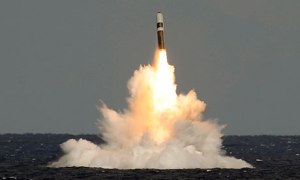
Unarmed Trident missile fired from HMS Vigilant

Agree with this article? Violently disagree? Scroll down to leave a comment.

Follow Semi-Partisan Politics on TwitterFacebook and Medium.